Articles & Guides
Tips, ideas and free printables — 338 guides and counting.
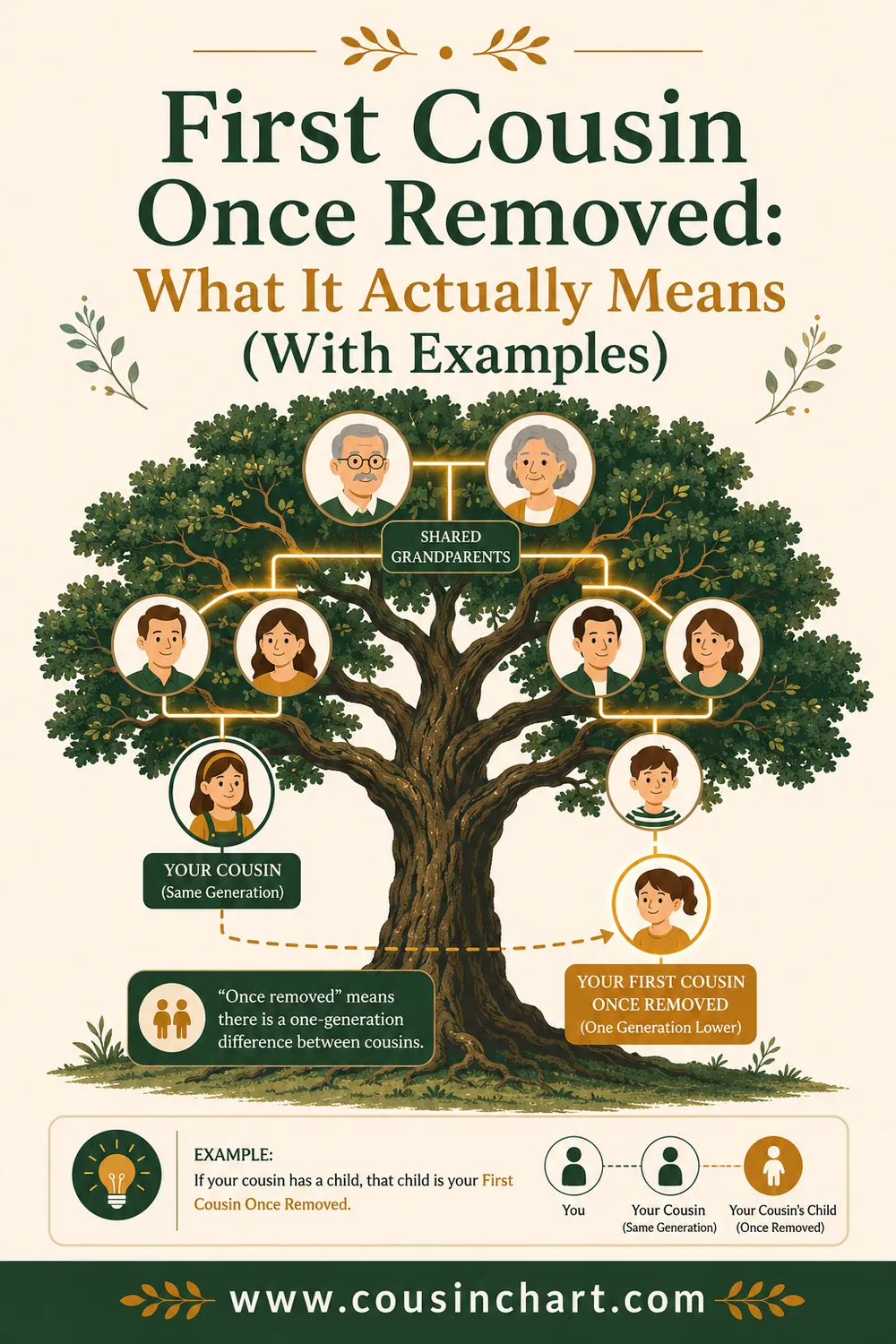
What is a first cousin once removed? It's your cousin's child or your parent's cousin. See clear examples, a simple chart, DNA percentages, and a free tool.
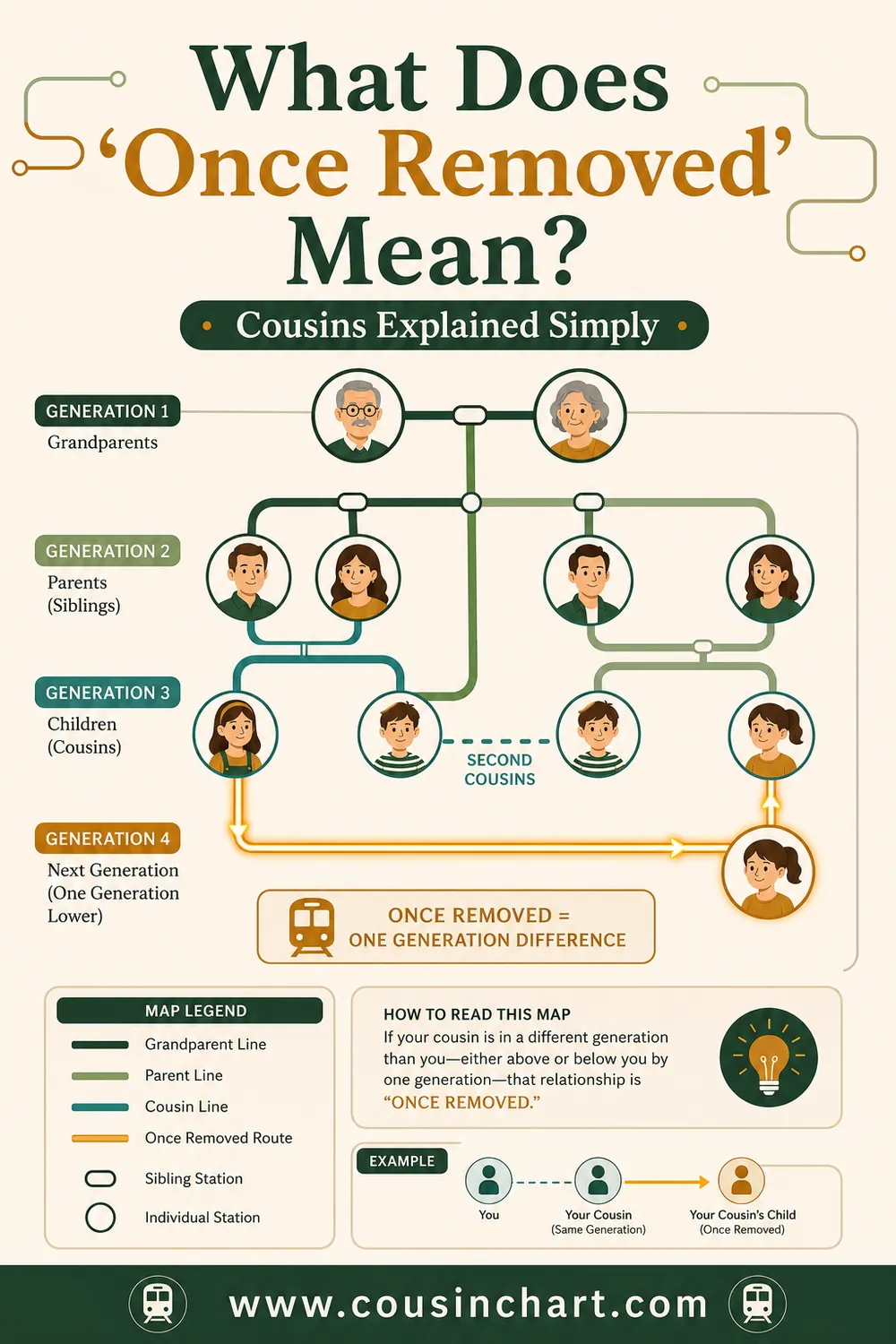
Once removed means one generation apart. Learn how removed cousins work, how to count generations, and name any family relationship with our free calculator.
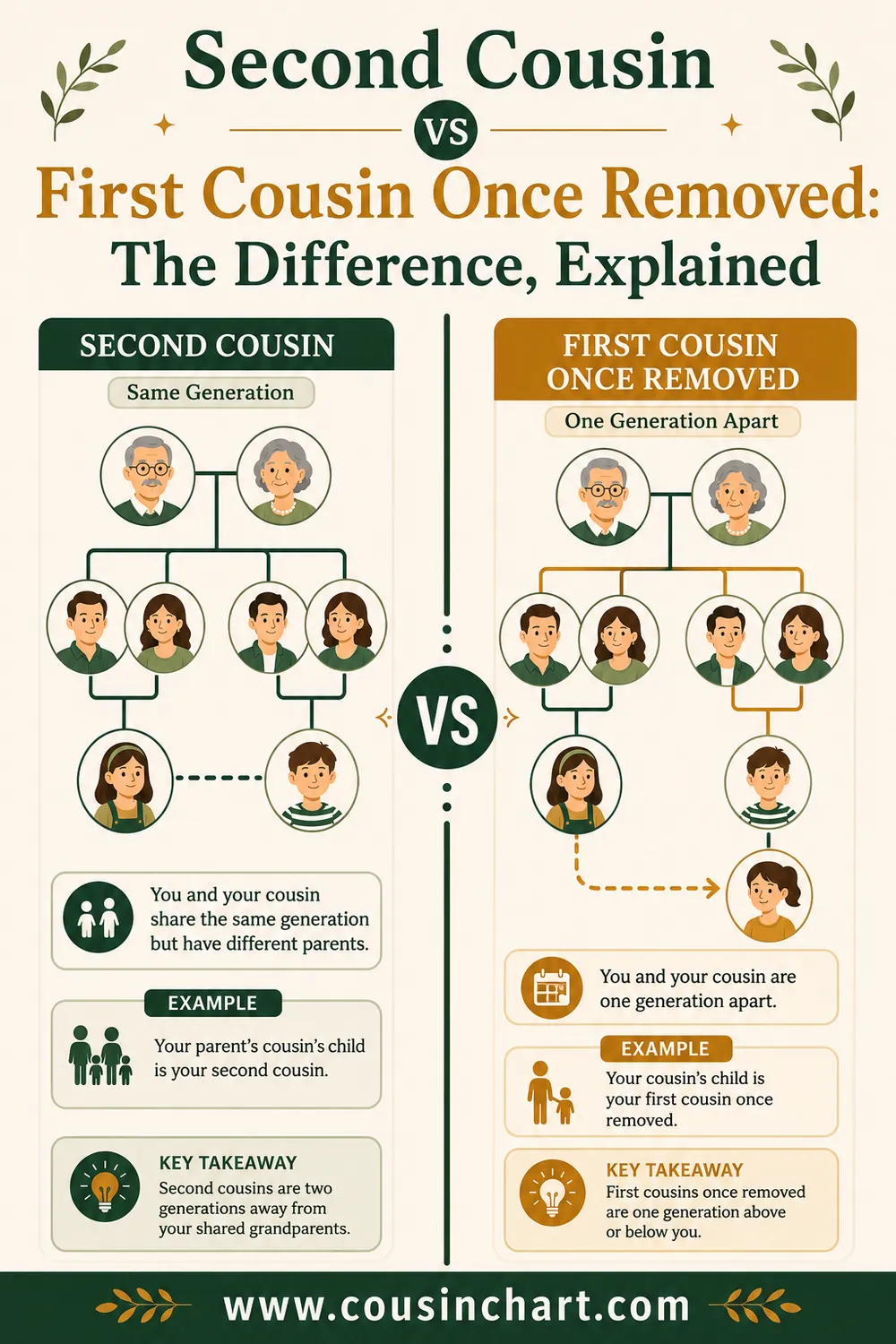
Second cousins share great-grandparents; a first cousin once removed is a generation apart. See the comparison table, DNA numbers, and a free calculator.
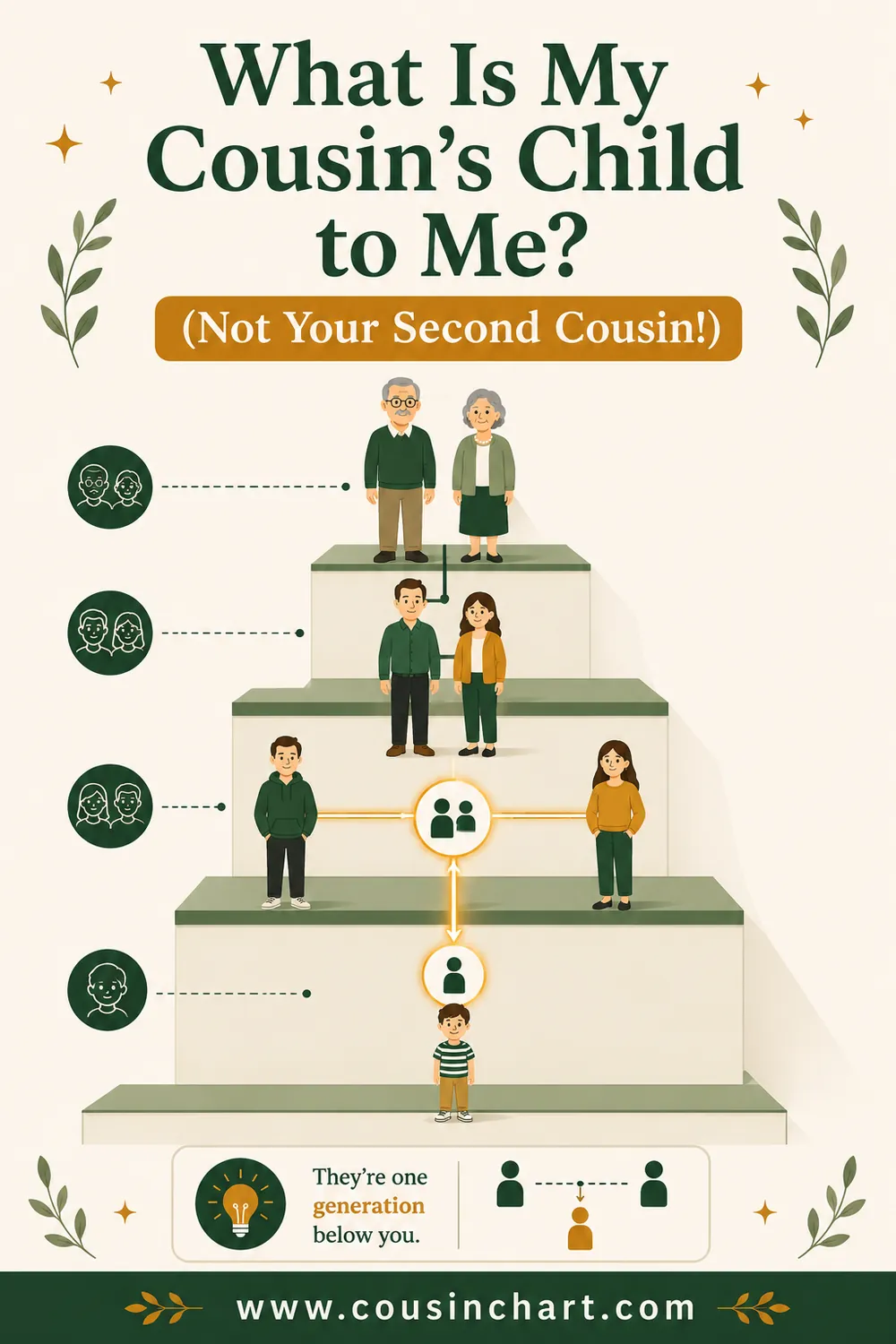
Your cousin's child is your first cousin once removed — not your second cousin. See why, what they call you, what your kids are to them, plus a free tool.
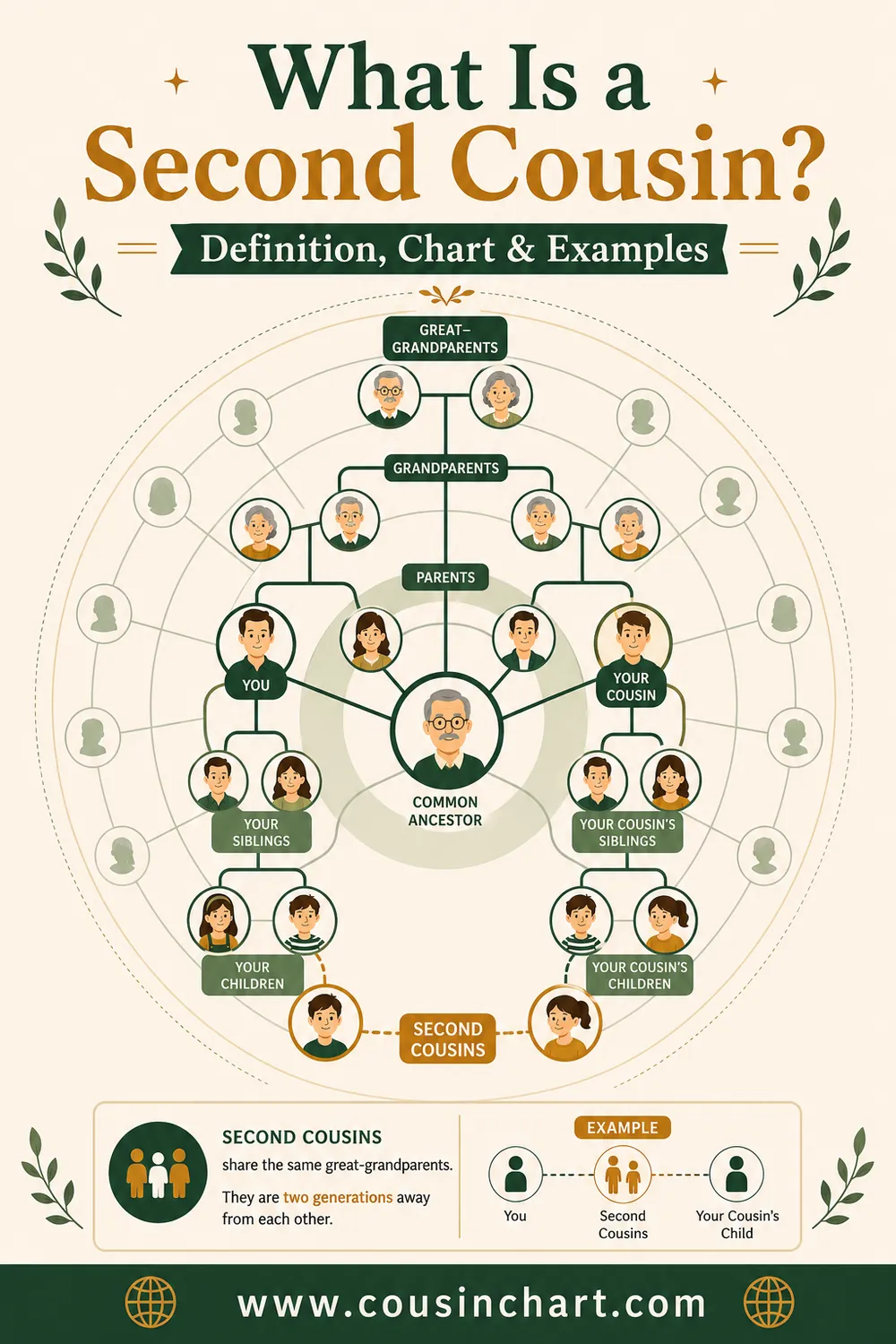
A second cousin shares great-grandparents with you — your parent's cousin's child. See the simple chart, DNA percentages, examples, and a free calculator.
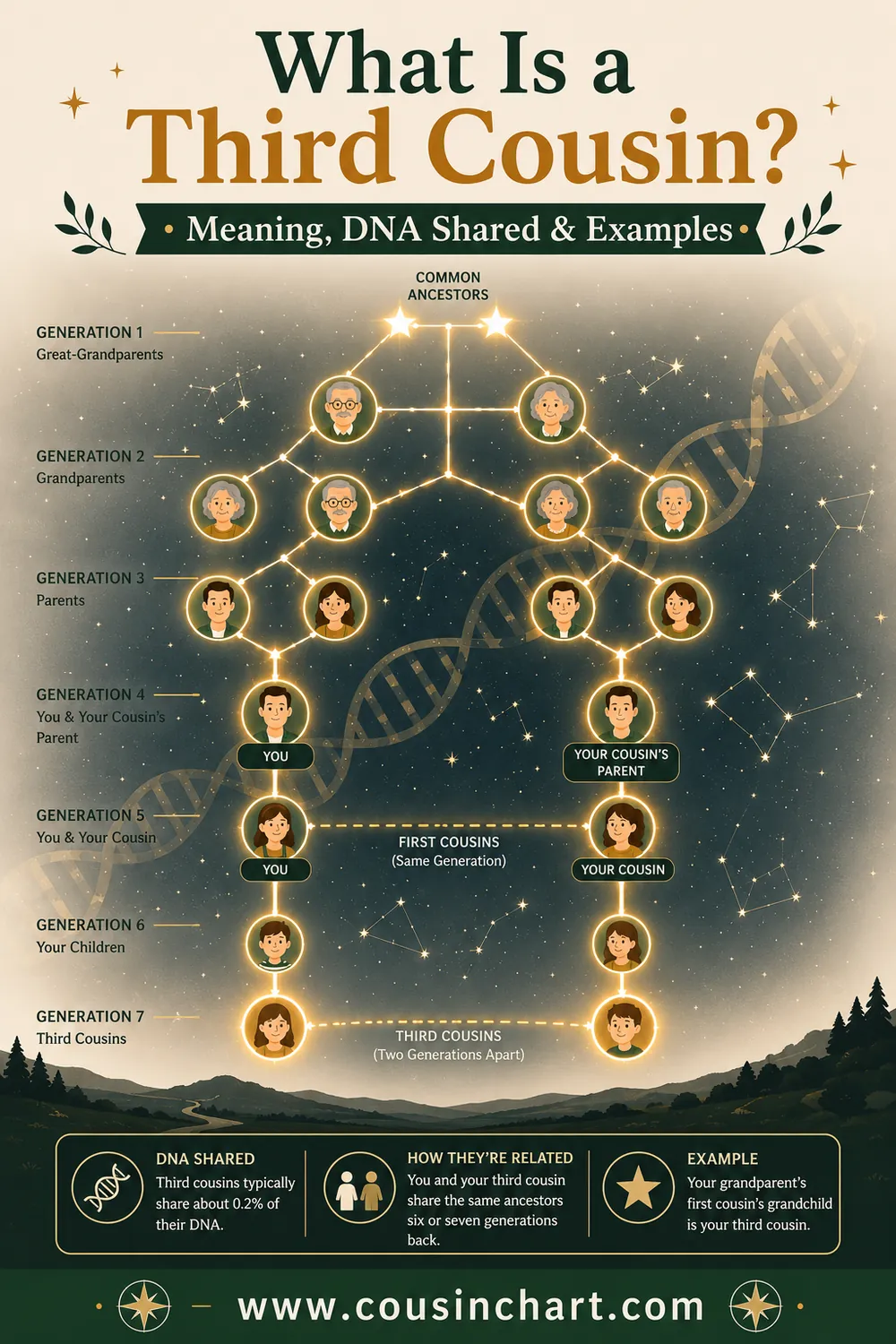
A third cousin shares great-great-grandparents with you and about 0.78% of your DNA. See how the relationship works, DNA match odds, and a free calculator.
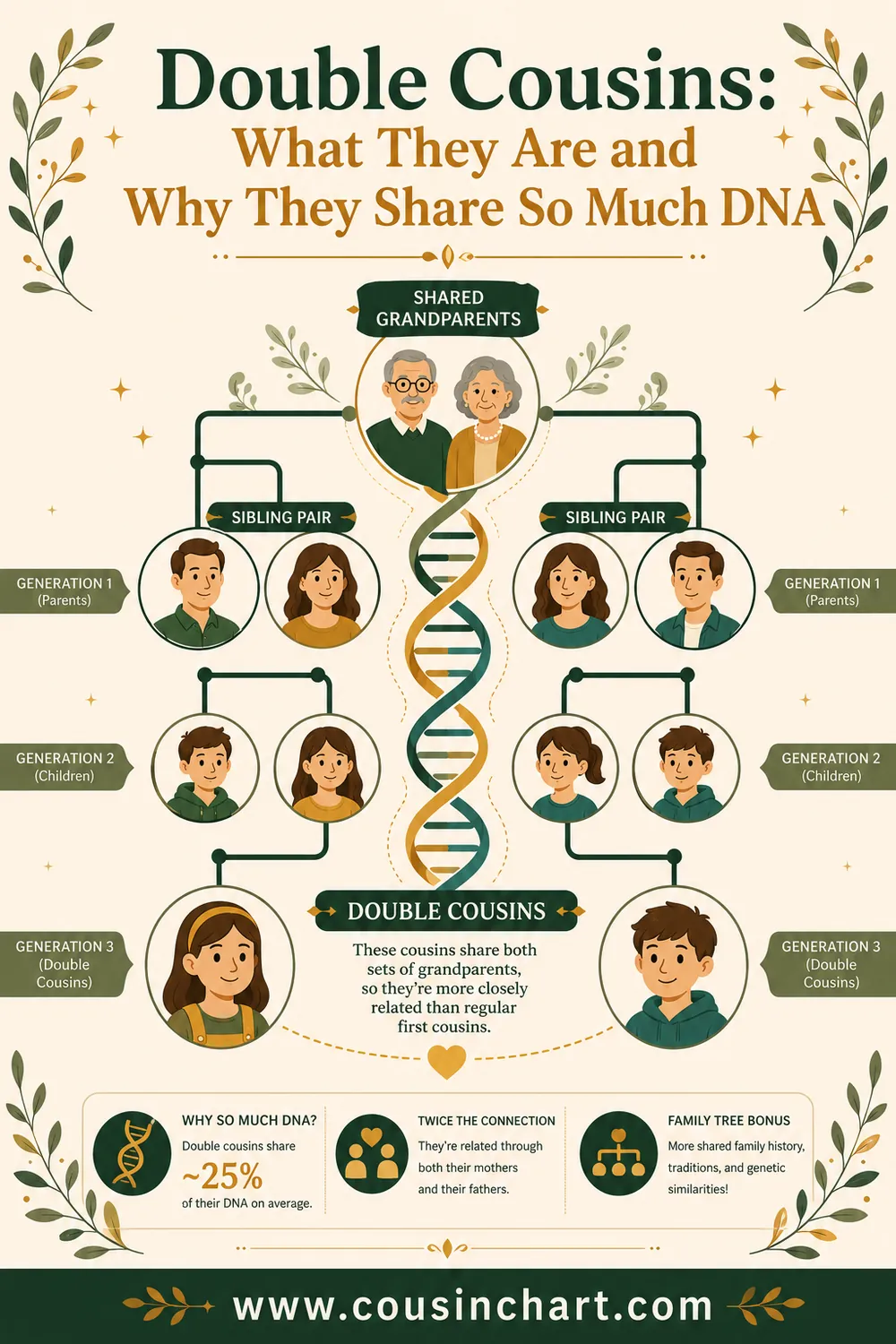
Double cousins happen when two siblings marry two siblings — the kids share both sets of grandparents and about 25% of their DNA. Here's how it all works.
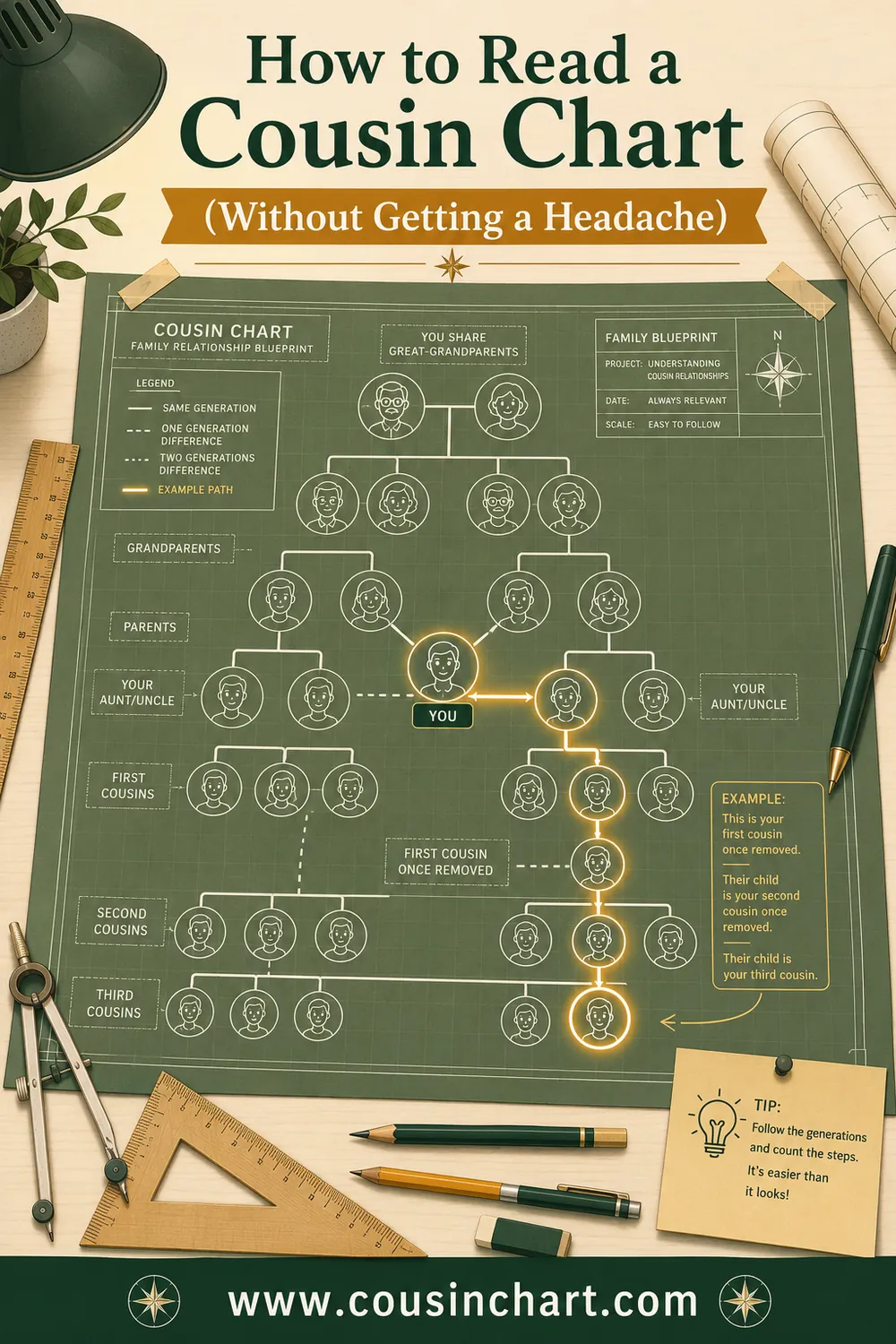
A cousin chart names any relative in two steps: find your shared ancestor, count the generations. Here's the chart, how to read it, and a free calculator.
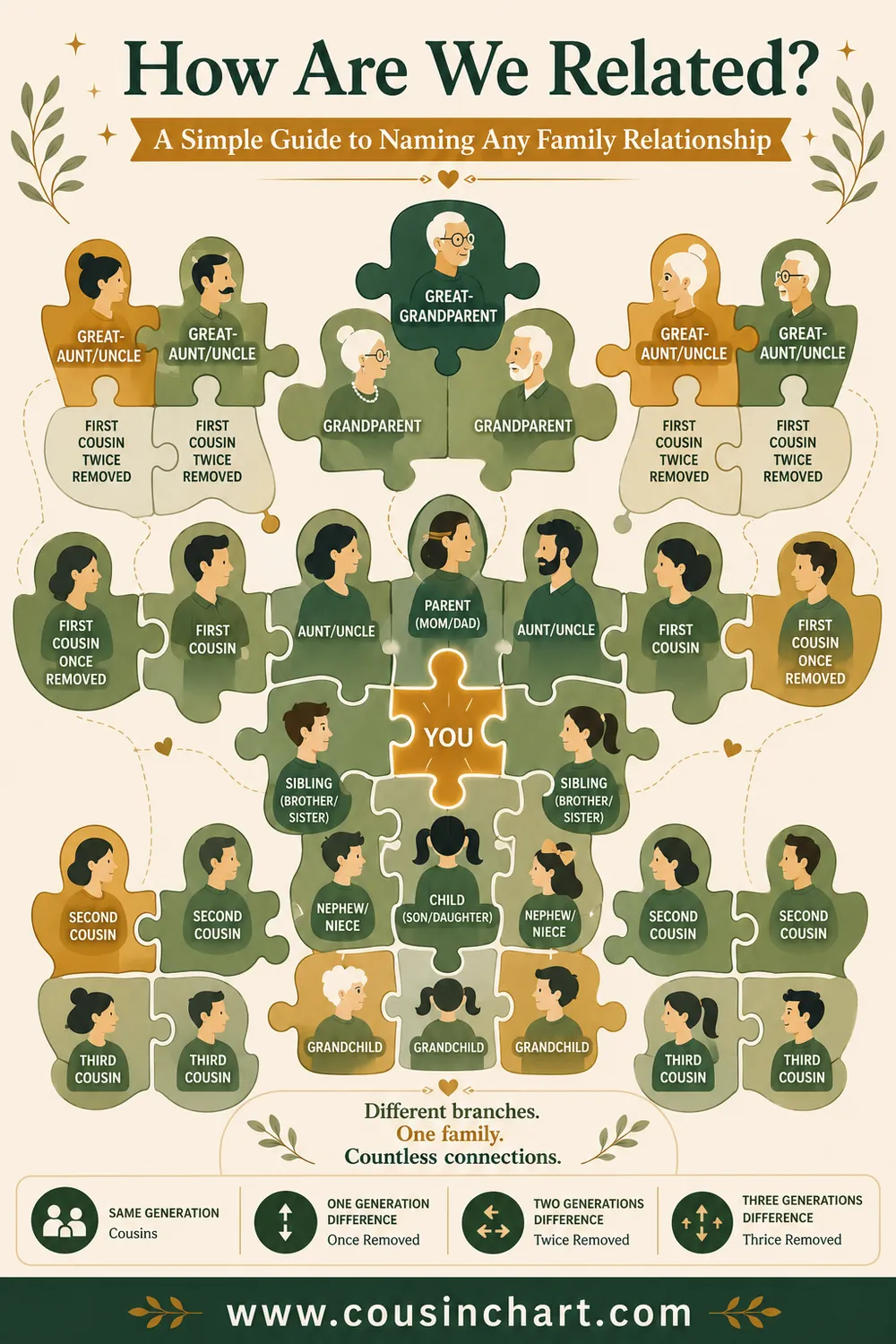
Figure out how any two relatives are related in 3 steps: find the shared ancestor, count generations, apply the naming rules. Includes a free calculator.
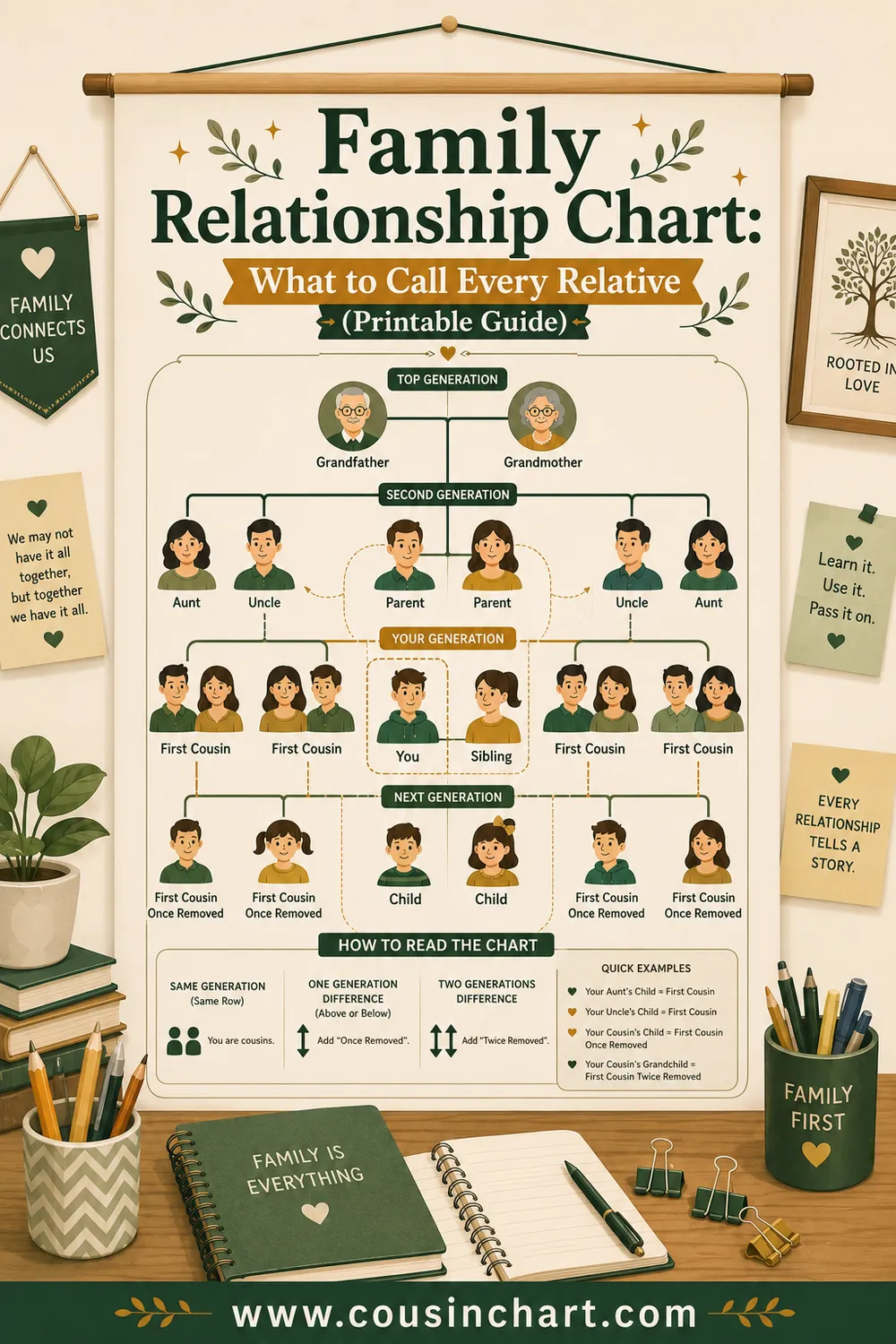
A complete family relationship chart: cousins, greats, in-laws, steps and halves, all in one place. Print it for the reunion or use the free calculator.
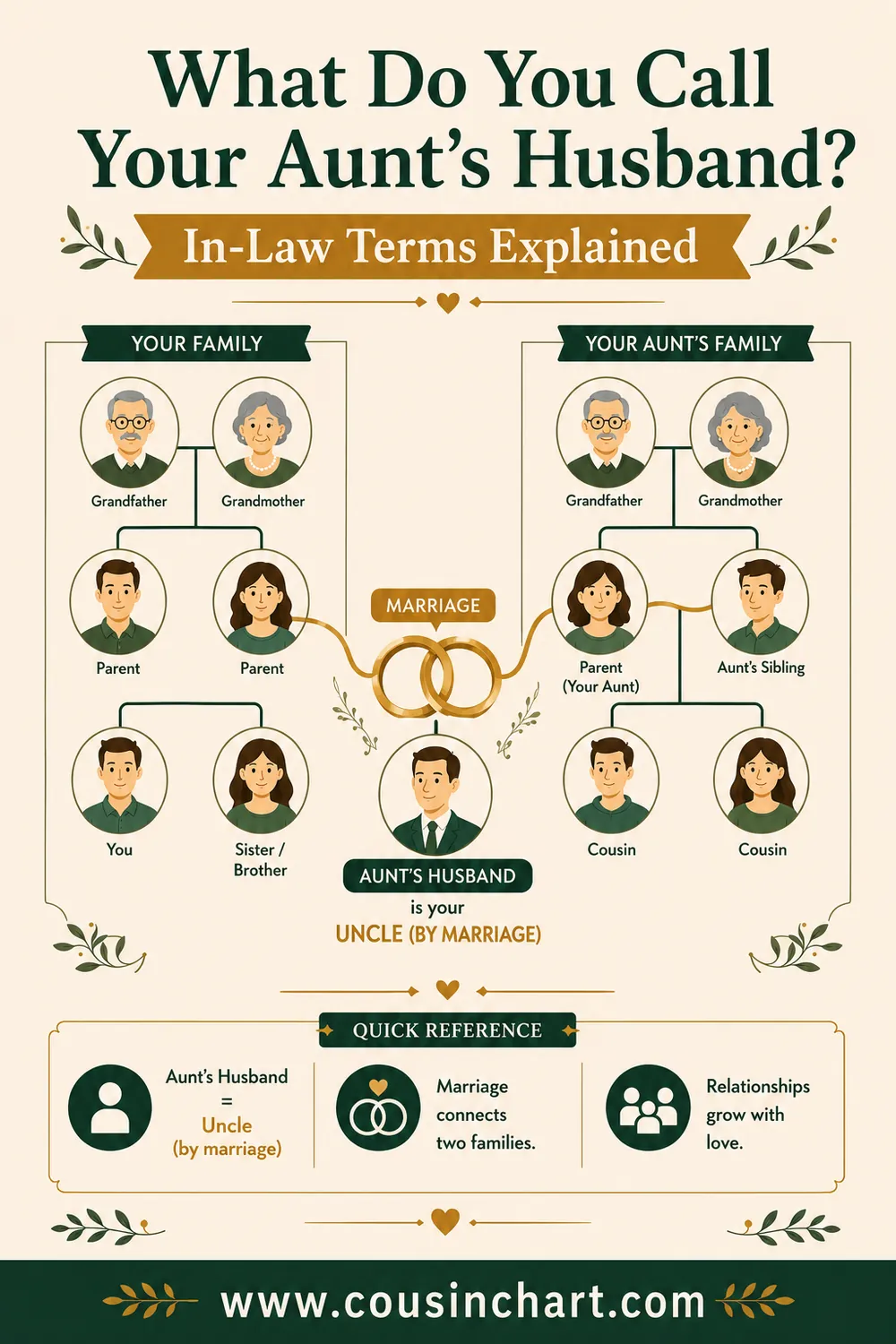
Your aunt's husband is simply your uncle — an uncle by marriage. Here's the full in-law glossary, plus what to call his relatives and your cousin's spouse.
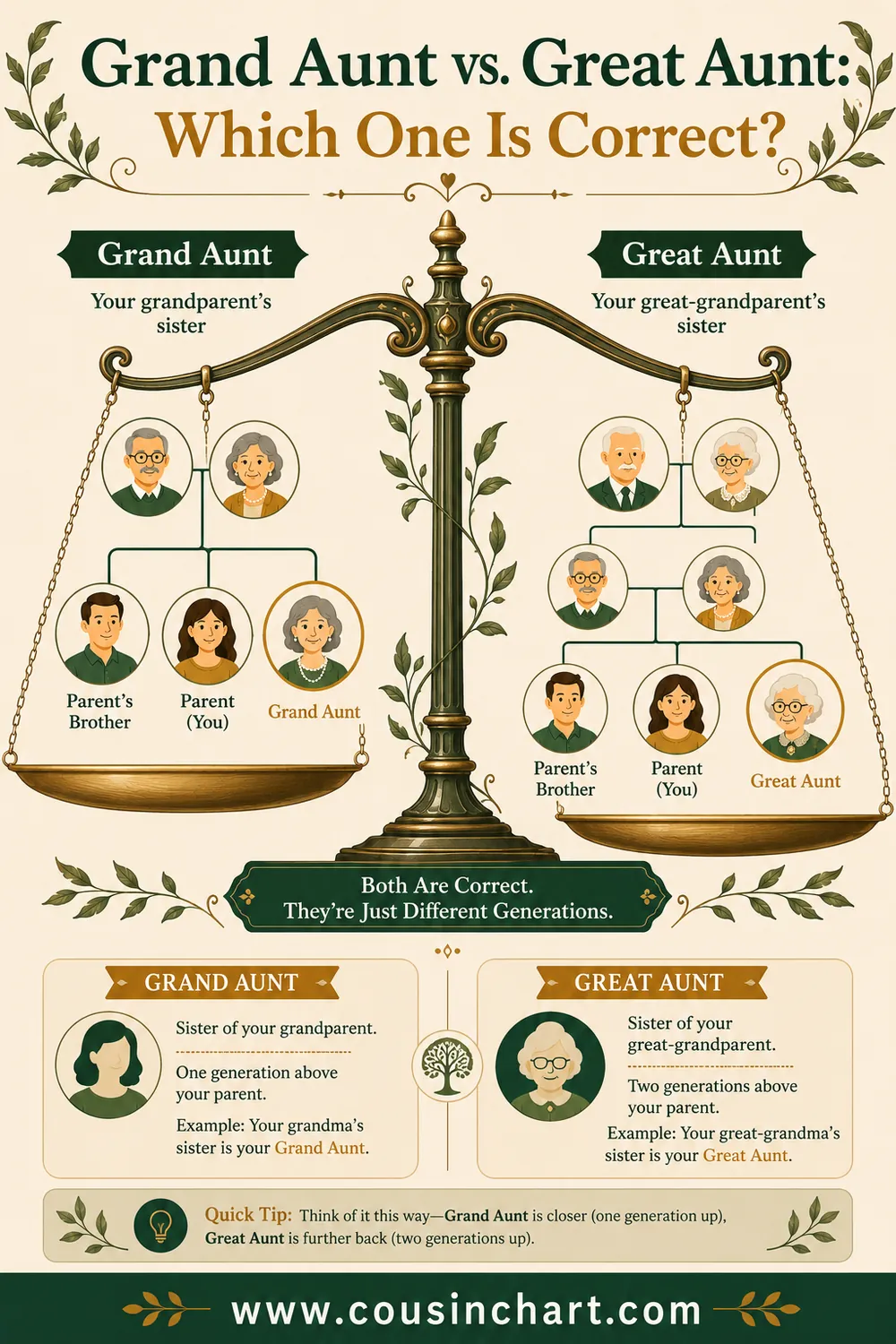
Grand aunt and great aunt both mean your grandparent's sister — and both are correct. Here's why genealogists prefer grandaunt, plus a generation cheat sheet.
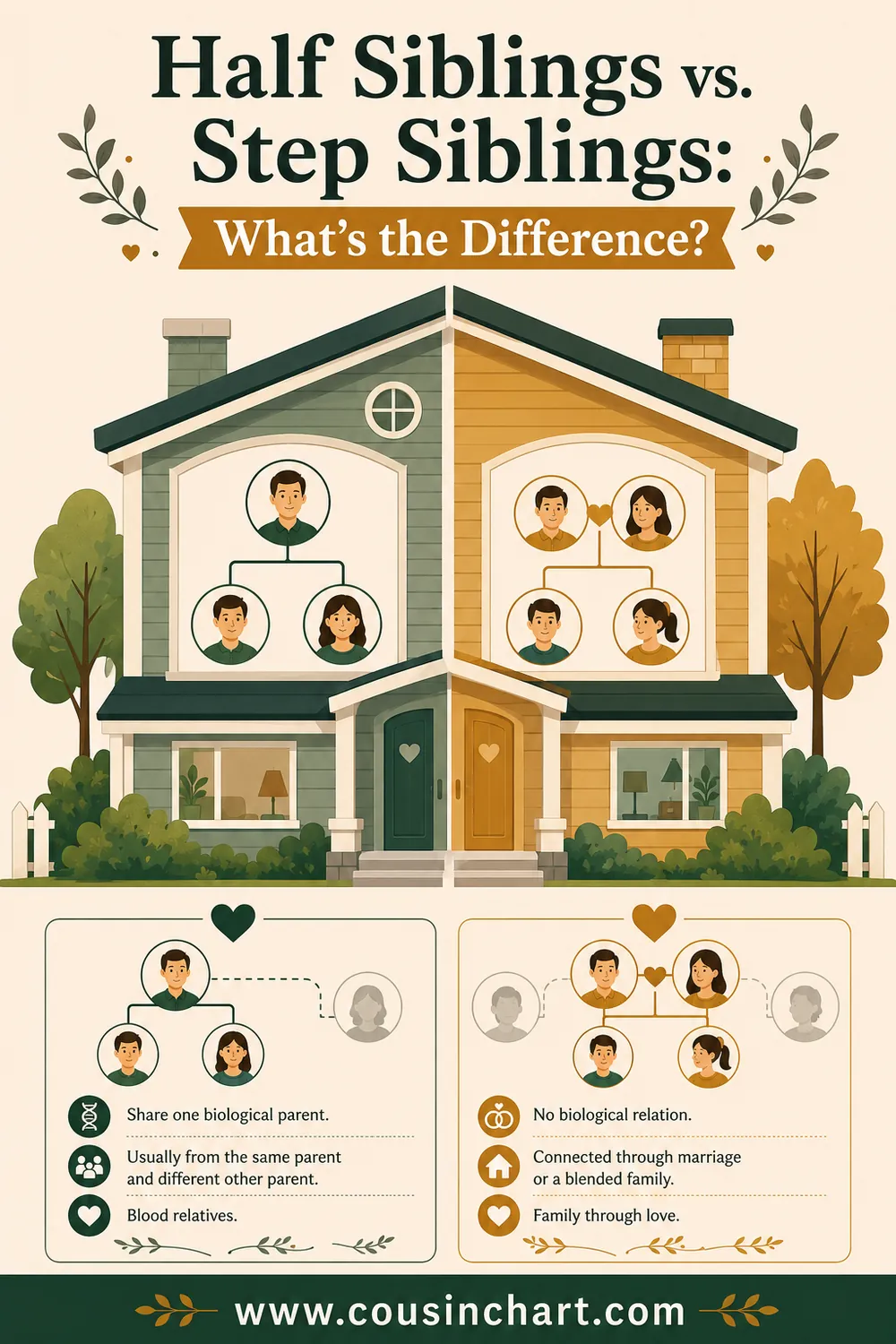
A half sibling shares one biological parent with you; a step sibling shares none. See the DNA, legal, and family-tree differences in one clear comparison.
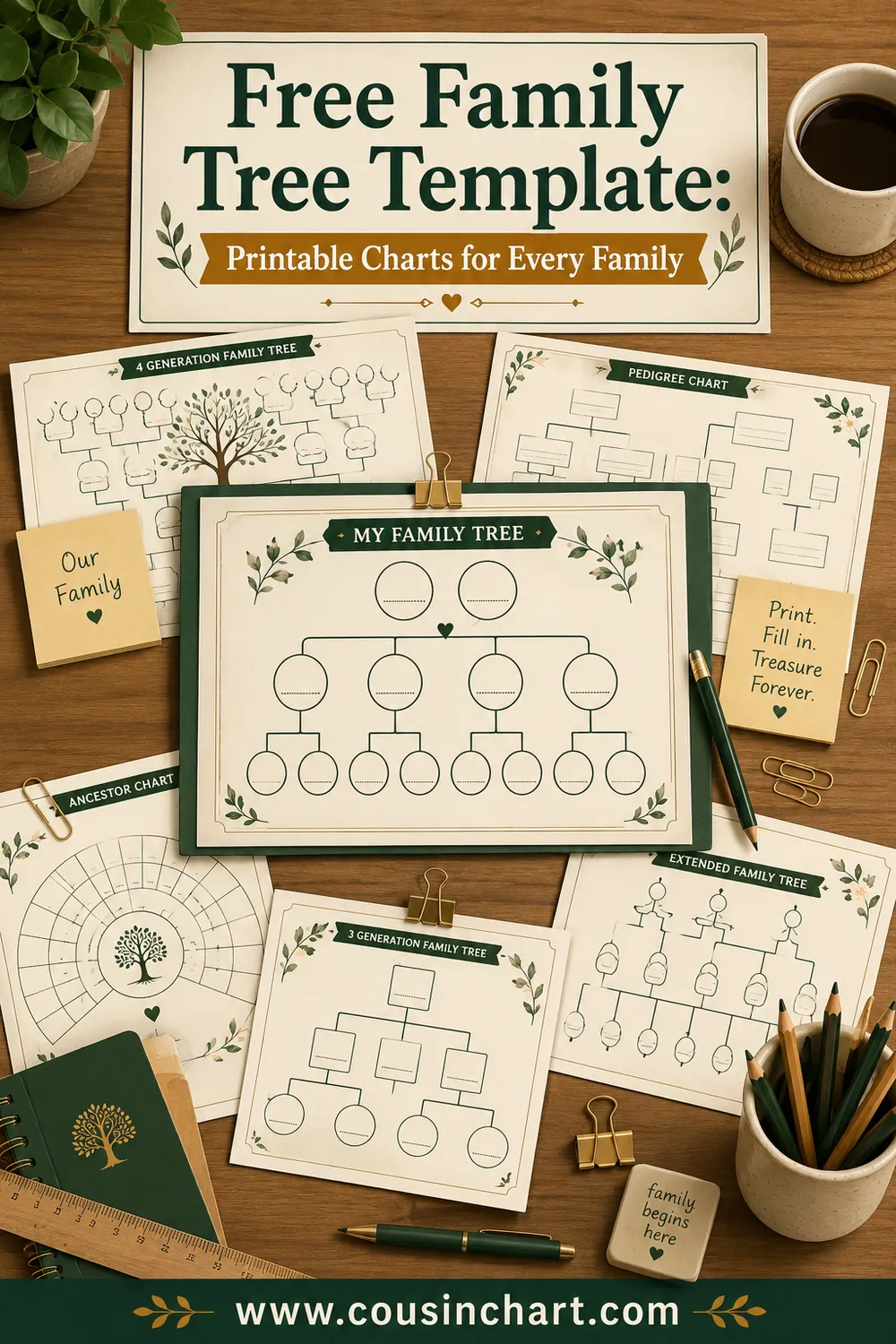
Download a free printable family tree template — 3, 4, and 5 generation layouts, fan charts, and kids' trees, with simple fill-in tips for each design.
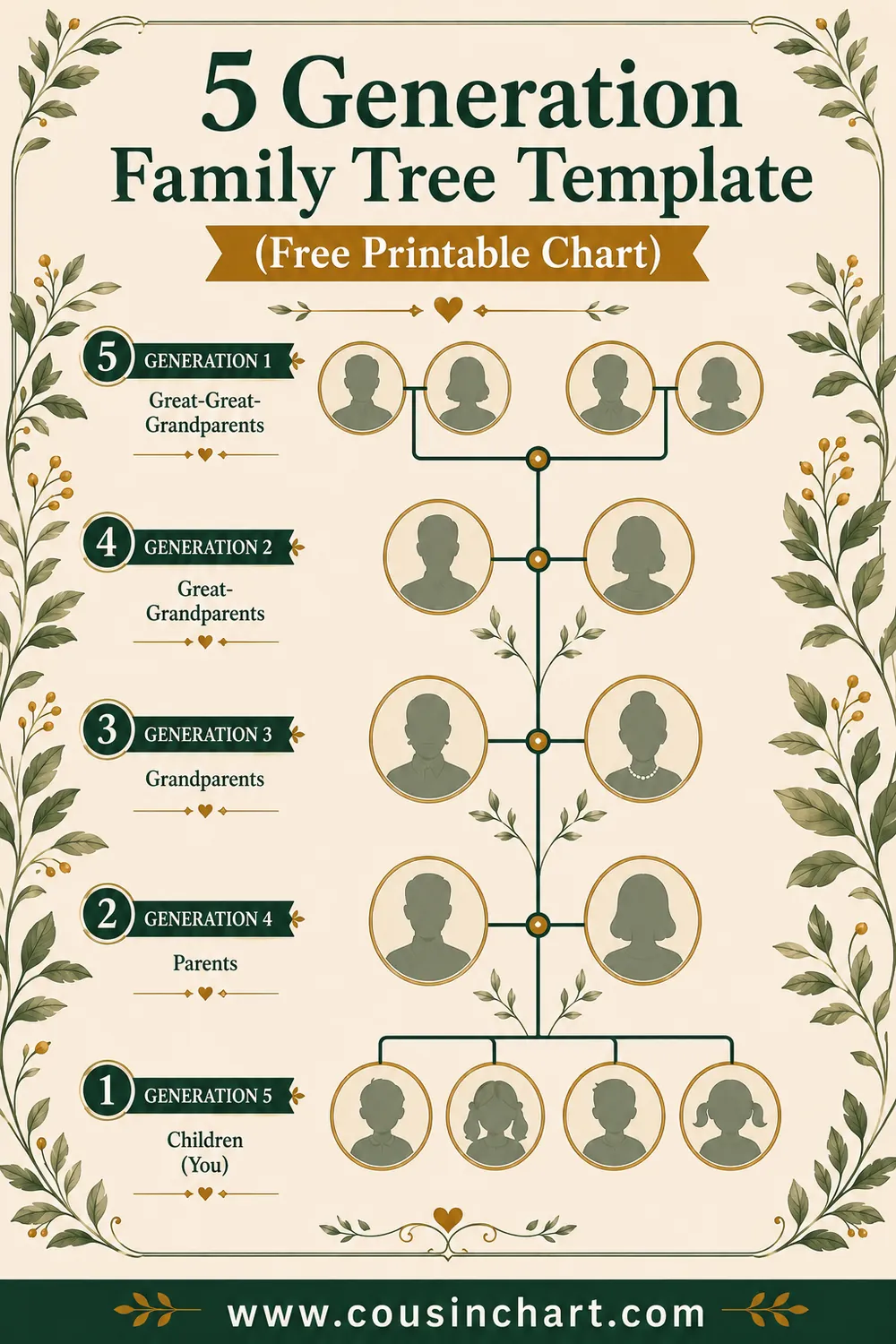
Free printable 5 generation family tree template with 31 boxes — you to your 16 great-great-grandparents. Layout guide, numbering system, and fill-in tips.
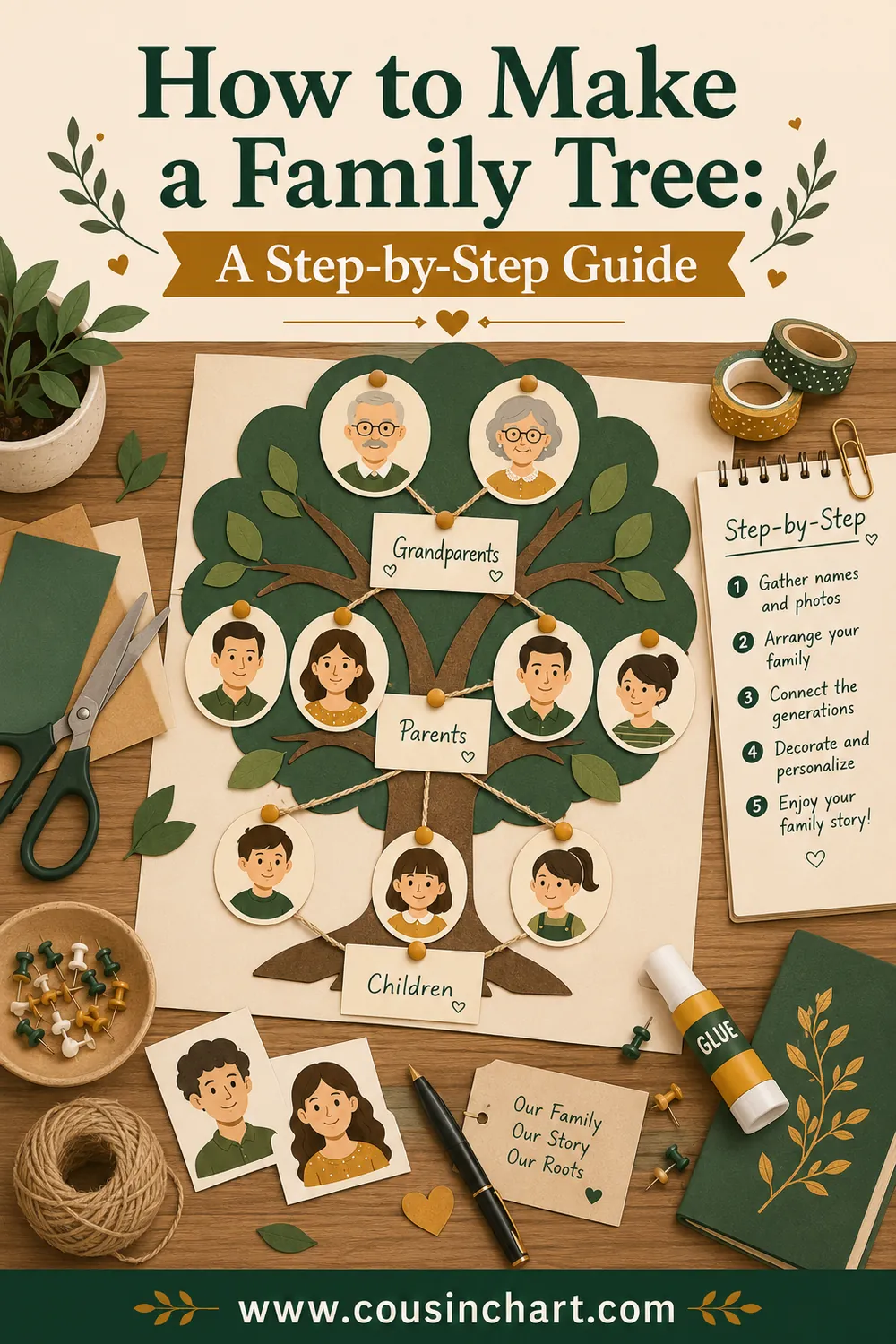
Learn how to make a family tree in 8 clear steps — from interviewing relatives to charting generations correctly, with free templates and record sources.
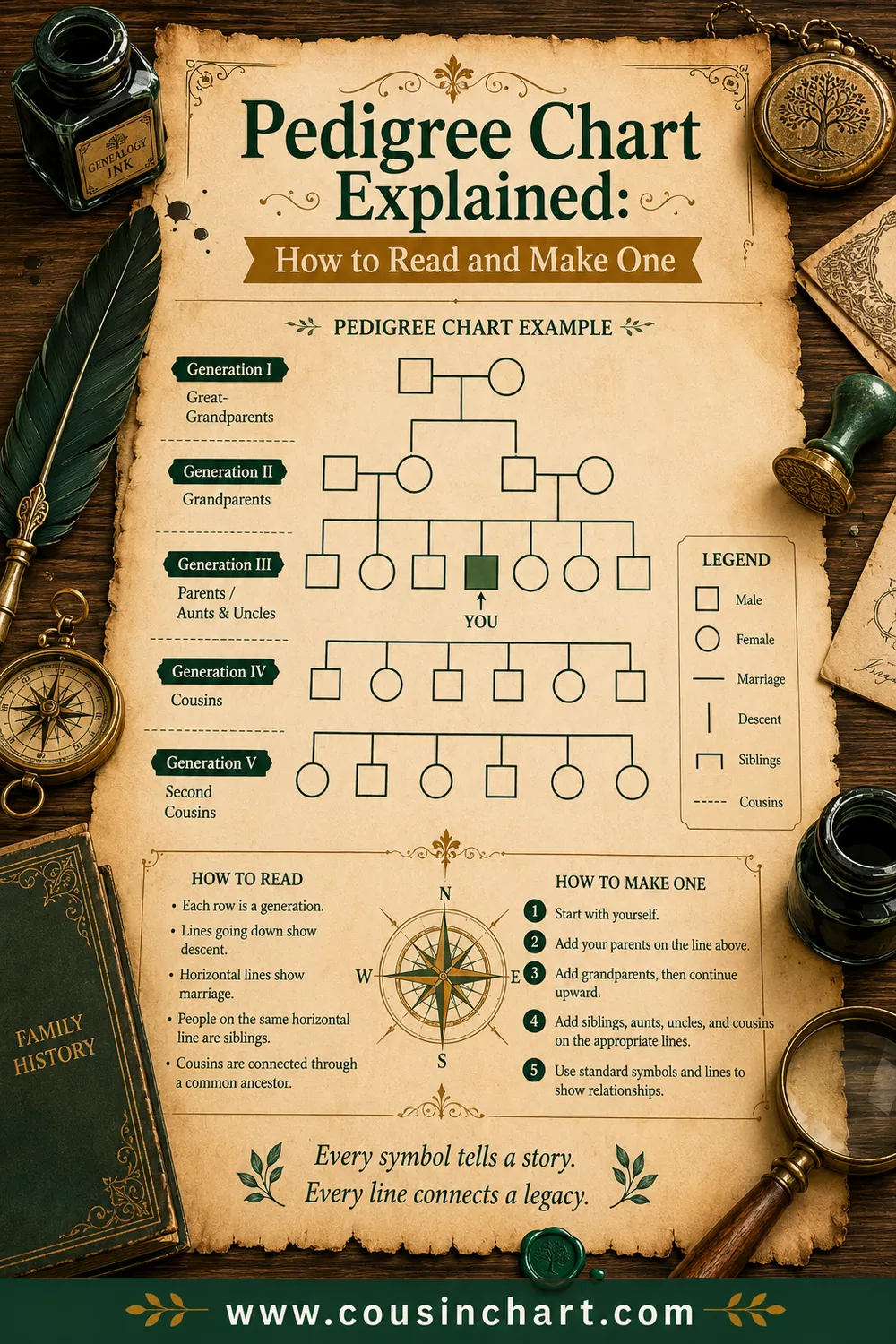
A pedigree chart maps your direct ancestors — no cousins, no siblings. Learn the numbering system, the genetics symbols, and how to read or make one.
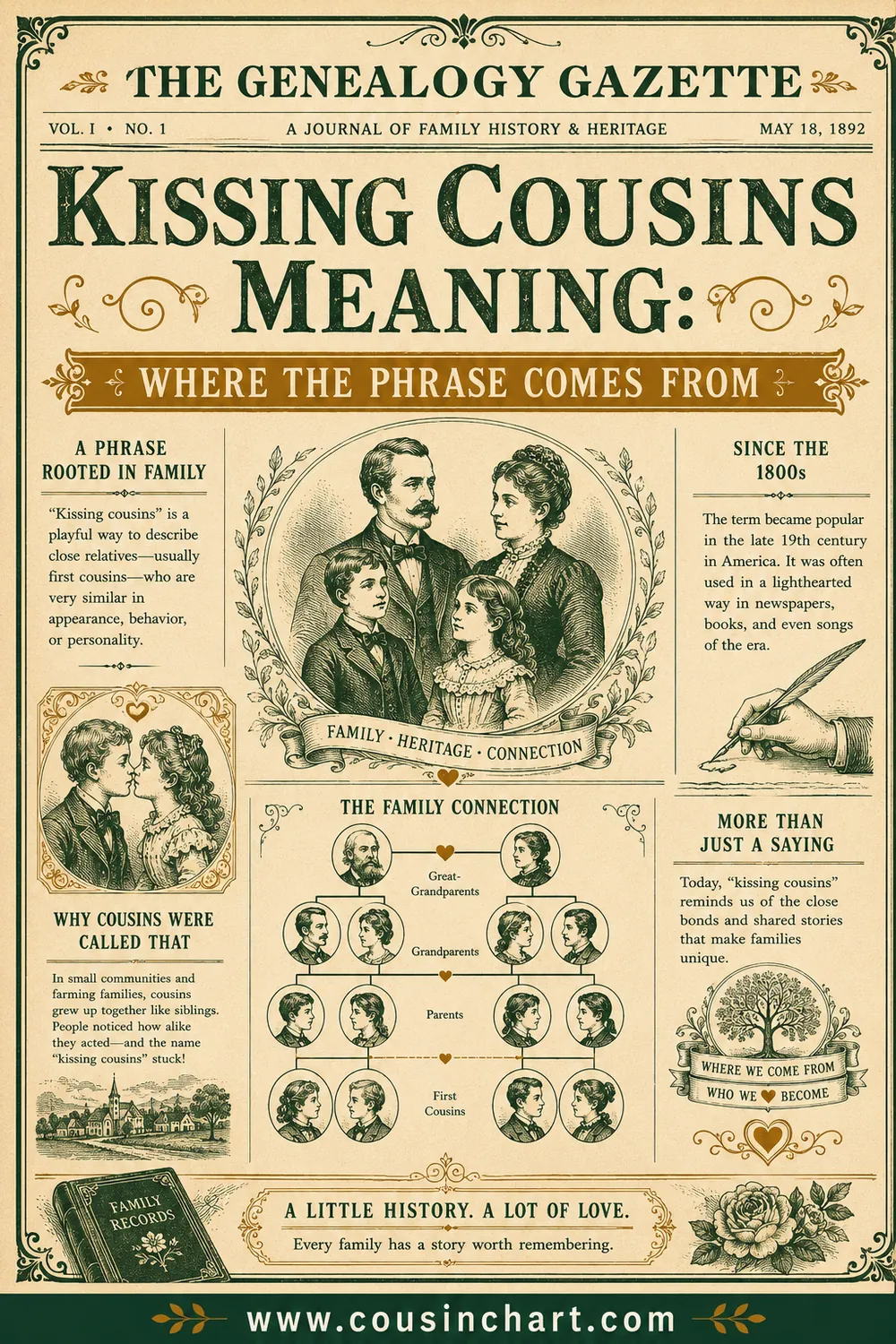
Kissing cousins means relatives distant enough to greet with a kiss — or two things nearly alike. The phrase's Southern roots, plus the cousin facts.
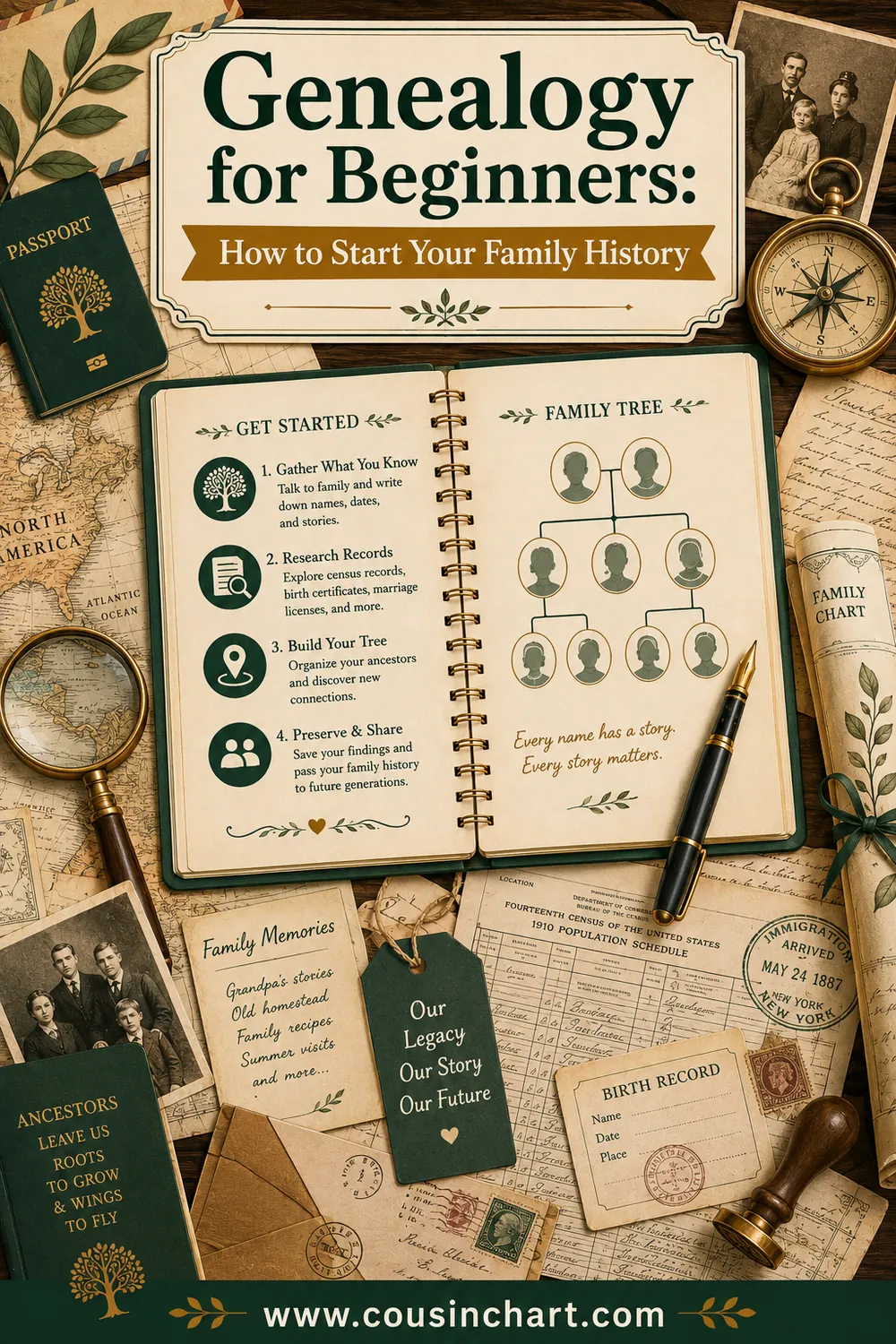
A friendly genealogy guide for beginners: start with yourself, interview relatives, and trace your family free with FamilySearch, census records, and more.
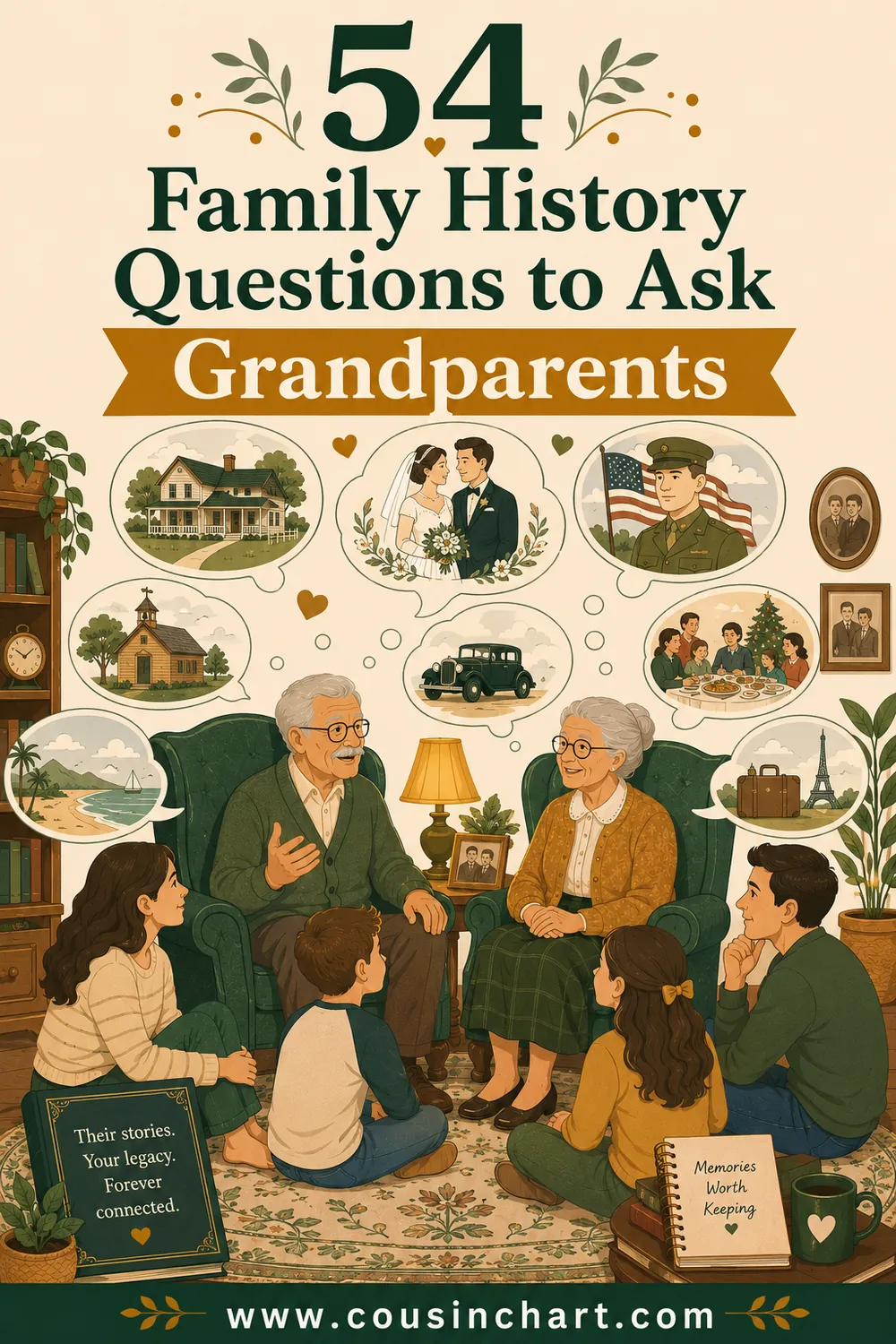
54 family history questions to ask grandparents, organized by theme — childhood, ancestors, love, work, and wisdom — plus tips for recording their answers.
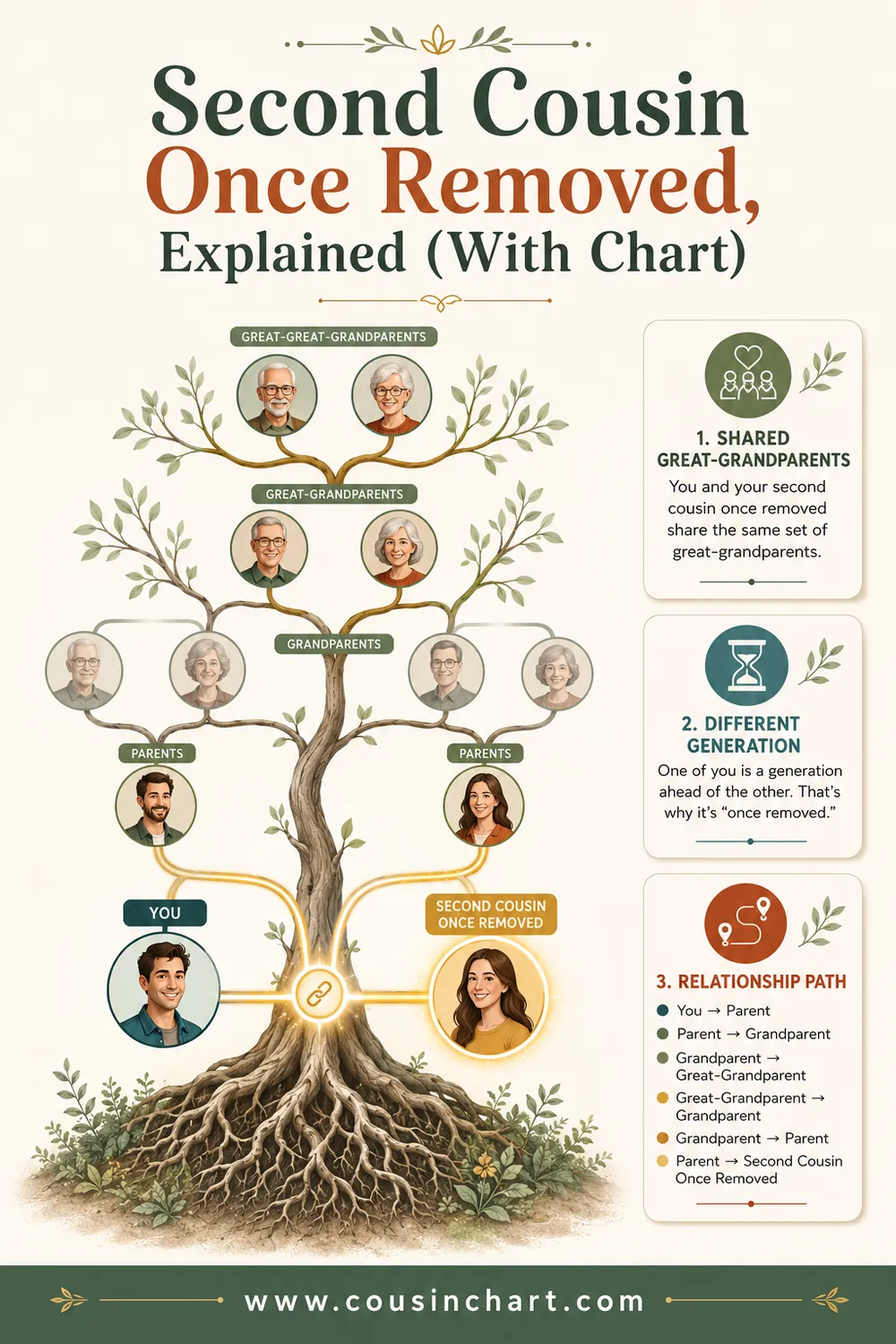
A second cousin once removed is your second cousin's child or your parent's second cousin. See the chart, clear examples, DNA shared, and a free calculator.
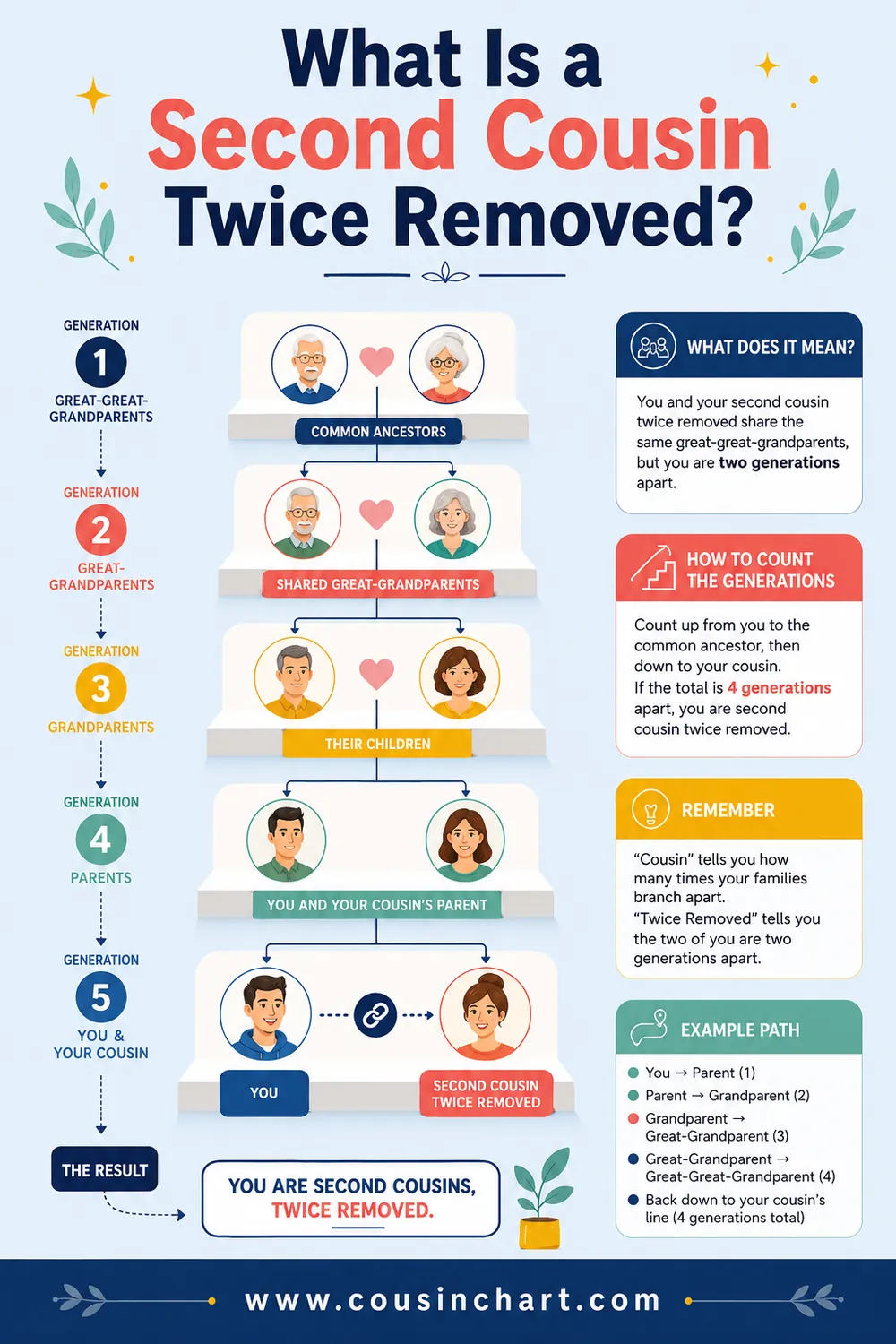
A second cousin twice removed is your second cousin's grandchild or your grandparent's second cousin. Get the chart, examples, DNA shared, and a free tool.
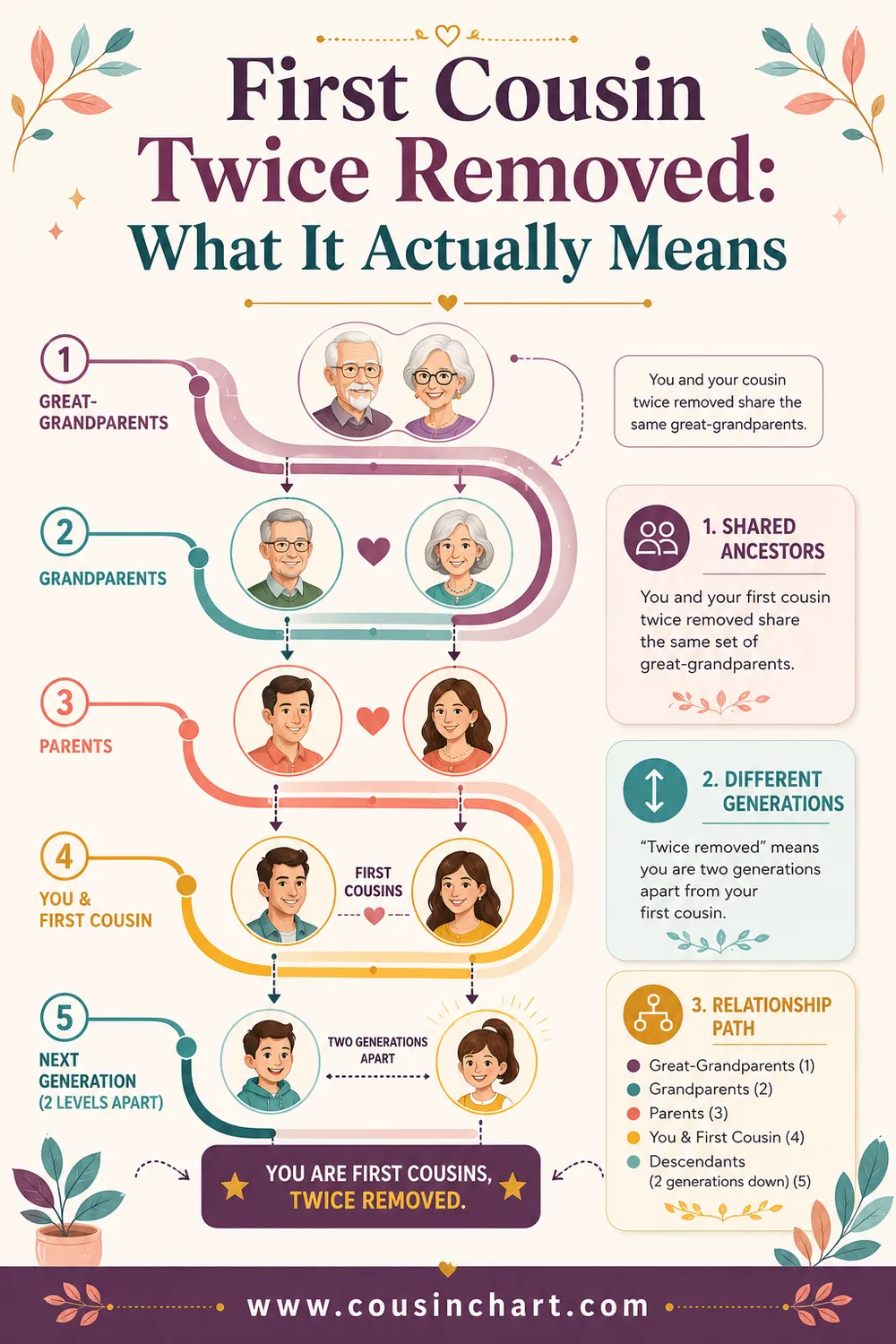
A first cousin twice removed is your cousin's grandchild or your grandparent's first cousin. See the chart, real examples, shared DNA, and a free calculator.
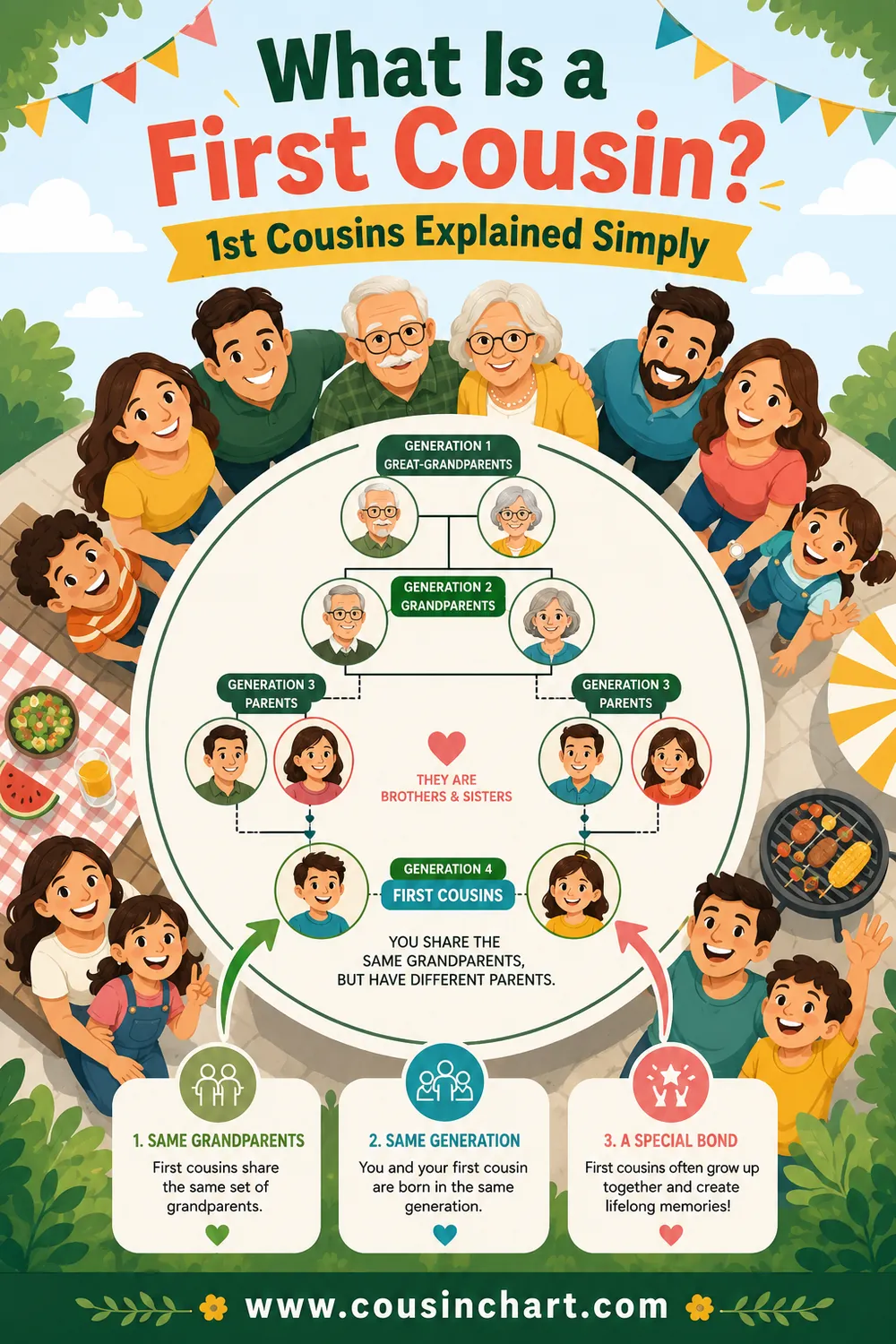
A first cousin is your aunt or uncle's child — you share grandparents. Learn how 1st cousins work, DNA shared, common mix-ups, and try the free calculator.
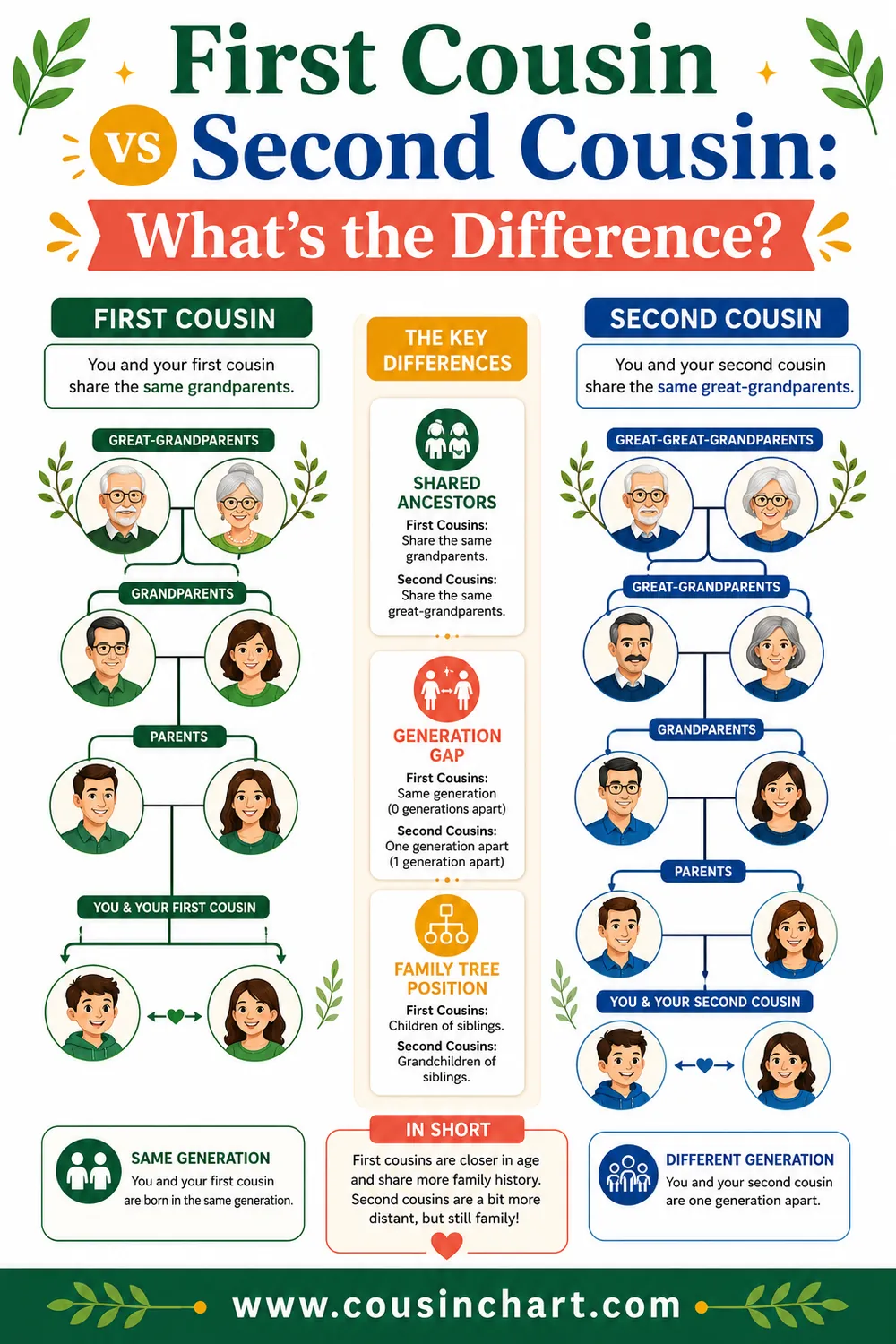
First cousins share grandparents; second cousins share great-grandparents. See the side-by-side chart, DNA numbers, easy tests, and a free calculator.
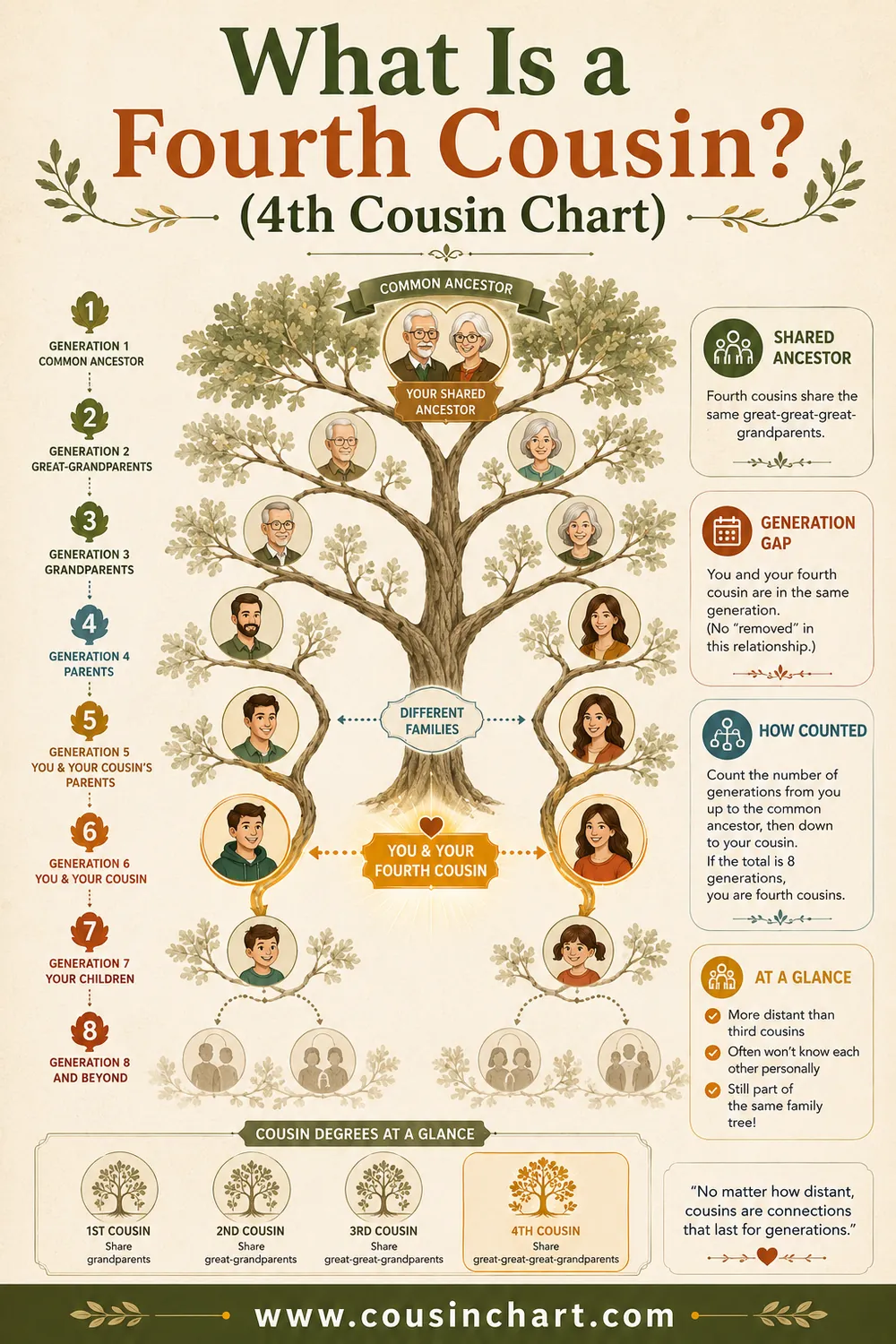
A fourth cousin shares your great-great-great-grandparents — your parents are third cousins. See the 4th cousin chart, DNA odds, and try the free calculator.
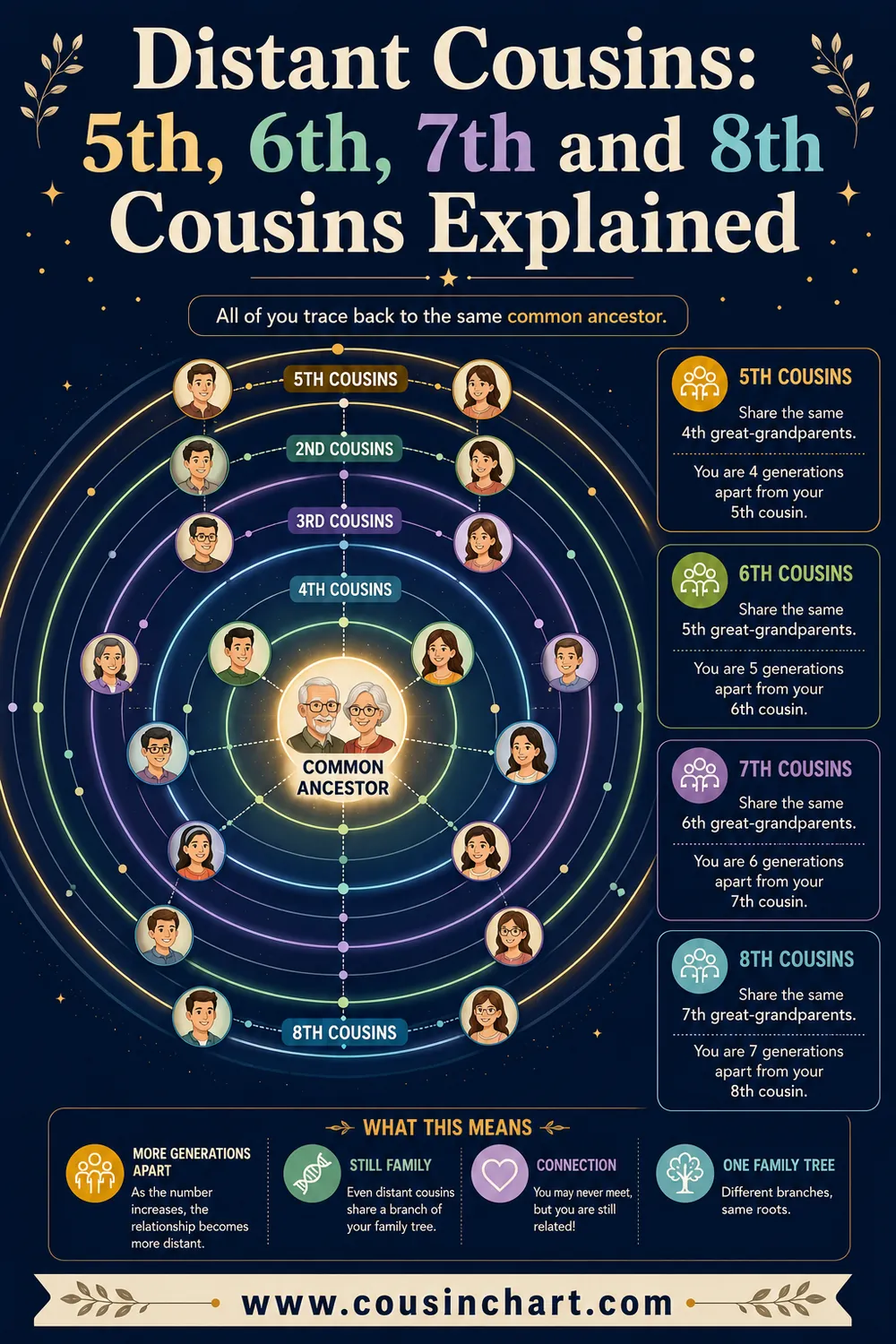
What are 5th, 6th, 7th and 8th cousins? See the distant cousin chart, shared ancestors, DNA odds, and how many you have — plus a free relationship calculator.
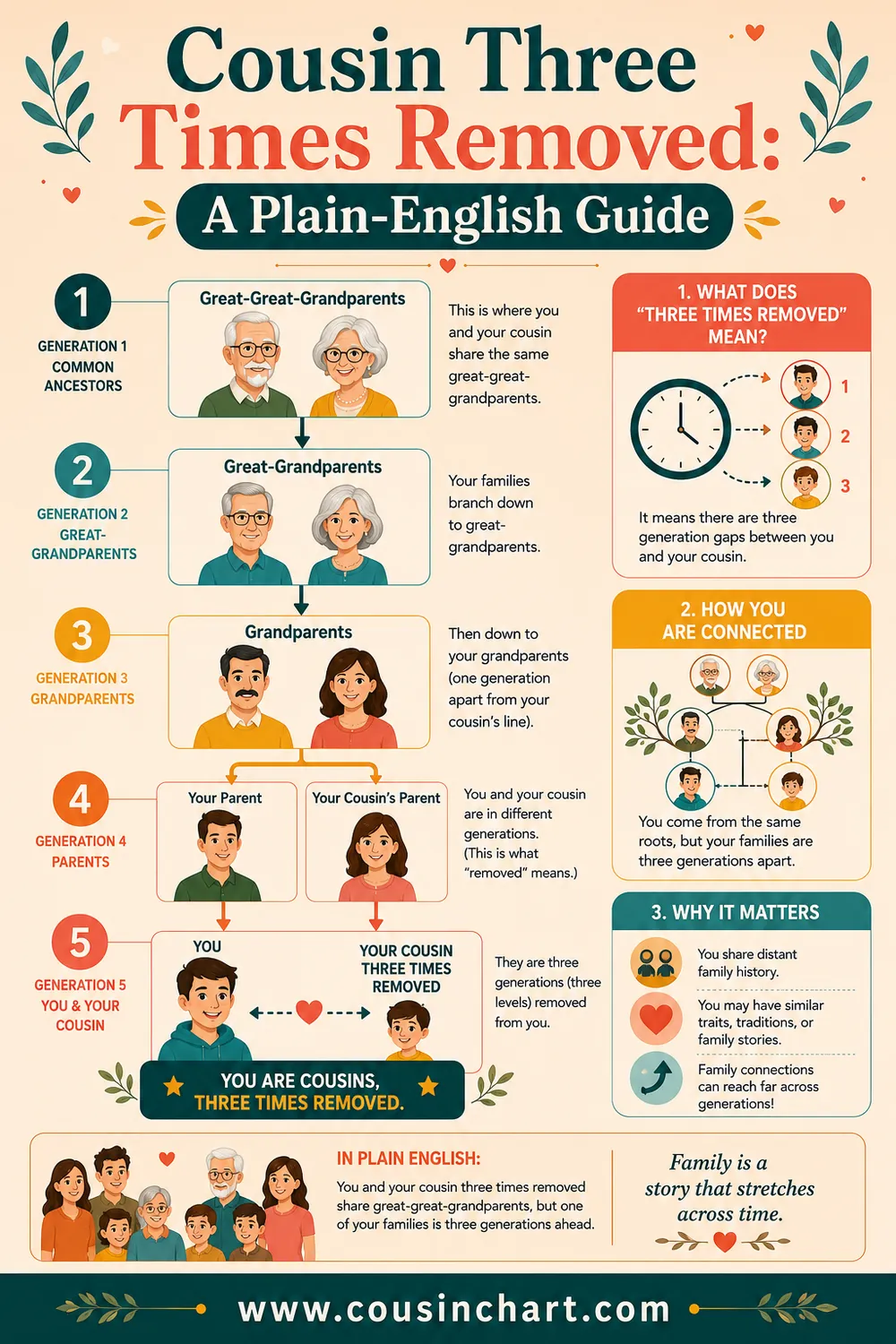
A first cousin three times removed is your cousin's great-grandchild or your great-grandparent's cousin. Simple chart, examples, DNA — plus a free calculator.
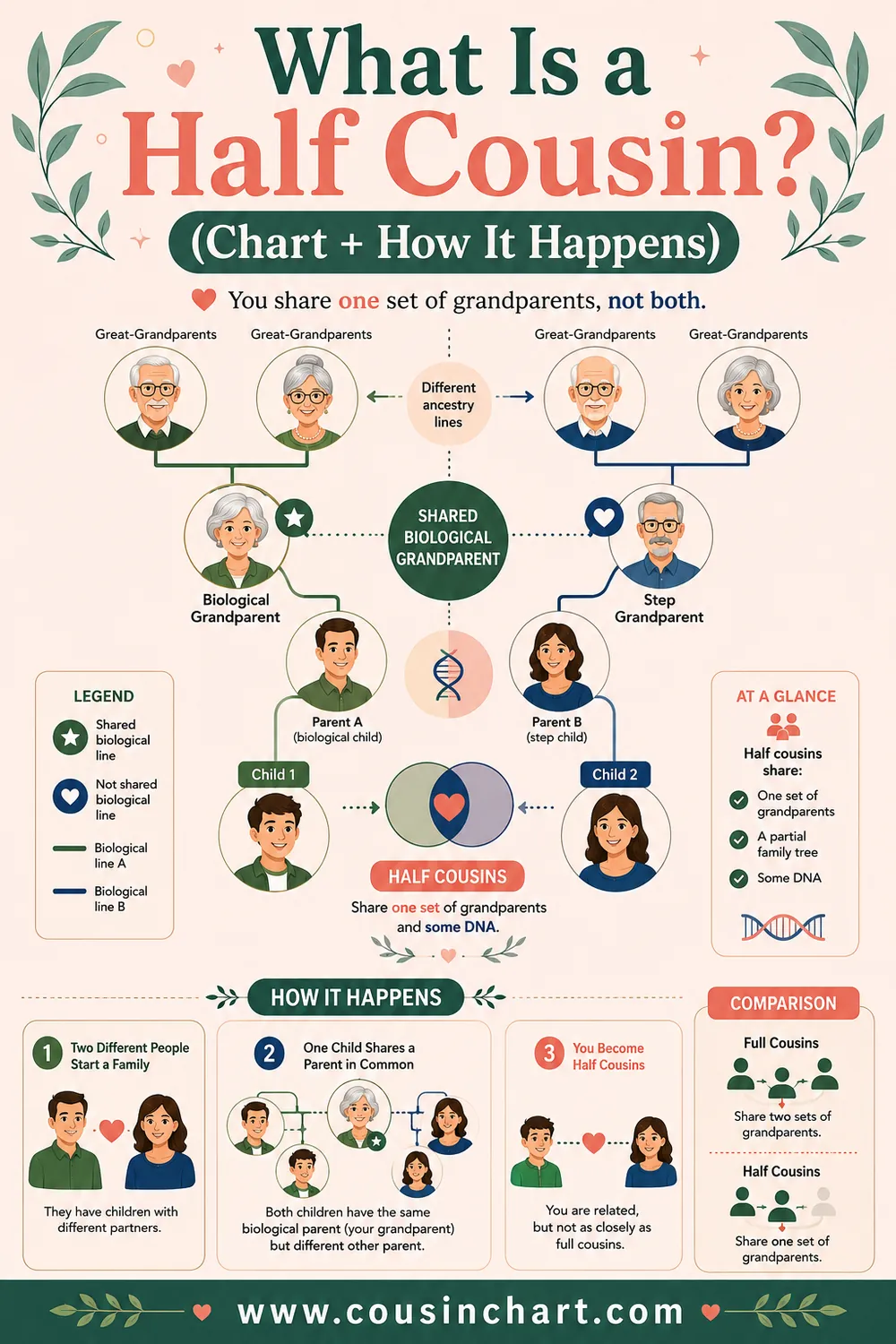
A half cousin is the child of your parent's half-sibling — you share one grandparent instead of two. See the half cousin chart, DNA shared, and a free tool.
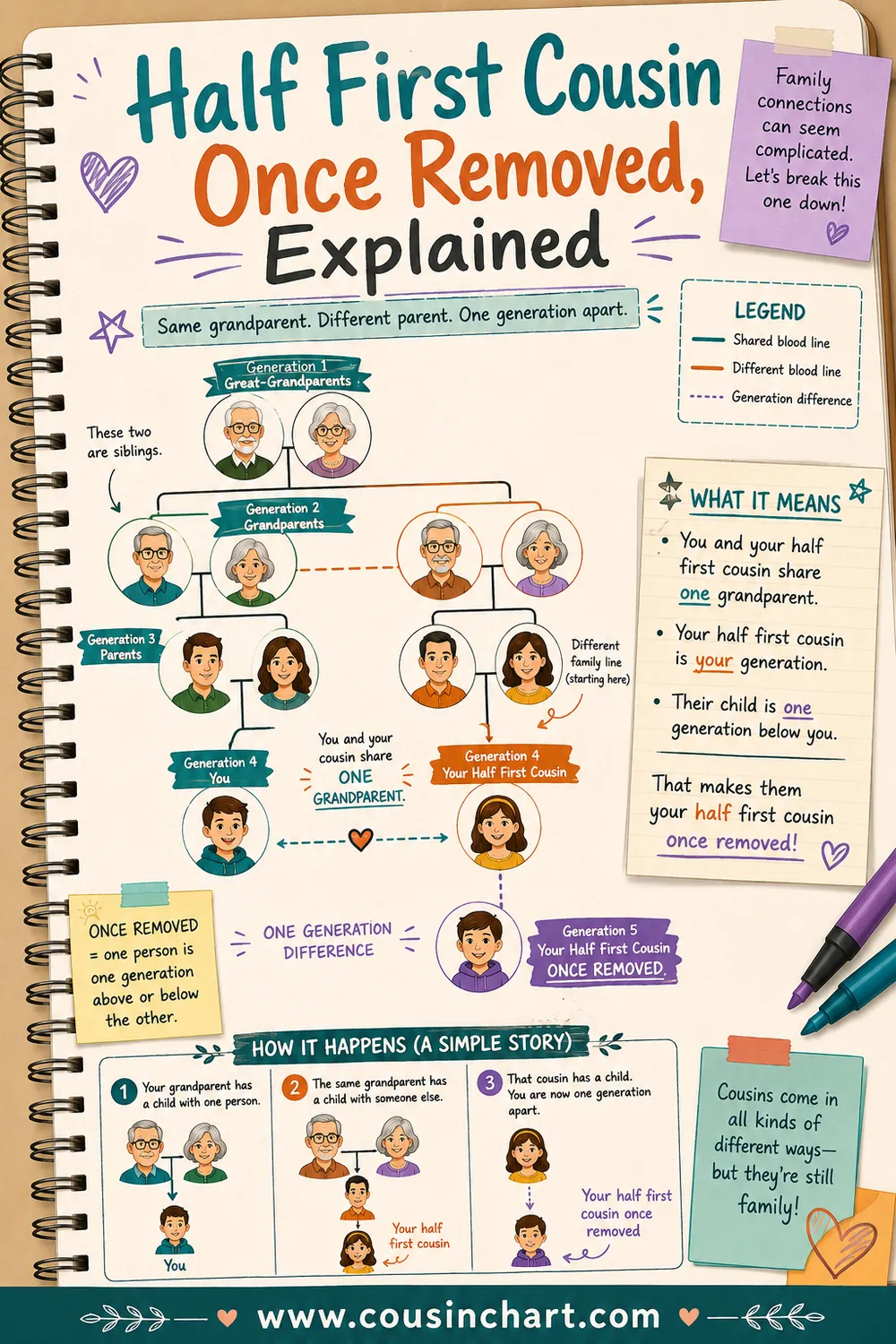
A half first cousin once removed is your half cousin's child or your parent's half cousin. See the chart, DNA overlap with second cousins, and a free tool.
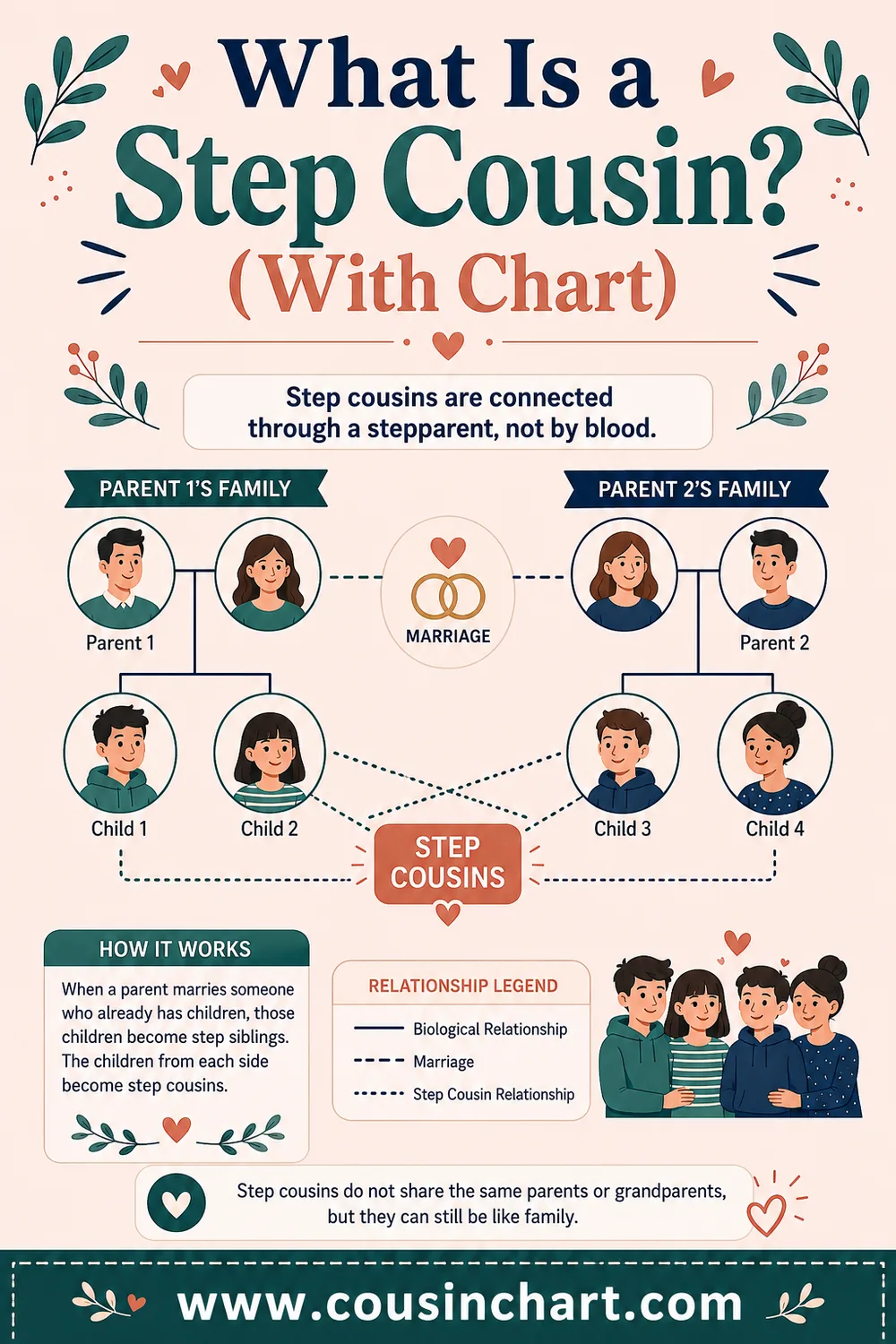
A step cousin is connected to you through a remarriage — your step-parent's nieces and nephews, for example. See the chart, examples, and the free calculator.
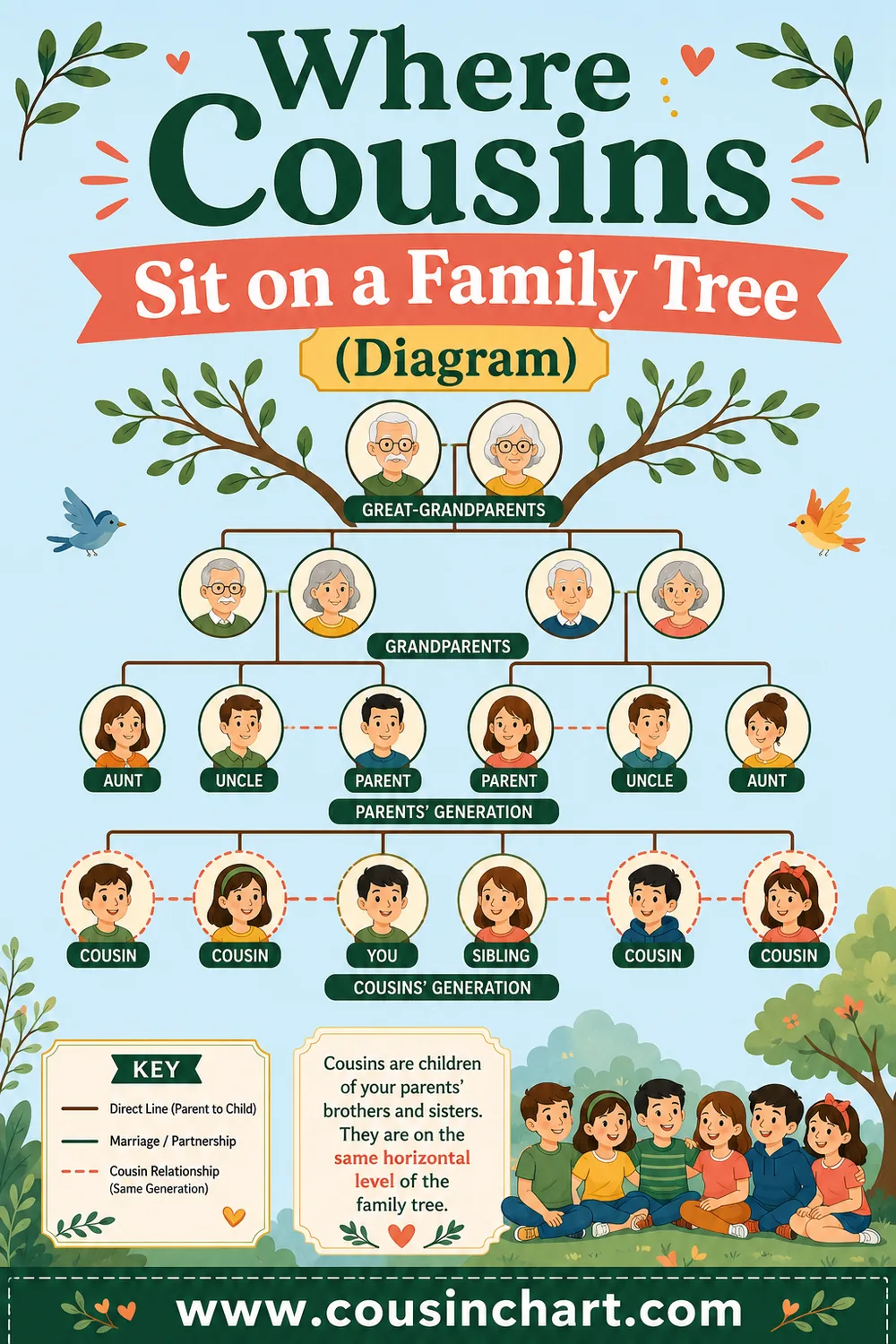
See exactly where first, second, and third cousins sit on a family tree — rows, branches, and removals made visual. Includes a free relationship calculator.
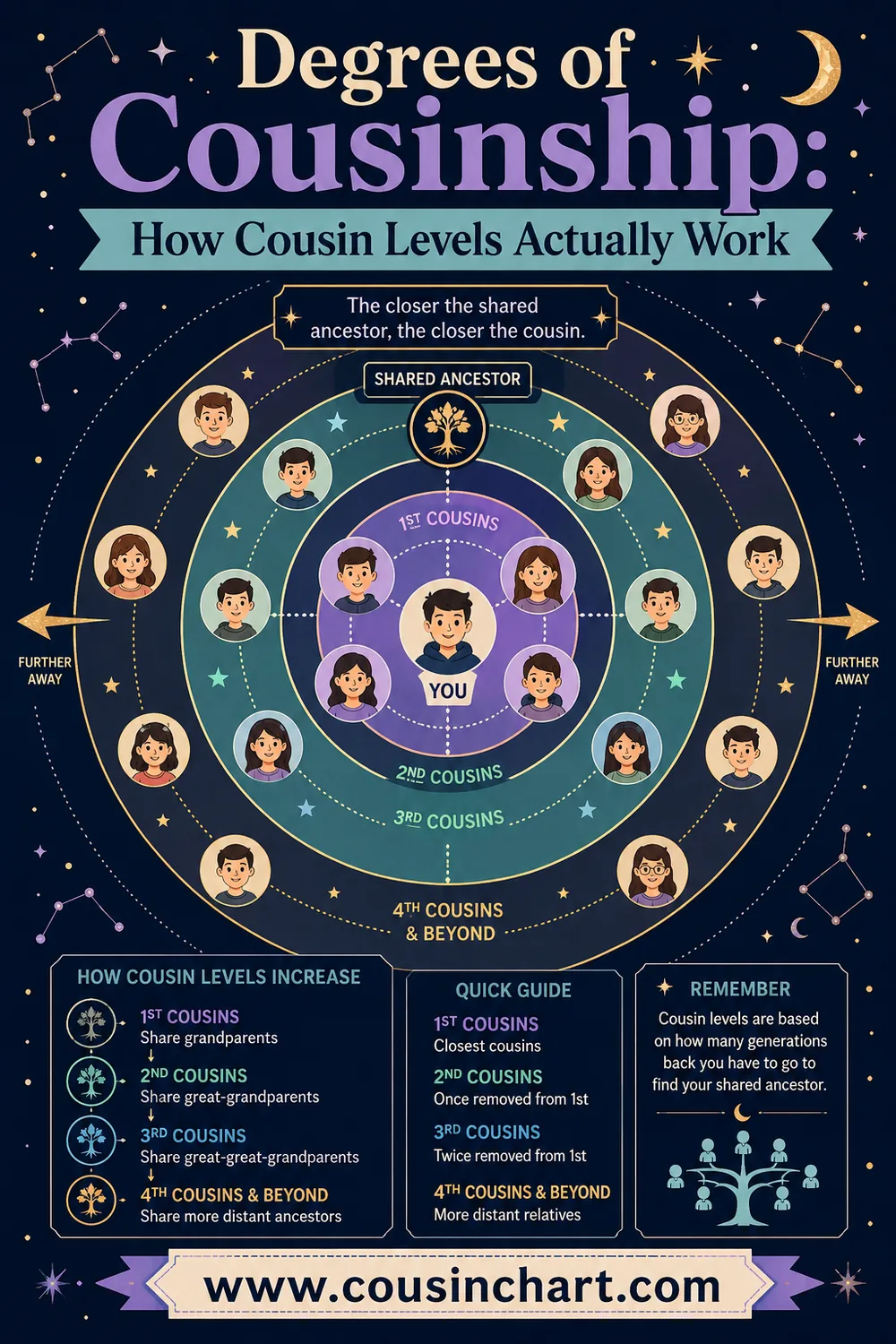
How cousin degrees work: count generations to the shared ancestor, subtract one. Full cousin degree chart, removals, worked examples, and a free calculator.
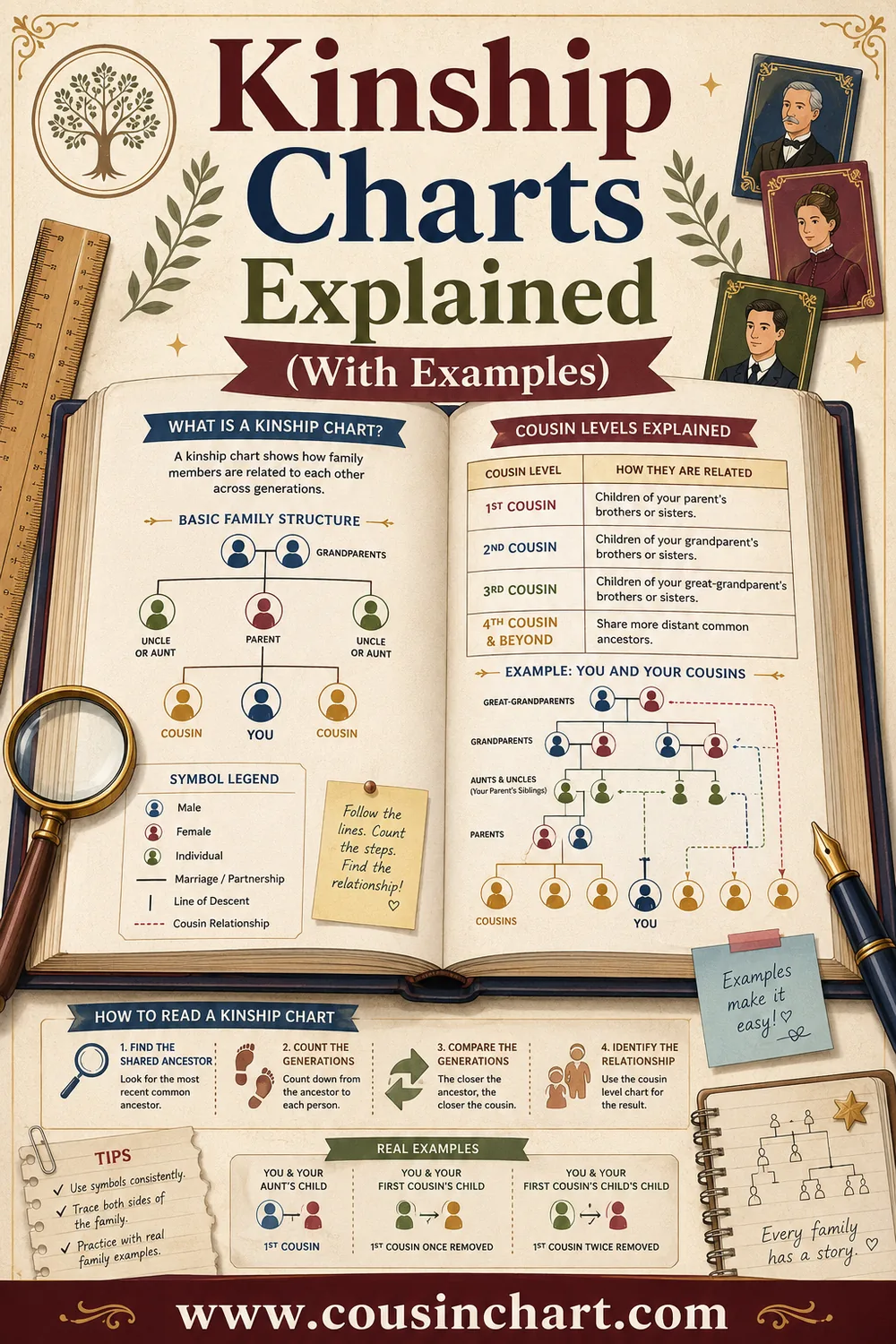
What a kinship chart is and how to read one: the genealogy grid, anthropology symbols, and worked examples — plus a free calculator that does it for you.
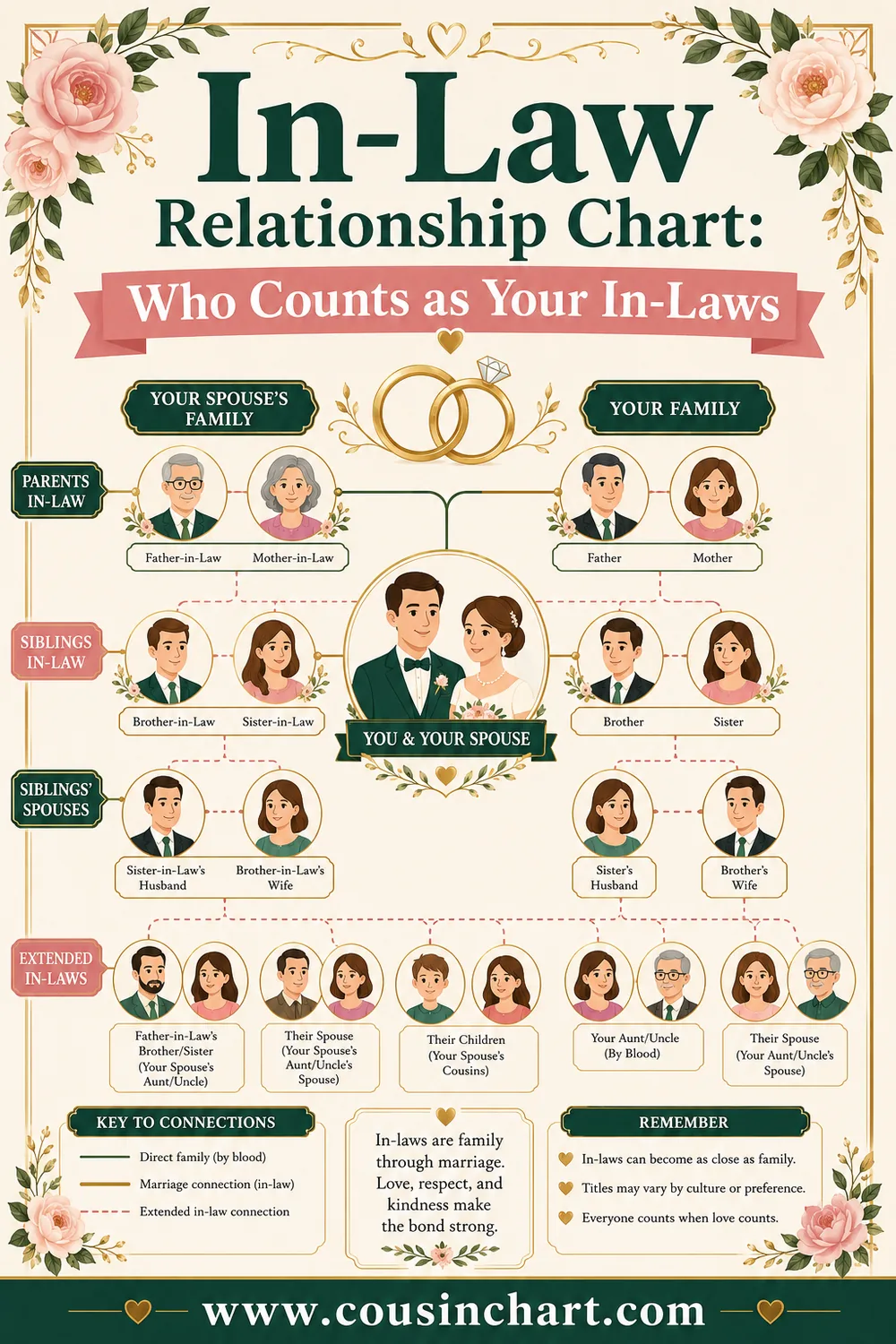
Who actually counts as your in-law? This in-law relationship chart names every marriage relative — from mother-in-law to co-brother-in-law — with a free tool.
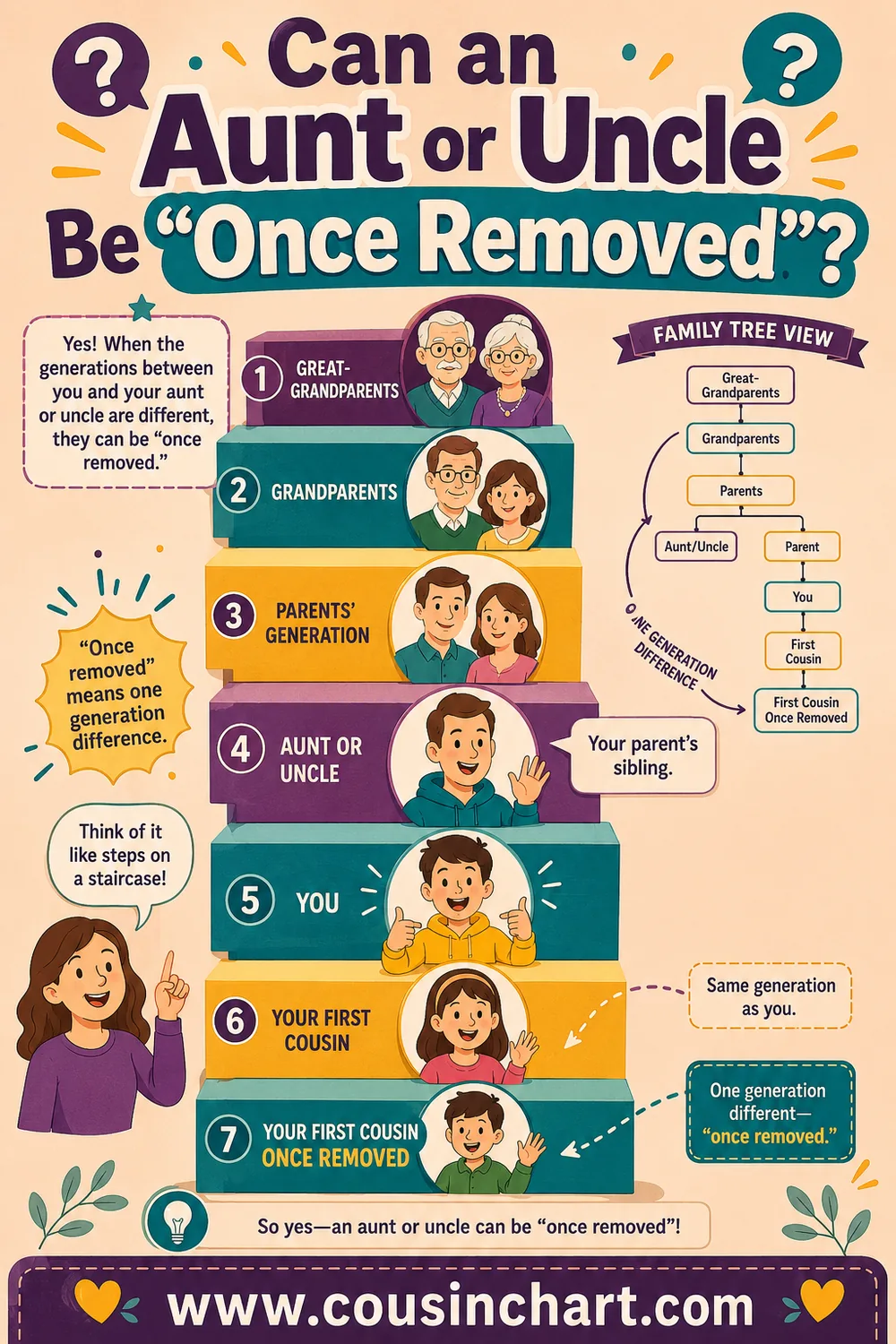
Is there such a thing as an aunt or uncle once removed? Not officially — here's what people actually mean, the correct terms, and a free tool to check any relative.
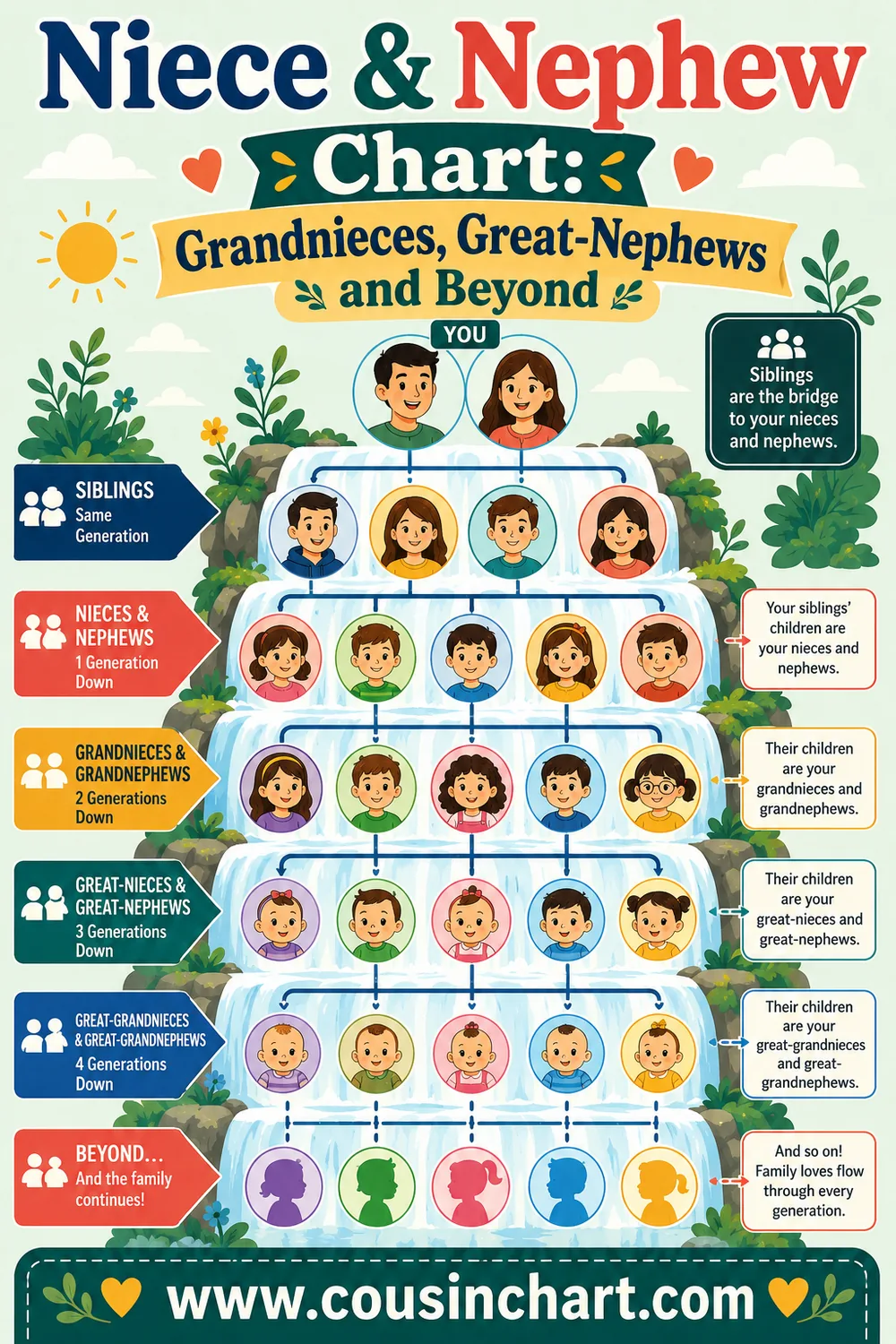
Sibling's child, sibling's grandchild, half-sibling's kids — this niece and nephew relationship chart names them all, with DNA percentages and a free calculator.
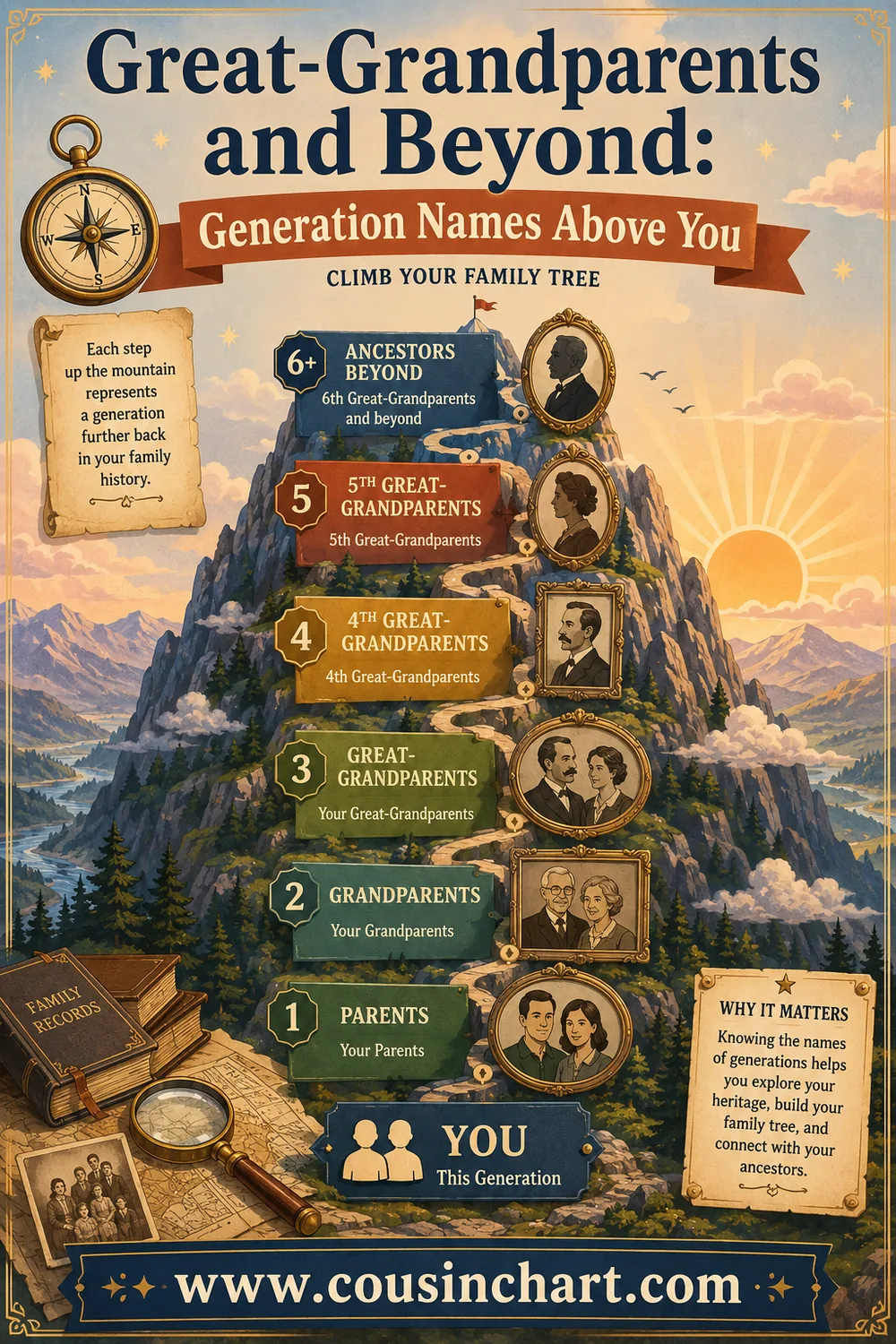
Grandparent, great-grandparent, 2nd great, 3rd great... This chart names every generation above you, counts your ancestors at each level, and includes a free tool.
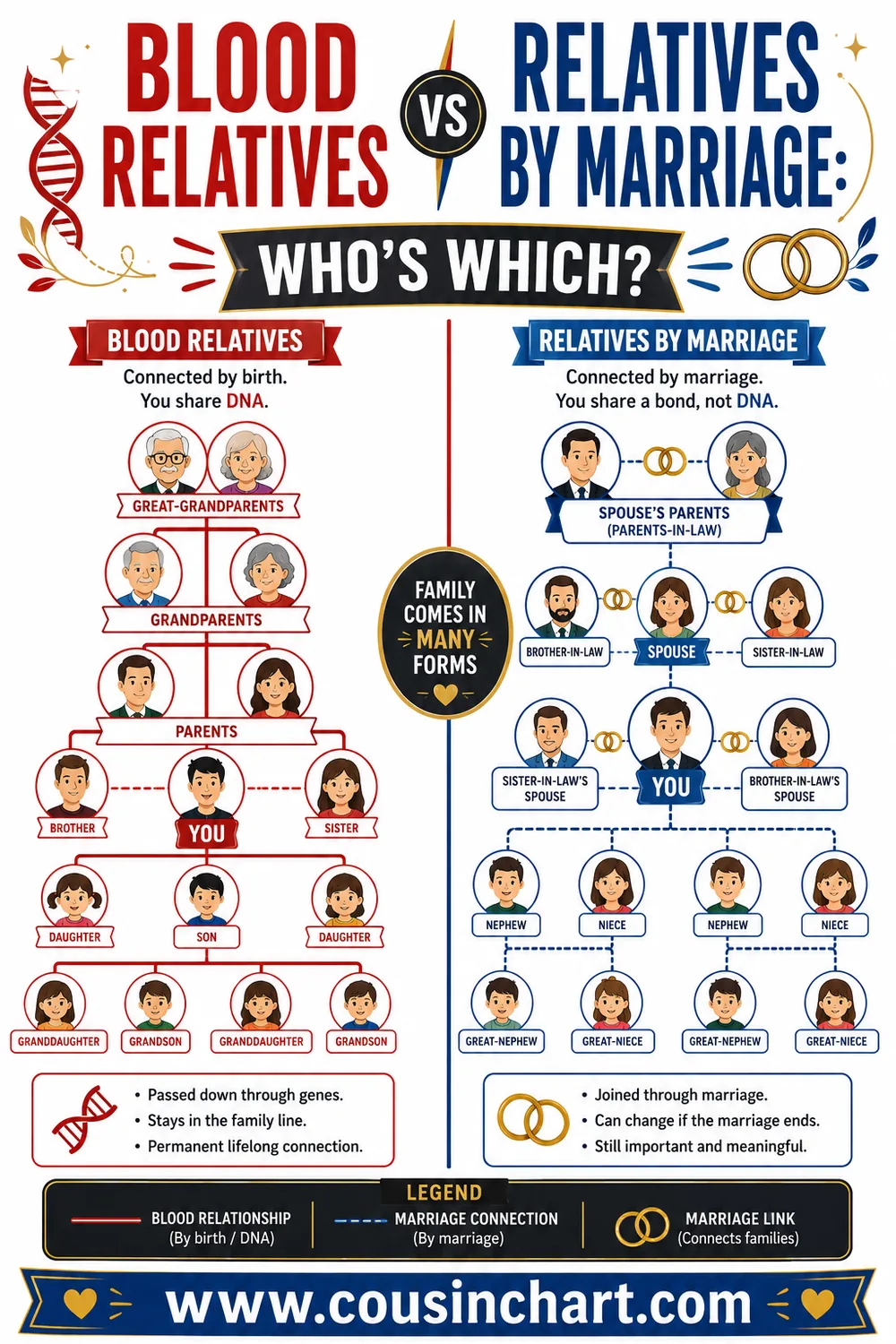
Which relatives share your DNA and which joined by marriage? A clear family blood relation chart, why it matters for health and inheritance, plus a free tool.
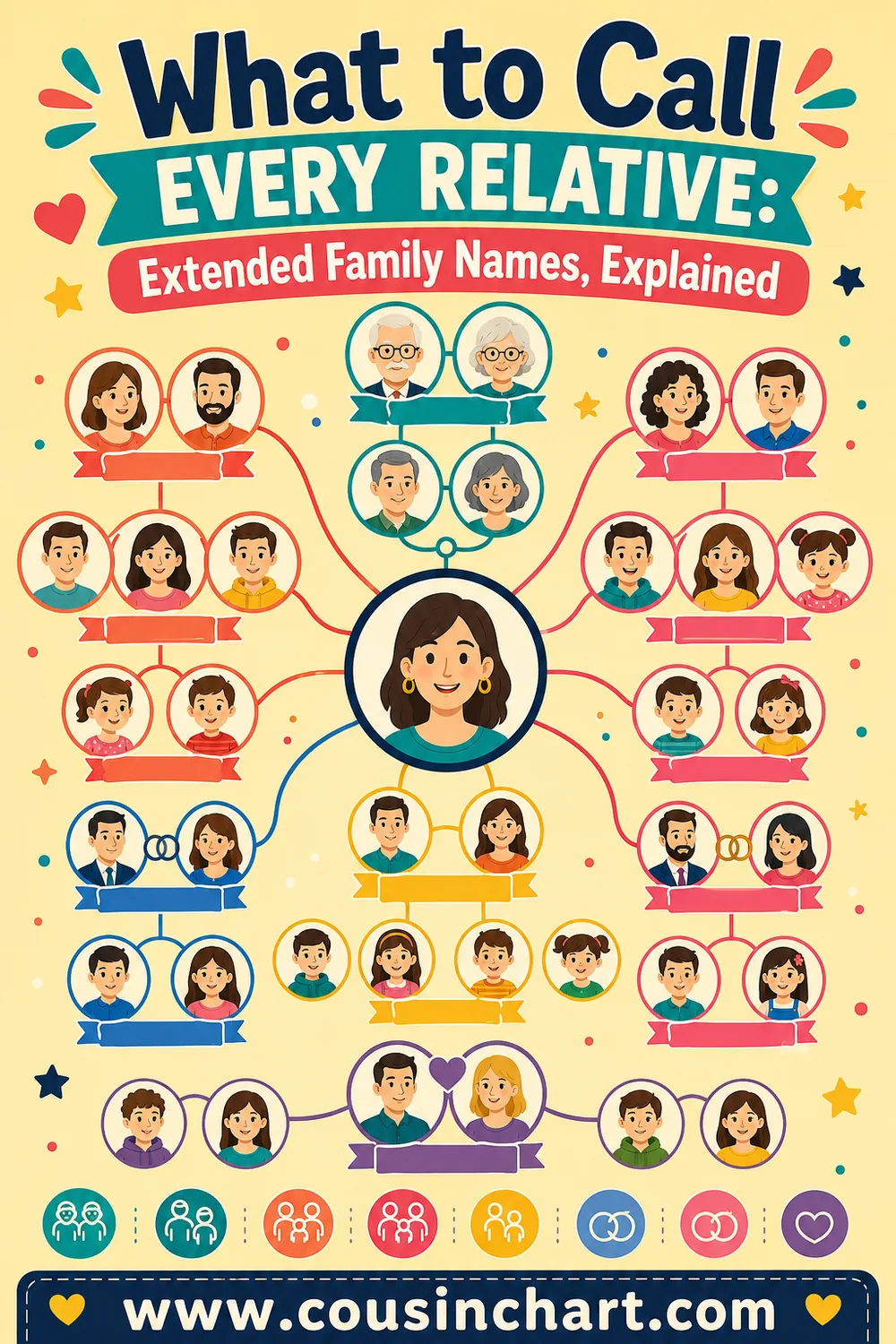
From great-aunts to co-parents-in-law, this glossary names every relative on the extended family tree — with charts, quick rules, and a free relationship tool.
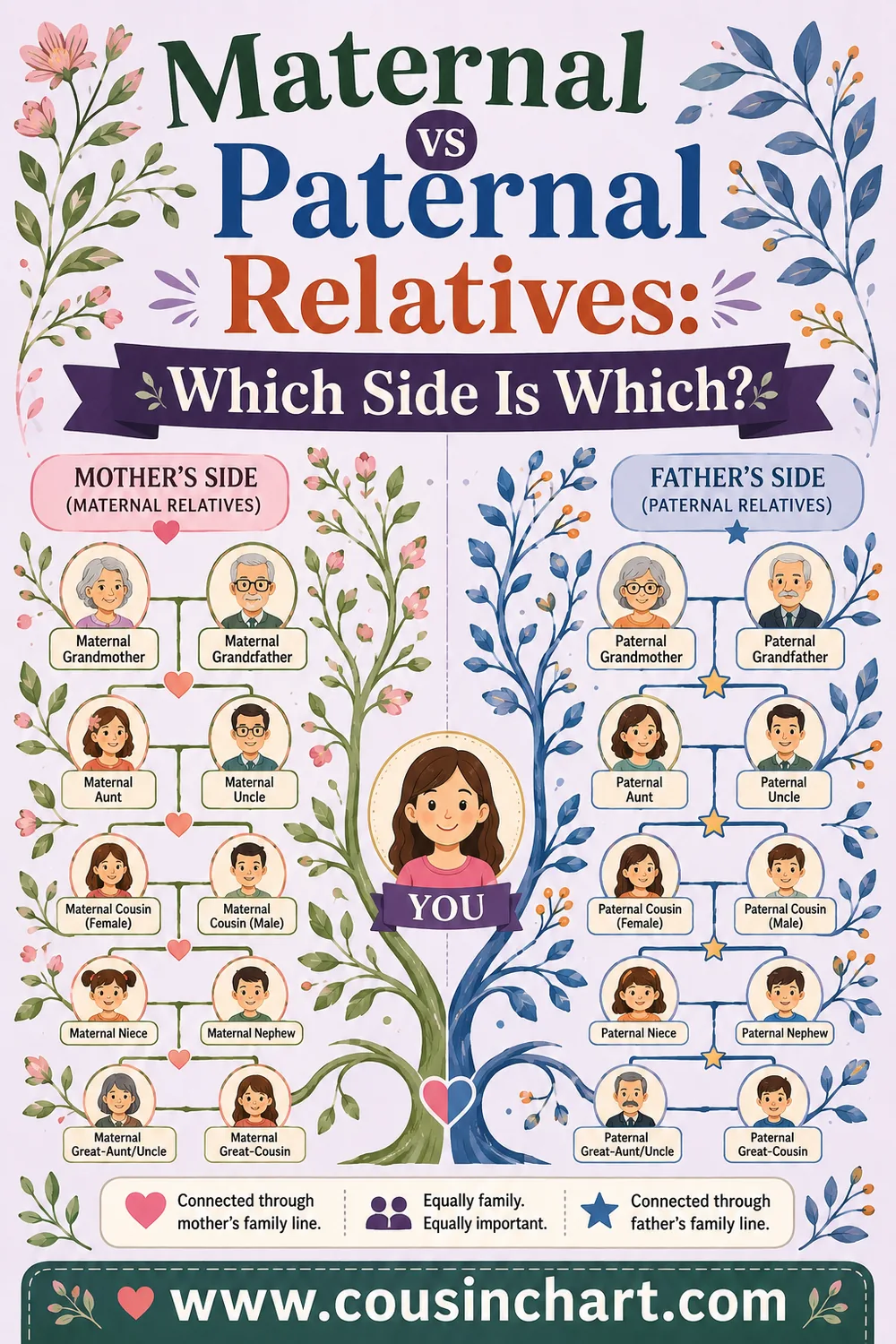
Maternal means your mother's side, paternal your father's. See how the labels work on a lineage chart, why DNA tests care, and name any relative with a free tool.
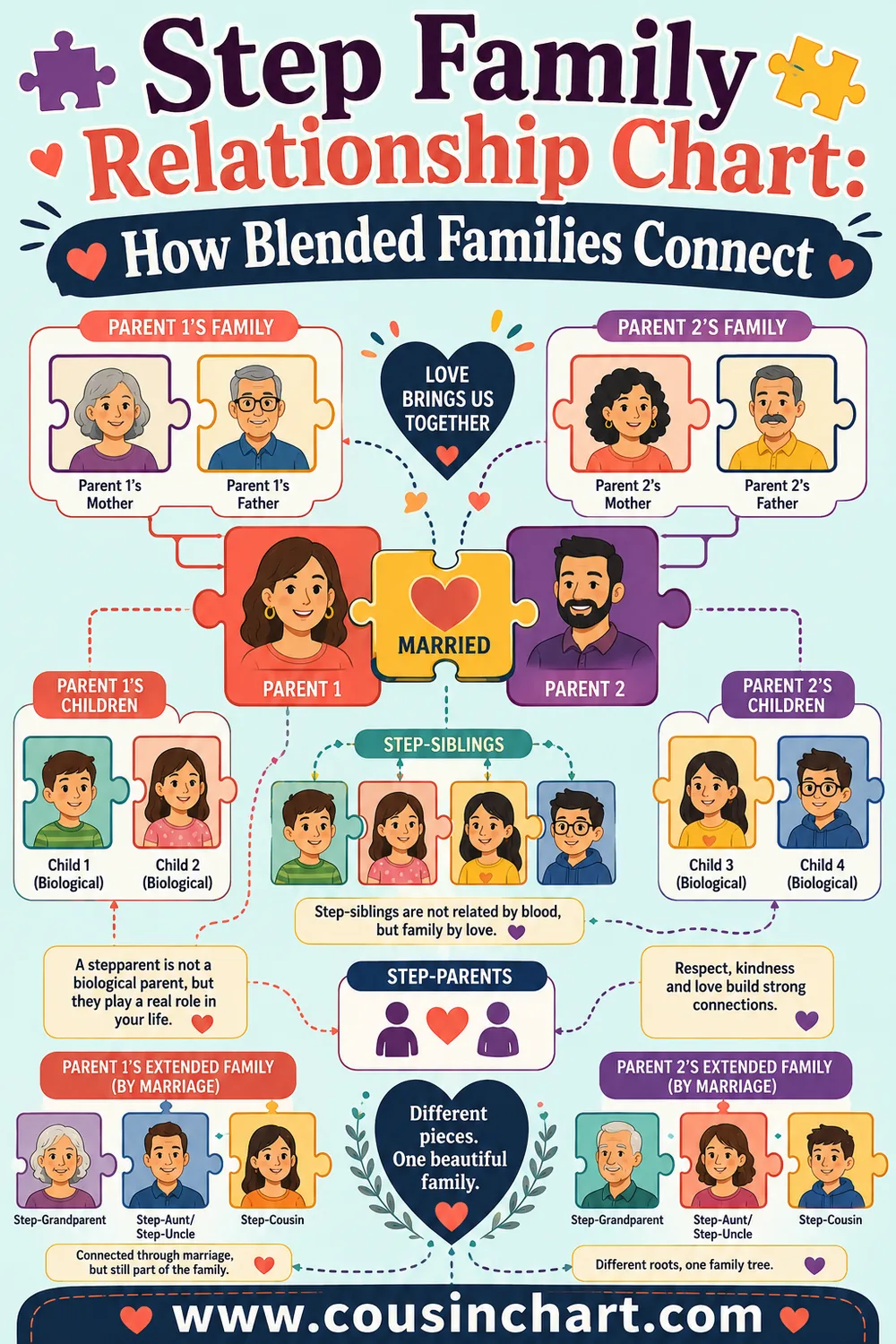
Stepbrother, step-grandma, step-cousin — this step family relationship chart names every blended-family connection, plus the half-sibling rule and a free tool.
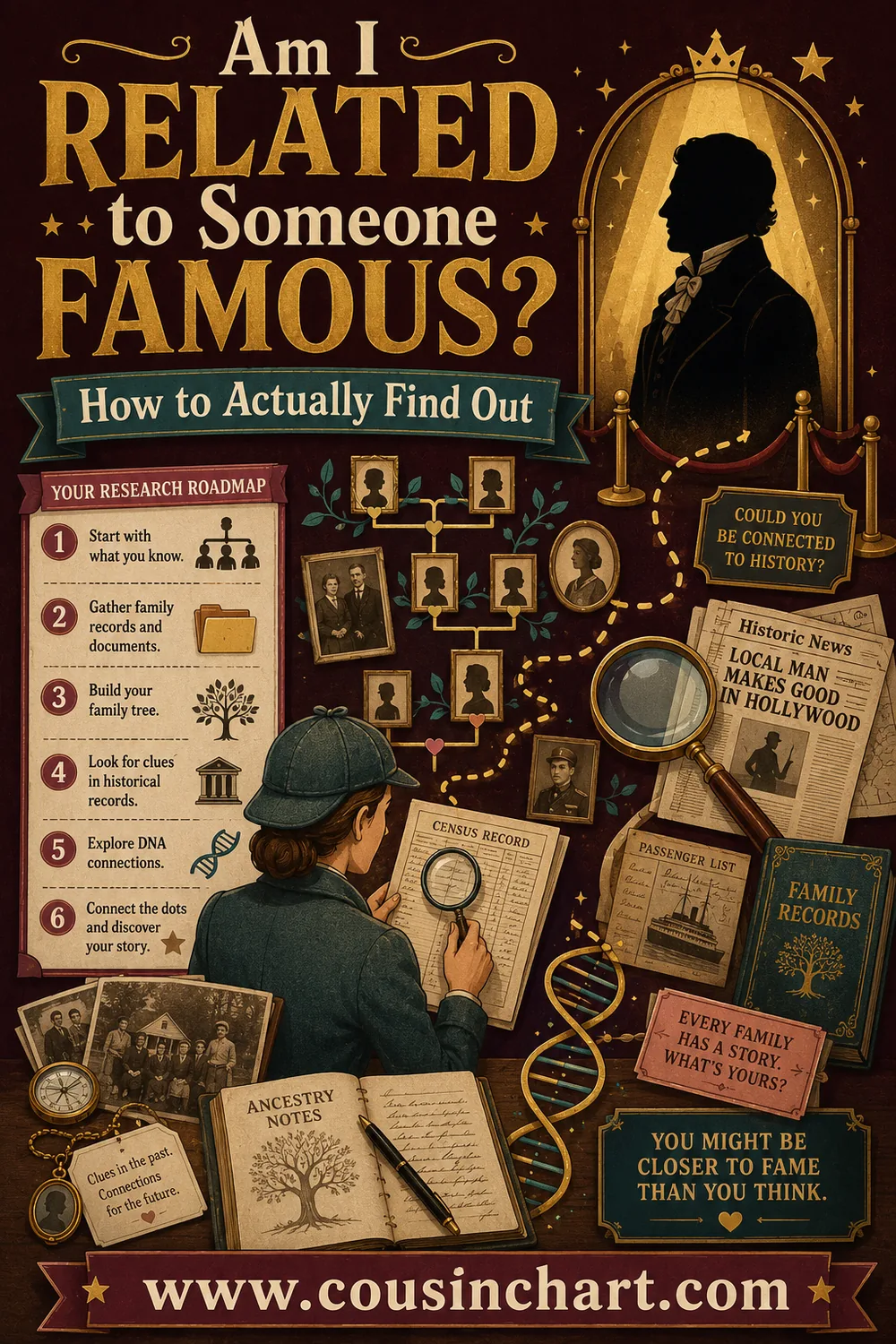
Odds are you're related to someone famous — the trick is proving it. Free tools, DNA options, gateway ancestors, and how to verify the claim, step by step.
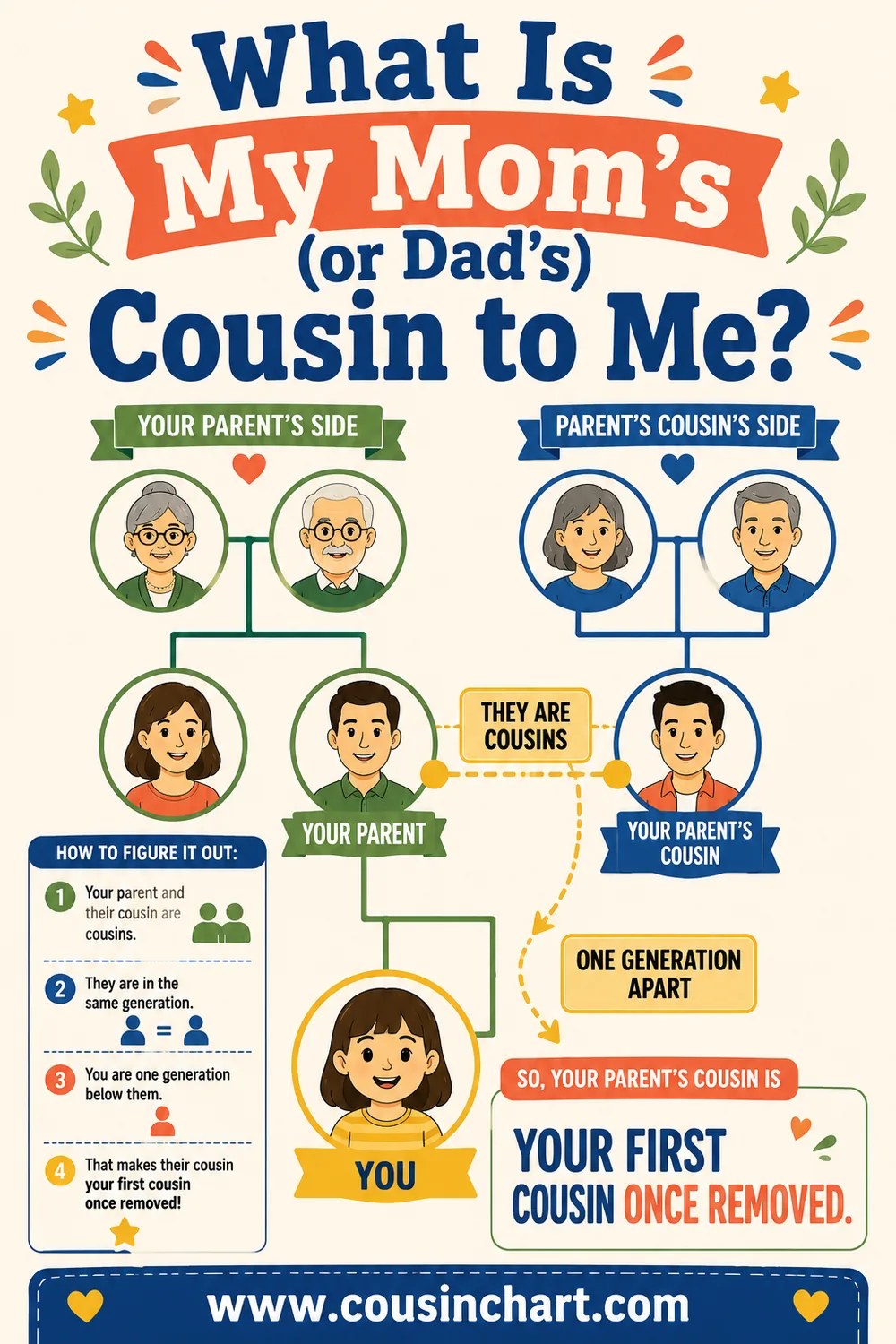
Your mom's or dad's first cousin is your first cousin once removed — not your second cousin. Here's why, with a chart, DNA percentages, and a free calculator.
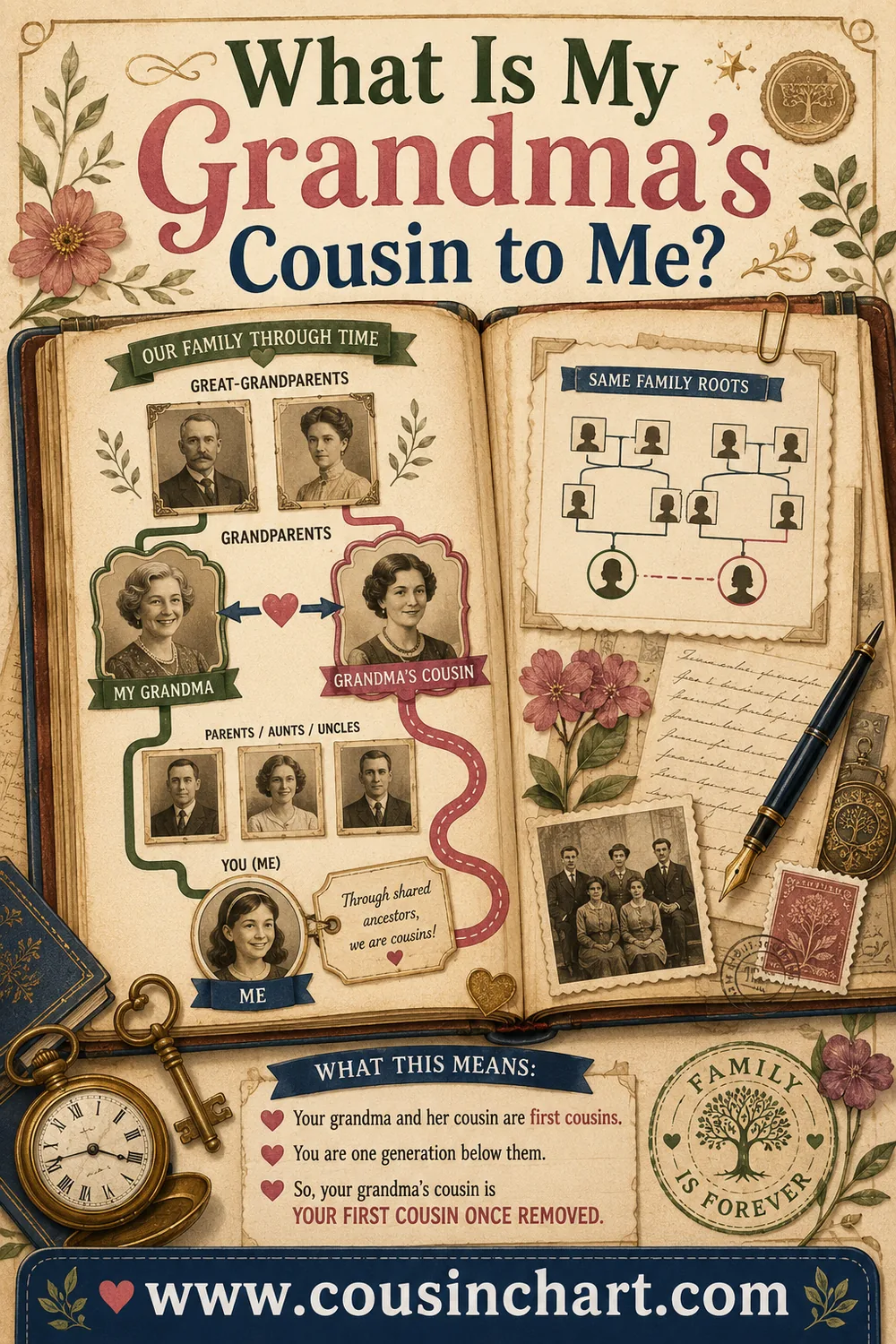
Your grandma's first cousin is your first cousin twice removed. See the simple two-step rule, a chart of their whole branch, DNA shared, and a free calculator.
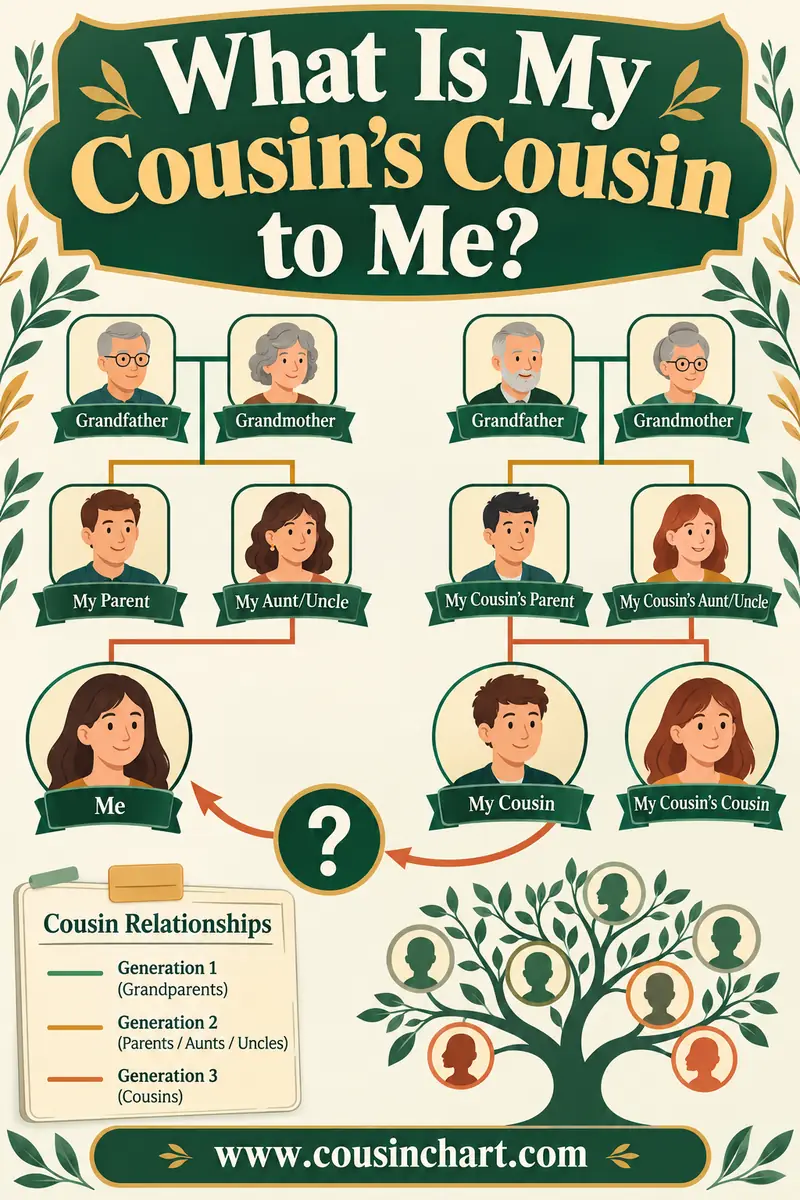
Your cousin's cousin is either your cousin too, or no relation at all — it depends which side they're on. See the simple test, examples, and a free calculator.
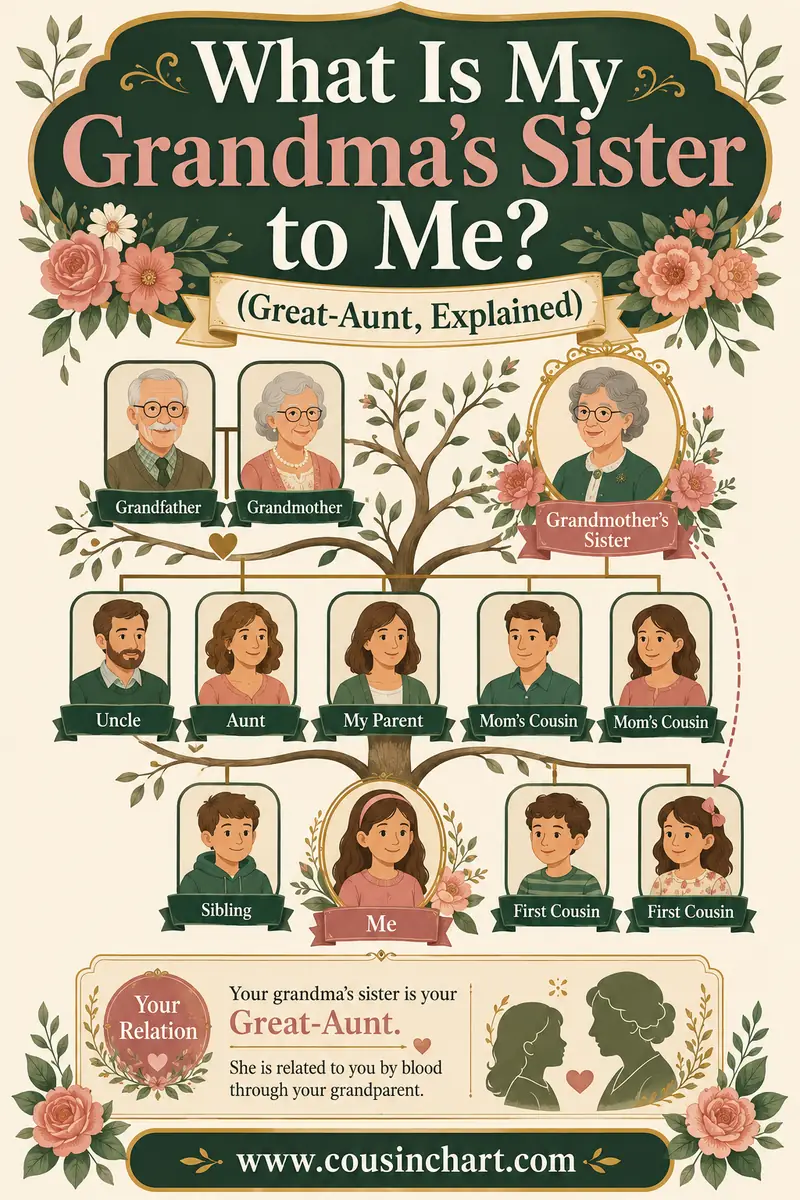
Your grandma's sister is your great-aunt (grand-aunt). See what her kids and grandkids are to you, the DNA you share, and check any relative with a free tool.
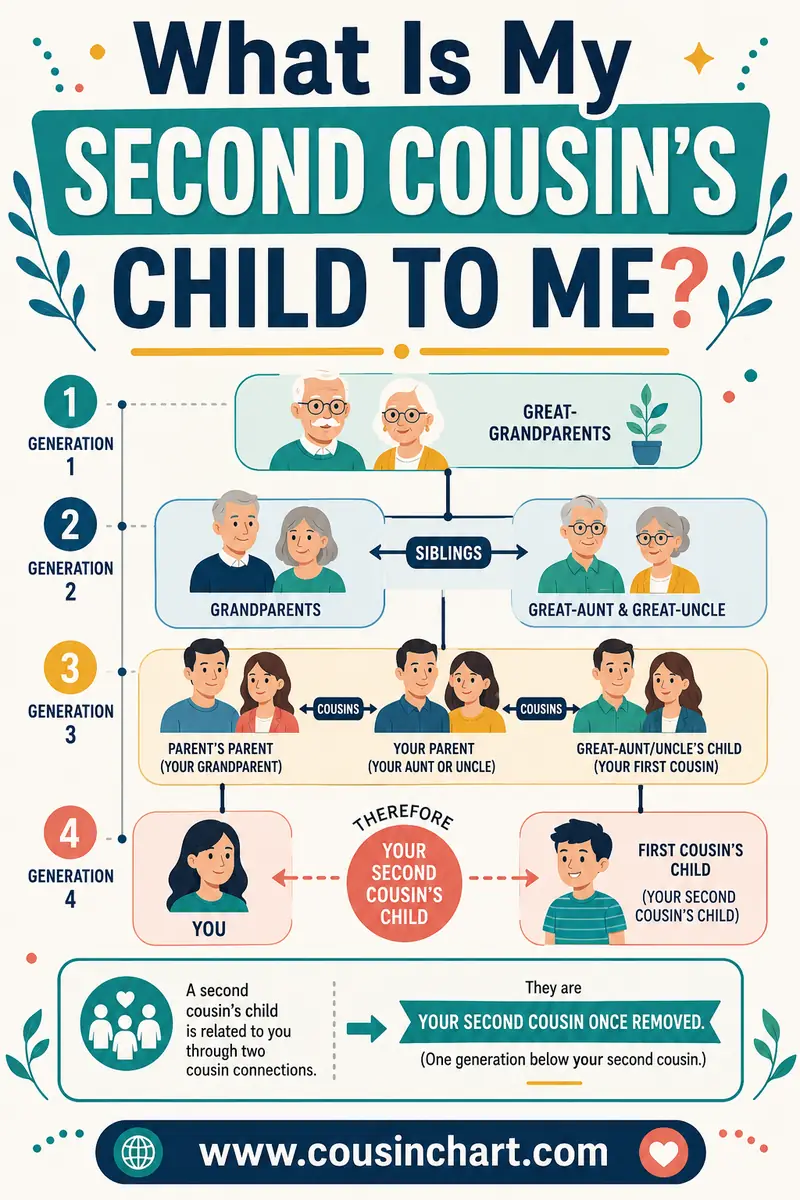
Your second cousin's child is your second cousin once removed — not your third cousin. See the simple rule, a chart, shared DNA, and a free relationship tool.
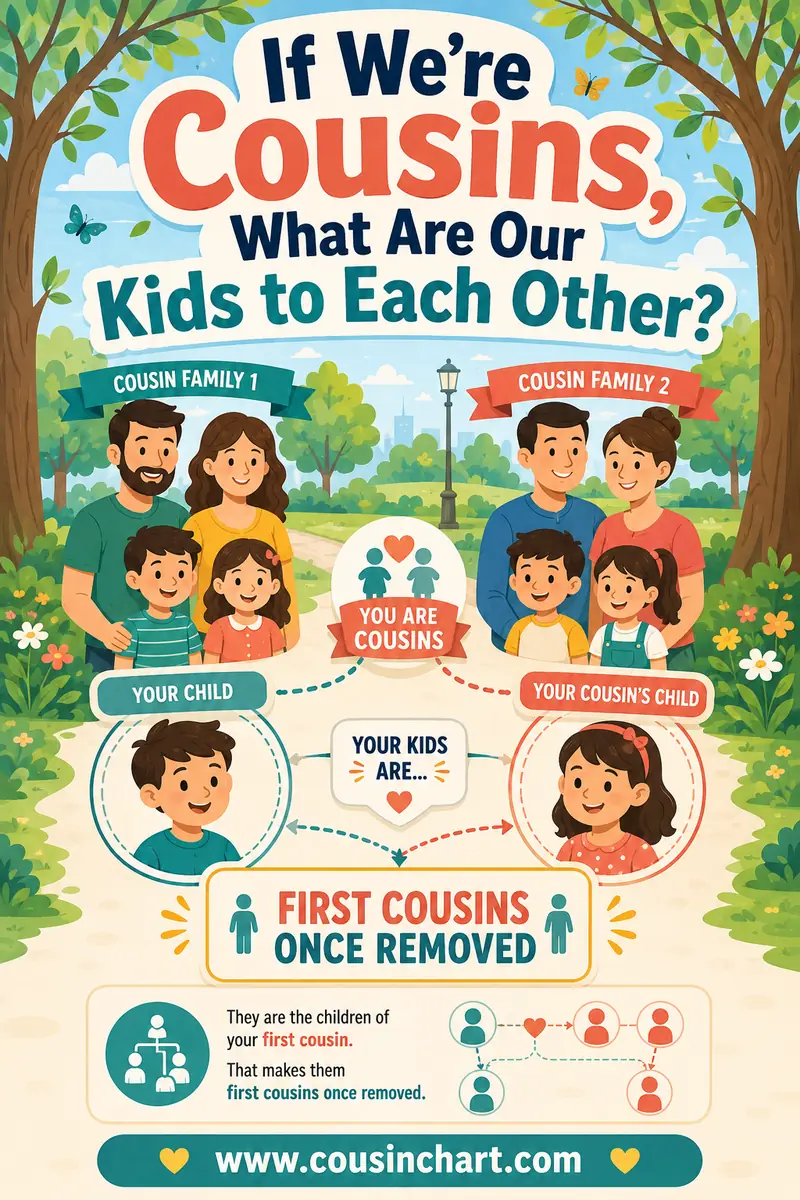
If you and someone are first cousins, your kids are second cousins to each other. See the pattern for second, third, half and double cousins — plus a free tool.
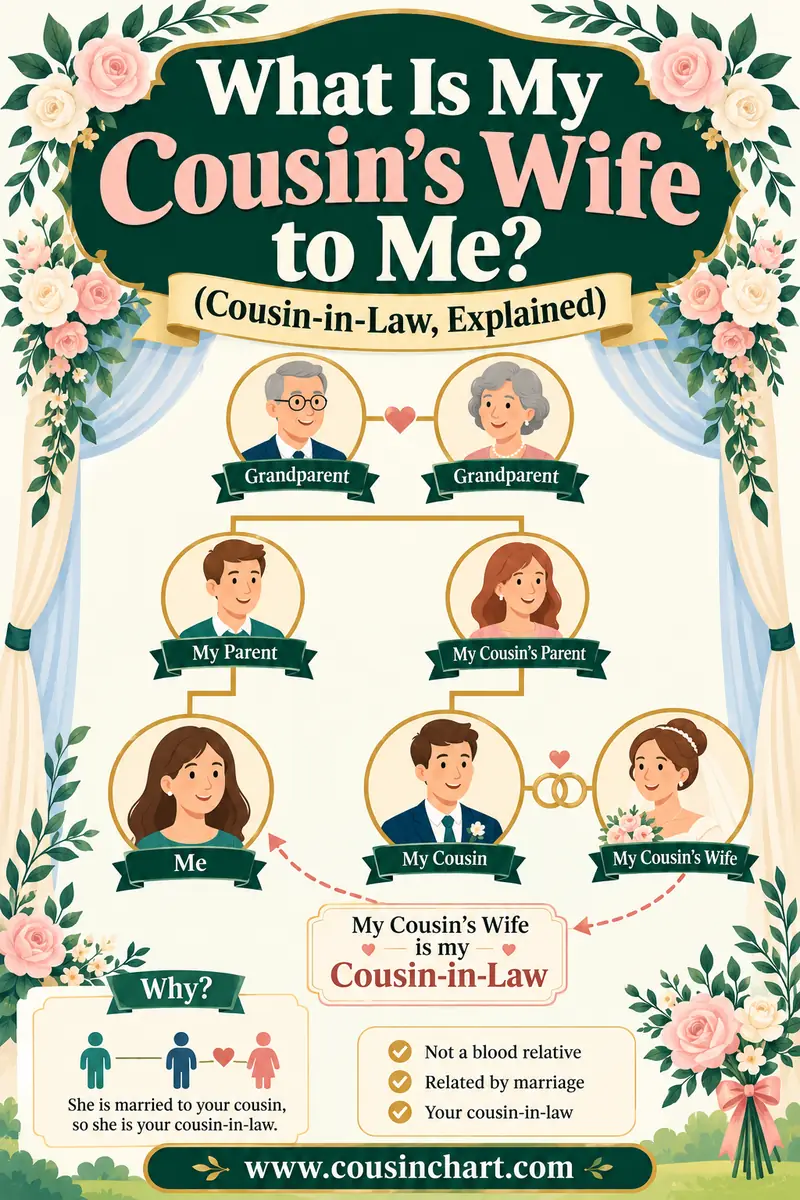
Your cousin's wife (or husband) is your cousin-in-law — family by marriage, not blood. See what her kids are to you, how the term works, plus a free calculator.
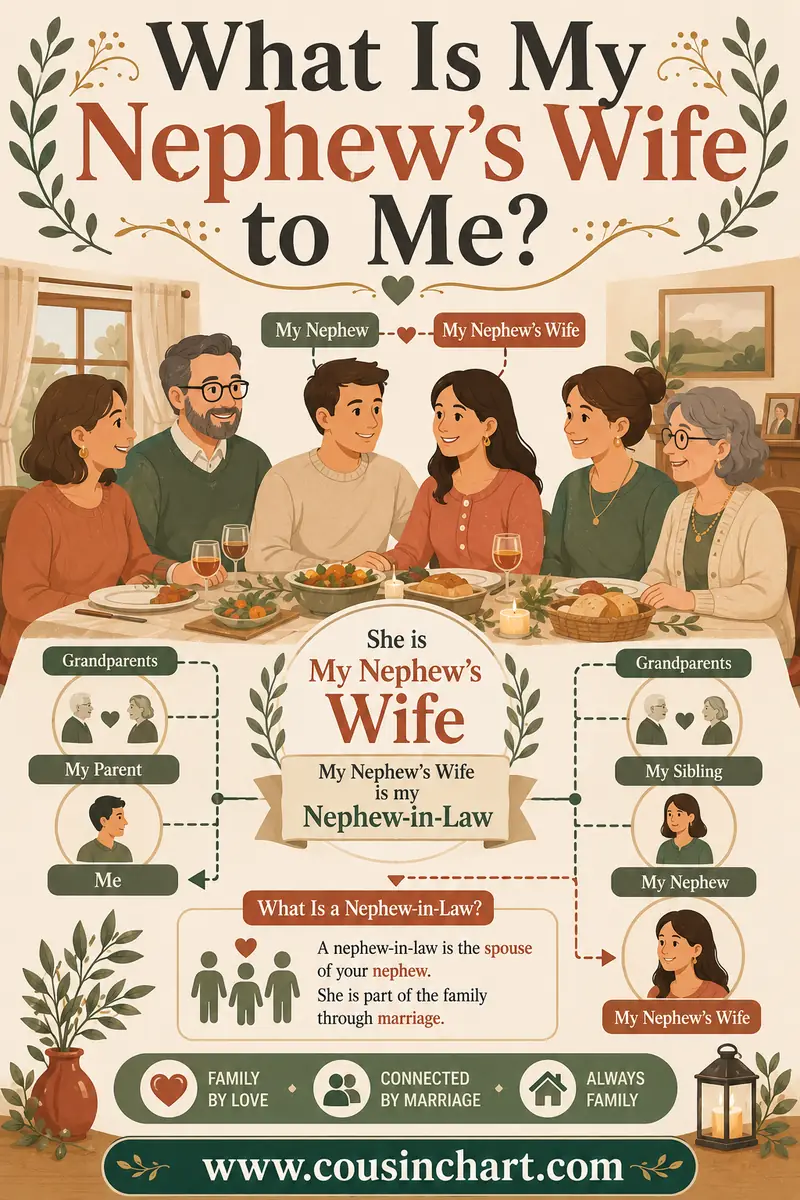
Your nephew's wife is your niece-in-law — family by marriage, not blood. See what their kids are to you, what she calls you, plus a free relationship calculator.
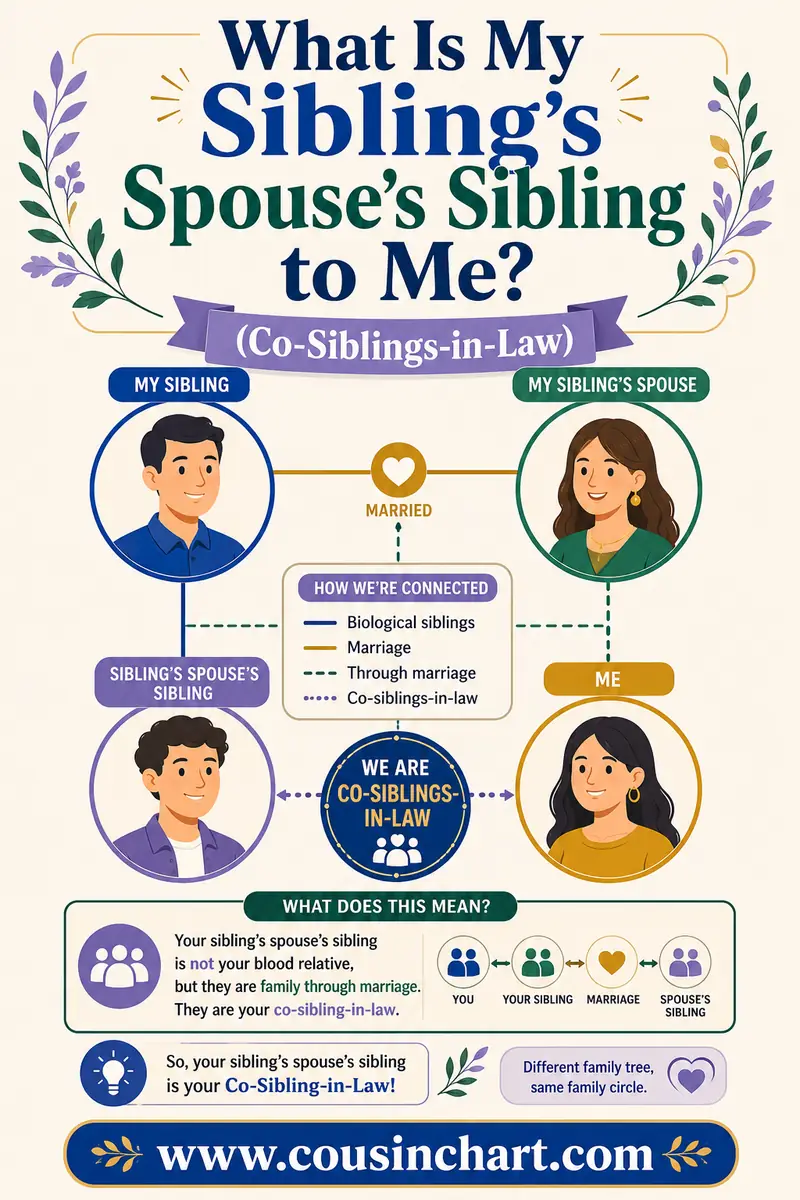
Your sibling's spouse's sibling is your co-sibling-in-law — no blood, no legal tie, but real family. What the term means, what other languages call it, and more.
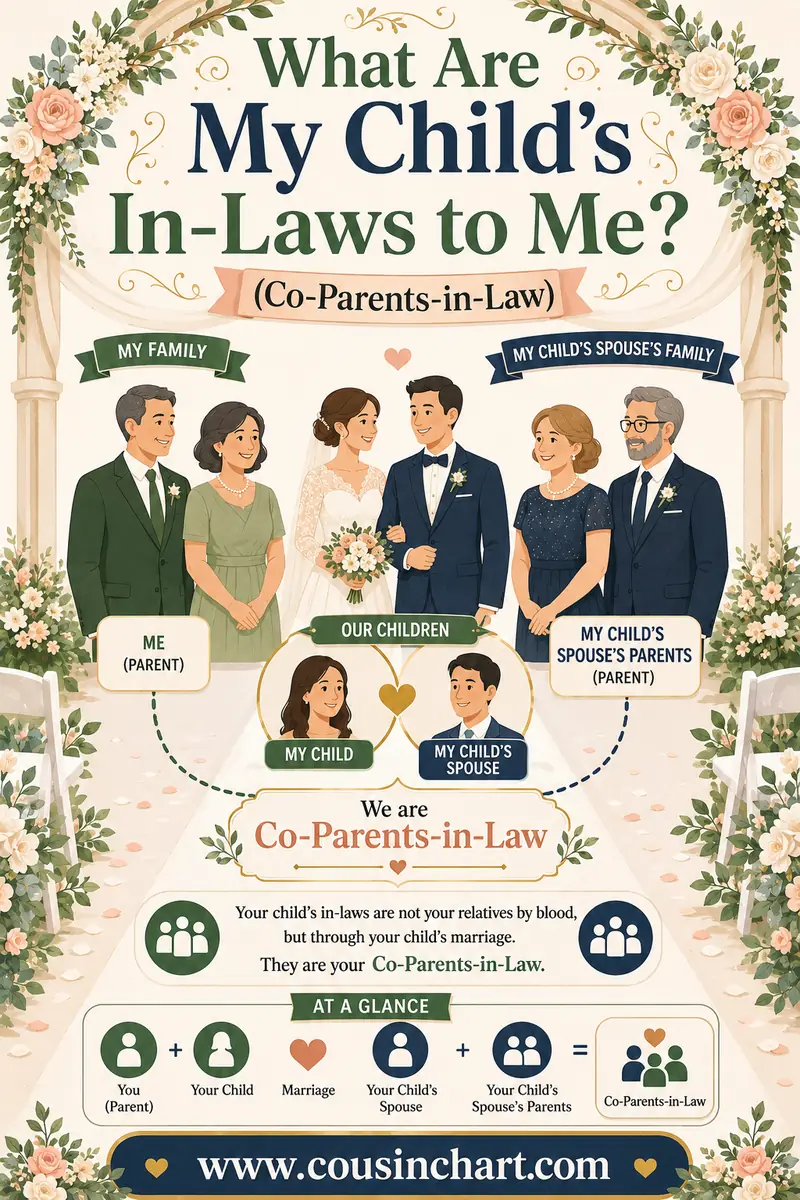
Your child's spouse's parents are your co-parents-in-law — machatunim in Yiddish, consuegros in Spanish. What to call them, how it works, plus a free calculator.
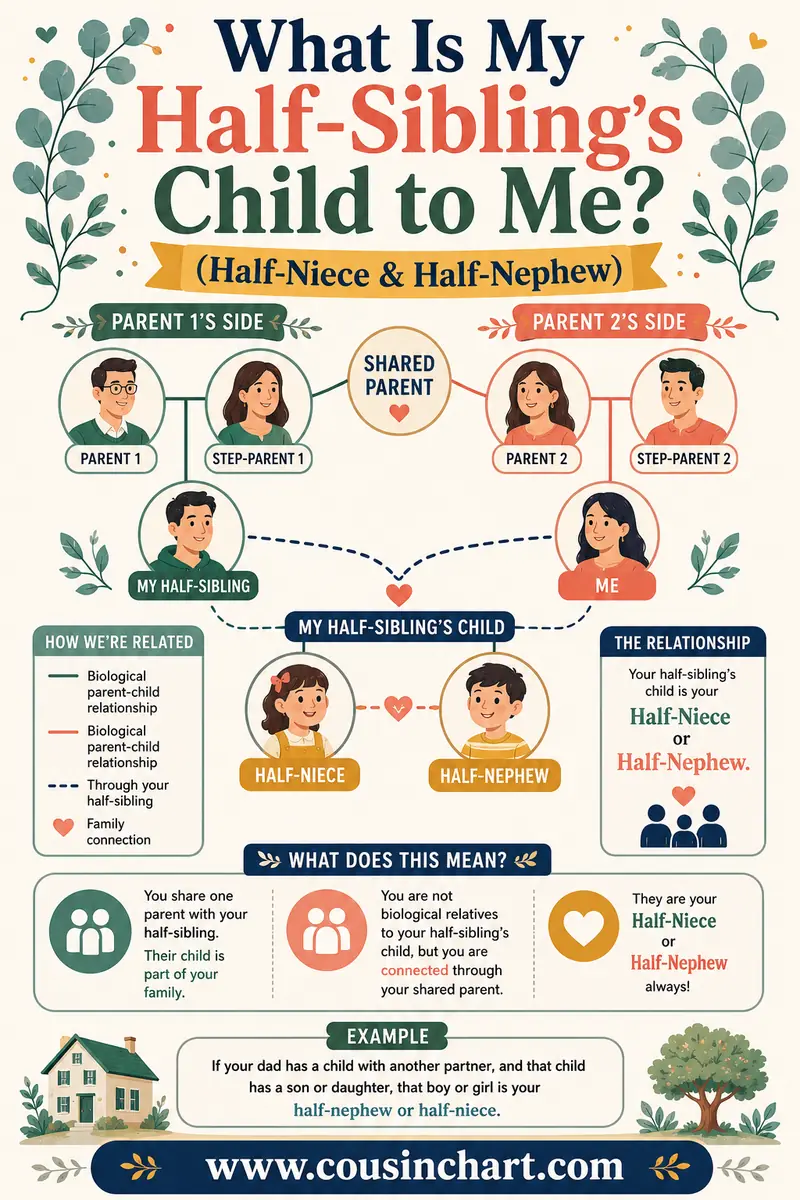
Your half-sibling's child is your half-niece or half-nephew — a real blood relative sharing about 12.5% of your DNA. See how it works, plus a free calculator.
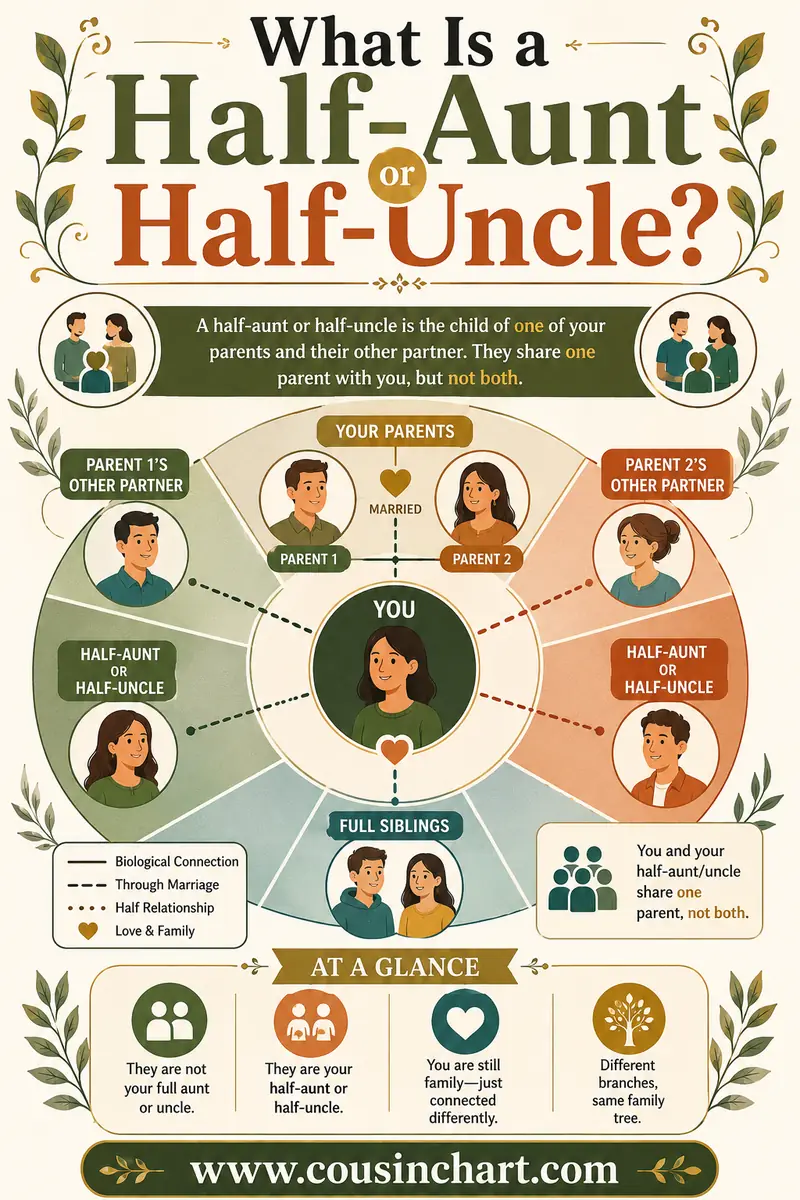
A half-aunt is your parent's half-sister — a blood relative sharing about 12.5% of your DNA. What the term means, DNA overlaps to know, plus a free calculator.
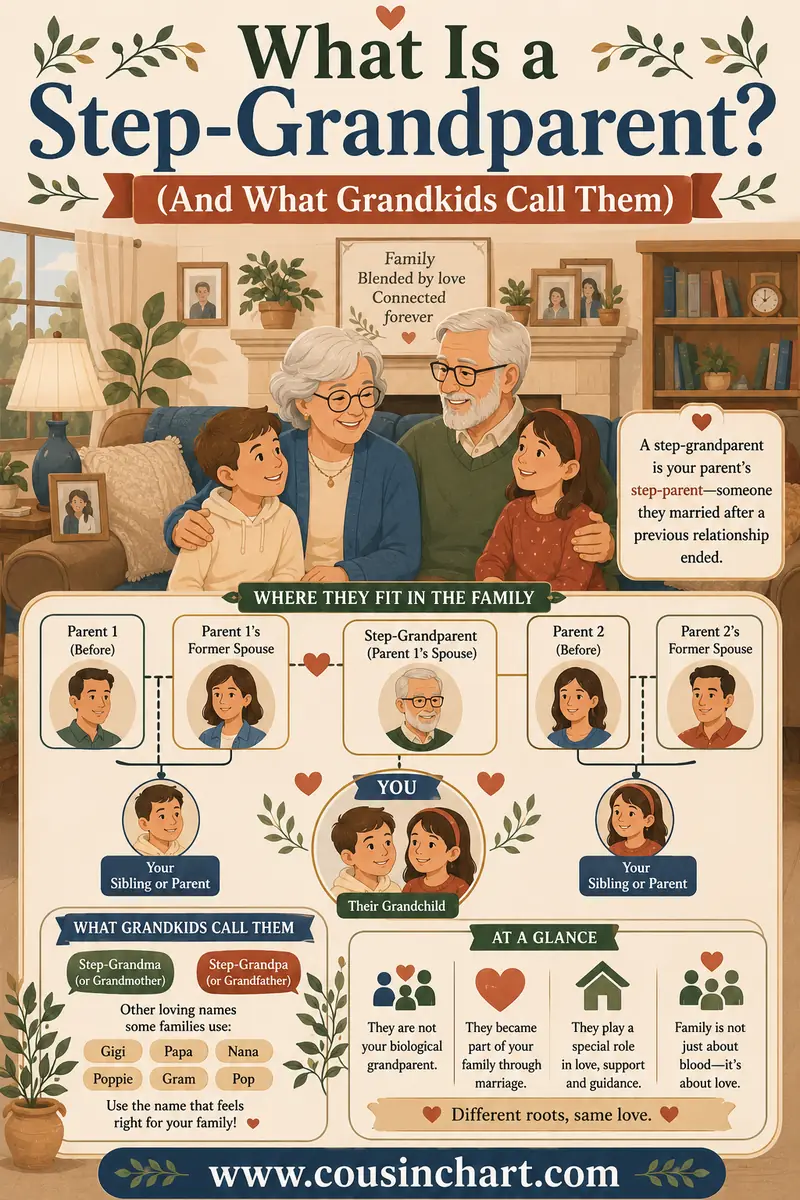
A step-grandparent is a grandparent's spouse or a step-parent's parent — family by marriage, not blood. How the term works, name ideas, plus a free calculator.
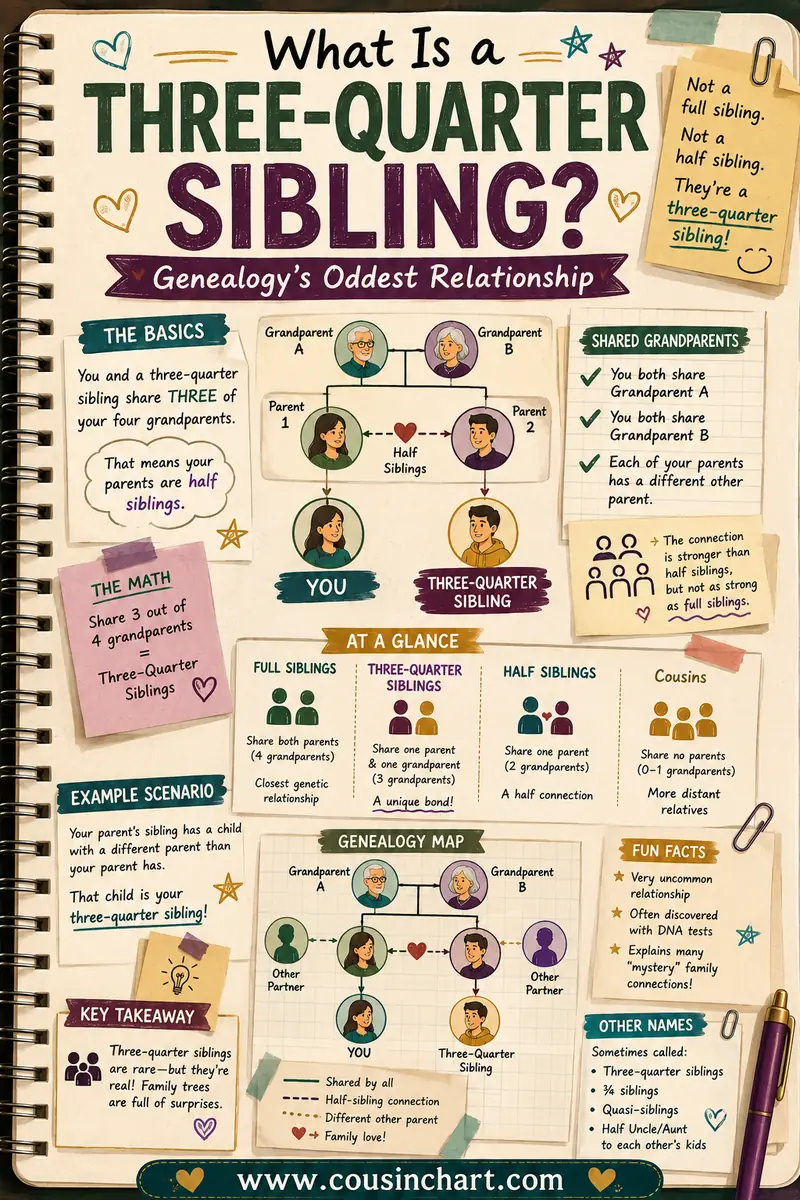
Three-quarter siblings share one parent, and their other parents are close relatives — about 37.5% shared DNA. How it happens, the math, plus a free calculator.
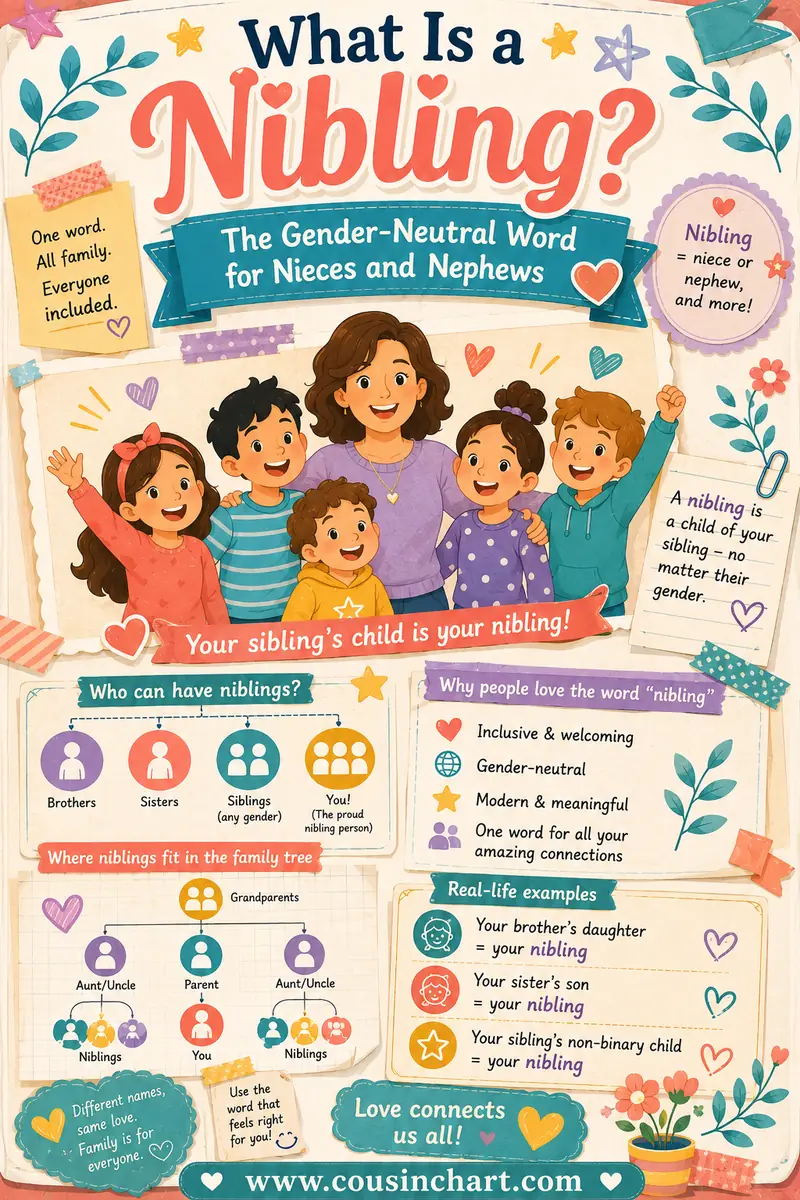
A nibling is a gender-neutral word for a niece or nephew — your sibling's child. Where the term came from, how to use it, related words, plus a free calculator.
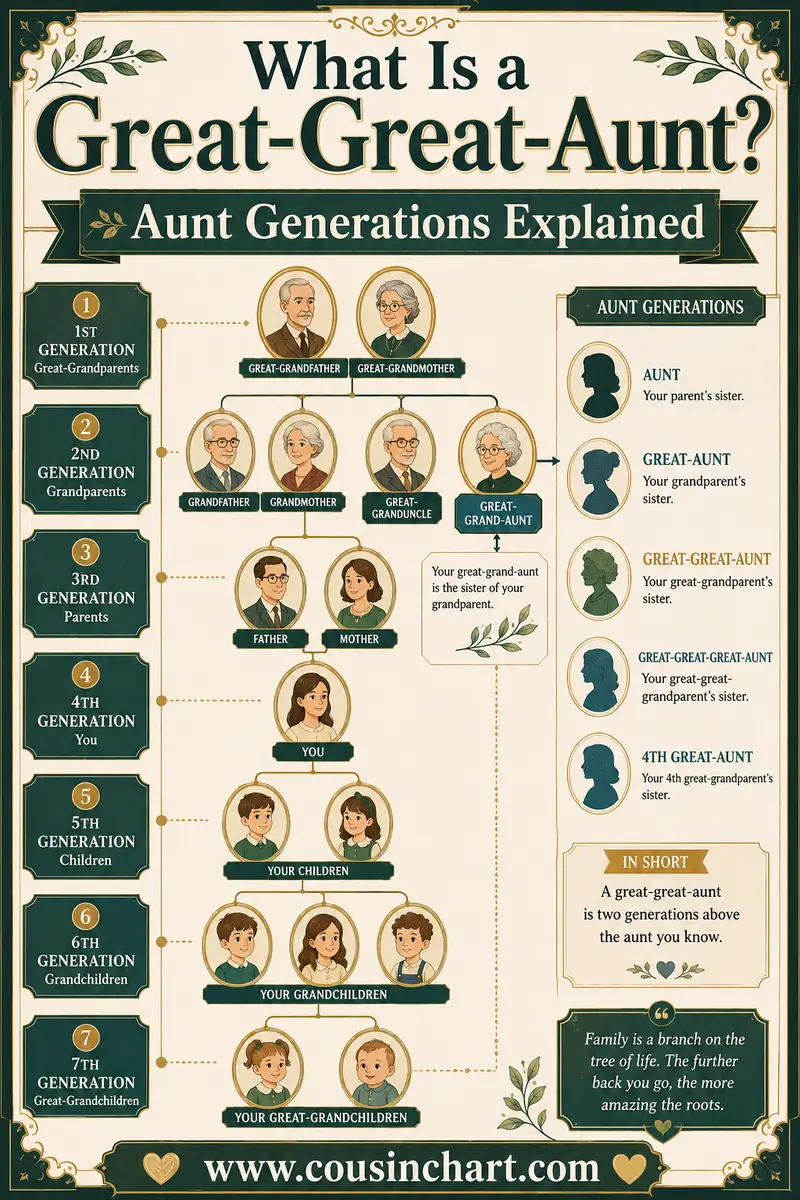
A great-great-aunt is your great-grandparent's sister — about 6.25% shared DNA. See the whole aunt ladder, what her kids are to you, plus a free calculator.
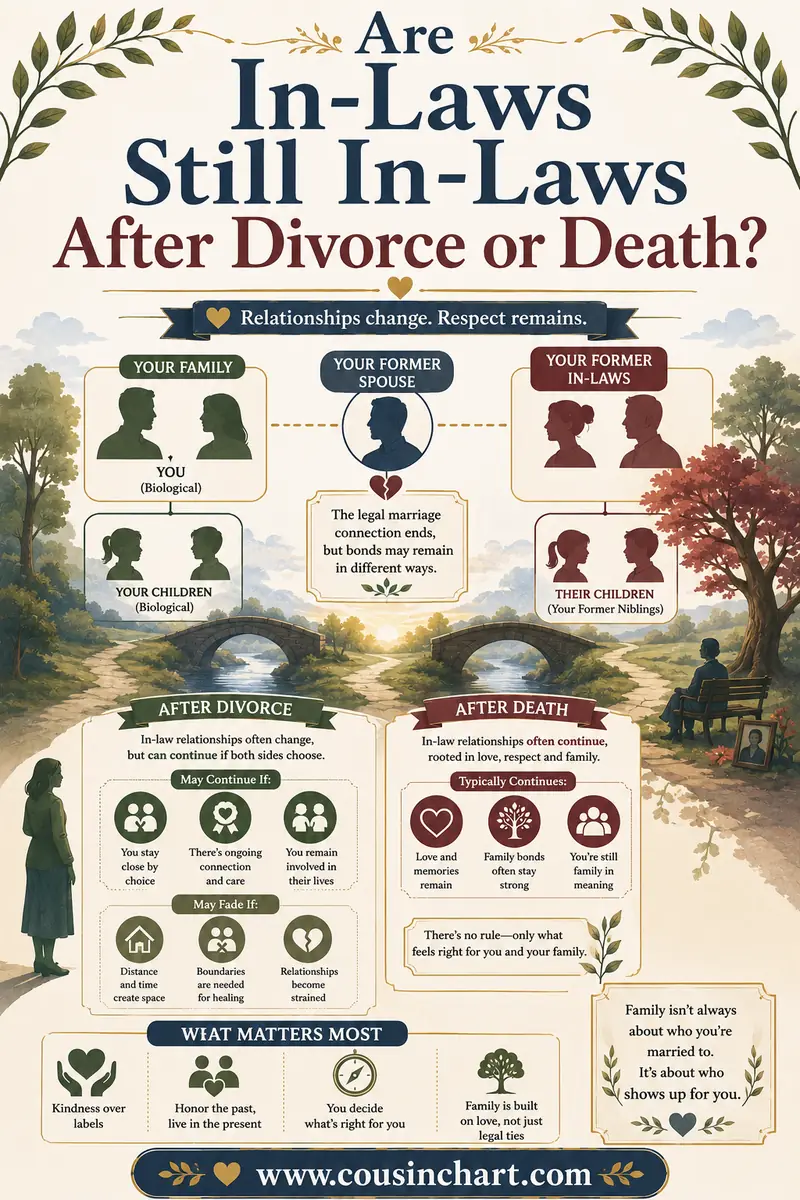
What ex in-laws become after divorce or a spouse's death — the terms, the etiquette, what stays the same for kids and grandparents, plus a free calculator.
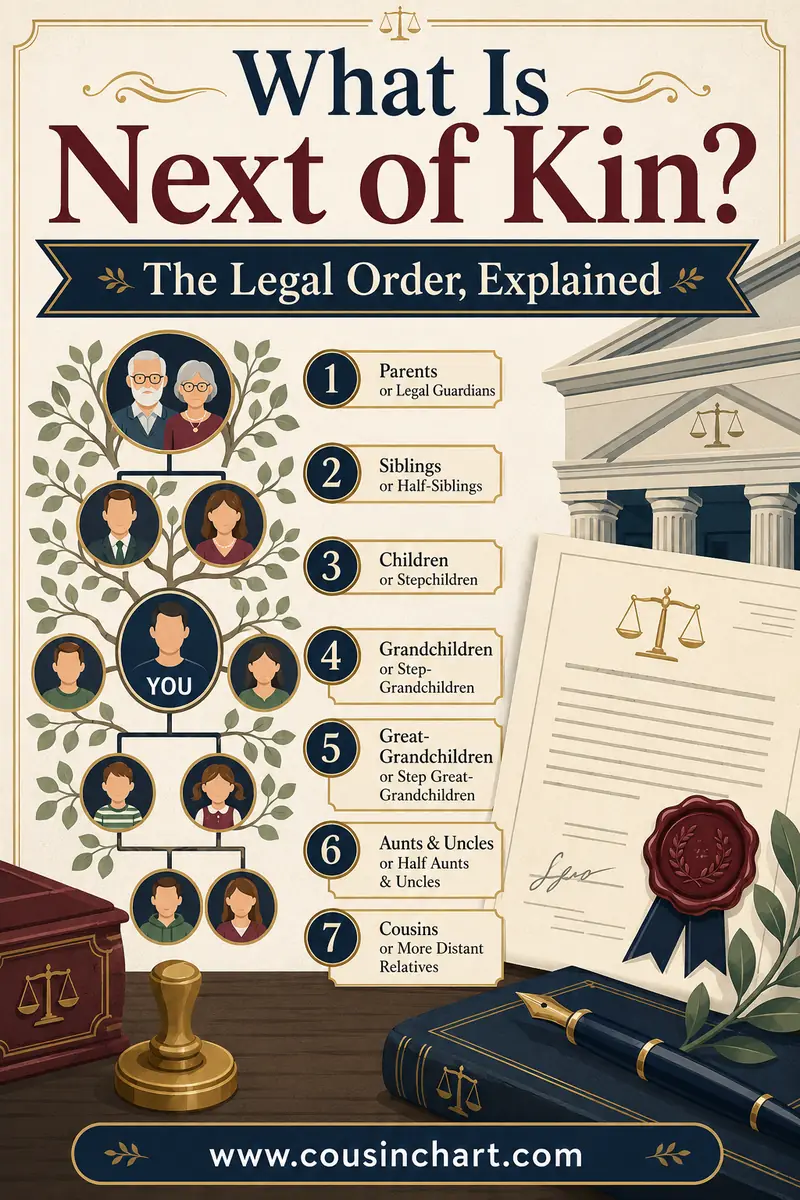
Next of kin means your closest living relatives — typically spouse, children, parents, then siblings. How the order usually runs, where it matters, and a free tool.
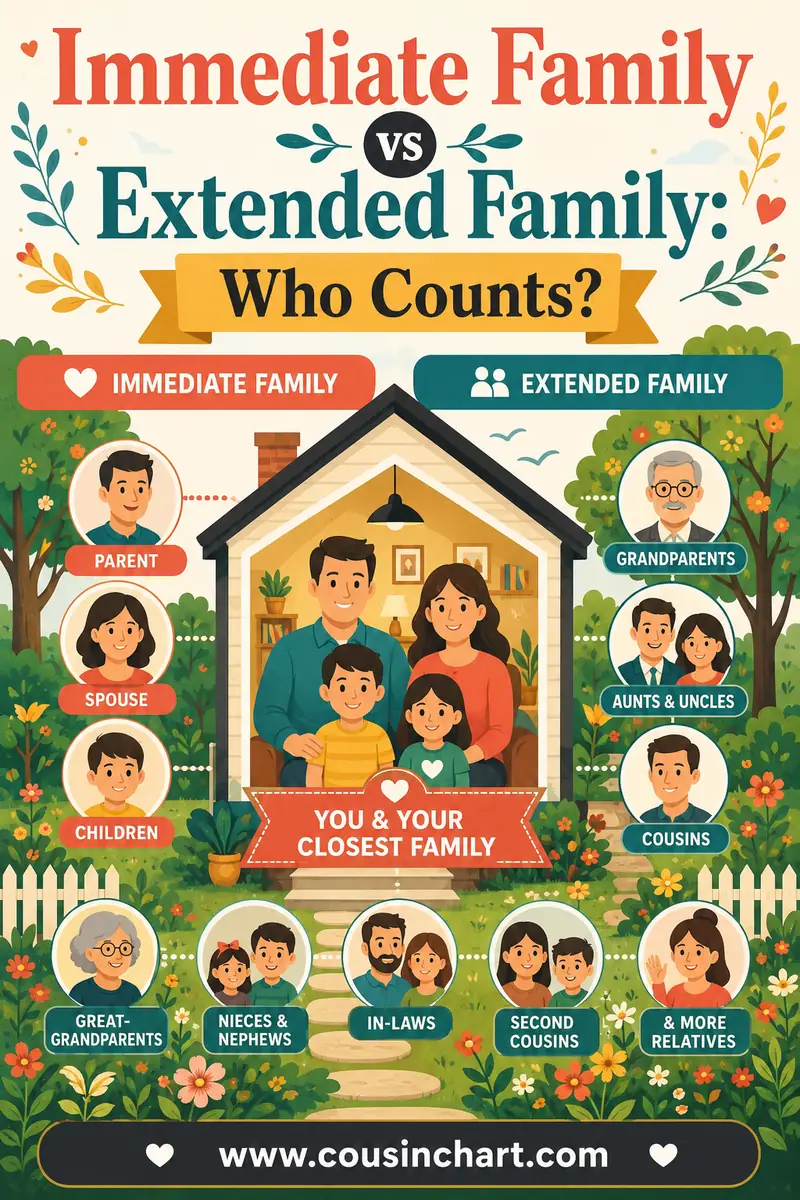
Immediate family usually means spouse, parents, children, and siblings — extended family is everyone beyond. See who counts for leave, FMLA, and more.
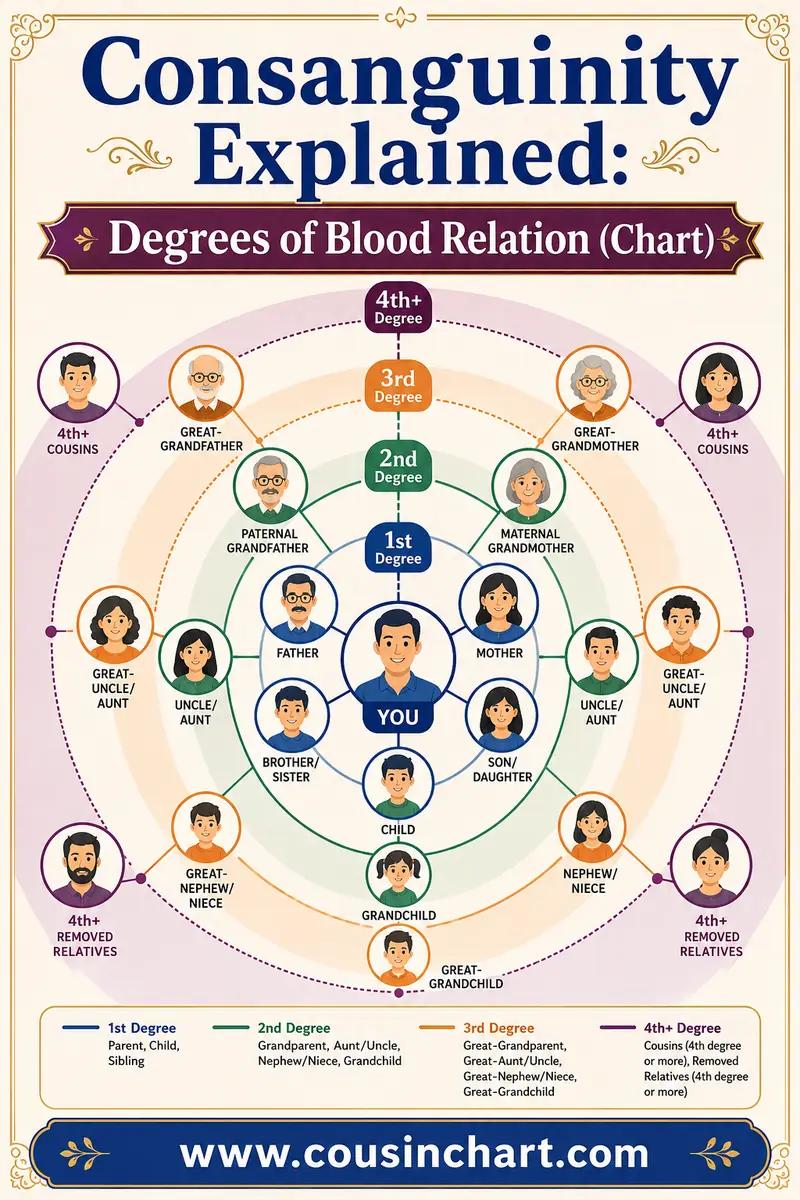
Consanguinity means blood relation, and degrees measure how close. See the full consanguinity chart, how to count degrees, and where the numbers matter.
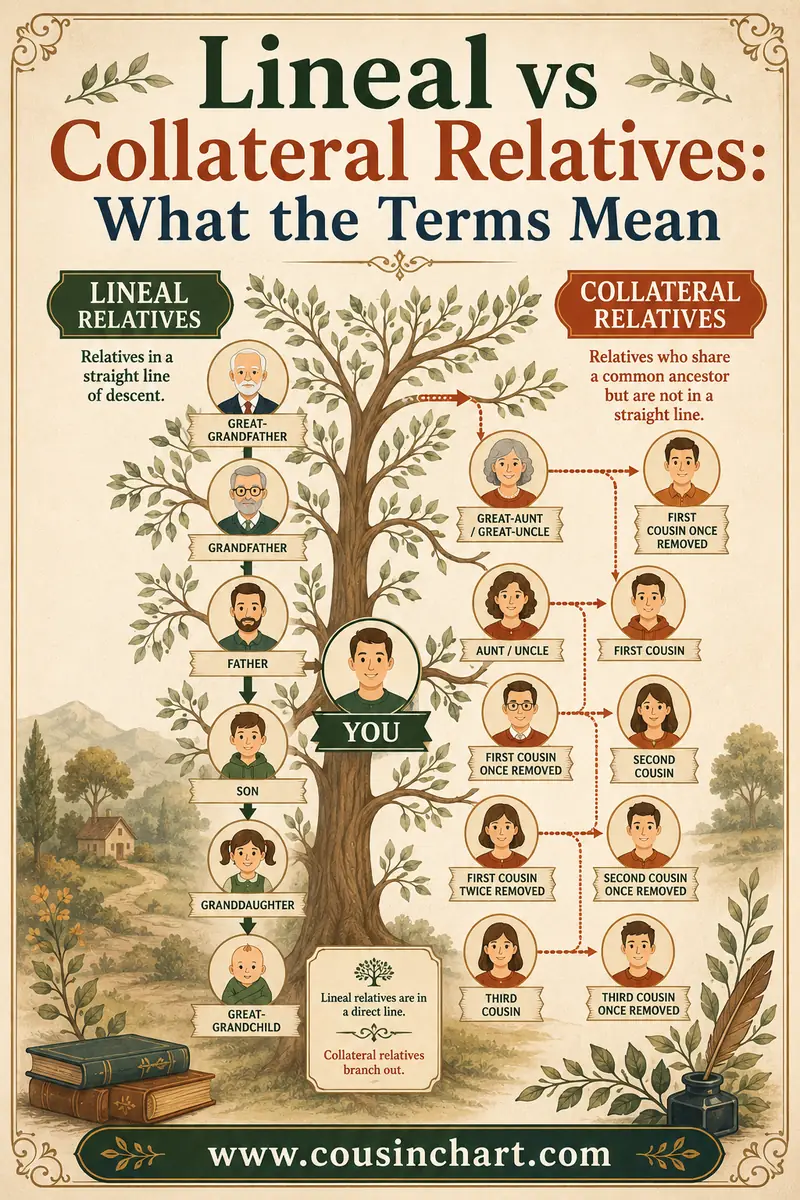
Lineal relatives are your direct line — parents, grandparents, kids. Collateral relatives branch off — siblings, aunts, cousins. See who's which and why it matters.
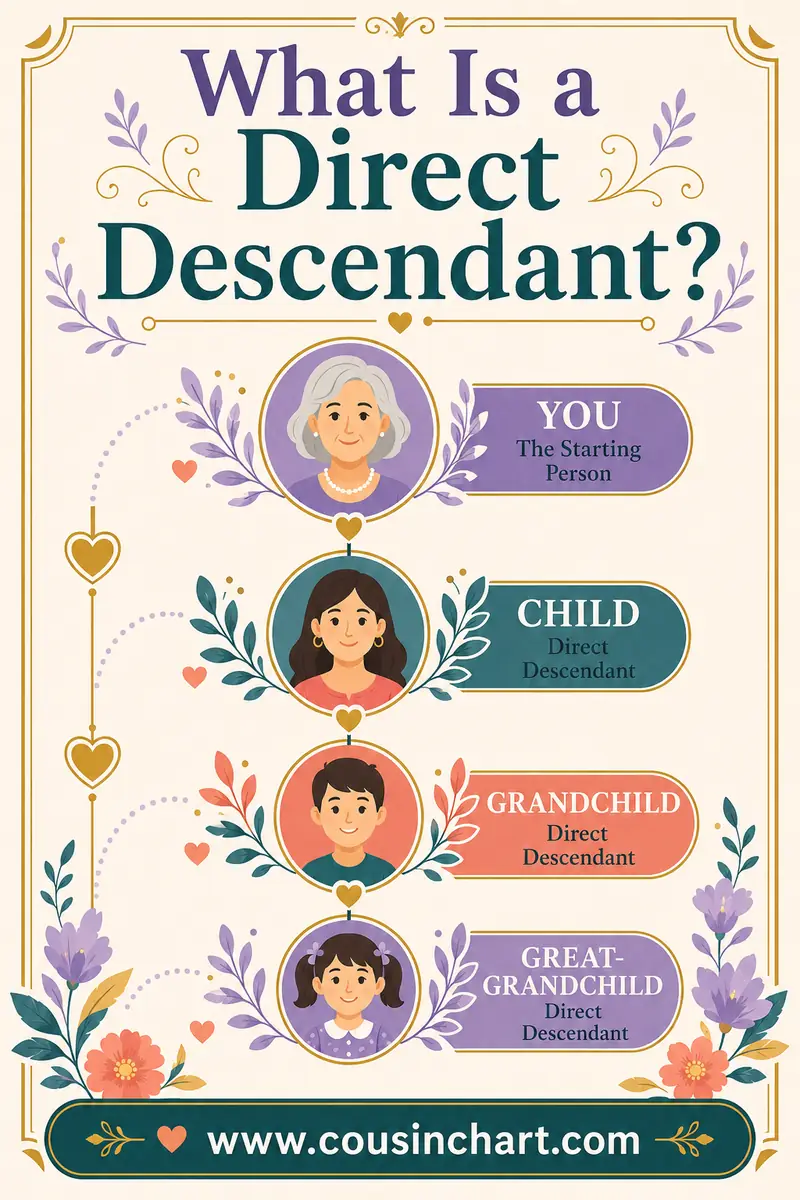
A direct descendant is a child, grandchild, great-grandchild — anyone in the straight line down. See who counts, who doesn't, and how to prove direct descent.
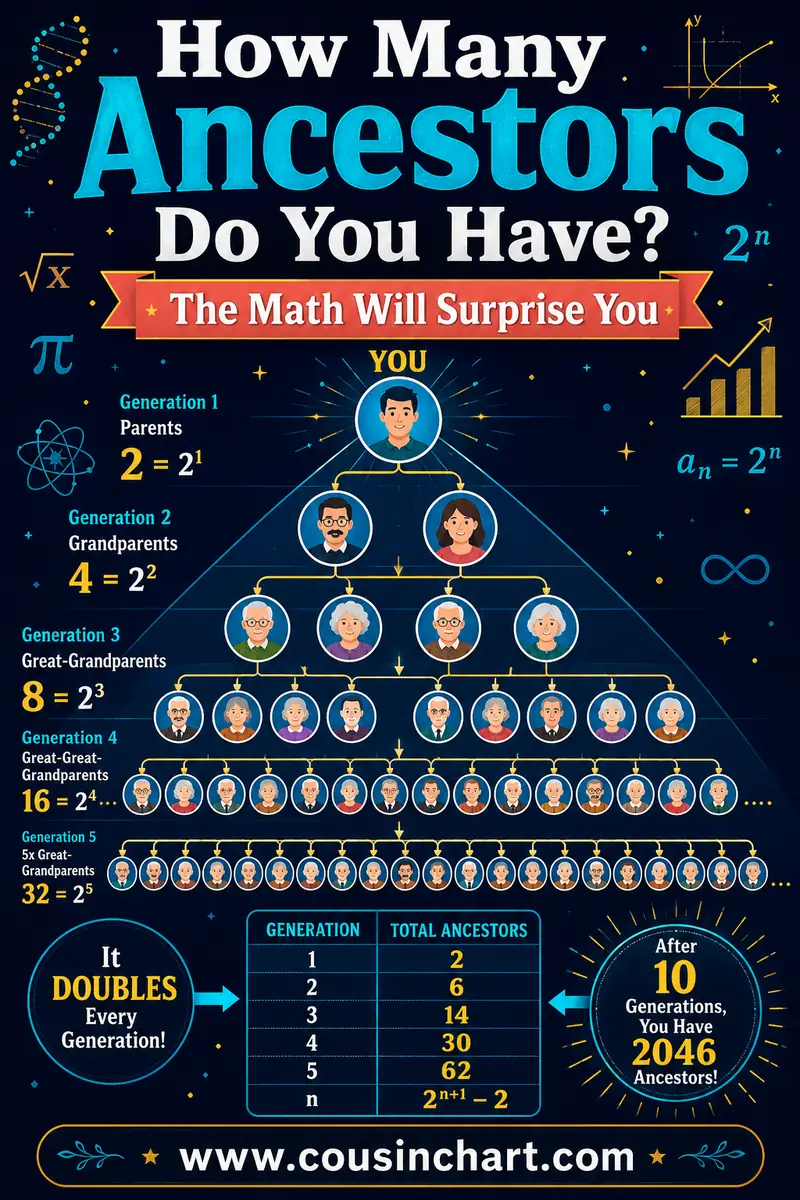
You have 2 parents, 4 grandparents, 8 great-grandparents — and by 30 generations the math demands a billion ancestors. Here's the doubling table and the twist.
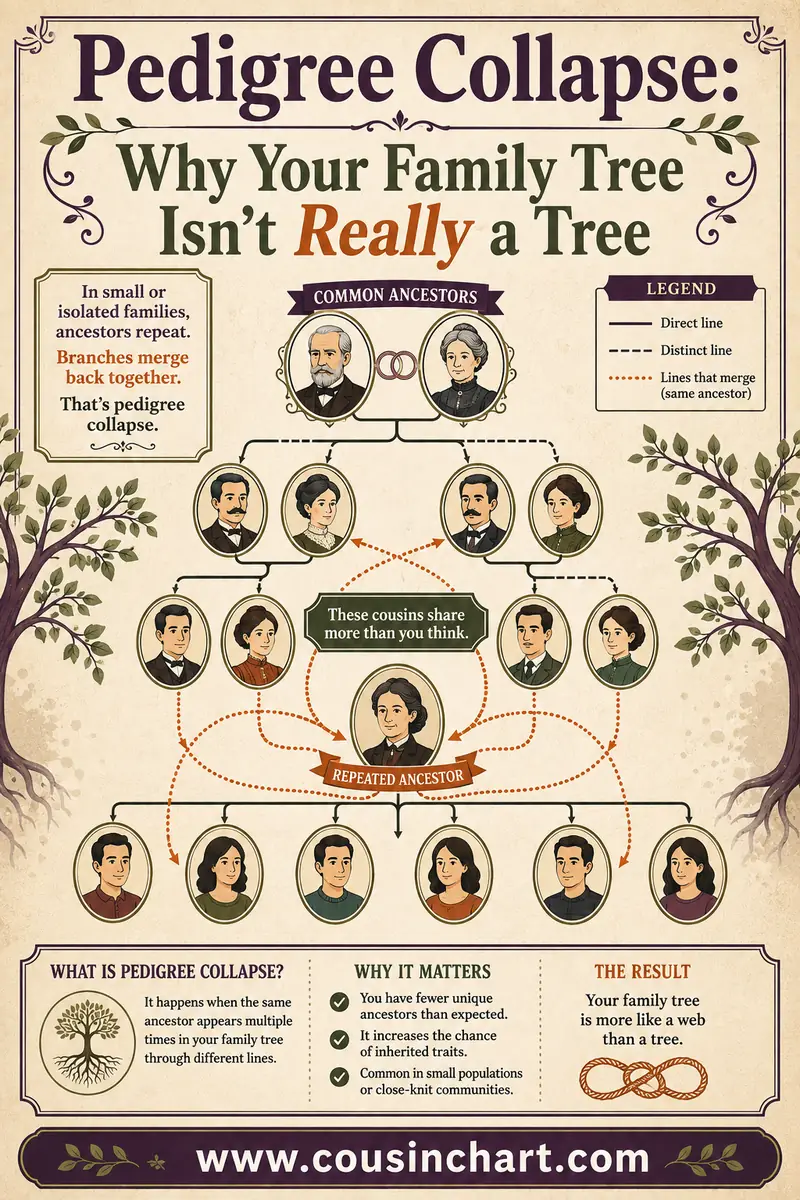
Pedigree collapse happens when the same ancestor fills multiple slots in your family tree. See why it's mathematically guaranteed, famous examples, and DNA effects.
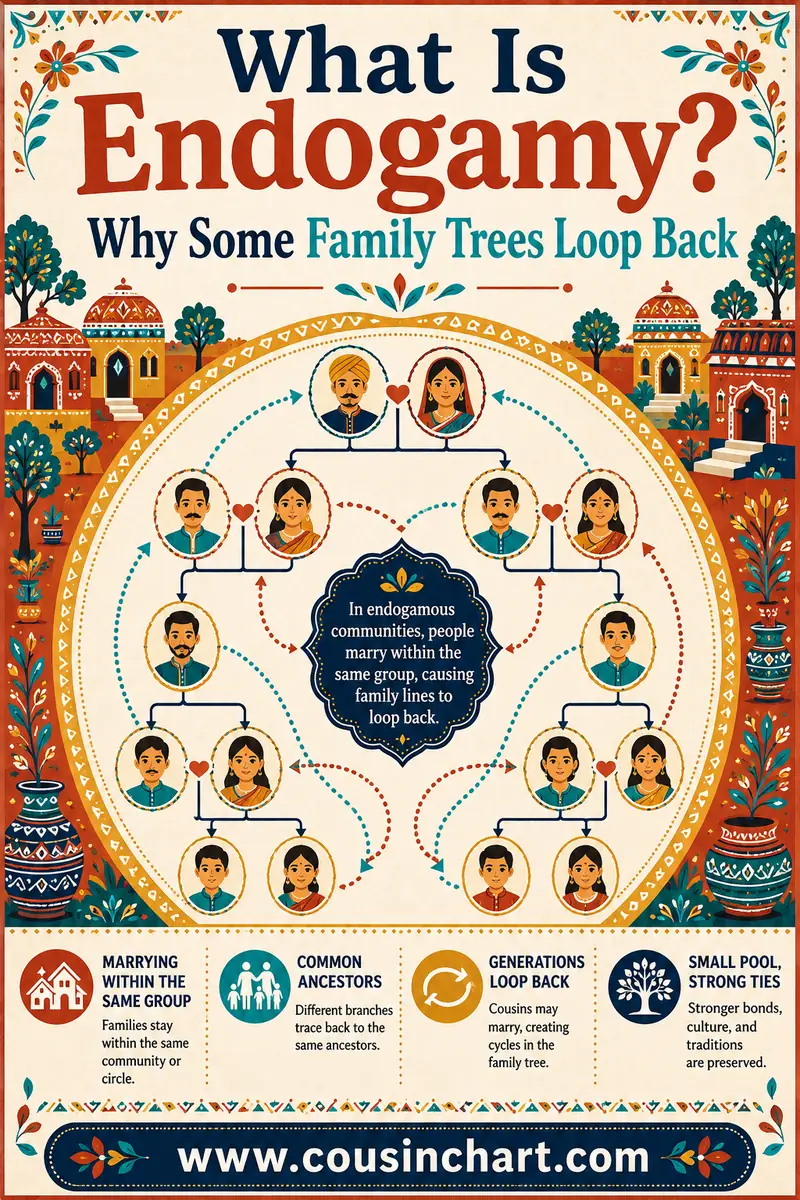
Endogamy means generations of marriage within one community — and it makes DNA matches look closer than they are. What it is, which groups have it, how to handle it.
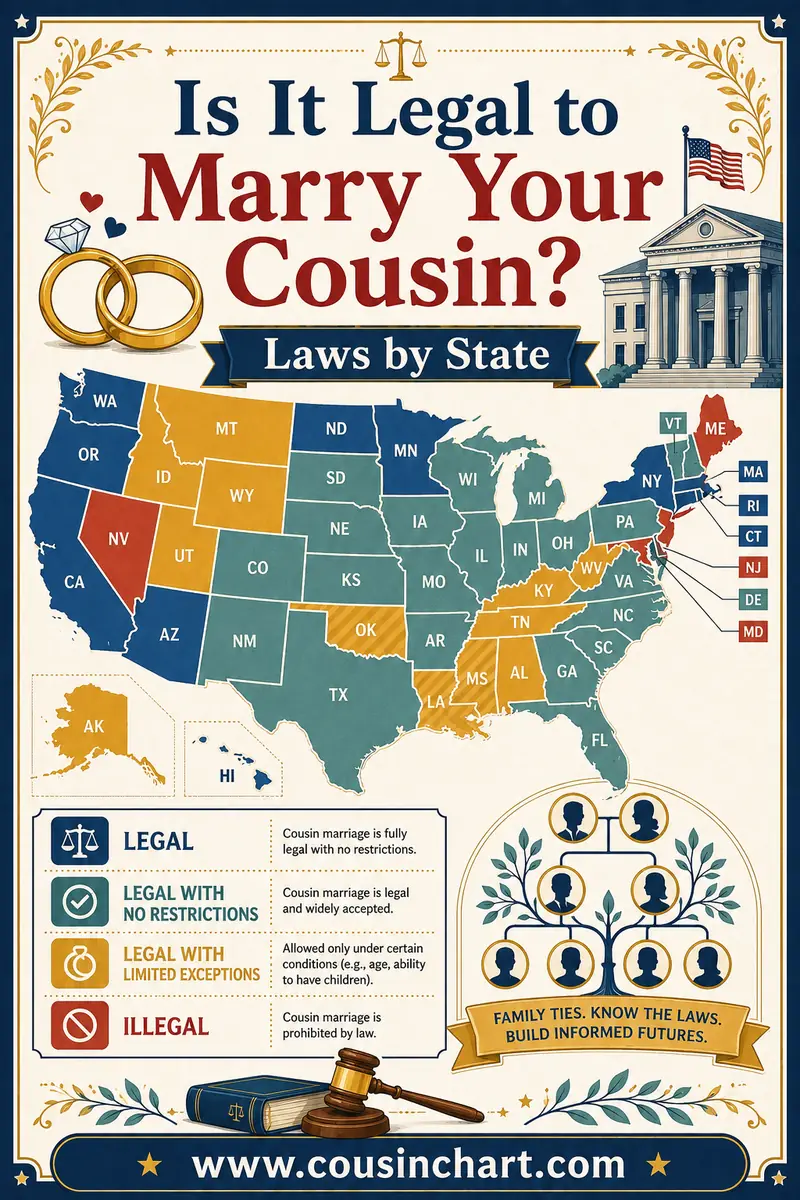
First-cousin marriage is legal in some US states, restricted in others, and banned in about half. A neutral, factual guide to cousin marriage laws by state.
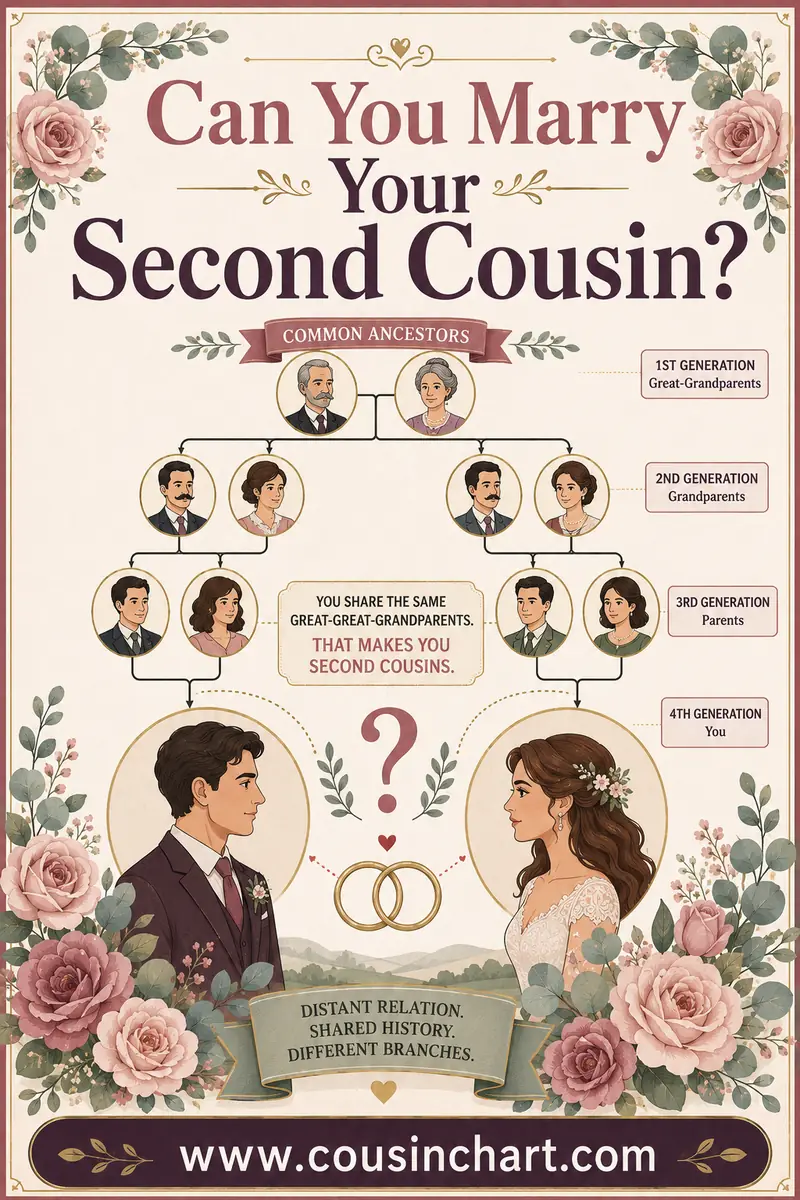
Yes — second-cousin marriage is legal in all 50 US states, and the genetic risk is close to baseline. What second cousins are, the law, DNA facts, and history.
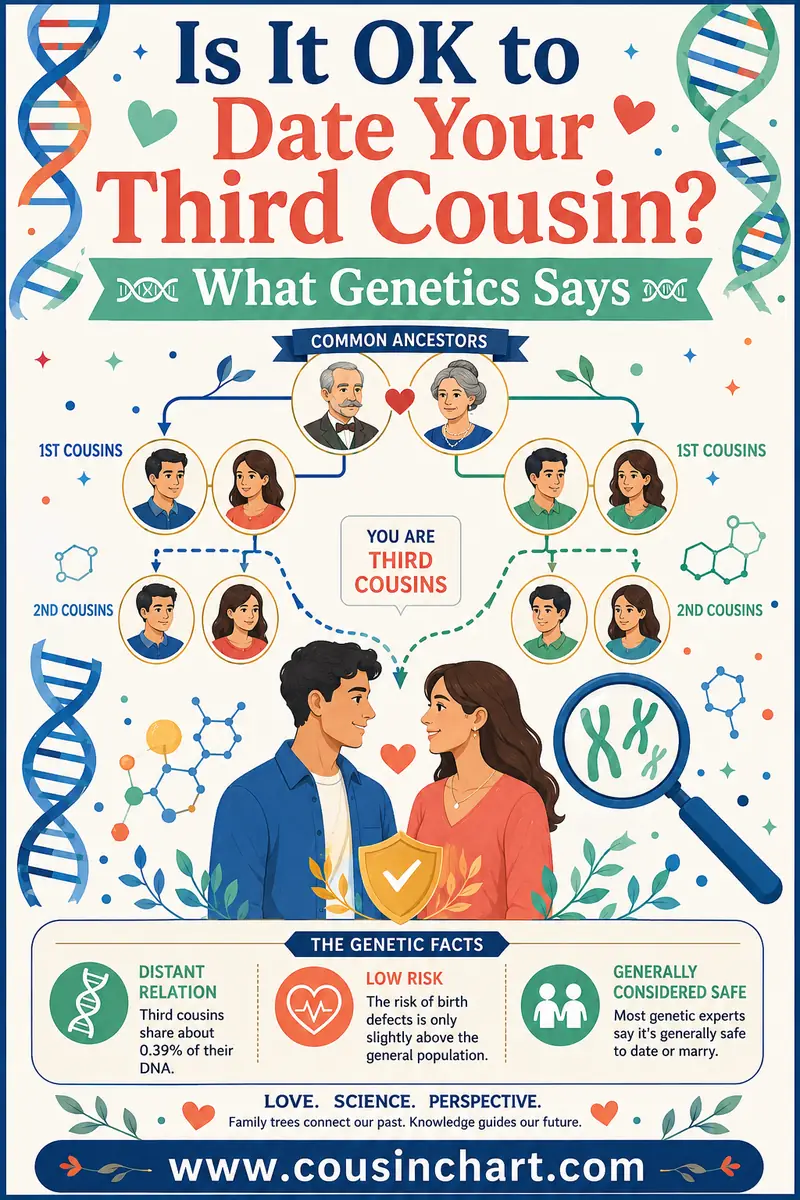
Is dating your third cousin OK? It's legal everywhere and you share just ~0.8% DNA. The genetics, the Iceland story, and a free tool to confirm the link.
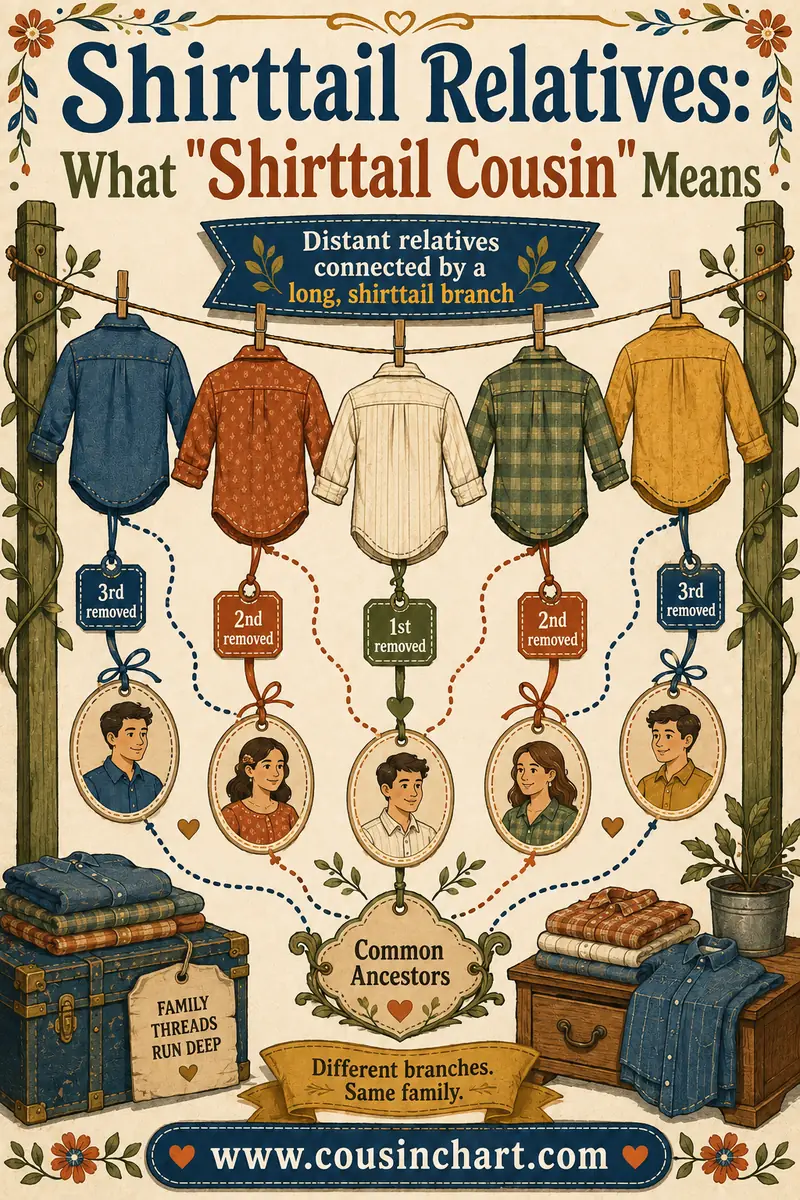
A shirttail cousin is a relative who's barely related — by marriage, distant blood, or just family habit. The meaning, the origin, and the real terms behind it.
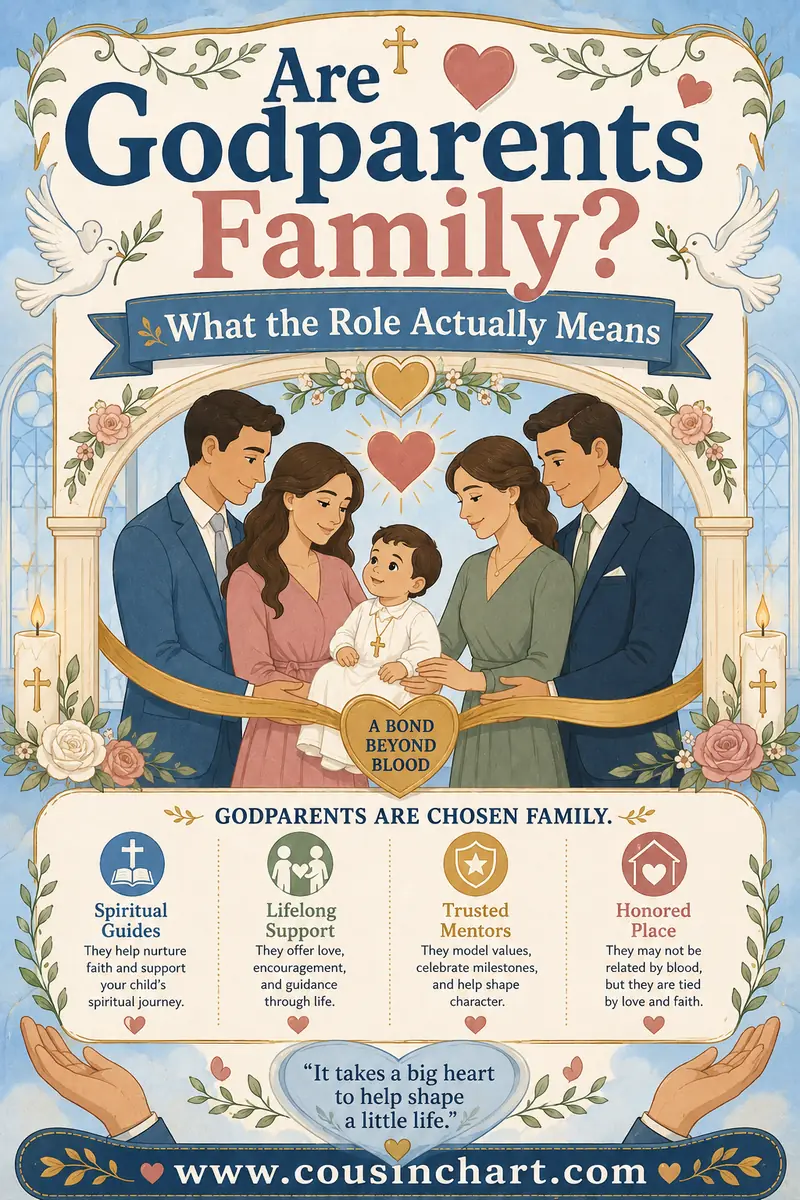
Godparents aren't legal relatives — the role is spiritual and social, not genealogical. What godparents do, guardianship myths, traditions, and family ties.
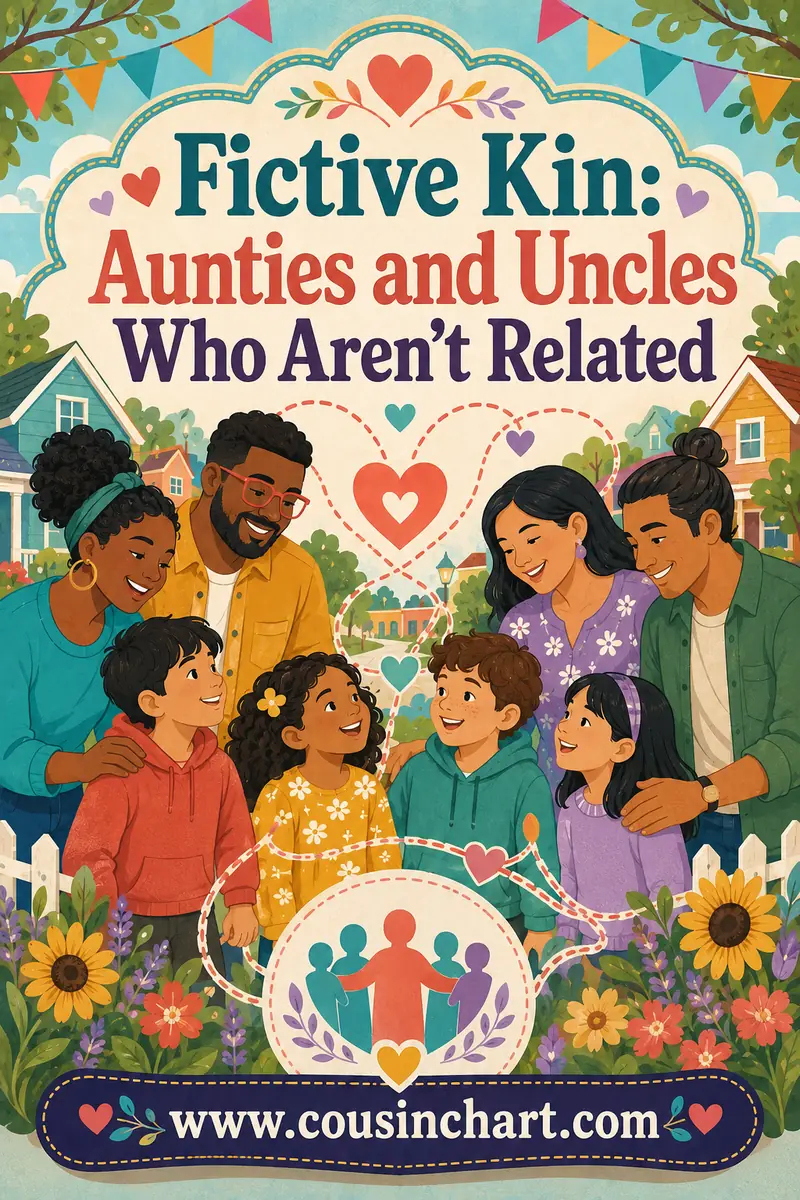
Fictive kin are family by choice — play cousins, honorary aunties, godparents. What the term means in anthropology and foster care, with examples worldwide.
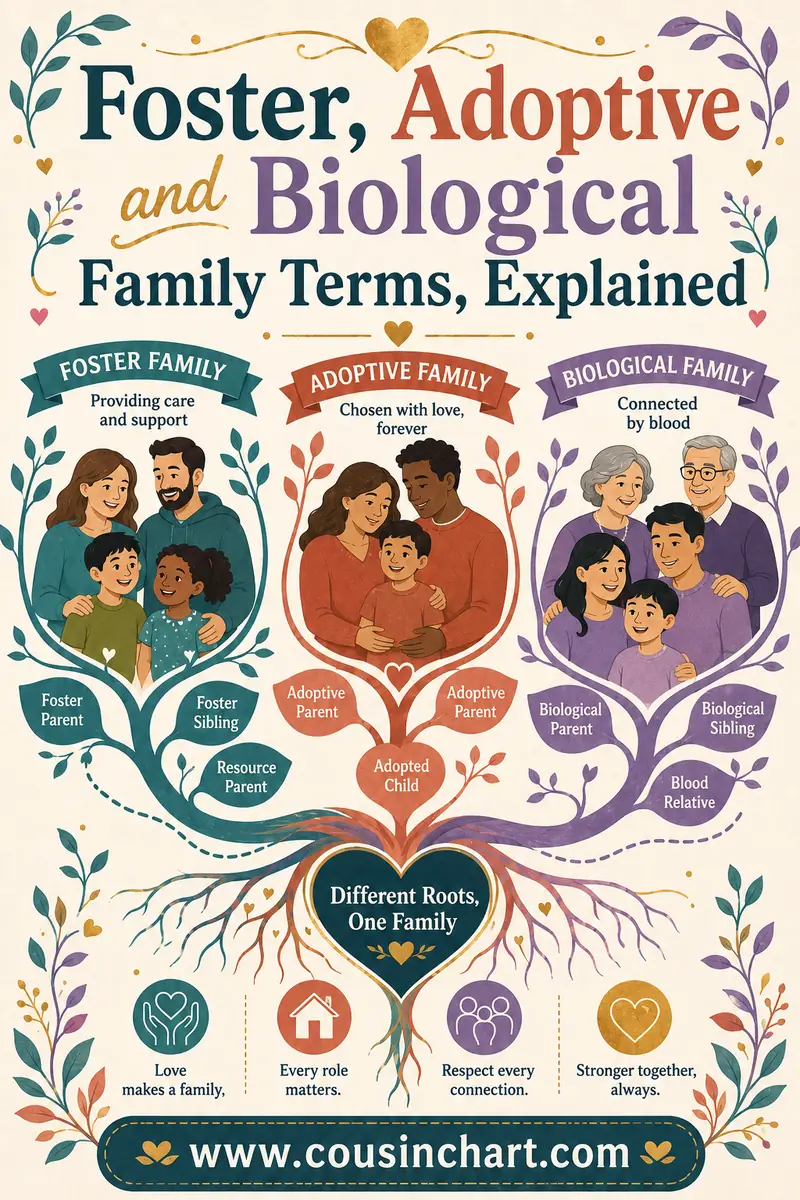
Foster sibling, adoptive parent, birth mother, legal guardian — what each term means, which ties are permanent, and how adoption redraws the family tree.
Kinship care means a relative — often a grandparent or aunt — raising a child when the parents cannot. Formal vs informal care, key terms, plus a free tool.
What does bonus mom mean? It's a warmer word for stepmom. See what bonus dad, bonus kids, and bonus family mean, when to use them, and a free relationship tool.
What does family matriarch or patriarch mean? It's the eldest leading figure of a family. See the difference, how the role works, and a free relationship tool.
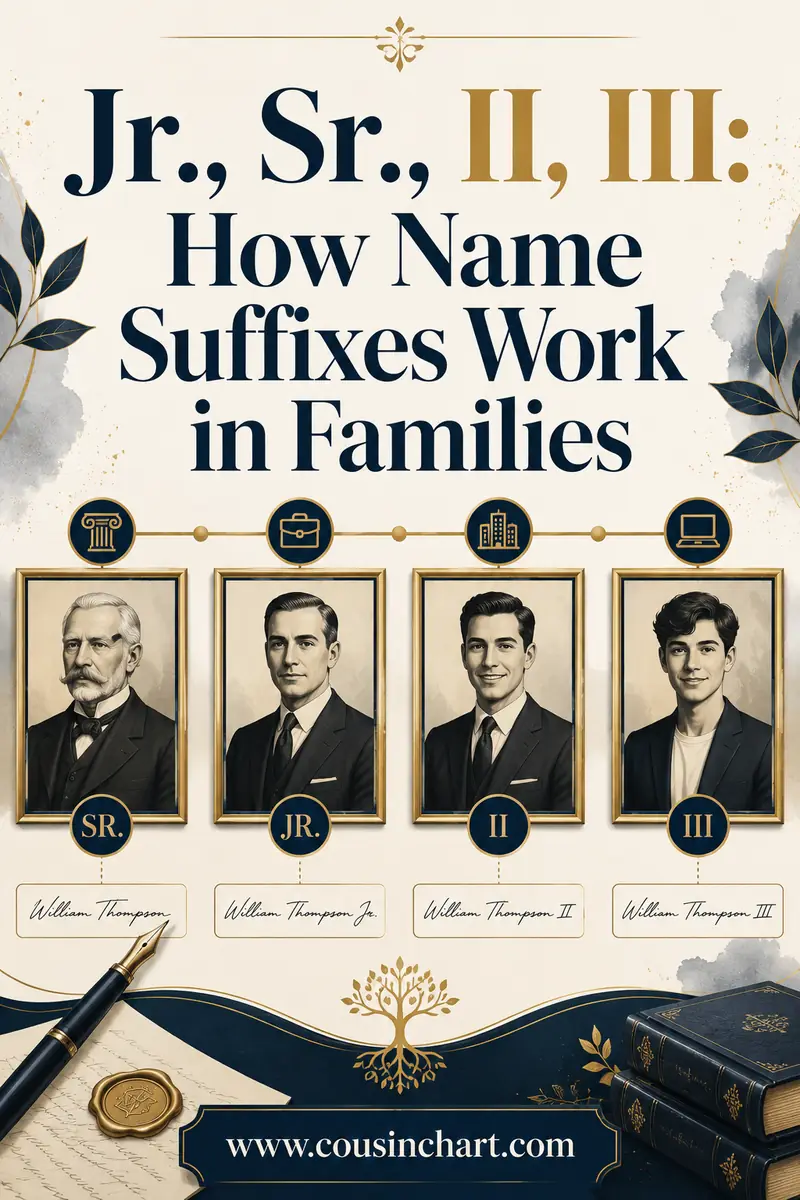
Jr. vs II, when to use Sr., III, or IV, and who gets which suffix. A clear guide to family name suffixes with examples, plus a free relationship tool.
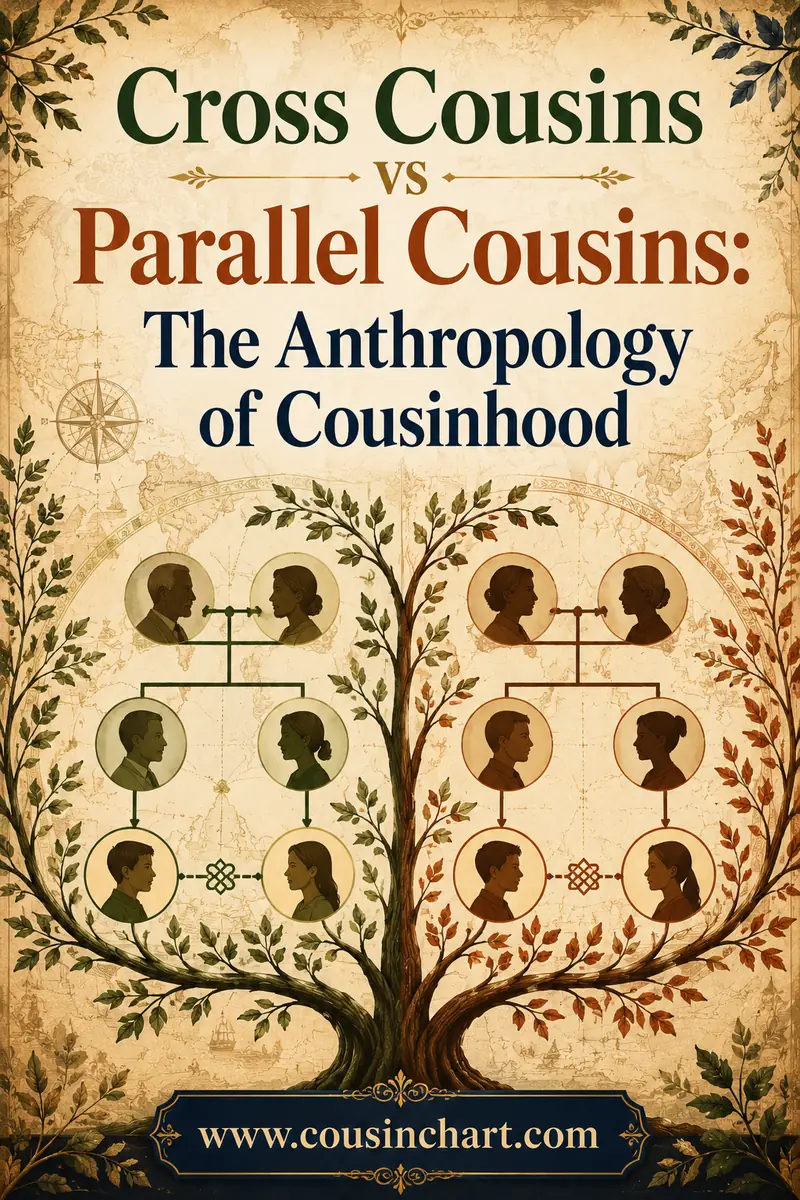
What are cross cousins and parallel cousins? Cross cousins come from opposite-sex siblings; parallel from same-sex siblings. See clear examples and a free tool.
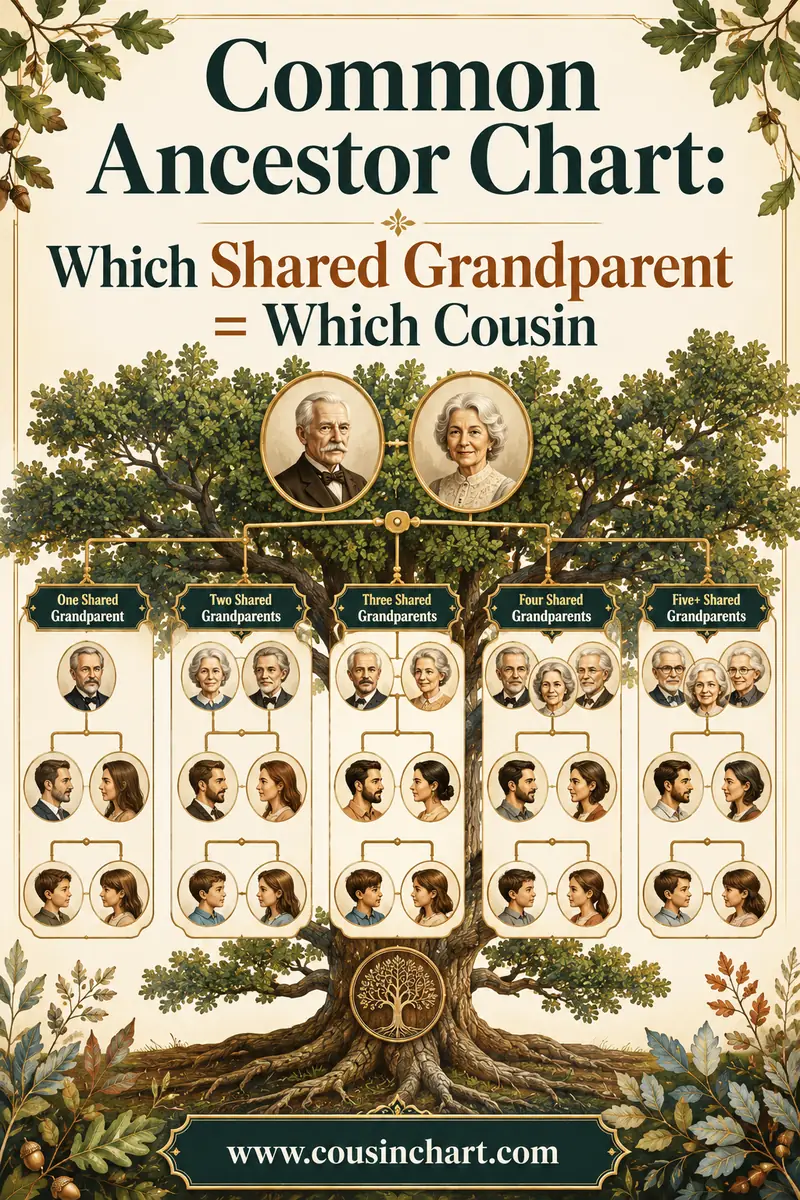
Which shared ancestor makes you first, second, or third cousins? A clear common ancestor chart shows exactly how relationships work, plus a free calculator.
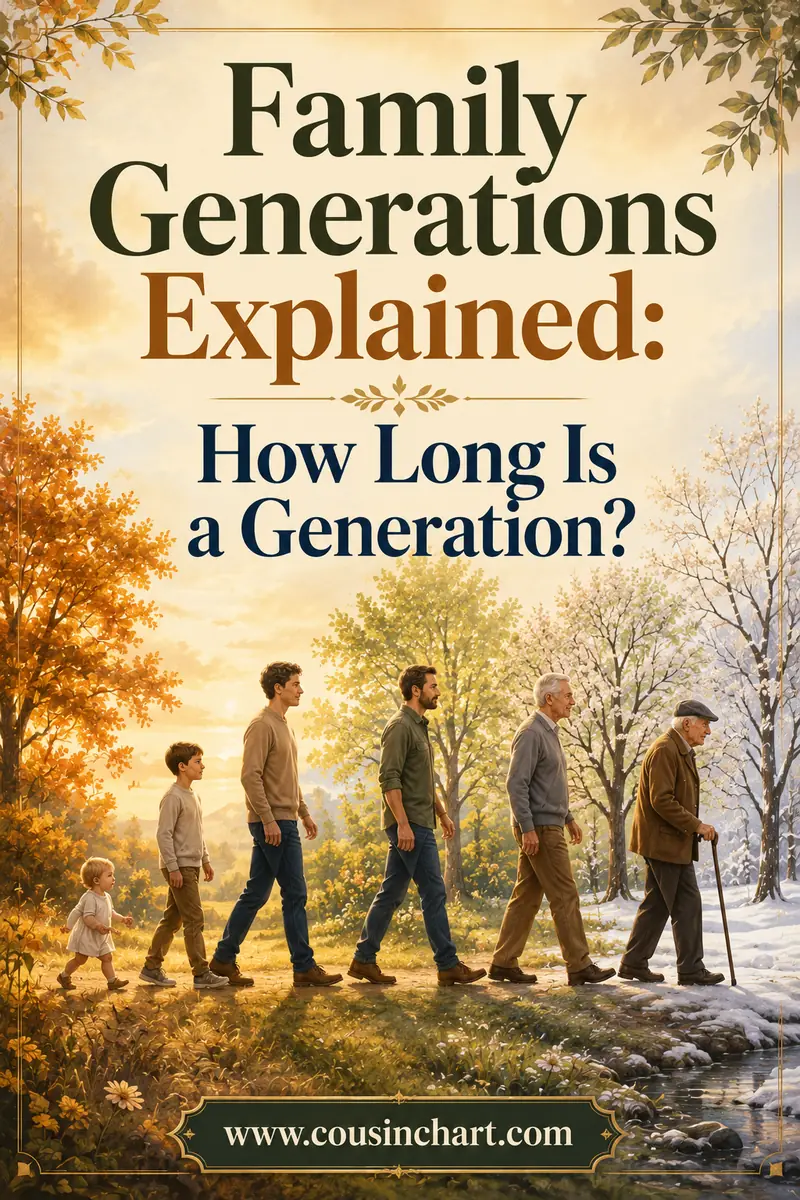
How long is a generation? Genealogists use about 25–30 years. Learn how generations are counted, why the number varies, and use a free relationship tool.
The most recent common ancestor of everyone alive lived only a few thousand years ago. Here's the surprising math behind why we're all distant cousins, plus a tool.
How is the royal family related? For centuries European royals married cousins. See how Victoria linked Europe's thrones, plus a free relationship calculator.
Which celebrities are cousins? From presidents to pop stars, discover famous people who are surprisingly related — and how the cousin math works, plus a free tool.
How many cousins does the average person have? Most people have around 5–12 first cousins and hundreds of second and third cousins. See the numbers, plus a tool.
What does Dutch uncle mean? A blunt but caring adviser. Explore family idioms like kissing cousins, blood is thicker than water, and black sheep, plus a free tool.
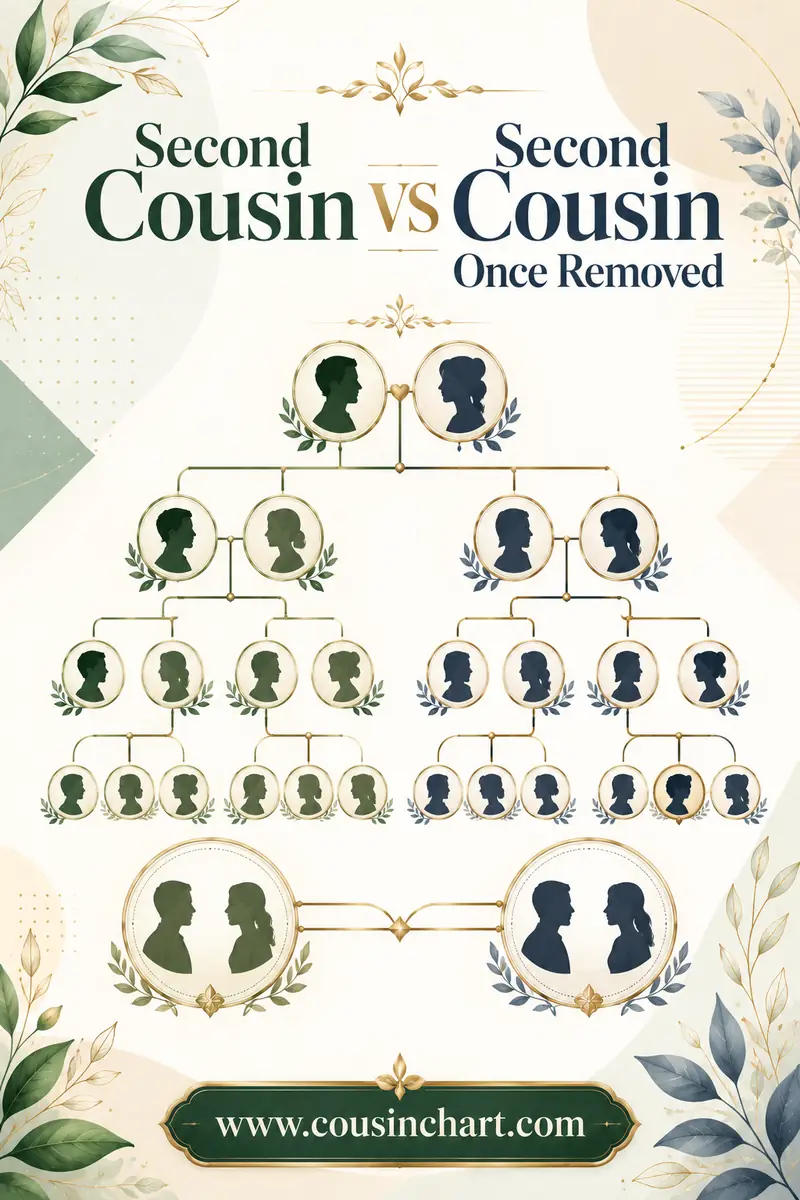
Second cousin vs second cousin once removed: same generation vs one generation apart. See the difference with a clear chart, DNA numbers, and a free calculator.
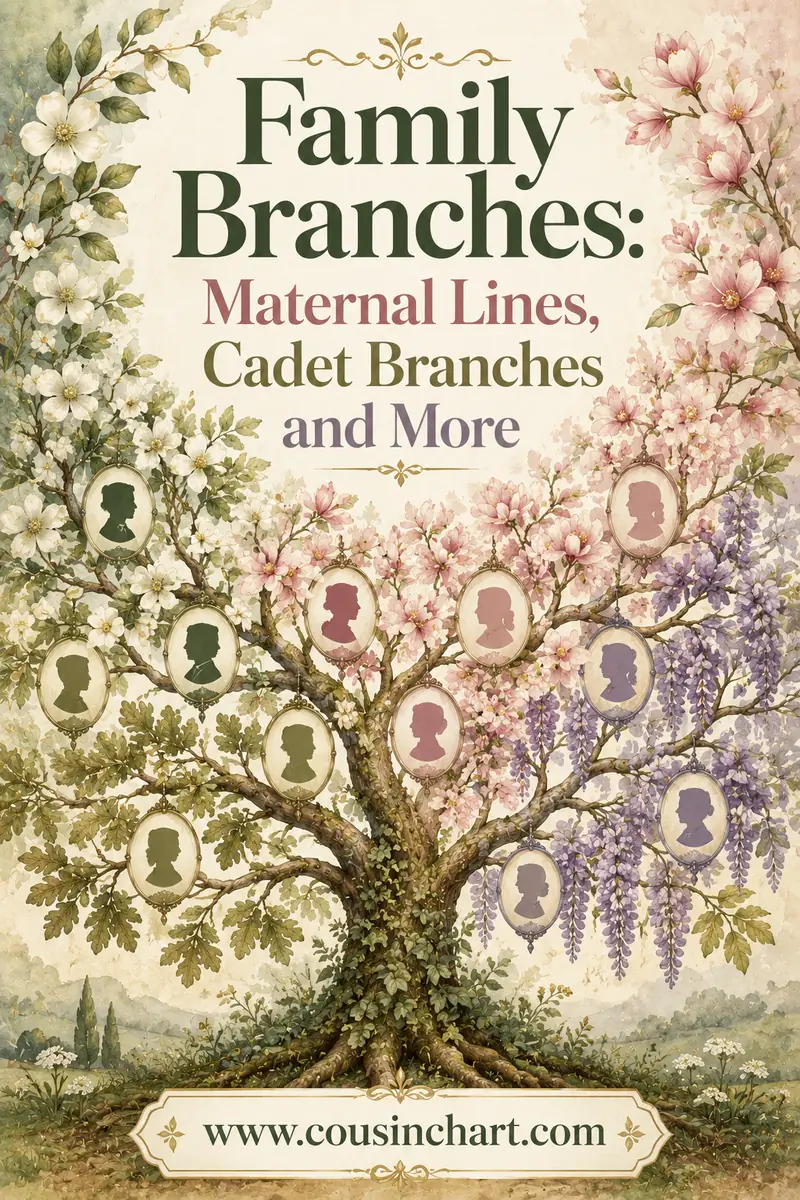
What is a family branch? It's one line of descent within a bigger family tree. Learn maternal vs paternal lines, cadet branches, and lineage terms, plus a free tool.
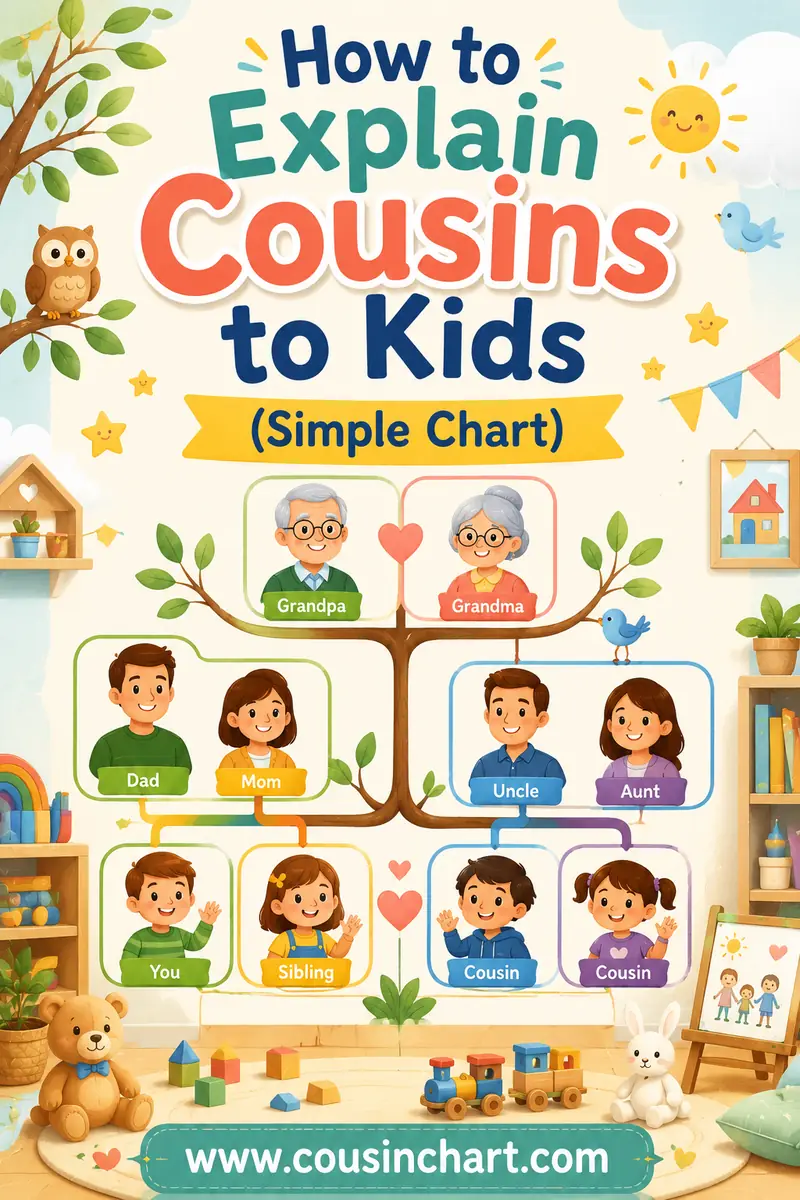
How do you explain cousins to kids? Start with 'our parents are siblings.' A simple, kid-friendly guide to first and second cousins, removed, and a free tool.
Search obituaries for free with Chronicling America, FamilySearch, Legacy.com, Google News Archive, and your library card. Step-by-step methods that work.
Find a Grave is 100% free to search — no account needed. Learn name search tricks, filters, photo requests, and how to mine memorials for family clues.
Find cemetery and burial records online free: Find a Grave, BillionGraves, Interment.net, FamilySearch, sexton registers, and church burial books, explained.
Search Ellis Island records free at the Statue of Liberty–Ellis Island Foundation database: 65+ million passenger records, 1820–1957. Step-by-step guide.
Find your ancestor's Ellis Island ship manifest free. What every manifest column means, how to search passenger lists, and the clues most people miss.
8 million immigrants arrived at Castle Garden before Ellis Island opened. Where their records survive, how to search them free, and what the manifests say.
Search every U.S. census free: FamilySearch, the National Archives, and the 72-year rule explained, plus search tricks for misspelled names and lost families.
Search the 1850 census free on FamilySearch. The first U.S. census to name every free person — what it asked, its limits, and tricks for finding your family.
Search the 1870 census free on FamilySearch. The first census to name formerly enslaved Americans — what it asked, why it matters, and how to search it well.
Search the 1880 census free on FamilySearch. The first census to state family relationships and parents' birthplaces — here's how to use every column.
Most of the 1890 census burned after a 1921 fire. What survives, which fragments are searchable free, and 8 proven ways to bridge the 1880–1900 gap.
Search the 1900 census free on FamilySearch. The only census with everyone's birth month and year — plus marriage, children, and immigration answers explained.
Search the 1910 census free on FamilySearch. Marriage numbers, mother tongue, Civil War veteran flags — every 1910 column explained with search tricks.
Search the 1920 census free on FamilySearch. The only census with the year of naturalization — plus its January census day and post-WWI birthplace quirks.
Search the 1930 census by name free on FamilySearch. The radio-set census: age at first marriage, home values, veteran columns, and search tricks explained.
Search the 1940 census free on FamilySearch and the National Archives. See what the 1940 census asked, why it matters, and how to find your family fast.
The 1950 census is free to search at 1950census.archives.gov and FamilySearch. Learn what it asked, how it was indexed, and how to find your family in it.
Can't find an ancestor by name? Search the census by address free: find their street, convert it to an enumeration district, and read the actual pages.
Search UK census records free: 1841–1911 indexes on FamilySearch and FreeCEN, the 1921 census, Scotland, Ireland, and the 1939 Register, all explained.
Search Canadian census records 1825–1931 free at Library and Archives Canada. Release rules, what each census asked, and how to find your family, explained.
FamilySearch.org is 100% free — billions of records, a shared world tree, and research tools. What's included, the catches, and how to use it like a pro.
The 25 best free genealogy websites — censuses, graves, newspapers, immigration, military, and UK, Irish, and Canadian records — organized by what each does best.
FamilySearch, Ancestry, MyHeritage, Findmypast, and Fold3 compared honestly — strengths, costs, and which genealogy website fits your research goals.
Use Ancestry free: the free account and tree, always-free record collections, Ancestry Library Edition, the 14-day trial, and FamilySearch Center access.
Trace your family tree free in 8 steps: start with yourself, interview relatives, then use FamilySearch, censuses, graves, and newspapers — no subscription.
Find an ancestor's military records free: NARA requests, draft cards on FamilySearch, pension files, the 1973 fire's impact, and what survives for each war.
Find Civil War ancestors free: the NPS Soldiers and Sailors database, service records, Union pension files, Confederate state pensions, and census clues.
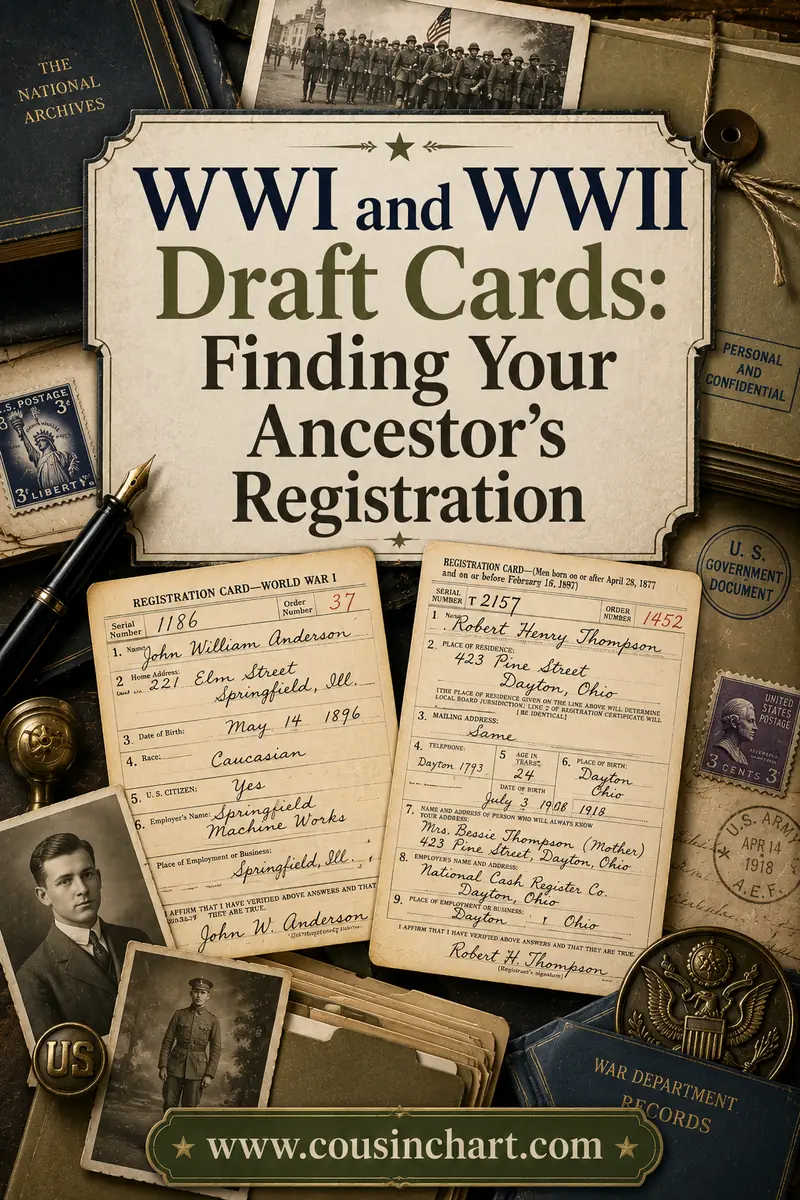
Look up WWI and WWII draft registration cards free on FamilySearch. Who registered, what each card reveals, the Old Man's Draft, and search tips that work.
Search for Revolutionary War ancestors free: the DAR and SAR patriot databases, pension files rich with family proof, and how lineage verification works.
Find an ancestor's naturalization records free: first papers, petitions, the 1906 rule change, USCIS C-Files, and why Ellis Island never granted citizenship.
Find immigration records free: Ellis Island, Castle Garden, FamilySearch passenger lists, border crossings, and library access to Ancestry. Step by step.
Search death records free with FamilySearch, state death indexes, the SSDI, Find a Grave, and obituaries. Where to look by year and state, step by step.
Find birth records free using FamilySearch indexes, state archives, delayed certificates, church baptisms, and census clues. What's open, what's restricted.
Find marriage records free: FamilySearch county collections, state indexes, church registers, and newspaper announcements. Where to search by era and state.
Search the Social Security Death Index free on FamilySearch and Steve Morse's site. What the SSDI covers, its 1962 gap, and how to order the SS-5 form.
Wills and probate records name every heir, in the ancestor's own words. Where to search them free on FamilySearch, county courts, and what each paper means.
Church records hold baptisms, marriages and burials from long before civil registration. Where to find them free: FamilySearch, diocesan and denominational archives.
Search old newspapers free: Chronicling America's millions of pages, state digital newspaper portals, Fulton History and library access. Search tricks included.
Date old family photos by format, card style, clothing and photographer's imprint. Daguerreotype to snapshot, with free tools to put names to faces.
Family Bible records hold births, marriages, and deaths no government ever recorded. Learn how to find lost family Bibles free in DAR files and state archives.
Search land and homestead records free: BLM GLO patents, county deed books on FamilySearch, bounty land and homestead case files at NARA. Step-by-step guide.
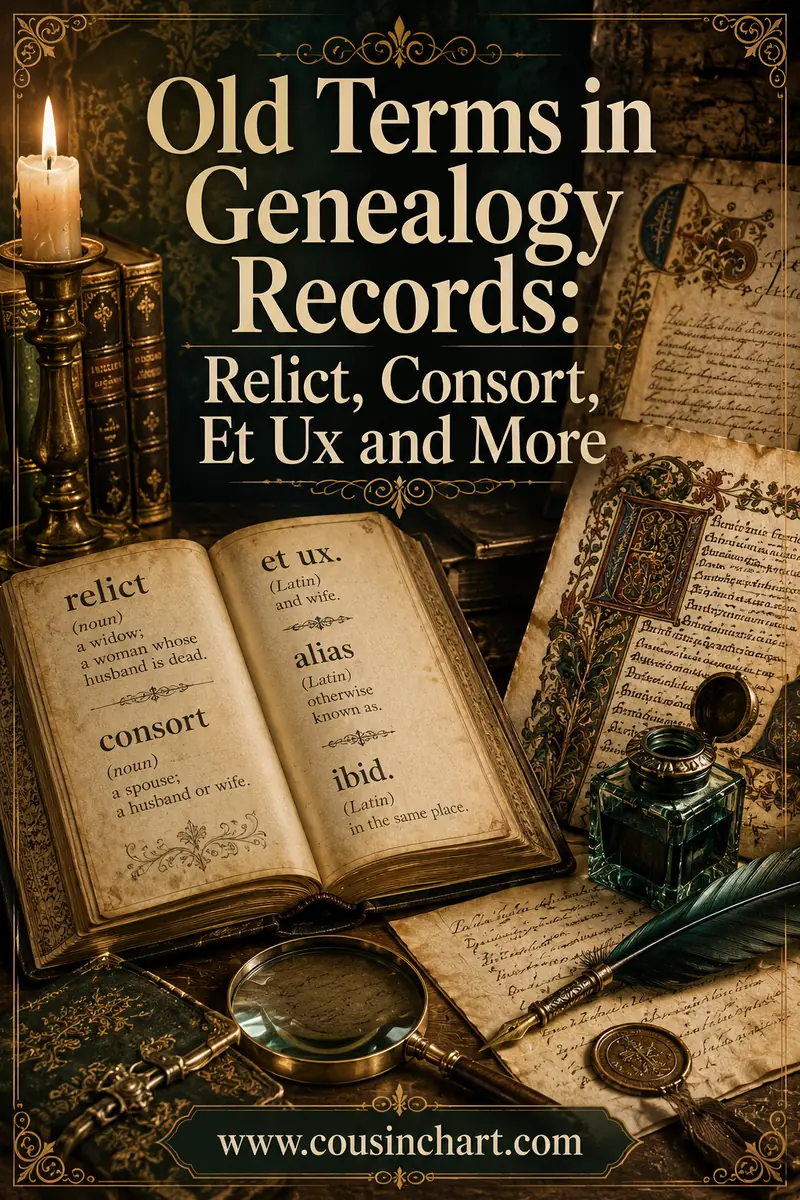
Relict, consort, et ux, instant, ultimo, d.s.p. — decode the old terms in genealogy records so you never misread a will, deed or gravestone again.
Free African American genealogy: Freedmen's Bureau and Freedman's Bank on FamilySearch, the 1870 census method, USCT records, WPA narratives and more.
Trace Italian ancestors free: the Antenati portal's civil records, FamilySearch collections, parish registers and how to find your ancestor's exact town.
Trace Irish ancestors free: irishgenealogy.ie civil records, the 1901/1911 censuses, Griffith's Valuation, NLI parish registers — and what the 1922 fire spared.
Find Jewish genealogy records free: JewishGen, JRI-Poland, Yad Vashem, JOWBR burials and Holocaust archives, plus naming customs that crack brick walls.
Find German genealogy records free: church books, civil registration, Meyers Gazetteer, FamilySearch, Matricula and genealogy.net — plus the 1876 rule.
Search Mexican genealogy records free: FamilySearch parish registers back to the 1500s, civil registration, the 1930 census, and border crossing files.
Use old city directories to trace ancestors year by year — where to search them free, what the abbreviations mean, and the death-date clue most people miss.
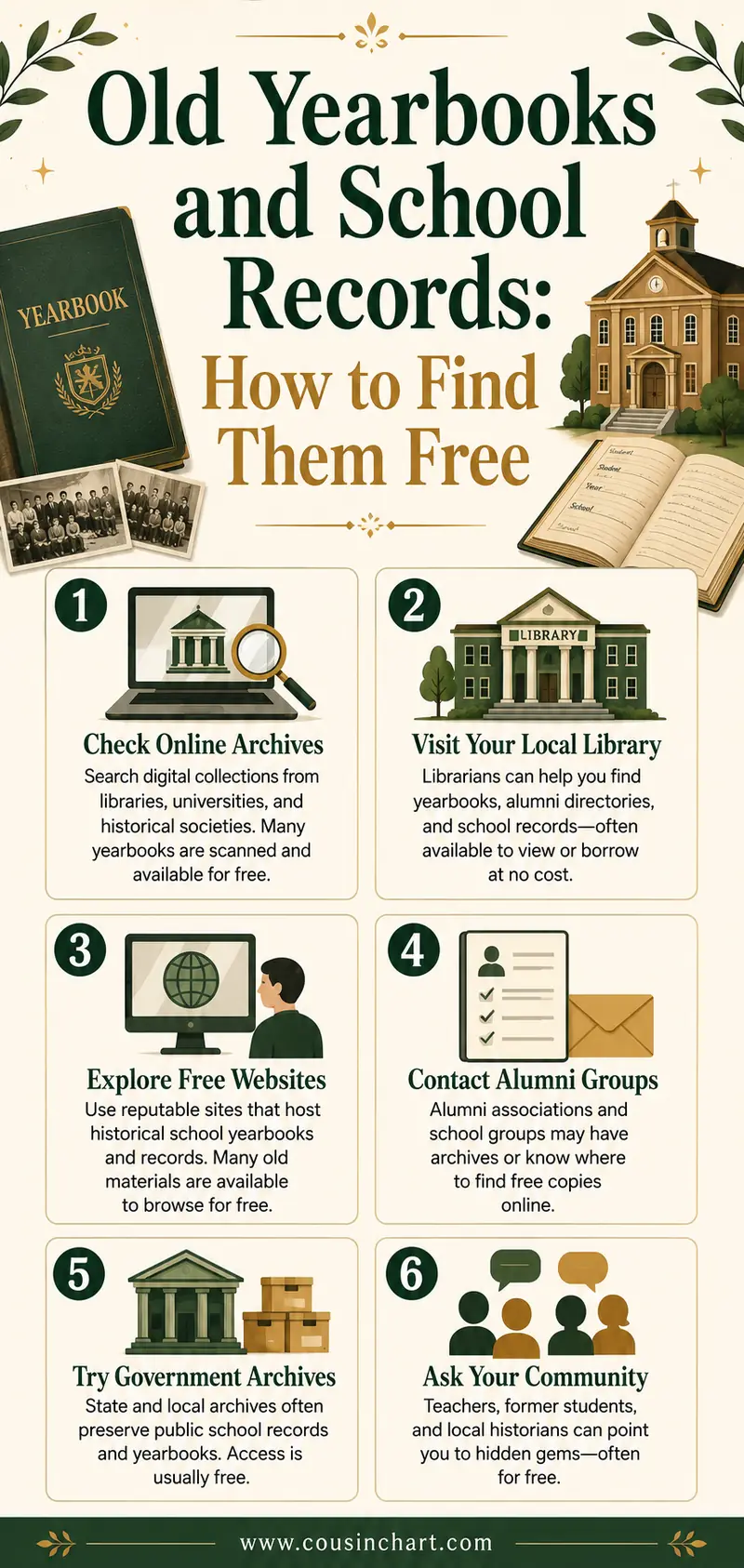
Find old yearbooks and school records free: the best online collections, library and alumni-office tricks, and what school censuses reveal about your family.
How to make a family tree in Canva step by step — best free templates, sizing and box math, print settings, plus free alternatives when Canva isn't the fit.
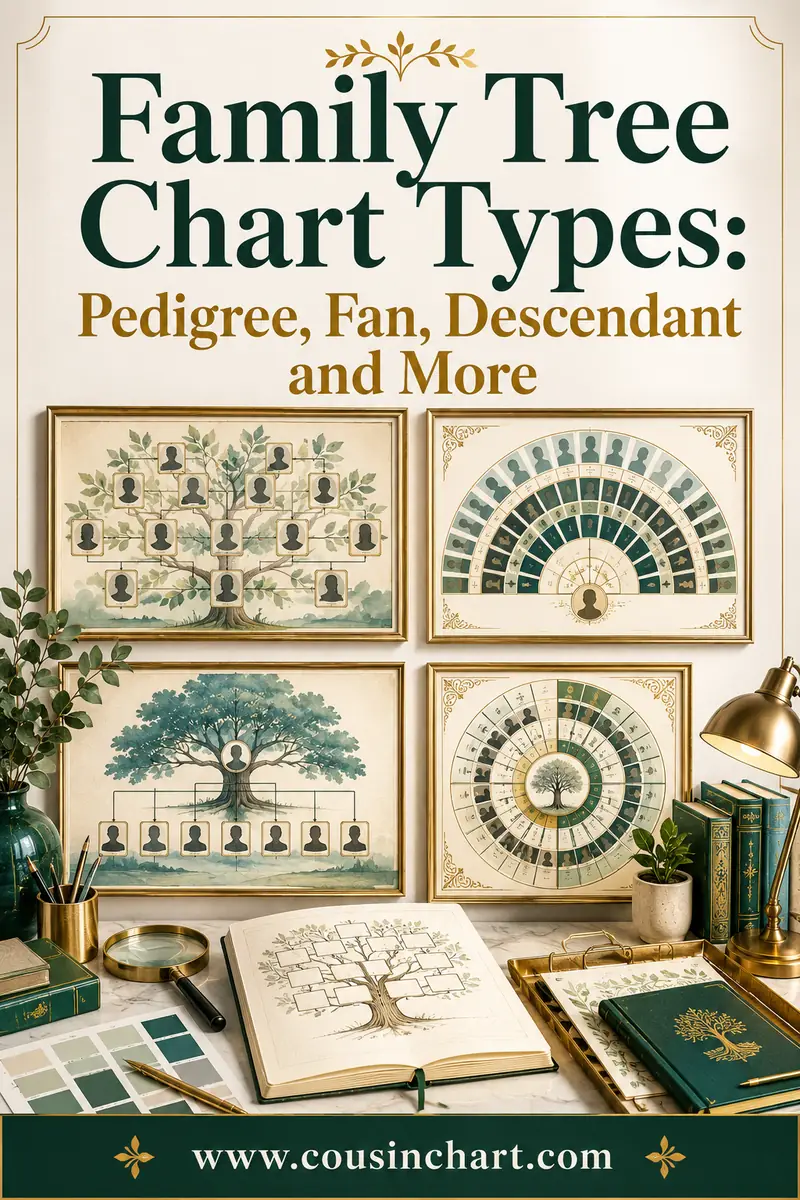
Every family tree chart type explained — pedigree, fan, descendant, hourglass, bow tie and genogram — with box counts, best uses, and free printable picks.
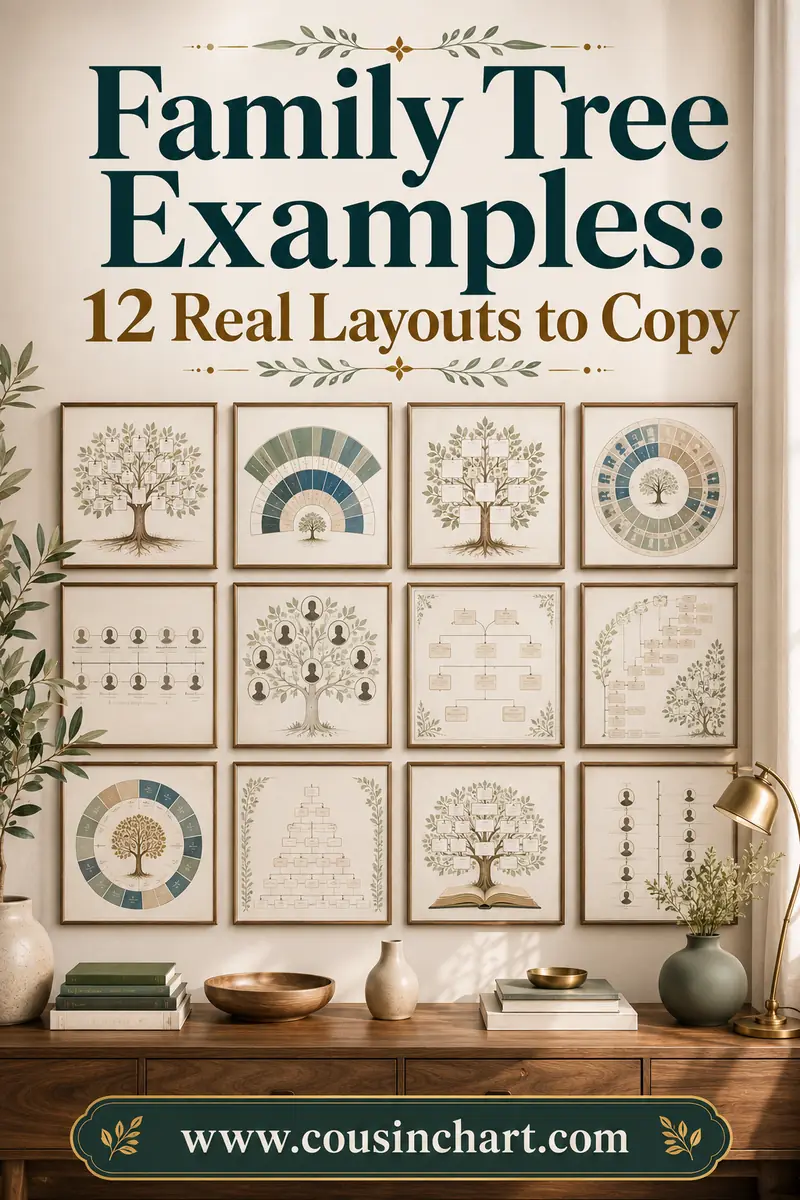
12 family tree examples with real layouts to copy: 3 to 6 generation charts, photo trees, kids' trees, blended families and reunion charts, with box counts.
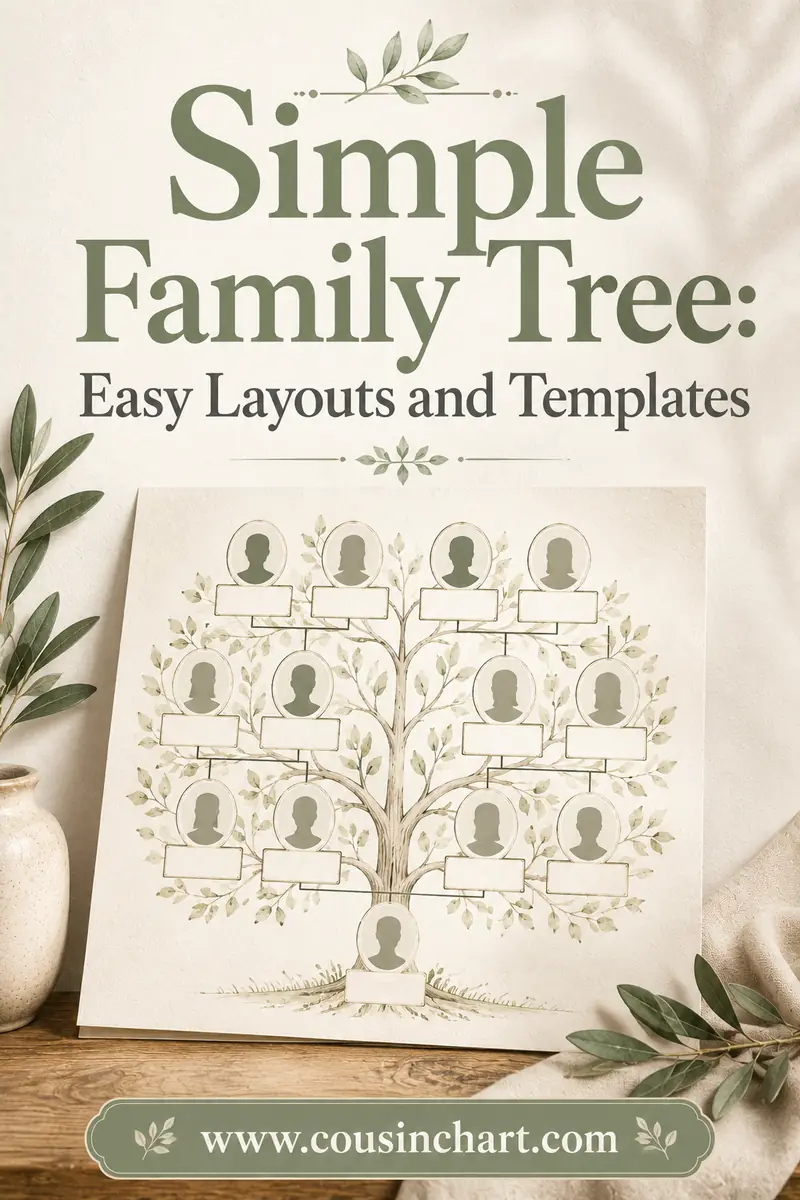
Make a simple family tree in minutes: the 7-box and 15-box layouts, printable templates, and plain rules for who goes where — no software or signup needed.
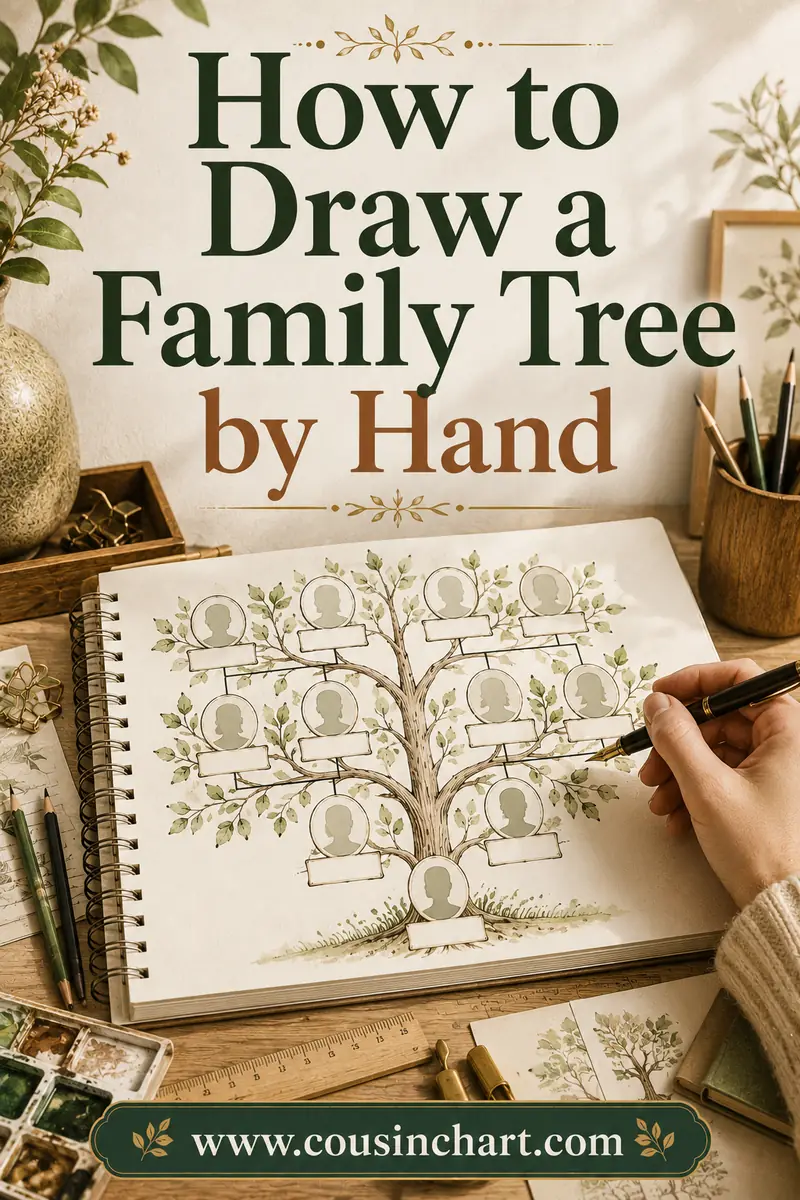
Draw a family tree by hand with real measurements: box sizes, row spacing, and line rules for 3–5 generations, plus fixes for siblings and blended families.
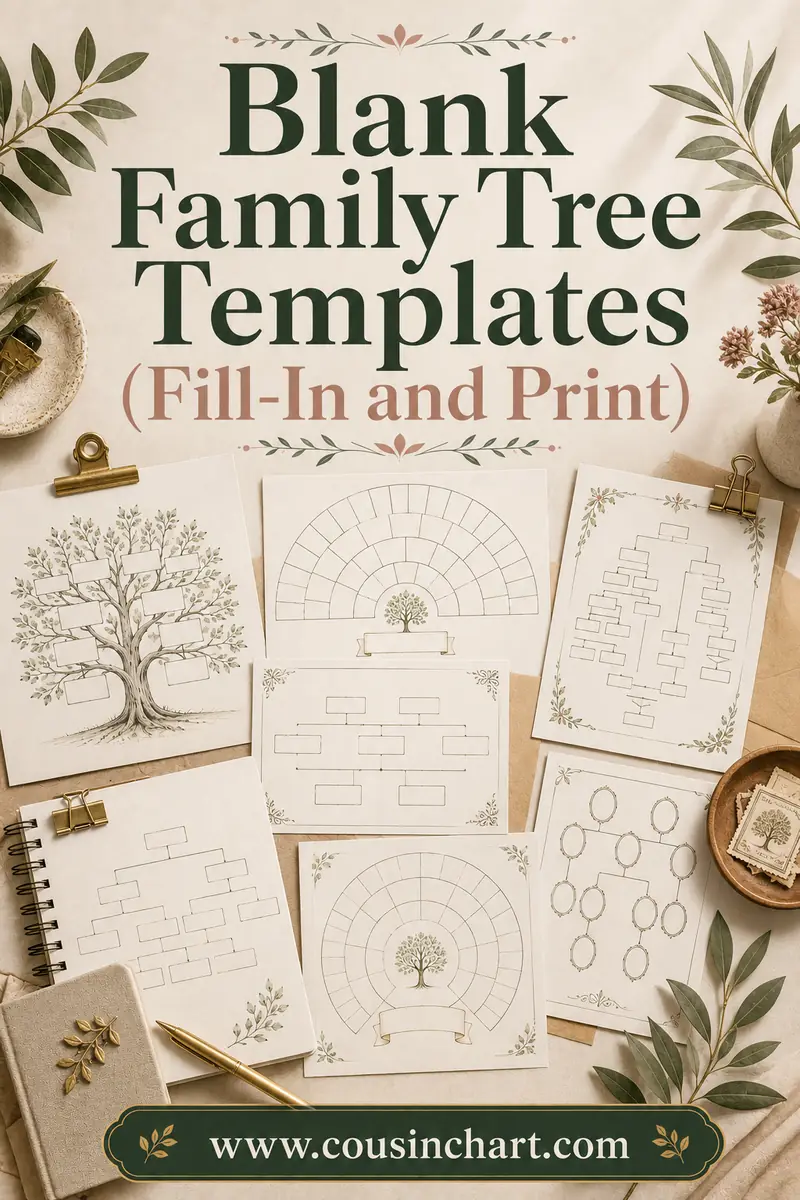
Free blank family tree templates to print and fill in — 3, 4, and 5 generation layouts plus sibling and fan versions, with tips for choosing the right one.
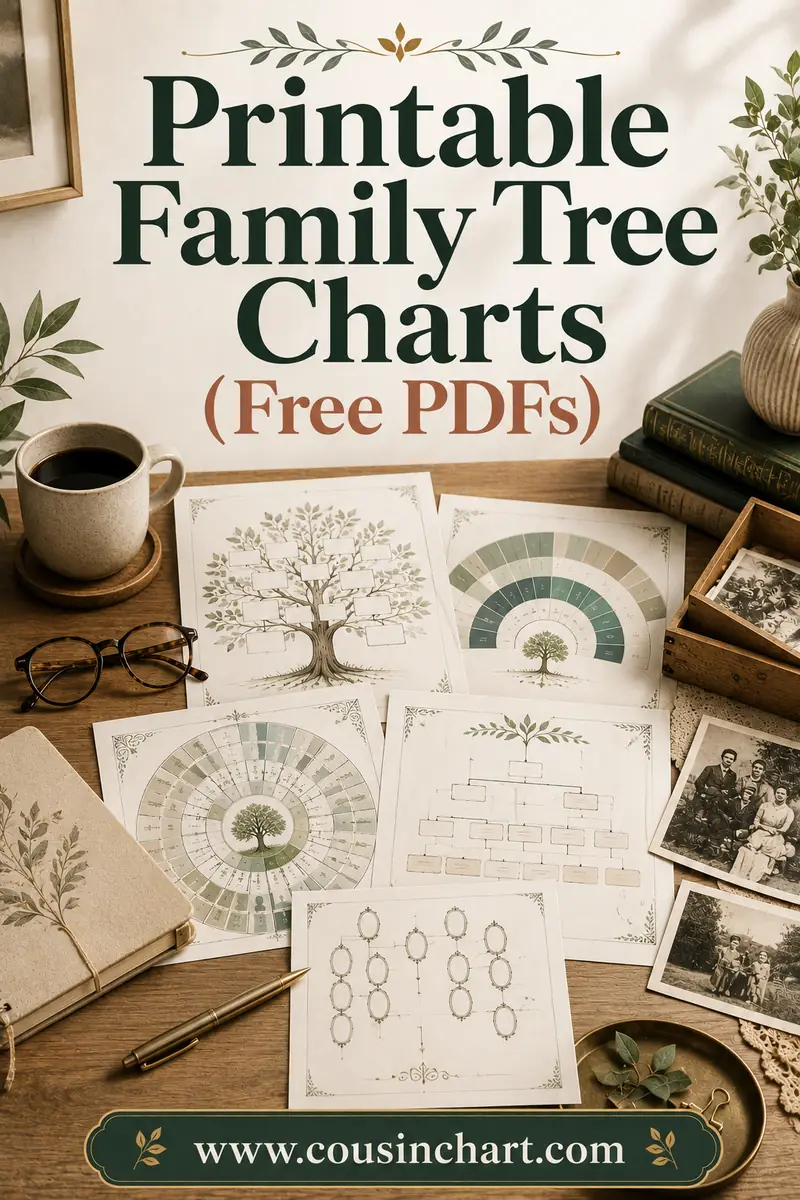
Free printable family tree charts: 3, 4, and 5 generation PDFs, fan and cousin charts, plus exact print settings, paper picks, and display ideas that work.
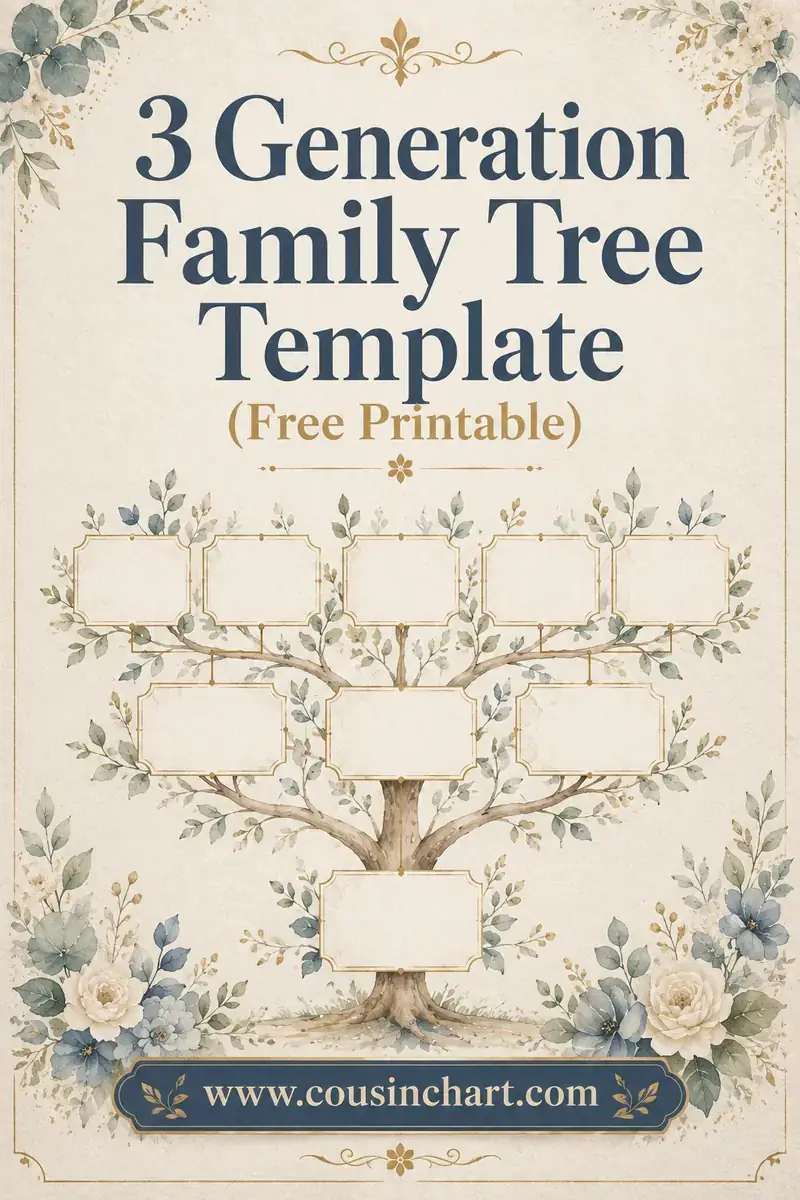
Free printable 3 generation family tree template — 7 boxes for you, parents, and grandparents, plus fill-in tips, sibling variations, and school project ideas.
Free printable 4 generation family tree template: 15 boxes to great-grandparents on one landscape page, with fill-in order, box math, and interview questions.
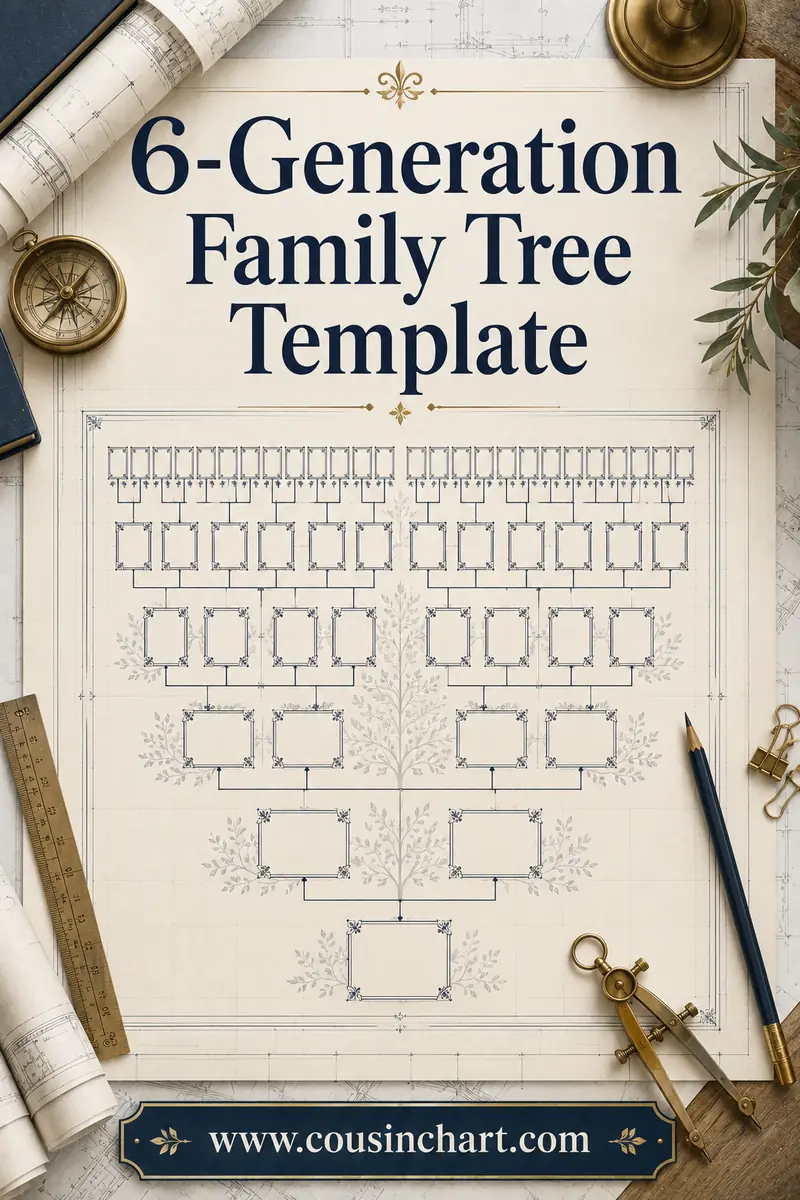
Free 6 generation family tree template: 63 boxes to your great-great-great-grandparents, with poster and multi-page layouts, numbering, and fan alternatives.
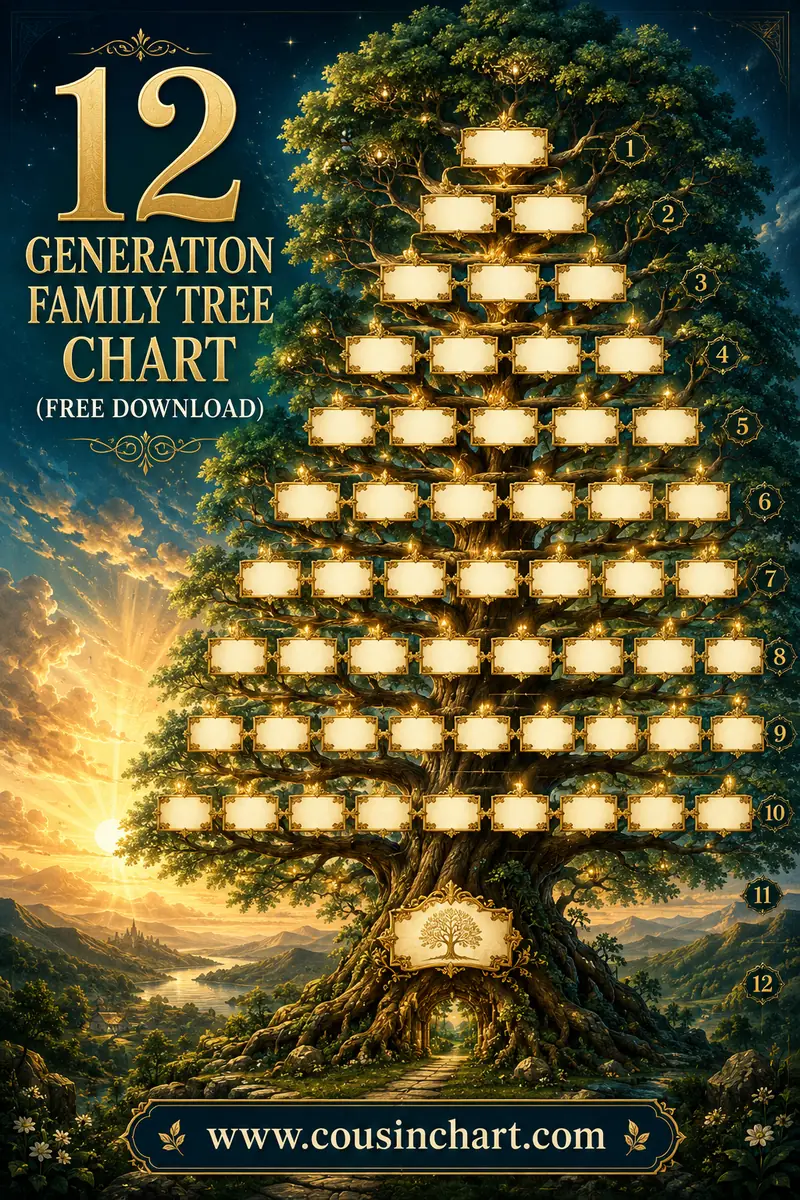
Free 12 generation family tree chart download: the ancestor math (4,094 slots), poster and fan formats that actually fit, print sizes, and a filling strategy.
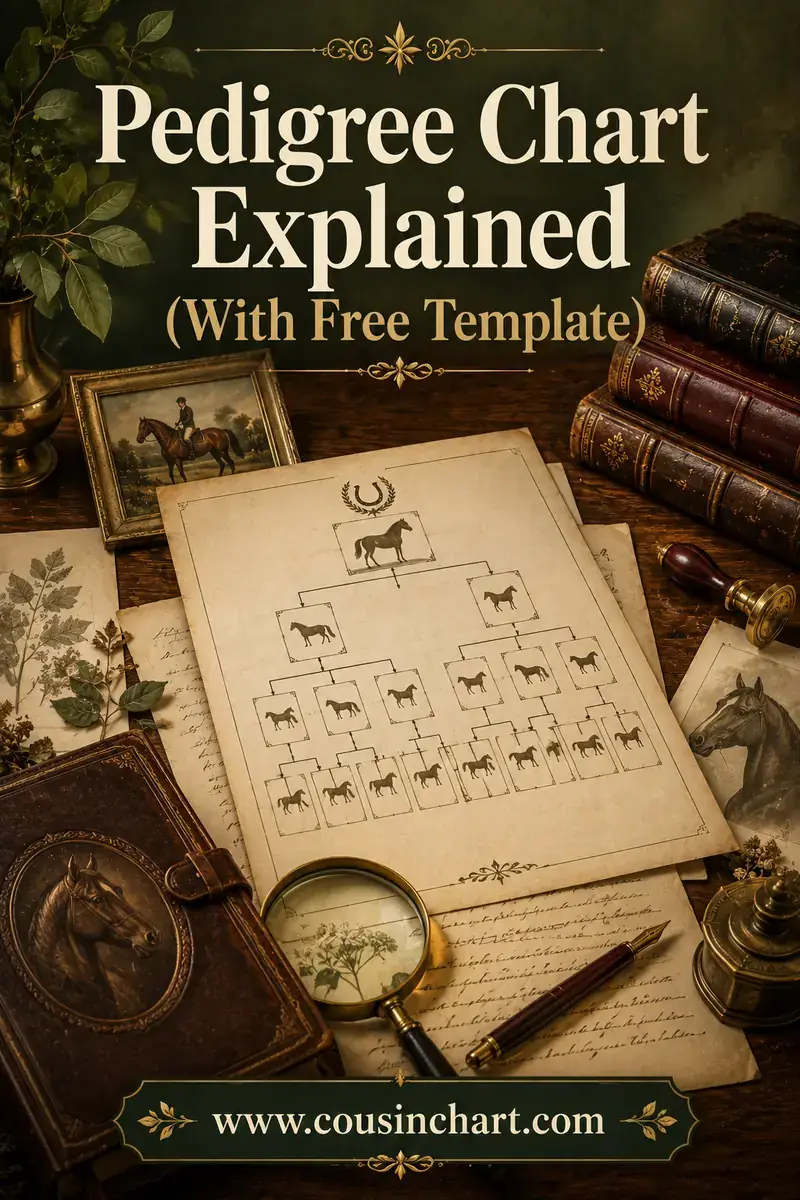
Free blank pedigree chart templates from 4 to 15 generations: box counts, standard fields, cascading chart numbering, print sizes, and how to fill one in right.
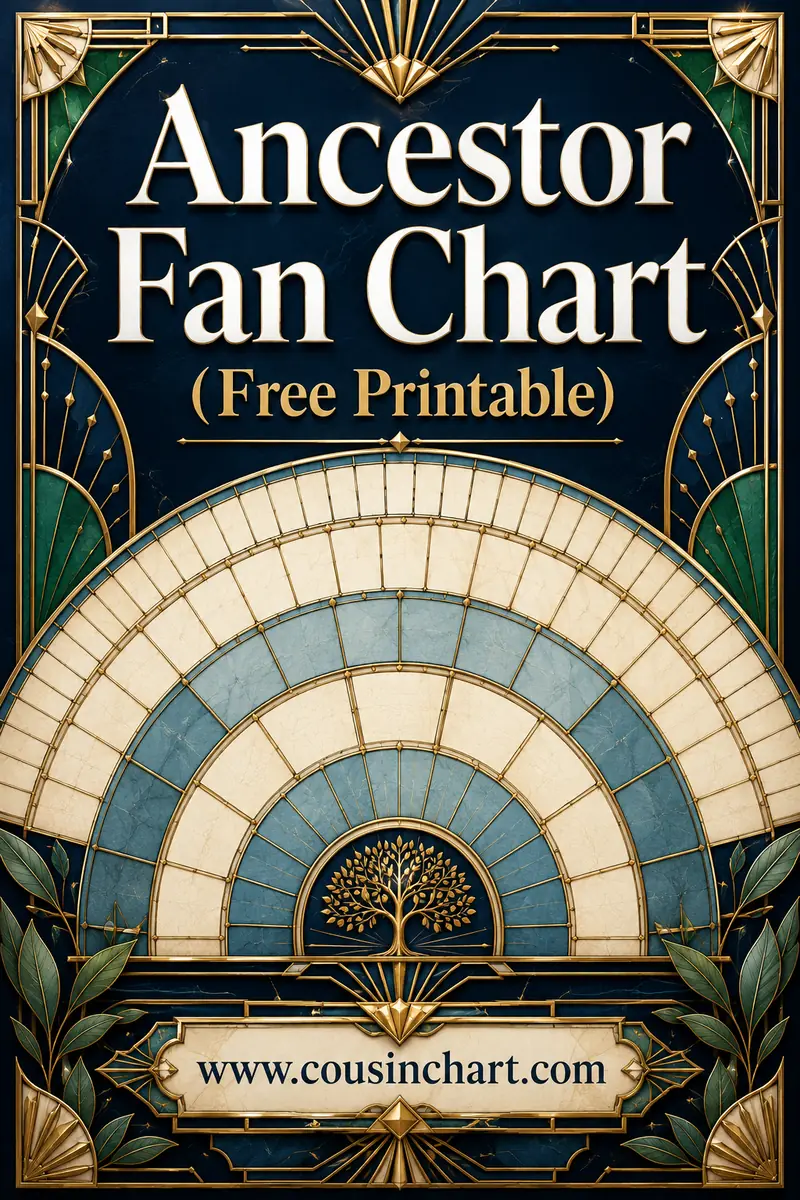
Genealogy fan chart templates and a full how-to: half vs full circle, how many generations fit each size, filling technique for curved boxes, and print tips.
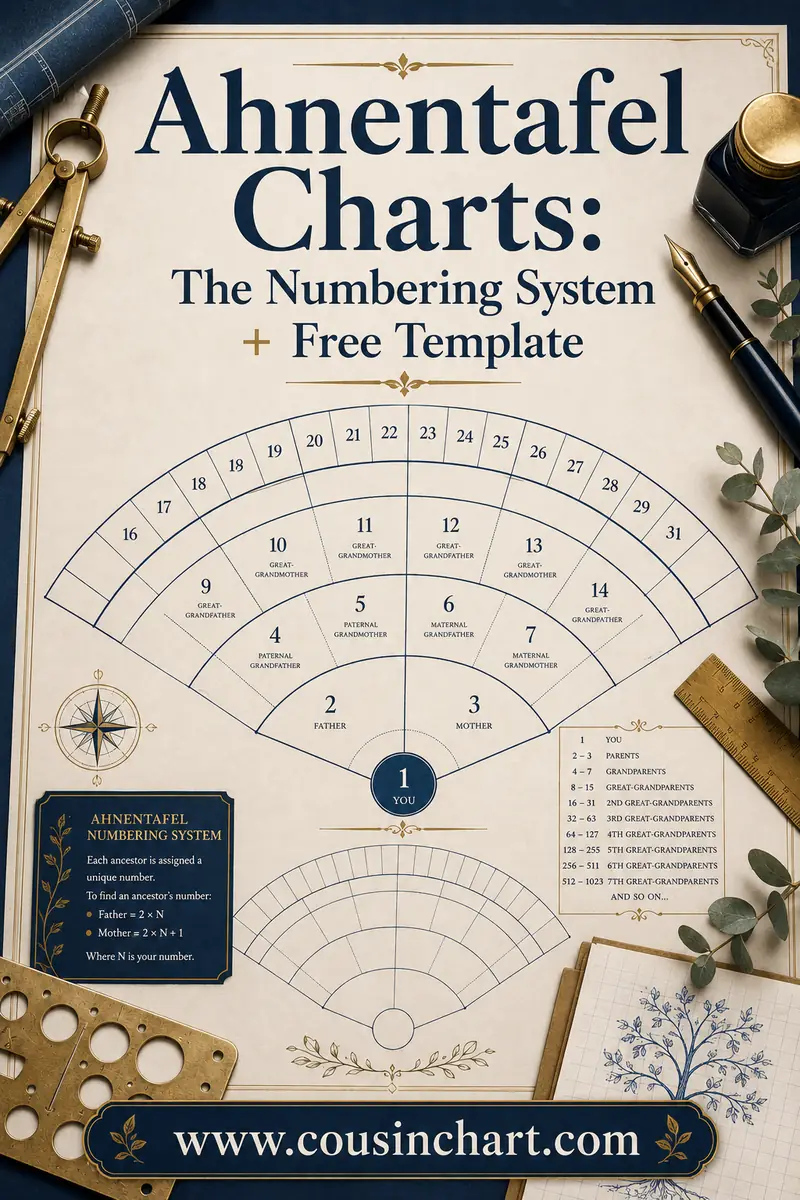
The ahnentafel chart explained: how the 2n numbering works, the binary trick that decodes any number, a worked example, plus a free printable template.
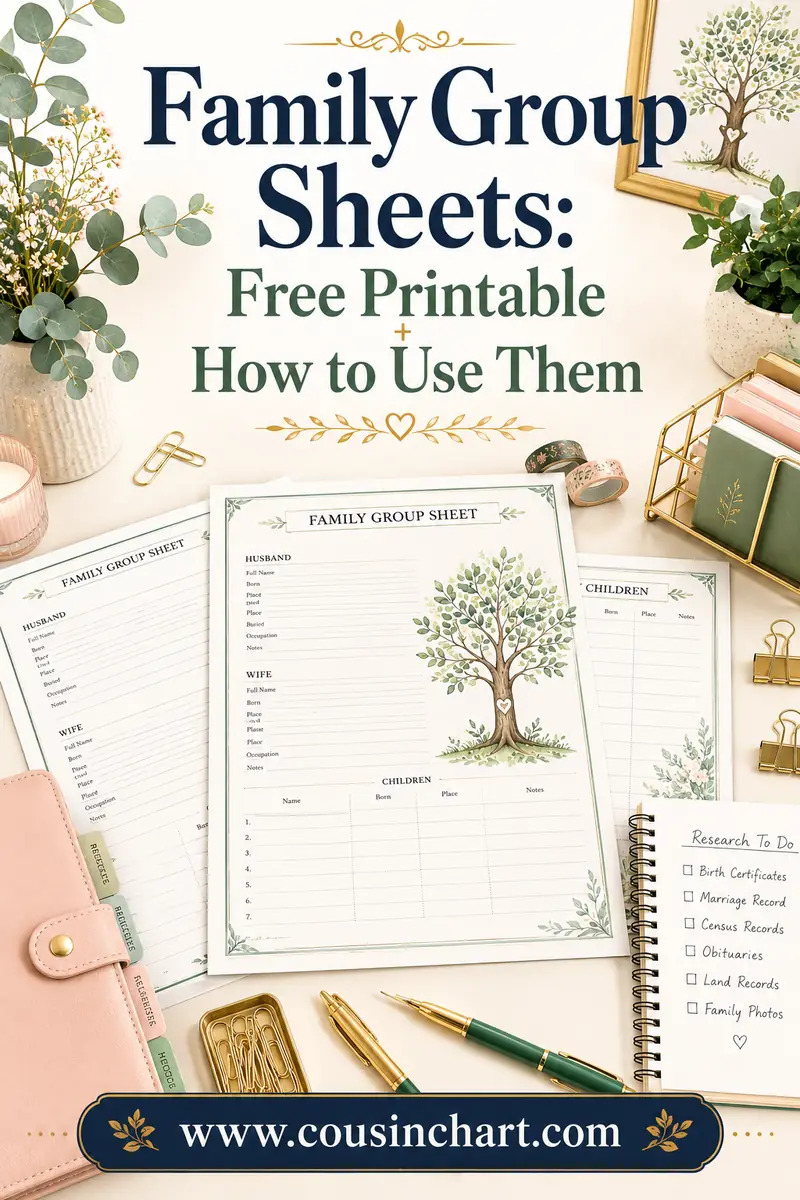
Free printable family group sheet: every field explained, one-sheet-per-couple rules, how sheets link to pedigree charts, and the filing habits that scale.
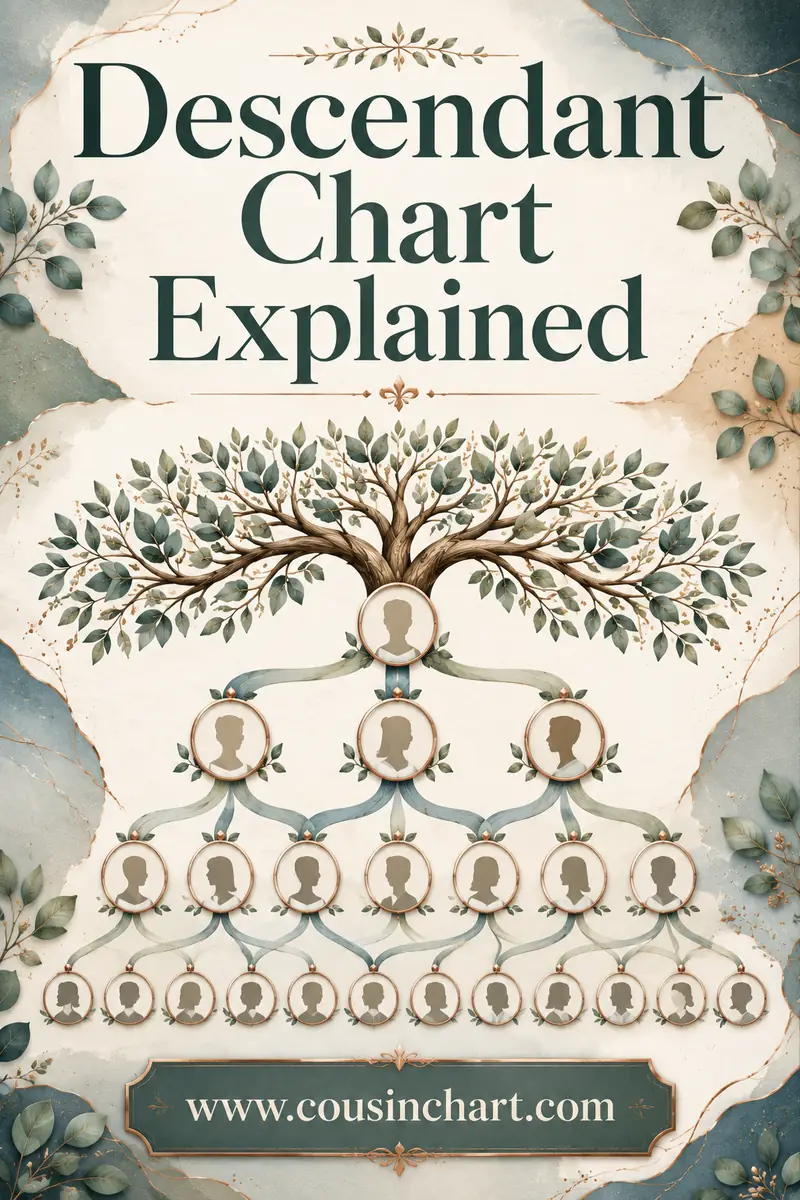
Free printable descendant chart template: how the top-down layout works, drop-line drawing rules, numbering systems, sizing for big families, and print tips.
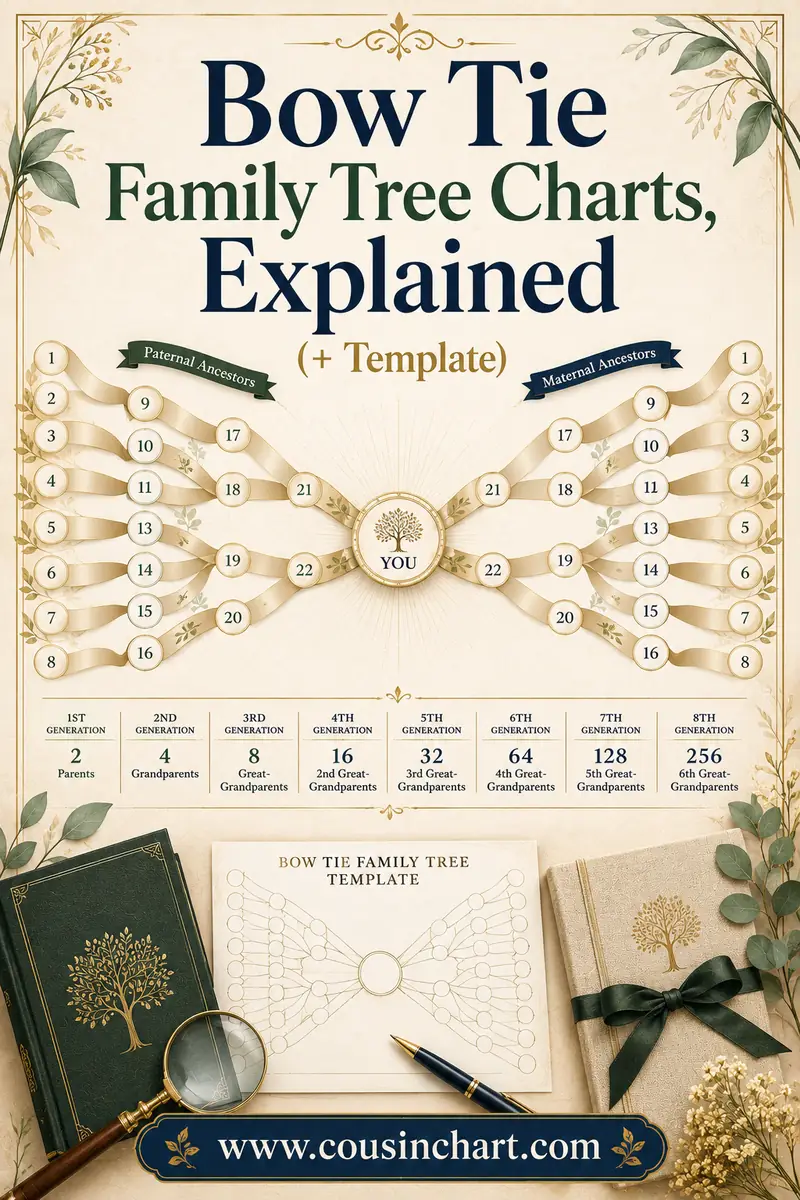
The bow tie family tree chart explained: you in the middle, dad's ancestors left, mom's right. Layout math, the wedding couple variant, and a free template.
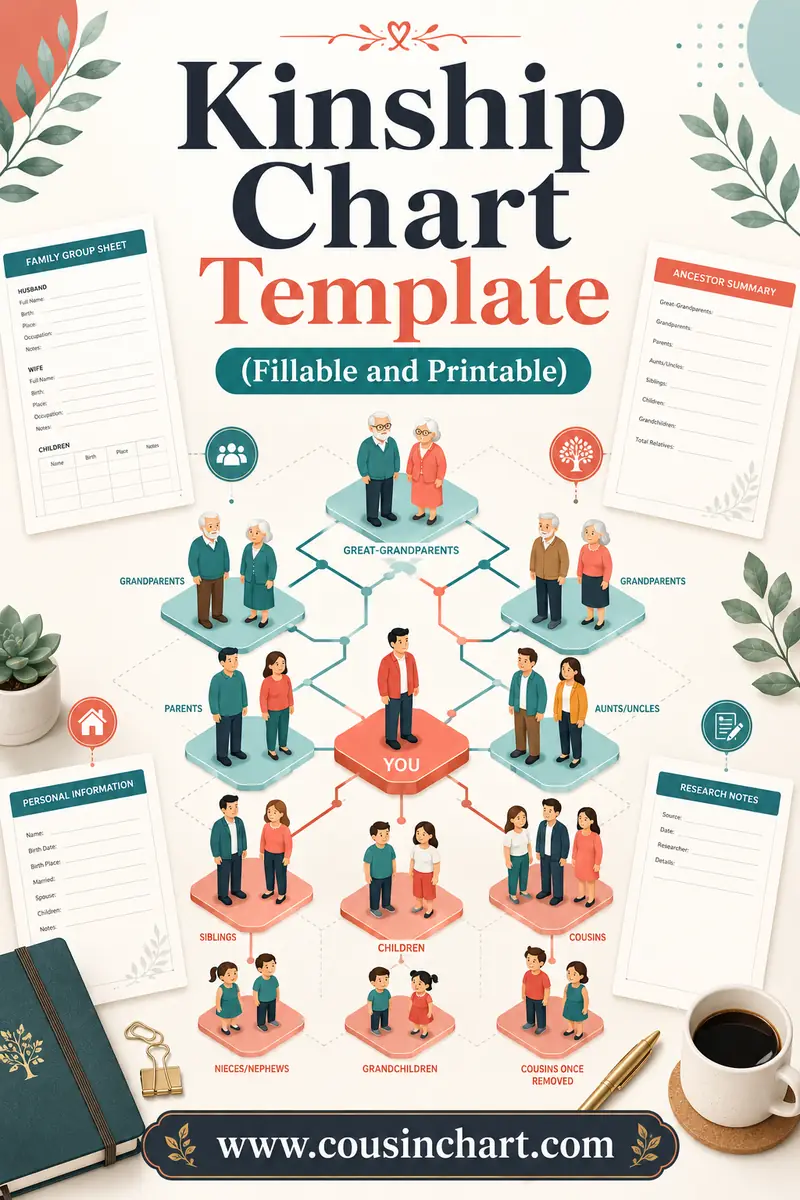
Free fillable kinship chart template: how the relationship grid works row by row, how to trace any cousin in ten seconds, plus the anthropology-style version.
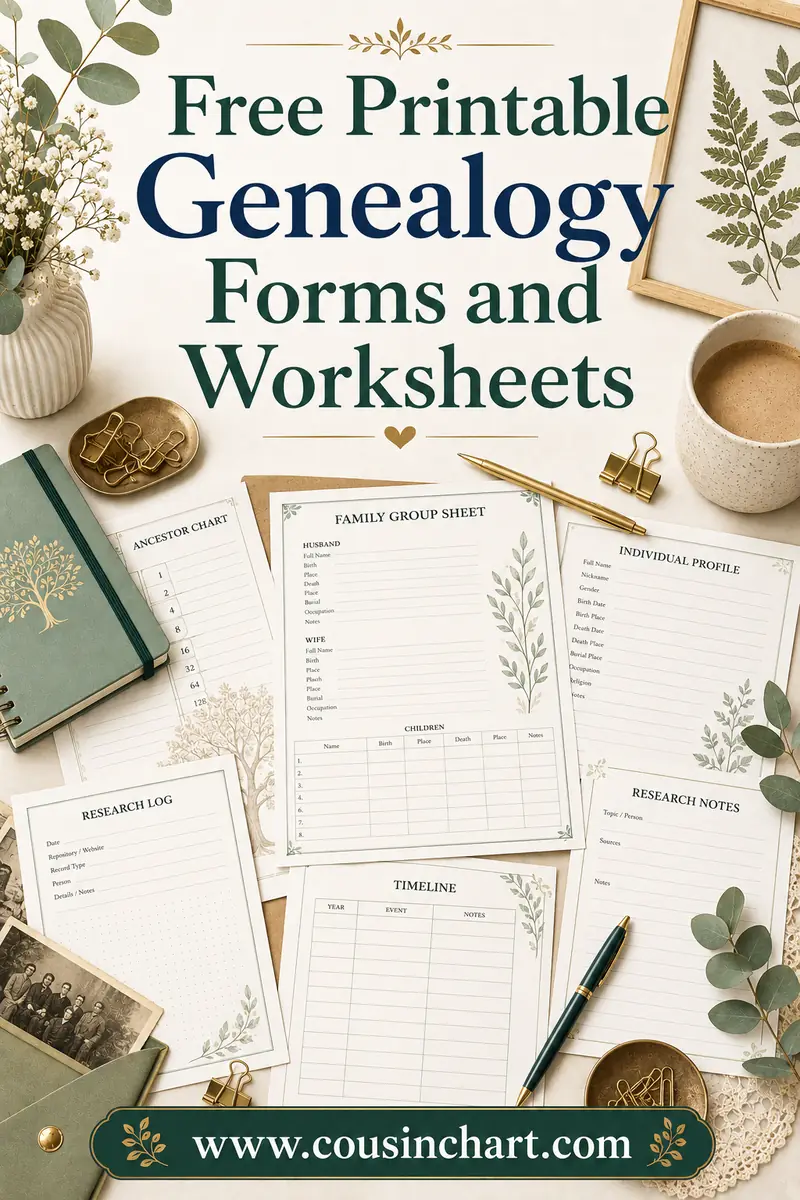
Every free printable genealogy form explained: pedigree charts, family group sheets, research logs, census extraction forms, and how to organize the binder.
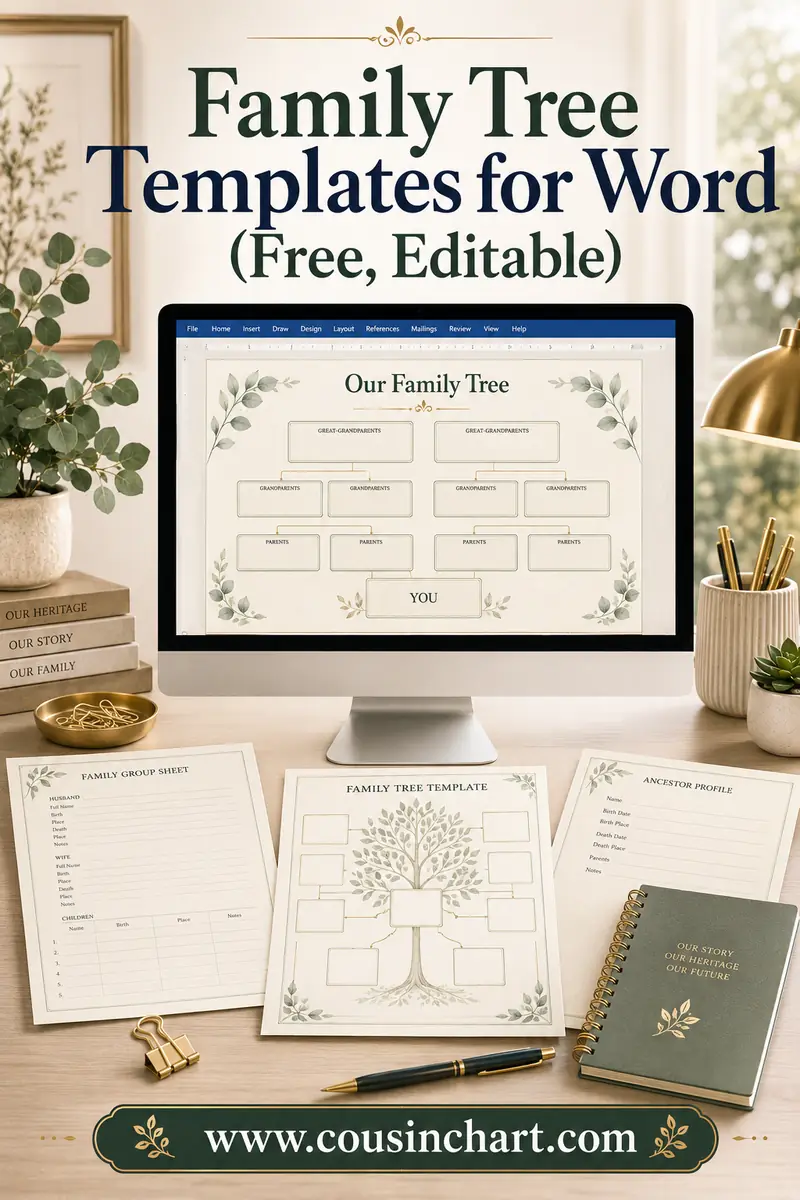
Free editable family tree templates for Microsoft Word, plus the three build methods — SmartArt, text boxes, tables — and which one survives a growing tree.
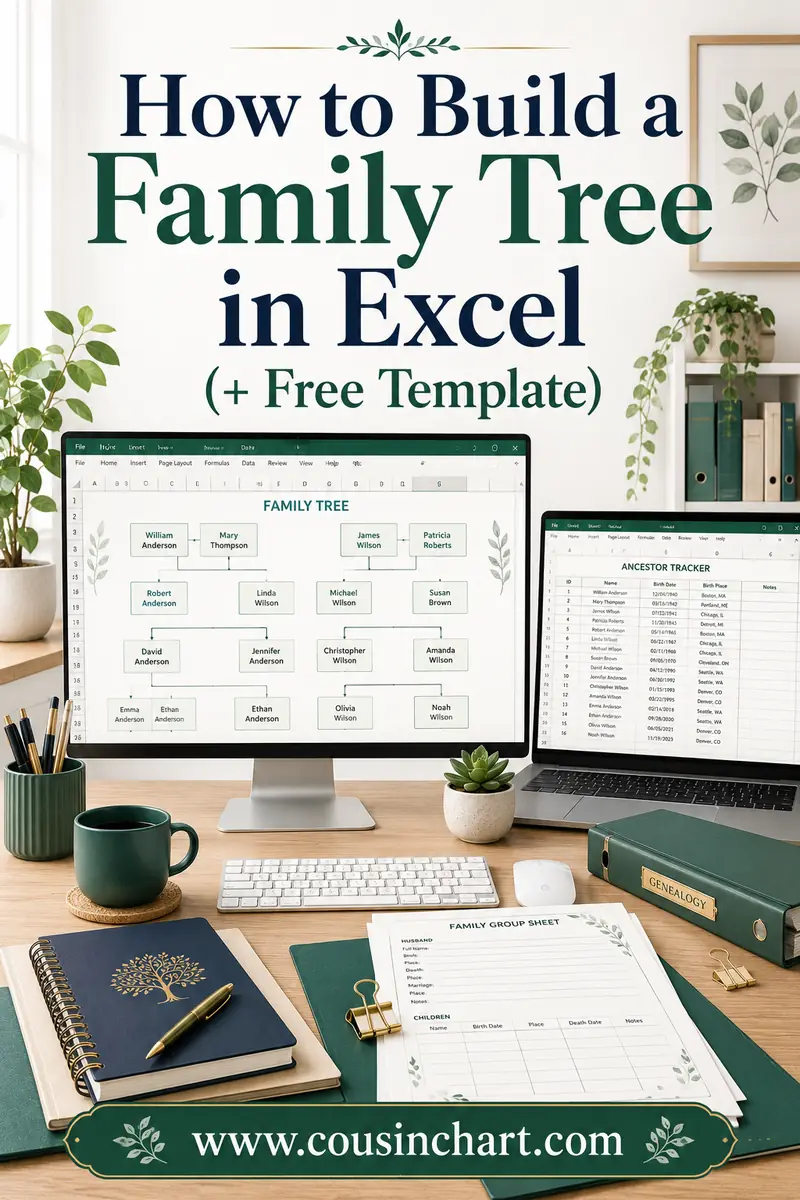
Build a family tree in Excel step by step: the merged-cell grid method, an ahnentafel numbering formula, SmartArt option, and print settings that don't shrink.
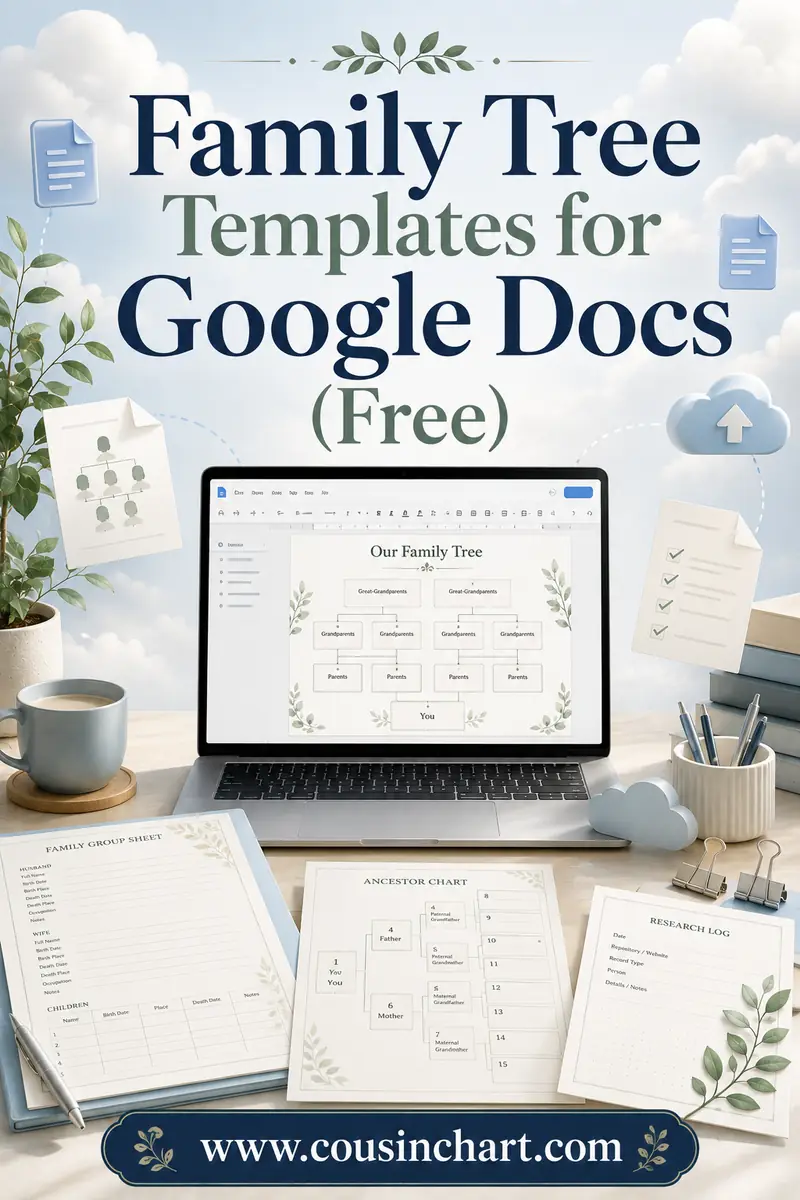
Make a family tree in Google Docs free: the Drawing method, the table method, and the shared-link trick that lets relatives fill in their own branches live.
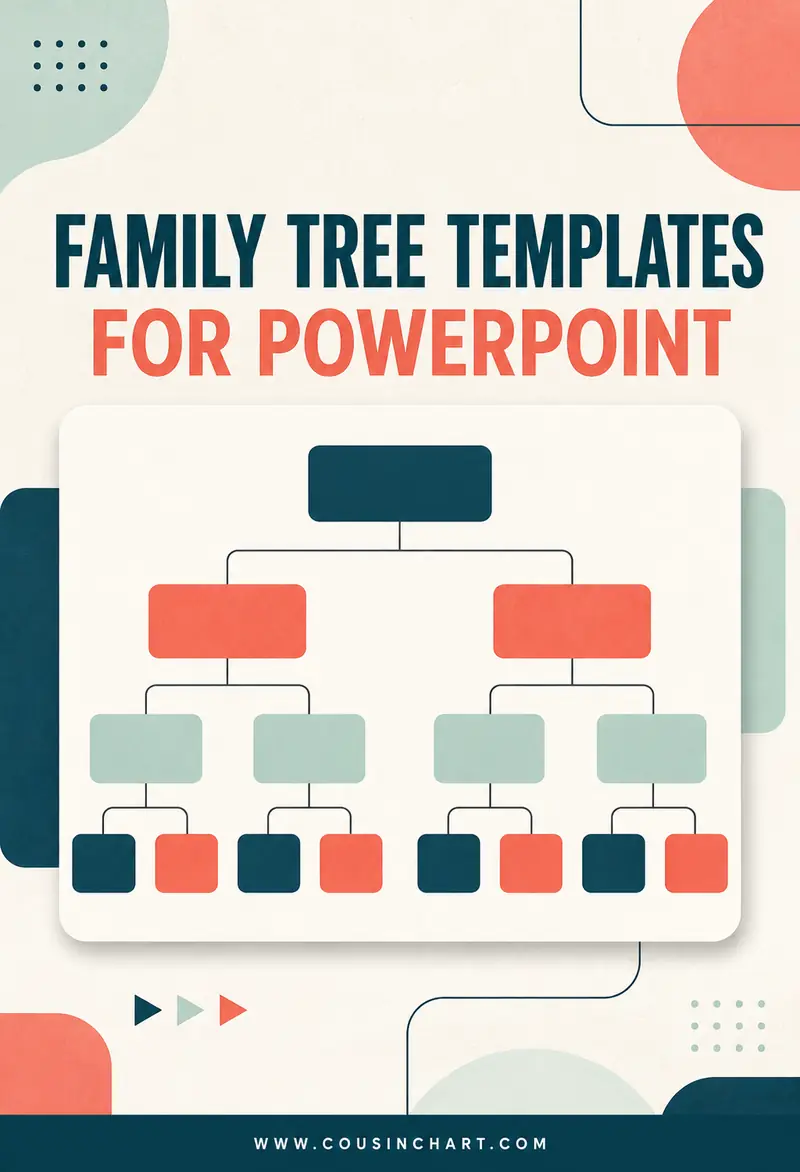
Why SmartArt cannot show two parents, the connector trick that keeps a tree tidy when you move boxes, and the slide setup to fix before you type a single name.
Photos change what a family tree holds: three generations, not five. Cropping, resolution, matching mismatched eras, and the layout that keeps faces readable.
Why standard templates break past three generations, and the formats that scale: fan charts, descendant charts, tiled printing and splitting a family by branch.
A direct-line tree leaves out everyone you actually know. How to add siblings, aunts, uncles and cousins without the chart collapsing, and where to stop.
Standard templates assume one marriage per person. How to chart divorce, remarriage, half-siblings and step-relations honestly, without anyone as a footnote.

A genogram maps relationships, not just descent. The full symbol key, how to build one in three passes, and where it differs from an ordinary family tree.
What separates a genuinely free genogram tool from a trial: symbol coverage, export options, and whether family medical data ever leaves your own computer.
Four worked genogram examples read symbol by symbol — a standard family, a divorce, a blended household and a medical pattern — plus what each one reveals.
What separates genuinely free family tree software from a trial: GEDCOM export, offline storage, and who owns your research. Plus when a spreadsheet wins.
Three generations, big boxes, room for photos. How to pitch a family tree by age, and how to handle adoption, step-parents and absent relatives kindly.
The Spanish family tree vocabulary, why Hispanic surnames use both parents' names, and how that changes what a template needs. Printable and classroom versions.
A cousin chart turns two people's relationship to a shared ancestor into a name. How to read one, print it properly, and when to use the calculator instead.
The chapter structure, page layout and front matter a family history book needs, plus how long it should run and where most unfinished manuscripts stall.
How accurate is AncestryDNA? Its DNA reading and relative matching are reliable, while ethnicity percentages are educated estimates. Here is the full picture.
How accurate is 23andMe? Its DNA reading and relative matching are reliable, while ethnicity and health results are estimates and screens. Here is the truth.
AncestryDNA vs 23andMe compared: database size, ethnicity estimates, health reports, family trees, and price. See which fits your goal before you buy a kit.
MyHeritage vs Ancestry compared: database size, ethnicity estimates, free uploads, international records, and price. See which DNA and records service fits you.
MyHeritage vs 23andMe compared: free DNA uploads, health reports, haplogroups, international matches, and records. See which DNA test really fits your goal.
Ancestry vs 23andMe vs MyHeritage compared head to head: database size, ethnicity, health, records, uploads, and price. Find which DNA test fits your goal.
How accurate is MyHeritage DNA? Its DNA reading and relative matching are reliable, while ethnicity estimates are educated guesses. Here is what to trust.
The best DNA test for ancestry depends on your goal. Compare AncestryDNA, 23andMe, MyHeritage, and FamilyTreeDNA by database, records, and features here.
The cheapest DNA test is often a free raw-data upload. See what you get free, under $50 on sale, and at full price, plus how to spend the least for matches.
The best DNA test for ethnicity depends on your roots and the reference panels each company uses. Compare how the major kits actually estimate ethnicity here.
How accurate are DNA ethnicity estimates? Reliable at the continental level, fuzzy at the country level, and always estimates. Here is how they work and why.
A clear DNA test comparison chart: AncestryDNA, 23andMe, MyHeritage, and FamilyTreeDNA side by side on database, records, health, haplogroups, and uploads.
DNA matches explained in plain English: what centimorgans and segments mean, how close matches differ from distant ones, and why some relatives never show up.
Why consumer DNA tests detect Indigenous American ancestry poorly, why a zero result proves nothing, and why no DNA test can support tribal enrolment.
What is a centimorgan? A cM measures genetic distance, not percentage. See typical cM totals by relationship, total vs longest segment, and why numbers vary.
No DNA test can prove Cherokee ancestry or support enrolment. Here is what a test really shows, why the family story often fades, and which records count.
How to read the shared centimorgan chart, why the 25% cluster is so ambiguous, and the four filters that narrow a cM number down to one likely relationship.
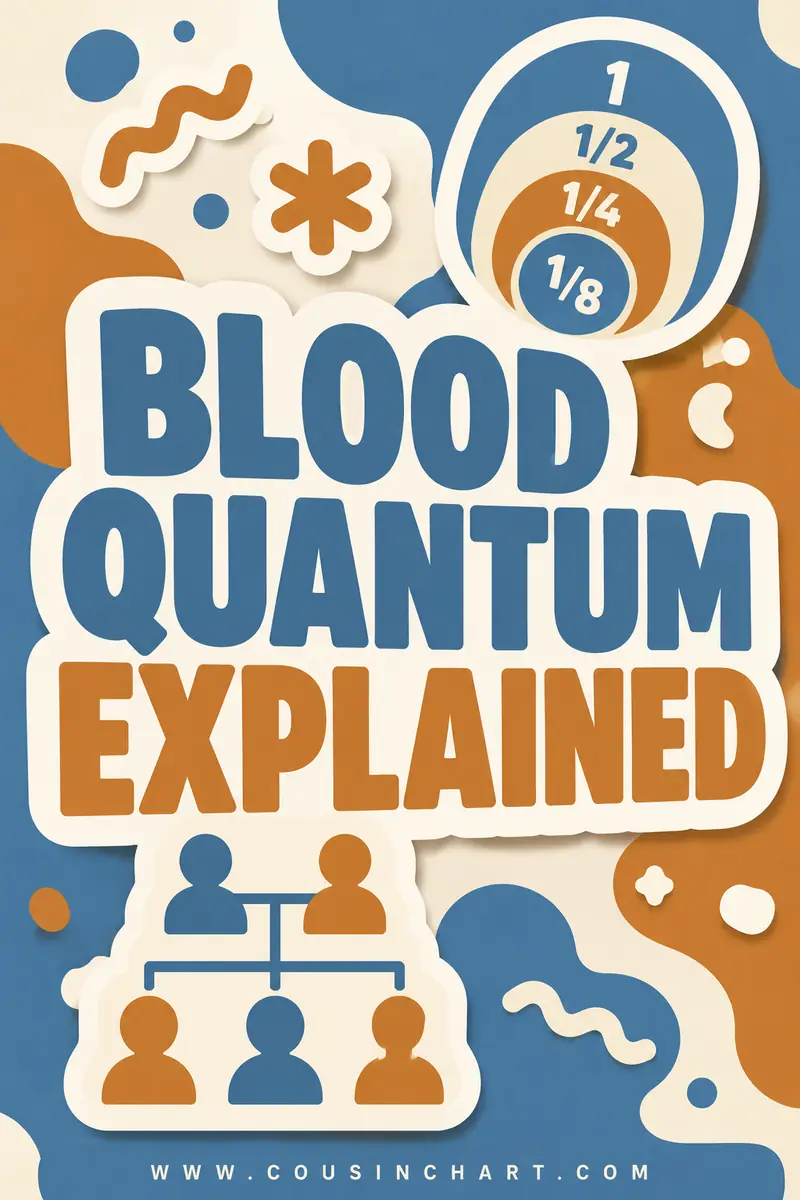
Blood quantum is a paper fraction inherited from historical rolls, not a DNA percentage. How it started, how it is calculated, and why the two never match.
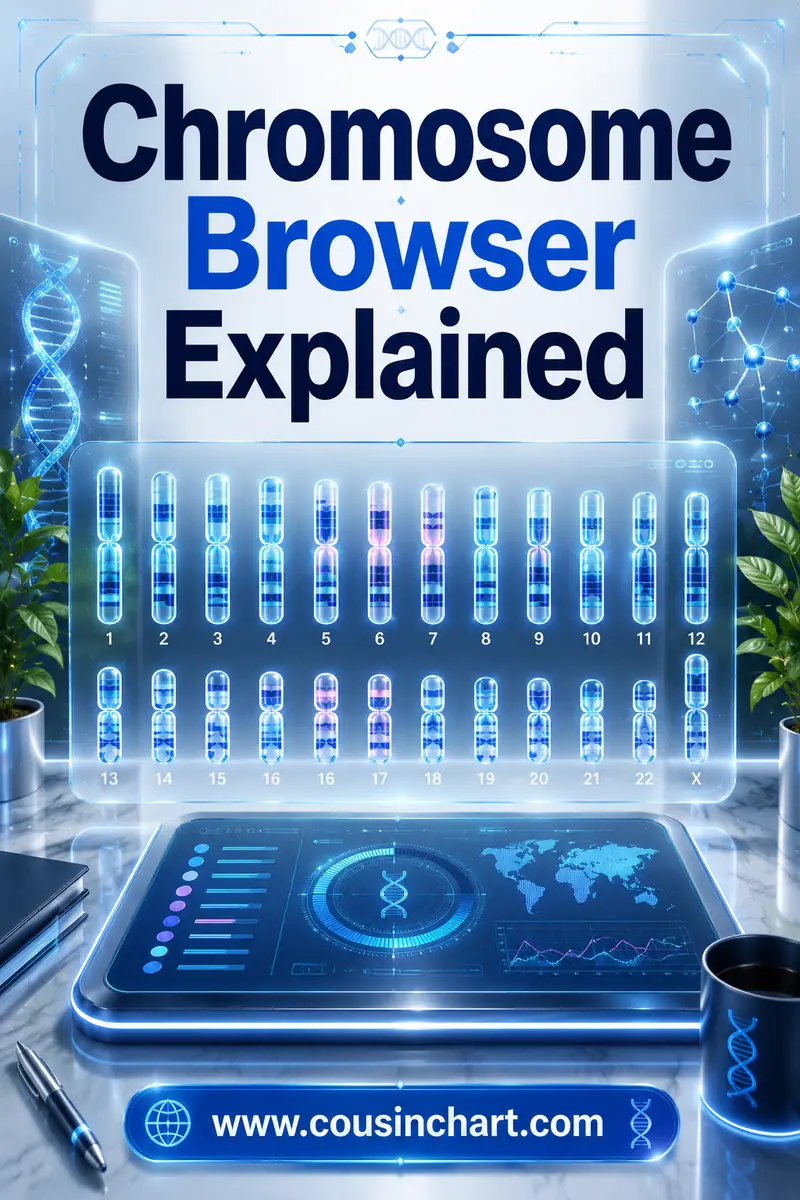
A chromosome browser shows exactly where you and a DNA match overlap. Learn which companies have one, how to read segments, and what triangulation proves.
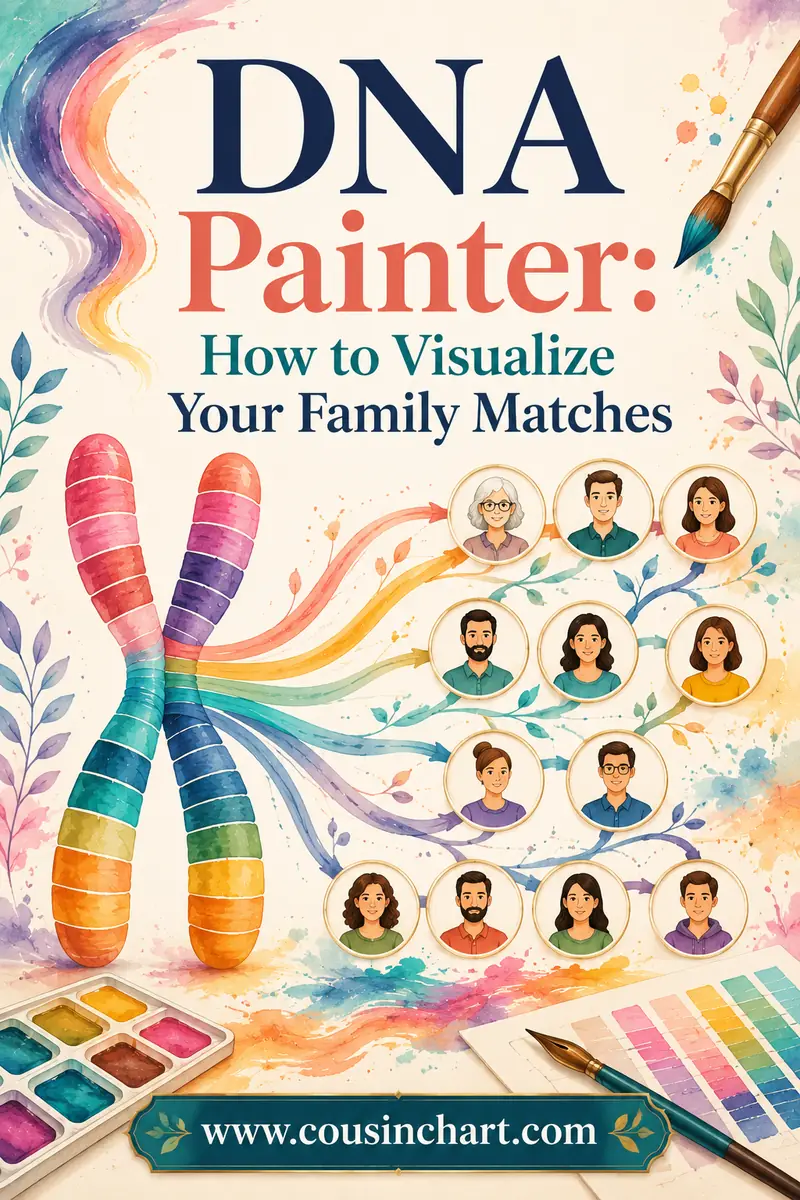
DNA Painter is a free site that turns shared cM into likely relationships and maps segments to ancestors. Here is how to use both tools, step by step.
Proving Native American ancestry takes documents, not a DNA kit. The rolls, records and order of research that actually establish a documented lineal descent.
Which DNA test works best for African ancestry, why regional estimates stay broad, what lineage tests really show, and why match databases matter far more.
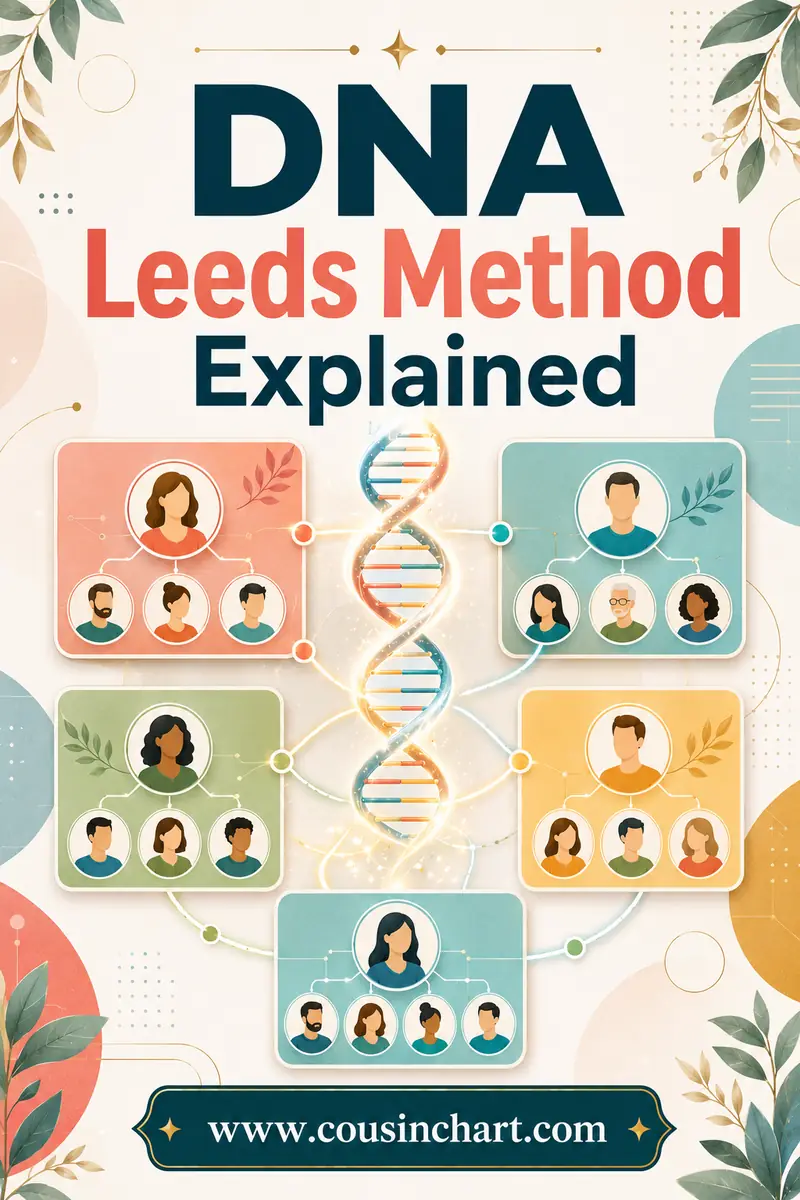
The Leeds Method sorts your DNA matches into four color clusters, one per grandparent line. Full step-by-step walkthrough with a worked spreadsheet example.
Which DNA test suits Hispanic and Latino ancestry, why Iberian and Indigenous results stay fuzzy, how endogamy inflates matches, and when records beat testing.
Confirming a DNA match takes more than centimorgans. Use shared matches, ages, family sides, records and triangulation to prove exactly how you're related.
Which DNA database an adoptee should test in first, which free uploads are worth doing, and what your closest match predicts about how hard the search will be.
A step-by-step unknown parent DNA search: which test to take, where to upload, how to cluster matches, realistic timelines, free help, and contacting with care.
Mirror trees were once the standard trick for unknown-parent searches. Here's how they worked, why researchers moved on, the ethical rules, and better methods.
No DNA test can prove Viking ancestry - Viking was a job, not a bloodline. What a Scandinavian percentage means, and why 1,000 years defeats autosomal DNA.
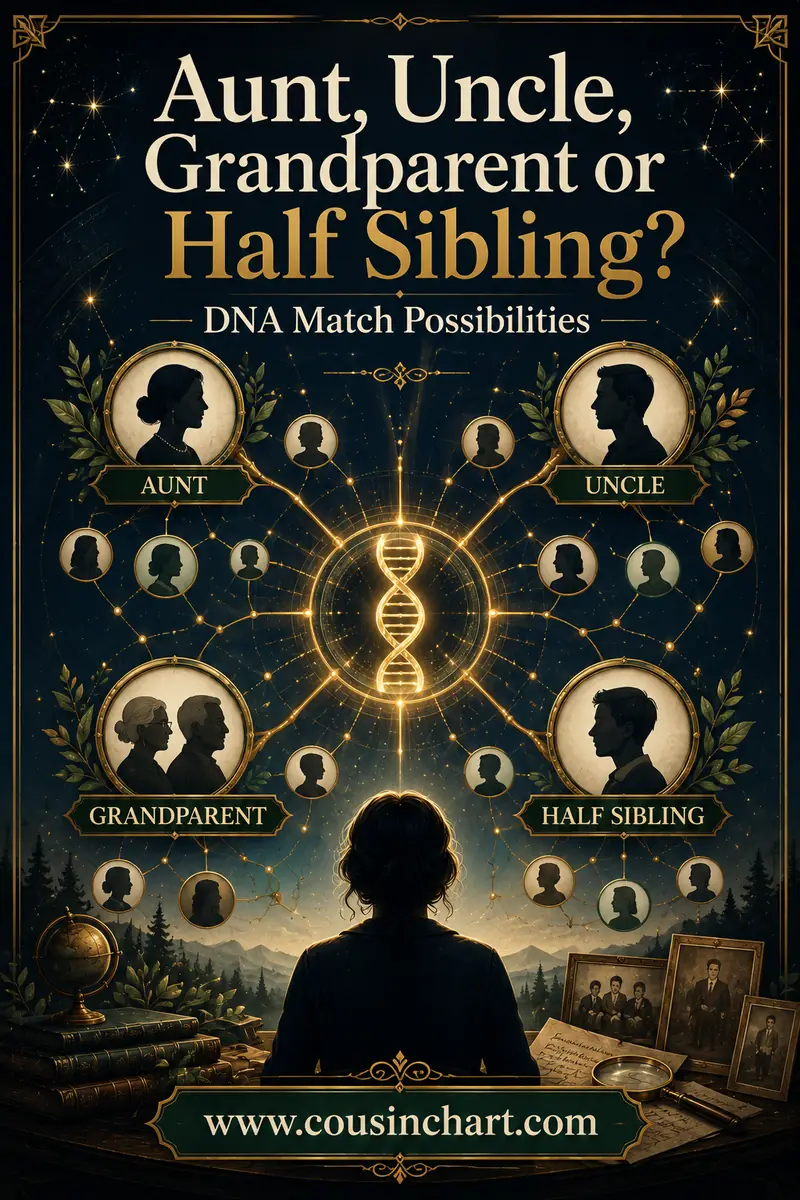
A DNA match at 1,300-2,300 cM could be a half-sibling, grandparent, aunt or uncle. Here's exactly which clues separate them - and which ones don't.
Which DNA test identifies a half-sibling, how the match appears on consumer sites, and why an accredited siblingship test needs the shared parent to be sure.
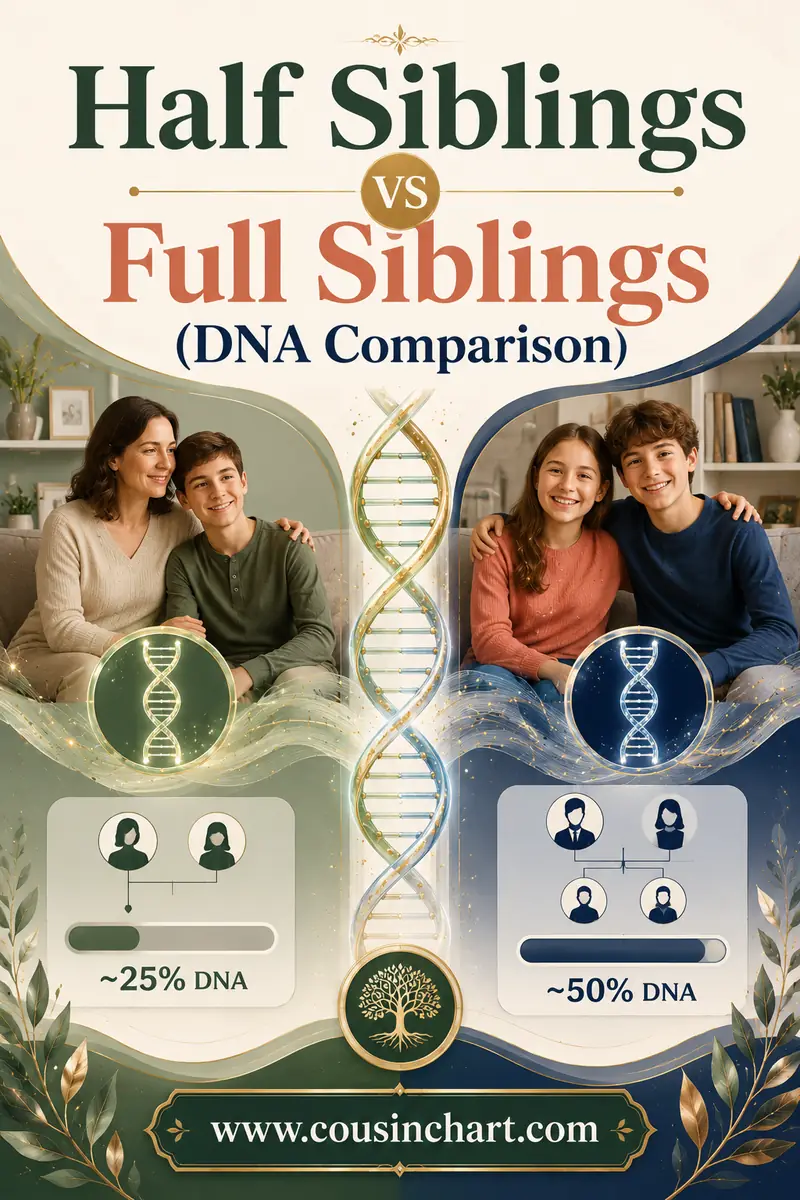
Full siblings share about 2,300-3,400 cM; half-siblings about 1,300-2,300 cM. Here's how to tell them apart confidently and what to do with a surprise.
Ethnicity percentages, missing cousins, changed results, legal proof - here are 10 DNA testing myths and the honest facts behind each one.
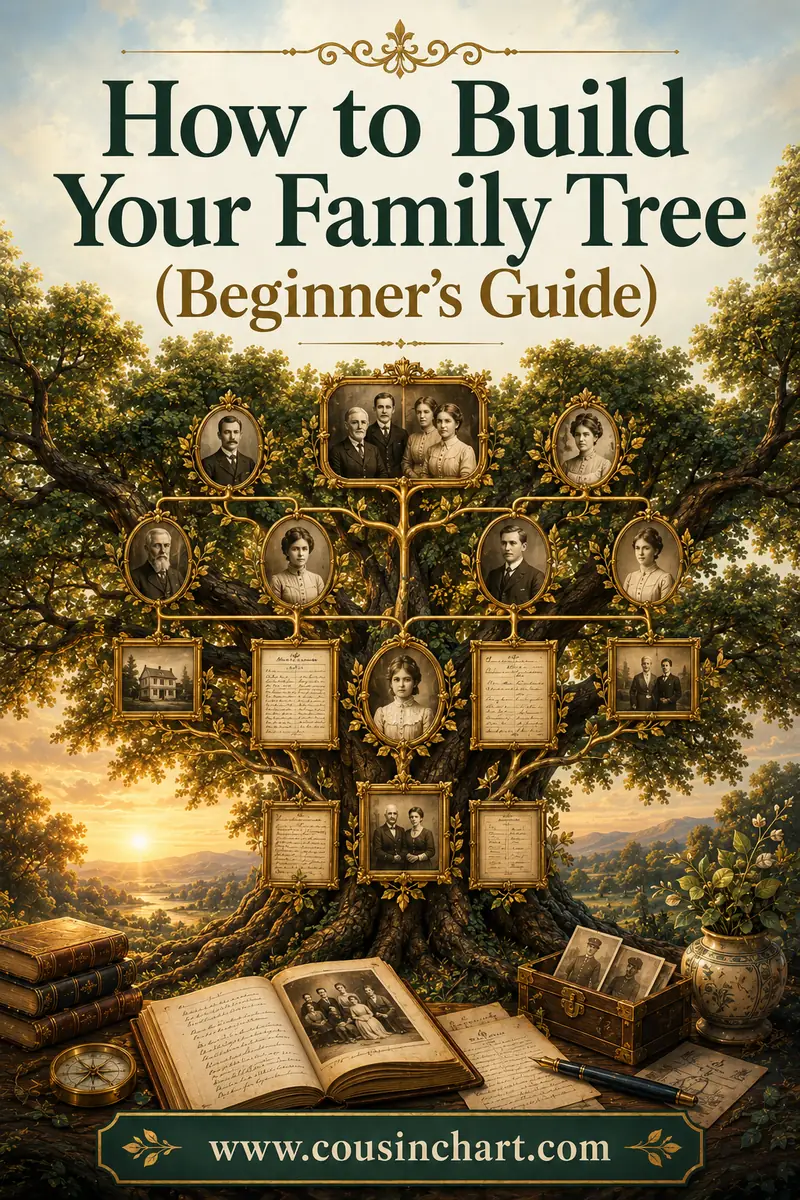
How to build a family tree from scratch: start with yourself, interview relatives, search free records, and cite every source so you never redo the same work.
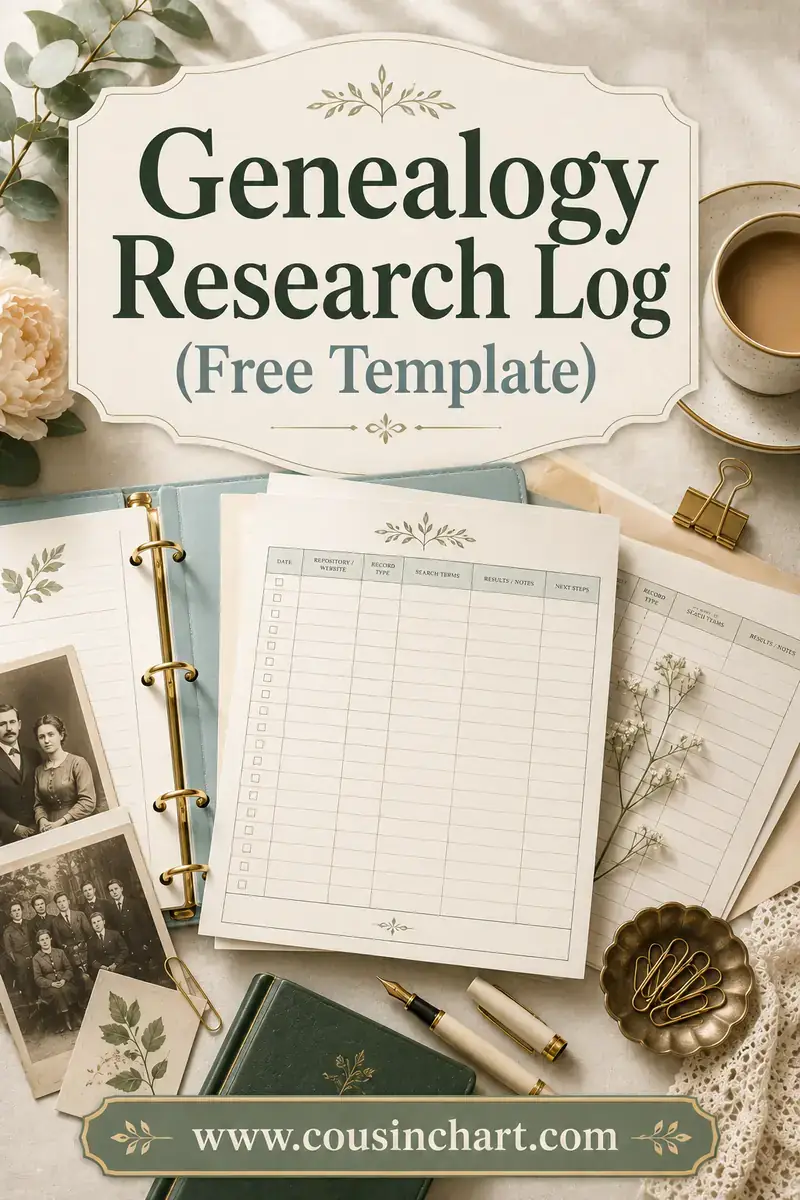
A genealogy research log records every search you run, including the ones that find nothing. Here are the exact columns to use, a worked example, and free options.
How to organize genealogy research: surname, family group and Ahnentafel filing compared, file naming rules, backups, citations and the Genealogical Proof Standard.
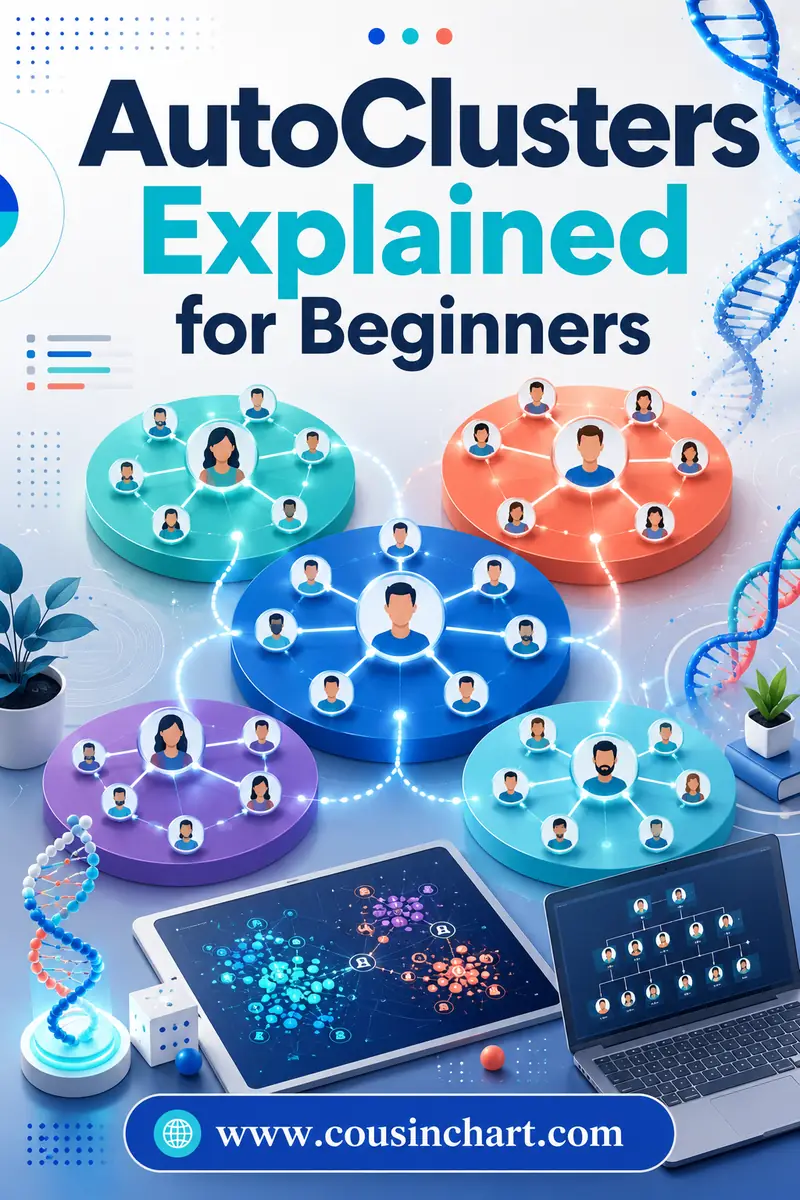
AutoClusters group your DNA matches into colored clusters by shared ancestor. Where to get them, how to read the grid, the right cM window, and endogamy limits.
How accurate a grandparent DNA test is, why two grandparents and the child's mother change the odds, and when an aunt-uncle or Y-DNA test works better.
DNA paternity tests report 99.9% or higher for an inclusion and 0% for an exclusion. What that means, why the mother helps, and when a brother breaks it.
Find living cousins and lost family branches with DNA testing. The full method, contact etiquette that gets replies, and honest limits on who DNA can and can't find.
Your DNA ethnicity estimate changed because it's an estimate against a reference panel. Why updates happen, why siblings differ, and why companies disagree.
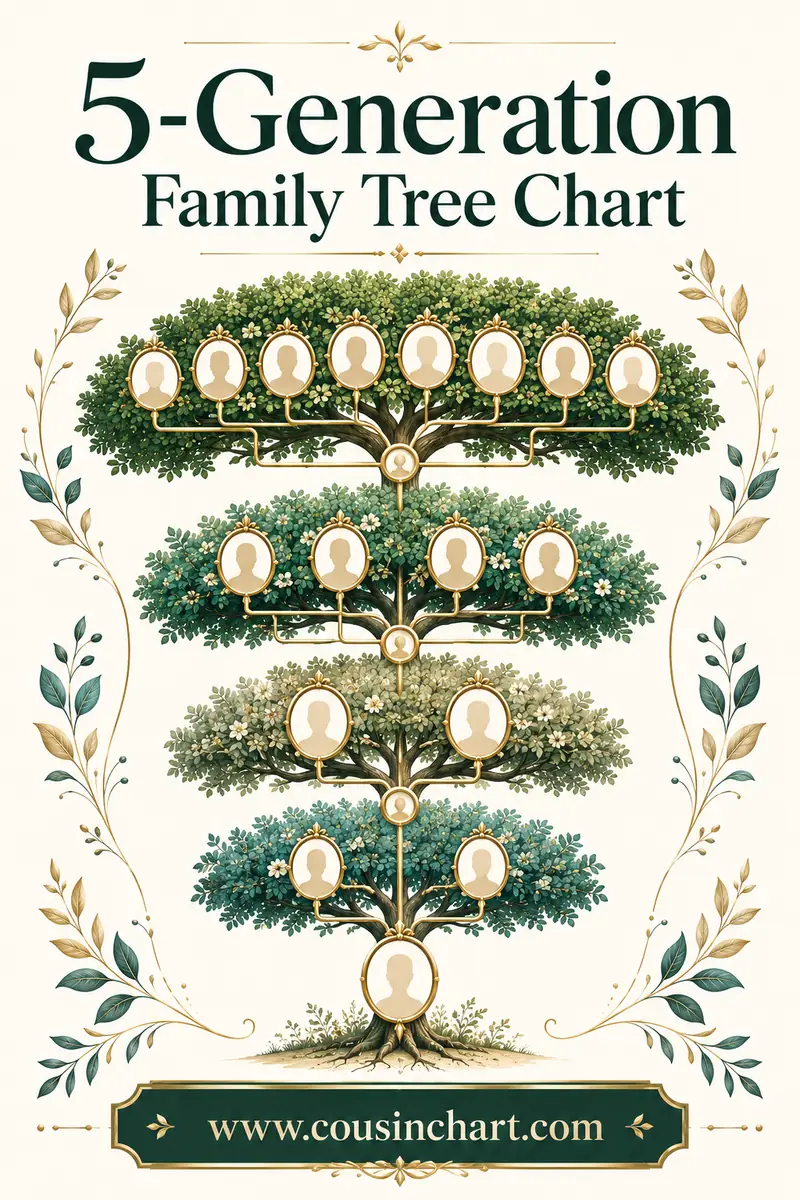
A 5 generation family tree chart holds 31 direct ancestors, from you back to your great-great-grandparents. Here is who goes where, what to write, and how to print it.
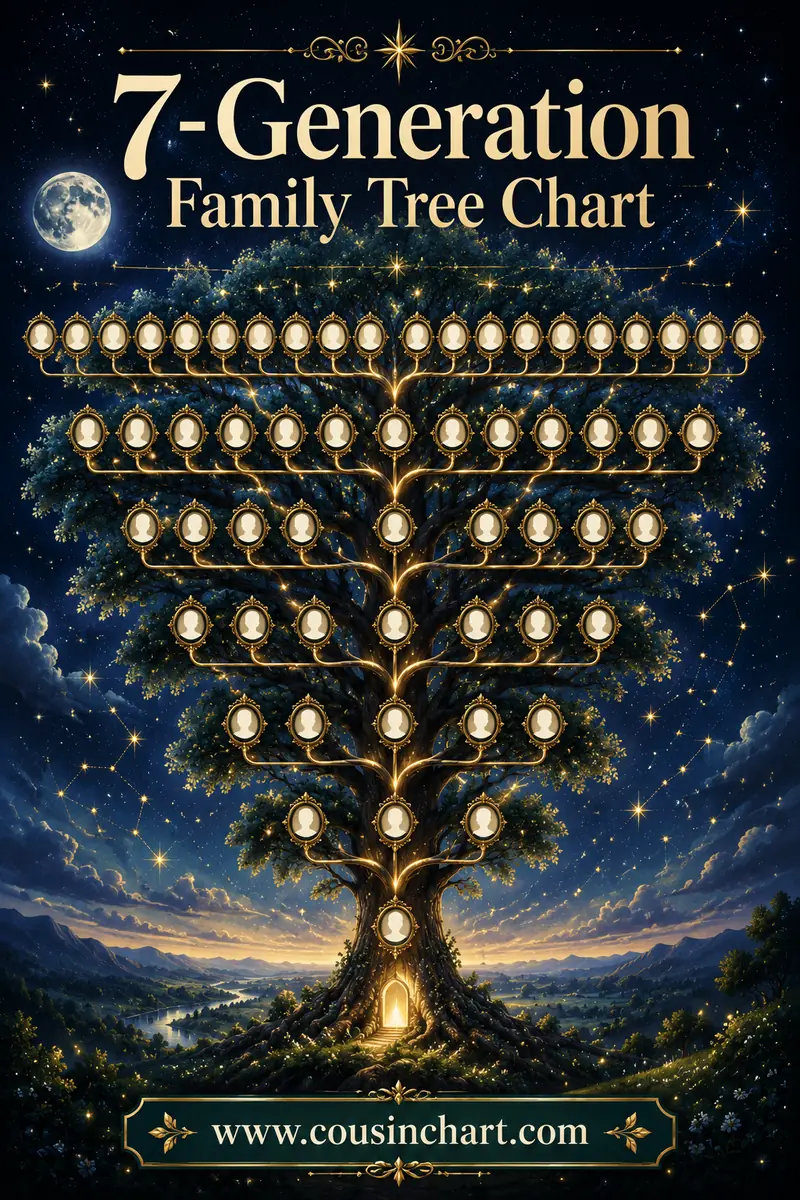
A 7 generation family tree chart holds 127 people. Here is how to print it, whether to use a fan chart or continuation sheets, and how Ahnentafel numbering keeps it straight.

What DNA testing companies hold, how law-enforcement matching works, what happens if a company is sold, and the settings to choose before you post the tube.
What ancestry and health combo DNA kits include: carrier status, risk and pharmacogenetic reports, what they miss, and why a clear result is not a clean bill.
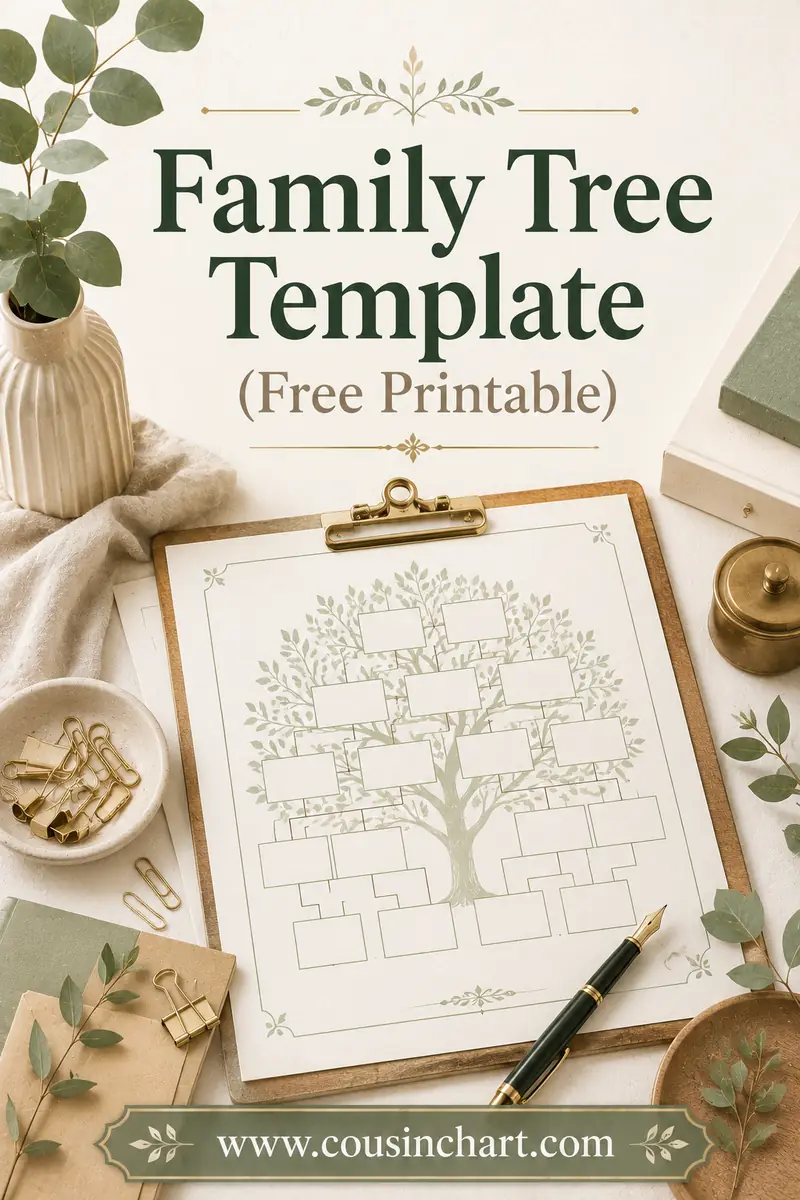
Free printable family tree templates explained: which chart suits ancestors, descendants or a whole household, what to write in each box, and how to print them properly.
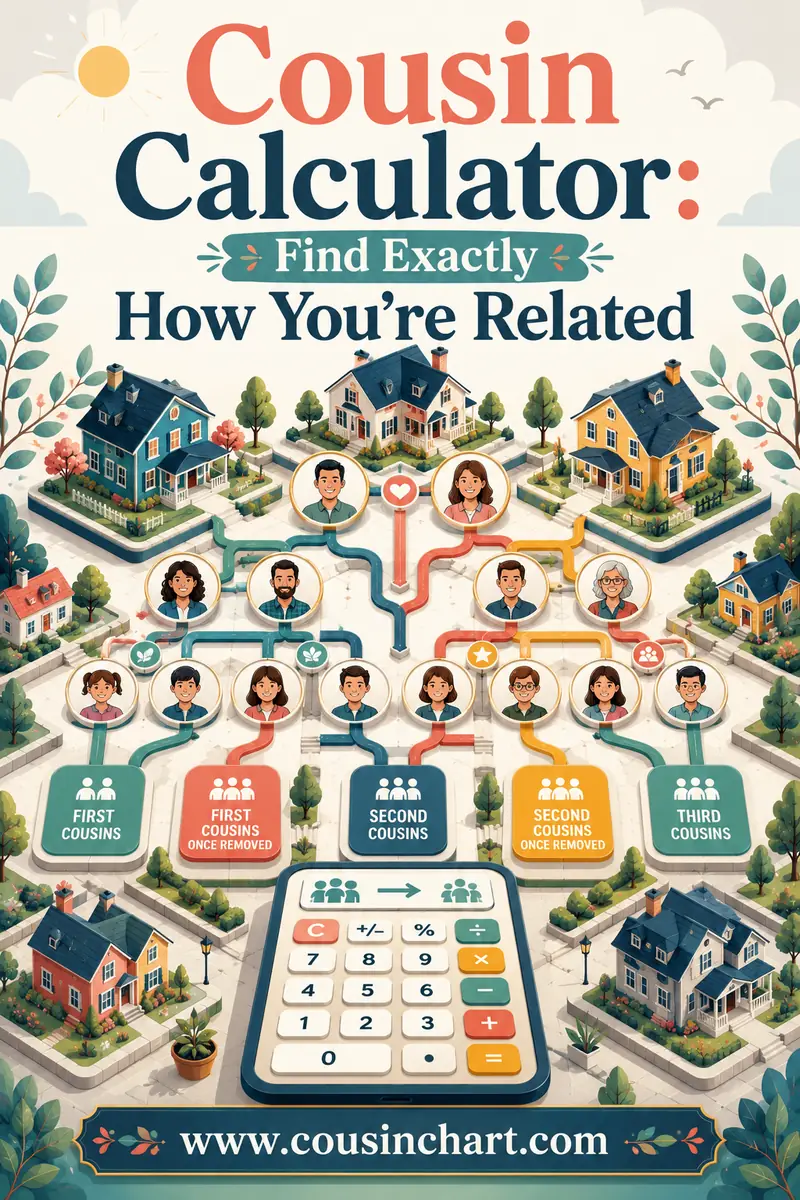
Use a cousin calculator the smart way. Learn how cousin numbers and removals actually work, follow worked examples, and get a full cousin degree chart.
Work out how you're related to anyone. How a family relationship calculator works, what a shared ancestor is, worked examples, and what DNA estimates mean.
O means descendant of, Mac means son of, and both were stripped under English rule. 100 Irish surnames, their real meanings, and the spelling traps to expect.
A practical guide to naming any relative: blood, marriage and step titles, in-law terms, cultural variation, and what to say when there's no right answer.
A calm, practical guide to adoptee genealogy: the paper track, the DNA track, realistic timelines, free volunteer help, and how to make first contact well.
Most Jewish surnames were imposed by law between 1787 and 1845, which is why so many are German compounds. 100 names, their meanings, and the old exceptions.
The best Newspapers.com alternatives for genealogy: free archives like Chronicling America, state collections, library access, and search tricks that actually work.
The -ski ending meant you came from a place, not that you were noble. 100 Polish surnames, their meanings, and why a wife's surname looks different in records.
Learn how to build a DNA family tree: cluster your matches, build quick trees, find the common couple, confirm with records, and keep the whole thing organized.
German surnames split into four clean categories and carry Europe's richest stock of trade names. 100 names, their meanings, and the umlaut trap in records.
English surnames became hereditary between 1200 and 1400, and many still cluster in one county. 100 names, their meanings, and what the map really shows.
A step-by-step genealogy checklist and research plan: one question at a time, free sources first, log everything, and the Genealogical Proof Standard explained.
Italy has more surnames than any country in Europe, split sharply north and south. 100 names, their meanings, and the foundling names every researcher meets.
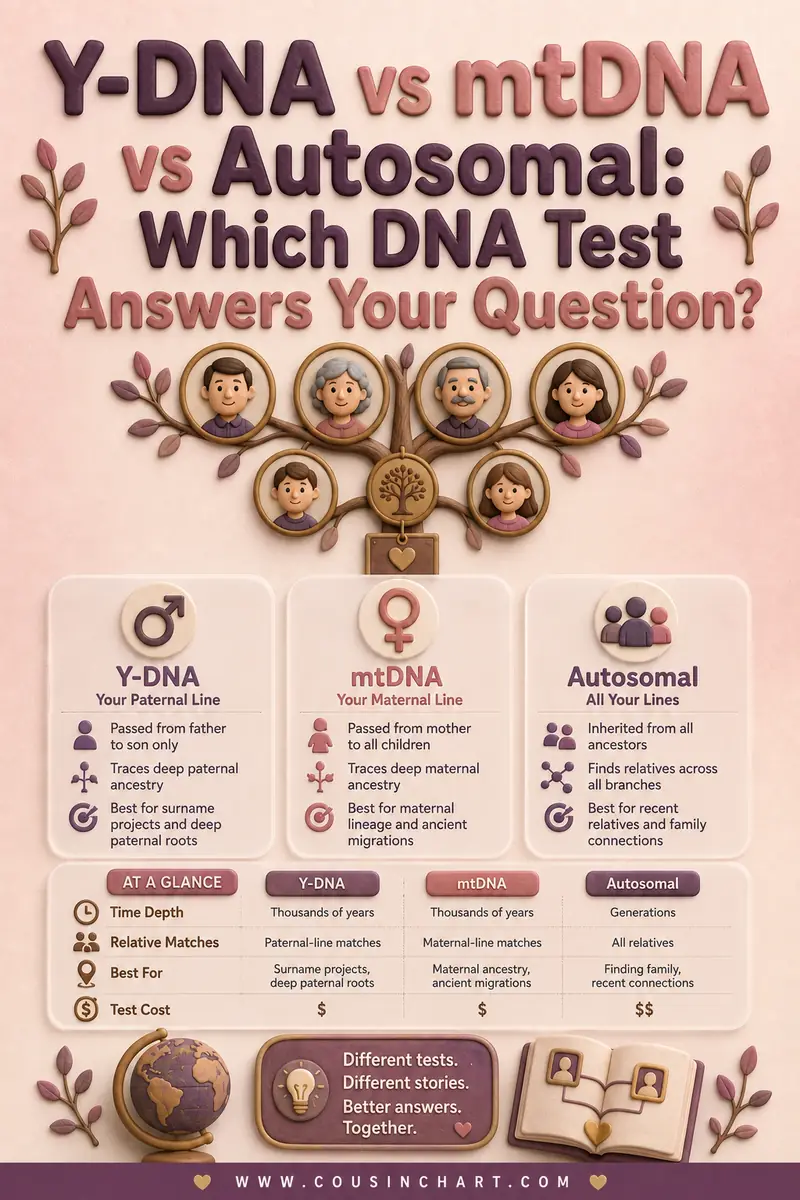
Y-DNA vs mtDNA vs autosomal DNA explained: who can take each test, how far back each reaches, what question each answers, and which one to buy for your goal.
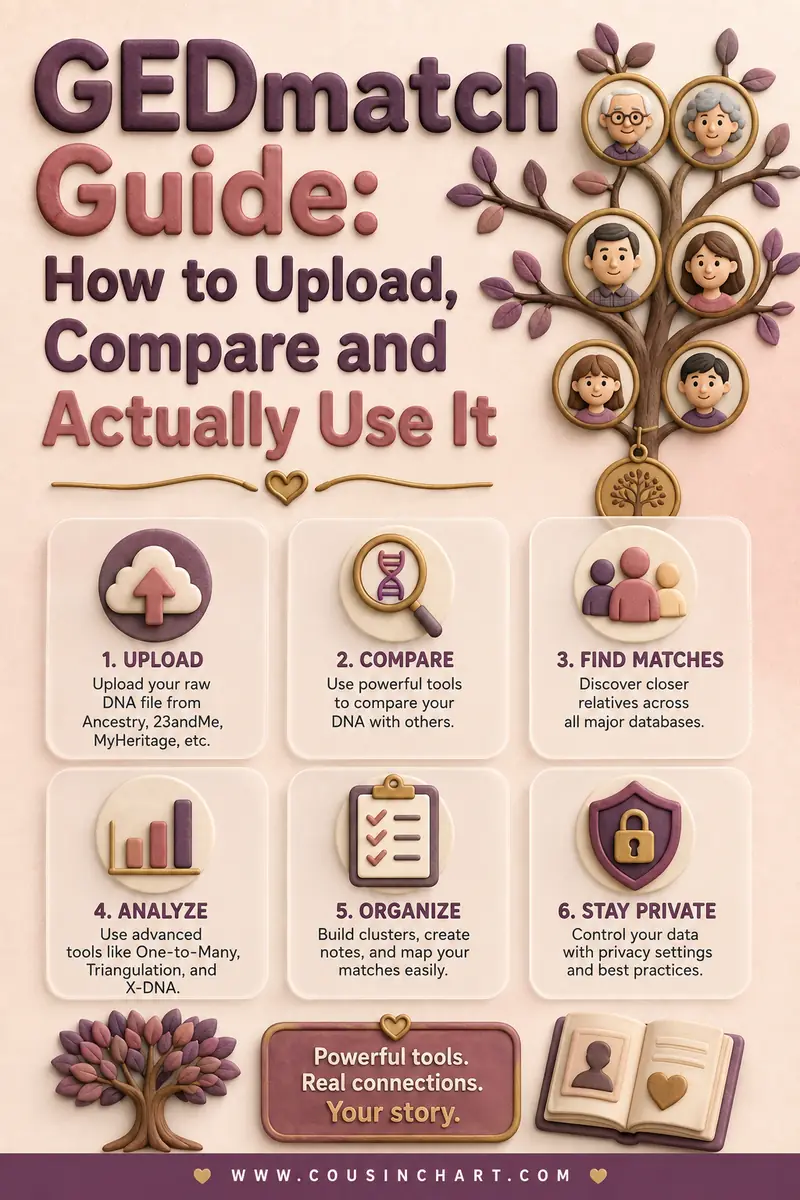
How to use GEDmatch: uploading raw DNA, the One-to-Many and One-to-One tools, the chromosome browser, why adoptees rely on it, and honest privacy settings advice.
Highland Mac names and Lowland trade names are two different systems, and most Scottish surnames are not clan names. 100 names and what they really mean.
French surnames were fixed by law in 1539, far earlier than English ones. What Dubois, Lefebvre and Leroy really mean, plus 100 names and their origins.
How to write a family history: choosing a scope you'll finish, structuring the narrative, handling gaps and difficult truths, and getting the first draft done.
How to interview an older relative about family history: what to ask, how to record it, handling difficult subjects, and what to do with the recording after.
Spanish surnames come in twos, father's then mother's, keeping the female line visible. What -ez really means, plus 100 surnames and their true origins.
How to preserve old family photos: safe storage and handling, what destroys them fastest, how to identify and label them, and when to call a conservator.
Wales kept changing patronymics for centuries after England froze surnames. How ap Hywel became Powell, why everyone is a Jones, and 100 names explained.
How to digitize family documents: scanner settings, file formats that last, naming and folder systems, OCR, and a backup plan that survives a drive failure.
Scandinavian surnames changed every generation until the 1800s. Denmark froze them in 1828, Sweden in 1901, Norway in 1923 — plus 100 names explained.
How to create a family history book: what to include, layout and image quality, printing options and costs, and how to get it finished rather than perfect.
Russian surnames change form by sex, so Ivanov and Ivanova are one family. What -ov, -ev, -in and -sky mean, plus 100 surnames and their real origins.
Mexican surnames come in twos and carry two histories: Spanish names assigned at baptism, and Maya and Nahuatl names that survived. 100 names explained.
What shared DNA matches are, why they group your matches into family lines, how to use them to identify unknown relatives, and the traps that catch people out.
Puerto Rican surnames mix Spanish, Canary Island, Corsican, Irish and French roots, thanks to an 1815 decree. 100 island surnames and what they really mean.
How X-DNA inheritance works, why it rules out entire ancestral lines, the different patterns for men and women, and how to use an X match in research.
How much DNA cousins share by relationship, the expected centimorgan ranges, why averages mislead, and how to tell apart relationships with similar amounts.
Romanian surnames are Latin at the root with Slavic, Hungarian and Turkish layers. What -escu and -eanu mean, why Popescu is everywhere, and 100 names.
Anglo-Saxons had no hereditary surnames at all. What survives is Old English vocabulary buried inside later names: tun, ford, leah, wulf, beorht and ric.
What DNA triangulation is, how triangulated groups prove a shared ancestral segment, which sites support it, and why shared matches alone aren't enough.
Celtic covers six languages, not one. Irish, Gaelic, Manx, Welsh, Cornish and Breton naming compared, and why these surnames are medieval rather than ancient.
Why a DNA test may not match a known relative: how often distant cousins share nothing, different testing sites, thresholds, and when it means something more.
How to find living relatives: working forward from records, using DNA matches, free and paid search tools, and how to make first contact without being ignored.
Warrior surnames from Germanic, Gaelic, Slavic, Japanese, Arabic and Turkish roots, what each element literally means, and which famous ones are folk etymology.
Identify the category first, find the earliest recorded spelling, then check historical distribution. The reliable sources, and why free meaning sites mislead.
How to break through a genealogy brick wall: rechecking assumptions, searching sideways, name and spelling variants, offline records, and using DNA to confirm.
How to cite genealogy sources without a formal manual: what every citation needs, templates for common record types, and how to record online and DNA evidence.
Historical surname distribution maps beat any lookup, because one name arose in several countries. Spelling clues, convergent forms and what DNA cannot say.
Wang, Li and Zhang top the world at roughly 100 million each. The full ranking by country, plus why surname distribution is so extraordinarily lopsided.
What vital records are, what each type contains, when civil registration began by country, who can order copies, and what to use before records existed.
How to find an ancestor's occupation from records, where trade and employment archives survive, how to decode obsolete job titles, and what a job reveals.
In a true patronymic system the surname changes every generation. Markers from -son to Mac, and why the date each country froze its names decides your research.
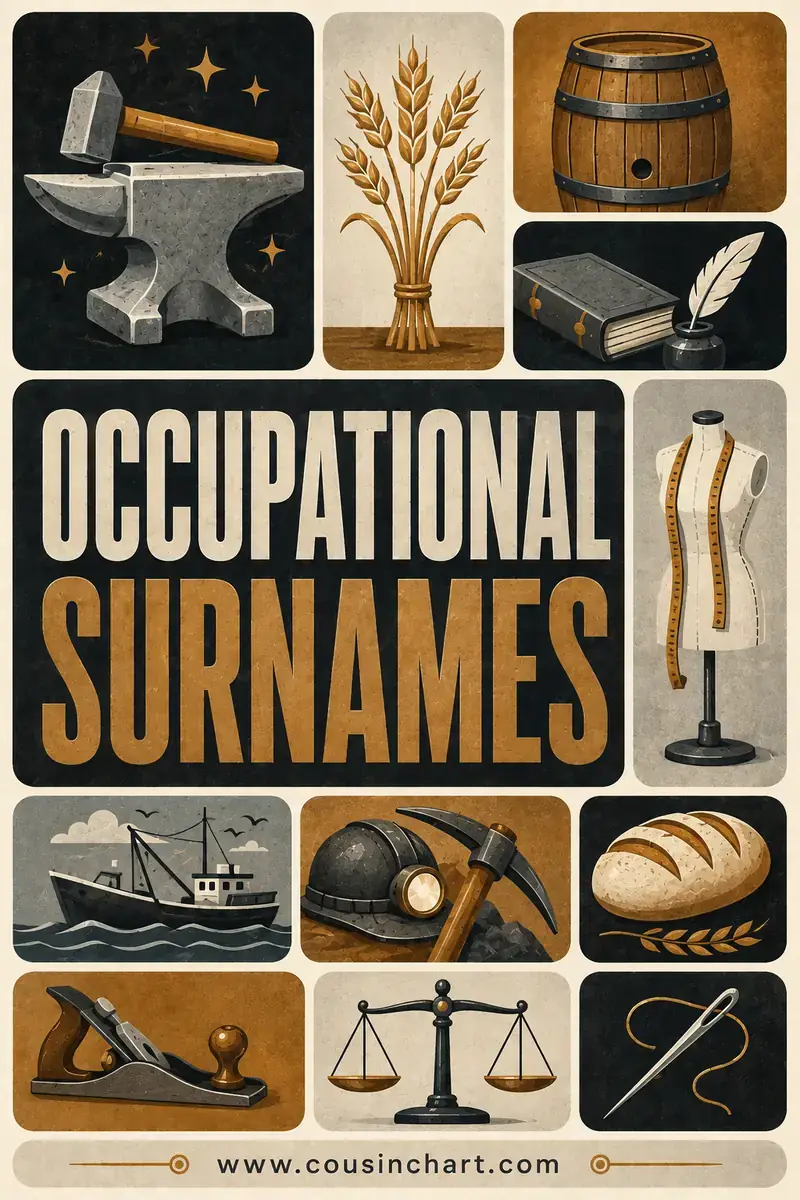
Over 100 occupational surnames in themed tables, from Fletcher and Chandler to Latimer and Sawyer, plus why Fuller, Tucker and Walker all mean the same job.
Your cousin's grandchild is your first cousin twice removed. How removals work, what to call them, and how the relationship differs for second cousins.
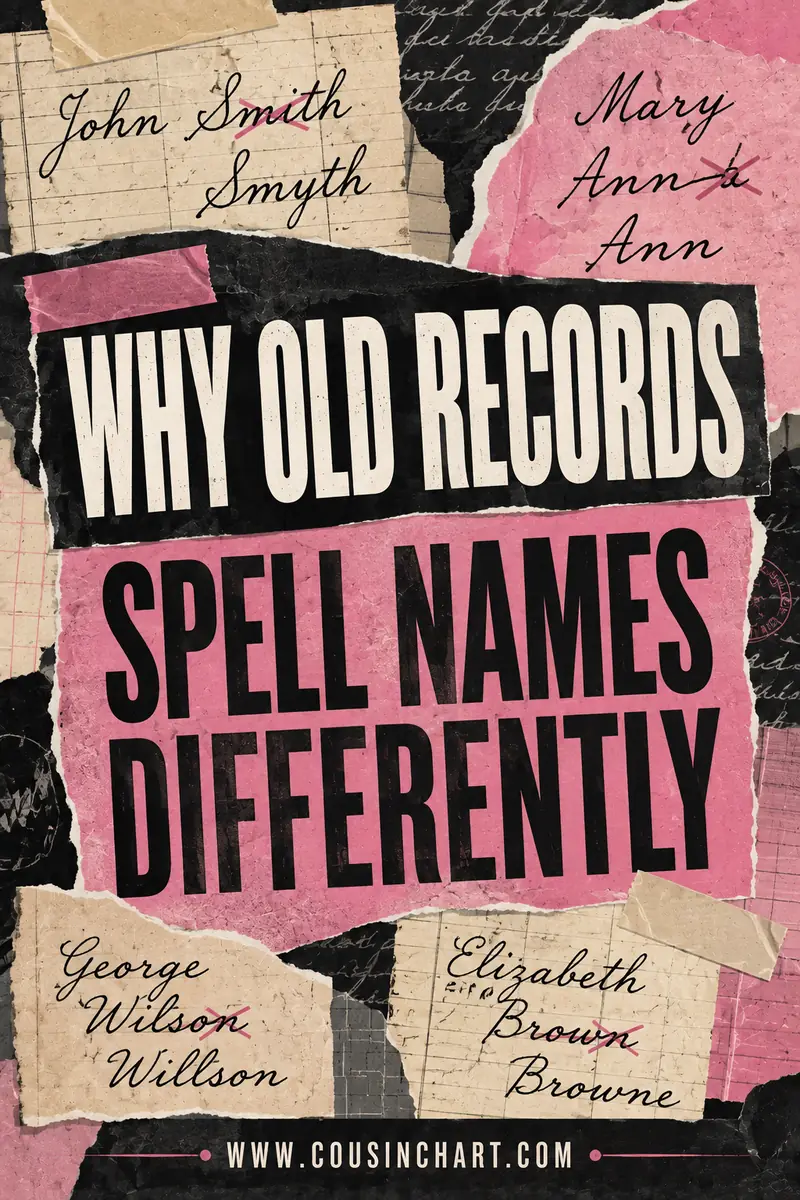
Before standard spelling there was no correct version of a name, so variants are not errors. The causes, plus wildcards, Soundex and phonetic search that work.
A great uncle is your grandparent's brother. Why some people say grand uncle, how the greats stack up, half and step versions, and how much DNA you share.
Who your first cousin three times removed is, how the removal system works in both directions, how much DNA you'd share, and why the label is often ambiguous.
Forty family reunion activities grouped by age and energy, with the ones that leave a keepsake — a filled-in chart, a recorded story, a named photograph.
A fifth cousin shares your fourth-great-grandparents. How many fifth cousins you have, why most share no DNA, and whether the relationship means anything.
Do cousins share DNA? How much by relationship, why close cousins always match, why distant ones often don't, and what shared DNA can and can't prove.
Family reunion games with real rules: player numbers, kit, and how to run trivia, baby-photo rounds and scavenger hunts across a four-to-eighty-four age range.
A month-by-month reunion checklist, from first head count to the thank-you email, plus the family history jobs that only work while everyone is in one room.
Project ideas by age, the research angle that lifts a mark, and how to handle a family that does not fit the worksheet. Materials, layout and presenting tips.
Charts, books, jewelry and recorded voices, sorted by recipient, budget and lead time, plus the name-checking step that saves an engraved gift being wrong.
Why no coat of arms belongs to a surname, what those souvenir shops are really selling, and how to design an honest one of your own that follows the real rules.
A hundred questions grouped by topic, from childhood to work to hard times, plus the follow-up phrases that turn a one-word answer into the story you wanted.
The questions worth asking your parents are about the years before you existed. What to ask, how to ask it without staging an interview, and when to start.
How to record family oral history properly: consent, a quiet room, an external mic, file formats that survive, timestamped logs, and where to deposit a copy.
Family memory book ideas: formats, spread layouts, prompts that fill pages, and how to write captions that still make sense to someone in fifty years.
How to make a family recipe book: photograph the original handwriting, collect recipes with a short form, and convert a teacup of flour without erasing it.
How to make a family time capsule that survives: what to include, what destroys a capsule from the inside, why you should never bury it, and how to record it.
Handprint trees, leaf trees, photo jars and salt dough tags, sorted by age and mess. Plus what to write on them so they still make sense in twenty years.
A system for sorting thousands of family photos: what order to sort in, how to name files, killing duplicates, and the test that tells you the job is done.
Fifty prompts for writing your own life down, not interviewing someone else. Everyday detail, turning points, and the things that will otherwise go unrecorded.
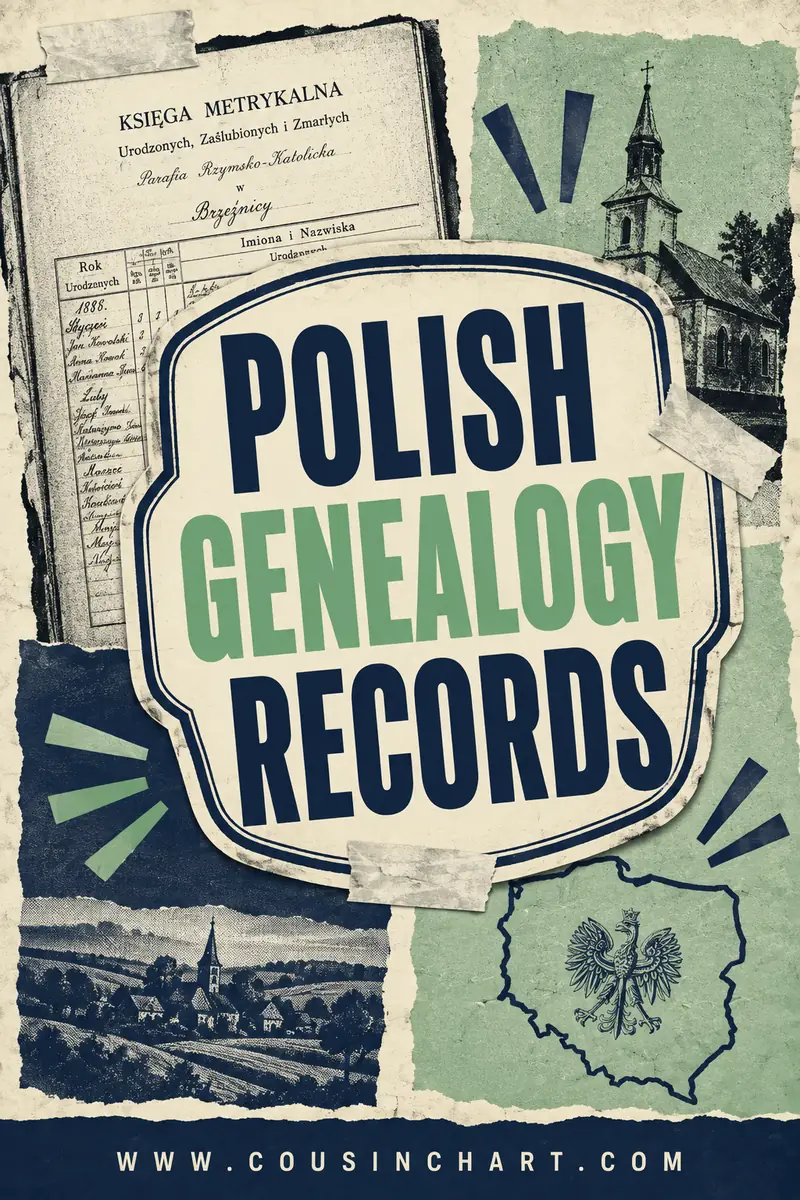
Trace Polish ancestors free with Geneteka, metryki scans and Szukaj w Archiwach — plus the partition rule that decides which records exist for your village.
How ScotlandsPeople credits really work, what is free on it, and the best free Scottish alternatives — plus why 1855 records beat every other year in Britain.
Trace Quebec ancestors with the Drouin collection and PRDH, decode dit names, and understand why every French-Canadian tree reaches 1650 and then collapses.
Past the census: how the GRO index beats FreeBMD, what parish registers hold from 1538, the 1858 probate line, and the marriage act that hides nonconformists.
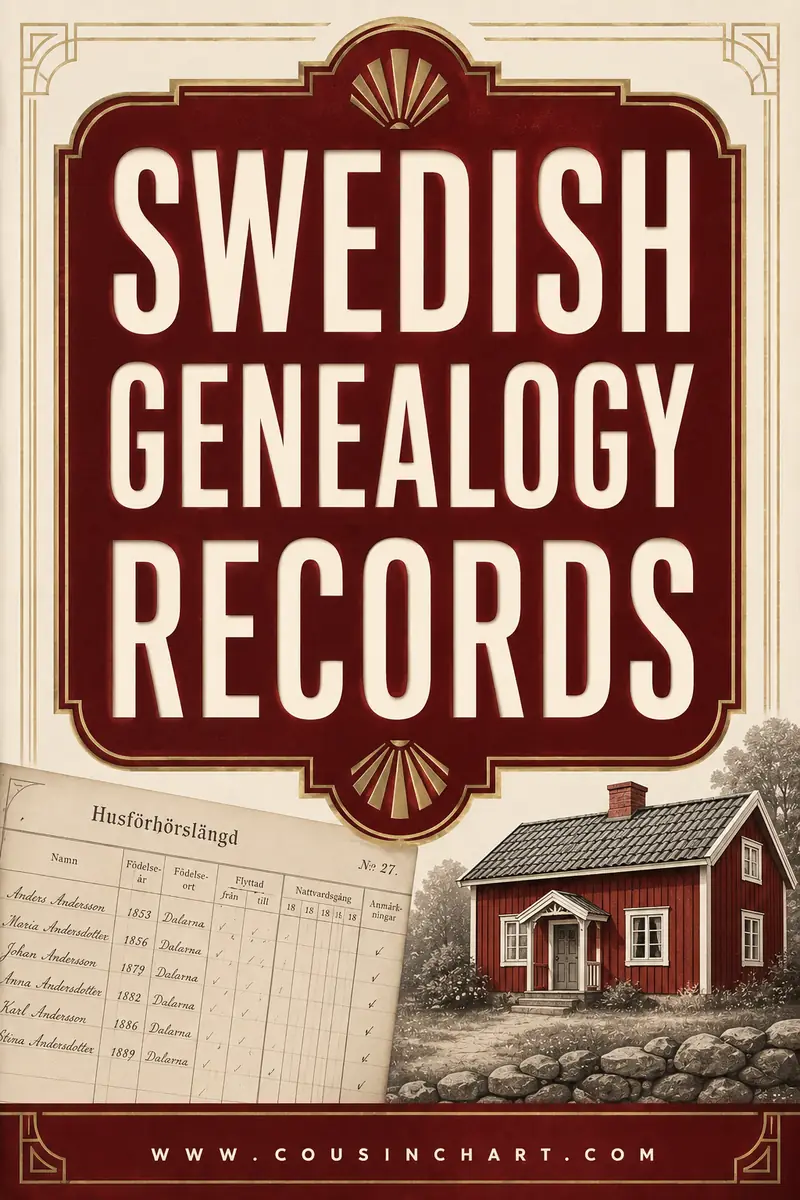
Sweden recorded every household every year from the 1600s. How to read husforhorslangder, use Riksarkivet free, and survive patronymics and soldier names.
Norway put its parish registers and censuses online free at Digitalarkivet. How to use it, and why a Norwegian surname is usually a farm, not a family name.
France put its civil registers online free, department by department. How to use the tables decennales, read a marriage act, and find records before 1792.
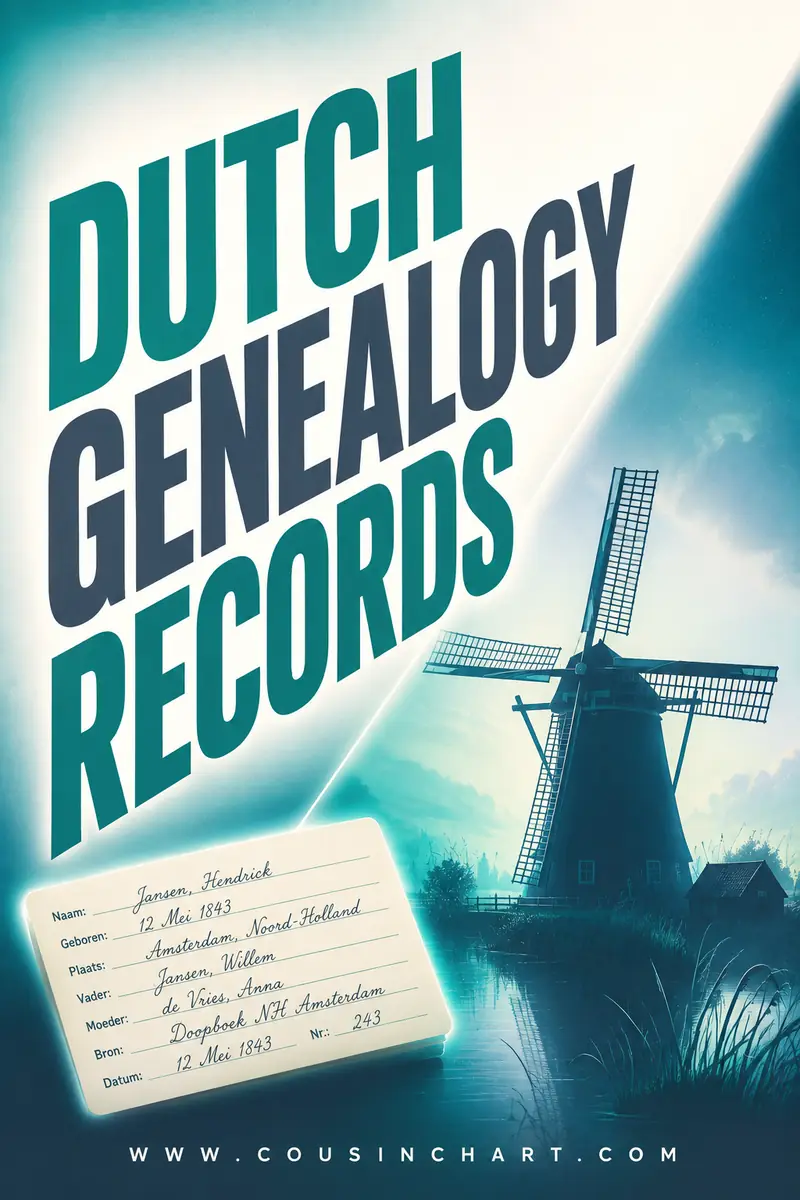
Search Dutch ancestors free on WieWasWie, use the 1811 name adoption registers, and understand why your family had no surname before Napoleon arrived.
Czech regional archives scanned their parish books and put them online free. How to find the right archive, and why Slovak records are filed under Hungary.
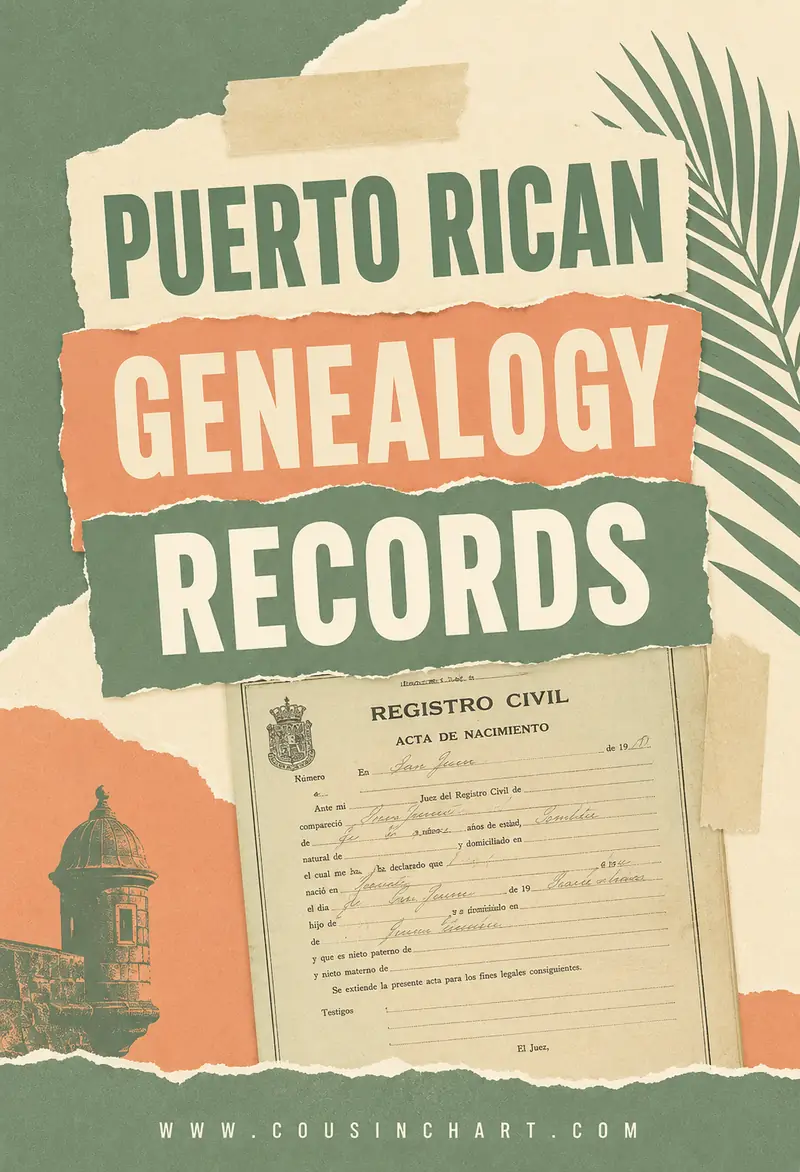
Trace Puerto Rican ancestors free on FamilySearch, use the two-surname system properly, and find the 1872 slave register, PARES and the 1935 island census.
Which US states took their own censuses and in what years, how they fill the ten-year federal gaps and the lost 1890, and where to search each one free.
Guardianships, divorces, civil suits, naturalizations, criminal dockets and inquests: the courthouse records that name relatives probate never mentions.
Tax lists appear every year, not every ten. How they date a son's 21st birthday, a land purchase, a death and a move, and where to find them free online.
Poorhouse and almshouse registers record age, birthplace, relatives and cause of admission. Where to find them, what they contain, and how to read them fairly.
Around 200,000 children rode the orphan trains west between 1854 and 1929. Which agencies hold the records, how to request them, and the census clues to spot.
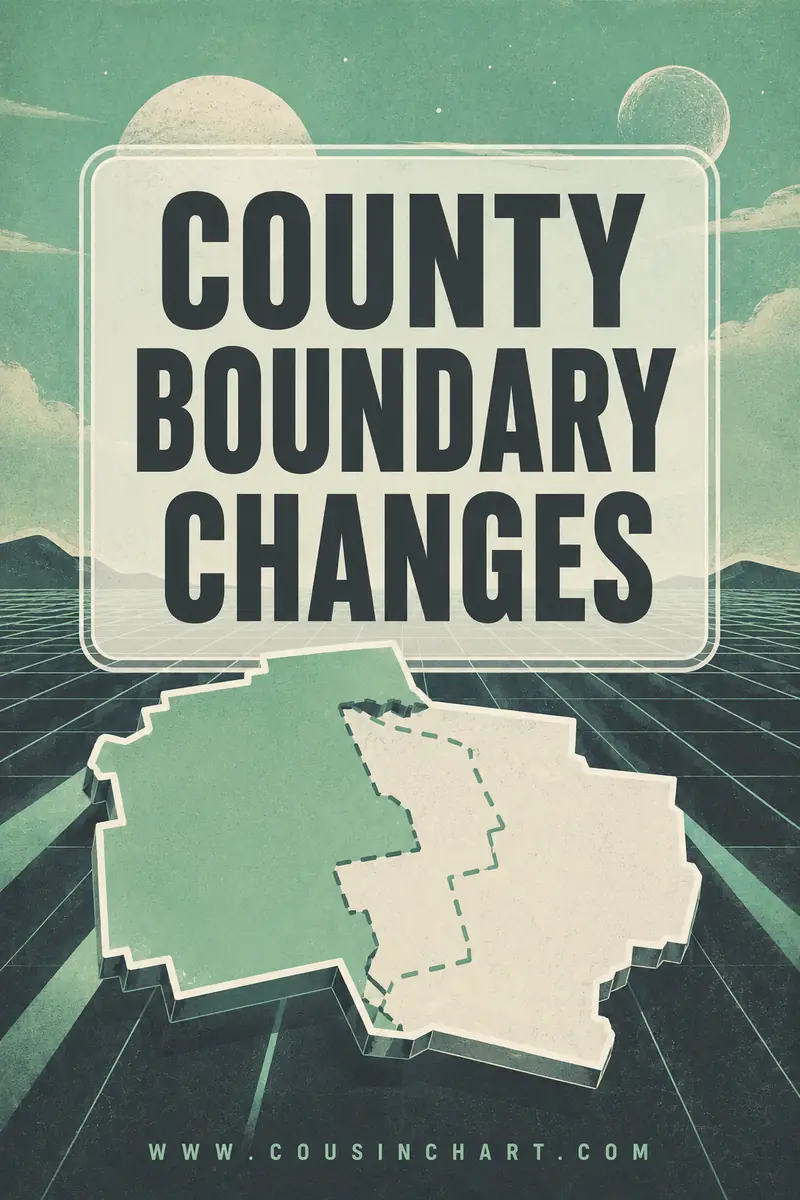
Records go missing because the county line moved, not the family. How to find which county held the land, and where duplicates survive for burned counties.
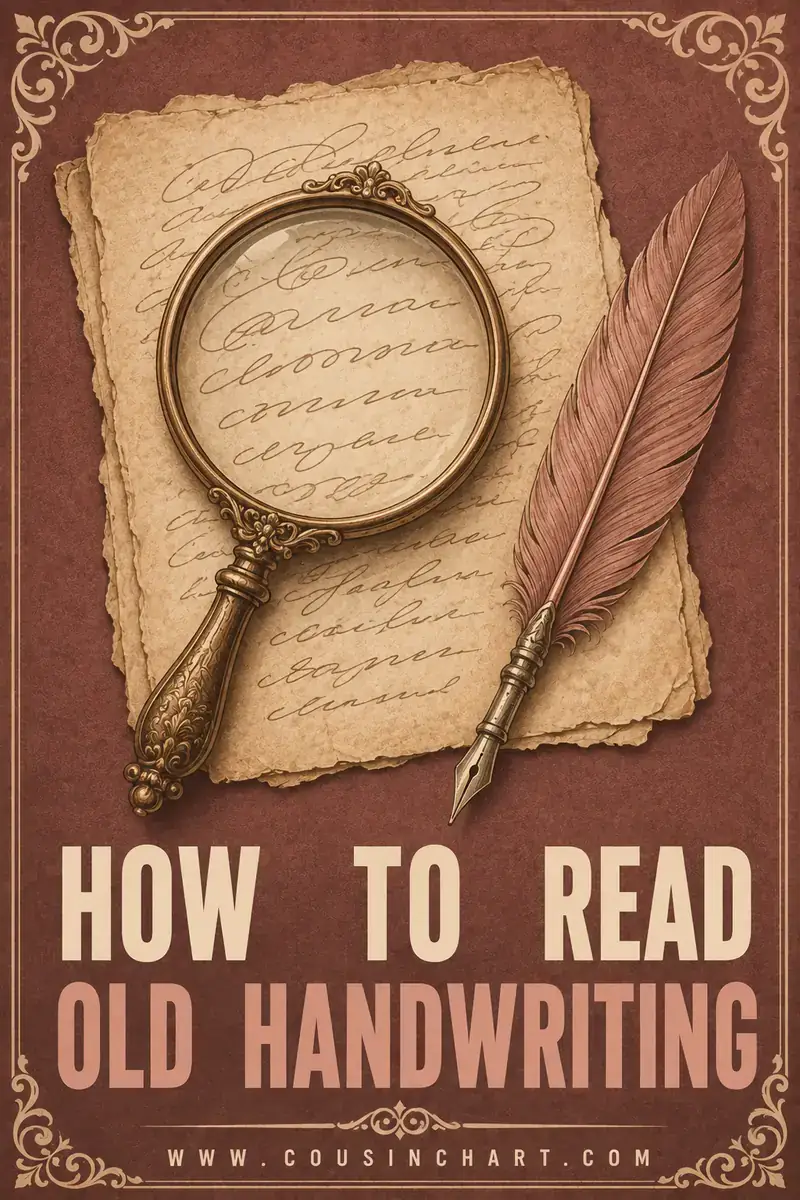
The long s that looks like f, the bar that doubles a letter, and the method that works: read the document's formula first, then build an alphabet from it.
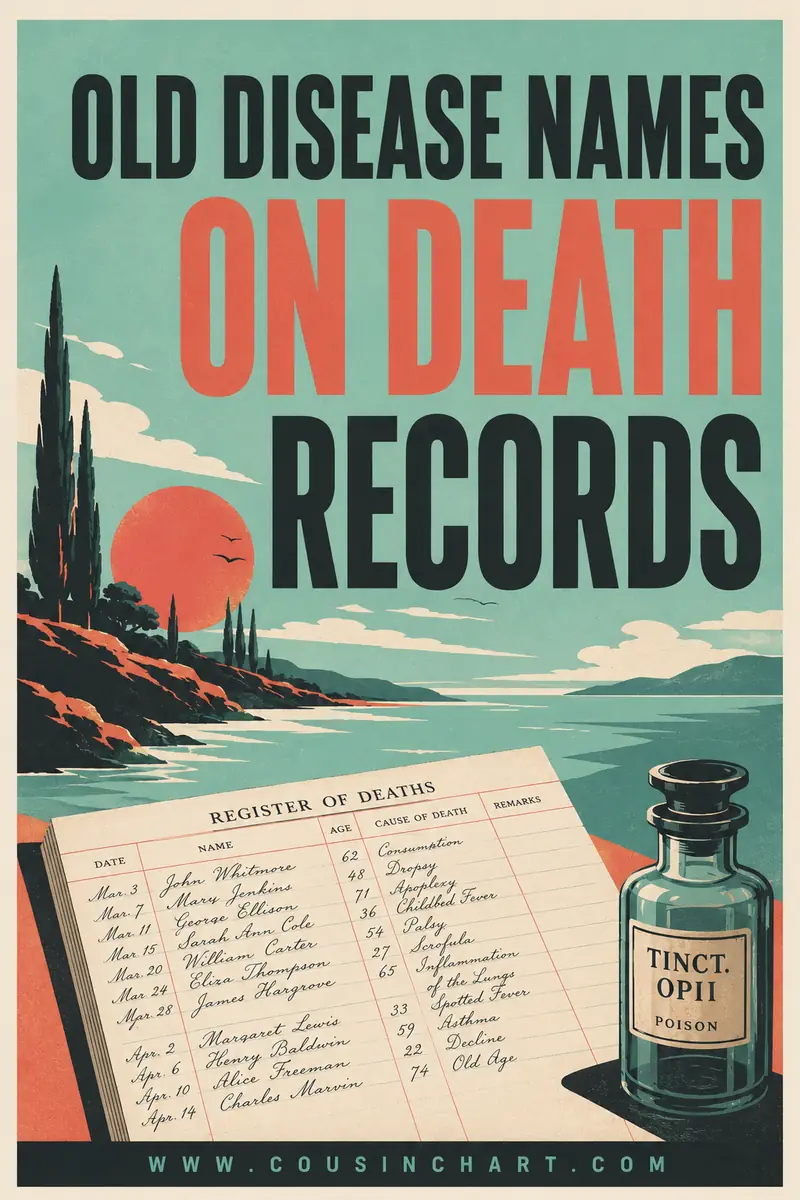
Consumption, dropsy, apoplexy, quinsy, milk sickness and childbed fever explained, plus why many old causes of death are symptoms rather than diagnoses.
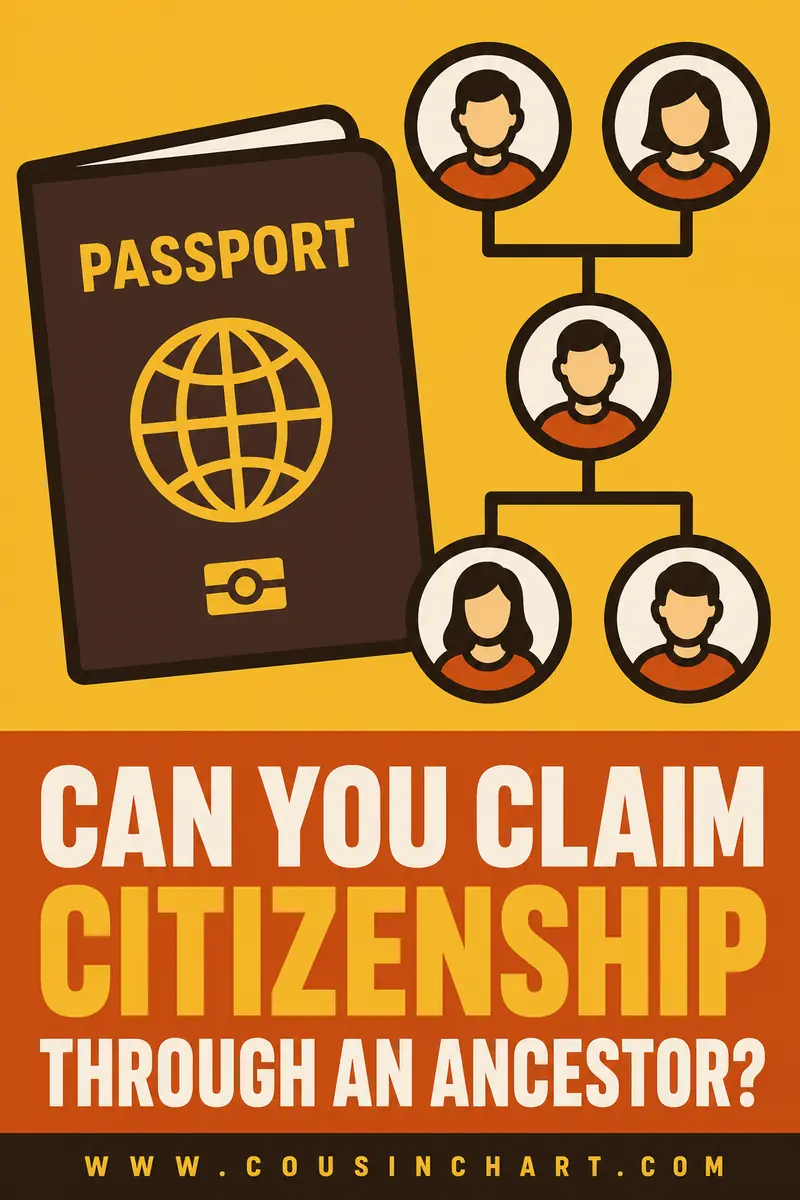
Citizenship by descent explained: jus sanguinis vs jus soli, why the law on your ancestor's birthday decides it, and the paperwork every claim really needs.
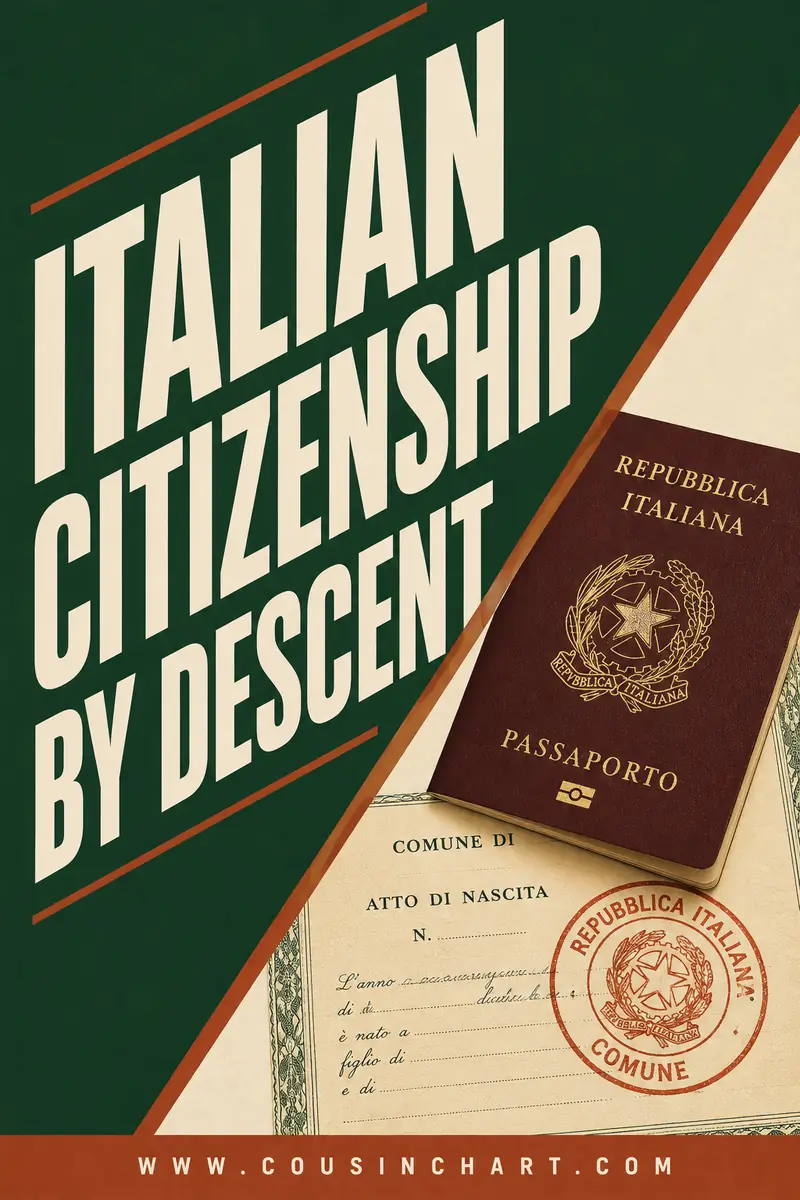
How Italian citizenship by descent works: the 1861 start date, the naturalization trap, the 1948 female-line rule, and why the requirements keep tightening.
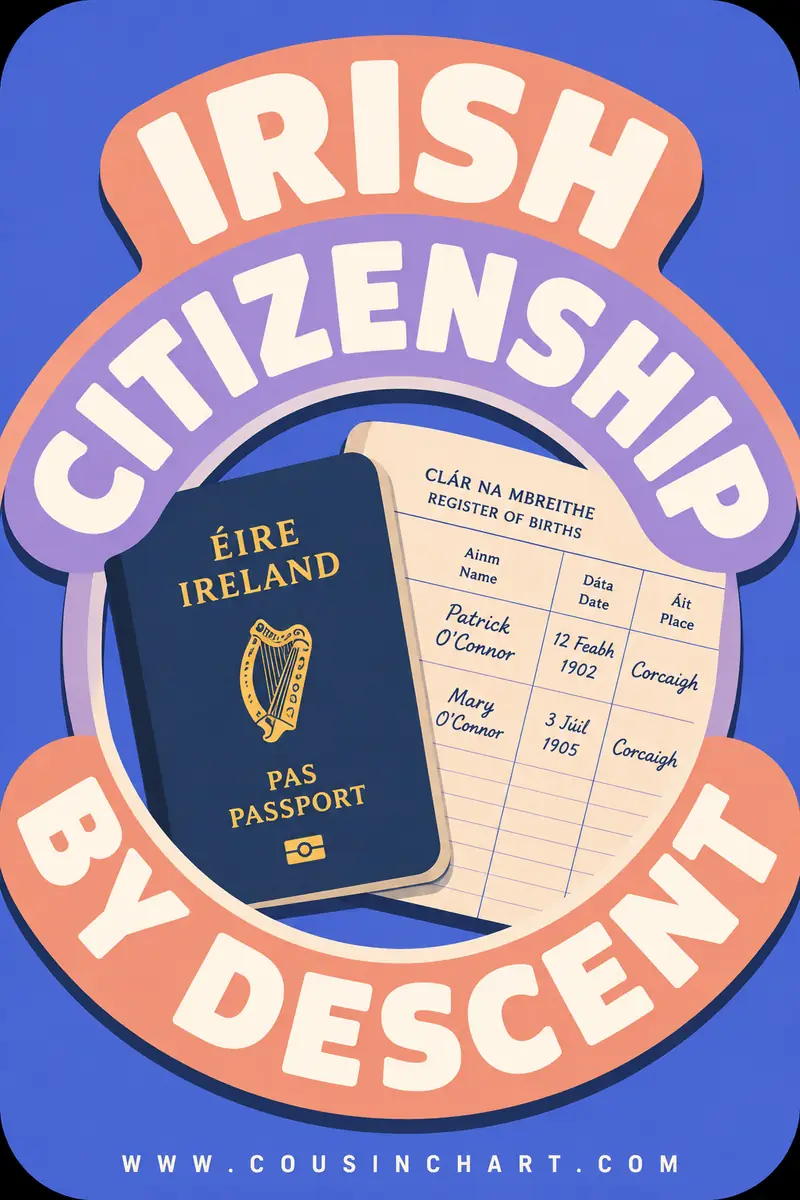
Irish citizenship by descent, explained simply: the parent rule, the grandparent route through the Foreign Births Register, and why registering early matters.
Joining the DAR is a documentation exercise: what counts as patriot service, the proof needed for every generation, and what an already-proven line saves you.
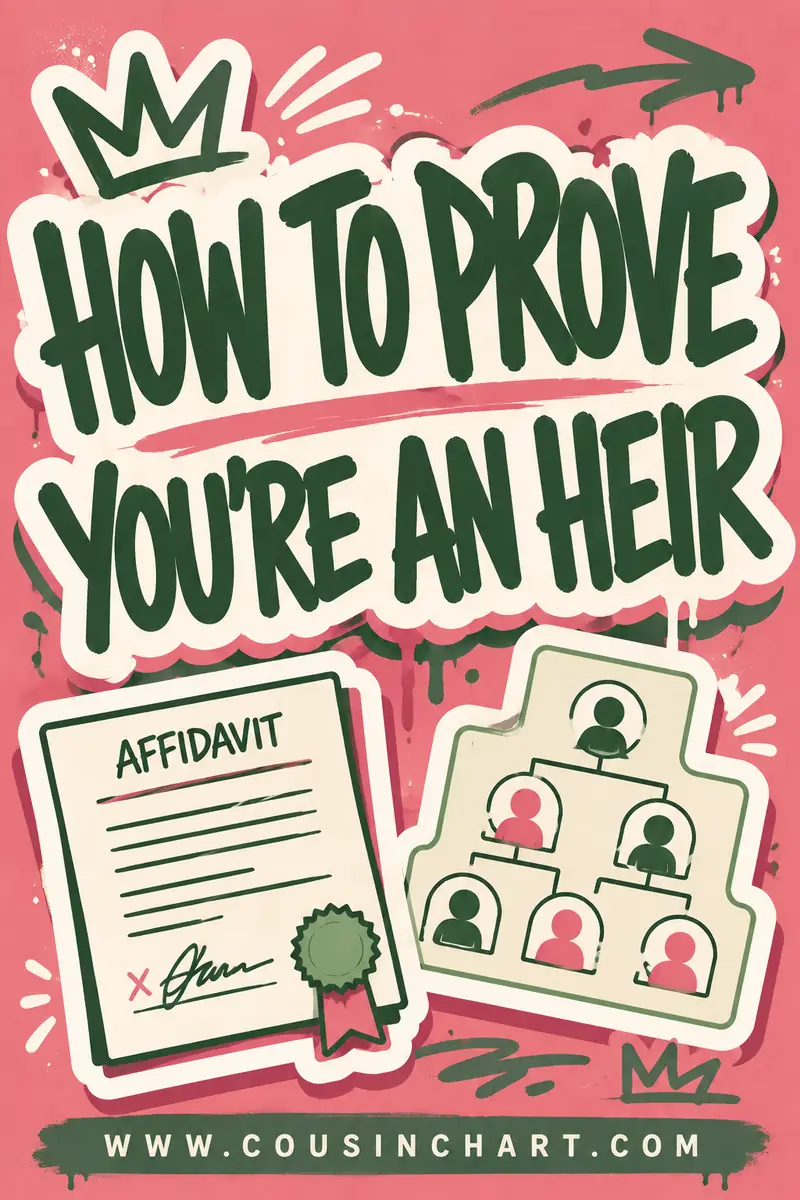
Proving heirship is a paperwork job: the certificates that evidence each link, how to build a kinship chart a court will read, and what affidavits actually do.
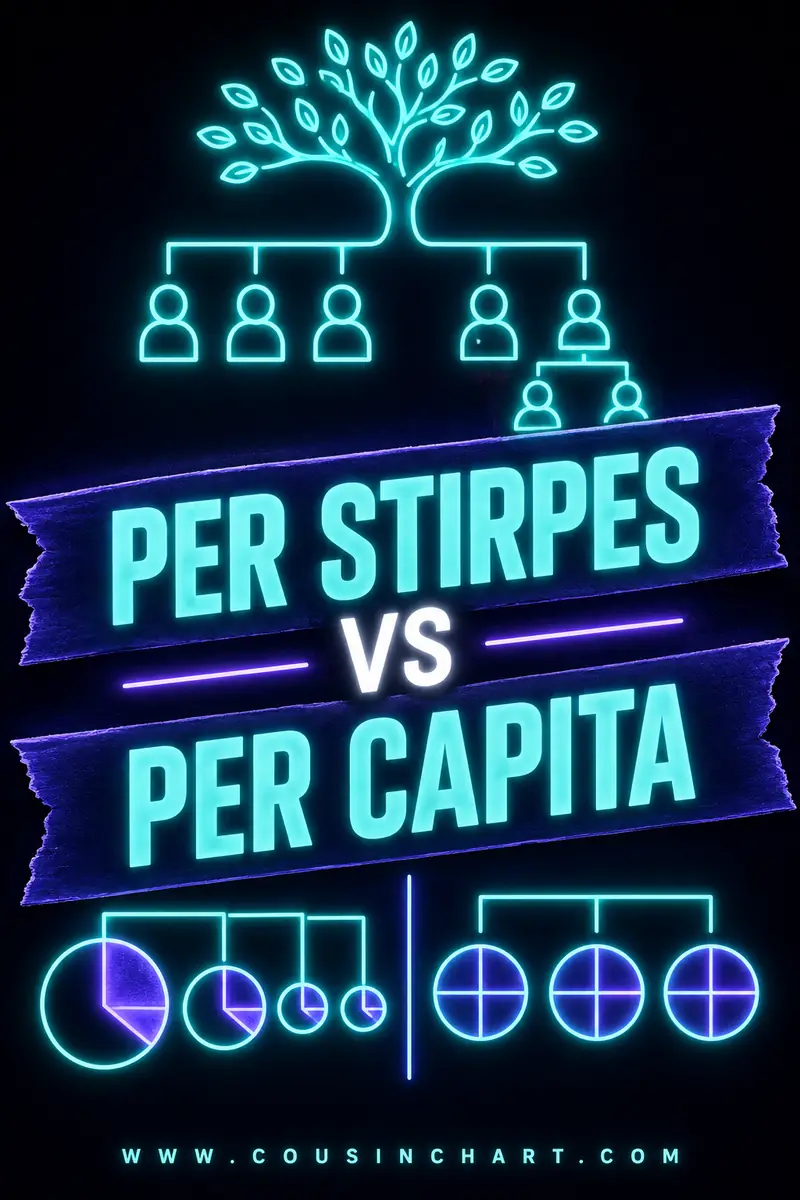
Per stirpes vs per capita, worked through with real numbers: how the same estate produces wildly different cousin shares depending on which method applies.
How to identify family heirlooms: reading silver hallmarks and maker's marks, the three different values people confuse, and why cleaning first destroys value.
How to digitize 8mm film, VHS, MiniDV and cassettes: what degrades first, why sticky tape plays only once, DIY versus a service, and the formats to ask for.
How to identify military medals and insignia: campaign versus gallantry awards, edge naming, ribbons and clasps, matching a unit, and why polishing ruins them.
How to date an old quilt: fabrics, dyes, printing methods, patterns by era, batting and stitching — and why the newest fabric, not the oldest, sets the date.
How to divide family heirlooms among siblings fairly: rotating choice, sealed bids and drawing lots, doing it before a death, and recording who got what.
How to donate family papers to an archive: what they will and won't take, how to approach one, deeds of gift, access restrictions, and where to try next.
What 1st cousin 1x removed means, both directions of the relationship, the shared cM range, and how it shows up in your DNA match list.
A 1st cousin 2x removed is your grandparent's first cousin or your first cousin's grandchild. The shared ancestors, cM range, and match-list clues.
What 2nd cousin 1x removed means, both directions of the relationship, the shared ancestors, the real cM range, and how it looks in a DNA match list.
A 2nd cousin shares great-grandparents with you. Learn the rule, how many you have, DNA percentages, "once removed," and marriage laws.
A 3rd cousin shares great-great-grandparents with you. Learn 3rd cousin DNA averages, why 10% share none, and how to ID matches.
A 4th cousin shares great-great-great-grandparents with you. Learn the DNA range, why fourth cousins flood match lists, and when to contact them.
A 5th cousin shares 4x-great-grandparents with you. The real DNA range, why most 5th cousins share none at all, and how they appear in match lists.
The abbreviation for cousin in genealogy is C, as in 1C or 1C1R. How cousin degrees and removals are notated on charts, in notes, and in DNA match lists.
Cousin bro means a male cousin in South Asian English. Where the term comes from, why the distinction exists, and the American English equivalent.
The full cousin definition, plus how to spell cousin, how to say it, and how cousins differ from siblings and niblings. Clear examples throughout.
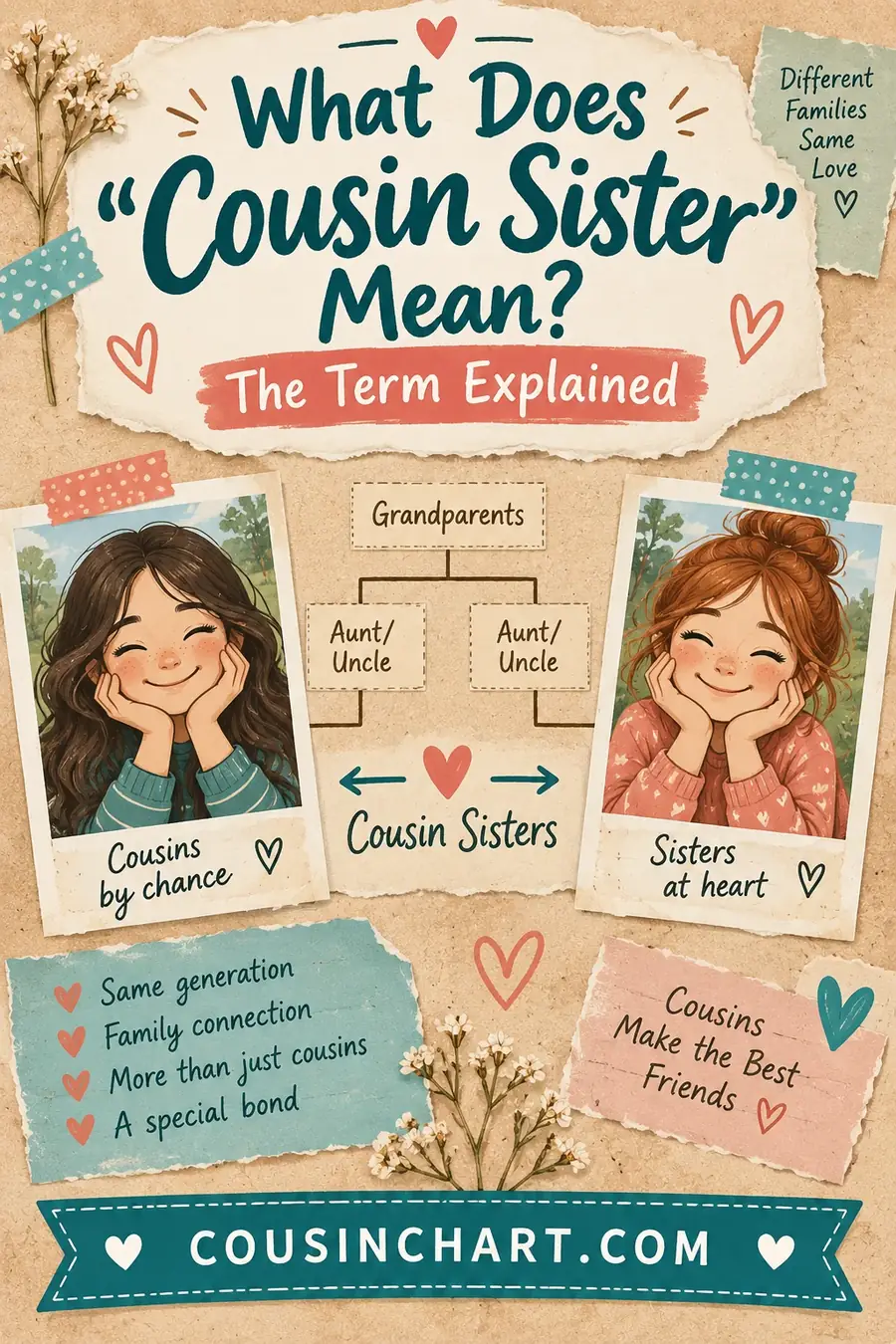
Cousin sister means a female cousin, standard in Indian English and other South Asian varieties. Here is where it comes from and how it maps to first cousin.
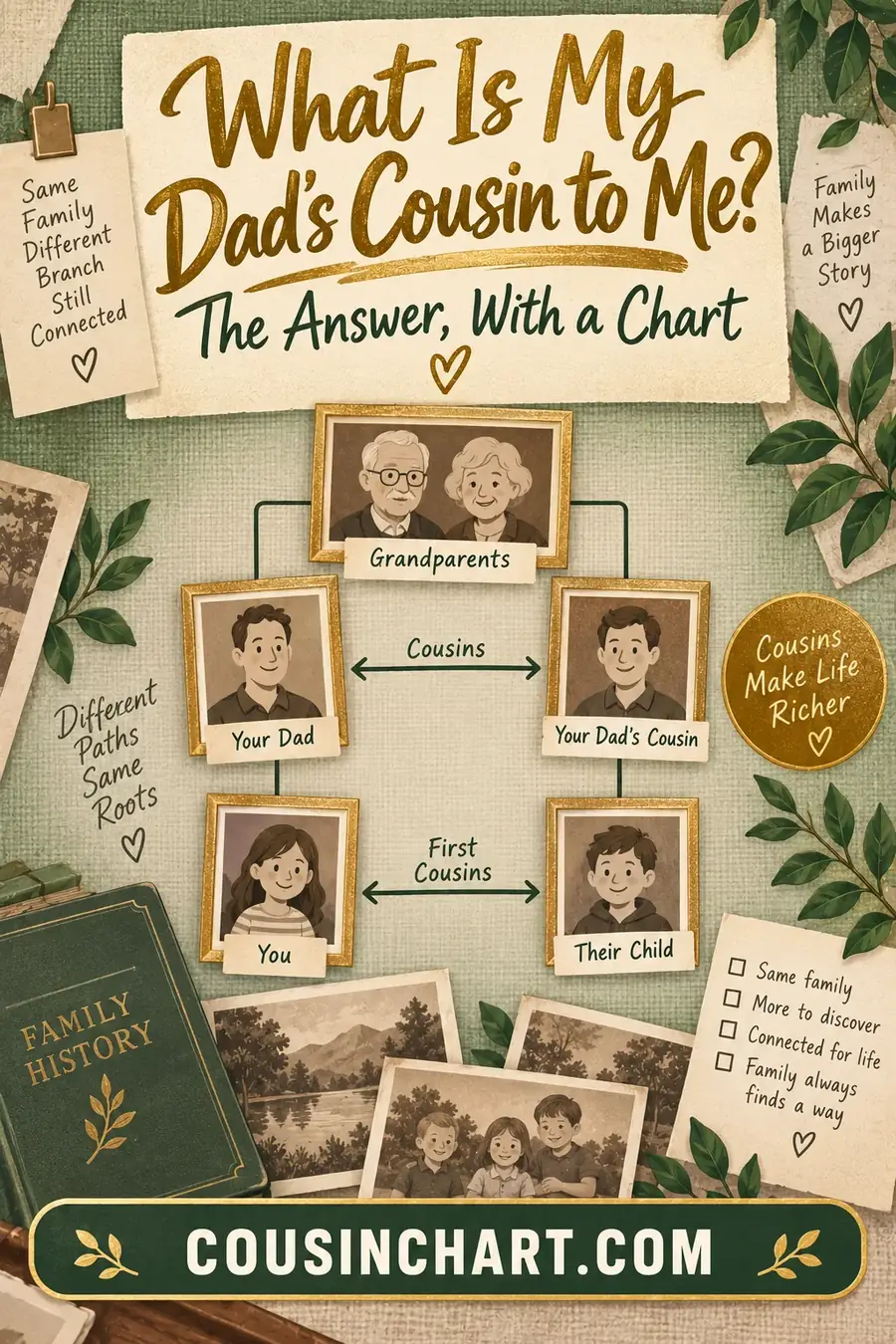
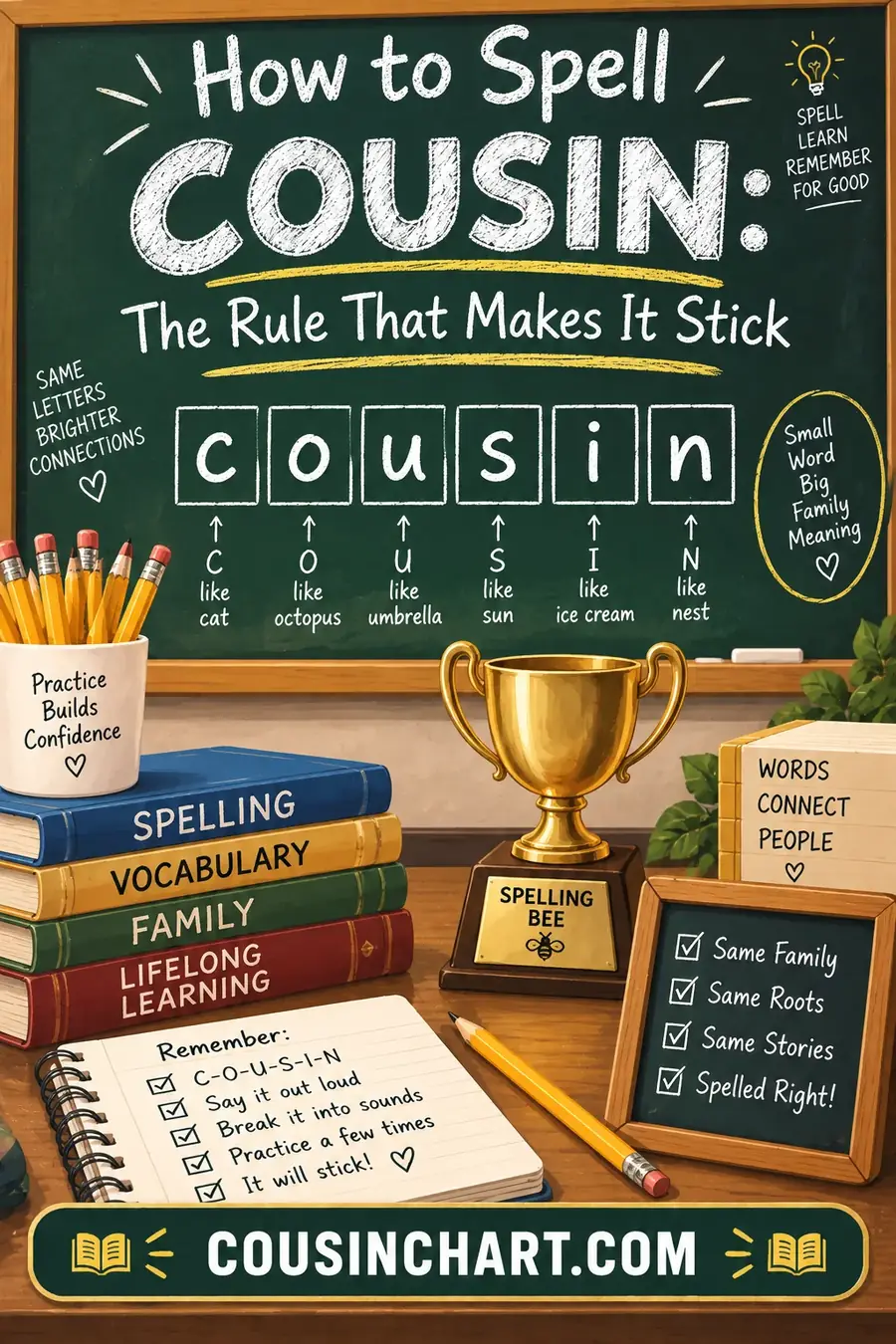
Cousin is spelled C-O-U-S-I-N - here
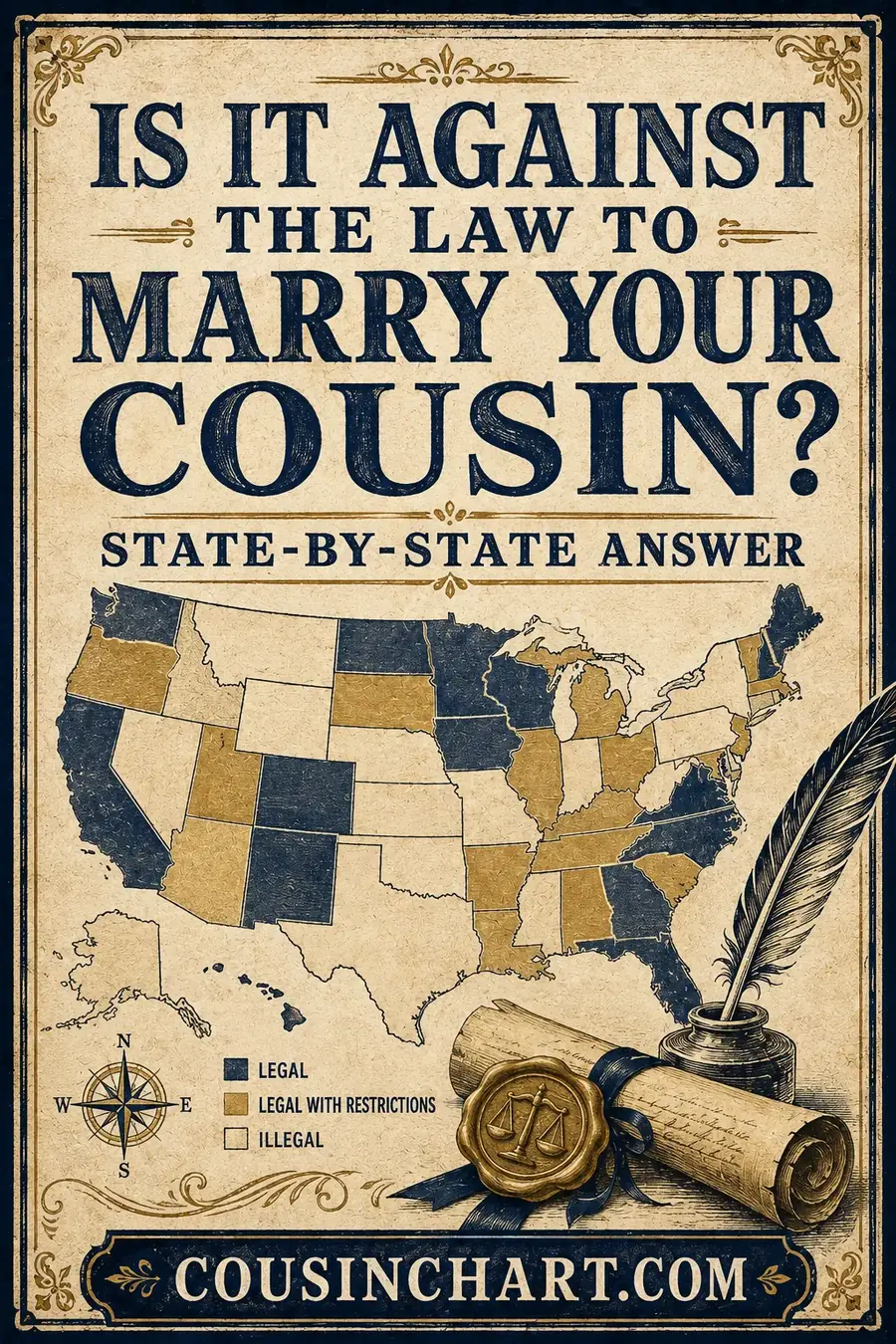
Whether marrying your cousin is legal depends entirely on which US state you
Is it legal to marry your first cousin? US law varies by state across three broad categories. Here is how the rules work and what to check.
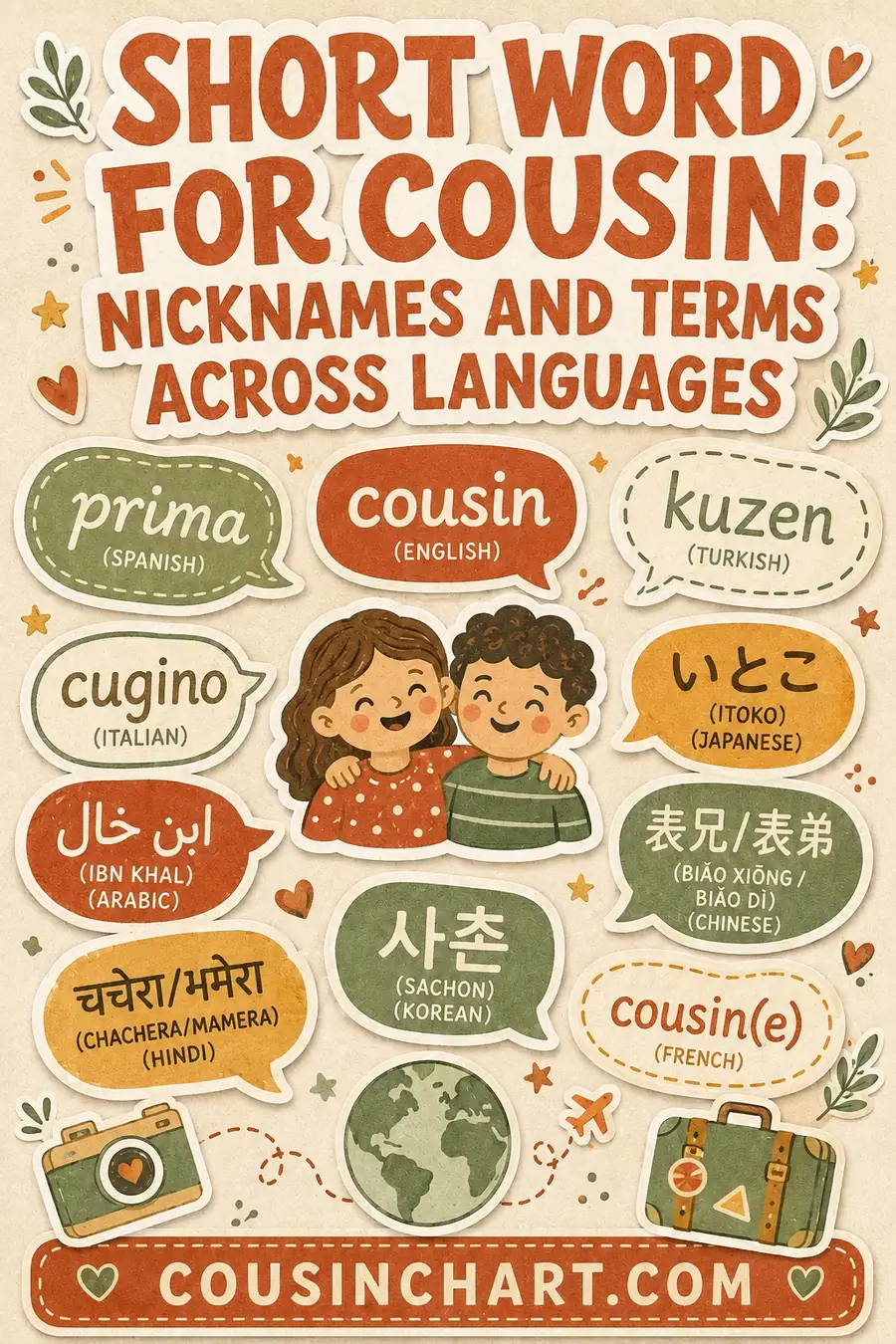
Short words and nicknames for cousin - casual English terms, family nicknames, and cousin words from other languages and cultures.
What is my mother's first cousin to me? They are your first cousin once removed. Here is why that label is right, plus DNA and what to call them.
What is your mother's cousin to you? Your first cousin once removed, and your dad's cousin is exactly the same. Why the family side never changes it.
Who is my mother's cousin to me? Use this 4-step method to find the exact label for her first, second, or third cousin, with worked examples.
No guides match your search — try another word.