How Are We Related? A Simple Guide to Naming Any Family Relationship
To work out how two people are related, do three things: find the closest ancestor you both share, count how many generations each of you is below that ancestor, and apply the naming rules (equal counts make siblings or cousins; unequal counts make aunts/uncles, grandparents, or "removed" cousins). That method names every blood relationship in existence.
This guide walks the three steps with real examples, then covers the relatives the ancestor method doesn't reach — in-laws, steps, and halves. If you'd rather have the answer than the method, the free relationship calculator at cousinchart.com does all three steps from a tapped-out path ("my mom → her cousin → his son") in seconds.
Relationship quick-check. Tap a phrase to see the correct term:
The answer will appear here.
Step 1: Find the Closest Shared Ancestor
Every blood relationship is anchored to one thing: the most recent ancestor (usually a couple) that both people descend from. Not an ancestor — the closest one.
Practical ways to find it:
- Walk upward from the less-known person. "Okay, Doreen is Grandma Pearl's cousin's daughter — so Doreen descends from Pearl's grandparents." Then check: do you descend from Pearl's grandparents? Yes, through Pearl. Found it.
- Compare grandparent names. Same grandparents → first cousins (or siblings). Same great-grandparents but different grandparents → second cousin territory.
- At a reunion, ask "who's the common relative?" Almost every "how are we related?" conversation already contains the answer — the person whose party, funeral, or farm connects you both is usually on the path to the shared ancestor.
If there is no shared ancestor, stop here: you're related by marriage (in-laws), by a parent's remarriage (steps), or not at all — jump to the in-laws section below.
Step 2: Count the Generations
From the shared ancestor, count the steps down to each person. Children = 1, grandchildren = 2, great-grandchildren = 3, and so on. Count people, not years — a 60-year-old and a newborn can be the same generation.
Write the two numbers down (or hold them on two hands). Say you and mystery guest Doreen both trace back to Grandma Pearl's grandparents. Your line: Pearl's parent (1) → Pearl (2) → your parent (3) → you (4). Doreen's line: her grandparent (1) → Pearl's cousin (2) → Doreen (3). So the numbers are 4 and 3.
That's all the raw material the naming rules need.
Step 3: Apply the Naming Rules
Three cases, based on your two numbers:
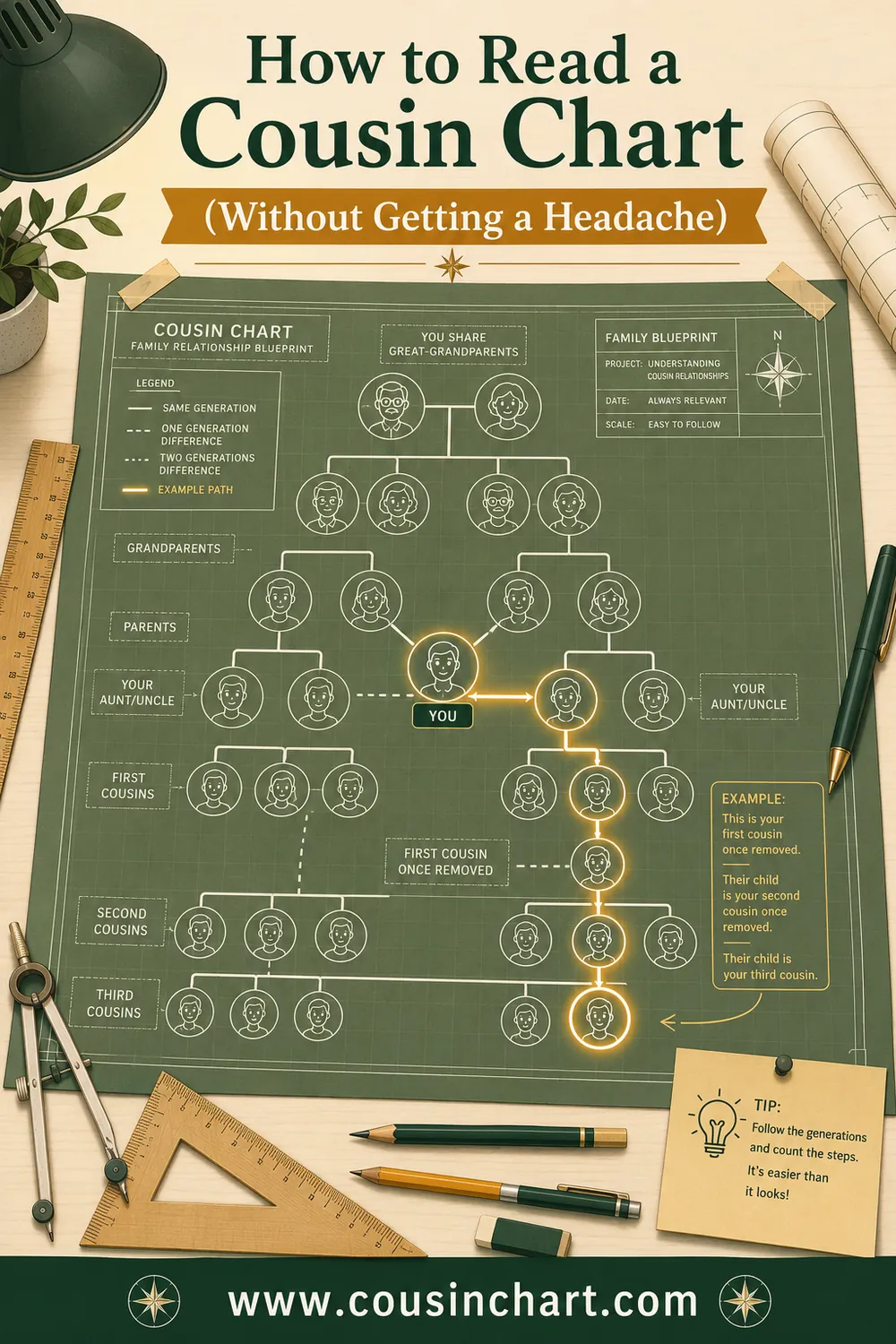
Equal numbers → siblings or cousins. Both 1: siblings. Both 2: first cousins. Both 3: second cousins. Both 4: third cousins. (Pattern: cousin number = the count minus one.)
One of the numbers is 0 → direct line or aunt/uncle line. If the "shared ancestor" is one of the two people, you've got parent/grandparent/great-grandparent relationships. If one person is a child of the ancestor (count 1) and the other is deeper, it's the aunt/uncle ladder: 1-and-2 = aunt/uncle ↔ niece/nephew; 1-and-3 = great-aunt/uncle; 1-and-4 = great-great-aunt/uncle. Each extra generation adds a "great," not a "removed."
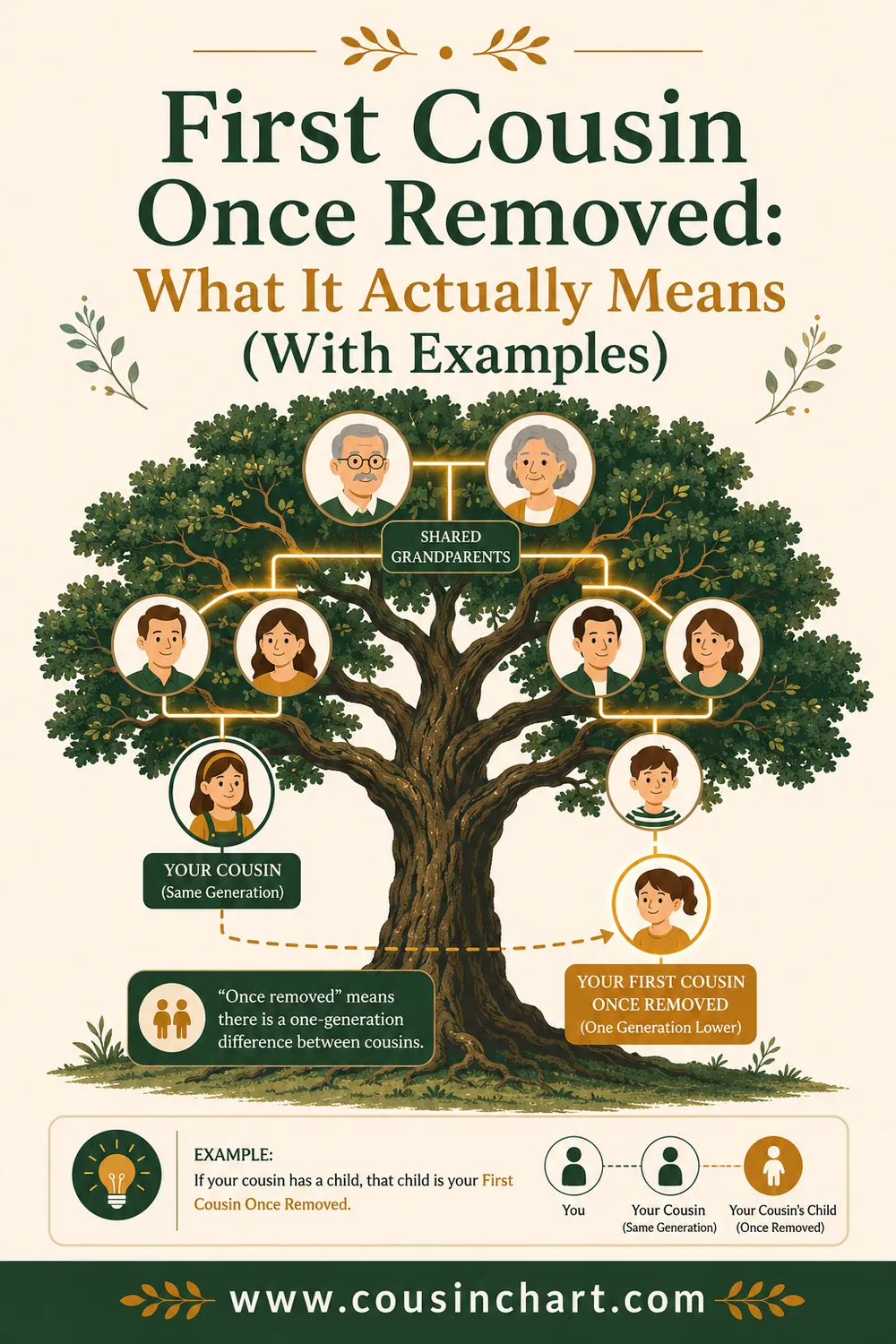
Unequal numbers, both 2 or more → removed cousins. Smaller number minus one = the cousin degree; the difference = the removals. Your 4-and-3 example: smaller is 3 → second cousins; difference 1 → once removed. Doreen is your second cousin once removed.
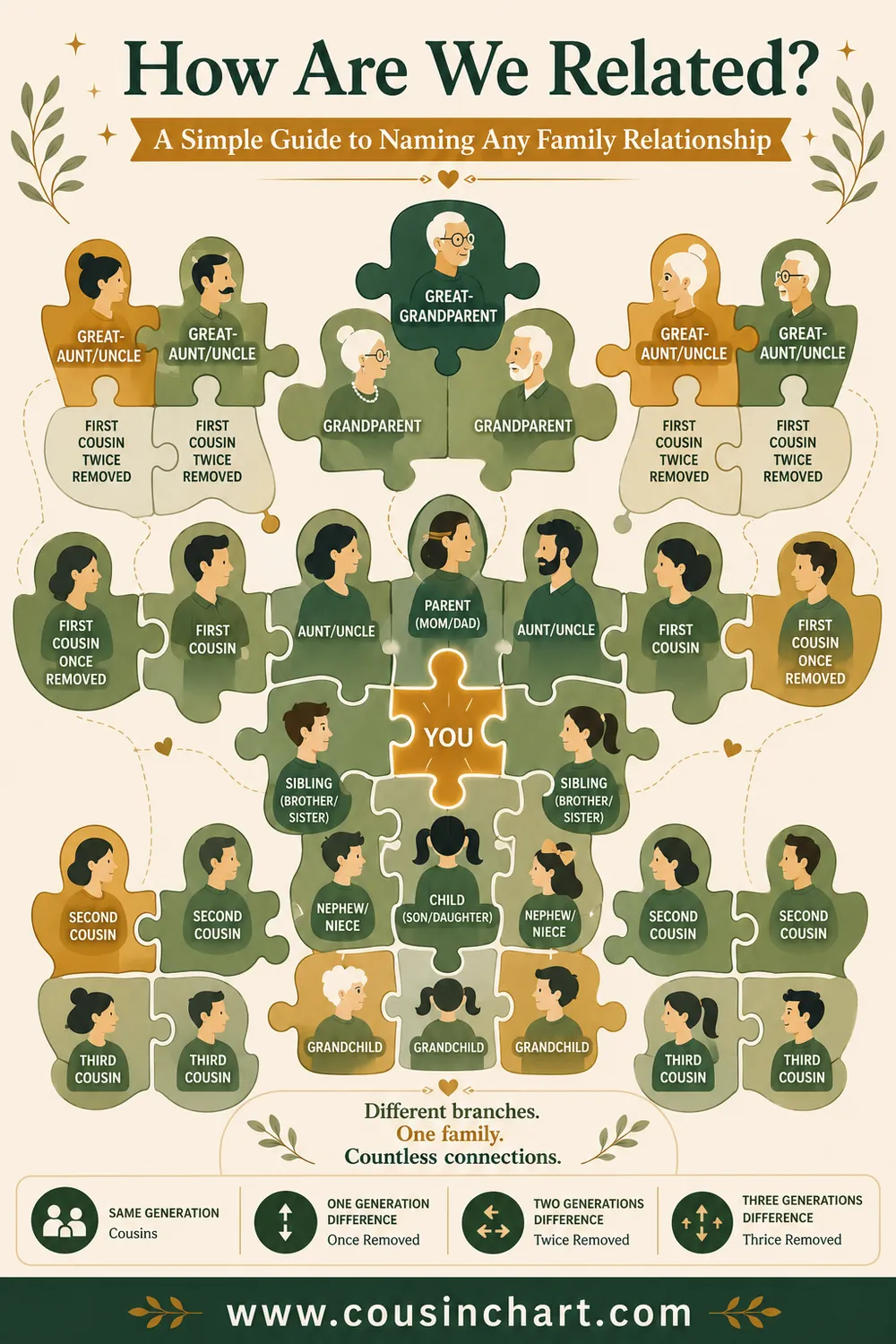
Those three cases generate every entry on a cousin chart — the chart is just this method precomputed. And the calculator is the chart with a friendlier face.
The Relationships With No Shared Ancestor
The ancestor method covers blood. Three more families of terms cover everyone else at the table:
| Type | How you're connected | Examples |
|---|---|---|
| In-laws (affinity) | Through a marriage | Spouse's sister = sister-in-law; aunt's husband = uncle (by marriage); cousin's wife = cousin-in-law |
| Step-relatives | Through a parent's (or your own) remarriage | Stepdad's son = stepbrother; spouse's daughter = stepdaughter |
| Half-relatives | Through one shared parent instead of two | Half-brother; half-sister's son = half-nephew |
Three quick clarifications people always want:
- Half counts as blood. Half-siblings share a parent (~25% DNA); half-cousins share one grandparent instead of a grandparent couple (~6.25%). The naming just prefixes "half."
- Steps and in-laws share no DNA (barring coincidence), but the terms are real and useful. There's no genealogical police against calling your stepmom "Mom," either.
- In-law chains don't extend forever. Your brother-in-law's brother is, formally, nothing to you — English just runs out of terms, and that's okay.
Worked Examples From Real Reunion Questions
"My great-uncle's grandchild — what are they to me?" Your great-uncle is your grandparent's brother, so the shared ancestors are your great-grandparents. You: 3 down. His grandchild: great-uncle (1) → his child (2) → grandchild (3). Equal 3s → second cousins.
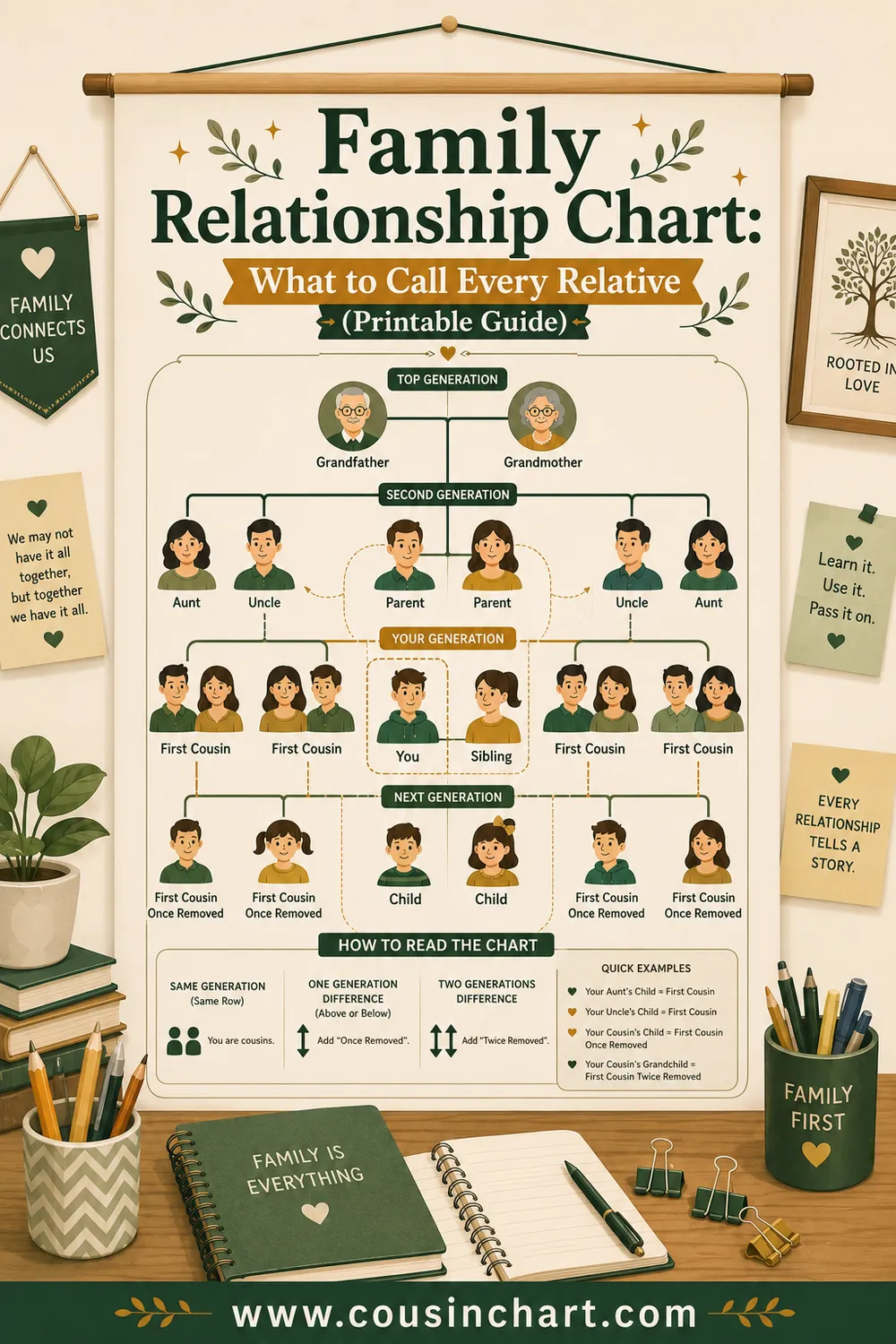
"My grandmother's sister?" No counting needed — sibling of a grandparent is your great-aunt (also called grand-aunt; both are correct, as our family relationship chart shows).
"My dad's cousin's daughter?" Shared ancestors: your great-grandparents. Her line: great-grandparents → the cousin's parent (1) → dad's cousin (2) → the daughter (3). Your line: your grandparent (1) → dad (2) → you (3). Equal 3s → second cousins.
"My cousin's wife's brother?" Chain breaks at the marriage — no shared ancestor, no standard term. He's "my cousin-in-law's brother," a.k.a. the guy at the reunion eating your potato salad.
Notice the method never changes. Ancestor, two counts, rules. When a chain gets long enough that counting feels wobbly — "my great-grandma's cousin's granddaughter" — that's the moment to hand it to the free calculator and get the term plus a drawn tree in one tap.
A Pocket Cheat Sheet
The whole method, compressed to something you can recite at a reunion:
- Same generation + shared grandparents → first cousins. Great-grandparents → second cousins. Great-great → third. (One "great" per cousin number, counting grandparents as zero greats.)
- Different generations on the cousin lines → add one "removed" per generation of gap. Parent's cousin and cousin's child are both once removed.
- Sibling of a direct ancestor → the aunt/uncle ladder: aunt, great-aunt, great-great-aunt as you climb. Their descendants feed back into the cousin grid.
- Connected through a marriage → in-law or step; no shared ancestor, no blood term.
- One shared parent instead of two somewhere → prefix "half" and carry on normally.
And the practice round to prove you've got it — answers follow each:
- Your grandpa's sister's daughter. Grandpa's sister is your great-aunt; her daughter is your parent's first cousin → your first cousin once removed.
- Your half-sister's grandson. Sibling line with a "half" prefix, two generations down → your half great-nephew.
- Your wife's cousin. Chain crosses a marriage → cousin-in-law, no blood term needed.
Three different ladders — cousin, niece/nephew, in-law — one per question. If you sorted them correctly, you've mastered the part that actually confuses people: not the counting, but knowing which ladder you're on.
Why Bother Getting It Right?
Casual life runs fine on "cousin" and "auntie." The precise terms earn their keep in a few places:
- DNA test results. Match lists say "2nd–3rd cousin," and knowing what that means (and which candidates fit) is how adoptees and family historians solve mysteries.
- Family medical history. "Heart disease in a first cousin once removed" and "in a second cousin" carry different weight.
- Inheritance and probate. Intestacy laws rank relatives precisely; "removed" can matter in court.
- The simple pleasure of knowing. Somebody at the party knows exactly how you're related to everyone. It might as well be you.
FAQ
What's the fastest way to figure out how two people are related?
Find the closest ancestor they share, count each person's generations below that ancestor, then: equal counts = siblings/cousins, one count of 1 = the aunt/uncle line, unequal counts = removed cousins. Or enter the path in a free relationship calculator and skip the math.
How are we related if we share great-grandparents?
If you're both 3 generations below them, you're second cousins. If one of you is closer — say a grandchild and a great-grandchild — you're first cousins once removed. Equal depth sets the degree; unequal depth adds removals.
What do I call my mom's cousin?
Your first cousin once removed. Her children are your second cousins. "My mom's cousin" is also perfectly acceptable in conversation — clearer than the formal term, honestly.
Is my aunt's husband my uncle?
By marriage, yes — that's exactly what "uncle" covers in everyday use. Formally he's an uncle by affinity rather than blood, which only matters for genetics and inheritance, not for birthday cards.
How are step-siblings and half-siblings different?
Half-siblings share one biological parent (~25% shared DNA). Step-siblings share no biology at all — they're connected because their parents married each other. Both are family; only one shows up on a DNA test.
Can two people be related in more than one way?
Yes — intertwined trees produce it all the time (double cousins are the classic case). Convention is to name the closest relationship, though genealogists sometimes record both.
Ask the Question, Get the Answer
"How are we related?" has a three-step answer: shared ancestor, two counts, naming rules. It works for every blood relative you'll ever meet, and the in-law/step/half vocabulary covers the rest of the table. And when the chain is six links long and dinner's getting cold, the free family relationship calculator turns the whole method into a ten-second tap-through — with a little chart you can hold up as proof.