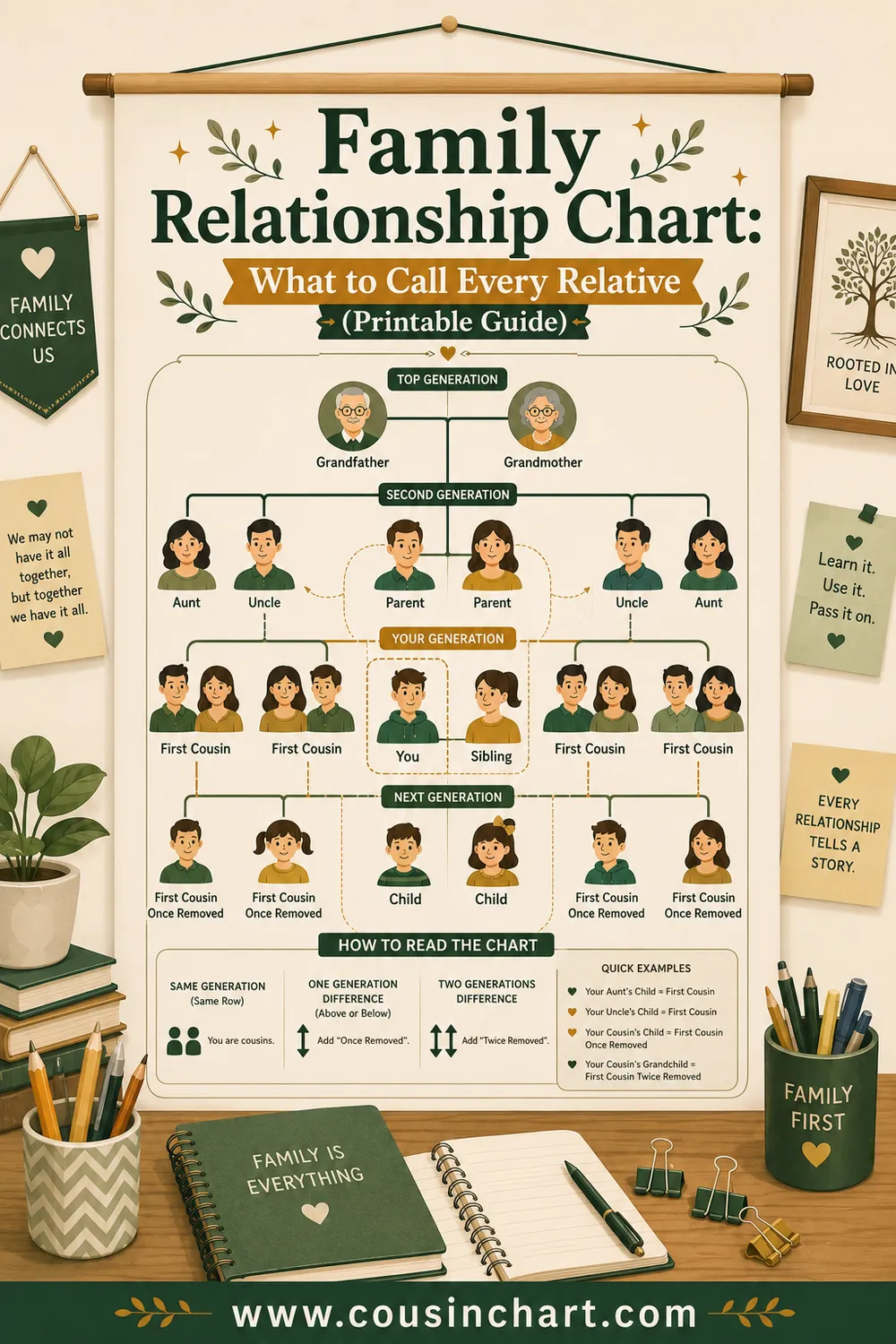
Family Relationship Chart: What to Call Every Relative (Printable Guide)
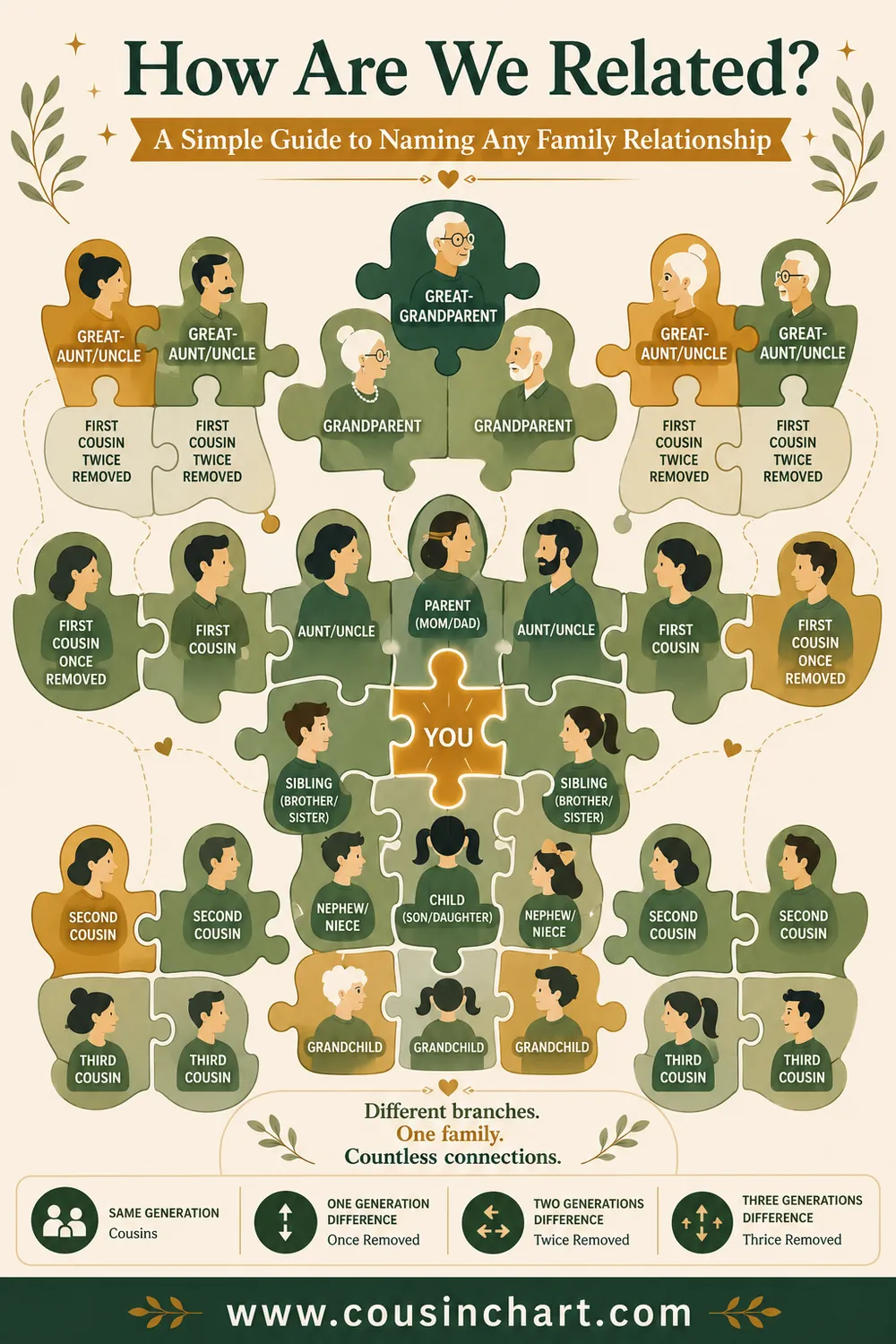
A family relationship chart shows what to call any relative based on how they connect to you — through which ancestor, how many generations apart, or through which marriage. The full chart is below, organized the way you actually meet people: up the tree (parents, grands), across it (siblings, cousins), down it (kids, nieces), and around it (in-laws, steps, halves).
Print it, stick it on the fridge before the reunion, and you'll never blank on "wait, what IS my mom's cousin to me?" again. (Answer: your first cousin once removed.) For live lookups with the counting done for you, the free relationship calculator at cousinchart.com names any connection in seconds.
Relationship quick-check. Tap a phrase to see the correct term:
The answer will appear here.
The Chart: Blood Relatives
Organized by how the relative connects to you. The "shared ancestor" column is the key to the whole system — it's what determines every name.
| They are your… | How they connect | Closest shared ancestor(s) | Avg DNA |
|---|---|---|---|
| Parent | You descend from them | — | ~50% |
| Sibling | Same parents | Your parents | ~50% |
| Grandparent | Parent's parent | — | ~25% |
| Aunt / uncle | Parent's sibling | Your grandparents | ~25% |
| Niece / nephew | Sibling's child | Your parents | ~25% |
| First cousin | Aunt/uncle's child | Your grandparents | ~12.5% |
| Great-aunt / great-uncle | Grandparent's sibling | Your great-grandparents | ~12.5% |
| Great-niece / great-nephew | Sibling's grandchild | Your parents | ~12.5% |
| First cousin once removed | Parent's cousin, or cousin's child | Grandparents (offset one generation) | ~6.25% |
| Second cousin | Parent's cousin's child | Your great-grandparents | ~3.125% |
| First cousin twice removed | Grandparent's cousin, or cousin's grandchild | Grandparents (offset two) | ~3.125% |
| Second cousin once removed | Parent's second cousin, or second cousin's child | Great-grandparents (offset one) | ~1.56% |
| Third cousin | Parent's second cousin's child | Your great-great-grandparents | ~0.78% |
DNA figures are population averages; individual results vary. Spot the two rules quietly running the table: each generation of distance roughly halves the DNA, and cousins pick up a "removed" whenever the two of you sit in different generations (full explanation here).
The Chart: In-Laws, Steps, and Halves
No shared ancestor here (except the halves) — these connect through marriages:
| They are your… | How they connect |
|---|---|
| Mother/father-in-law | Your spouse's parent |
| Brother/sister-in-law | Your spouse's sibling — or your sibling's spouse |
| Son/daughter-in-law | Your child's spouse |
| Uncle/aunt (by marriage) | Your blood aunt/uncle's spouse |
| Cousin-in-law | Your cousin's spouse (informal but universally understood) |
| Stepparent | Your parent's spouse (not your parent) |
| Stepsibling | Your stepparent's child — no blood shared |
| Half-sibling | Shares one parent with you (~25% DNA — blood relative) |
| Half-cousin | Your parent's half-sibling's child (~6.25% DNA) |
Three points save most of the confusion:
- "Step" means a marriage created the link; "half" means one shared parent. Half-relatives are blood relatives; step-relatives aren't. Both are family.
- English in-law terms stop after one link. Your brother-in-law's mother has no official title — "my brother-in-law's mom" is the correct term, honestly.
- Marriage titles are honorary but universal. Your aunt's husband is your uncle in every conversation that matters.
How to Use the Chart in 3 Steps
- Describe the person as a chain from you: "my mom's → cousin's → son."
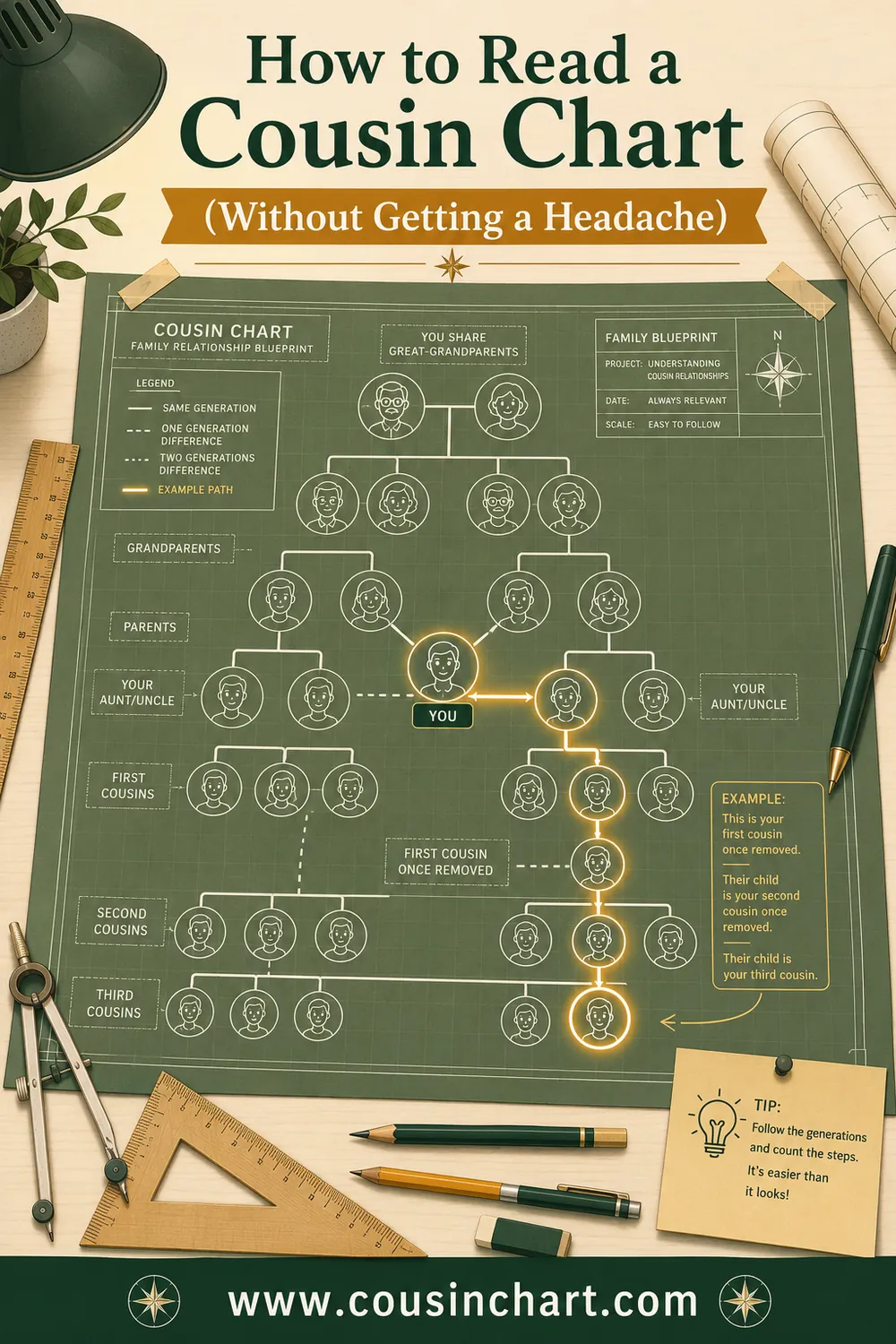
- Collapse the chain with the chart: mom's cousin = first cousin once removed; their son drops one generation back to your row = second cousin.
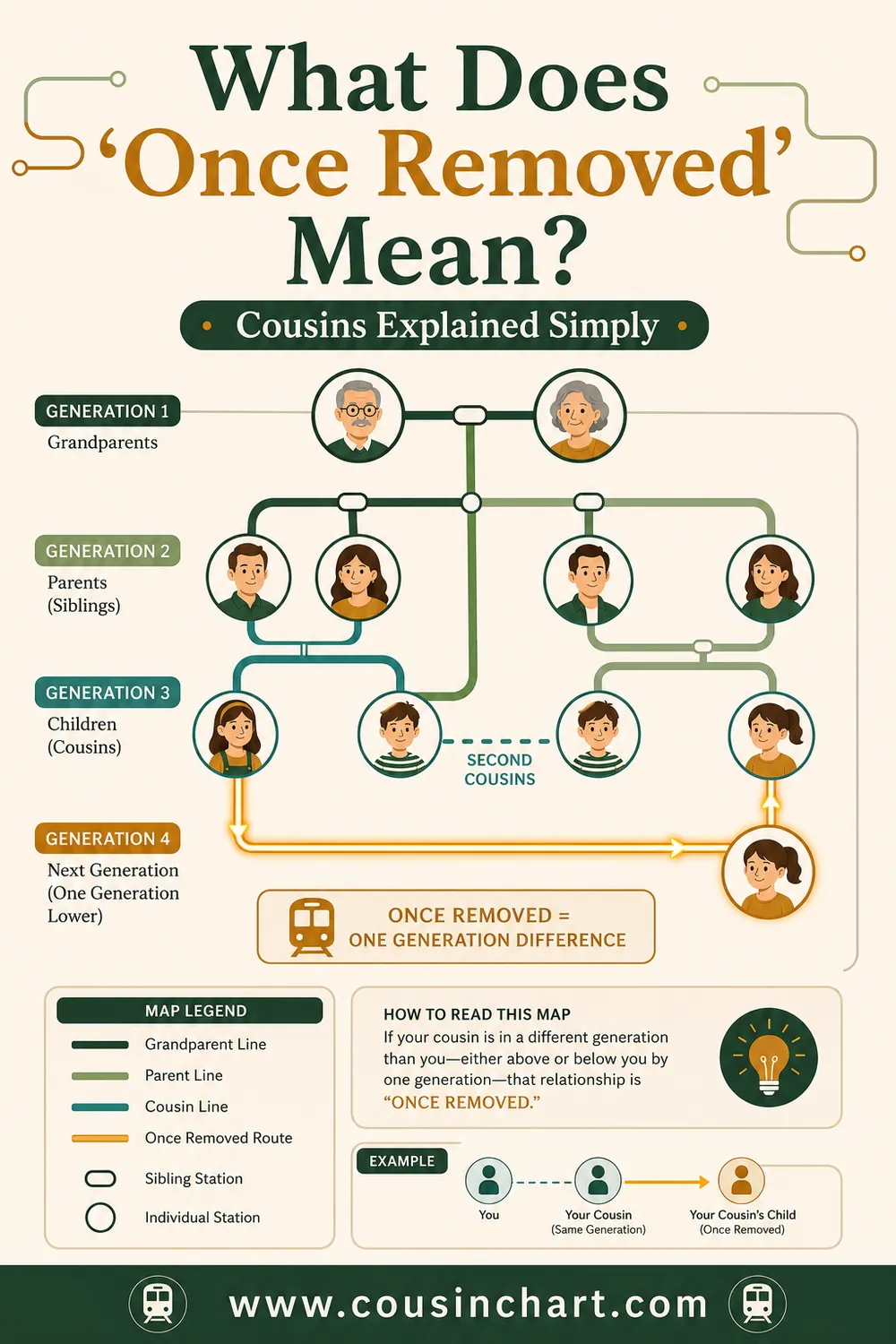
- Check the direction of generations. Same generation as you → plain cousin (first, second, third). Above or below you → either the aunt/uncle ladder (adds "great") or the cousin ladder (adds "removed").
The two ladders trip everyone up, so here's the distinction plainly: **relatives connected through your parents' or grandparents' siblings stack "greats" (aunt → great-aunt → great-great-aunt as you climb). Cousins in different generations stack "removeds"** (cousin → once removed → twice removed as you offset). If you can classify which ladder you're on, the chart does the rest — and if you can't, tap the chain into the calculator and it classifies for you.
The Five Lookups Everyone Actually Needs
Decades of reunion arguments boil down to about five rows of the chart:
- Mom or dad's cousin → your first cousin once removed (not your second cousin).
- Your cousin's child → also your first cousin once removed (the full story).
- **Your cousin's child and your child → second cousins** to each other.
- Grandma's sister → your great-aunt (grand-aunt is equally correct).
- Grandma's sister's grandchild → your second cousin — you're both great-grandchildren of the same couple.
Memorize those and you're the family authority. For everything weirder — "my great-grandpa's cousin's granddaughter" — the cousin chart method or the calculator picks up where memory stops.
Printing Tips: Make It Reunion-Ready
A relationship chart earns its keep on paper, next to the guest book, where three generations can argue over it lovingly. Suggestions from families who've done it:
- Print landscape, one page. The blood-relative table above fits a landscape Letter/A4 sheet at readable size. Laminate it if your reunions involve barbecue sauce.
- Add your own names. Before printing, pencil real family members into a few rows ("First cousin once removed — e.g., Uncle Pete's grandson Tyler"). Abstract charts click instantly when one row has a familiar face.
- Post it where the bottleneck is. The kitchen doorway and the drinks table are where "how are we related?" conversations actually happen.
- Pair it with a QR code to the calculator. Print a small QR linking to the free tool in the corner — the chart answers the common cases, the phone handles the exotic ones.
Turn the Chart Into a Reunion Game
The fastest way to get a family fluent in its own structure is to make the chart competitive. Three formats that work across ages:
- "Name That Relative." One person picks two people at the gathering ("Grandma Lucy and baby Mateo") and everyone races to name the exact relationship. Chart-checking allowed; the calculator referees disputes. First to five wins the last slice of pie.
- The generation line-up. Have everyone physically stand in generation rows — grandparents' generation, parents', kids'. Suddenly "removed" is visible: anyone you're pointing at diagonally is a removed cousin, anyone in your own row is a plain cousin. Kids grasp it in one round.
- Mystery ancestor. Read a fact about a shared ancestor ("she came from Palermo in 1912") and have players work out what that person is to them — great-great-grandmother to some rows, great-great-great to the littlest. Sneaky genealogy lesson included free.
Beyond the fun, these games do something quietly valuable: they attach the abstract terms to faces while the older generation is still there to confirm who's who. Plenty of family historians trace their obsession to exactly one afternoon like this.
Why the Names Are Worth Knowing
Beyond winning the potato-salad debate:
- DNA test season. When AncestryDNA says "2nd cousin — 210 cM," the chart is how you shortlist who that could be.
- Medical history forms. Doctors ask about conditions "in first-degree relatives" and beyond; precise labels keep the record accurate.
- Wills and inheritance. Intestacy law distributes property by exact relationship; "cousin once removed" and "second cousin" can sit in different places in line.
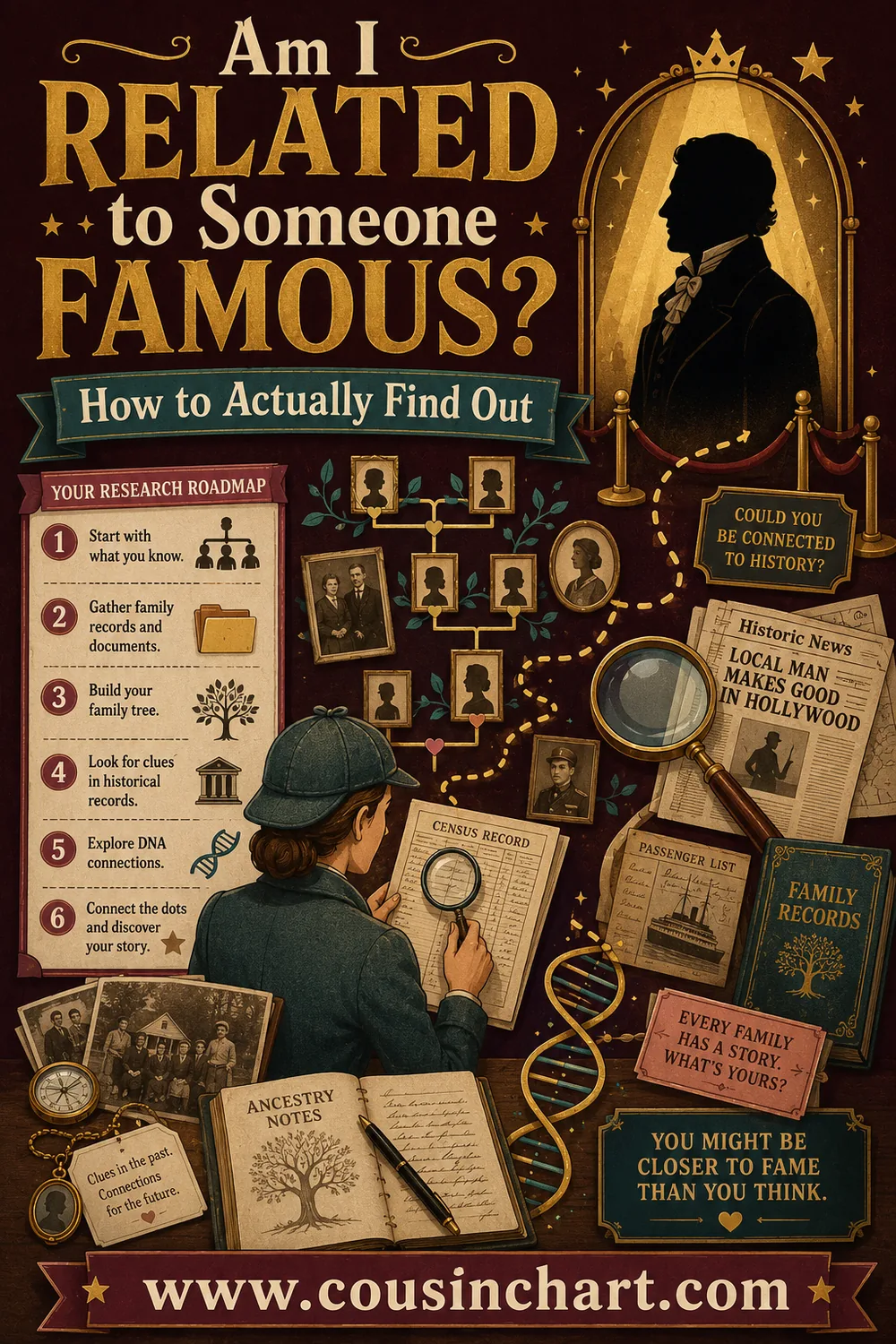
- Storytelling. "Your great-great-aunt Rosa crossed the Atlantic alone at 19" hits differently when everyone knows exactly where Rosa sits on the tree.
FAQ
What is a family relationship chart?
A reference table that names every type of relative — cousins, greats, in-laws, steps — based on how they connect to you through ancestors and marriages. Genealogists also call the cousin-specific version a cousin chart or canon-law relationship chart.
What do I call my mom's cousin?
Your first cousin once removed — one generation above you on the first-cousin line. Her children are your second cousins.
What's the difference between a great-aunt and a grand-aunt?
Nothing — both mean your grandparent's sister. "Grand-aunt" is technically more consistent (she's the same generation as your grandparents), but "great-aunt" is far more common. Use either.
Is my aunt's husband my uncle?
In everyday usage, yes — he's your uncle by marriage. He shares no DNA with you, which only matters for genetics and inheritance questions, not for family life.
What do half-siblings count as on a family chart?
Full blood relatives who share one parent instead of two — about 25% shared DNA. Their children are your half-nieces and half-nephews. "Half" describes the connection, not the closeness.
Is there a chart for cousins specifically?
Yes — the classic cousin chart grid, which maps cousin degree and "removed" from your shared ancestor. We walk through it square by square in how to read a cousin chart, or the free calculator reads it for you.
One Chart on the Fridge, One Tool in Your Pocket
Every relative has an exact name, and now you have both versions of the answer key: the printable chart for the wall, and the free family relationship calculator for everything the chart can't fit — the four-link chains, the double connections, the "okay but what's HER daughter to MY grandson" follow-ups. Print one, bookmark the other, and enjoy being the person at the reunion who actually knows.