What Does "Once Removed" Mean? Cousins Explained Simply
Last updated: September 30, 2026
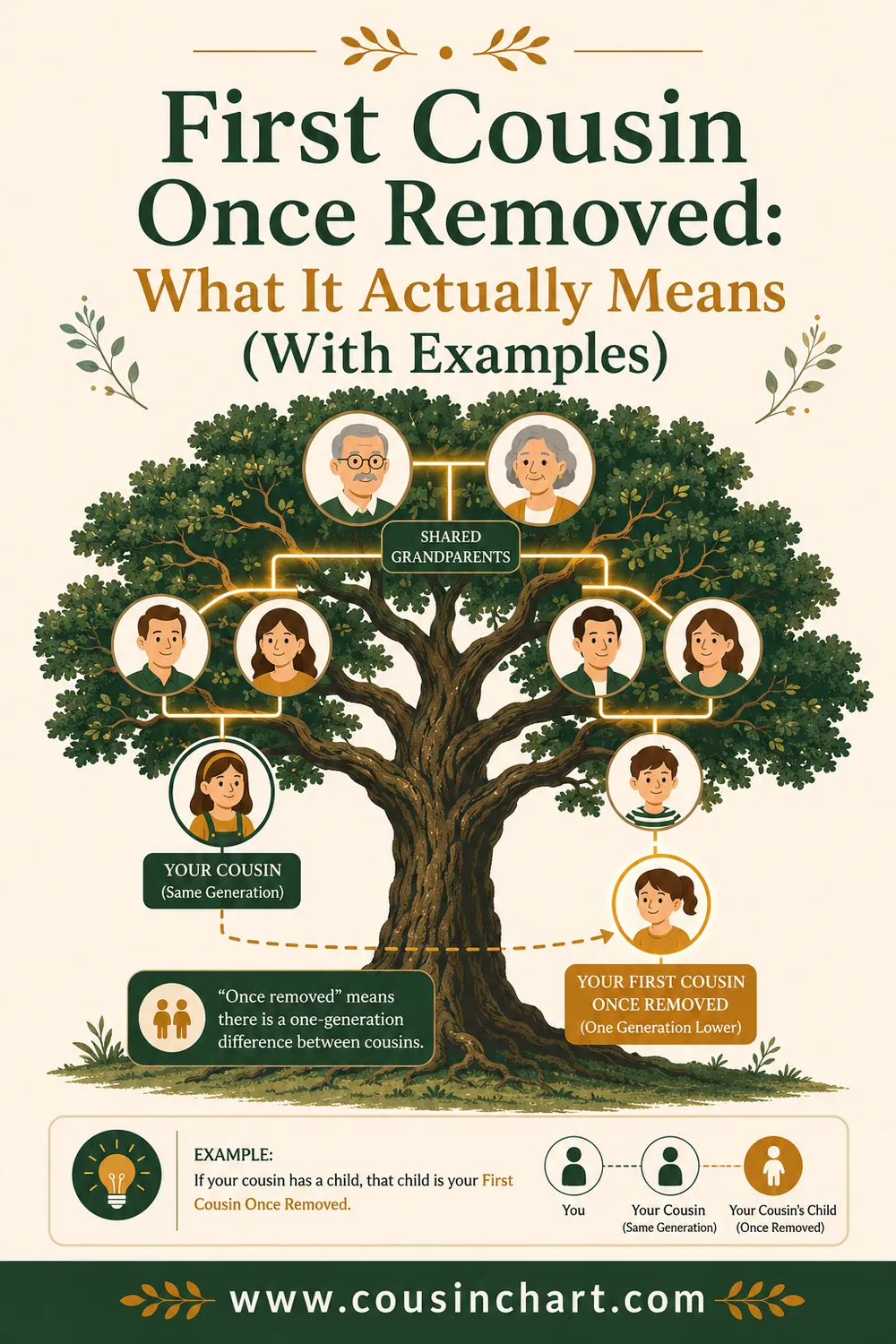
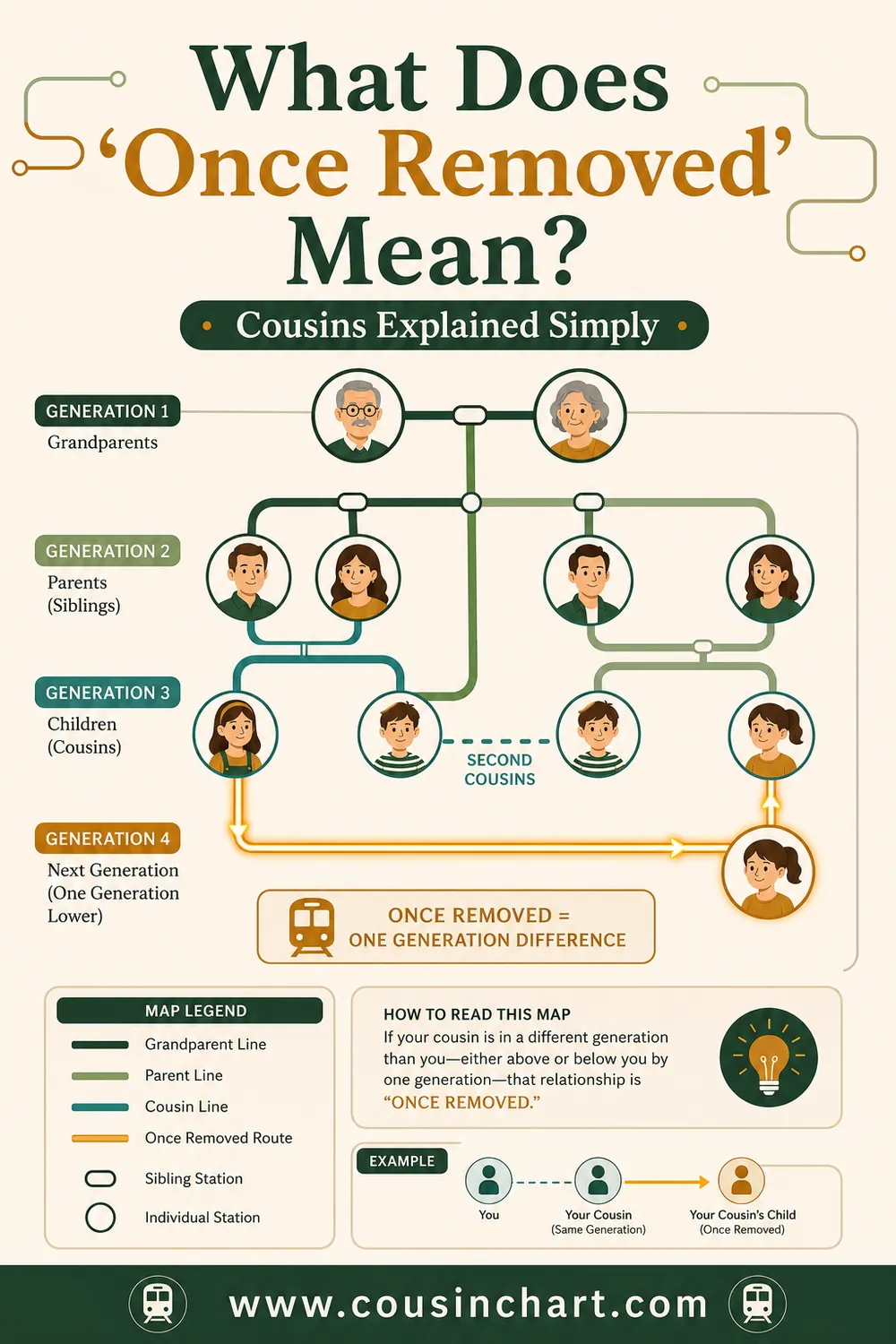
"Once removed" means one generation apart. When two cousins aren't in the same generation — say, you and your cousin's daughter — the generation gap is described as "removed": one generation apart is once removed, two is twice removed, and so on. The cousin number (first, second, third) is a separate measurement that tells you how far back your shared ancestor is.
Once you see the two measurements side by side, the whole system clicks — and you'll be able to name any relative in your tree. This guide walks through it with plain examples. If you'd rather just get an answer, the free relationship calculator at cousinchart.com names any family connection instantly.
Relationship quick-check. Tap a phrase to see the correct term:
The answer will appear here.
The Two Numbers Behind Every Cousin Name
Every cousin label — "third cousin twice removed," "first cousin once removed" — is built from exactly two measurements:
- The cousin number (first, second, third…) tells you how far back the shared ancestor is.
- The removal (once, twice, three times removed) tells you how many generations apart the two people are.
That's the entire system. Genealogists didn't invent baroque terminology for fun; they needed two independent facts encoded in one phrase, because two cousins can share the same ancestor while standing on different rungs of the generational ladder.
Here's the ancestor rule in one line: shared grandparents = first cousins, shared great-grandparents = second cousins, shared great-great-grandparents = third cousins. Each extra "great" bumps the cousin number by one. (Formally: count the generations from the shared ancestor down to the closer person, then subtract one — that's the cousin degree.)
And the removal rule in one line: count the generation gap between the two people. Same generation? No removal. One apart? Once removed. Two apart? Twice removed.
"Removed" Works in Both Directions
Here's the part that surprises people: your parent's first cousin and your first cousin's child are both your first cousin once removed. One is a generation above you, one is a generation below — English uses the same term either way.
Think of it like floors in a building. You're on floor 3. A cousin one floor up (floor 4) and a cousin one floor down (floor 2) are both "one floor removed" from you. The word doesn't say which direction, just the distance.
If you need to be direction-specific — genealogists occasionally do — you can say "once removed ascending" (older generation) or "descending" (younger). In normal conversation, "my dad's cousin" or "my cousin's son" is clearer than either.
One more reassuring symmetry: the relationship name is always mutual. If Priya is your first cousin once removed, you are Priya's first cousin once removed. Nobody outranks anybody.
How to Count It: A 3-Step Method
You can name any cousin relationship with three steps and your fingers:
- Find the closest ancestor you both share. Not any shared ancestor — the most recent one (usually a couple, like a set of great-grandparents).
- Count generations from that ancestor to each of you. Child = 1, grandchild = 2, great-grandchild = 3, and so on.
- Apply the two rules. The smaller count minus one = cousin number. The difference between the counts = how many times removed.
Worked example: you and your grandmother's first cousin's grandson. Your shared ancestors are your great-great-grandparents (your grandmother's grandparents). You're 4 generations below them. He's… let's count: their child (1), grandchild — your grandma's cousin (2), his child (3), his son (4). Both of you are 4 generations down: smaller count 4 − 1 = third cousins, difference 0 = no removal.
Feels like homework? It kind of is. That's why we built the family relationship calculator — you tap out the path ("my grandma → her cousin → his grandson") and it does steps 1–3 for you, instantly.
Once, Twice, Three Times Removed — A Reference Table
The pattern is completely regular, so a table makes it obvious. Start from your first cousin and slide up or down:
| Person | Generations from you | Relationship to you |
|---|---|---|
| Your first cousin | 0 | First cousin |
| Your first cousin's child | 1 down | First cousin once removed |
| Your first cousin's grandchild | 2 down | First cousin twice removed |
| Your first cousin's great-grandchild | 3 down | First cousin three times removed |
| Your parent's first cousin | 1 up | First cousin once removed |
| Your grandparent's first cousin | 2 up | First cousin twice removed |
| Your great-grandparent's first cousin | 3 up | First cousin three times removed |
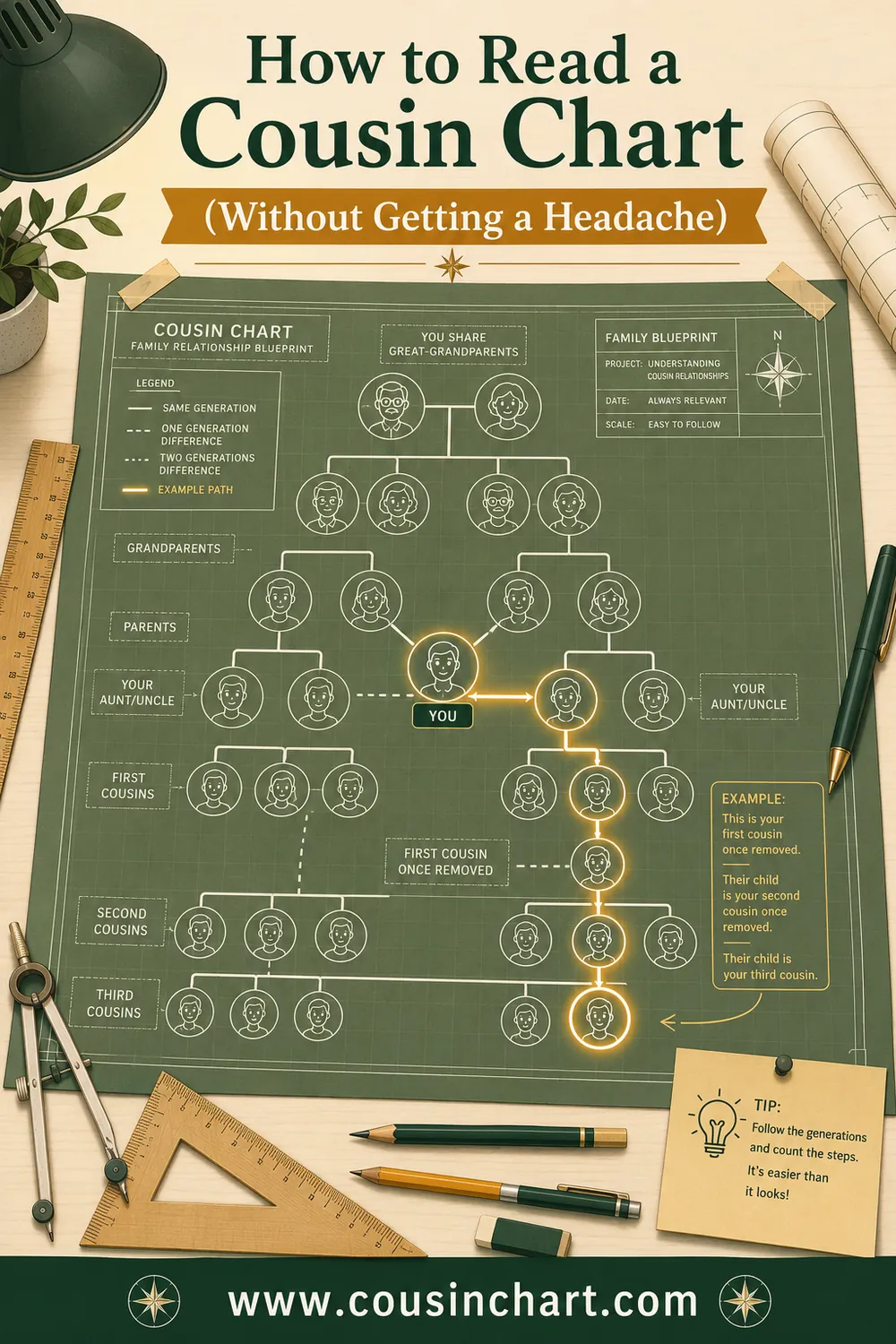
The same ladder works for second cousins, third cousins, any cousins: keep the cousin number, add one "removed" per generation of gap. For the full grid covering every combination, see our guide to reading a cousin chart.
The Classic Mistake: "Removed" vs. Second Cousin
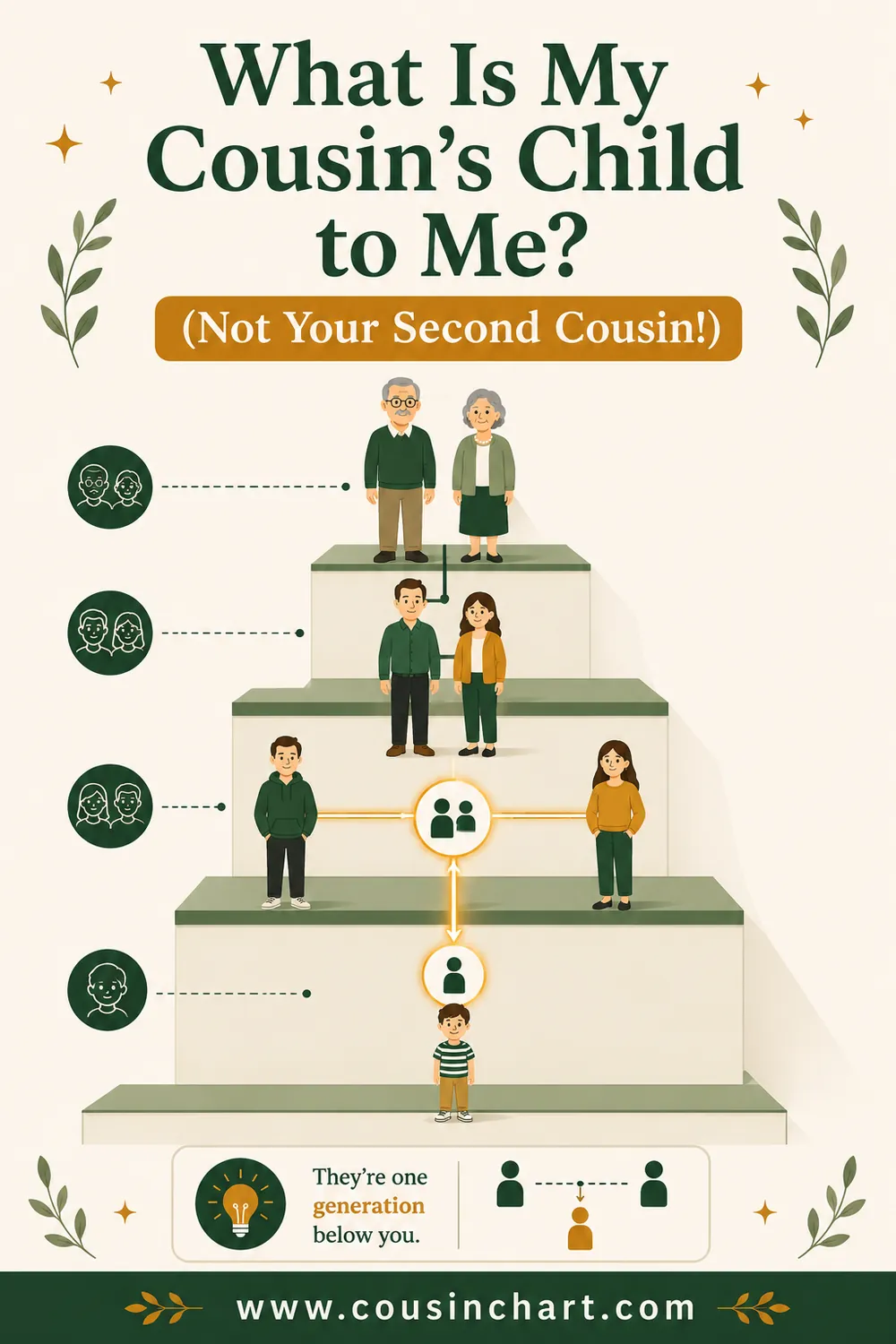
The single most common family-tree error is calling your cousin's child your "second cousin." They're not — they're your first cousin once removed. The confusion is understandable: both terms feel like they mean "a cousin, but a bit further away."
The distinction that untangles it:
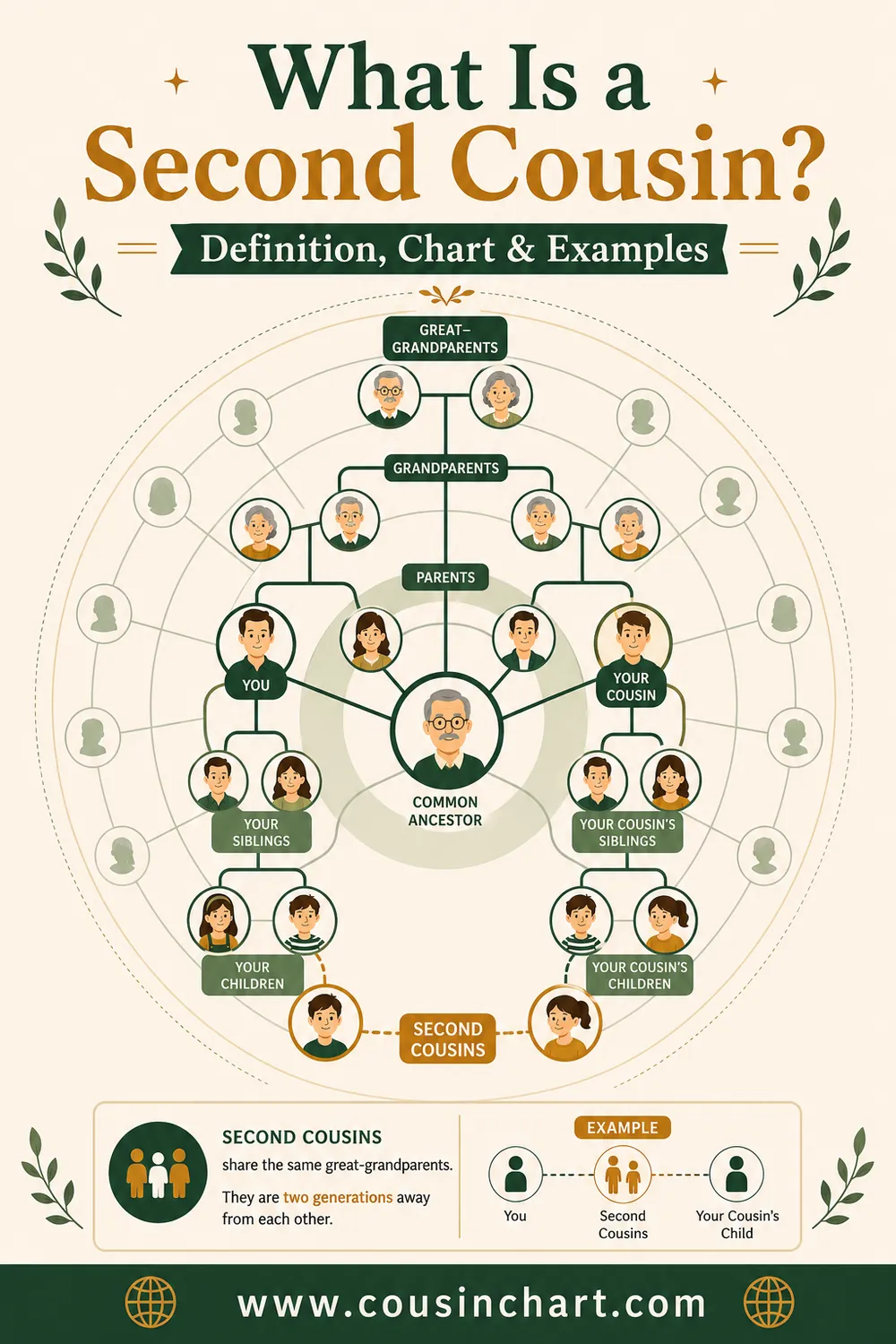
- Second cousin = same generation as you, shared great-grandparents. In practice: your parent's cousin's child.
- First cousin once removed = one generation offset from you, on the first-cousin line.
A memorable version: numbers move sideways, removals move up and down. Higher cousin numbers mean the connection is further back in time; removals mean you're leaning across generations. Our second cousin guide digs into the sideways direction.
Does "Removed" Matter for DNA?
Yes — each step of removal roughly halves the expected shared DNA, exactly like each step of cousin number. Averages:
| Relationship | Average shared DNA |
|---|---|
| First cousin | ~12.5% |
| First cousin once removed | ~6.25% |
| First cousin twice removed | ~3.125% |
| Second cousin | ~3.125% |
Spot the overlap: a first cousin twice removed and a second cousin share the same average DNA (~3.125%). DNA tests can estimate how much ancestry you share but not always the shape of the connection — which is why match lists say things like "2nd–3rd cousin." The paper trail (or a well-labeled family tree) resolves what the percentages can't.
Why English Even Has This Word
"Removed" in the cousin sense has been in English since at least the 1500s — records from that era already describe relatives as "cousins once removed." Older systems needed precise kinship words because inheritance, marriage rules, and titles depended on exact relationships. Many other languages carve up the cousin space differently; some use one warm word for every distant relative, others have separate terms for maternal and paternal lines. English settled on a compact two-number system — a bit mathematical, but wonderfully unambiguous once you know the code.
Try It Yourself: Three Practice Rounds
Reading the rules is one thing; running them is what makes the system yours. Cover the answers and try these:
1. Your grandpa's cousin's son. Shared ancestors: your grandpa and his cousin shared grandparents — your great-great-grandparents. You're 4 generations below them; the son is 3 (his grandparent → grandpa's cousin → him). Smaller count 3 − 1 = second cousin; gap of 1 = once removed. Second cousin once removed. (Cross-check: grandpa's cousin's son is your parent's second cousin — same answer from the other direction.)
2. Your cousin's daughter's daughter. Your first cousin, then two generations down. Keep the "first," add two removals: first cousin twice removed.
3. Your great-grandmother's sister. Trick question — siblings of your direct ancestors aren't cousins at all. A great-grandparent's sibling is your great-great-aunt (the aunt/uncle ladder adds "greats," not "removeds").
If you got all three, congratulations: you now outrank most of your relatives at kinship math. If the third one got you, that's the most common trap — the cousin rules only apply once the family line has branched for a full generation. Either way, you can always check your work against the calculator; it never miscounts, even after two helpings of pie.
When the Precise Term Actually Matters
Day to day, "my cousin's kid" beats "my first cousin once removed" for clarity, and no one will fight you. The precise term earns its keep in four places:
- DNA match lists, where "1C1R" is a standard label and knowing the expected ~6.25% helps you place mystery matches.
- Genealogy software and records, which use the formal terms (and their shorthand: 1C1R, 2C2R) as the canonical way to log relationships.
- Inheritance law, where statutes rank relatives by exact degree and a "removed" can shift someone's place in line.
- Medical family history, where a doctor charting hereditary risk needs generations counted correctly.
Everywhere else, warmth wins. Call them your cousin, your auntie, your "little cousin Theo" — the chart will still be here when you need the formal version.
Quick answer: "Removed" always means the number of generations between two cousins, at any level. Once removed is one generation apart, twice removed is two, three times removed is three, and so on. To name any pair, the person who sits higher in the family tree sets the cousin number, and the generation gap sets how many times removed.
The General Rule for "Removed" at Any Level
This works for first cousins or fifth cousins, above you or below you. Just remember that generations are about position in the tree, not age. What matters is how many parent-to-child steps each person sits below the shared ancestor.
The level-up method, step by step
- Figure out who sits higher, meaning fewer generations below the shared ancestor.
- Start from the lower person and climb their own direct line until you reach the higher person's generation. The number of steps you climbed is the number of times removed.
- Name the relationship between the higher person and the ancestor you landed on. If they're first cousins, second cousins, or third cousins, that's your cousin number.
- Put the two together: "second cousin, twice removed." If step 3 turns out to be siblings, it isn't a cousin at all. It's an aunt, uncle, or great-aunt relationship instead.
Three Worked Examples: Up, Down, and a Surprise
Going up: your great-grandfather's second cousin. He sits higher than you, so climb your own line: parent (1), grandparent (2), great-grandparent (3). He and your great-grandfather are second cousins. So he's your second cousin three times removed.
Going down: your second cousin's granddaughter. This time you're the higher one. Climb her line: her parent (1), her grandparent, who is your second cousin (2). You and that grandparent are second cousins, so she is your second cousin twice removed. (More in our second cousin twice removed guide.)
The surprise: your grandmother's first cousin's great-grandson. "First cousin three times removed" is his relationship to your grandmother, not to you. The shared ancestors are your grandmother's grandparents, which makes them your great-great-grandparents. You're 4 generations below them and he's 5, so you sit higher. Climb his line one step to his parent, who is in your generation. His parent and you are third cousins, which makes him your third cousin once removed. The cousin number went up because the higher person is you, not your grandmother.
Quick Reference Table: Any Cousin, Any Removal
Find the higher person's row, then read across by the generation gap.
| Higher person is the shared ancestor's… | Same generation | 1 generation apart | 2 apart | 3 apart |
|---|---|---|---|---|
| Child | Sibling | Aunt/uncle | Great-aunt/uncle | Great-great-aunt/uncle |
| Grandchild | First cousin | 1C1R | 1C2R | 1C3R |
| Great-grandchild | Second cousin | 2C1R | 2C2R | 2C3R |
| Great-great-grandchild | Third cousin | 3C1R | 3C2R | 3C3R |
| 3x great-grandchild | Fourth cousin | 4C1R | 4C2R | 4C3R |
Read "2C1R" as "second cousin once removed." The table keeps going in both directions, and our guide to degrees of cousinship explains the numbering behind each row. Or skip the counting and tap the path into the relationship calculator on our homepage.
Common Mix-Ups
- Borrowing someone else's label. "Grandma's first cousin twice removed" is never your first cousin twice removed. Run the steps from your own spot in the tree.
- Letting the lower person set the cousin number. The number comes from the higher person, which is why your second cousin's child isn't your third cousin.
- Using "removed" for aunts and uncles. Your ancestors' siblings get "great" added instead, like great-great-aunt. See what a great-great-aunt is.
- Stopping at three. The pattern never ends. Four times removed is just as real, only rarer. The three-times-removed guide covers that far end of the ladder.
FAQ
What does once removed mean in simple terms?
One generation apart. Your first cousin once removed is either your first cousin's child (one generation below you) or your parent's first cousin (one generation above you). The cousin relationship is the same; "removed" just flags the generation gap.
Is once removed up or down the family tree?
Either. "Removed" measures distance, not direction — your parent's cousin and your cousin's child are both once removed from you. If direction matters, just describe the person ("my mom's cousin") or add "ascending/descending" in formal genealogy.
What's the difference between a second cousin and a cousin once removed?
A second cousin is in your own generation and shares great-grandparents with you. A first cousin once removed is one generation above or below you on the first-cousin line. Different measurements: one is about ancestor depth, the other about generation gap.
Can someone be twice removed?
Yes — that's a two-generation gap. Your first cousin's grandchild is your first cousin twice removed, and so is your grandparent's first cousin. Three generations of gap makes three times removed, and the pattern continues indefinitely.
Is a cousin once removed still a blood relative?
Absolutely. A first cousin once removed shares about 6.25% of your DNA on average and descends from the same grandparental line you do. "Removed" describes geometry on the family tree, not closeness of blood.
What does 2C1R or 3C2R mean?
They're shorthand from family trees and DNA match lists. The first number is the cousin number and the number before R is how many times removed, so 2C1R is a second cousin once removed and 3C2R is a third cousin twice removed.
Can someone be four or five times removed?
Yes. Your great-great-grandparent's first cousin is your first cousin four times removed, because that person sits four generations above you on the first-cousin line.
Can two people be related in two different ways?
Yes. When families intermarry more than once, two people can connect through more than one line, for example as second cousins on one side and third cousins once removed on the other. Our guide to pedigree collapse explains how this happens.
Do "removed" relationships work the same for half cousins?
Yes. "Half" just means your relatives share one ancestor instead of a couple. The generation gap is counted the same way, so the child of your half first cousin is your half first cousin once removed.
Name Any Relative in Five Seconds
You now hold both keys: cousin number = ancestor depth, removed = generation gap. That's genuinely all there is. But when your aunt asks how she's related to her cousin's granddaughter mid-conversation, skip the finger-counting — open the free cousin calculator, tap the path, and read out the answer (with a little chart to prove it). It handles every removal, every degree, every time.