What Is a Second Cousin? Definition, Chart & Examples
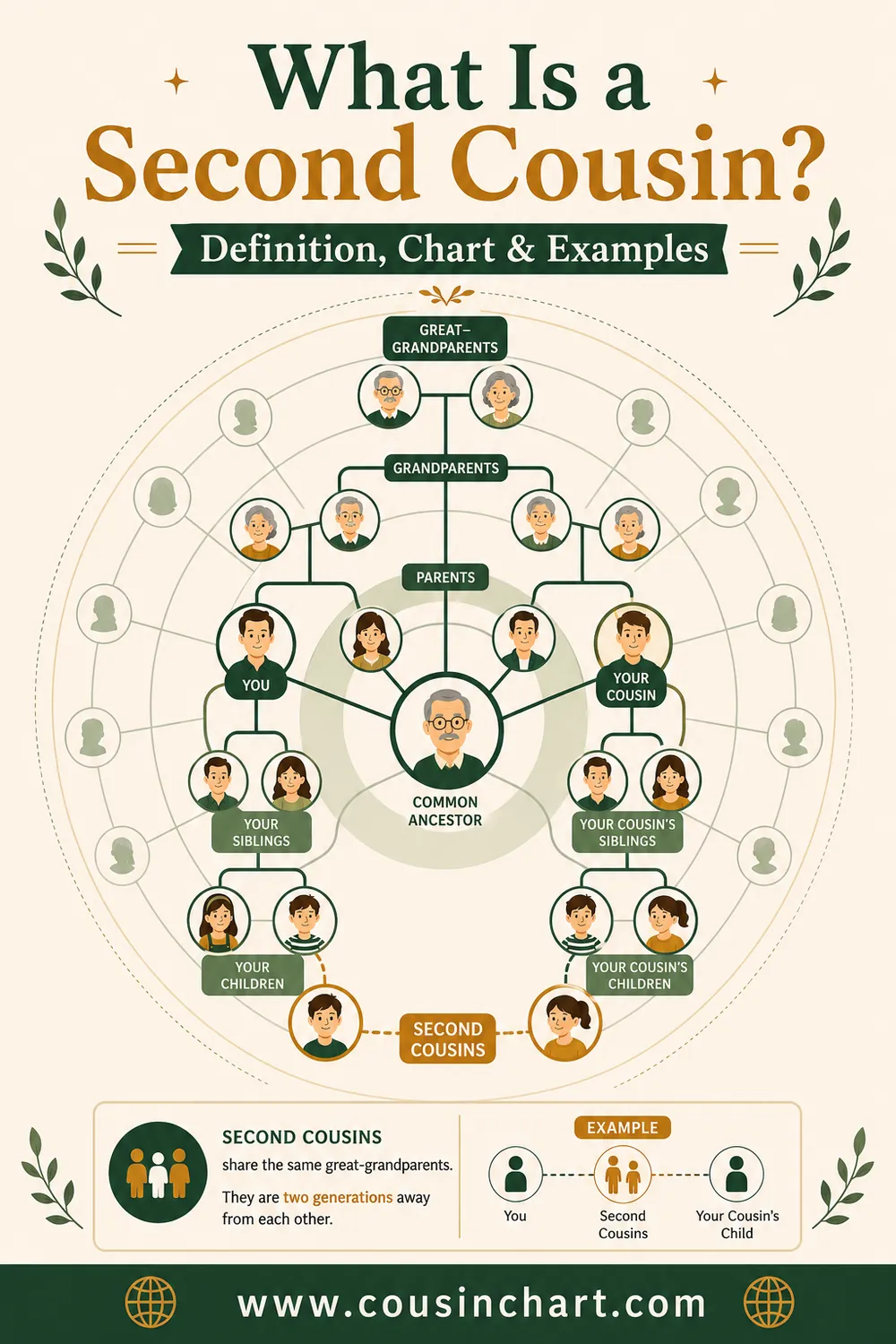
A second cousin is someone who shares great-grandparents with you but not grandparents. In everyday terms: your second cousin is your parent's first cousin's child. You're in the same generation, and on average you share about 3.125% of your DNA.
That's the core of it. Below you'll find the family-tree logic, a chart, the DNA numbers, and answers to the questions that always follow ("so what's my second cousin's kid?"). And whenever a relationship gets too twisty to count on fingers, the free relationship calculator on our homepage sorts it out in seconds.
Relationship quick-check. Tap a phrase to see the correct term:
The answer will appear here.
The Definition, Drawn Out
Start at the top and walk down. Your great-grandparents had several children. One of them became your grandparent. The others — your grandparent's siblings — are your great-aunts and great-uncles.
- Your great-aunt/uncle's children are your parent's first cousins (and your first cousins once removed).
- Their children — the great-grandchildren of your great-grandparents, through a different branch — are your second cousins.
Three parallel descents from one couple: great-grandparents → grandparent → parent → you, and great-grandparents → great-aunt → her child → your second cousin. Same depth on both sides, which is why you're the same generation.
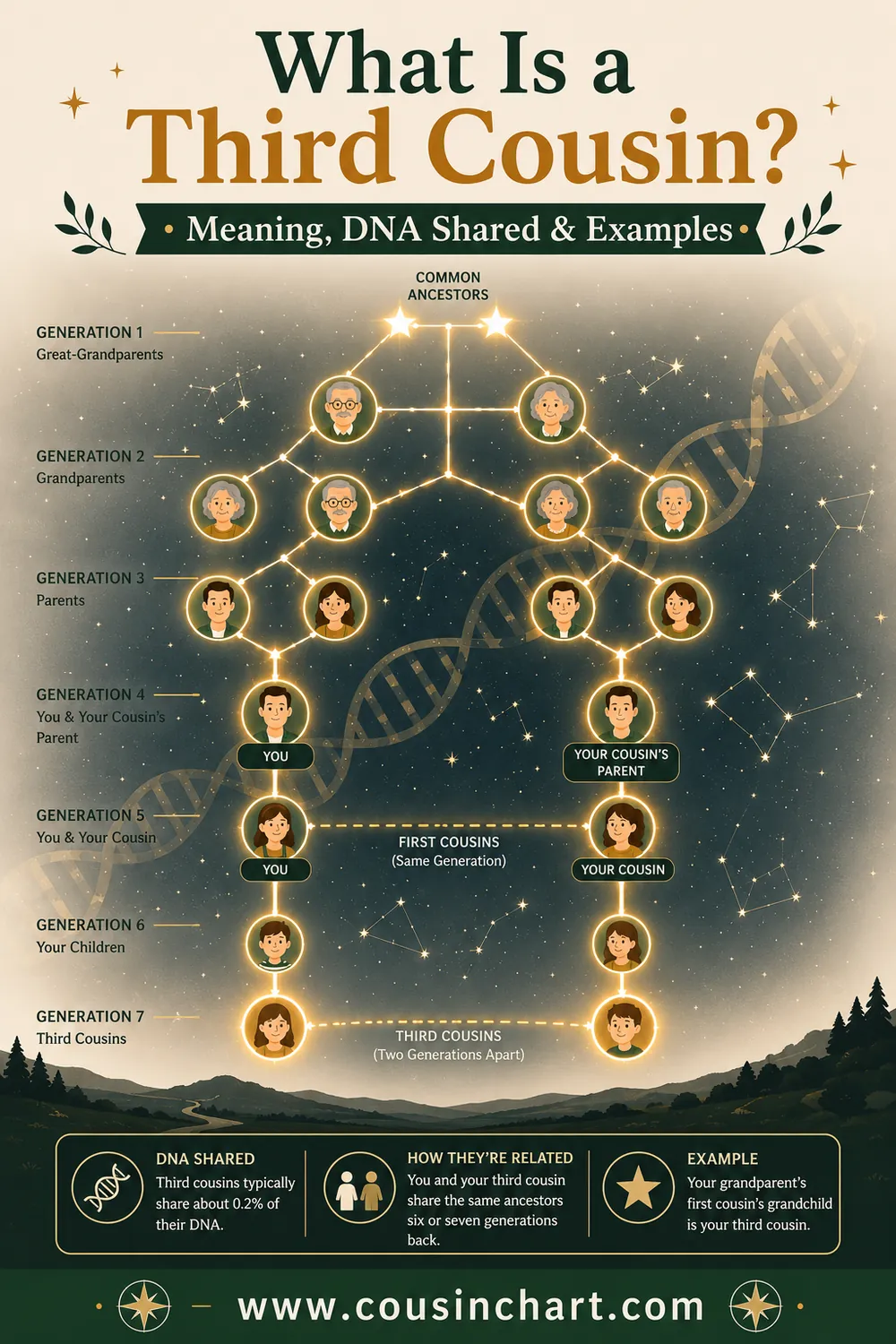
The general rule behind the name: the cousin number equals the number of generations from the shared ancestors down to you, minus one. Grandparents are 2 generations up → first cousins. Great-grandparents are 3 up → second cousins. Great-great-grandparents are 4 up → third cousins. Every extra "great" adds one to the cousin number.
The Quick Tests: Is Someone Your Second Cousin?
Three checks, any of which settles it:
- The parent test: are your parents first cousins to each other? Then you're second cousins. (This is the everyday definition.)
- The ancestor test: is your closest shared ancestor a great-grandparent on both sides? Second cousins.
- The generation test: are you the same generation? If not, they're not your second cousin — a generation gap means some flavor of "removed."
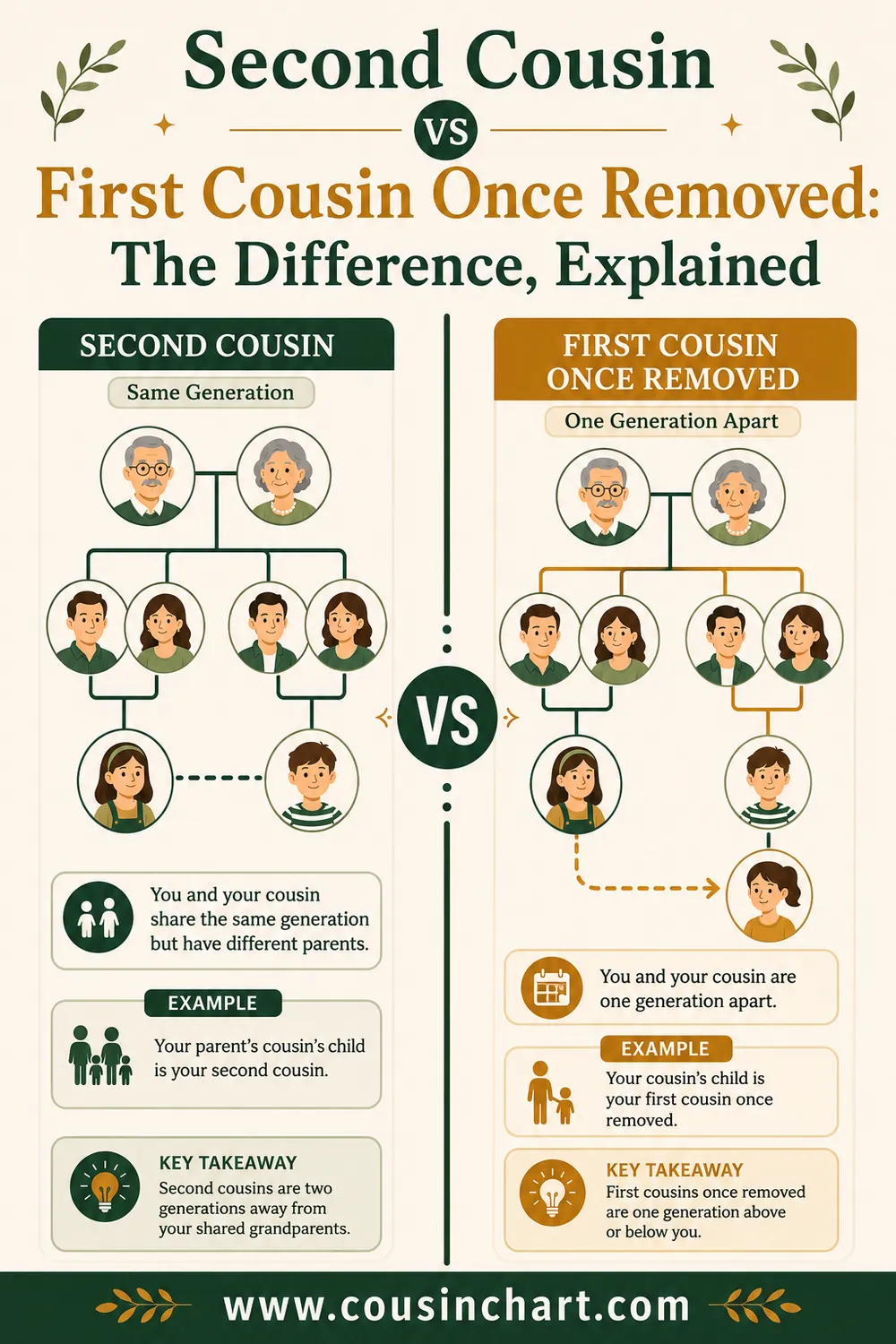
That third check catches the most common mistake in all of kinship: your parent's cousin is not your second cousin (they're your first cousin once removed — one generation up), and your cousin's child isn't either (first cousin once removed, one generation down). The full head-to-head lives in second cousin vs first cousin once removed.
Second Cousin Chart
| Relationship | Shared ancestor | Same generation? | Avg DNA shared |
|---|---|---|---|
| First cousin | Grandparents | Yes | ~12.5% |
| First cousin once removed | Grandparents / great-grandparents (offset) | No — 1 apart | ~6.25% |
| Second cousin | Great-grandparents | Yes | ~3.125% |
| Second cousin once removed | Great-grandparents (offset) | No — 1 apart | ~1.56% |
| Third cousin | Great-great-grandparents | Yes | ~0.78% |
Reading tip: the cousin number tracks the shared-ancestor depth; "removed" flags a generation offset. Two numbers, whole system. If you'd like the full grid — every cousin, every removal — our cousin chart guide walks through it square by square, or the calculator skips straight to the answer.
How Much DNA Do Second Cousins Share?
On average, second cousins share about 3.125% of their DNA — roughly 230 centimorgans (cM), with real-world results commonly landing anywhere from about 75 to 360 cM. The spread is normal: DNA halves on average each generation, but the shuffle is random.
Two practical notes for DNA-test users:
- Second cousins essentially always show up as matches. Unlike third or fourth cousins, a true second cousin virtually never shares zero detectable DNA. If a paper-trail second cousin genuinely shares no DNA with you, that's a flag worth investigating (adoptions and misattributed parentage reveal themselves this way).
- The amount overlaps with other relationships. ~230 cM could also be a first cousin twice removed or a half first cousin once removed. Match lists give ranges for exactly this reason; the family tree decides.
Do Second Cousins Count as "Real" Family?
Genetically and legally, absolutely — though the practical answer is "as real as your family makes them."
- Legally: second-cousin marriage is legal in all 50 US states (it's first cousins that some states restrict). Most countries take the same view.
- Genetically: 3.125% shared DNA is a modest but genuine overlap — geneticists consider children of second cousins to carry only a slightly elevated risk compared to the general population.
- Socially: second cousins are often reunion-level family — the kids of "Uncle" Ray who's technically your dad's cousin. Same generation usually means same-age playmates, which is why many people are closer to a second cousin than to a distant first cousin.
Second Cousin Once Removed, Twice Removed…
The moment you've placed your second cousins, their relatives slot in predictably:
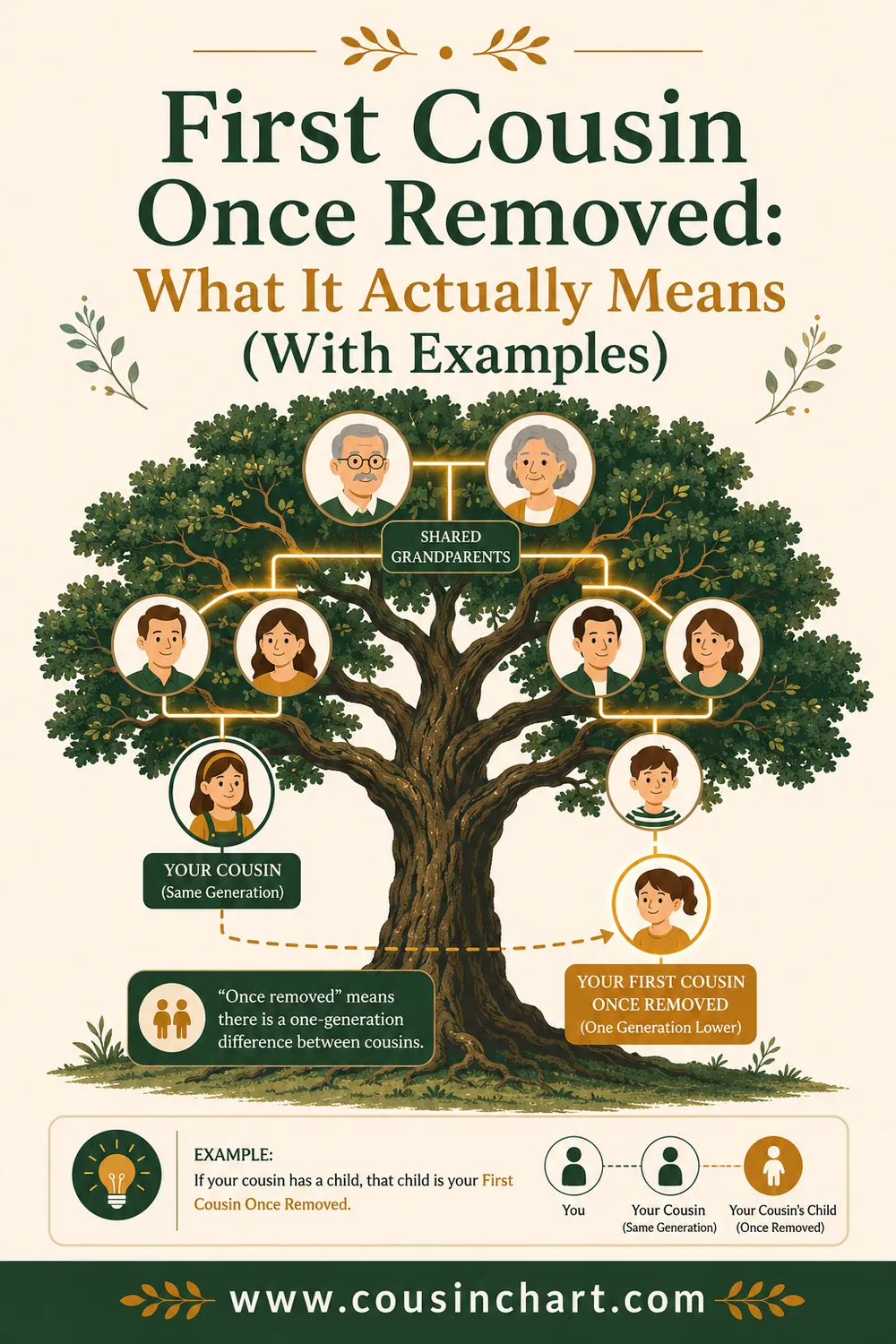
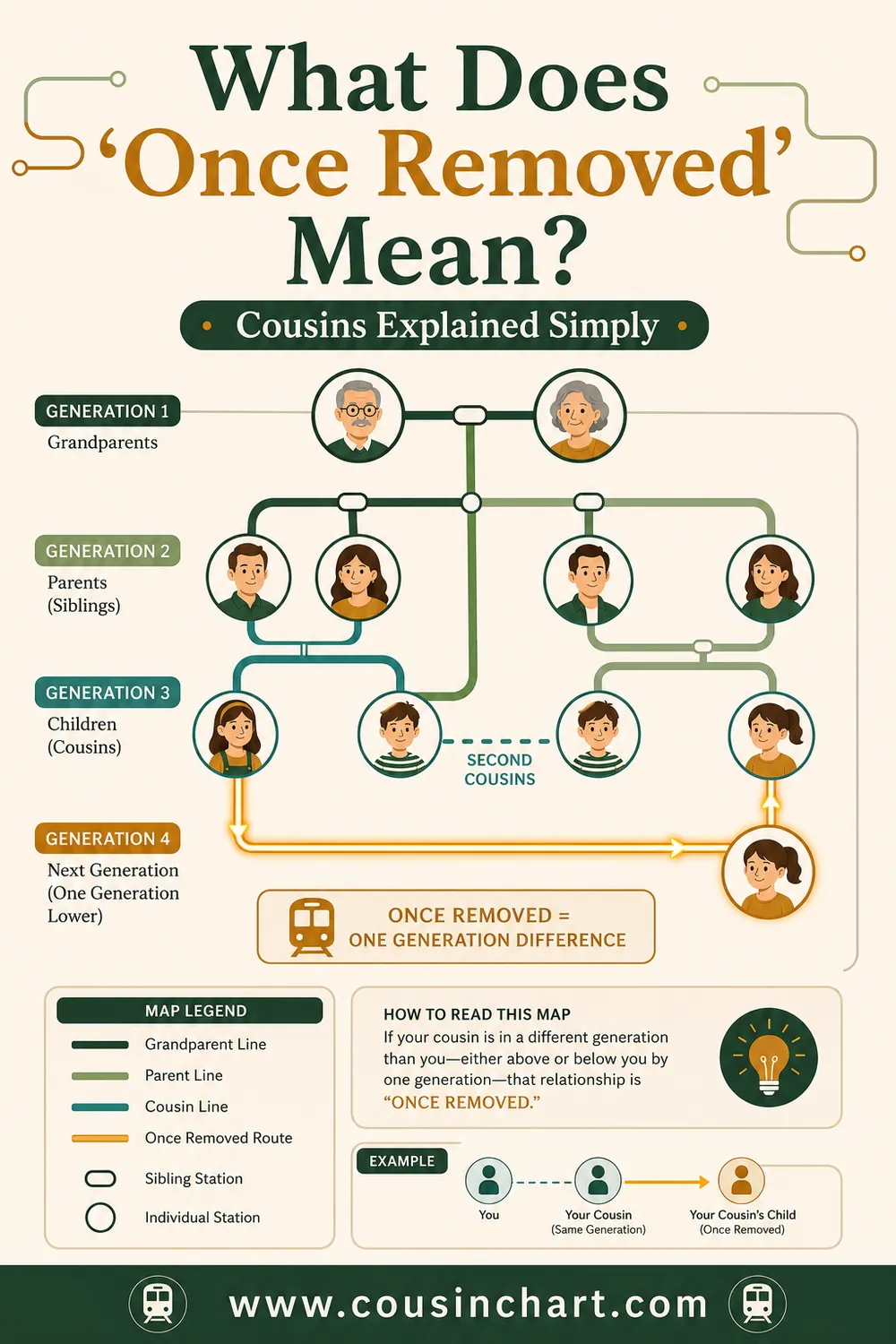
- Your second cousin's child → your second cousin once removed (one generation down).
- Your parent's second cousin → also your second cousin once removed (one generation up — the term is direction-blind).
- Your second cousin's grandchild → second cousin twice removed.
- Your kids and your second cousin's kids → third cousins to each other. Each new generation of same-row descendants bumps the cousin number by one.
If "second cousin twice removed" still makes your eyes cross, you're in good company — this is the exact point where most people give up counting and use the free calculator instead. No shame in it; that's the tool's whole job.
A Worked Example You Can Reuse
Say your great-grandparents were Ruth and Harold. They had two kids: Alice (your grandmother) and George.
- George's son Pete is your mom's first cousin — and your first cousin once removed.
- Pete's daughter Jen is your second cousin. (Parent test: your mom and Pete are first cousins ✓. Ancestor test: you and Jen both descend from Ruth and Harold as great-grandparents ✓. Generation test: same row ✓.)
- Jen's son Oliver is your second cousin once removed.
- Your kids and Oliver? Count from Ruth and Harold: your kids are 4 down, Oliver is 4 down — third cousins.
Swap in your own family's names and the structure holds every time.
How Many Second Cousins Do You Have?
More than you can name, almost certainly. Count the branches: you have up to four great-grandparent couples, and every great-grandchild of theirs who isn't your sibling or first cousin is your second cousin. In a family averaging two to three children per generation, that typically works out to a few dozen second cousins — and in big farm-family generations, easily over a hundred.
Most people can name only a handful, which is exactly why DNA tests are so startling: suddenly there they all are, filed under "2nd cousin," sharing your great-grandmother's chromosomes and none of your holidays. Every one of them sits on a branch you can actually trace — second cousins connect through great-grandparents, recent enough that records, photos, and living memory usually still exist.
Second Cousins Are Genealogy Gold
If you're building a family tree, second cousins are the most useful relatives you're not talking to:
- They hold the other half of the photo album. Your great-grandparents' belongings scattered across all their descendants. The portrait you're missing may be in a second cousin's attic.
- They remember different stories. Their grandparent was your grandparent's sibling — same household, different narrator. Interviewing a second cousin about your shared great-grandparents routinely surfaces facts your own line forgot.
- They anchor DNA research. A confirmed second cousin match (~230 cM) validates an entire branch of your paper tree. When adoptees search for birth family, a second-cousin match is often the break that cracks the case, because it narrows the search to one set of great-grandparents.
Before you reach out to one, make sure you can explain the connection in one sentence — "our great-grandparents were János and Ilona; my grandmother was Erzsébet's daughter" opens more doors than "we're related somehow." The relationship calculator will draw that sentence's diagram for you.
FAQ
What is a second cousin in simple terms?
The child of your parent's first cousin. You share great-grandparents, sit in the same generation, and share about 3.125% of your DNA on average.
Is my mom's cousin my second cousin?
No — your mom's first cousin is your first cousin once removed. Their child is your second cousin. The generation gap is what separates the two terms.
What is my second cousin's child to me?
Your second cousin once removed: the second-cousin relationship plus a one-generation gap. Meanwhile, your children and your second cousin's children are third cousins to each other.
How much DNA do second cousins share?
About 3.125% on average — roughly 230 cM, typically ranging from about 75 to 360 cM. True second cousins essentially always share detectable DNA on tests like AncestryDNA or 23andMe.
Can second cousins marry?
Yes — second-cousin marriage is legal in every US state and most of the world. Restrictions, where they exist, apply to first cousins and closer relatives.
Are second cousins blood related?
Yes. You both descend from the same great-grandparents, making second cousins genuine blood relatives — just one branch further out than first cousins.
Place Every Cousin, Instantly
Second cousin = parent's cousin's child = shared great-grandparents = same generation. Hold onto any one of those and you'll never lose the thread. For everyone else at the reunion — the once-removeds, the great-aunts, the "wait, whose kid is that?" — pull up the free family relationship calculator and get the exact term with a visual chart in seconds. It's the fastest way to settle it while the potato salad's still cold.