Second Cousin vs First Cousin Once Removed: The Difference, Explained
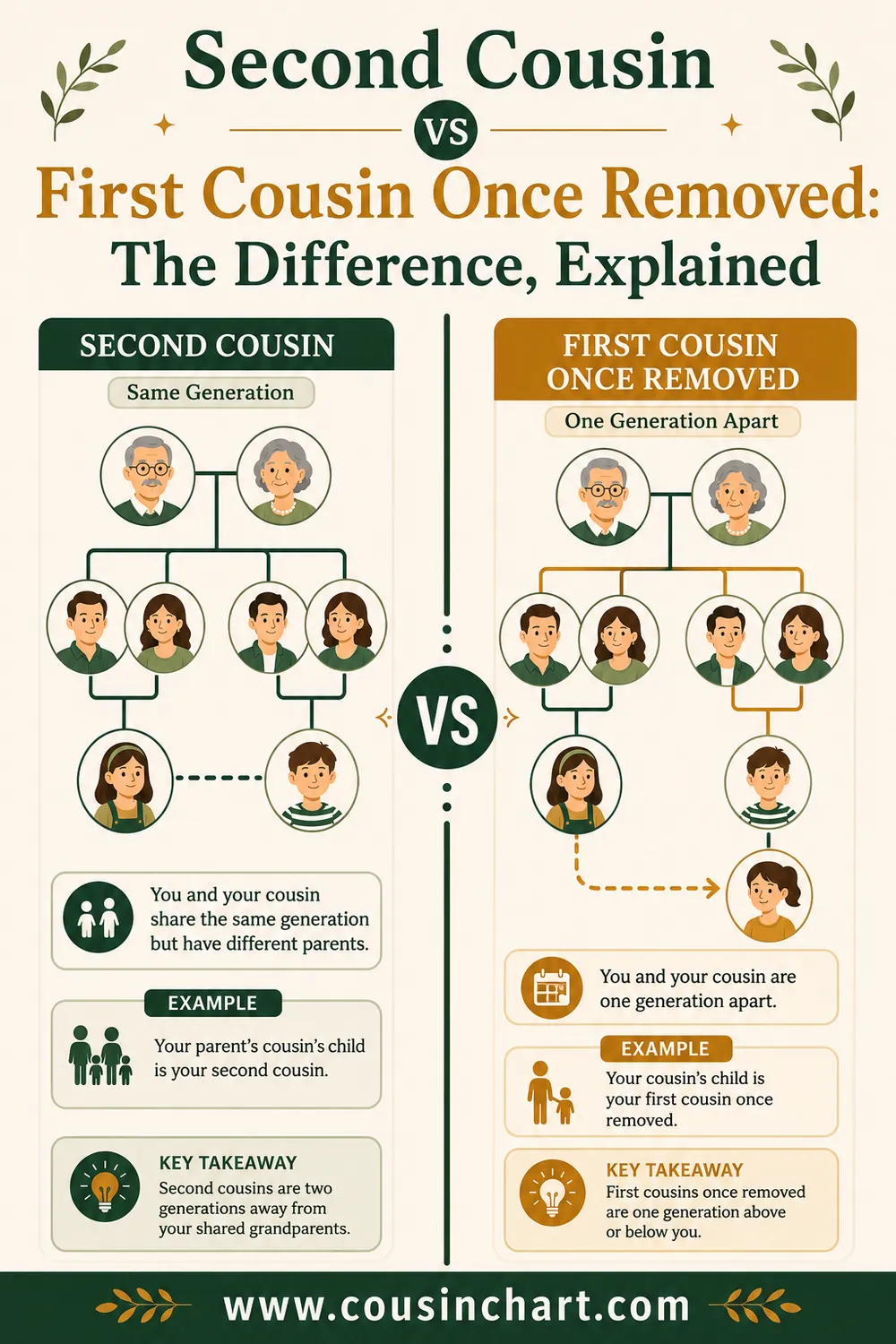
Here's the difference in two sentences. A second cousin is in your own generation — you share great-grandparents, and they're typically your parent's cousin's child. A first cousin once removed is one generation above or below you — your parent's first cousin, or your own first cousin's child.
People swap these terms constantly (your cousin's kid is not your second cousin — more on that below), so this guide lays out the definitions, a side-by-side table, the DNA numbers, and a foolproof test you can run in your head. Or run it on autopilot: the free relationship calculator on our homepage names any connection in seconds.
Relationship quick-check. Tap a phrase to see which one it is:
The answer will appear here.
The Comparison Table
Everything important, side by side:
| Second cousin | First cousin once removed | |
|---|---|---|
| Generation | Same as yours | One above or below yours |
| Who they usually are | Your parent's first cousin's child | Your parent's first cousin, or your first cousin's child |
| Closest shared ancestors | Your shared great-grandparents | Your grandparents = their great-grandparents (or the reverse) |
| Average DNA shared | ~3.125% (~230 cM) | ~6.25% (~440 cM) |
| Their kids are your… | Second cousins once removed | Second cousins (if they're your cousin's kids' kids… see below) |
| Mnemonic | "Second" = two greats back, same row | "Removed" = different row |
The single fastest way to tell them apart: ask whether you're in the same generation. Same row of the family tree → some kind of plain cousin (first, second, third). Different rows → somebody is removed.
What Each Term Actually Means
Second cousin: same row, further back
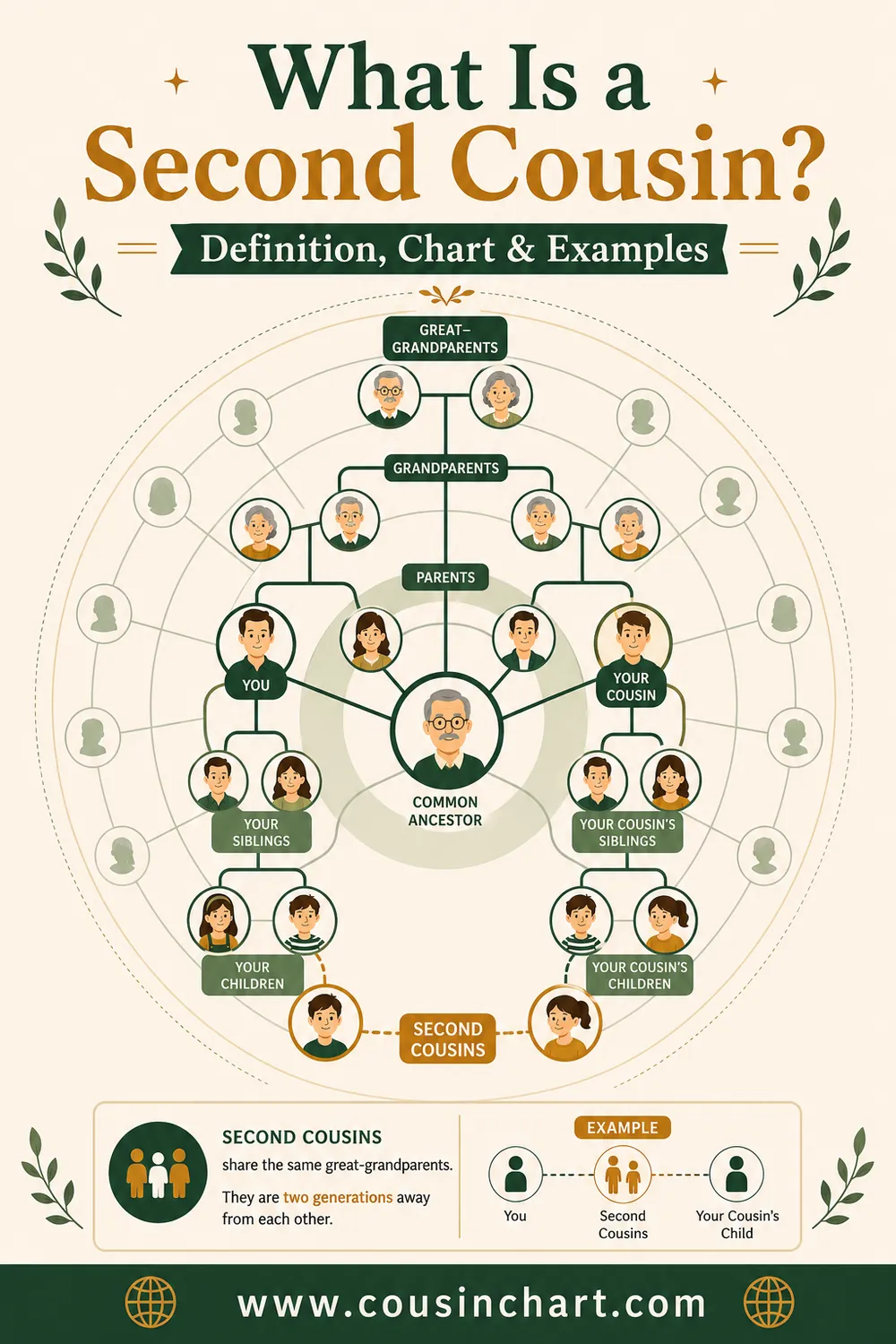
Second cousins share great-grandparents but not grandparents. Trace it: your great-grandparents had children (your grandparent and their siblings), those siblings had kids (your parent's first cousins), and those cousins' kids are your second cousins.
The number in "second cousin" counts how deep the shared ancestor is: grandparents make first cousins, great-grandparents make second cousins, great-great-grandparents make third. Same generation the whole way — the family just branches further back. Full detail in what is a second cousin.
First cousin once removed: same branch, different row
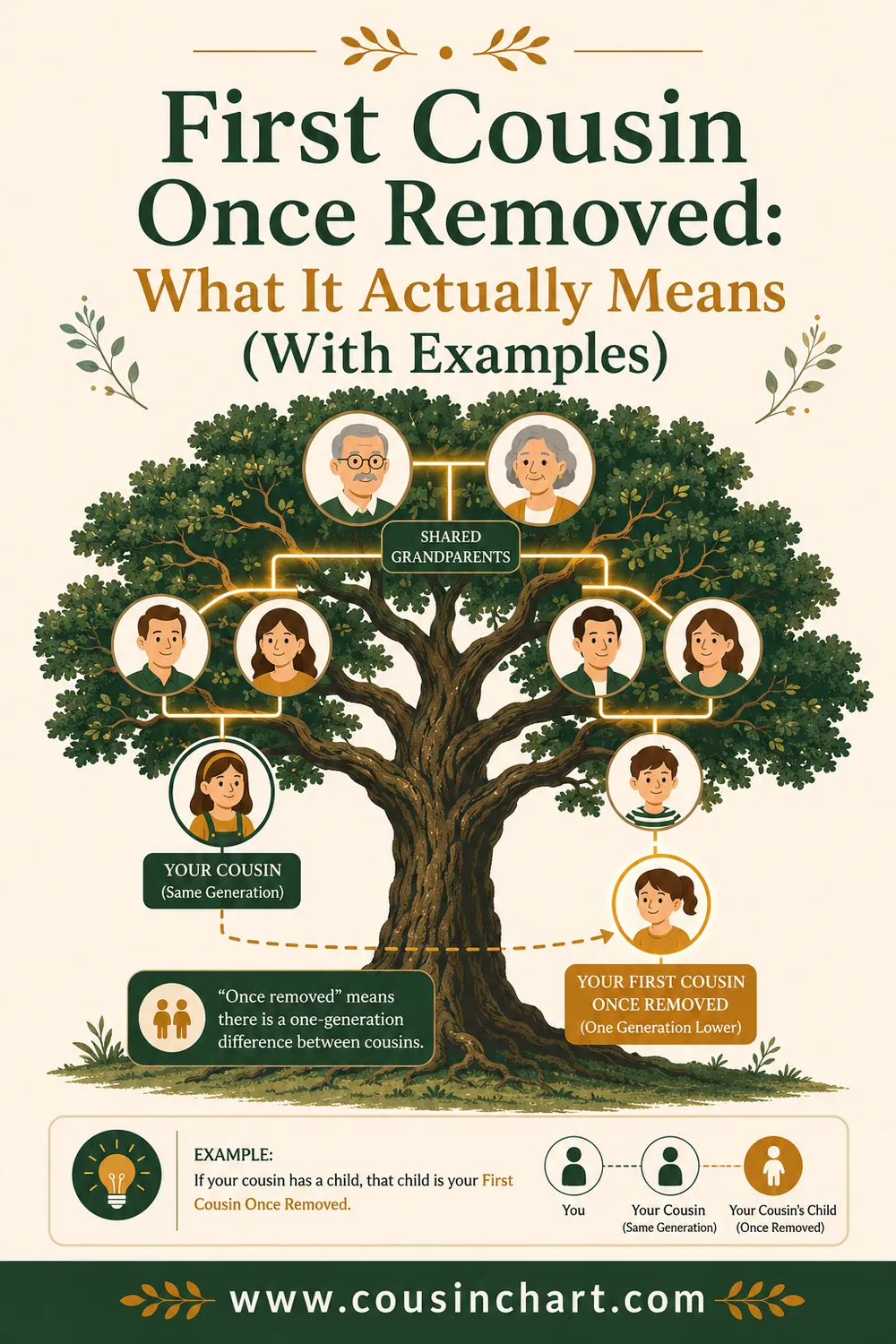
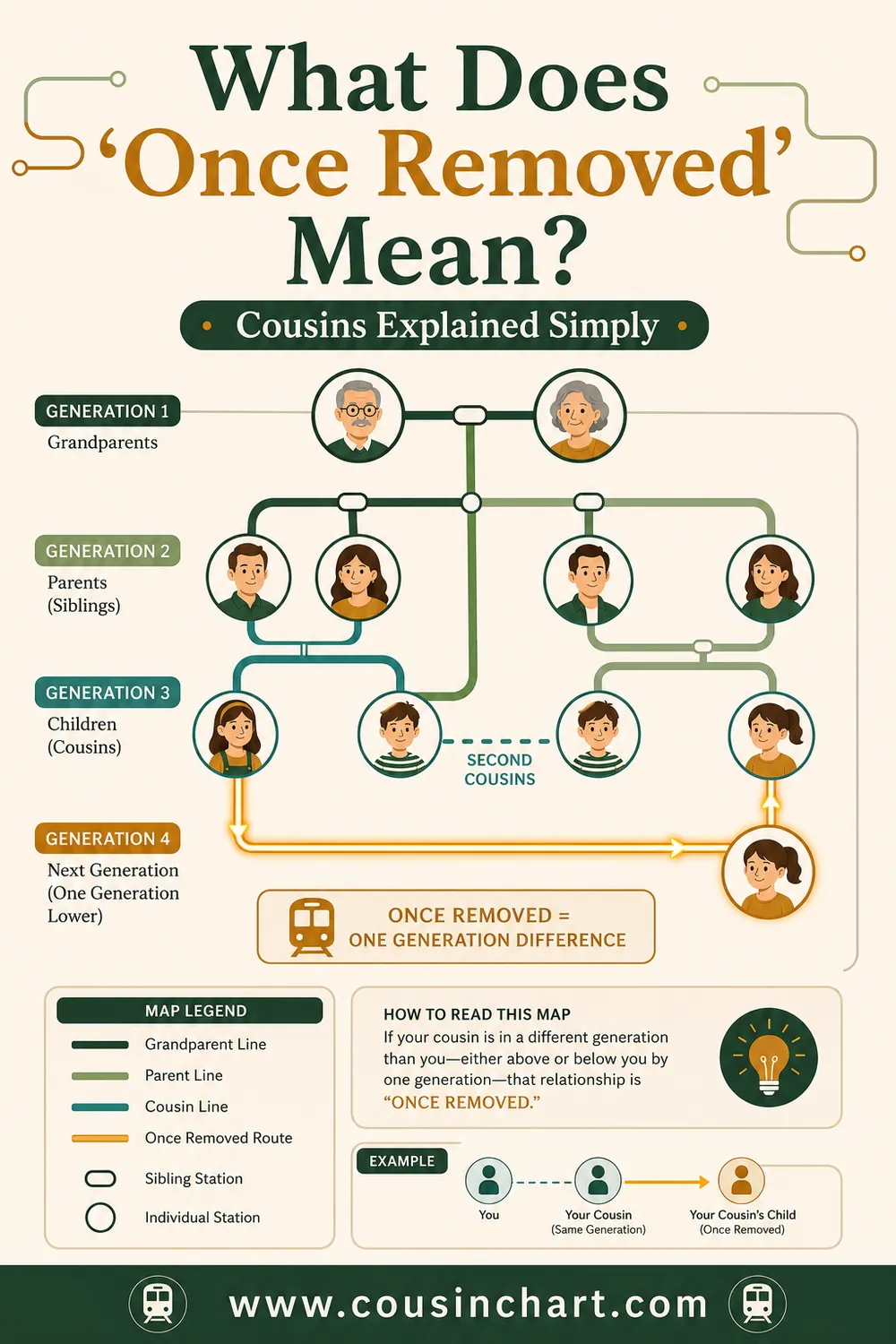
"Once removed" means a one-generation gap. The cousin relationship itself is still "first" — the branch split at your grandparents — but one of you stands a step higher on the ladder. It applies in both directions: your dad's first cousin and your own first cousin's daughter are both your first cousins once removed. We unpack the term fully in what does once removed mean.
Why People Mix Them Up (And the Fix)
The confusion has one root: both terms describe "a cousin who feels one step more distant than a regular cousin." So people reach for "second cousin" as a catch-all. But the two phrases measure completely different things:
- The cousin number moves horizontally — it says how far back the family split.
- "Removed" moves vertically — it says how many rungs apart you stand.
The fix is a two-question test you can run in your head:
- Are we the same generation? (Roughly: are our parents the cousins, or are we?) If yes → no removals; you're plain first/second/third cousins.
- If not, how many generations apart are we? That number = the removals.
Run it on the classic error: "my cousin's daughter is my second cousin." Same generation? No — she's one below you. So she can't be any kind of plain second cousin. One generation apart → once removed. She's your first cousin once removed. Test passed.
The DNA Tells Them Apart (Usually)
Here's something neat: although the two relationships get confused in conversation, a DNA test often can distinguish them, because they sit a halving apart:
| Relationship | Average shared DNA | Typical range |
|---|---|---|
| First cousin | ~12.5% | ~550–1,100 cM |
| First cousin once removed | ~6.25% | ~215–650 cM |
| Second cousin | ~3.125% | ~75–360 cM |
| Second cousin once removed | ~1.56% | ~30–215 cM |
A first cousin once removed shares roughly twice the DNA of a second cousin on average. The ranges overlap, though — a low-sharing 1C1R can look like a high-sharing 2C on paper — so DNA companies label matches with a range ("1st–2nd cousin") and let your family tree settle the rest. If a mystery match just appeared in your results, sketch the possible paths in our relationship calculator and see which one fits the shared-DNA amount.
One Family, Both Relationships
Watch both terms appear in a single small family:
- Elena and Joy are sisters (your great-grandmother Elena, in this story).
- Elena's daughter is your grandmother; Joy's son is Sam.
- Your grandmother's daughter is your mom. Sam's daughter is Nadia. Nadia's son is Theo.
Now place yourself:
- Your mom and Nadia — second cousins? Let's check: their grandmothers were sisters, so they share great-grandparents (Elena and Joy's parents). Same generation. Second cousins. ✔
- You and Nadia — she's your mom's second cousin, one generation above you: second cousin once removed.
- You and Theo — count down from the shared ancestors (Elena and Joy's parents). Your line: Elena → your grandmother → your mom → you = 4 generations. Theo's line: Joy → Sam → Nadia → Theo = 4 generations. Same depth, same generation: third cousins. ✔
- You and Sam — Sam is your grandmother's first cousin: first cousin twice removed.
If that third one made you squint, you've found the exact moment where a free calculator beats mental arithmetic.
Don't Forget the Hybrid: Second Cousin Once Removed
Once you can tell the two apart, there's a third character waiting backstage: the second cousin once removed — the second-cousin bond plus a generation gap. Two people qualify:
- Your parent's second cousin (one generation up), and
- Your second cousin's child (one generation down).
They share great-grandparents with one of you offset by a generation — in DNA terms, about 1.56% on average, half a second cousin's share. The naming machinery is completely regular: any cousin degree can carry any number of removals. Second cousin twice removed, third cousin once removed — all real, all built from the same two measurements (degree from the shared ancestor, removals from the generation gap).
This is worth knowing because DNA sites love this zone. A "3rd cousin" prediction at ~100 cM is very often actually a second cousin once removed — the amounts overlap heavily, and 2C1Rs vastly outnumber the closer relationships in most trees.
Practice: Three Quick Reps
Cover the answers and run the generation test on these:
- Your dad's cousin's daughter. Same generation as you (your parents are the cousins, you're each one below). No removal, split at the great-grandparents: second cousin.
- Your grandma's first cousin. Two generations above you on the first-cousin line: first cousin twice removed.
- Your second cousin's son. One generation below your second cousin: second cousin once removed.
Miss one? Re-run the two questions: same generation? and how far back did the branch split? Those two answers always produce the term — and when you'd rather not run them at a noisy reunion, the free calculator runs them for you.
Which One Is "Closer" Family?
Genetically, a first cousin once removed is closer (about double the shared DNA). Socially, it depends entirely on your family. Second cousins are often the same age, grow up at the same reunions, and feel like siblings-of-cousins; a first cousin once removed might be a beloved "aunt" figure or a toddler you've met twice.
Terminology tip for real life: most families just say "cousin" for both, and that's perfectly fine. The precise labels earn their keep in genealogy research, DNA match lists, medical family histories, and settling good-natured arguments at Thanksgiving.
FAQ
Is my cousin's child my second cousin?
No — your first cousin's child is your first cousin once removed. Your children and your cousin's children are second cousins to each other, because they're the same generation and share great-grandparents.
Which is closer, a second cousin or a first cousin once removed?
By DNA, the first cousin once removed: about 6.25% shared on average versus about 3.125% for a second cousin. Socially, either can be closer — the labels describe tree positions, not relationships.
What is my mom's cousin to me?
Your first cousin once removed — one generation above you on the first-cousin line. Her children are your second cousins.
What do I call my second cousin's child?
Your second cousin once removed. Keep the cousin number, add one "removed" for the one-generation gap.
Can a DNA test tell a second cousin from a first cousin once removed?
Often, but not always. The averages differ by half (3.125% vs 6.25%), so a clear reading points one way — but the ranges overlap, so testing companies report a span like "1st–2nd cousin." Combining the DNA amount with known family branches settles it.
Are second cousins blood relatives?
Yes. Second cousins descend from the same great-grandparents and share about 3.125% of their DNA on average — solidly real family, just one branch further out than first cousins.
Settle It in Five Seconds
Same generation → count the "greats" and you've got plain cousins. Different generation → count the gap and add "removed." That's the whole distinction between a second cousin and a first cousin once removed. Next time the debate breaks out over pie, don't argue — open cousinchart.com, tap the two people in, and pass the phone around. Free, instant, and it draws the little tree so everyone can see why.