First Cousin Once Removed: What It Actually Means (With Examples)
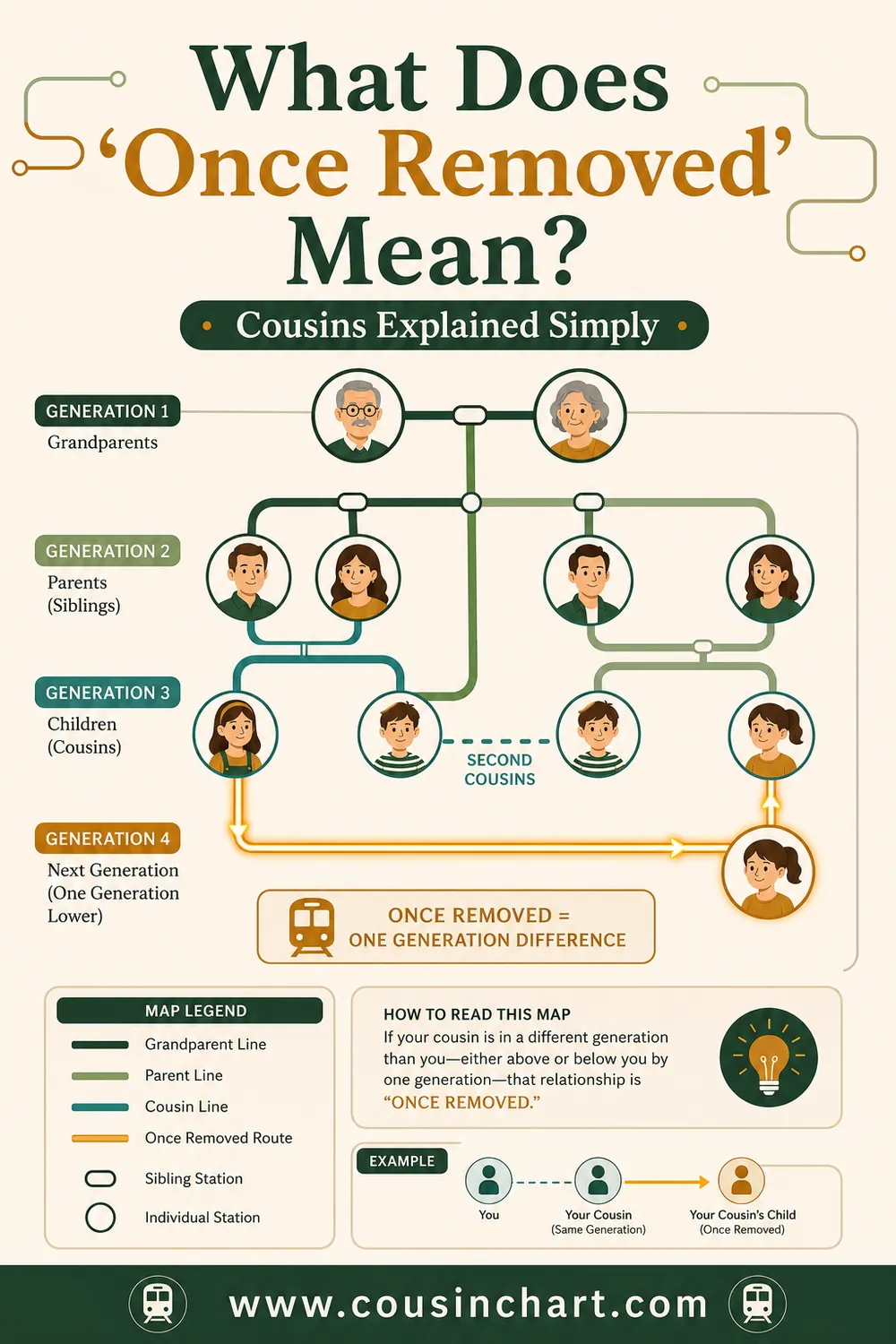
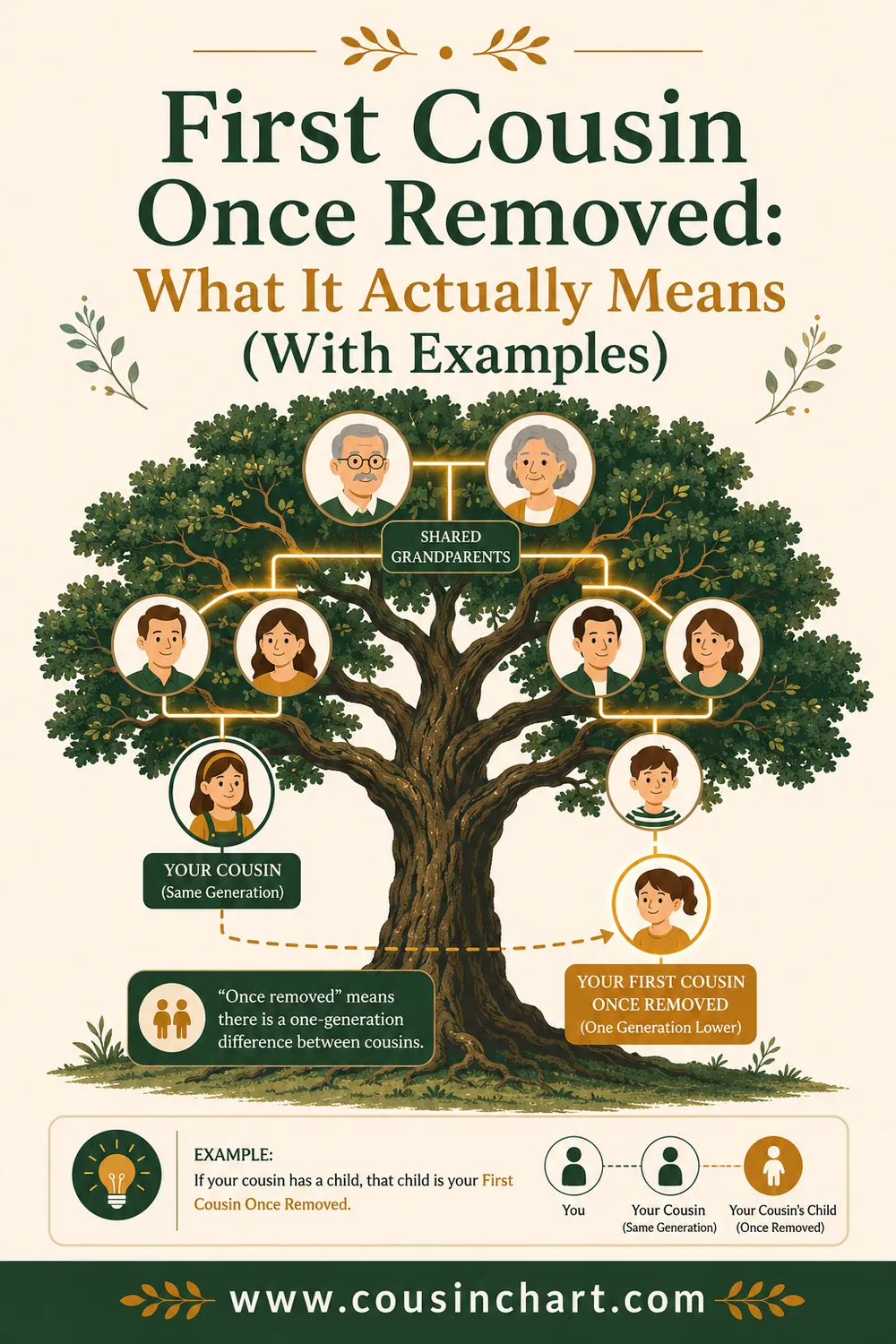
A first cousin once removed is either your first cousin's child or your parent's first cousin. The "removed" part simply means you're one generation apart — the cousin relationship is the same, but one of you sits a step higher or lower on the family tree.
That's the whole answer. The rest of this guide shows you why both of those people get the same label, how to tell a first cousin once removed apart from a second cousin (the classic mix-up), and how much DNA you actually share. And if you'd rather skip the theory, the free relationship calculator on our homepage works it out for you in about five seconds — just pick the two people and it names the relationship.
Relationship quick-check. Tap a phrase to see the correct term:
The answer will appear here.
The Two People Who Are Your First Cousin Once Removed
The term covers two different people, and that's exactly why it confuses everyone. Both directions get the same name:
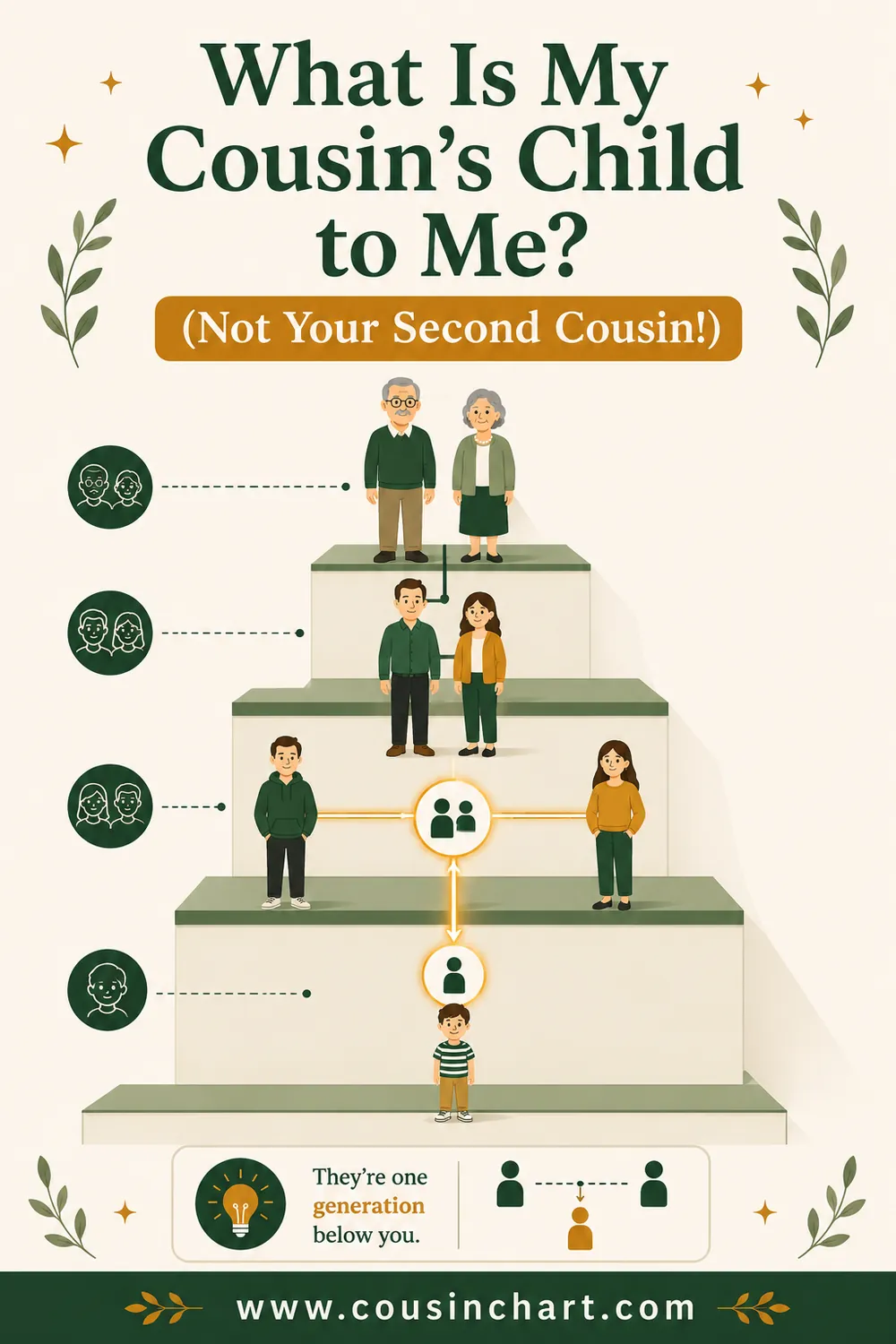
- One generation down: your first cousin's child. You and your cousin share grandparents; their child is one step below that shared line.
- One generation up: your parent's first cousin. Your parent and this person share grandparents; you're one step below their shared line.
Notice the symmetry. If Maria is your mom's first cousin, then you are Maria's first cousin once removed too — the label works in both directions. English doesn't have separate words for "removed upward" and "removed downward," so context (or a quick chart) does the work.
Some genealogists informally distinguish them as "once removed ascending" and "once removed descending," but in everyday conversation nobody bothers. If you ever need to be precise, just say "my dad's cousin" or "my cousin's daughter" — everyone understands that instantly.
What "Removed" Actually Means
"Removed" is a counting word, not a judgment. It measures the generation gap between two cousins:
- Same generation → not removed at all (first cousins, second cousins, and so on).
- One generation apart → once removed.
- Two generations apart → twice removed.
- Three apart → three times (or "thrice") removed.
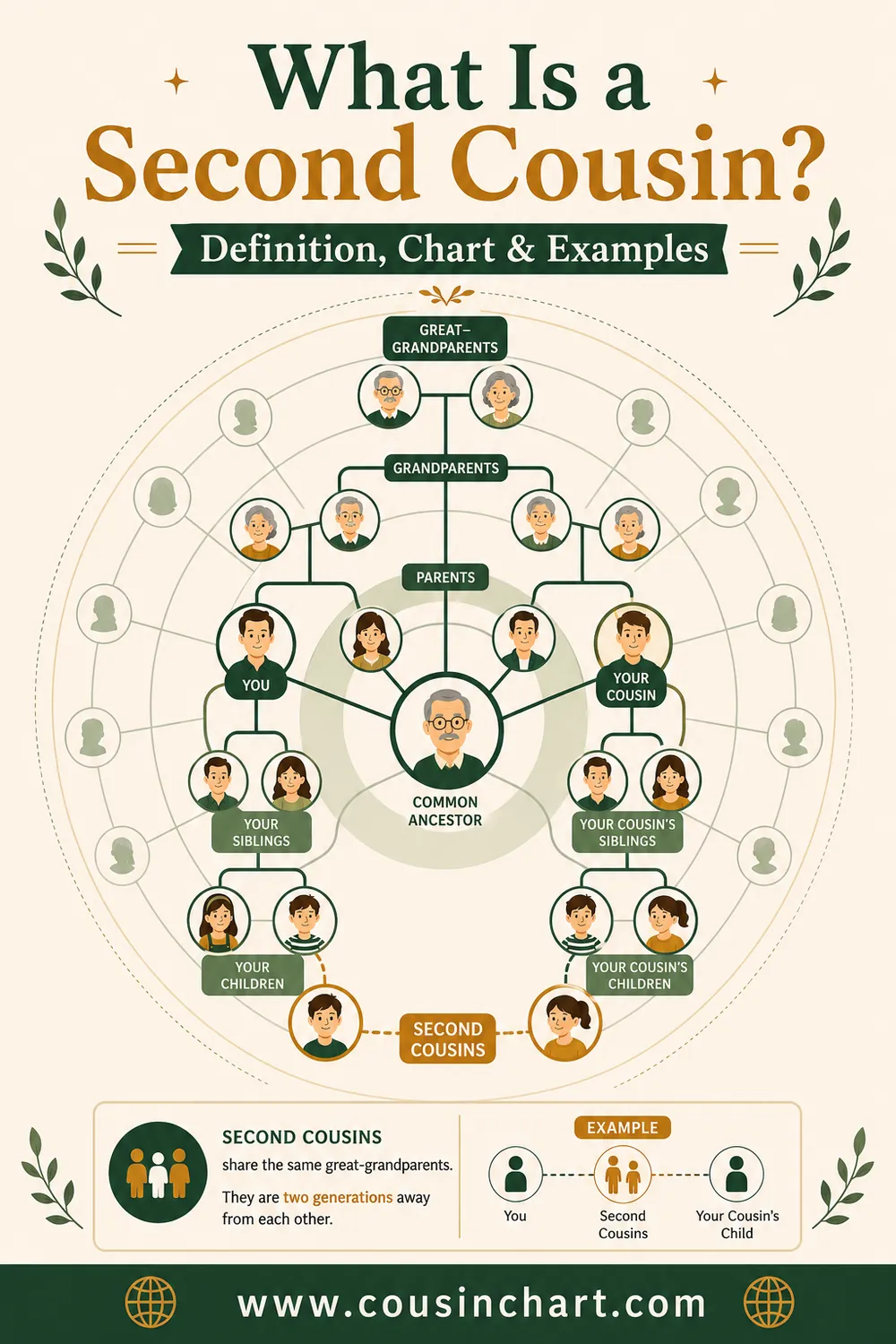
The cousin number (first, second, third) comes from a different measurement: how far back your closest shared ancestor sits. First cousins share grandparents. Second cousins share great-grandparents. Third cousins share great-great-grandparents. A simple way to remember it: count the "greats and grands" in the shared ancestor, and that's your cousin number — grandparents (one "grand") means first cousins, great-grandparents (two levels) means second cousins.
Put both rules together and you can name any cousin relationship on earth. We break the counting method down fully in what does once removed mean if you want the complete system.
First Cousin Once Removed vs. Second Cousin
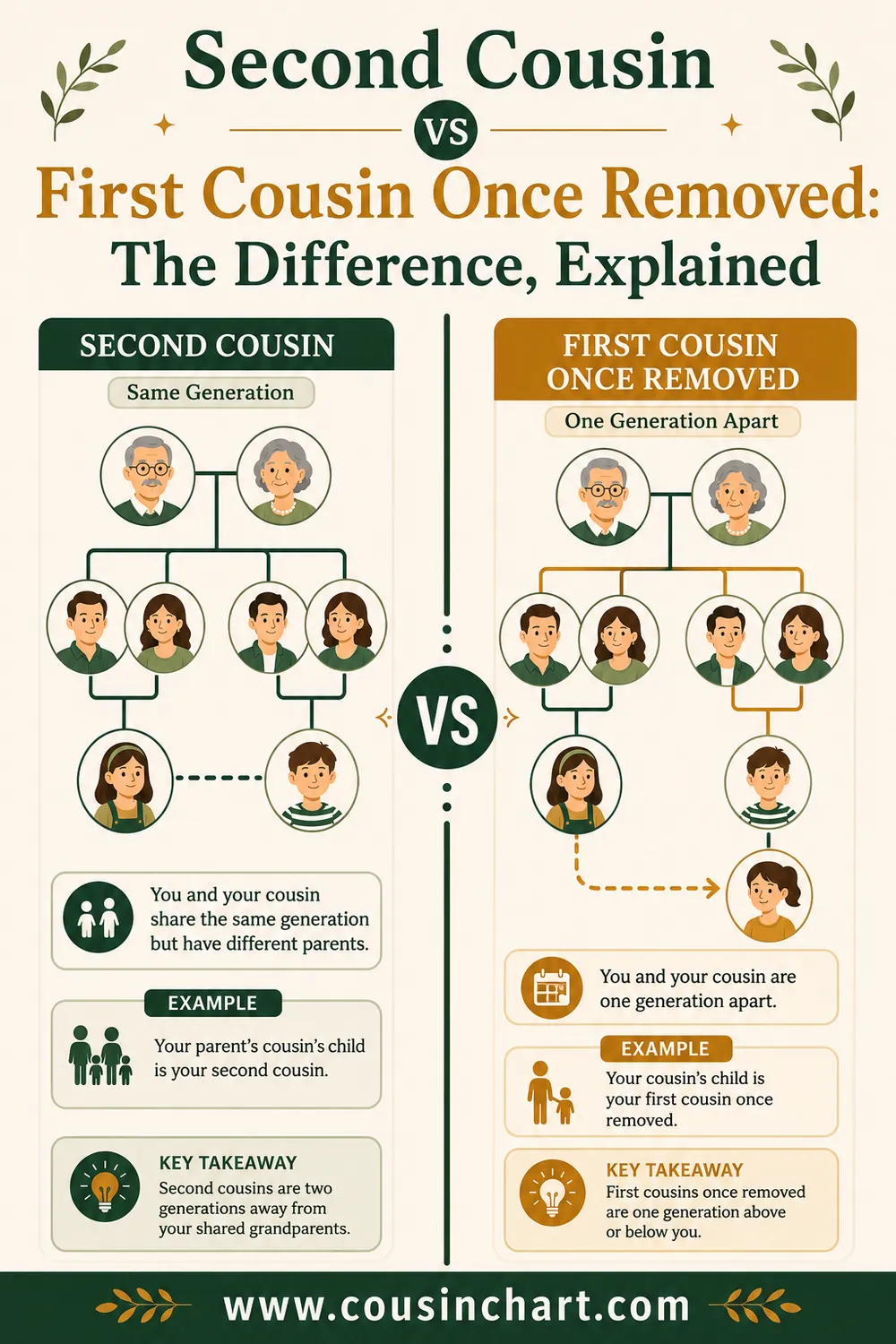
This is the mix-up that launched a thousand family arguments. Your cousin's child is not your second cousin. Here's the difference at a glance:
| First cousin once removed | Second cousin | |
|---|---|---|
| Who they are | Your cousin's child, or your parent's cousin | Your parent's cousin's child |
| Generation | One above or below you | Same generation as you |
| Shared ancestors | Your grandparents are their great-grandparents (or vice versa) | You both share the same great-grandparents |
| Average DNA shared | ~6.25% | ~3.125% |
| Example | Your cousin Jake's daughter Lily | Jake's daughter Lily and your daughter |
The last row is the key insight: your children and your first cousin's children are second cousins to each other. The relationship slides down one notch per generation. Your cousin's child is once removed to you, but a plain second cousin to your kids.
If you want the full head-to-head, we've written a dedicated comparison: second cousin vs first cousin once removed.
How Much DNA Do You Share?
DNA testing has made "once removed" suddenly practical — it's how sites like AncestryDNA and 23andMe label your matches. On average, first cousins once removed share about 6.25% of their DNA, which works out to roughly 425–450 centimorgans (cM). These are averages; real results vary because DNA is inherited randomly.
| Relationship | Average DNA shared | Typical cM range |
|---|---|---|
| First cousin | ~12.5% | ~550–1,100 cM |
| First cousin once removed | ~6.25% | ~215–650 cM |
| Second cousin | ~3.125% | ~75–360 cM |
| First cousin twice removed | ~3.125% | ~75–360 cM |
Notice a wrinkle in that table: a first cousin twice removed and a second cousin share the same average DNA. That's why DNA companies often report a range ("1st–2nd cousin") rather than an exact label — the numbers alone can't always tell generational position. A paper trail (or a grandparent's memory) settles what the chromosomes can't.
Real-World Examples
Abstract rules stick better with names attached. Meet a small family:
- Rosa and Ben are siblings.
- Rosa's son is Marco. Ben's daughter is Ana. Marco and Ana are first cousins.
- Ana has a son, Leo.
Now the relationships:
- Marco and Leo — first cousins once removed. Leo is the child of Marco's first cousin.
- Leo's view: Marco is his mom's first cousin — also his first cousin once removed. Same term both ways.
- Marco's future kids and Leo — second cousins. Same generation, sharing Rosa and Ben's parents as great-grandparents.
- Marco and Leo's future kids — first cousins twice removed. The gap widens by one each generation.
Try walking your own family through the same steps — or save yourself the pencil work and let the relationship calculator do it. Pick "my cousin's child" style paths and it names the relationship and shows the shared ancestor.
What Do You Actually Call Them at Thanksgiving?
Genealogy charts are precise; real life is casual. In most families, a first cousin once removed just gets called "cousin" — and honestly, that's fine. Some common conventions:
- Kids often call an older first cousin once removed "aunt" or "uncle" out of respect for the age gap. Genealogically inaccurate, socially perfect.
- "My little cousin" / "my mom's cousin" — descriptive and instantly clear.
- Southern US and many other cultures use "cousin" as a warm catch-all for any relative of roughly cousin-ish distance.
The precise term matters mainly in three places: genealogy research, DNA match lists, and legal or medical contexts (inheritance questions, family health history). Everywhere else, warmth beats precision.
Quick Rules to Never Get It Wrong Again
Three pocket-sized rules cover nearly every cousin question:
- Cousin number = shared ancestor depth minus one. Shared grandparents → first cousins. Shared great-grandparents → second cousins.
- Removed = generation gap. Count how many generations separate the two people. If it's zero, no "removed."
- When the generations differ, use the person closer to the shared ancestor to set the cousin number. Your cousin's child: your cousin is 2 generations from your shared grandparents, so it stays "first" cousin — with one removal for the gap.
If a relationship still ties your brain in a knot (great-grandma's cousin's grandson, anyone?), that's exactly what cousinchart.com is for — it's free, instant, and shows the connection visually.
Where You'll Meet This Term in the Wild
"First cousin once removed" isn't just trivia — it shows up in real paperwork and real software, usually abbreviated:
- DNA match lists. AncestryDNA, 23andMe, and MyHeritage group matches by estimated relationship, and the ~6% zone is labeled with ranges like "1st–2nd cousin." When you confirm the paper trail, most tree software records it as 1C1R — the standard genealogy shorthand (2C1R for second cousin once removed, and so on).
- Family tree software. Ancestry, FamilySearch, and Gramps all have a "relationship to me" feature that spits out these exact terms. If the software's answer surprises you, it's almost always because of a generation offset you didn't notice — the "removed" catching you again.
- Obituaries and wills. Estate law ranks kin precisely. In intestacy cases (no will), whether someone is a first cousin once removed or a second cousin can genuinely change who inherits, because many statutes work through the closest class of relatives first.
- Old letters and records. The usage goes back centuries — English wills from the 1500s already describe legatees as cousins "once removed," so if you do archival research, you'll meet the term in beautiful handwriting.
A memory trick that makes the term stick for good: the phrase has two slots. The number slot (first) answers "how far back did our families split?" The removed slot (once) answers "how many floors apart do we live?" Every cousin term in English is just those two slots filled in — once you hear it that way, you can't unhear it.
FAQ
Is my cousin's child my second cousin or my first cousin once removed?
First cousin once removed. Second cousins share great-grandparents and sit in the same generation. Your cousin's child is a generation below you, which makes them "removed." Your children and your cousin's children are the second cousins.
Is my dad's cousin my second cousin?
No — your dad's first cousin is your first cousin once removed. You're one generation below the cousin pair. Your dad's cousin's child is your second cousin.
What is a first cousin twice removed?
Someone two generations away from your first-cousin line: your first cousin's grandchild, or your grandparent's first cousin. The cousin degree stays "first"; the generation gap adds the "twice removed."
How much DNA do I share with a first cousin once removed?
About 6.25% on average — roughly 425–450 centimorgans. Actual amounts vary widely because DNA inheritance is random, which is why testing companies show a range of possible relationships for each match.
Can you marry your first cousin once removed?
In most US states, yes — laws restricting cousin marriage mostly target first cousins, and even those vary by state. Rules differ around the world, so check your local law. Genetically, first cousins once removed share half the DNA that first cousins do.
Does "removed" mean we're not really related?
Not at all. "Removed" only describes a generation difference — it says nothing about closeness. A first cousin once removed is a genuine blood relative who shares great-grandparents with you (or grandparents, one generation offset).
Work It Out in Seconds
You now know the rule: cousin number from the shared ancestor, "removed" from the generation gap. But at a reunion with a phone in one hand and a paper plate in the other, nobody wants to count generations. Open the free family relationship calculator, tap through "my cousin → their child," and get the exact term with a mini-chart you can show around the table. No signup, no downloads — just the answer.