What Is My Cousin's Child to Me? (Not Your Second Cousin!)
Last updated: September 30, 2026
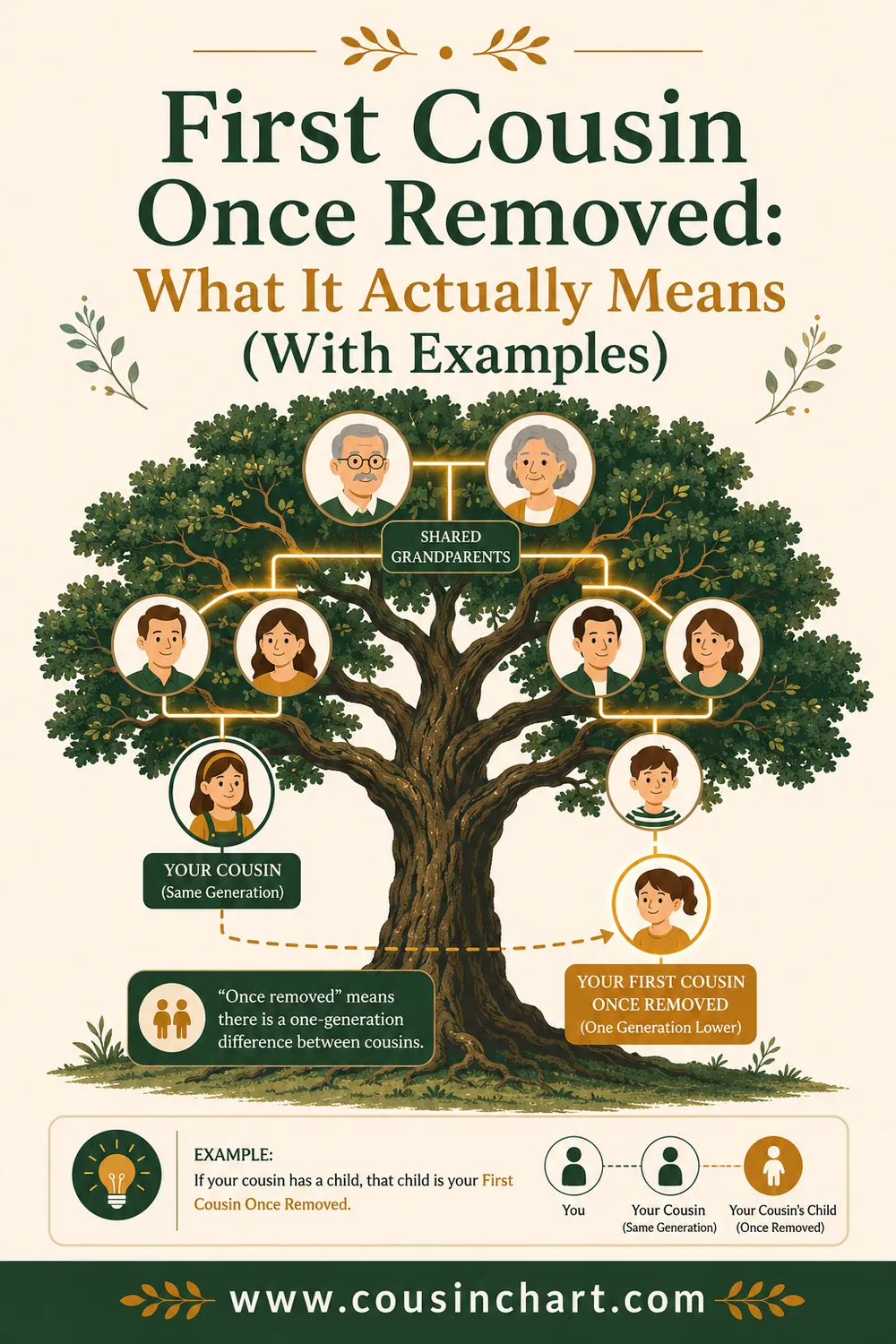
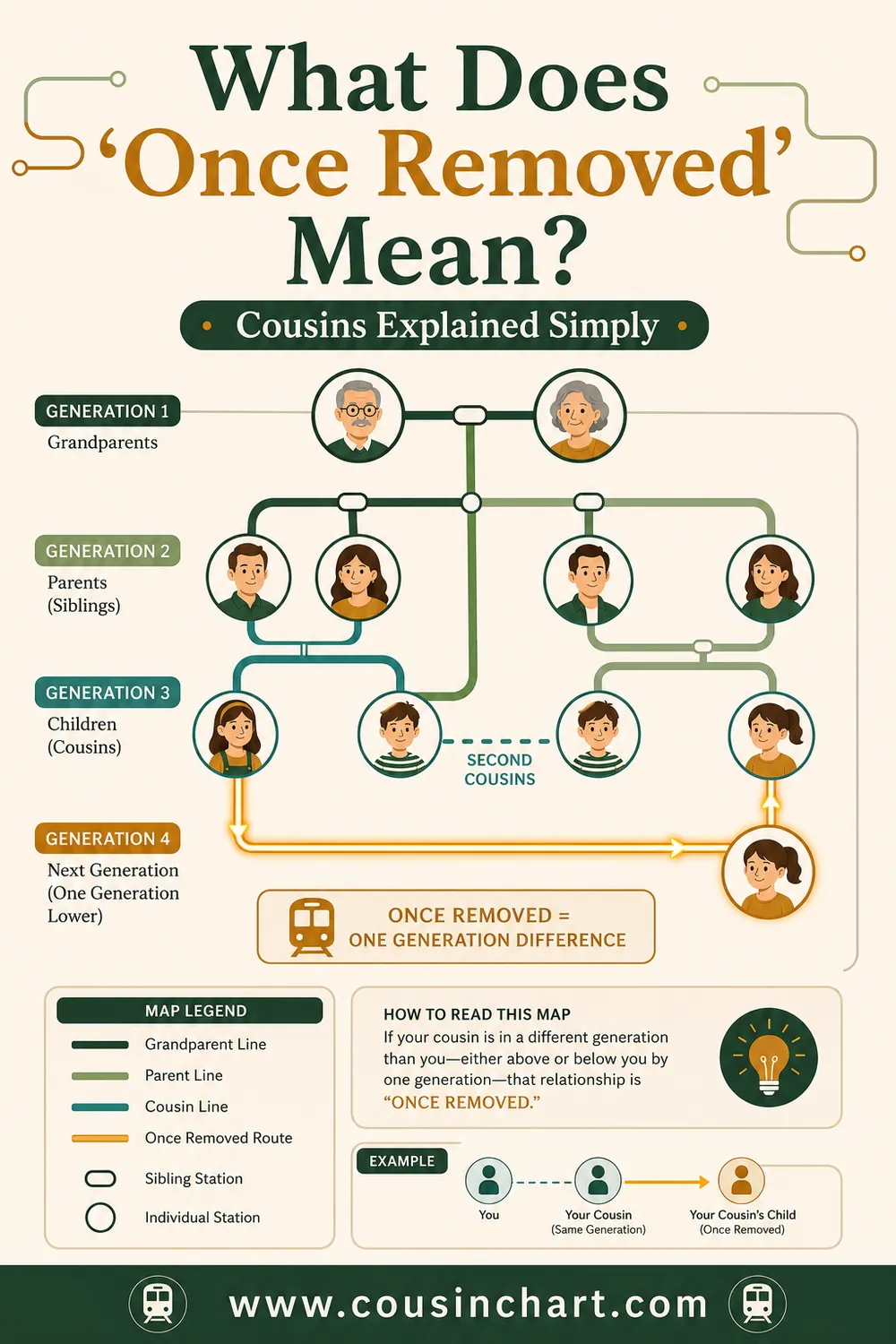
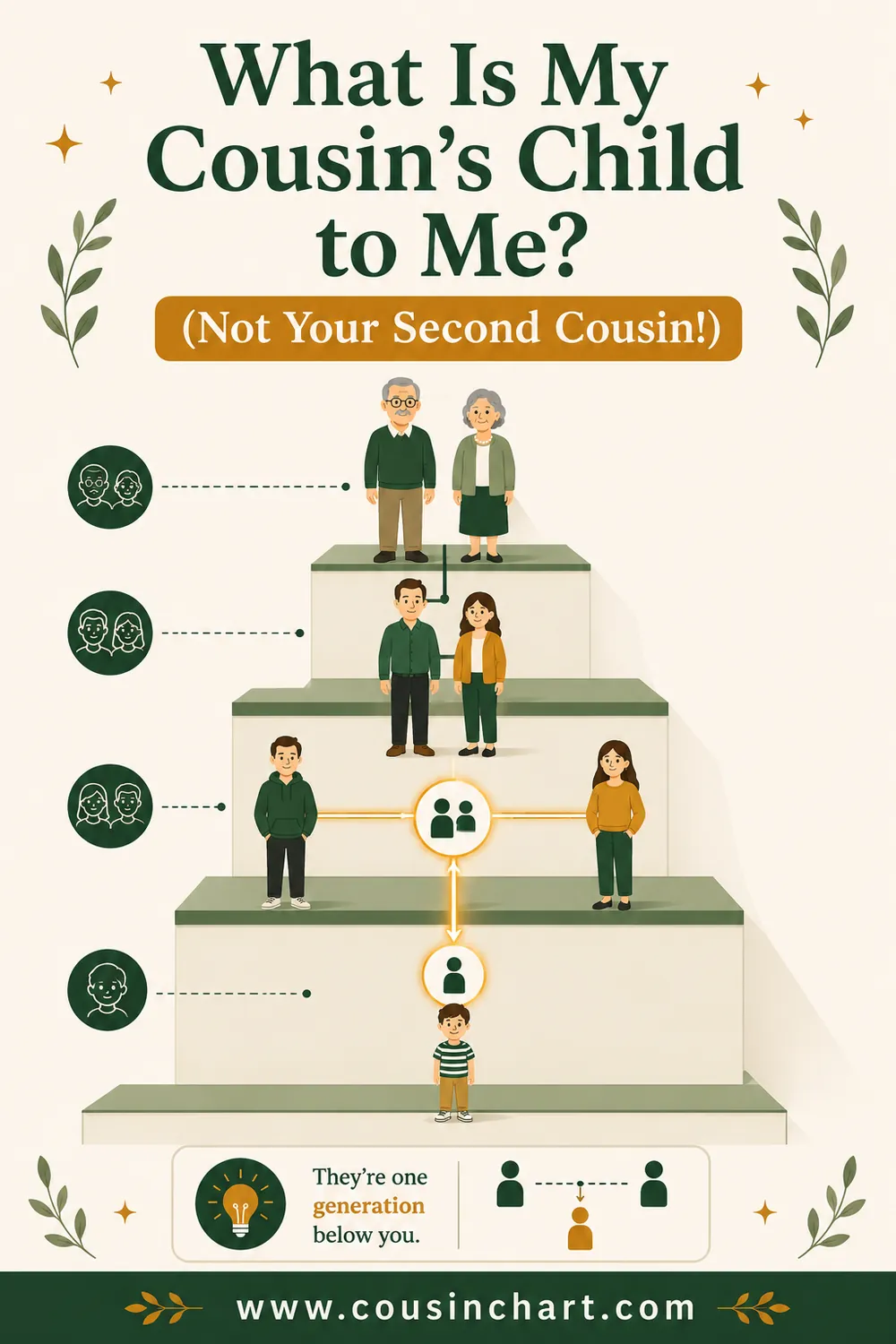
Your first cousin's child is your first cousin once removed. They are not your second cousin, and they're not your niece or nephew — though plenty of families happily use those words anyway. "Once removed" simply means you're one generation apart.
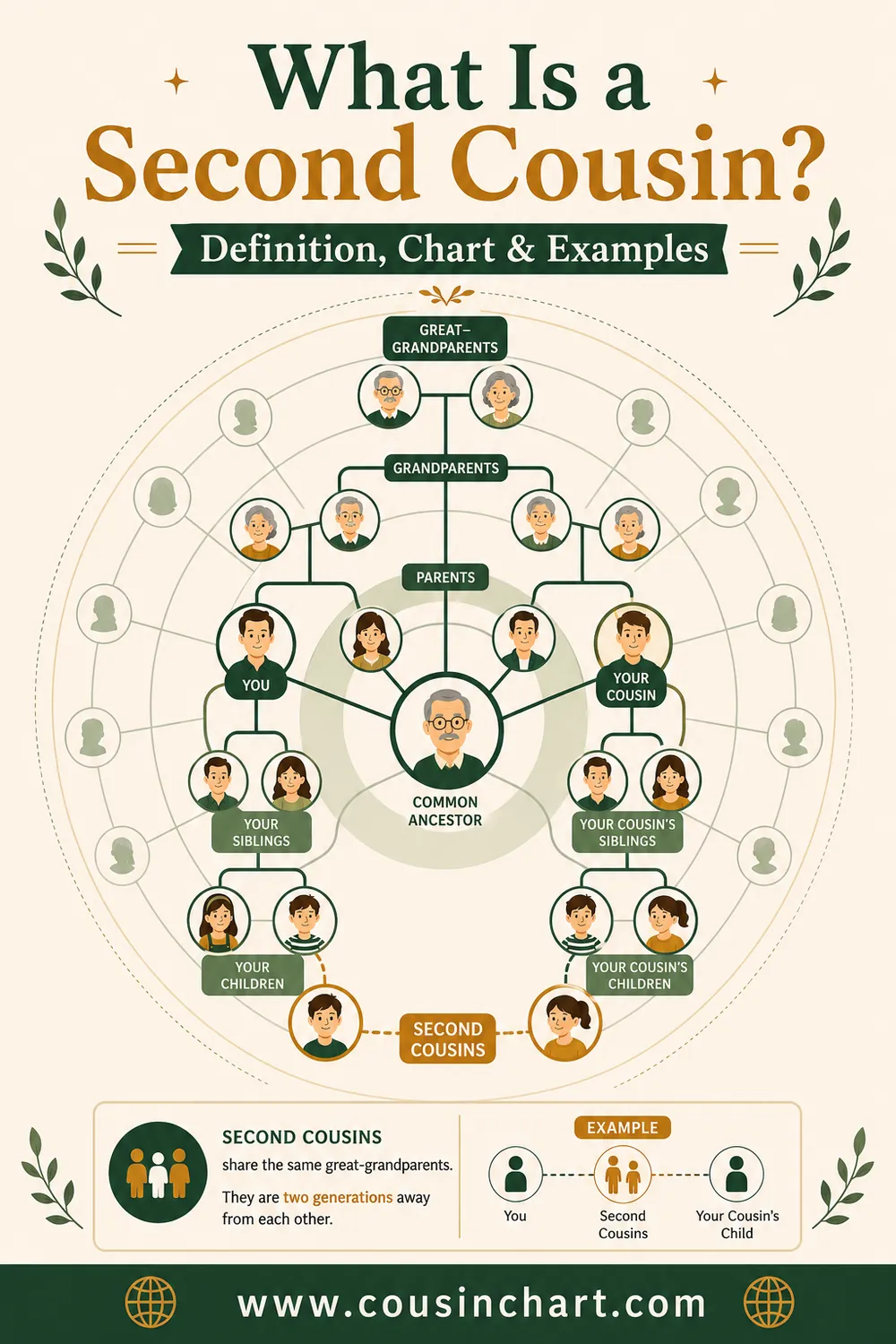
And the flip side, since it's usually the next question: your children and your cousin's children are second cousins to each other. This guide walks through why, what your cousin's child should call you, and every nearby relationship you might be wondering about. For anything beyond that, the free relationship calculator on our homepage names any family connection instantly.
Relationship quick-check. Tap a phrase to see the correct term:
The answer will appear here.
The Direct Answer, With the Why
Two facts produce the answer:
- You and your first cousin share grandparents. That's what makes you first cousins — your parents are siblings.
- Your cousin's child sits one generation below that cousin pairing. The family split is still at your grandparents' level, so the "first cousin" part stays. The one-generation gap adds "once removed."
So: first cousin once removed. In genealogy shorthand you'll sometimes see it written 1C1R.
A quick gut-check that helps it stick: your grandparents are your cousin's child's great-grandparents. Whenever one person's grandparents are the other's great-grandparents, you've got a first cousin once removed pair.
Why It's Not Your Second Cousin
"Second cousin" is the label almost everyone reaches for, and it's understandable — the child feels like "a cousin, one step further." But cousin numbers don't count steps down the tree; they count how far back the shared ancestor sits, and they only apply to people in the same generation.
- Second cousins share great-grandparents and stand in the same generation.
- Your cousin's child shares your grandparents (as their great-grandparents) and stands one generation below you.
Different geometry, different term. The people who genuinely are second cousins here: your kids and your cousin's kids. They're the pair standing in the same generation with shared great-grandparents. The relationship you were tempted to give the child actually belongs to your children. Our full second cousin explainer covers that side of the fence.
What Does Your Cousin's Child Call You?
The exact same thing: you are their first cousin once removed. Cousin relationships are always mutual — there's no "upstream" or "downstream" version of the label. If you want direction, genealogists sometimes tack on "ascending" (the older one) or "descending" (the younger one), but in conversation nobody does.
What they'll actually call you is another matter, and every family solves it differently:
- "Aunt Dana" / "Uncle Marcus" — extremely common. You're an adult of their parent's generation-ish; "aunt/uncle" signals warmth and respect, and no genealogy police will come.
- "Cousin Dana" — the classic Southern-US and Caribbean solution; "cousin" covers everyone.
- Just your first name — increasingly the default in casual families.
There's no wrong answer socially. The precise term matters in family-tree software, DNA match lists, and wills — not at birthday parties.
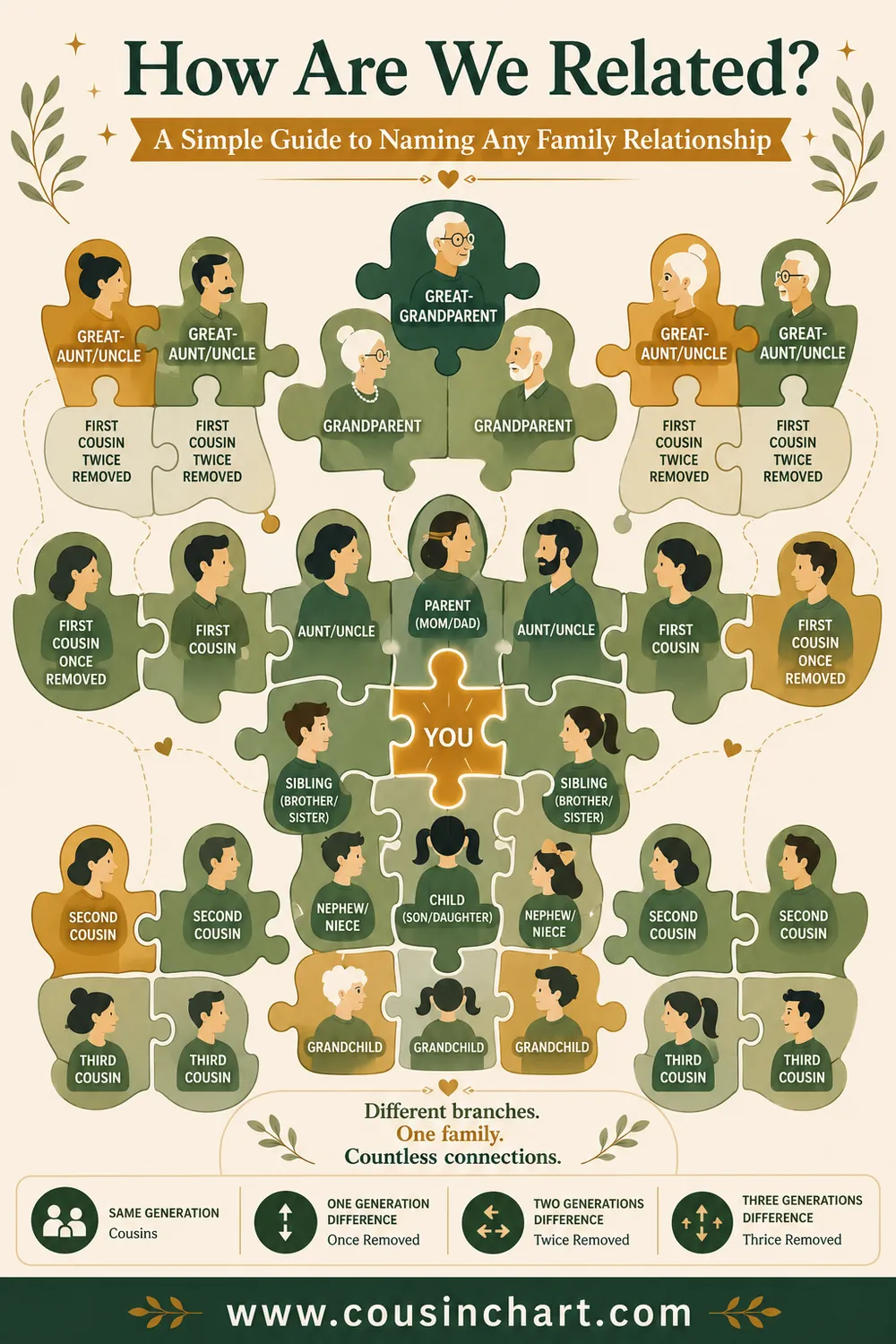
The Whole "Cousin's ___" Family, in One Table
Once you know the pattern, every relative attached to your cousin becomes predictable:
| Person | Relationship to you | Why |
|---|---|---|
| Your cousin's child | First cousin once removed | One generation below the cousin bond |
| Your cousin's grandchild | First cousin twice removed | Two generations below |
| Your cousin's great-grandchild | First cousin three times removed | Three generations below |
| Your cousin's spouse | Cousin-in-law (no blood) | Related by marriage only |
| Your cousin's stepchild | No blood relation | Connected through marriage, not descent |
| Your child + your cousin's child | Second cousins (to each other) | Same generation, shared great-grandparents |
| Your grandchild + your cousin's grandchild | Third cousins (to each other) | Same generation, shared great-great-grandparents |
Notice the two patterns running in parallel: your relationship to each new generation adds a "removed," while the same-generation pairs (kids with kids, grandkids with grandkids) climb the cousin numbers — second, third, fourth. Both patterns continue forever. If you ever need the far reaches — say, your cousin's great-great-grandchild — the cousin calculator handles unlimited generations without breaking a sweat.
How Much DNA Do You Share With Your Cousin's Child?
On average, about 6.25% — roughly 425–450 centimorgans. That's half of what you share with the cousin themselves (~12.5%), because each generation step halves the expected shared DNA. Their kids will share about 3.125% with you, and so on down the line.
These are averages, not guarantees. DNA shuffles randomly each generation, so one first cousin once removed might share 5% with you and their sibling 8%. That's normal — and it's why DNA sites label matches with ranges rather than exact relationships.
One practical use: if a DNA match shares ~6% with you and you can't place them, "first cousin once removed" (in either direction — a parent's cousin, or a cousin's child) belongs on your shortlist, alongside relationships with similar averages like half-aunts and great-grandparents.
In genealogy software and match lists you'll see the relationship abbreviated as 1C1R — worth recognizing, because it's how Ancestry, FamilySearch, and most tree tools will label your cousin's child once you connect the branches. Age is no guide here, by the way: a first cousin once removed can easily be older than you if your cousin started their family early, and in big families the "removed" generation above you (your parents' cousins) can include people younger than you. Generations are about position in the tree, never birthdays.
"Niece" and "Nephew" — Close, but Different Branch
Because your cousin's child is a kid one generation down, lots of people file them mentally next to nieces and nephews. Worth keeping the branches straight:
- Niece/nephew = your sibling's child. You share a parent with their parent. Average shared DNA ~25%.
- First cousin once removed = your cousin's child. You share grandparents with their parent. Average shared DNA ~6.25%.
Some families use "second niece" or "cousin-niece" informally — sweet, but not standard terms. If you're recording a family tree or medical history, stick with first cousin once removed. If you're wondering how any relative connects — in-laws, steps, halves, greats — our guide to figuring out how you're related walks the general method.
Adopted, Step, and Half Versions
Real families are rarely textbook diagrams, so here's how the variations play out:
- Your cousin adopts a child. Genealogically and legally, adopted children take their full place in the tree — the child is your first cousin once removed, no asterisk. DNA tests won't show a match, but family trees (and inheritance law) treat adoption as complete kinship.
- Your cousin's stepchild. Connected through your cousin's marriage, so there's no blood term — informally they're simply part of the family, and "my cousin's stepdaughter" is the accurate description if anyone asks.
- Your half-cousin's child. If your parent and your cousin's parent were half-siblings (one shared grandparent for you instead of two), your cousin is your half first cousin (~6.25% DNA), and their child is your half first cousin once removed (~3.125%). The "half" prefix just rides along down the generations.
- Your cousin's child from different marriages. Makes no difference — every biological child of your first cousin is your first cousin once removed, regardless of which marriage or partner.
Practice: Place These Three
Quick reps to lock it in — cover the answers first:
- Your cousin's daughter's son. Two generations below your cousin: first cousin twice removed.
- Your mom's cousin's daughter. Your mom and her cousin are the cousin pair; you and the daughter are each one generation below — same row: second cousin.
- Your cousin's wife's sister. The chain breaks at the marriage — no blood relation (and no formal term; "my cousin's sister-in-law" does the job).
If number 2 tripped you, you've found the pattern worth memorizing: you and your cousin's kid are offset; your kids and your cousin's kids line up. The offset pairs get "removed"; the lined-up pairs get bigger cousin numbers.
Quick answer: Your cousin's child is your first cousin once removed (often written 1C1R). To your own children, that same child is a second cousin. The easy way to remember it: keep your cousin's label, then add one "removed" for each generation you step down from them.
Working It Out in Real Life: Three Examples
Example 1: The baby shower invitation
Your mom's sister is your Aunt Ana. Her son Marcus just had a baby girl, Lily, and you're invited to the shower.
- Name the person in the middle. Marcus is your aunt's son, so he's your first cousin.
- Count the steps down from him. Lily is his daughter: one step.
- Put it together. Keep "first cousin," add "once removed." Lily is your first cousin once removed.
Bonus: Lily is a second cousin to your kids and a great-niece to your mom, who is Marcus's aunt.
Example 2: The long-winded description
Someone at a reunion introduces a teenager as "your dad's brother's granddaughter." Shorten it in two moves: your dad's brother is your uncle, and your uncle's child is your first cousin. So she's really "your cousin's daughter," which makes her your first cousin once removed. Rewrite any chain until it starts with "my cousin's," and the answer comes quickly.
Example 3: Your spouse wants to know too
Your husband asks what your cousin's son, Theo, is to him. Since Theo is connected to your husband only through your marriage, there's no blood relationship. Most families just say "my wife's cousin's son" (our in-law relationship chart covers the marriage side). Your children are a different story: they descend from your grandparents, so Theo is their second cousin.
How to Record It and Explain It
- In a family tree app, add the child under your cousin as their parent. Don't attach them straight to you. Once every link is in place, most tree programs label the relationship on their own.
- Double-check the link at the top. The whole relationship runs through your grandparents, so make sure your parent and your cousin's parent are recorded as siblings with the same parents.
- Explaining it to your kids? Keep it simple: "Marcus and I are cousins, so you and Lily are cousins too, just second cousins."
- When the path gets longer, like a cousin's stepchild's baby or a half-cousin's grandchild, type each step into the relationship calculator on our homepage and let it name the connection for you.
Common Mix-Ups
- "My cousin's child" vs. "my child's cousin." Your child's cousin is your niece or nephew (your sibling's child), or your spouse's niece or nephew if the cousin is on the other side of the family.
- Calling them a grandniece or great-niece. Those words belong to your sibling's grandchildren. Your cousin's child stays on the cousin line. For how the niece and nephew side works, see our niece and nephew relationship chart.
- Mixing up your cousin's child with your cousin's grandchild. Each generation adds one more "removed," so the grandchild is your first cousin twice removed. Our guide to your cousin's grandchild walks through that next step.
- Moving up to "second cousin" one generation too early. The child of your second cousin is your second cousin once removed. That's the same pattern one branch further out, explained in what your second cousin's child is to you.
FAQ
Is my cousin's child my second cousin or my niece?
Neither — they're your first cousin once removed. Second cousins are in your own generation (your kids and your cousin's kids). Nieces and nephews are your siblings' children.
What are my children to my cousin's children?
Second cousins. They're in the same generation and share great-grandparents (your grandparents). Their children, in turn, will be third cousins to each other.
What is my cousin's baby to my parents?
Your parent is your cousin's aunt or uncle, so the baby is your parent's great-niece or great-nephew (also written grand-niece/grand-nephew). That branch follows the niece/nephew ladder, not the cousin ladder — "removed" doesn't apply.
What do I call my cousin's grandchild?
Your first cousin twice removed. Each generation below your cousin adds one "removed": child = once, grandchild = twice, great-grandchild = three times.
How much DNA do I share with my first cousin once removed?
About 6.25% on average, roughly 425–450 cM. It varies person to person because DNA inheritance is random — anywhere from about 3% to 9% is unremarkable.
Is my cousin's child related to me by blood?
Yes — a first cousin once removed is a genuine blood relative. You both descend from your grandparents (their great-grandparents), sharing about 6.25% of your DNA on average.
What is my cousin's child to my husband or wife?
No blood relation. They're connected to your spouse only through your marriage, so most families simply say "my spouse's cousin's child" or call them a cousin by marriage. The children you and your spouse have together are that child's second cousins.
Can I call my cousin's kids my nieces and nephews?
Socially, yes, and lots of families do it as a sign of closeness. It just isn't the exact term. For family trees, medical history, or legal papers, use "first cousin once removed" so nobody mistakes them for your sibling's children.
Is my cousin's child part of my immediate family?
Usually not. Immediate family normally means parents, siblings, spouse, and children, and sometimes grandparents. Cousins and their children count as extended family. Employers, schools, and other organizations write their own definitions, so check the exact wording when it matters.
Is my cousin's child my grandniece or great-niece?
No. Grandniece and great-niece mean your sibling's grandchild. Your cousin's child is your first cousin once removed. To your parents, though, your cousin's child really is a great-niece or great-nephew, since your parents are your cousin's aunt or uncle.
What is my cousin's grandchild to my child?
A second cousin once removed. Your child and your cousin's child are second cousins, and your cousin's grandchild is one generation below that pair, which adds one "removed."
Get the Term for Anyone in Your Tree
So: cousin's child = first cousin once removed, your kids and theirs = second cousins, and every generation adds one more "removed." That covers this branch — but family trees have a way of producing new puzzles ("okay, but what's my grandma's cousin's grandson?"). For those, skip the scratch paper: the free family relationship calculator maps any path between two relatives and hands you the exact term, instantly.