What Is a Third Cousin? Meaning, DNA Shared & Examples
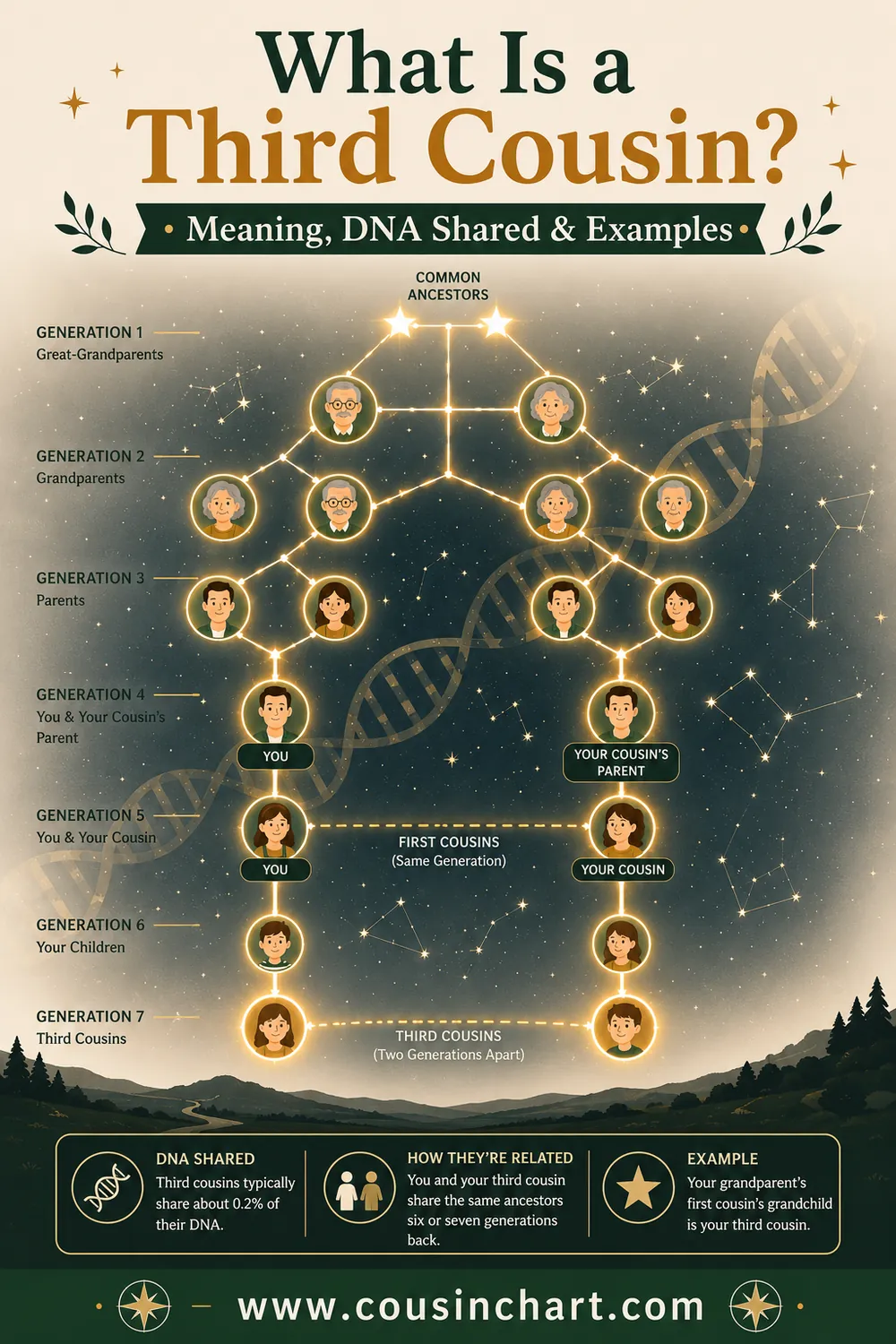
A third cousin is someone who shares great-great-grandparents with you. In everyday terms, your third cousin is your parent's second cousin's child — you're in the same generation, four steps down from the ancestors you have in common, and you share about 0.78% of your DNA on average.
Third cousins live right at the edge of "family you might actually know" and "stranger who shows up in your DNA matches." This guide covers both sides: the family-tree math and the DNA reality. For any specific pair of people, the free relationship calculator on our homepage names the connection instantly.
Relationship quick-check. Tap a phrase to see the correct term:
The answer will appear here.
The Family-Tree Math
Cousin numbers follow one clean rule: count the generations from your closest shared ancestors down to you, then subtract one.
- Grandparents (2 generations up) → first cousins
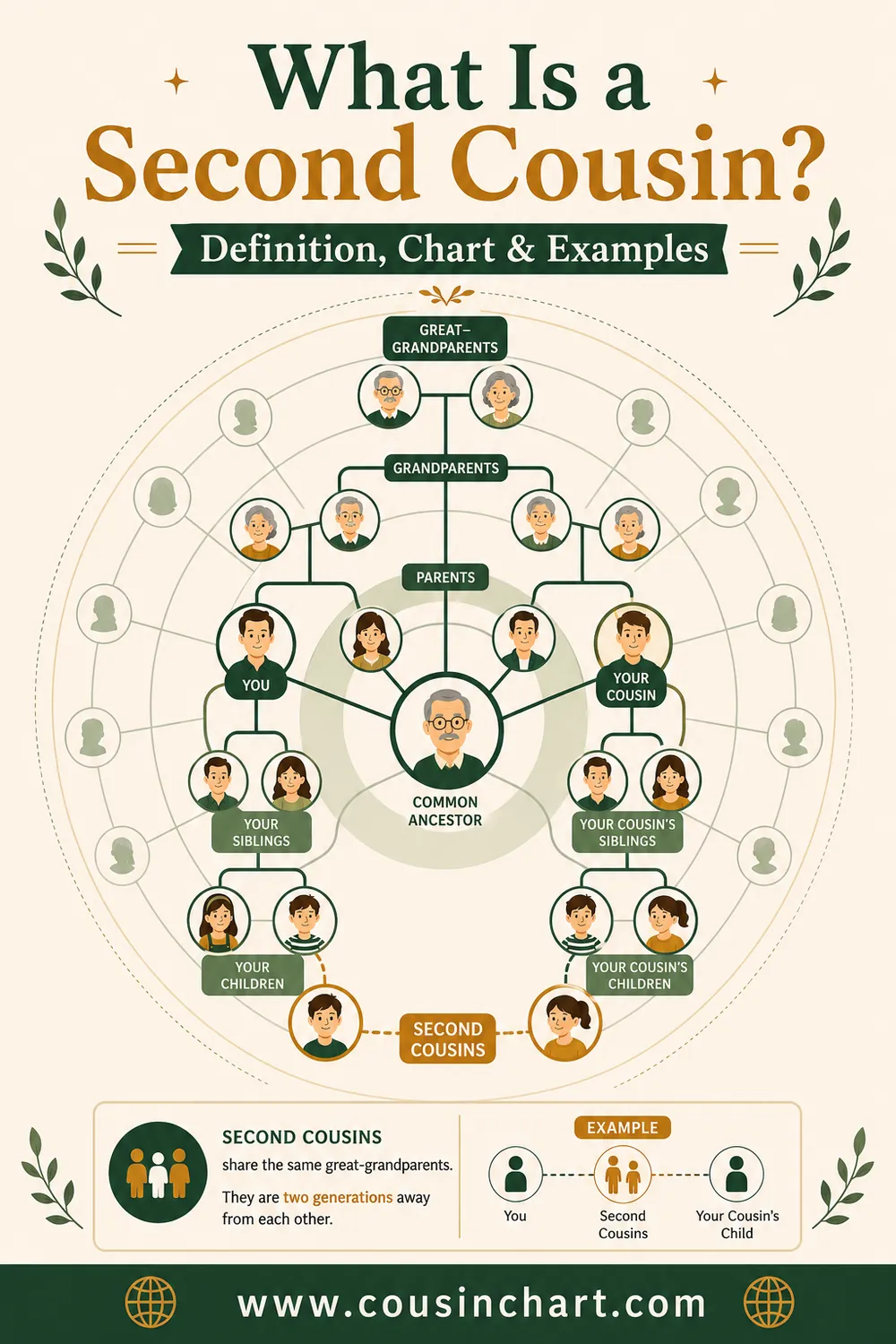
- Great-grandparents (3 up) → second cousins
- Great-great-grandparents (4 up) → third cousins
- Great-great-great-grandparents (5 up) → fourth cousins
For third cousins, the branch split happened four generations ago. Your great-great-grandparents had children; one line led to your grandparent, another to somebody else's grandparent; two more generations down each side, and the two of you are third cousins — same row of the tree, quite a distant branch.
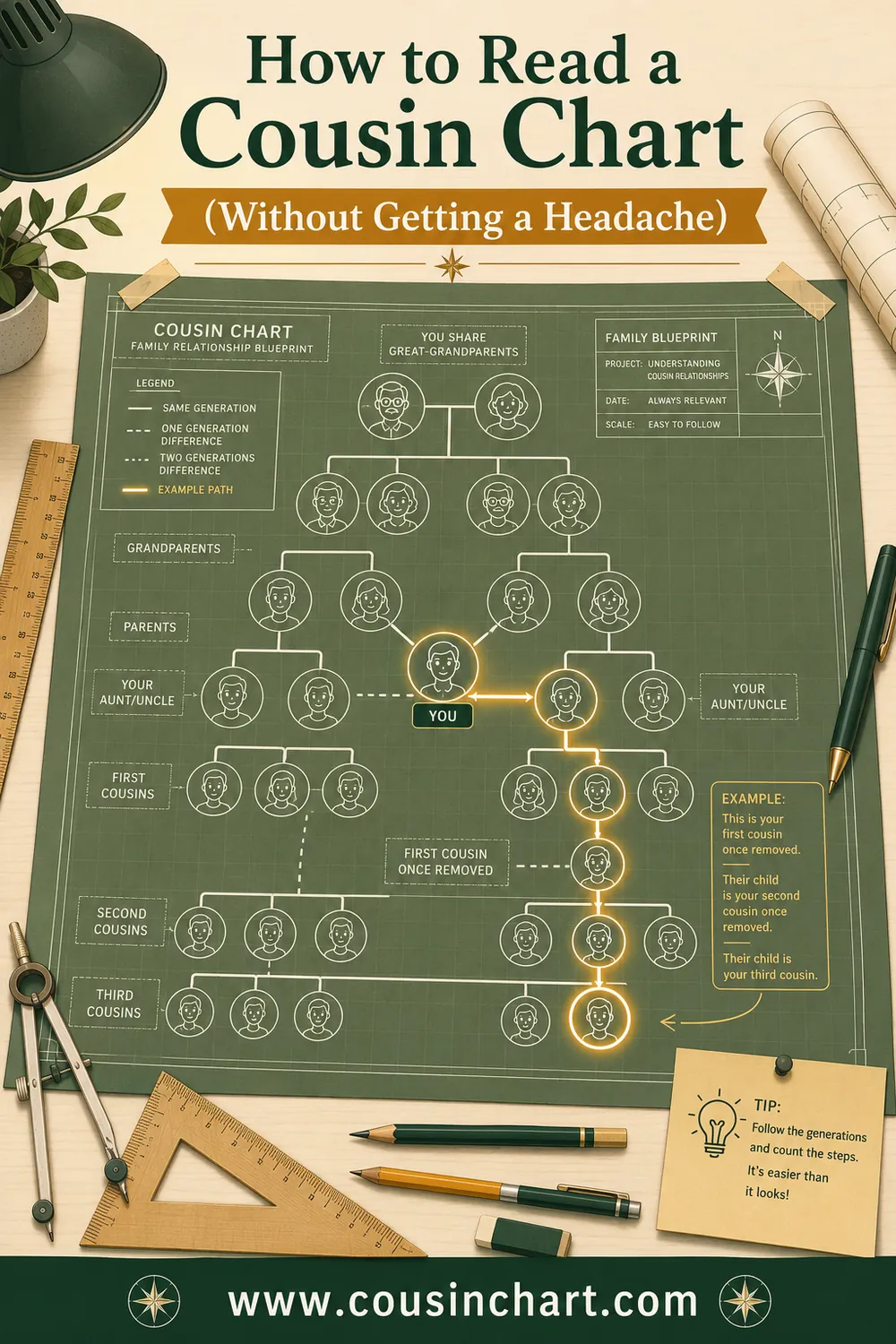
The step-by-step version, if you like chains: your great-great-grandparents' children were siblings (your great-grandparent's generation). Those siblings' children were first cousins (your grandparent's generation). Their children were second cousins (your parents' generation). And their children — you and yours — are third cousins. Siblings beget first cousins beget second cousins beget third cousins, one generation at a time.
How Much DNA Do Third Cousins Share?
The headline number: third cousins share about 0.78% of their DNA on average — roughly 73 centimorgans (cM), with observed results ranging from 0 to around 230 cM.
That "0" is not a typo, and it's the single most useful thing to know about third cousins and DNA:
| Relationship | Avg DNA shared | Avg cM (approx.) | Chance of detectable match |
|---|---|---|---|
| First cousin | ~12.5% | ~850 | ~100% |
| Second cousin | ~3.125% | ~230 | ~100% |
| Third cousin | ~0.78% | ~73 | ~90% |
| Fourth cousin | ~0.20% | ~35 | roughly half |
Around 10% of genuine third cousins share no detectable DNA at all. By the time DNA has been shuffled and halved across four generations on each side, whole segments from those great-great-grandparents can simply fail to survive the trip in one line or the other. So a missing third-cousin match proves nothing — while a present one is a lovely little inheritance from a couple born well over a century ago.
All figures above are averages from standard population genetics; individual results scatter widely, which is why testing companies label matches with ranges.
Third Cousins on Your DNA Match List
If you've tested with AncestryDNA, 23andMe, or MyHeritage, your match list is probably full of estimated third cousins. A few practical pointers:
- ~73 cM is ambiguous on purpose. The same amount could be a third cousin, a second cousin once removed, or even a first cousin three times removed. The cM value narrows the field; your paper trail picks the winner.
- Work from the shared ancestor hypothesis. A predicted third cousin should connect through one of your 8 great-great-grandparent couples. That's a finite search space — check surnames and locations branch by branch.
- Shared matches are your friend. If the mystery match also matches your known paternal second cousin, you've likely found which side (and which branch) they belong to.
When you think you've found the paper connection, sanity-check the relationship label with the cousin calculator — it'll confirm whether "grandma's cousin's grandson" really works out to third cousin (it does, by the way).
How Many Third Cousins Do You Have?
More than you'd guess. You have (up to) 8 sets of great-great-grandparent couples, and every descendant of theirs in your generation — outside your closer family — is a third cousin. In families averaging 2–3 children per generation, estimates typically land in the range of 100 to 200 third cousins, and historically large families can push that far higher.
This is why genealogists love the third-cousin zone: it's distant enough to be numerous, close enough to be traceable. Most successful "mystery match" solves happen right here.
Do Third Cousins Count as Family?
Legally, the question never even comes up: third-cousin marriage is legal essentially everywhere, and third cousins fall outside every common legal definition of close kin. Genetically, 0.78% shared DNA is a whisper — children of third cousins carry no meaningfully elevated genetic risk compared to the general population.
Socially? Third cousins are usually the outer ring of the family reunion — the folks you're introduced to with a chain of explanation ("this is Carol, her great-grandma and your great-grandma were sisters"). But in small towns, close-knit cultures, and families that keep good records, third cousins can be lifelong friends. The label measures tree distance, not affection.
Third Cousin vs. the Near Misses
Three relationships get confused with third cousins constantly:
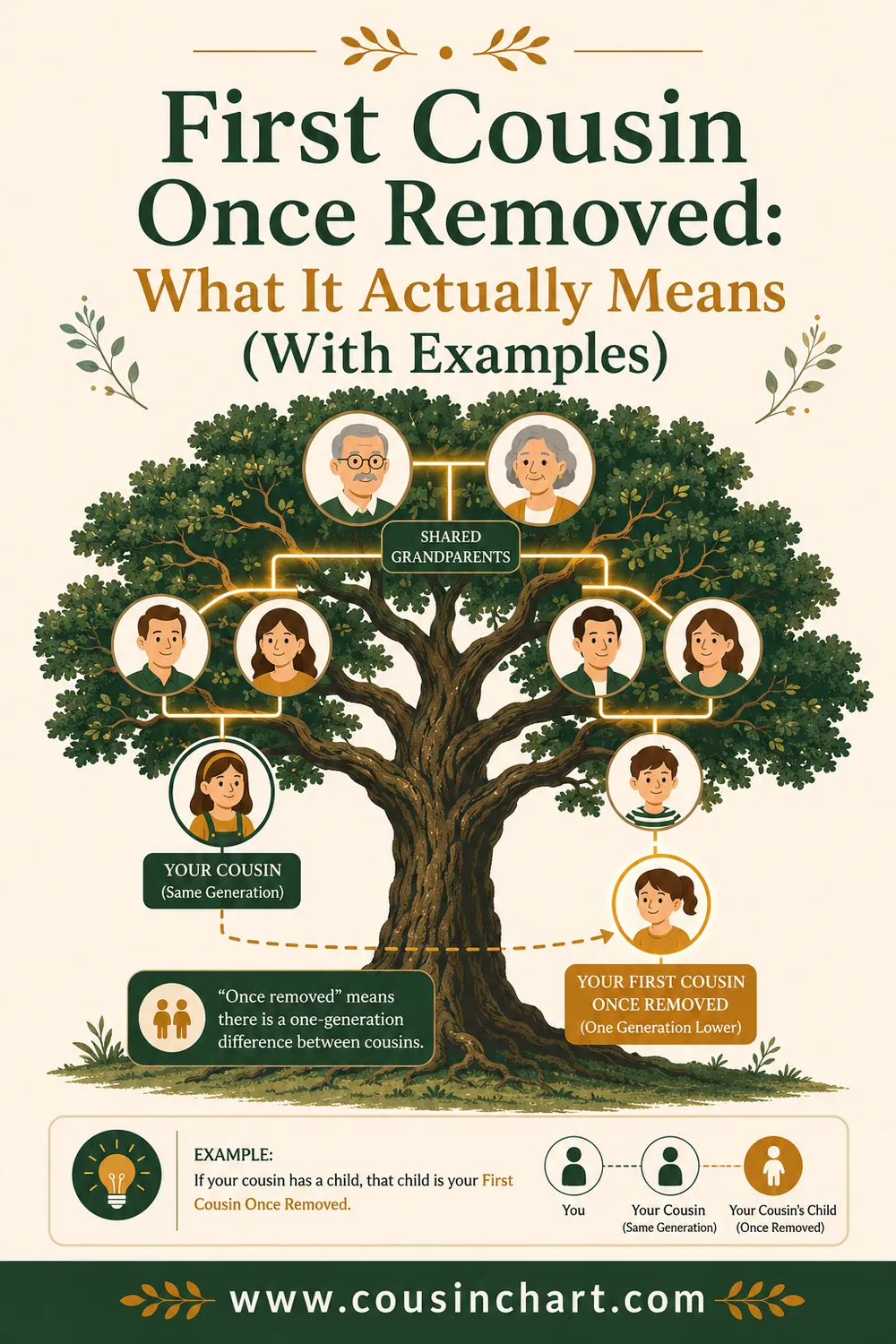
- Second cousin once removed — your parent's second cousin, or your second cousin's child. One generation offset, and at ~1.56% shared DNA, they average about double a third cousin's share. A second cousin refresher helps here.
- Third cousin once removed — your third cousin's child or your parent's third cousin. Same "third" branch depth, one generation offset, ~0.39% average.
- "Distant cousin" — not a real term, just shorthand. If you can trace the actual path, there's always an exact label; the full cousin chart shows where every combination lands.
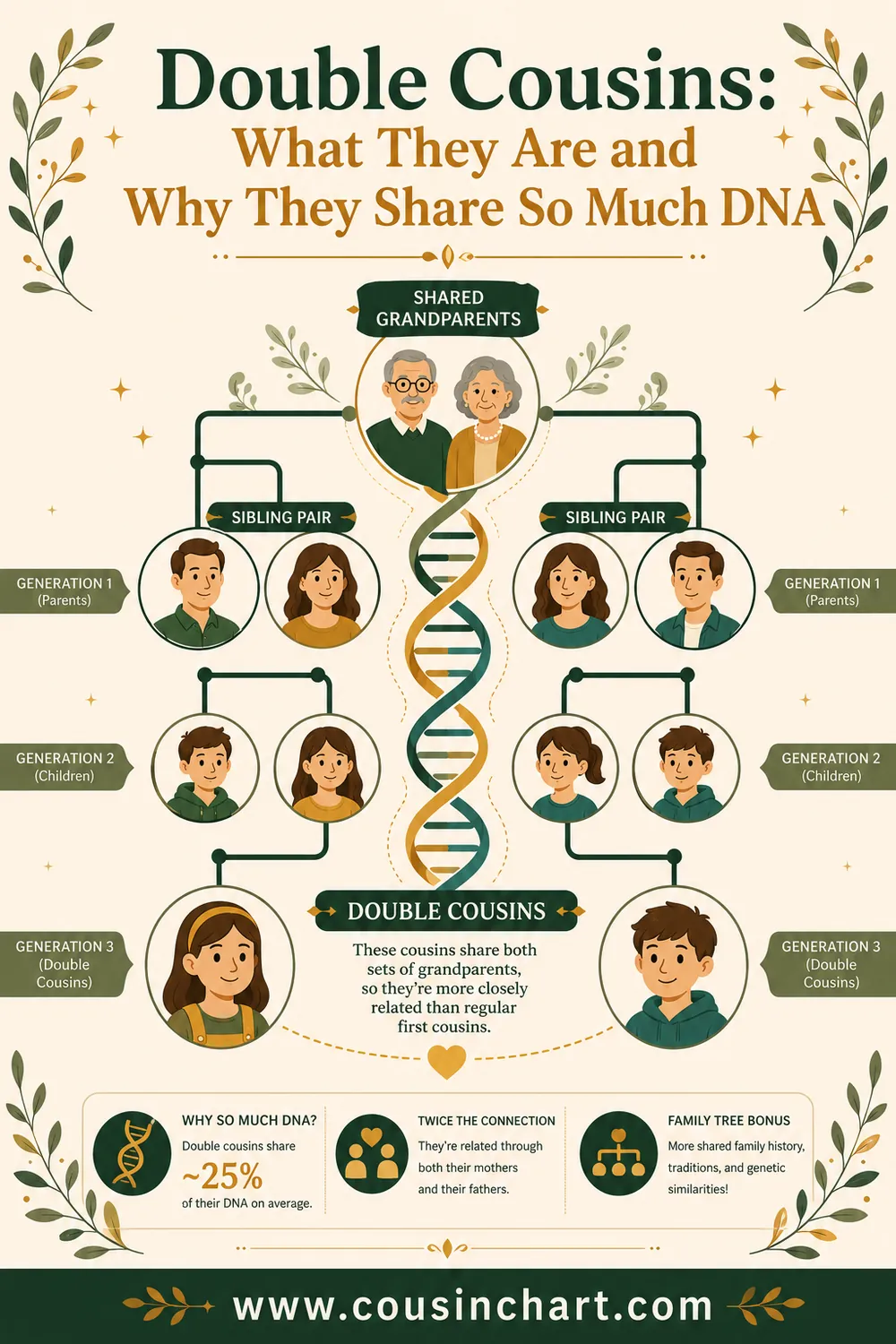
One more relative worth knowing about while you're this deep in the tree: if your family has intermarried branches (two siblings marrying two siblings), you may have double cousins — who share far more DNA than their label suggests.
Using Third Cousins to Break Brick Walls
Serious family historians treat third-cousin matches as a research tool, and the technique works even if you're brand new:
- Cluster first. Group your DNA matches by who matches each other. A cluster of third-cousin-level matches usually descends from one of your 8 great-great-grandparent couples.
- Identify the couple. Find the cluster members with public trees and look for the surname/place combination they share. That points at the ancestral couple — sometimes one you didn't have a name for yet.
- Build down, not up. Once you suspect the couple, trace their children forward toward your matches. Meeting in the middle is far easier than climbing your own line into the unknown.
This "descendancy" approach is how people identify unknown great-grandfathers, confirm immigrant origins, and reconnect branches split by war or emigration. Third cousins are the sweet spot because they're numerous enough that several have tested, and close enough that the connecting records (born mid-1800s onward, typically) actually survive.
Practice: Which Cousin Is It?
Three reps — answers follow each:
- Your grandma's cousin's great-grandchild. Shared ancestors: your great-great-grandparents. You're 4 down; they're 5 (cousin at 2, then three more generations). Smaller count 4 − 1 = third cousin, gap 1: third cousin once removed.
- Your third cousin's daughter. One generation below the third-cousin bond: third cousin once removed (the downward version of the same term).
- Your kids and your third cousin's kids. Both 5 generations below the shared couple — same row: fourth cousins.
The pattern to internalize: same row = bigger numbers as you go back; different rows = "removed." When the chains get long — and at third-cousin distance they always do — the free calculator counts the generations so you don't have to.
FAQ
What is a third cousin in simple terms?
The child of your parent's second cousin. You share great-great-grandparents — the family branch split four generations back — and you're in the same generation.
How much DNA do third cousins share?
About 0.78% on average, roughly 73 cM, ranging from 0 to about 230 cM. Around 10% of true third cousins share no detectable DNA at all, so an absent match doesn't disprove the relationship.
Are third cousins blood related?
Yes — they descend from the same great-great-grandparents. The genetic overlap is small (under 1% on average) but real, and about 90% of third cousins show up as matches on DNA tests.
Can third cousins marry?
Yes, legally almost everywhere in the world. Genetically, third cousins are distant enough that experts consider the added risk for children negligible.
What is my third cousin's child to me?
Your third cousin once removed. And your own children and your third cousin's children are fourth cousins to each other — the pattern keeps climbing one number per generation.
How is a third cousin different from a first cousin three times removed?
They share the same average DNA (~0.78%) but different geometry. A third cousin is your generation with the split four generations back; a first cousin three times removed is on the close first-cousin branch but three generations above or below you.
Trace Any Branch in Seconds
Third cousin: shared great-great-grandparents, same generation, ~0.78% DNA, child of your parent's second cousin. Four ways to say one relationship — and 100+ people in your tree who fit it. When one of them turns up at a reunion or in your match list, don't re-derive the math: open the free family relationship calculator, tap out the path, and get the exact term with a chart to show for it.