How to Read a Cousin Chart (Without Getting a Headache)
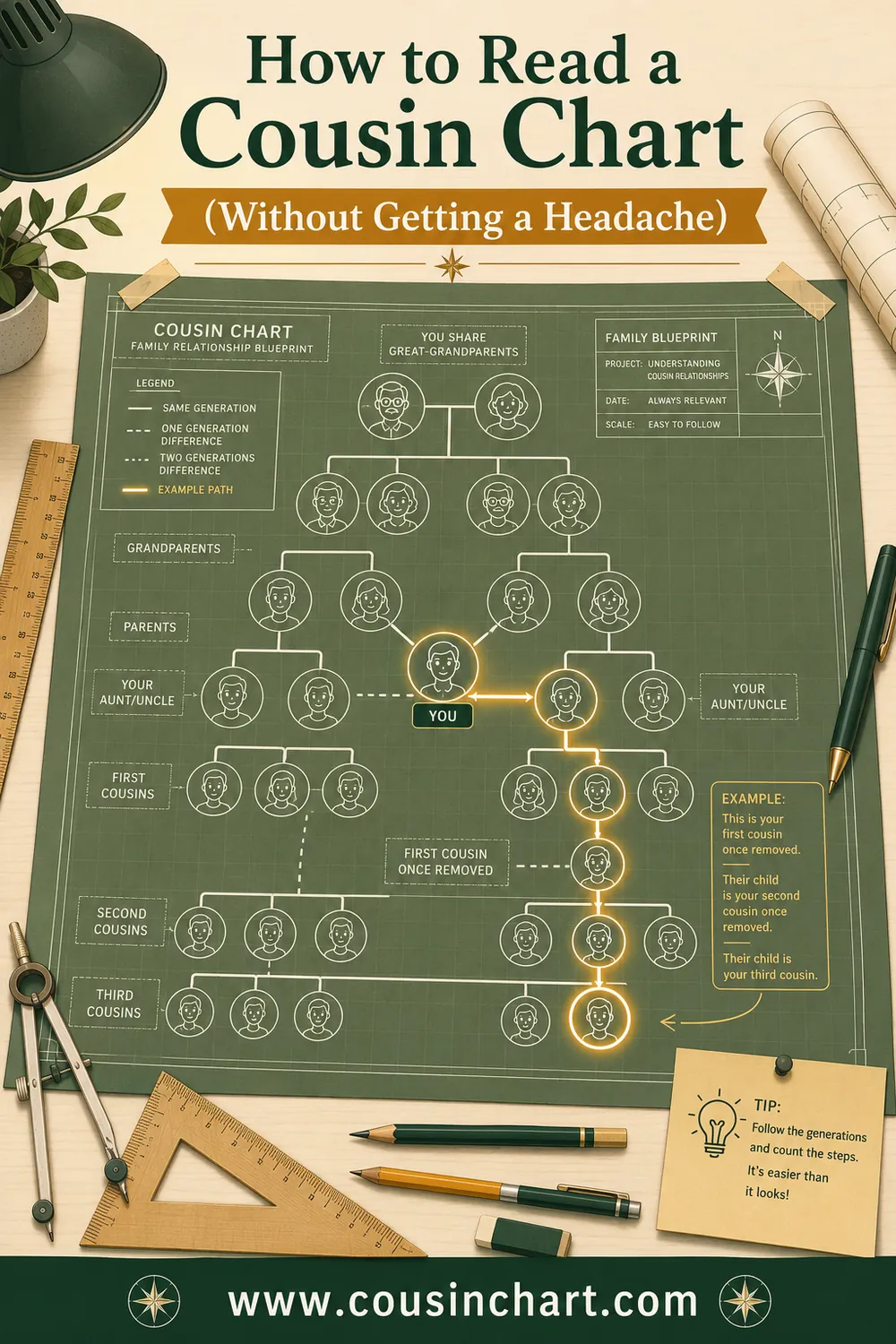
A cousin chart names the relationship between any two relatives in two steps: find the ancestor you both share, then count how many generations each of you is below that ancestor. Where your row and their column meet on the chart, that's your relationship.
This guide gives you the chart itself, the two rules that generate every square of it, and worked examples so it actually sticks. Fair warning, though: the fastest way to "read" a cousin chart in 2026 is to not read one at all — the free relationship calculator at cousinchart.com is the same grid with the counting done for you. Keep it open in another tab and check your answers as we go.
Relationship quick-check. Tap a phrase and see where it lands on the chart:
The answer will appear here.
The Chart
Every cousin chart is the same idea: put the shared ancestor in the corner, run one person's line of descent down the rows, the other person's down the columns, and read the intersection.
| ↓ You are the ancestor's… / They are the ancestor's… → | Child | Grandchild | Great-grandchild | Great-great-grandchild |
|---|---|---|---|---|
| Child | Siblings | Niece/nephew | Great-niece/nephew | Great-great-niece/nephew |
| Grandchild | Aunt/uncle | First cousins | First cousin once removed | First cousin twice removed |
| Great-grandchild | Great-aunt/uncle | First cousin once removed | Second cousins | Second cousin once removed |
| Great-great-grandchild | Great-great-aunt/uncle | First cousin twice removed | Second cousin once removed | Third cousins |
Two patterns to notice before we break down the rules:
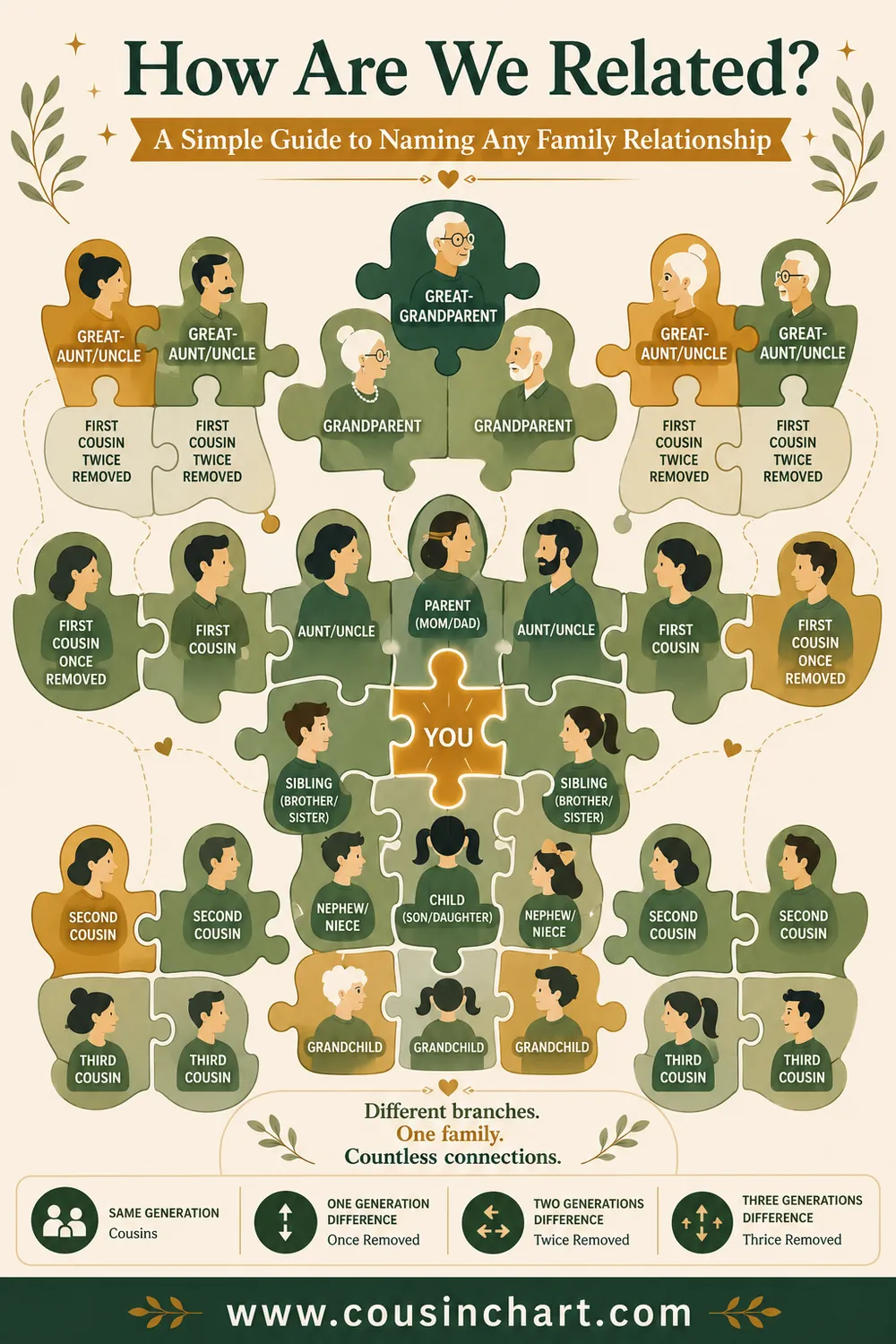
- The diagonal (bold) is where both people are the same number of generations down — that's where the plain cousins live: first, second, third, marching outward forever.
- Moving off the diagonal adds "removed" — one step off, once removed; two steps, twice removed. The chart is symmetric, because relationships are mutual.
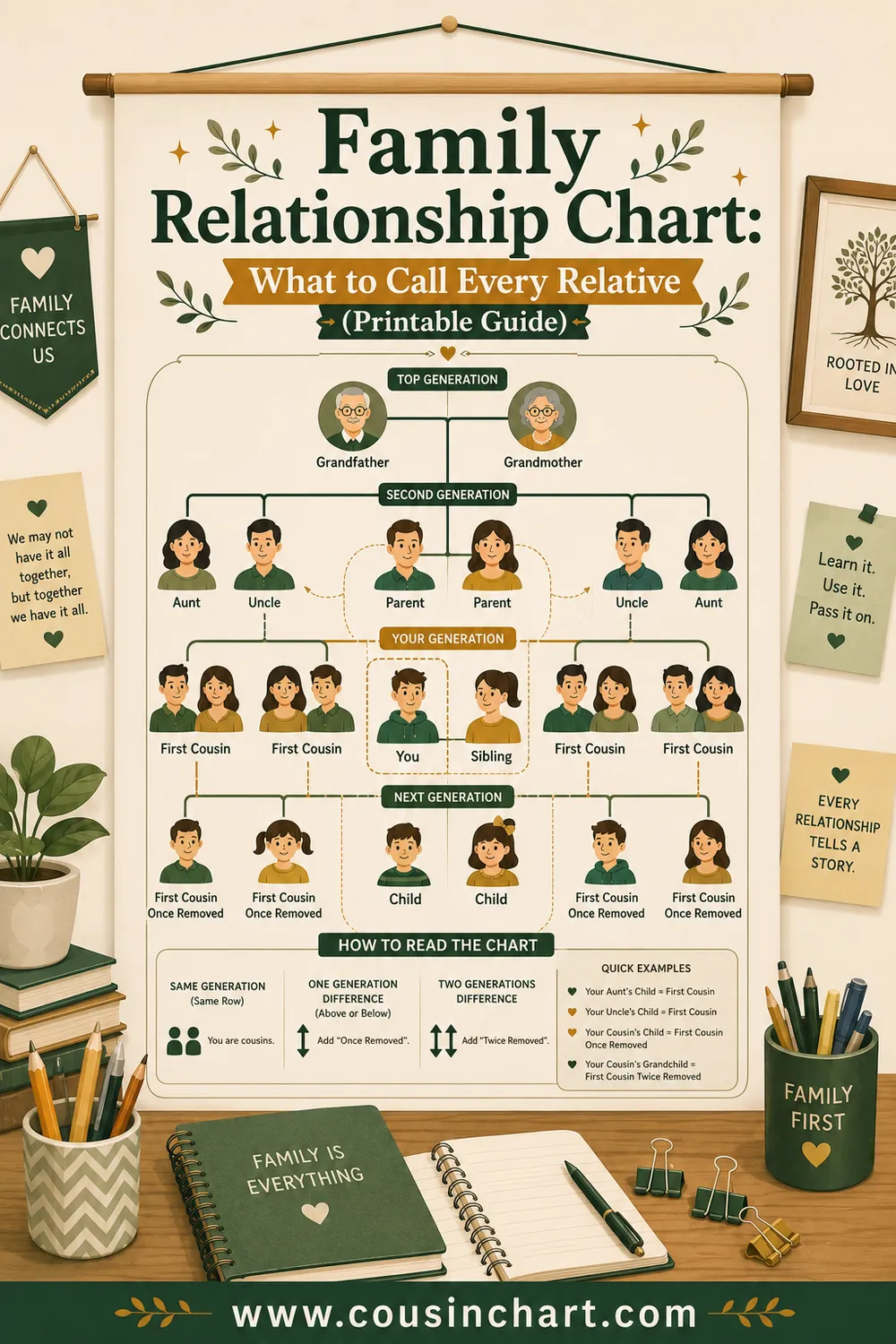
The top row and left column aren't cousins at all — they're the aunt/uncle and niece/nephew lines, which have their own ladder of "greats." A broader table covering in-laws, steps, and greats lives in our family relationship chart.
Rule 1: The Cousin Number Comes From the Shared Ancestor
Cousin degree = generations from the shared ancestor down to the closer person, minus one.
- Both grandchildren of the shared couple (2 down each) → 2 − 1 = first cousins.
- Both great-grandchildren (3 down) → second cousins.
- Both great-great-grandchildren (4 down) → third cousins.
Equivalent shortcut: count the "G-words" in what the shared ancestor is to the closer person. Grandparent = 1 G-word past "parent" → first cousin. Great-grandparent → second. Great-great-grandparent → third. The pattern never breaks — eighth cousins share ancestors nine generations up.
Important: use the closest ancestor you share. Any two humans share ancestors if you go back far enough; the chart runs on the most recent common couple.
Rule 2: "Removed" Comes From the Generation Gap
Removals = the difference between your two generation counts.
If you're 3 generations below the shared couple and they're 2, that's second-cousin territory? No — careful, this is the one spot people slip. The cousin number uses the smaller count: 2 − 1 = first cousin. The gap (3 − 2 = 1) adds once removed. So: first cousin once removed.
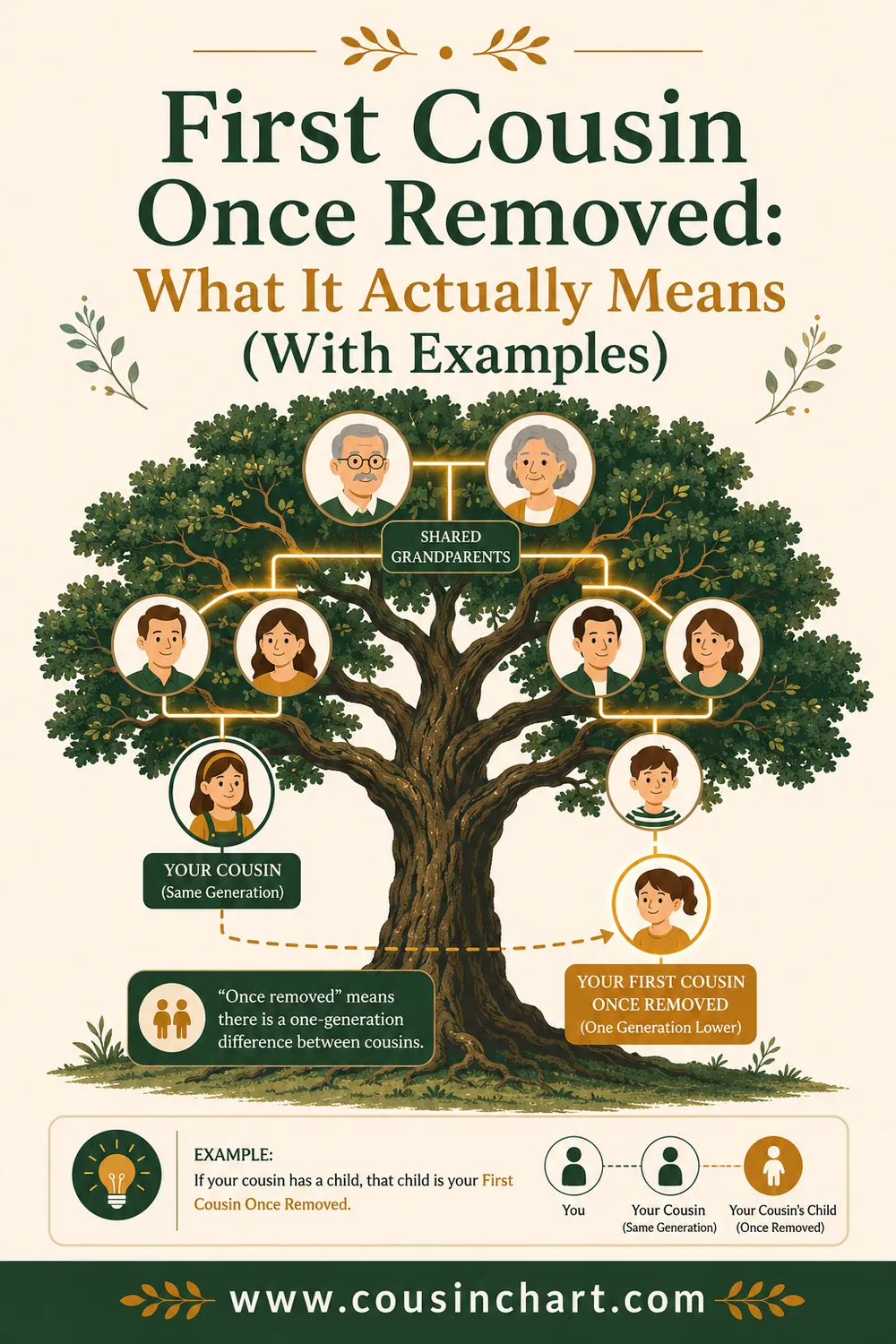
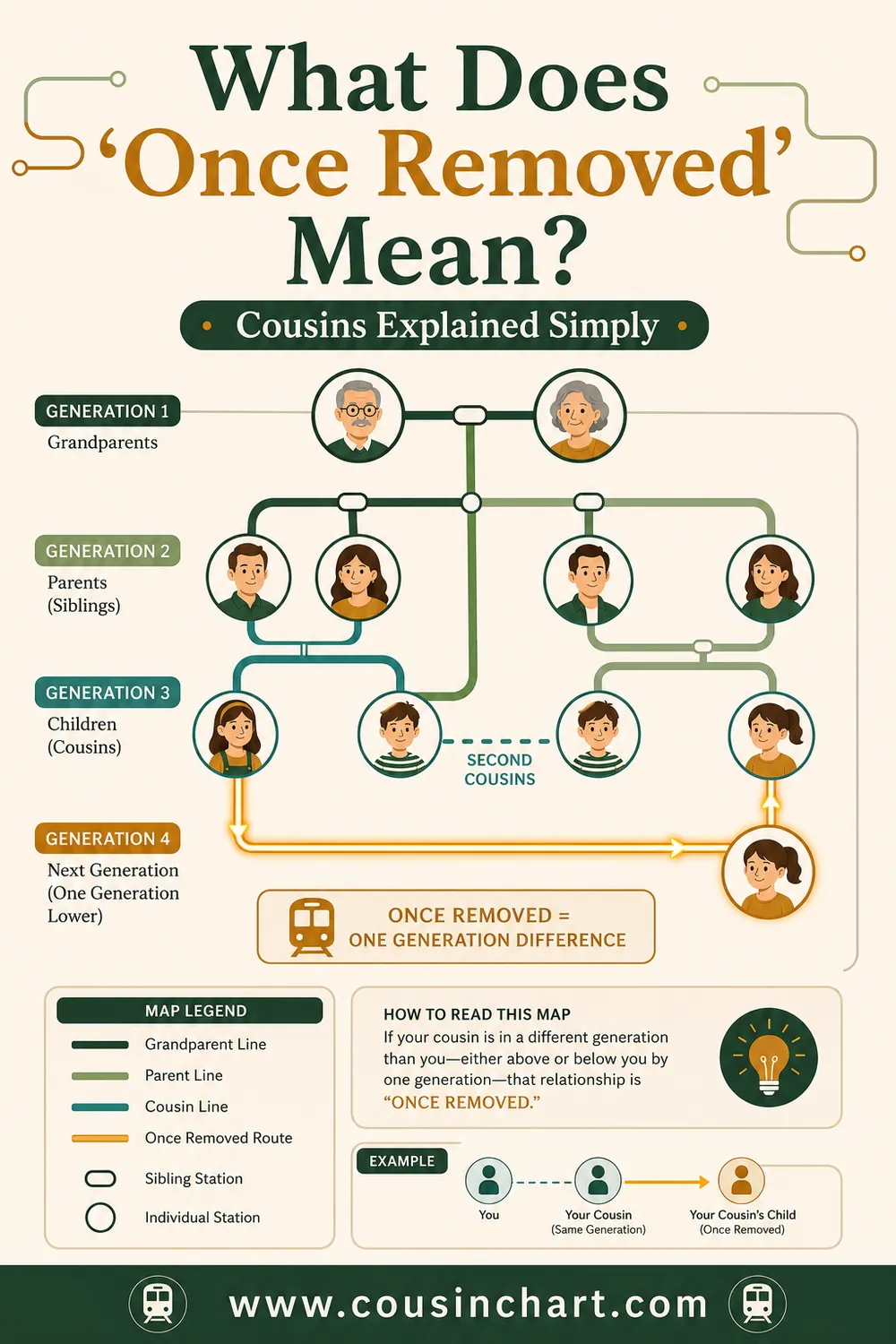
The word "removed" says nothing about direction — one generation up and one generation down get the same label. Your dad's cousin and your cousin's daughter are both first cousins once removed to you. (More on that in what does once removed mean.)
Reading the Chart, Step by Step
Let's run a real query: what is my grandmother's cousin's grandson to me?
- Find the shared ancestor. Your grandmother and her cousin shared grandparents — those are your great-great-grandparents. That couple is the corner of the chart.
- Count your line. Great-great-grandparents → great-grandparent → grandmother → parent → you. You're their great-great-grandchild (4 down).
- Count their line. Same couple → their child → grandma's cousin (2 down) → cousin's son (3) → grandson (4). He's also a great-great-grandchild.
- Read the intersection. Great-great-grandchild × great-great-grandchild → the diagonal → third cousins.
One more, quicker: my dad's second cousin? Your dad's second cousin means dad and that person are both great-grandchildren of the shared couple (3 down each). You're one more step down (4). Smaller count 3 − 1 = second cousin; gap of 1 = once removed. Second cousin once removed.
That's genuinely the whole skill. The only hard part is counting the lines accurately in a real family — names, remarriages, and "wait, whose mother was she?" are where it gets slippery. Which is why the calculator version asks you to tap the path step by step ("my grandmother → her cousin → his grandson") and does the bookkeeping itself.
Shortcuts Worth Memorizing
A few high-traffic squares of the chart, ready for instant recall:
- Your cousin's child → first cousin once removed (full story here).
- Your parent's cousin → first cousin once removed (the upward twin of the one above).
- Your parent's cousin's child → second cousin — same generation as you.
- Your kids + your cousin's kids → second cousins to each other.
- Your grandparent's cousin → first cousin twice removed.
- Grandparent's sibling → great-aunt/great-uncle (not a cousin — different line).
- Each generation down from any cousin adds one "removed." Cousin's grandchild = twice removed; great-grandchild = three times.
Tape those seven to your mental fridge and you'll handle 90% of reunion questions without the chart.
Where People Go Wrong
Four classic misreadings, so you can dodge them:
- Calling the cousin's kid a "second cousin." Second cousins are on the diagonal — same generation. A generation gap always means "removed," never a bigger number.
- Counting the shared ancestor as a generation. Start counting at the ancestor's children (child = 1). The couple in the corner is generation zero.
- Using a distant shared ancestor. If you share grandparents and great-great-grandparents (it happens in intertwined families), the closest pair — the grandparents — defines the relationship.
- Forgetting the chart is symmetric. If you work out that she's your second cousin once removed, you are exactly that to her too. No relationship reads differently from the other end.
Three More Practice Reads
Charts become instinct with reps. Cover the answers and place these:
- Your mother's grandmother's sister's great-granddaughter. Mother's grandmother = your great-grandmother; the shared couple is her parents — your great-great-grandparents. You: 4 down. Her: the sister (1) → child (2) → grandchild (3) → great-granddaughter (4). Diagonal, both at 4: third cousins.
- Your great-uncle's son. Great-uncle = grandparent's brother, so the shared couple is your great-grandparents. You: 3 down. His son: great-uncle (1) → son (2). Counts 3 and 2 → smaller is 2 → first cousin; gap 1 → first cousin once removed. (Sanity check: he's your parent's first cousin. Same answer.)
- Your second cousin's grandchild. Keep the degree, count the offset: two generations down → second cousin twice removed.
Notice how example 2 offered two routes to the same answer — the count-from-the-ancestor route and the "I recognize this square" route. That's the sign the chart is sinking in.
Where Cousin Charts Come From
The grid has surprisingly deep roots. Medieval church lawyers drew consanguinity trees — diagrams of exactly this structure — because canon law forbade marriage within certain degrees of kinship, and priests needed a way to check a couple's relatedness before performing a wedding. Civil law systems developed their own degree-counting for inheritance. The modern "cousin chart" you see at genealogy sites (sometimes called a canon-law relationship chart) is a direct descendant of those working documents: same shared-ancestor corner, same generational rows and columns.
Which is a nice bit of perspective — for most of history, this chart wasn't trivia. It decided who could marry and who inherited the farm. Today the stakes are friendlier (bragging rights and DNA-match sleuthing), but the math hasn't changed in eight hundred years. Only the interface has: the free calculator is the same medieval grid, minus the parchment and the Latin.
FAQ
What is a cousin chart?
A grid that names the relationship between two people based on how many generations each is below their shared ancestor. One person's descent runs down the rows, the other's across the columns; the intersection is the relationship.
How do I figure out cousin relationships fast?
Two counts: generations from the shared ancestor to each person. The smaller count minus one gives the cousin number; the difference between the counts gives the removals. Or skip the counting — the free calculator does both steps from a tapped-out path.
What does the diagonal of a cousin chart mean?
Equal generation depth — plain cousins. First cousins are both grandchildren of the shared couple, second cousins both great-grandchildren, and so on. Everything off the diagonal is "removed."
Are aunts and uncles on the cousin chart?
They're the first row and column: one person is the ancestor's child, the other is deeper down. Child × grandchild = aunt/uncle and niece/nephew; child × great-grandchild = great-aunt/uncle. The cousin numbering only starts one row further in.
What's the highest cousin number possible?
There's no limit — the chart extends as far as records go. Practically, beyond fourth or fifth cousins the shared DNA usually becomes undetectable and the relationships are paper-only. The math still works at any distance.
Why do cousin charts start with a shared ancestor?
Because that's what defines a cousin relationship: descent from a common couple through different children. Everything on the chart — degree and removal — is measured from that corner square.
Or Let the Chart Read Itself
Now you can read any cousin chart: diagonal for the degree, offset for the removals, closest shared ancestor in the corner. But honestly? The chart's best trick is becoming software. The cousinchart.com calculator is this grid — you tap the path from you to your mystery relative, and it lands on the right square, names it, and draws the mini-tree. Free, instant, and immune to miscounting. Keep the rules; outsource the arithmetic.