What Do You Call Your Aunt's Husband? In-Law Terms Explained
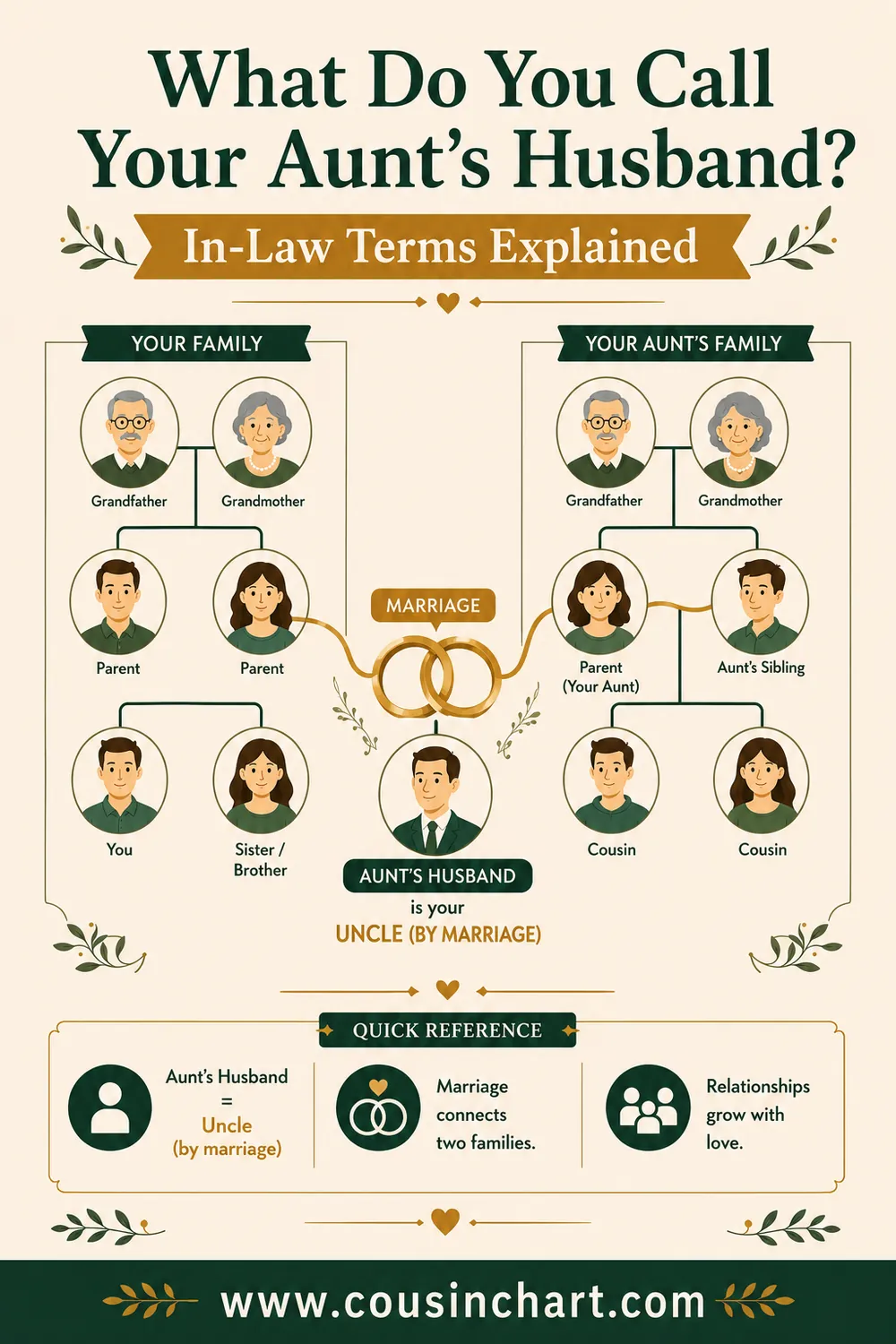
Your aunt's husband is your uncle. English doesn't have a separate everyday word for an uncle who married into the family, so the man who married your mom's sister gets the same title as your mom's brother. If you want to be precise — say, for a family tree — he's your uncle by marriage, or in genealogy-speak, an affinal uncle.
That's the quick answer. But this question usually comes up because in-law terms get murky fast: what about his brother? Your cousin's wife? The parents of your son's spouse? This guide walks through the whole in-law glossary. And if you ever hit a relationship you can't name, the free family relationship calculator on our homepage untangles it in a couple of clicks.
Relationship quick-check: tap a phrase to see the correct term.
Tap a phrase above to see the answer.
Work out any family relationship →The short answer: he's your uncle
In everyday English, aunt and uncle cover both blood and marriage. Your parent's siblings are your aunts and uncles, and so are the people those siblings married. Nobody at Thanksgiving is calling him "affinal uncle." He's Uncle Dave.
This is worth saying plainly because a lot of people feel like they're using the word wrong. You're not. Dictionaries define uncle as "the brother of one's father or mother or the husband of one's aunt." Both meanings are standard, and they've been standard for centuries.
Some families do use uncle-in-law, especially when they want to flag that he joined the family by marriage. It's understandable and people will know what you mean, but it's rare in practice. "Uncle" does the job.
Uncle by blood vs. uncle by marriage
The distinction only matters in two situations: genealogy and genetics.
- On a family tree, your aunt's husband is recorded as a spouse of your aunt, not as a sibling of your parent. Genealogists call this an affinal relationship — related by marriage (affinity) rather than by blood (consanguinity).
- In DNA terms, you share roughly 25% of your DNA with a blood uncle or aunt, and 0% with an uncle by marriage (barring coincidence). If you ever take a DNA test, Uncle Dave won't appear in your matches — but his kids with your aunt will, because they're your first cousins through her.
That last point trips people up, so it deserves its own line: your aunt's husband isn't related to you, but your aunt's children are. They're your first cousins by blood, through your aunt. The marriage brought him in; the bloodline runs through her.
The full in-law glossary
Here's the complete cheat sheet for the marriages around you. "You call them" is the everyday term; the notes give the technical version where one exists.
| Who they are | You call them | Notes |
|---|---|---|
| Your aunt's husband | Uncle | Uncle by marriage |
| Your uncle's wife | Aunt | Aunt by marriage |
| Your spouse's brother/sister | Brother-/sister-in-law | Classic in-law |
| Your sibling's husband/wife | Brother-/sister-in-law | Same word, other direction |
| Your spouse's sibling's spouse | Co-brother-/co-sister-in-law | Most people just say "in-law" |
| Your spouse's parents | Mother-/father-in-law | |
| Your child's spouse | Son-/daughter-in-law | |
| Your child's spouse's parents | Co-parents-in-law | Consuegros in Spanish |
| Your cousin's spouse | Cousin-in-law | Everyday speech: "cousin" |
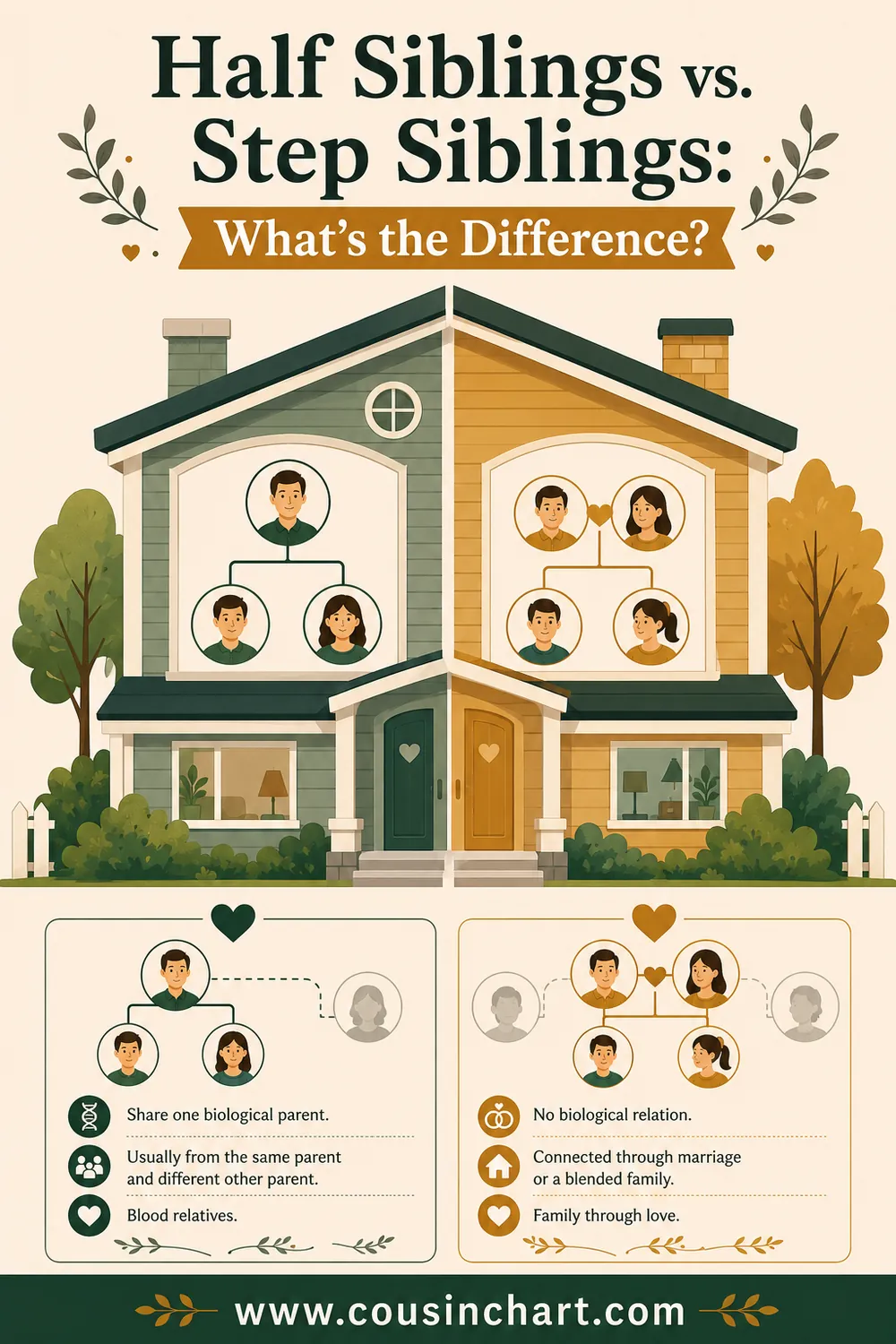
| Your step-parent's sibling | Step-uncle / step-aunt | Related through remarriage |
| Your aunt's husband's relatives | No standard term | Not related to you |
Two patterns make the whole table easier to remember:
- Aunt/uncle absorb marriage. Anyone who marries your aunt or uncle takes the matching title. No "-in-law" needed.
- "-In-law" attaches to your generation and the ones directly above and below — siblings-in-law, parents-in-law, children-in-law. Beyond that, English mostly shrugs.
What about his family? Where in-law chains stop
Once you go past your aunt's husband himself, the chain of relationship ends. His brother, his parents, his cousins — none of them are related to you in any legal, genetic, or genealogical sense. There's no term for them because there's no relationship to name.
A few specific cases people ask about:
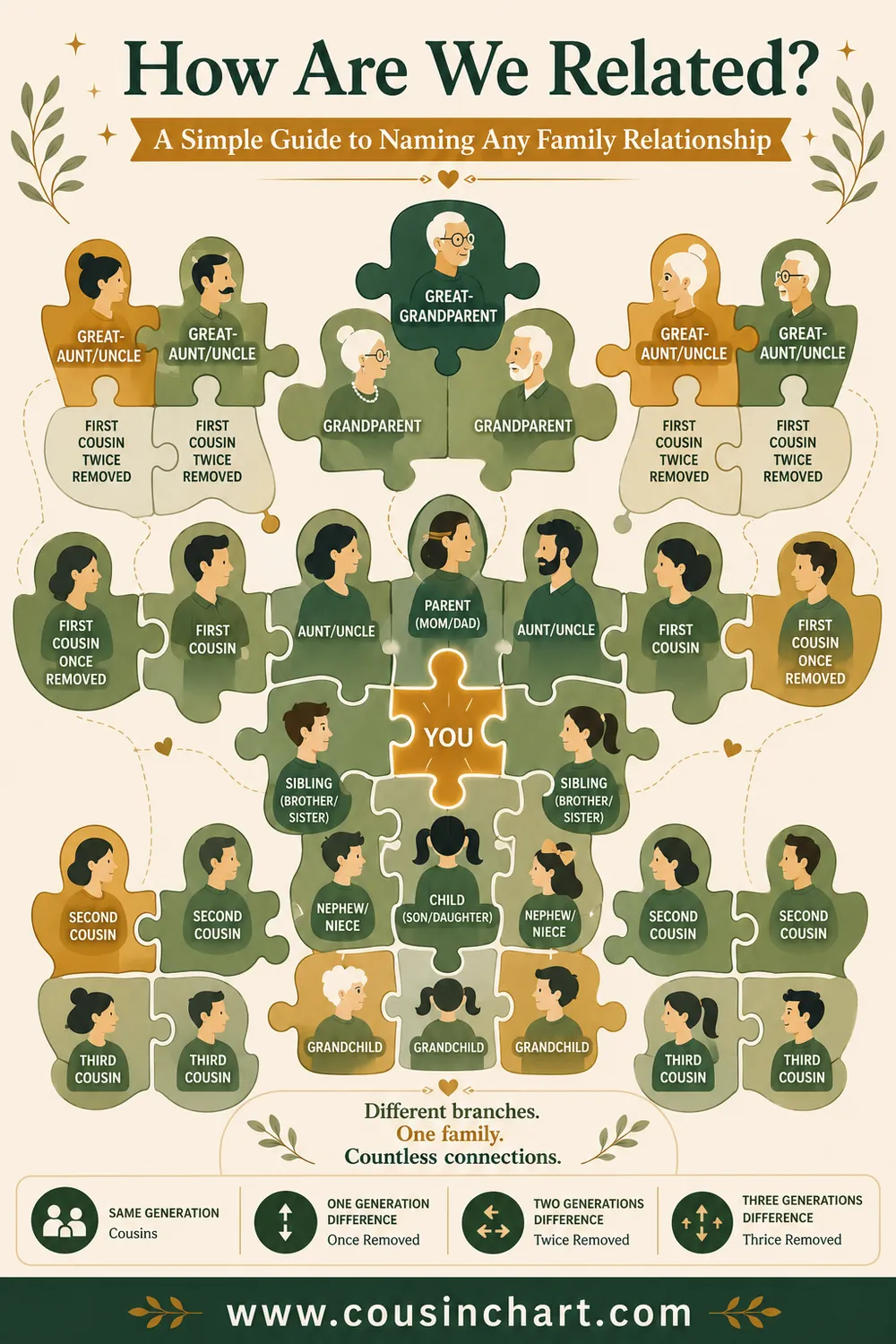
- His children with your aunt: your first cousins, full stop. Blood relatives through your aunt.
- His children from a previous relationship: your aunt's stepchildren. To you they're sometimes called step-cousins or "cousins by marriage," though neither is a formal term. You share no ancestor with them.
- His brother or sister: no relation. If you're close, you might still call them aunt or uncle as a courtesy title — plenty of families do — but that's affection, not genealogy.
- His parents: no relation, and no term. "My aunt's in-laws" is the clearest way to describe them.
Courtesy titles deserve a quick word here. In many families and many cultures, "aunt" and "uncle" are used for close family friends or any adult of your parents' generation. That's a social custom, and a lovely one — just don't let it confuse the family tree.
And what does he call you?
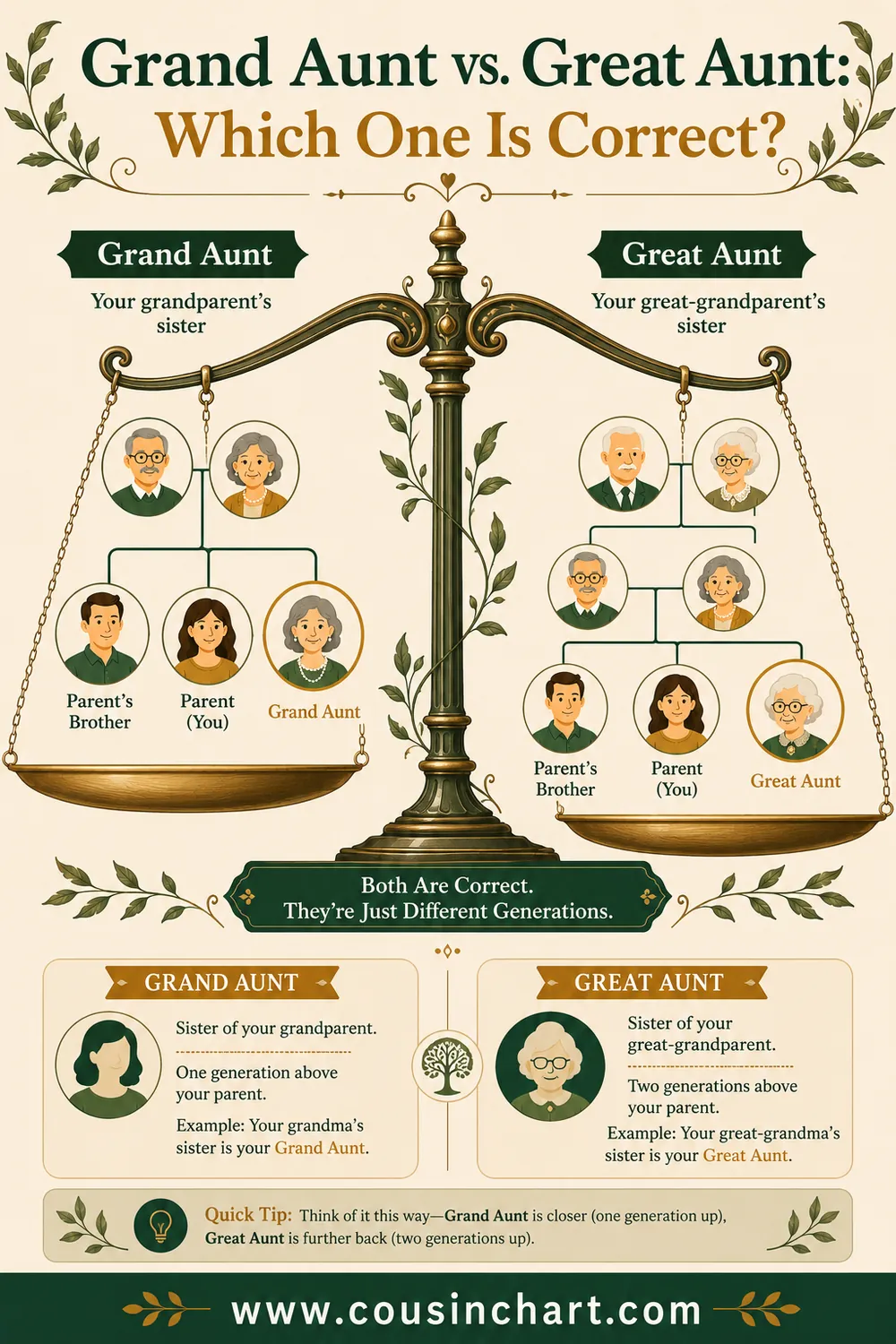
Relationship terms always come in mirrored pairs, so flip it around: to your aunt's husband, you are his nephew or niece — by marriage, technically, but nobody says that part either. The pairing rule is handy whenever you're unsure of a term: figure out either direction and the other comes free. Uncle pairs with nephew/niece, grandaunt pairs with grandnephew/grandniece, cousin pairs with cousin.
This mirroring is also why "uncle" feels so natural for an aunt's husband even though there's no blood tie. Kinship words in English describe roles in the family structure, not genetics. He stands in the uncle position — married into your parent's generation, one step up from you, on a branch beside your parents — so he gets the uncle word, the uncle birthday cards, and, if he's lucky, the uncle jokes.
Why English is so vague about in-laws
English is unusually thin on kinship words. Plenty of languages carve this territory up much more precisely:
- Spanish has tío político — literally a "political uncle," an uncle by marriage — and consuegros for your child's parents-in-law.
- Yiddish has machatunim, the mutual term for the two sets of parents joined by their children's marriage.
- Hindi and Urdu distinguish your father's brother (chacha), mother's brother (mama), father's sister's husband (phupha), and mother's sister's husband (mausa) — four different "uncles."
- Mandarin Chinese does the same, with separate words depending on which side of the family the uncle is on and whether he's older or younger than your parent.
English collapsed most of these distinctions centuries ago, which keeps things simple until you're trying to explain exactly how someone is connected. That's precisely the gap a relationship calculator fills — you pick the path ("my mother's sister's husband") and it hands you the term.
How to work out any in-law relationship
When a relationship stumps you, trace it in three steps:
- Find the blood link. Work out how the blood relative connects to you first. Your aunt's husband? The blood link is your aunt — your parent's sister.
- Apply the marriage. The spouse of a blood relative usually takes the matching title (aunt/uncle, cousin-in-law) or an "-in-law" form.
- Stop at one marriage. Relationships don't pass through two marriages. Your brother-in-law's sister isn't your sister-in-law (in most usage); your aunt's husband's brother is nobody to you.
Or skip the mental gymnastics: the free CousinChart relationship calculator lets you click the path person by person — "my mother" → "her sister" → "her husband" — and tells you the correct term instantly, with the explanation. It handles cousins, removals, in-laws, and step-relationships too.
FAQ
Is my aunt's husband my uncle or my uncle-in-law?
Both are correct, but "uncle" is the standard everyday term. English uses uncle for your parent's brother and for your aunt's husband. "Uncle-in-law" is understood but rarely used; save the distinction for genealogy charts, where he's recorded as an uncle by marriage.
Do I share DNA with my aunt's husband?
No. An uncle by marriage shares no DNA with you. You share about 25% of your DNA with a blood aunt or uncle, and about 12.5% with the first cousins your aunt and her husband have together — that DNA comes entirely through your aunt's side.
What do I call my uncle's wife?
Your aunt. It's the mirror image of the aunt's-husband rule: anyone who marries your aunt or uncle takes the matching title, so your uncle's wife is your aunt by marriage.
What do I call my cousin's husband or wife?
Technically your cousin-in-law. In everyday conversation, nearly everyone just says "my cousin's husband" or simply "cousin." There's no expectation of a formal title at that distance.
Is my aunt's husband's brother related to me?
No. Relationships by marriage don't extend past the person who married in. Your aunt's husband's brother, parents, and cousins have no legal or genealogical relationship to you, and there's no English term for them.
What are the parents of my child's spouse called?
English's best answer is co-parents-in-law, though almost nobody says it. Many English speakers borrow the Spanish consuegros or the Yiddish machatunim. In conversation, "my son's in-laws" is the phrase people actually use.
Untangle the rest of your family tree
So: your aunt's husband is your uncle, his kids with your aunt are your first cousins, and his brother is a friendly stranger. If the next family gathering serves up something harder — "your grandma's cousin's granddaughter," say — don't diagram it on a napkin. The free family relationship calculator at CousinChart works out any connection, from simple in-laws to third cousins twice removed, and explains the answer in plain English. It takes about ten seconds, and it settles arguments beautifully.