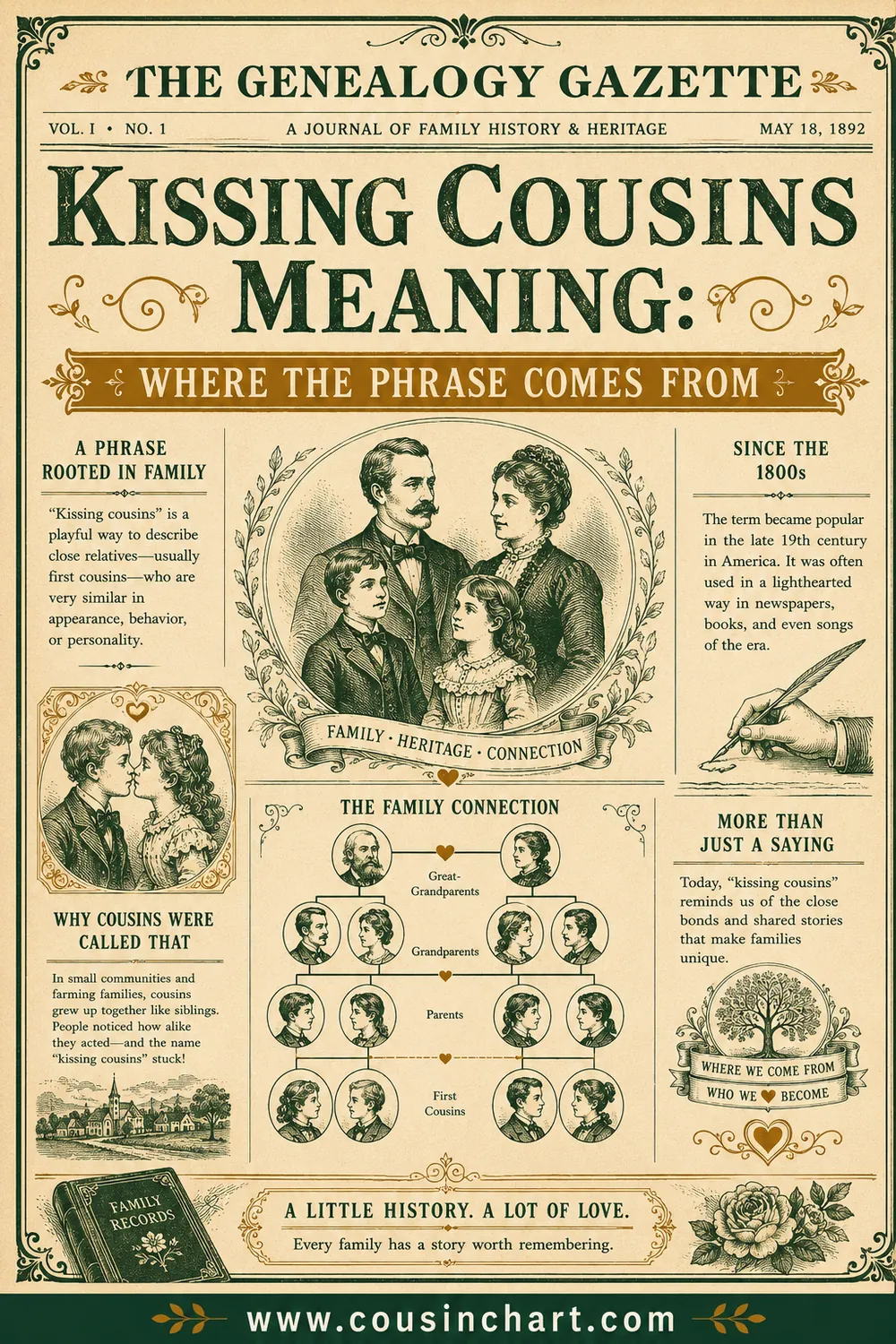
Kissing Cousins Meaning: Where the Phrase Comes From
"Kissing cousins" means relatives who are familiar enough to greet with a kiss — usually cousins distant enough that nobody's quite sure of the exact connection, but close enough to be family at the reunion. By extension, the phrase also describes any two things that are nearly alike: "bluegrass and country music are kissing cousins." Despite how it sounds, the idiom is mostly innocent; it's about affectionate greeting, not romance — though the phrase does carry a wink, and we'll get to why.
This article covers what the expression really means, where it came from, and the genuinely interesting cousin facts hiding behind the joke — how much DNA cousins actually share, which famous figures married their cousins, and where the law stands. If you've got a "cousin" whose exact relationship nobody at the reunion can name, the free family relationship calculator on our homepage settles it in seconds.
Relationship quick-check: tap a phrase to see the correct term — and how "close" that cousin really is.
Tap a phrase above to see the answer.
Work out any family relationship →The two meanings of "kissing cousins"
The idiom does double duty in modern English:
- The literal, family meaning: a relative — typically a distant cousin — whom you know well enough to greet with a kiss on the cheek. The emphasis is on familiarity despite distance: not your first cousin you grew up with, but the reunion relative whose exact branch nobody remembers. Some older Southern usage narrows it further: kin close enough to greet with a kiss, distant enough to court. That's the wink the phrase never quite lost.
- The figurative meaning: two things that are closely similar without being identical. "The bass guitar and the double bass are kissing cousins." This is the sense you'll meet most often in writing today, and it's entirely PG.
Merriam-Webster records both senses — "one that is closely related in kind to something else" and "a relative known well enough to be given a kiss in greeting."
Where the phrase comes from
"Kissing cousins" (and its sibling "kissing kin") comes out of the American South, with printed examples appearing by the mid-20th century and the underlying custom reaching back much further. In large, tight-knit rural families, extended kin gathered often, and a kiss on the cheek was the standard greeting for family — so a "kissing cousin" was simply anyone kin enough to rate one. Since Southern families were famously sprawling, that could cover a lot of people whose precise relationship — second cousin? first cousin once removed? — nobody could quite reconstruct.
The phrase spread nationwide in the 20th century, got a boost from its slightly scandalous sound, and settled into the two meanings above. (Elvis Presley's 1964 film Kissin' Cousins certainly didn't slow it down.)
The genetics behind the joke: what cousins actually share
The phrase endures partly because "how related is too related?" is a genuinely interesting question. Here are the real numbers:
| Relationship | Shared ancestor | Avg. shared DNA |
|---|---|---|
| First cousins | Grandparents | ~12.5% |
| First cousins once removed | Grandparents / great-grandparents | ~6.25% |
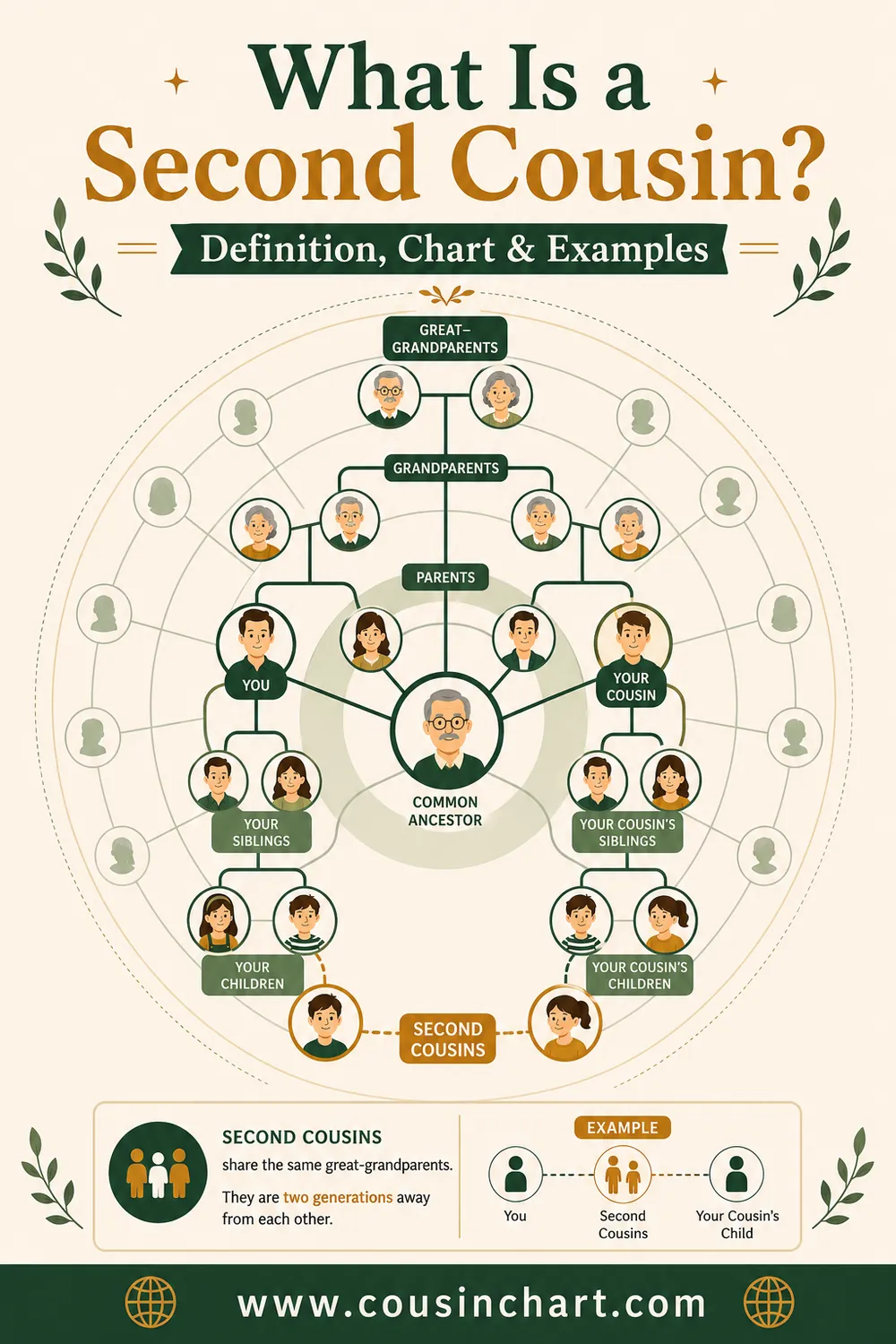
| Second cousins | Great-grandparents | ~3.1% |
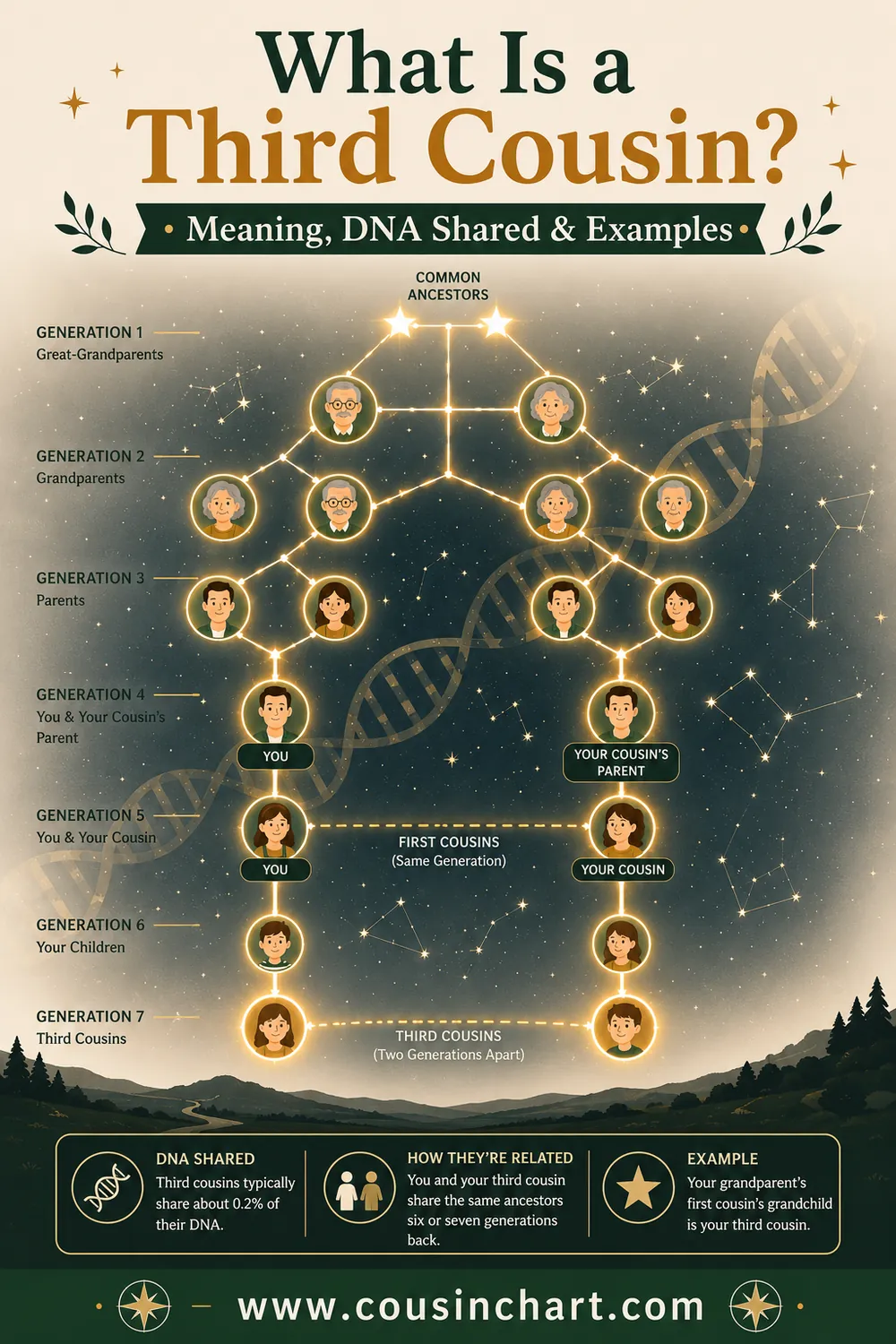
| Third cousins | Great-great-grandparents | ~0.8% |
| Fourth cousins | 3×-great-grandparents | ~0.2% |
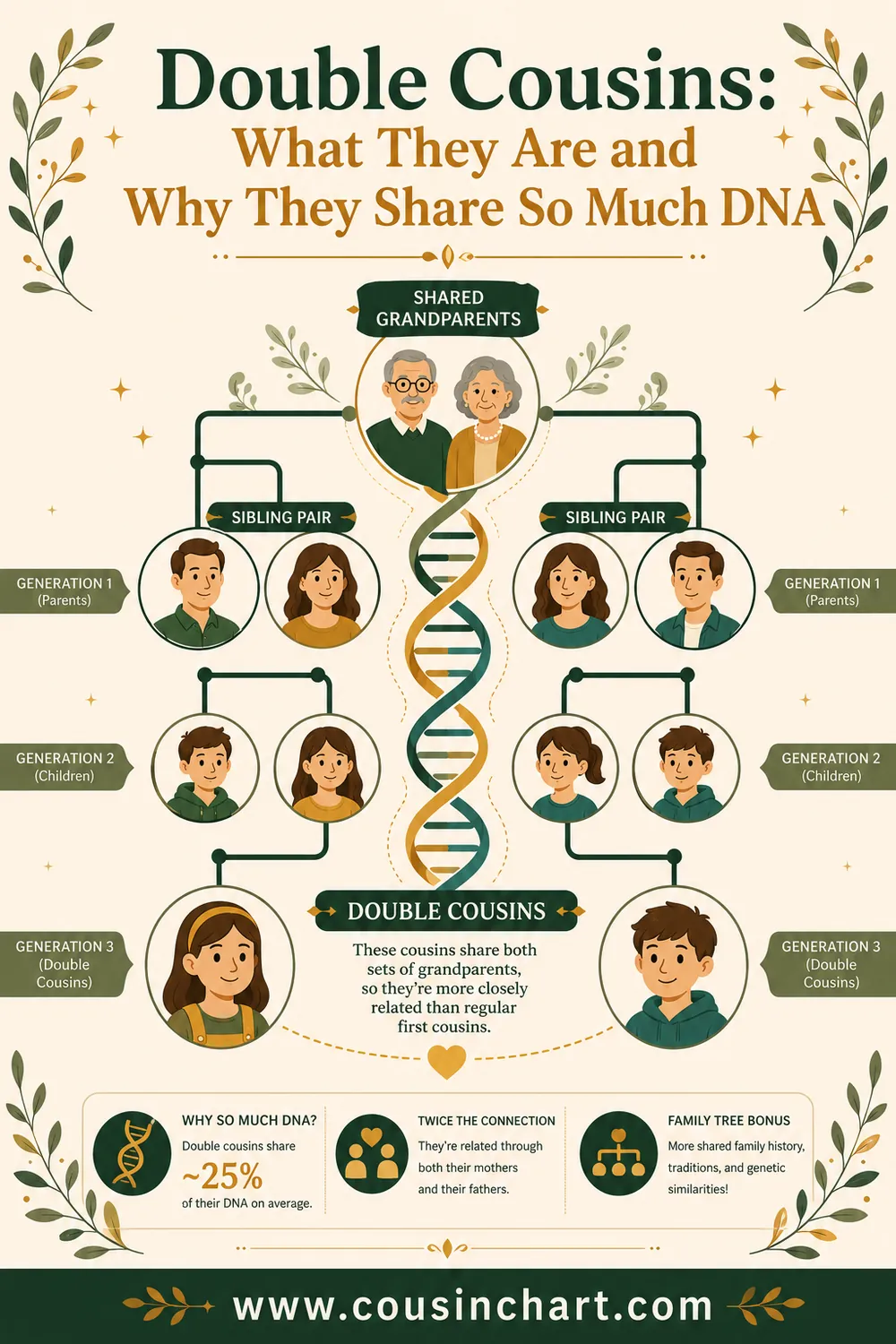
| Double first cousins | All four grandparents | ~25% |
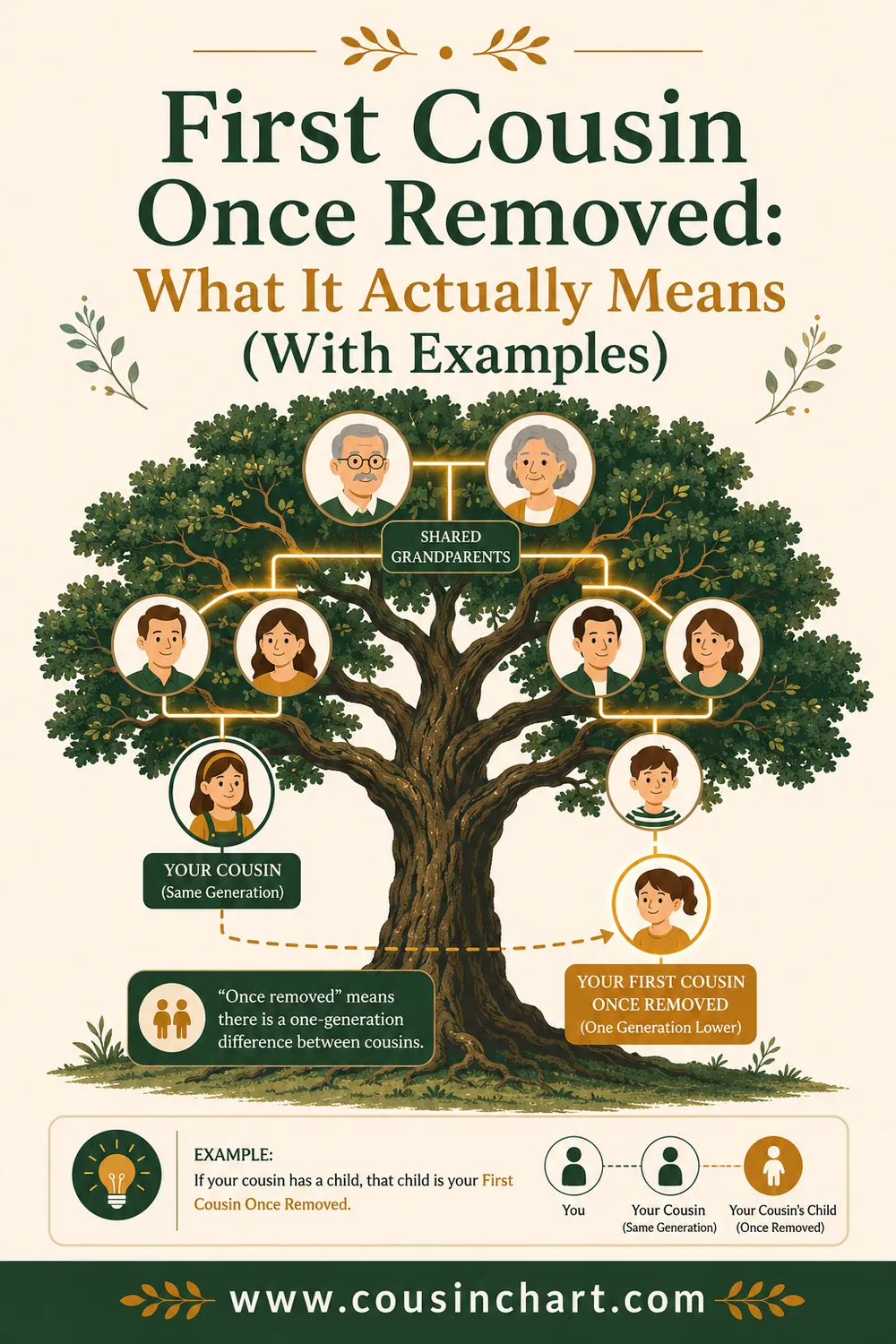
Two takeaways. First, relatedness falls off a cliff: by third cousins you share less than 1% of your DNA, and by fifth or sixth cousins you may share none detectable at all — genetically, distant cousins really are near-strangers who happen to attend the same reunions. Second, the "removed" business is just generation-counting; our first cousin once removed guide untangles it, or the calculator will do it for you.
Famous kissing cousins (the marrying kind)
History is full of prominent cousin marriages, which is a big part of why the idiom carries its wink:
- Charles Darwin married his first cousin Emma Wedgwood in 1839 — and later, characteristically, worried in writing about whether cousin marriage affected his children's health.
- Queen Victoria married her first cousin Prince Albert; European royalty treated cousin marriage as standard diplomatic practice for centuries.
- Albert Einstein's second wife, Elsa, was his first cousin on his mother's side (and a second cousin on his father's).
- Edgar Allan Poe married his first cousin Virginia Clemm.
- Franklin D. Roosevelt and Eleanor Roosevelt were fifth cousins once removed — so distant it barely counts, but she didn't even have to change her surname.
The pattern isn't just celebrity trivia: for most of human history, in villages and small towns, some degree of cousin marriage was simply how populations worked, and it remains common and lawful in much of the world today.
So... is marrying a cousin actually legal?
Since the idiom flirts with the question, here are the facts, kept factual:
- In the United States, it depends on the state. Roughly 18 states (plus D.C.) allow first-cousin marriage outright; a handful more allow it under conditions (for example, only past childbearing age); the rest prohibit it, and a few criminalize cohabitation between first cousins. The map is a genuine patchwork.
- Second cousins and beyond are legal to marry in all 50 states. No US jurisdiction restricts marriage past the first-cousin level.
- Internationally, first-cousin marriage is legal in Canada, the UK, most of Europe, and much of the rest of the world; globally, around one in ten marriages is estimated to be between second cousins or closer.
- The genetic risk is real but smaller than folklore says. Children of unrelated parents carry roughly a 3% baseline risk of significant birth defects; for first cousins, studies (including a widely cited 2002 report in the Journal of Genetic Counseling) put the additional risk at about 2–3 percentage points. Elevated, worth genetic counseling, but far from the doom of playground legend — and it fades to statistical noise past second cousins.
None of this is advice — it's the factual backdrop that makes "kissing cousins" a joke with an actual answer underneath it.
The rest of the cousin-idiom family
"Kissing cousins" has relatives of its own in English, and they're worth knowing because they answer the same social need — naming fuzzy kinship:
- Kissing kin: the older, broader Southern version — anyone related closely enough to greet with a kiss.
- Shirttail cousin (or shirttail relative): a relative so distant, or connected only by marriage, that the link barely holds — hanging on "by the shirttail." Common in the Midwest.
- Country cousin: a rural relative visiting the city, usually with a gentle (or not so gentle) implication of unsophistication. It works in reverse as "city cousin."
- Cousin-german: the old formal term for a full first cousin — german here comes from Latin germanus, "of the same parents," and has nothing to do with Germany. You'll meet it in old wills and Scottish records.
- First cousin, once removed: not an idiom at all, but so widely misunderstood that it functions like one. It has an exact meaning — see our guide to removed cousins.
The pattern across all of them: families are bigger than our everyday vocabulary, so speech invents warm, vague words while genealogy keeps the precise ones. You want both — one for the porch, one for the chart.
How to figure out if someone's your kissing cousin
The whole idiom exists because nobody at the reunion can compute "your grandmother's cousin's granddaughter" on the spot. The trick genealogists use: find the shared ancestor, count generations down each side, and the smaller count sets the cousin number while the difference sets the "removed." Or skip the arithmetic — the free CousinChart relationship calculator lets you click the path person by person and hands you the exact term with a one-line explanation. Ten seconds, and the mystery relative has a name: second cousin once removed. Still kiss them hello, obviously.
FAQ
What does "kissing cousins" actually mean?
Two things: a relative distant enough that the exact relationship is fuzzy but familiar enough to greet with a kiss; and, figuratively, any two things that are closely similar — "sister ships are kissing cousins." The everyday figurative sense is entirely innocent.
Where did the phrase "kissing cousins" originate?
From the American South, where extended families greeted kin with a kiss on the cheek — a "kissing cousin" was anyone related enough to rate one. Printed uses appear by the mid-20th century, and the phrase spread nationally from there.
Is "kissing cousins" about cousins marrying?
Not primarily — the core meaning is affectionate greeting between relatives. But the phrase has always carried a wink toward courtship between distant kin, which is part of why it stuck. Historically, marriage between distant cousins was ordinary in most of the world.
Is it legal to marry your cousin?
Second cousins and beyond: legal in all 50 US states. First cousins: legal in roughly 18 states plus D.C., conditionally legal in a few more, and prohibited in the rest — while being legal in Canada, the UK, and most of Europe. Laws vary, so check your jurisdiction.
How much DNA do cousins share?
First cousins average about 12.5%, second cousins about 3%, third cousins under 1%, and by fifth cousins there may be no detectable shared DNA at all. Double first cousins are the outlier at about 25% — as much as half siblings.
What do I call a cousin I can't place?
Genealogically, work out the shared ancestor and count generations — or use a relationship calculator to get the exact term (second cousin, first cousin once removed, and so on). Socially? "Cousin" covers everyone, which is exactly how the phrase kissing cousins was born.
Name the mystery cousin before the next reunion
"Kissing cousins" survives because every family has them: definitely kin, exact wiring unknown. Now you know the phrase's Southern roots, the surprisingly steep DNA drop-off, and where the law actually stands. For the last step — putting a real name on your own mystery relative — the free CousinChart family relationship calculator traces any connection and explains it in plain English. Settle it once, then go back to arguing about the potato salad.