How to Make a Family Tree: A Step-by-Step Guide
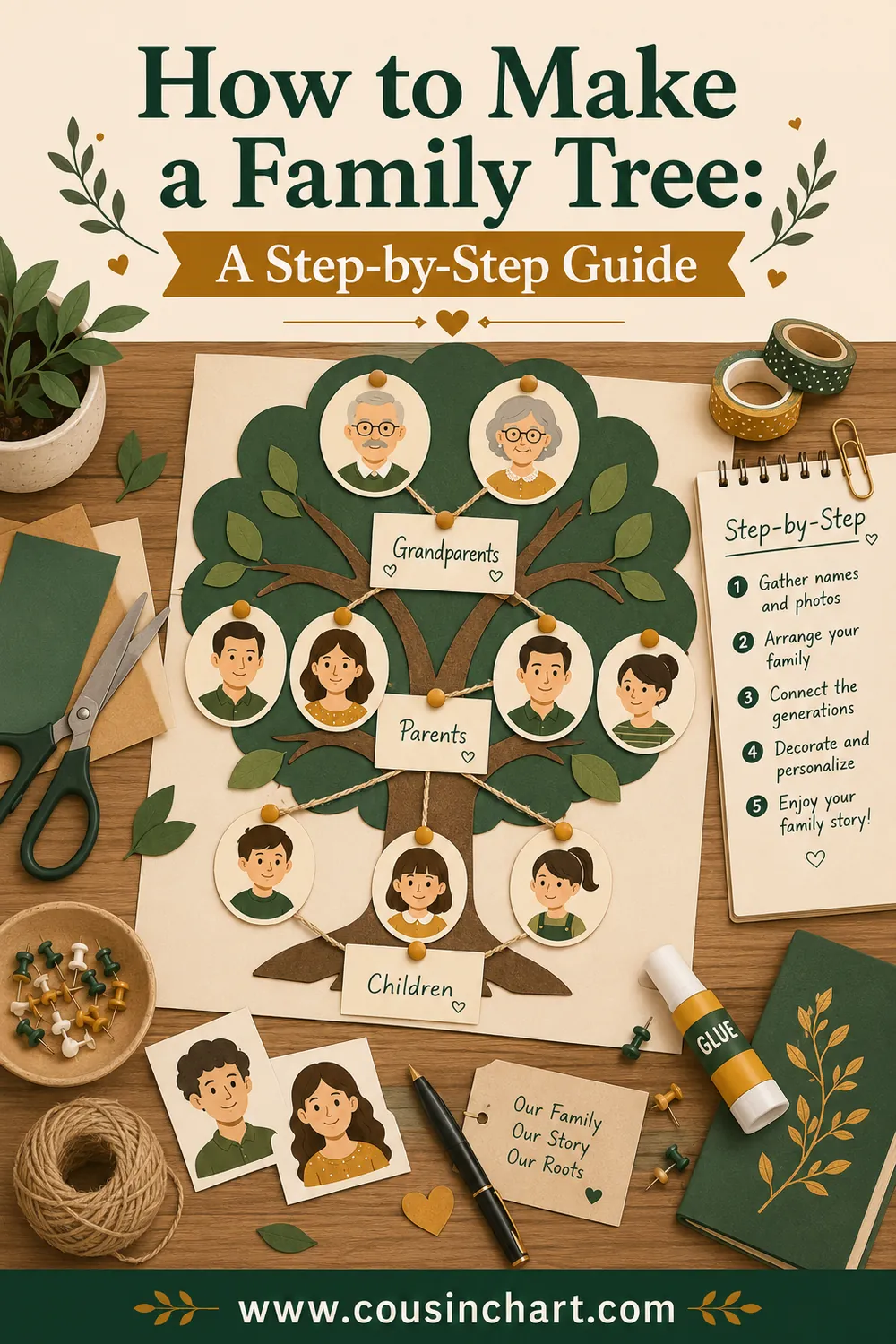
To make a family tree, start with yourself and work backward one generation at a time: write down what you know, interview your oldest relatives, verify names and dates against records, and add each proven ancestor to a chart. That's the whole method — the rest is knowing where to look and how to keep the chart tidy as it grows.
This guide walks through the eight steps in order, from blank page to a tree you can print, frame, or hand to your kids. Two free tools will carry you the whole way: our printable family tree templates, and the family relationship calculator on our homepage for the moment — and it always comes — when you find a relative and can't tell whether they're a second cousin or a first cousin once removed.
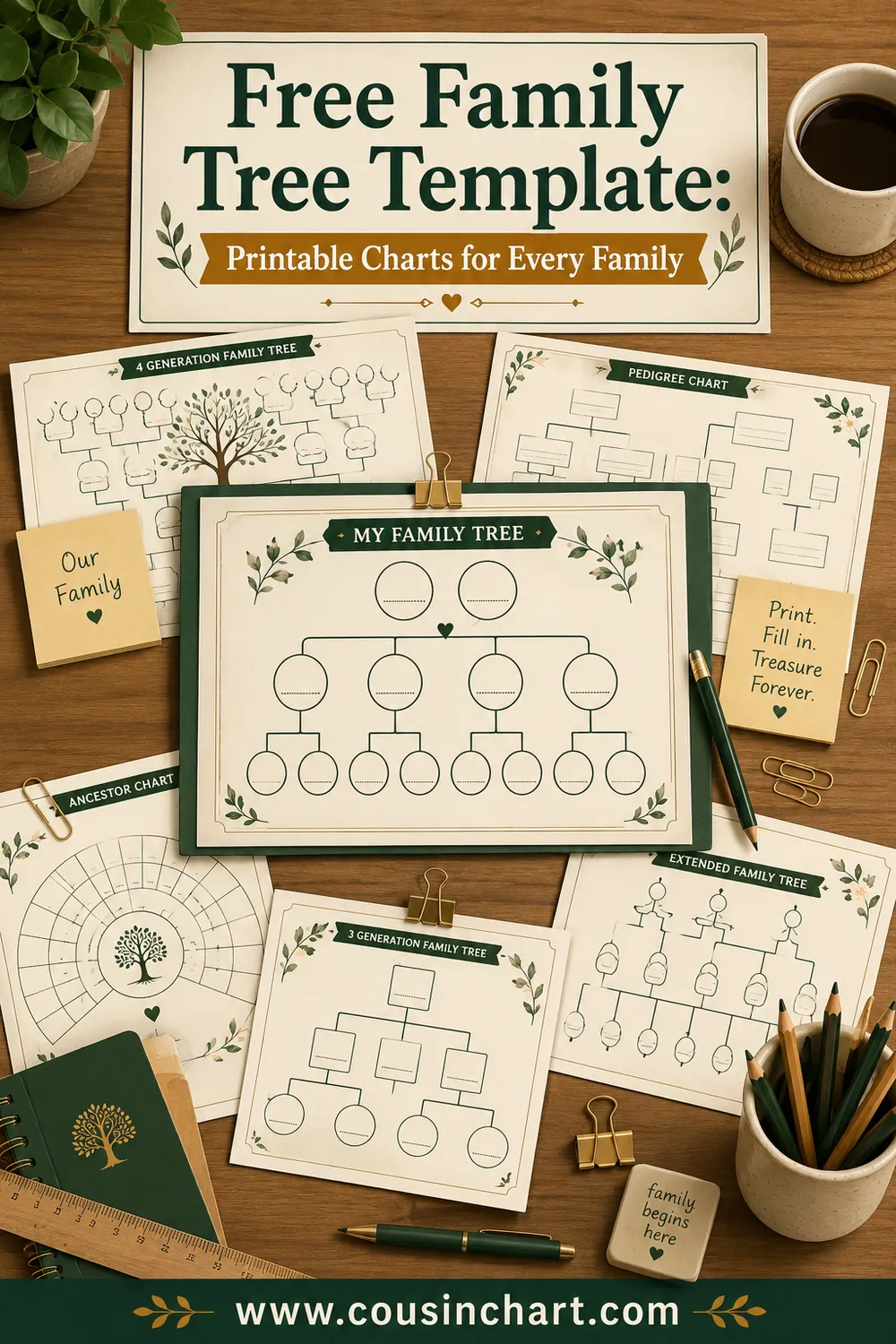
Free printables for this page
Download a blank PDF (US Letter or A4) — free, no sign-up — or customize it in the maker above before printing.
 3-Generation Family TreeYou, parents and grandparents. Portrait, big boxes, 10 minutes to fill.
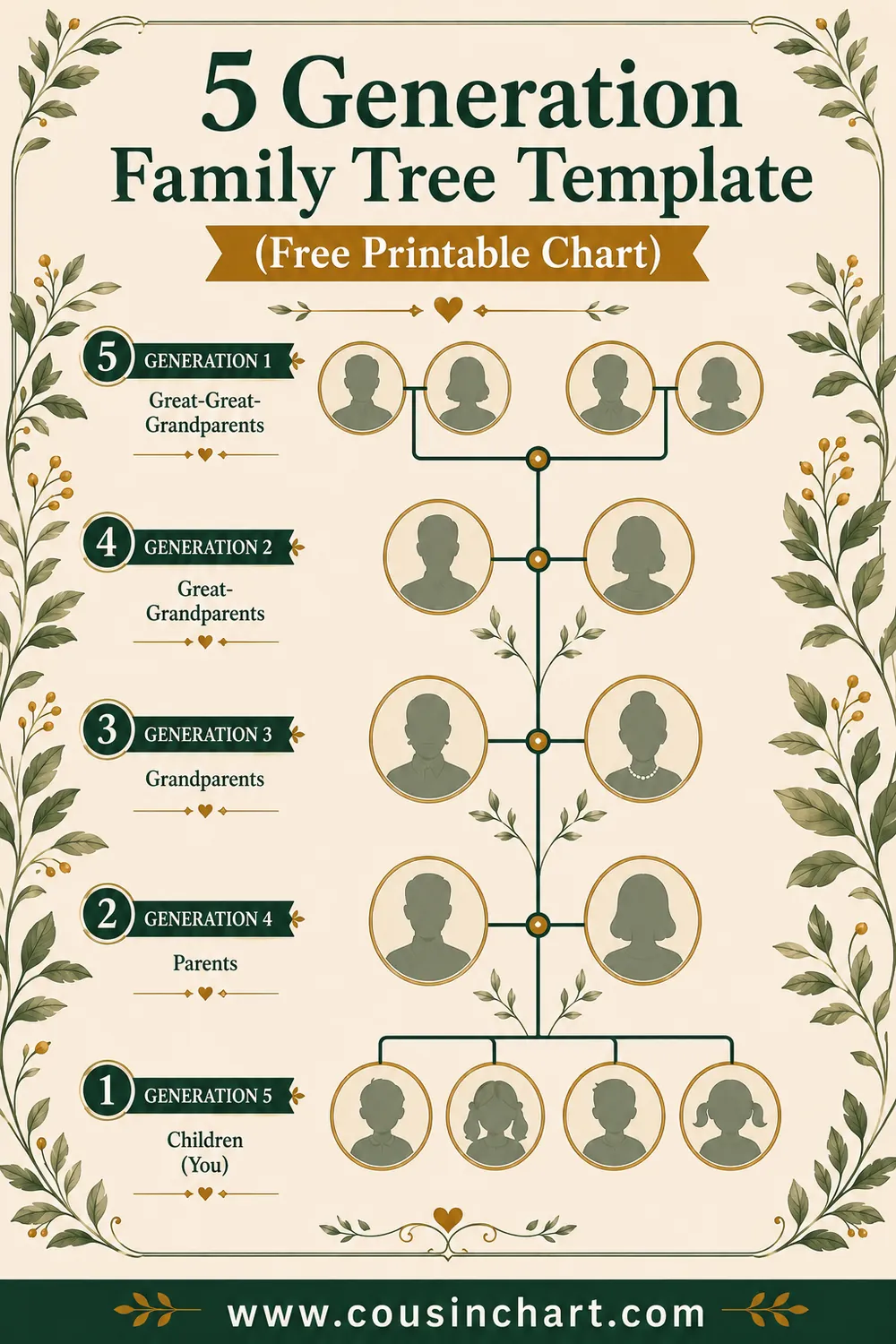
 5-Generation Pedigree Chart
 Family Group Sheet
 Family Interview Worksheet
Relationship quick-check: tap a phrase to see the correct term before you add them to your tree.
Tap a phrase above to see the answer.
Work out any family relationship →How to make a family tree in 8 steps
Step 1: Decide what kind of tree you're making
Pick your scope before you draw a single box, because it changes the chart you need:
- Ancestor tree (pedigree): just your direct line — parents, grandparents, great-grandparents. Clean, structured, doubles each generation. Best for heritage projects and genealogy.
- Descendant tree: starts with one ancestor (say, your great-grandparents) and shows everyone descended from them. Best for reunions and cousin-mapping.
- Full family tree: ancestors plus siblings, aunts, uncles, and cousins. The bushiest and the most work — great for capturing the living family.
Also decide how deep: three generations is a weekend project, five is a hobby, nine is a lifestyle. Starting with 4–5 generations is the sweet spot for most people.
Step 2: Write down everything you already know
Start with yourself and work backward — never the other way around. Genealogy's first rule is to build from the known to the unknown; starting from a rumored famous ancestor and working down almost always builds a fantasy tree.
For each person, capture four things: full name (maiden name for women), birth date and place, marriage date, death date and place. Estimates are fine for now — "abt 1932" is a real genealogical notation. You'll be surprised how much you can produce in thirty minutes, and equally surprised where the blanks are. The blanks are your to-do list.
Step 3: Interview your relatives — soon
Your oldest relatives are living archives, and this step has a deadline nobody likes to say out loud. Call, visit, or video-chat, and ask about:
- Full names, including maiden names and nicknames ("everyone called him Buck — his real name was Wilbur")
- Dates and places: births, marriages, moves, deaths
- The old country, the immigration story, why the family moved
- Who has the documents — the family Bible, the photo box, the naturalization papers
Record the conversation with permission; you will not remember it all. One good interview routinely fills two whole generations of a chart and adds stories no census will ever hold.
Step 4: Gather documents and verify with records
Family memory is wonderful and wrong about 20% of the time — dates drift, names get americanized, two Great-Uncle Johns merge into one. Verify against records:
- FamilySearch.org — completely free, the largest genealogy record collection anywhere. Start here.
- US federal census records (1790–1950 are public) — a snapshot of each household every ten years: names, ages, birthplaces, occupations.
- Vital records — birth, marriage, and death certificates from state or county offices.
- Find a Grave — free cemetery records with dates, often photos of headstones.
- Immigration and naturalization records — passenger lists and citizenship papers, many free through the National Archives and FamilySearch.
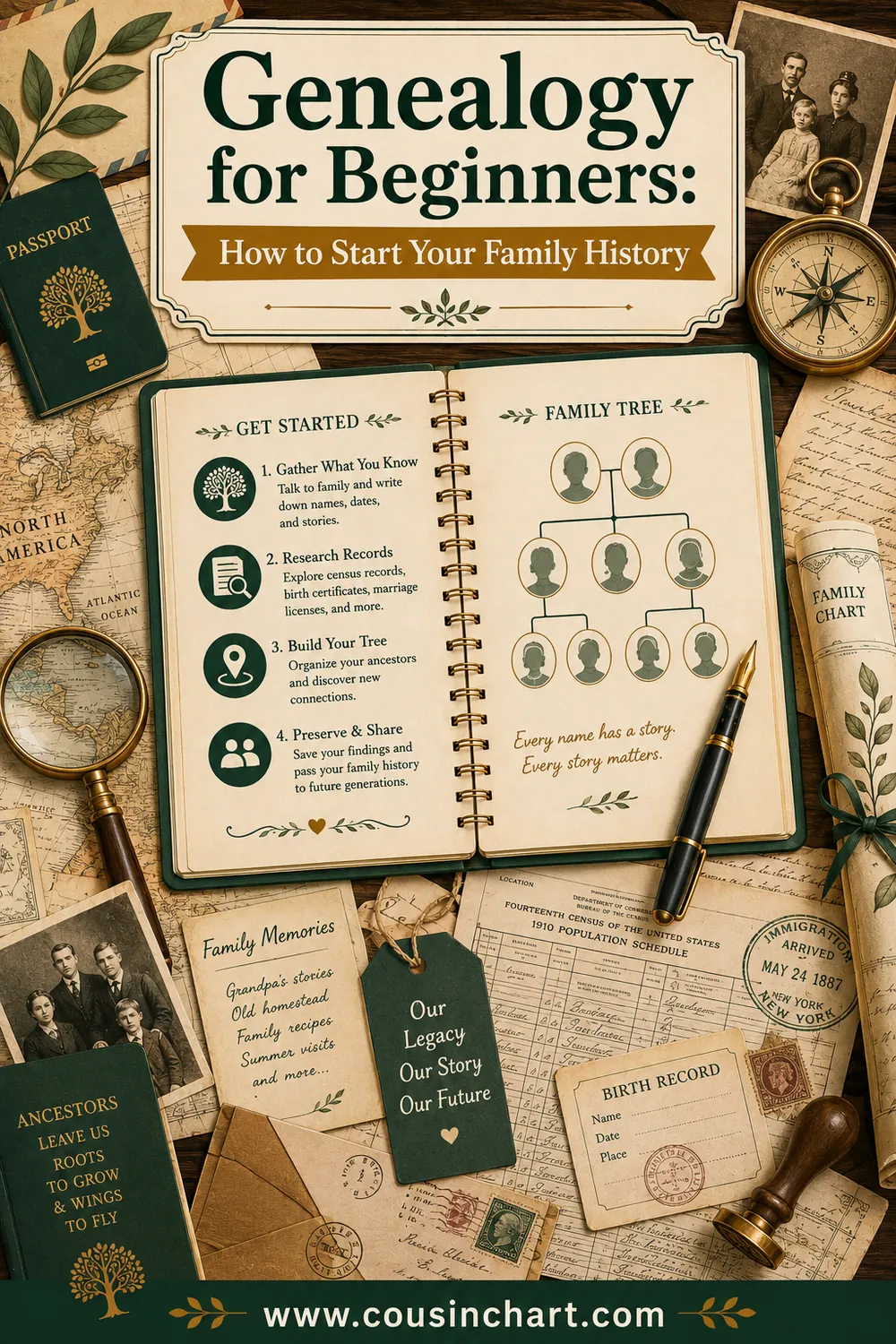
The working standard: two independent sources per fact before you write it in ink. Our genealogy for beginners guide covers each of these sources in detail.
Step 5: Choose your format — paper, software, or online
- Printable chart: tangible, giftable, zero learning curve. Grab a free family tree template — the 5-generation chart holds 31 ancestors on one page.
- Genealogy software or websites: better for big trees; they store sources, print charts on demand, and never run out of margin space.
- Both: most hobbyists keep a digital master tree and print charts for display and reunions. Nothing beats paper for getting relatives to lean in and start talking.
Step 6: Draw the tree using standard conventions
The conventions exist so that anyone — including you in twenty years — can read the chart:
- Put the root person (you, or your child) at the base or the left side.
- Bloodlines run vertically from parent to child; marriage lines run horizontally between spouses.
- Keep each generation on its own row or column — this is the single biggest readability rule. If cousins wander onto the wrong row, relationships become unreadable.
- Write surnames in CAPITALS and women under maiden names.
- Use b., m., and d. for birth, marriage, death: "KOWALSKI, Anna — b. 1898 Kraków, m. 1921, d. 1967 Chicago."
- Mark uncertain facts with a question mark and keep a source note for every date. "Grandma said so" is a legitimate source — label it.
Step 7: Place the tricky relatives correctly
Every real family tree has knots. The rules:
- Half siblings connect to their actual biological parents — one shared parent line, not two.
- Step-relatives connect through marriage lines only. A step-parent gets a marriage line to your parent; no bloodline flows to you.
- Adopted children are drawn as children of their adoptive parents (some charts add a small "a." notation); an adoptee may keep a second, biological tree if they choose.
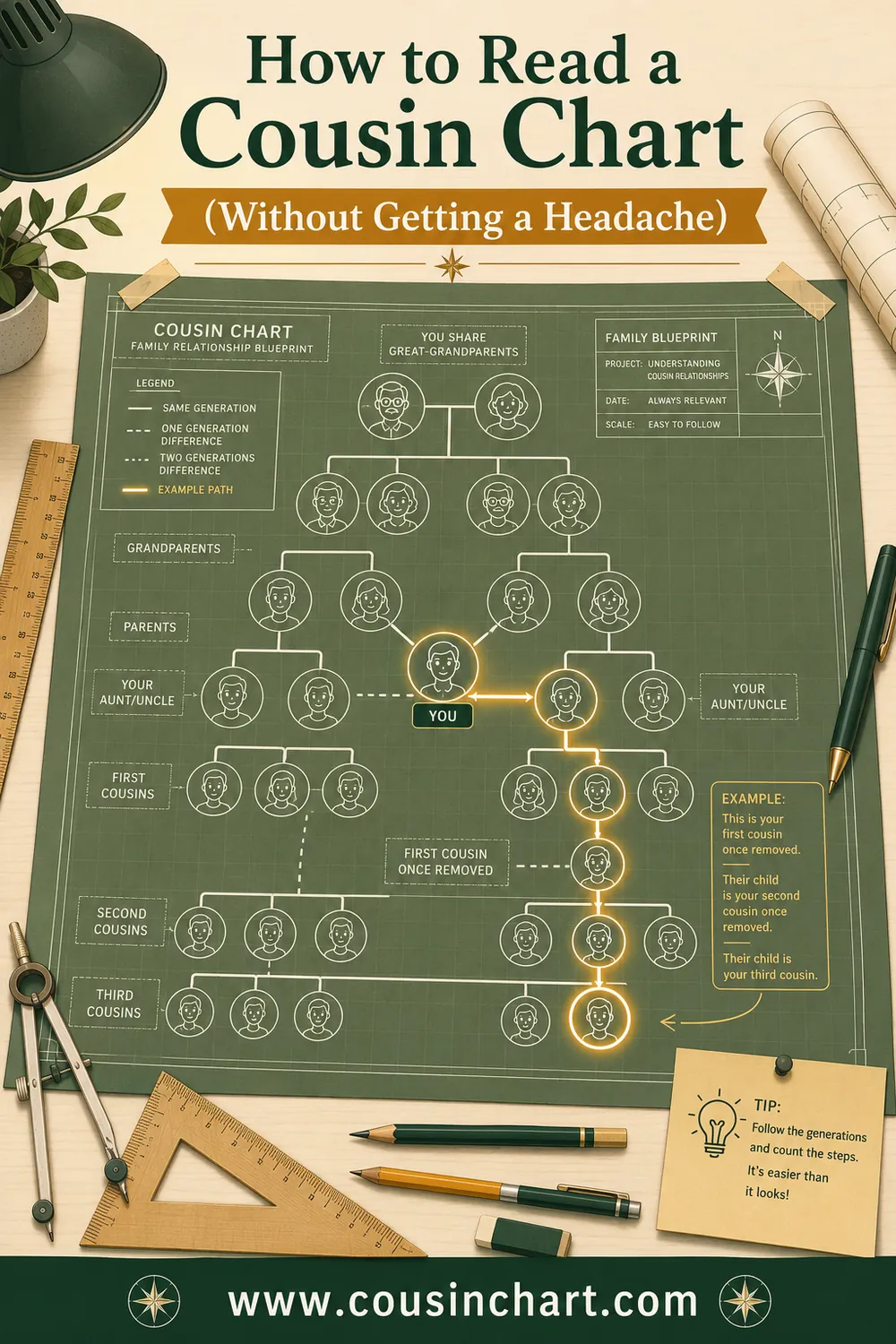
- Cousins with confusing labels — "your grandmother's cousin's granddaughter" — get sorted before they get drawn. Run the path through the free relationship calculator and it names the relationship and the generation row it belongs on. Our how to read a cousin chart guide explains the underlying grid.
Step 8: Share it, then keep it alive
A family tree is never finished — it's a living document:
- Print and share copies at the next holiday gathering; corrections and additions will come flying at you, which is exactly what you want.
- Interview the next-oldest relative — every conversation adds branches.
- Date every version ("compiled July 2026") so future family historians know what you knew and when.
- Store a digital copy somewhere durable, and give copies away. Redundancy is how family history survives house moves and hard-drive deaths.
Common mistakes to avoid
| Mistake | Why it hurts | Do this instead |
|---|---|---|
| Starting from a famous "ancestor" | Builds a tree on rumor | Start with yourself, work backward |
| Married names for women | Erases whole maternal lines | Record maiden names |
| Trusting one source | Memory and indexes both err | Two sources per fact |
| Mixing generations on one row | Makes relationships unreadable | One generation per row |
| Guessing relationships | One wrong link corrupts everything above it | Verify with the calculator first |
| Keeping it on one device | One spill from oblivion | Print copies, share files |
FAQ
How do I start a family tree with no information?
Start with yourself — you always know generation 1. Add your parents and grandparents from memory or from relatives, then use free records (FamilySearch, the US census, Find a Grave) to work backward one proven generation at a time. Nearly everyone can document 4–5 generations for free.
What's the easiest way to make a family tree?
Print a free 4- or 5-generation template, fill in what you know in pencil, and call your oldest relative to fill the gaps. That's a genuine family tree in one afternoon — you can move it into software later without losing anything.
Should a family tree include aunts, uncles, and cousins?
Only if you want it to. Ancestor (pedigree) charts show just your direct line; descendant and full family trees include everyone. Many people keep both: a clean pedigree chart plus a bushy descendant chart for the reunion wall.
How far back can a beginner realistically go?
In the US, most beginners can reach the mid-1800s — four to six generations — using free census and vital records. Beyond that depends on the country, the surviving records, and luck. Every family eventually hits a "brick wall," and knocking it down is half the hobby.
How do I show divorce and remarriage on a family tree?
Draw each marriage as its own horizontal line (a common convention adds a small slash through a divorced marriage line), and hang each child from the correct biological couple. Step and half relationships then read clearly — see our half siblings vs step siblings guide for how each connects.
What information goes in each box of a family tree?
Full name (maiden name for women), birth date and place, marriage date, and death date and place — the genealogical "vital facts." Keep dates in an unambiguous format like 4 Jul 1898, and note your source for each fact somewhere, even informally.
Start your tree today
Making a family tree isn't a research skill — it's a habit: write down what you know, ask the people who know more, prove it, chart it. Print a free template, fill in your first three generations tonight, and let the blanks pull you forward. And keep the free CousinChart relationship calculator open while you work — every tree-builder eventually meets a "first cousin once removed or second cousin?" moment, and ten seconds beats an hour of finger-counting every time.