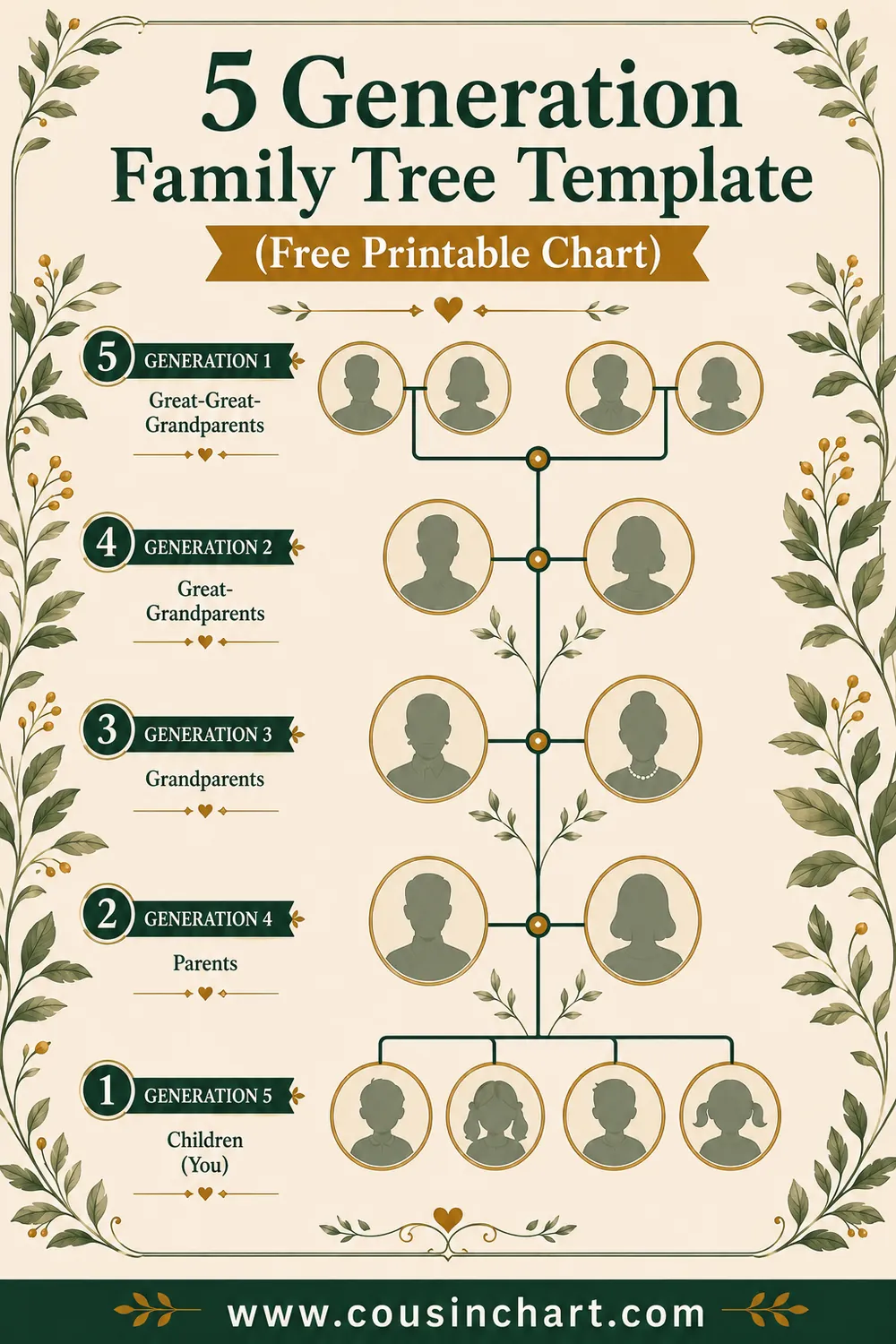
5 Generation Family Tree Template (Free Printable Chart)
A 5 generation family tree template holds exactly 31 people on one page: you, your 2 parents, 4 grandparents, 8 great-grandparents, and 16 great-great-grandparents. It's the standard working chart of genealogy — big enough to show real ancestry, small enough to print at home. You can download our free printable 5 generation template right here on CousinChart, sized for US Letter and A4, with no signup and no watermark.
Below you'll find the exact layout, the genealogist's numbering trick that keeps 31 boxes organized, and what to do when you outgrow the page. And when filling in the chart raises the classic question — who is my great-great-grandfather's other descendant to me? — the free family relationship calculator on our homepage answers it instantly.
Relationship quick-check: tap a phrase to see who they are — and which generation column they belong in.
Tap a phrase above to see the answer.
Work out any family relationship →The layout: 31 boxes in 5 columns
Print the template in landscape and you'll see five columns, doubling as they march to the right:
| Column | Generation | Who | Boxes |
|---|---|---|---|
| 1 | You | The root person | 1 |
| 2 | Parents | Father & mother | 2 |
| 3 | Grandparents | Both sides | 4 |
| 4 | Great-grandparents | 8 | |
| 5 | Great-great-grandparents | 16 |
Total: 1 + 2 + 4 + 8 + 16 = 31 ancestors (well, 30 ancestors plus you). The convention is father's line in the upper half, mother's line in the lower half, so your paternal great-great-grandparents fill the top eight boxes of column 5 and the maternal ones fill the bottom eight.
Why five generations and not six? Space, purely. Generation 6 alone would need 32 boxes — more than the entire 5-generation chart — and the boxes would shrink below writable size on Letter paper. Five generations is the sweet spot the genealogy world settled on decades ago, which is why archives, societies, and research binders all standardize on this exact chart.
Time-wise, five generations reaches surprisingly far. If you're an adult today, your great-great-grandparents were likely born somewhere between the 1850s and the 1900s — before cars, often in another country. One printed page connects you to the world of steamships and homesteads.
The numbering trick that keeps 31 boxes sane
Serious pedigree charts number every box using the ahnentafel system (German for "ancestor table"), and it's worth adopting even on a casual chart because it encodes the whole structure in simple arithmetic:
- You are #1.
- Anyone's father is their number doubled. Your father is #2; his father is #4; his father is #8.
- Anyone's mother is double plus one. Your mother is #3; your father's mother is #5.
- Result: men get even numbers, women get odd numbers (except #1, which is you, either way).
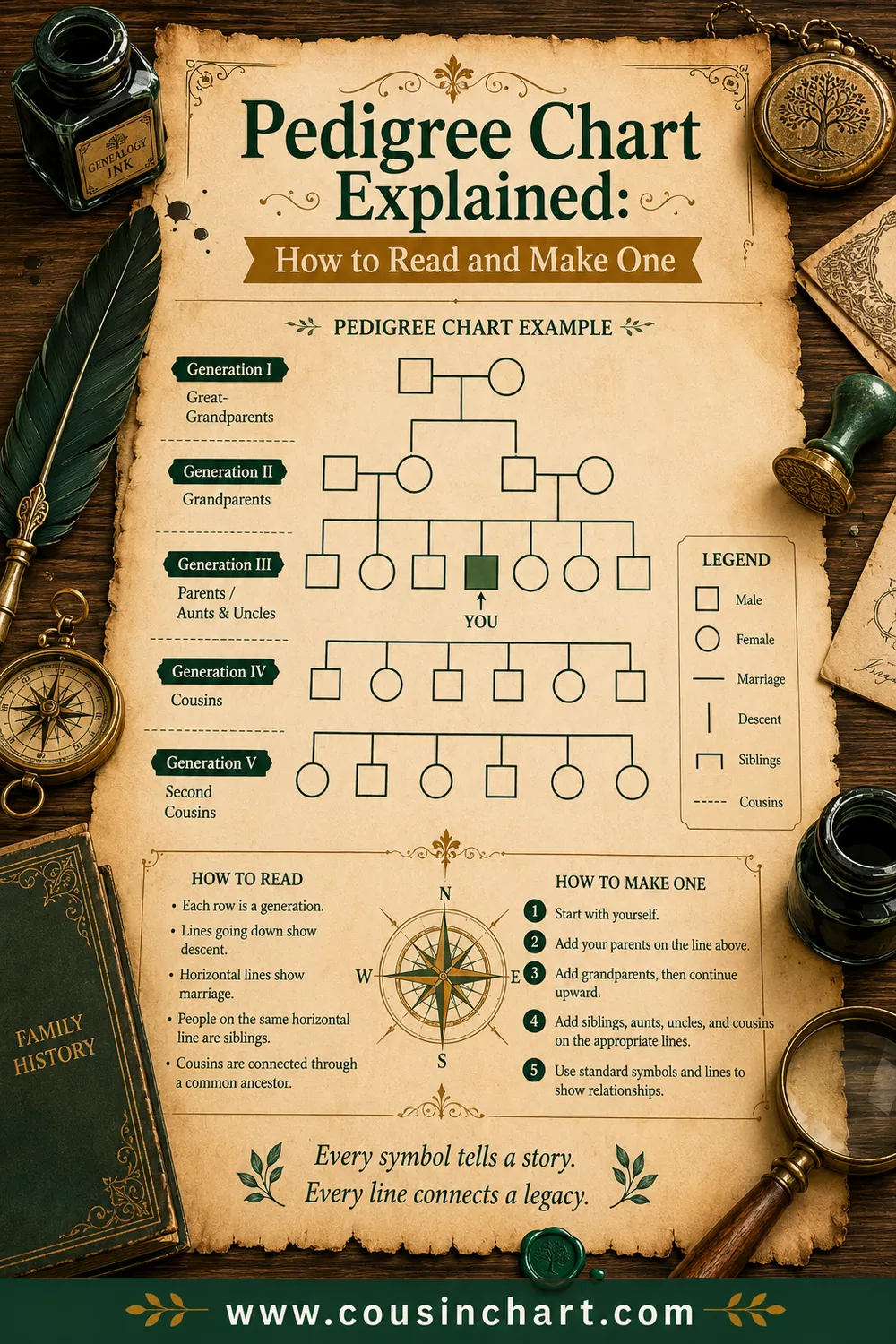
So box #9 is always your father's mother's mother — no labels needed, the number is the address. Your 16 great-great-grandparents are #16 through #31. If you find a chart in Grandma's papers numbered this way, you can reconstruct exactly who everyone is even if the ink has faded off half the names. Our pedigree chart explained article digs deeper into the system.
How to fill it in (without regretting your pen choice)
- Start with yourself in box 1 — full name, birth date, birthplace. Every ancestor chart grows from a root person. Making one as a gift? Put the recipient (or their child) in box 1 instead.
- Fill generations 2 and 3 from memory, then verify the details with relatives. Parents and grandparents usually come easily.
- Interview before you research. The fastest route to generation 4 is a phone call to the oldest relative you have, not a search engine. Ask for full names, maiden names, dates, and places.
- Write it the genealogy way. Surnames in CAPS, women under maiden names, dates as "4 Jul 1898", and places as town–county–state/country. Future-you will be grateful.
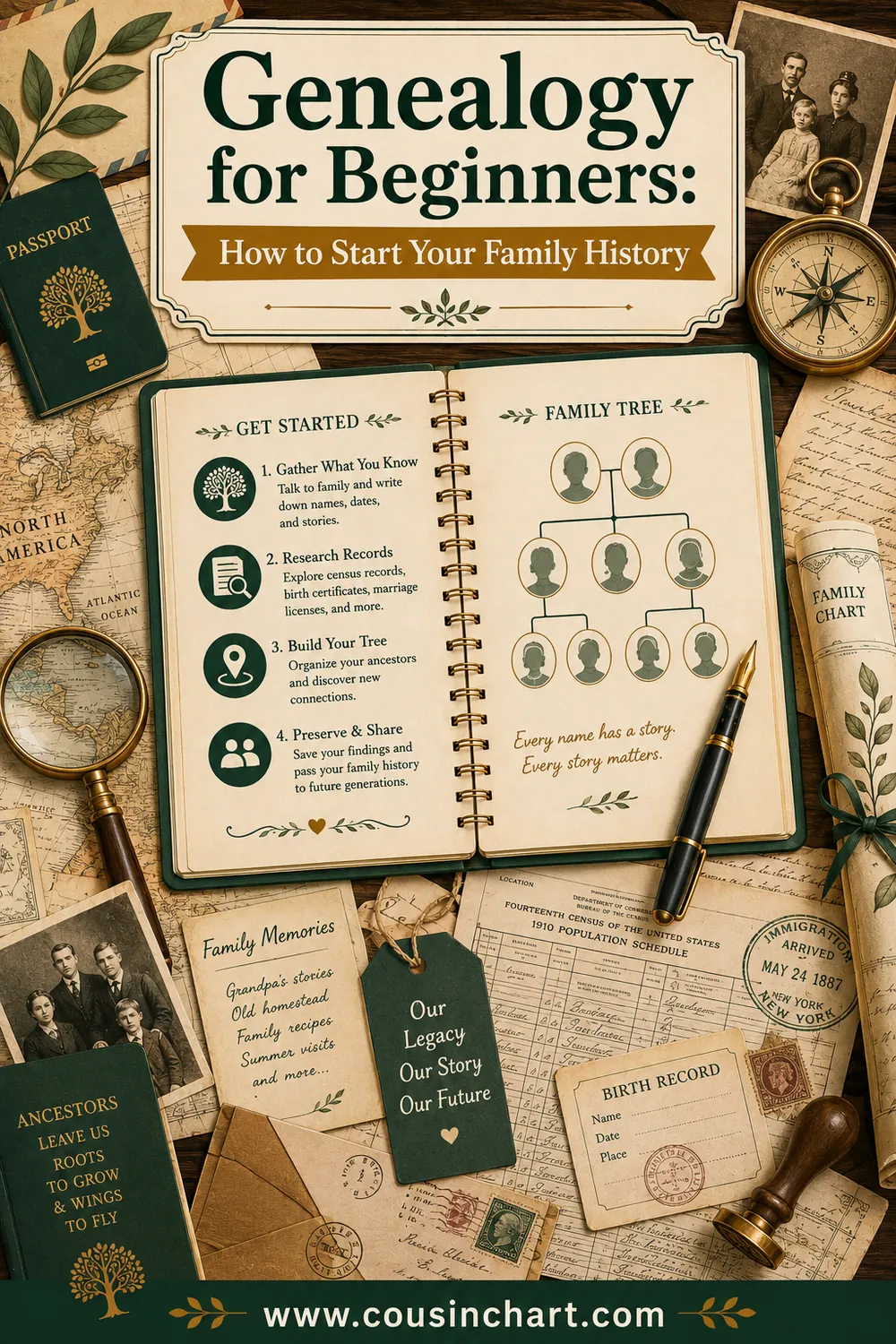
- Pencil for generations 4 and 5. These are the rows that get corrected as records turn up. Our genealogy for beginners guide lists the free record sources — FamilySearch and the US census will fill more of column 5 than you'd expect.
- Check relationships before you commit ink. When Aunt Linda says "Grandpa Joe was your great-great-grandfather's nephew," don't diagram it on faith — run the path through the free relationship calculator and place him correctly the first time.
When you outgrow the page: continuation charts
Thirty-one boxes fill faster than you'd think, and the 16 people in column 5 each have parents of their own. The standard solution is elegant: cascading charts.
- Your first chart is Chart 1. Each person in the last column gets a note like "continues on Chart 2."
- On Chart 2, that great-great-grandparent moves into box #1, and the page now shows their five generations — reaching back nine generations from you in total.
- A full set at that depth is 16 charts, and a three-ring binder of numbered 5-generation charts is exactly how family historians organized research for a century. It still works beautifully.
This modular design is the real reason the 5-generation template endures: it's not just a poster, it's a filing system.
Five mistakes that ruin a 5-generation chart
The 31-box format is forgiving, but these errors force reprints often enough to list:
- Swapping a couple's boxes. Convention puts the father in the upper box of each pair. Mix it up once and every branch above that couple lands on the wrong side of the chart.
- Married names in the women's boxes. Box #7 labeled "Mary Johnson" (her married name) instead of "Mary SZABO" cuts off the entire Szabo line — a quarter of your chart — at generation 3.
- Attaching a step-parent as a bloodline. If great-grandpa remarried, his second wife was your great-grandmother's successor, not your ancestor. Chart the biological mother in the box; note the remarriage in the margin.
- Guessing a generation to "finish" the row. An invented great-great-grandparent doesn't just waste one box — everything you later research above it belongs to a stranger. Empty beats wrong, every time.
- Trusting a relationship you haven't checked. "Uncle Gus was your great-grandfather's cousin — or brother?" makes a real difference to whether he shares your box #16 parents. Run the stated path through the calculator before deciding whether Gus belongs on this chart or just near it.
Display ideas: from research binder to wall art
The same 31-slot structure works as decor, and this is where the template earns its keep on Pinterest:
- Framed heirloom chart: print on cream cardstock, fill it in your best hand (or hire a calligrapher for the 31 names), frame it. A completed 5-generation chart is a genuinely moving anniversary or milestone-birthday gift — it shows someone exactly where they came from.
- Reunion poster: enlarge the PDF to 11×17" or bigger at a print shop and let relatives fill in blanks during the reunion. Empty boxes start conversations; someone always knows a name nobody else did.
- Wedding version: two 5-generation charts side by side — one per spouse — showing the two rivers joining. Pin-worthy and surprisingly easy.
- Kids' heritage project: a child filling in their 16 great-great-grandparents' countries of origin turns abstract "heritage" into something concrete they can point to.
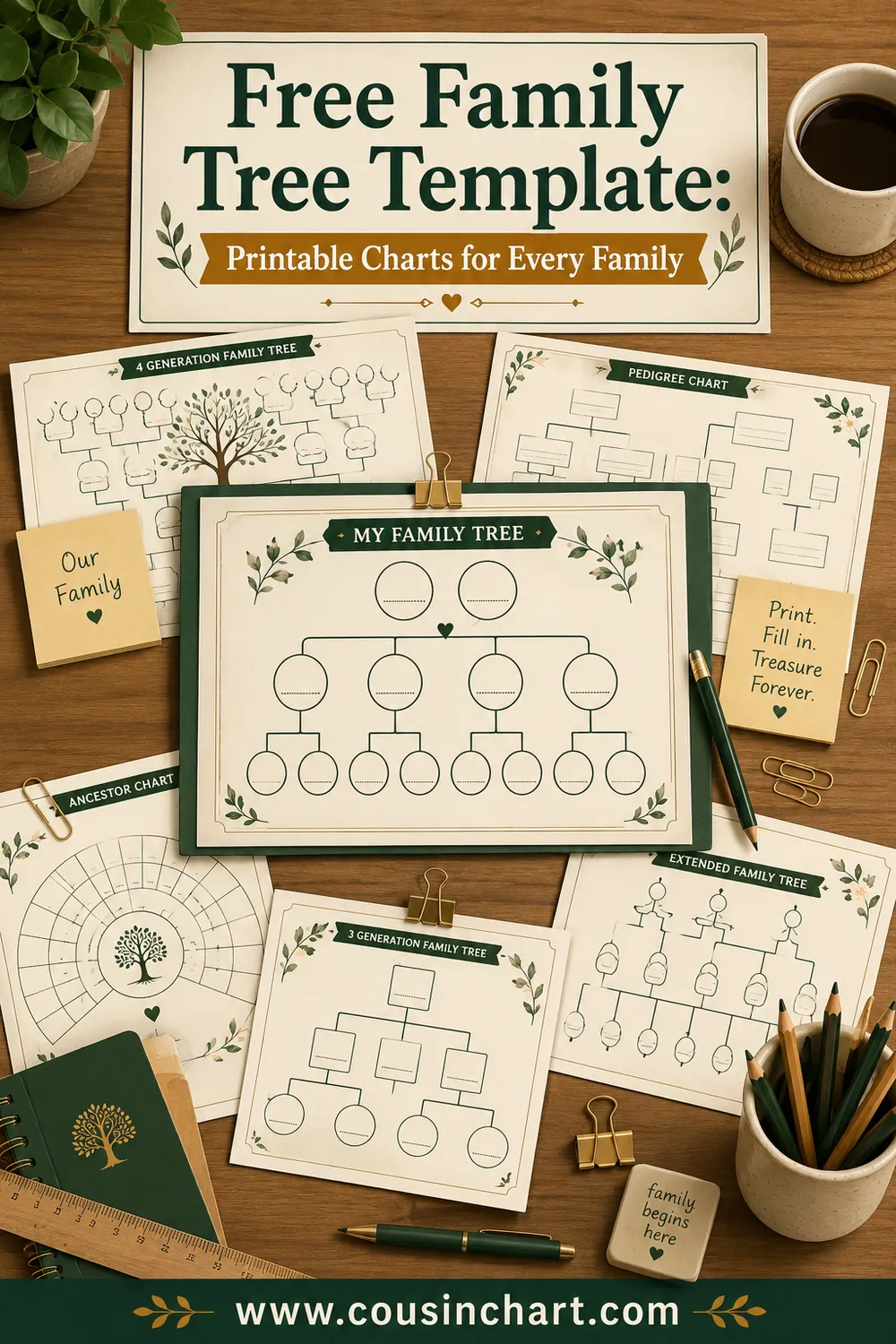
If you want something smaller or rounder, our free family tree template roundup covers 3- and 4-generation layouts plus the fan chart.
FAQ
How many people are on a 5 generation family tree?
Thirty-one: you, 2 parents, 4 grandparents, 8 great-grandparents, and 16 great-great-grandparents. Each generation doubles the one before it, which is why the chart's columns go 1, 2, 4, 8, 16.
Does a 5 generation chart include aunts, uncles, and cousins?
No — it's an ancestor (pedigree) chart, showing only your direct line. Siblings of your ancestors don't get boxes. To map cousins and side branches, use a descendant chart or a branching family tree layout, and use the relationship calculator to name how any side-branch relative connects to you.
Who counts as the fifth generation?
Your great-great-grandparents — all 16 of them. Counting yourself as generation 1, the columns run: you (1), parents (2), grandparents (3), great-grandparents (4), great-great-grandparents (5).
What paper size should I print a 5 generation template on?
US Letter or A4 works, in landscape, at 100% scale. The generation-5 boxes are small, so if you want writing room — or plan to display the chart — have a print shop enlarge the PDF to 11×17" (A3). Cardstock upgrades it from worksheet to keepsake.
How do I continue past five generations?
Use cascading charts: each person in the last column becomes person #1 on a new 5-generation chart. Chart numbers cross-reference each other ("continued on Chart 4"), and a binder of them can carry your line back nine generations and beyond.
What is the numbering system on pedigree charts?
It's called an ahnentafel. You are 1, each person's father is their number doubled, and each mother is double plus one — so men land on even numbers and women on odd. Box 9, for example, is always the root person's father's mother's mother.
Print yours and start filling boxes
Download the free 5 generation family tree template, print it in landscape, and put your own name in box #1 tonight — generations 2 and 3 will be done before your coffee cools, and the hunt for the other 24 names is the fun part. Pin the blank chart for your next reunion or gift project. And whenever a name comes with a confusing connection attached — a granduncle, a third cousin, somebody's mother's cousin's son — the free CousinChart relationship calculator names the relationship in ten seconds so every box lands where it belongs.