Children of Identical Twins: Cousins on Paper, Half-Siblings in DNA
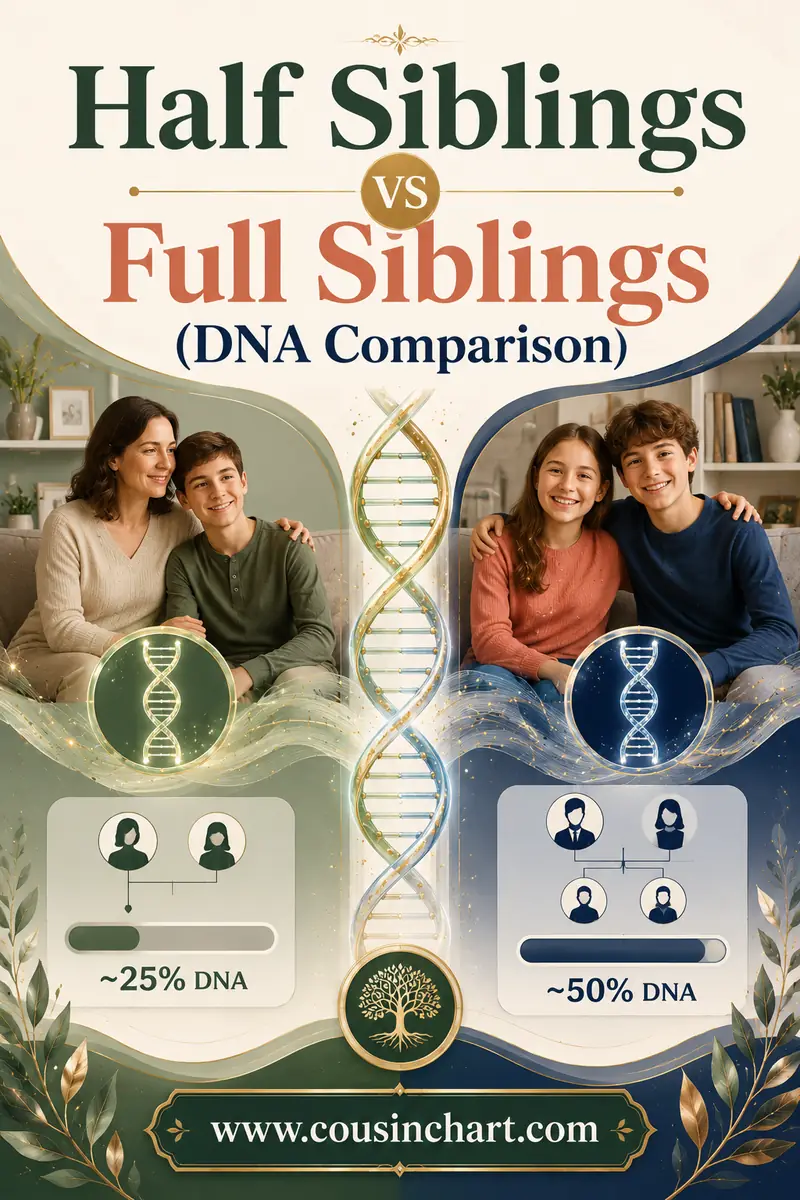
The children of identical twins are first cousins on the family tree, but in their DNA they look like half-siblings. Because identical twins carry the same genome, each twin's child gets half of that same genome, so the cousins share about 25% of their DNA instead of the usual 12.5% for first cousins. A DNA test will usually put them in the half-sibling range, not the cousin range.
That one fact surprises a lot of families, and it ripples outward. It changes how much DNA the kids share with their aunt or uncle, how their own children match each other, and how a DNA match list gets read years later by someone who doesn't know there were twins in the family. This guide walks through all of it with real numbers, shows the math step by step, and gives you a few examples to try yourself.
The short answer: cousins on paper, half-siblings in DNA
Let's set up a simple family. Twin sisters, Anna and Beth, are identical twins. Anna has a son, Leo. Beth has a daughter, Mia. Anna's husband and Beth's husband aren't related to each other.
On the family tree, Leo and Mia are first cousins: their mothers are sisters. That's what they'll call each other, and that's what any genealogy program will label them. Nothing about the twins changes the family relationship.
In DNA, though, the picture is different. Leo got half of his DNA from Anna. Mia got half of hers from Beth. Since Anna and Beth have the same genome, Leo and Mia each got a random half of the same set of chromosomes. That's exactly what happens with two half-siblings who share a mother. So:
- Family relationship: first cousins
- Genetic relationship: equivalent to half-siblings
- Expected shared DNA: about 25%, versus about 12.5% for ordinary first cousins
A genetic counseling student at Stanford put it the same way in a Stanford at The Tech "Ask a Geneticist" answer: the children share about 25% of their DNA instead of 12.5%, and while they're legally first cousins, genetically they're more like half-siblings. Twin researchers noticed this decades ago. In 1976 the geneticist Walter Nance described the offspring of identical twins as "a unique class of human half-sibs" and used families like Leo's and Mia's to study how traits are inherited.
How identical twins form and why their DNA matches
To see why the cousins end up so closely matched, it helps to start with the twins themselves.
Identical twins come from one fertilized egg
According to MedlinePlus Genetics from the National Library of Medicine, identical twins, also called monozygotic (MZ) twins, happen when a single egg is fertilized by a single sperm and the resulting embryo splits in two very early in development. They occur in about 3 to 4 out of every 1,000 births worldwide, and most of the time the cause of the split is unknown.
Fraternal twins, called dizygotic (DZ) twins, are different. They come from two separate eggs fertilized by two different sperm in the same cycle. MedlinePlus notes that fraternal twins are about twice as common as identical twins and much more likely to run in families.
What "same genome" really means
The National Human Genome Research Institute's glossary says identical twins "share the same genomes" and are nearly always the same sex, while fraternal twins, like other siblings, share about half of their genomes.
"The same genome" is very close to exact, but not perfectly exact. A large study by deCODE genetics in Iceland, described in their release "Monozygous but not identical", sequenced hundreds of identical twin pairs and their relatives. It found that identical twins differ by an average of about 5.2 early developmental mutations, tiny changes that happened in the first cell divisions of the embryo. In roughly 15% of pairs, one twin carried a noticeable number of these changes and the other didn't.
For family DNA testing, those few differences don't matter. A consumer DNA test looks at hundreds of thousands of positions and measures long stretches of matching DNA. A handful of single-letter differences won't break up those stretches in any way you'd notice. So for everything in this article, treat identical twins as genetically the same person.
Why this matters for the next generation
Every child gets one copy of each chromosome from each parent. Which copy, and which mix of the parent's two copies, is shuffled at random each time an egg or sperm forms. That shuffling is called recombination. If two children get their DNA from the same parent, they each get a different random half of that parent's DNA. If two children get their DNA from two genetically identical parents, the result is statistically the same thing. That's the whole reason children of identical twins behave like half-siblings.
Why children of identical twins share as much DNA as half-siblings
Here's the math, done the way geneticists do it. It uses the coefficient of relationship, a number written as r that says what share of DNA two people are expected to have inherited from the same recent ancestors. Two key rules make it work:
- Every time DNA passes from a parent to a child, only half of it is passed on. So each parent-to-child step on a path between two people multiplies by 1/2.
- If two people are connected through more than one ancestor, you add up the paths.
Each of those parent-to-child steps is called a meiosis (plural meioses), after the type of cell division that makes eggs and sperm.
Step 1: Ordinary first cousins
Say Anna and Beth were ordinary sisters, not twins. Leo and Mia would be connected through two shared grandparents: their grandmother and their grandfather.
- Path through Grandma: Leo to Anna (1 step), Anna to Grandma (1 step), Grandma to Beth (1 step), Beth to Mia (1 step). That's 4 steps, so (1/2) x (1/2) x (1/2) x (1/2) = 1/16.
- Path through Grandpa: the same 4 steps, another 1/16.
- Total: 1/16 + 1/16 = 2/16 = 1/8, or 12.5%.
That's the textbook value for first cousins, and it matches published tables, such as the relative-pair table in Puppala and colleagues' 2011 study in Human Heredity, which lists first cousins at 0.125.
Step 2: Now make the sisters identical twins
When Anna and Beth are identical twins, there's a shortcut. Their genomes are the same, so you can treat them as one genetic person. Their coefficient of relationship with each other is 1, or 100%.
- Path: Leo to Anna (1 step), then Anna is genetically Beth (0 steps, multiply by 1), then Beth to Mia (1 step).
- That's 2 steps: (1/2) x (1/2) = 1/4, or 25%.
Now compare that with half-siblings who share a mother:
- Path: Child 1 to Mom (1 step), Mom to Child 2 (1 step).
- That's 2 steps: (1/2) x (1/2) = 1/4, or 25%.
Same number of steps, same result. Genetically, the twins' children are in exactly the same position as half-siblings.
Step 3: Don't add the grandparent paths too
Here's where people trip up. Anna and Beth do have parents, and you might think Leo and Mia still have two grandparent paths worth 1/16 each on top of the twin path. They don't. The grandparent paths are already inside the twin path. The reason the twins are identical is that they came from one fertilized egg, so the grandparents' contribution was fixed once, then copied into both twins. Adding 1/4 + 1/16 + 1/16 would count the same DNA twice and give a wrong answer of 3/8. The correct answer is 1/4.
If you want to go deeper into this kind of math, including how to handle double cousins and other multi-path families, CousinChart has a full guide to the coefficient of relationship.
Step 4: Turn the percentage into centimorgans
DNA testing companies don't report percentages first. They report centimorgans (cM), a unit that measures the length of matching stretches of DNA. If the unit is new to you, our guide to centimorgans explains it in plain terms.
Blaine Bettinger's Shared cM Project, Version 4.0 (March 2020) gives the conversion we need. It says the expected value for half-siblings is 25%, "or 1,700 cM". So:
- If 25% = 1,700 cM, then 100% = 1,700 / 0.25 = 6,800 cM.
- Children of identical twins at 25%: 0.25 x 6,800 = about 1,700 cM.
- Ordinary first cousins at 12.5%: 0.125 x 6,800 = about 850 cM.
So the twins' kids are expected to share about twice as much DNA as regular first cousins. In real life, the amount varies around that expected value, which is what the next section is about.
What a DNA test shows for children of identical twins
The Shared cM Project collected nearly 60,000 submitted matches from people who knew their exact relationship. The project report explains that 57,975 data points were used after cleaning, and the top and bottom 0.5% of each relationship were trimmed as likely errors. Jonny Perl at DNA Painter turned that data into the free Shared cM Project 4.0 tool, which is where the averages and ranges below come from.
| Relationship | Average shared cM | Range (cM) | How it applies to twin families |
|---|---|---|---|
| Half sibling | 1,759 | 1,160 to 2,436 | Children of identical twins are expected here |
| Grandparent / grandchild | 1,754 | 984 to 2,462 | Overlaps with the twins' children |
| Aunt or uncle / niece or nephew | 1,741 | 1,201 to 2,282 | Overlaps with the twins' children |
| First cousin (1C) | 866 | 396 to 1,397 | Children of fraternal twins, or ordinary siblings, land here |
| Half first cousin | 449 | 156 to 979 | Grandchildren of identical twins are expected here |
| Parent / child | 3,485 to 3,487 | 2,376 to 3,720 | A twin and the other twin's child are expected here |
| Full sibling | 2,613 | 1,613 to 3,488 | Children of two identical-twin couples are expected here |
Two things jump out. First, the twins' children (expected around 1,700 cM) sit nowhere near the normal first-cousin average of 866 cM. Their expected value is close to double it. Second, they sit right in the middle of a crowded group that the Shared cM Project calls Meiosis Grouping 2: half-siblings, grandparents and aunts or uncles. The project groups relationships that are separated by the same number of meioses, because they're expected to share similar amounts of DNA. All of the relationships in this group share about a quarter of their DNA on average, and their ranges overlap heavily. A DNA number of 1,700 cM simply can't tell you which of them you're looking at.
Our article on telling an aunt or uncle, grandparent and half-sibling apart covers the same overlap from a different angle, and it applies to twin families too.
What the range means for real cousins
Children of identical twins won't share exactly 1,700 cM. Recombination is random, so the real amount scatters. The half-sibling range of 1,160 to 2,436 cM is the best guide to what you'll see. As percentages of 6,800 cM, that's:
- 1,160 / 6,800 = about 17%
- 2,436 / 6,800 = about 36%
So a pair of twins' children could share anywhere from roughly 17% to 36%. At the low end, they'd overlap with a very high-sharing pair of ordinary first cousins (the first-cousin range tops out at 1,397 cM). At the high end, they'd overlap with full siblings. Most pairs will land somewhere in the middle.
What the twin aunt or uncle sees
This one catches people off guard. Leo's aunt Beth is genetically identical to his mother, Anna. So when Beth and Leo compare DNA, Beth looks exactly like a parent. Leo got one full copy of each chromosome from Anna, and Beth has that same copy, so they match along the whole length of one copy of every chromosome.
- Expected: 50% of 6,800 = 3,400 cM
- Shared cM Project parent/child average: about 3,485 cM, range 2,376 to 3,720
A testing company will often suggest "parent/child" for a niece or nephew and their twin aunt or uncle. That's not a mistake in the lab. It's the correct genetic reading of a relationship the software can't see on the tree. It's also why family members sometimes get a shock when an aunt's test seems to say she's a parent. If there's an identical twin in the family, that's the first explanation to consider.
Every relationship in an identical-twin family, recalculated
The twin effect doesn't stop at the first generation. Any path between two relatives that runs through the twin pair is one meiosis shorter than it would be through ordinary siblings, because you skip the trip up to the grandparents and back down. That doubles the expected sharing for every relationship that crosses from one twin's branch to the other's.
The table below uses the Anna and Beth family. "Twin's side" means the relative is on Anna's branch, and "other twin's side" means Beth's branch. Expected cM is the expected percentage times 6,800, rounded.
| Relationship on the family tree | Usual expected share | Expected share through identical twins | Expected cM through twins | Behaves genetically like |
|---|---|---|---|---|
| Twin to twin | 50% (full siblings) | 100% | Full genome | Same person |
| Twin to other twin's child (aunt or uncle to niece or nephew) | 25% | 50% | about 3,400 | Parent and child |
| Twin to other twin's grandchild (great-aunt or great-uncle) | 12.5% | 25% | about 1,700 | Grandparent and grandchild |
| First cousins (the twins' children) | 12.5% | 25% | about 1,700 | Half-siblings |
| First cousin once removed (one twin's child and the other twin's grandchild) | 6.25% | 12.5% | about 850 | Half aunt or uncle and niece or nephew |
| Second cousins (the twins' grandchildren) | 3.125% | 6.25% | about 425 | Half first cousins |
| Third cousins (the twins' great-grandchildren) | 0.78% | 1.56% | about 106 | Half second cousins |
Here's how to check a couple of those rows by counting steps:
- Second cousins through twins: Grandchild 1 to Parent 1 to Anna, then Anna is Beth, then Beth to Parent 2 to Grandchild 2. That's 4 steps: (1/2) to the 4th power = 1/16 = 6.25%. Half first cousins are also 4 steps apart through one shared grandparent, so they match. DNA Painter's tool gives half first cousins an average of 449 cM (range 156 to 979), close to the expected 425.
- First cousin once removed through twins: Leo to Anna, Anna is Beth, Beth to Mia, Mia to Mia's child. That's 3 steps: (1/2) to the 3rd power = 1/8 = 12.5%. The Shared cM Project's half aunt or uncle has an average of 871 cM, range 492 to 1,315, which fits the expected 850.
A simple rule falls out of this: across the twin line, every relationship acts like the "half" version of the next-closer relationship. Cousins act like half-siblings, second cousins act like half first cousins, and so on. If you've read our explainer on half cousins, you've already seen these numbers. They're the same.
What doesn't change
Relationships that don't cross between the two twins' branches are completely normal. Leo and his own siblings are ordinary full siblings. Leo and his father's side of the family are ordinary relatives. And if Anna and Beth had a third, non-twin sibling, Carl, then Carl's children would be ordinary first cousins to both Leo and Mia, at about 12.5%. The twin effect only applies when the path between two people runs through both twins.
When identical twins marry identical twins
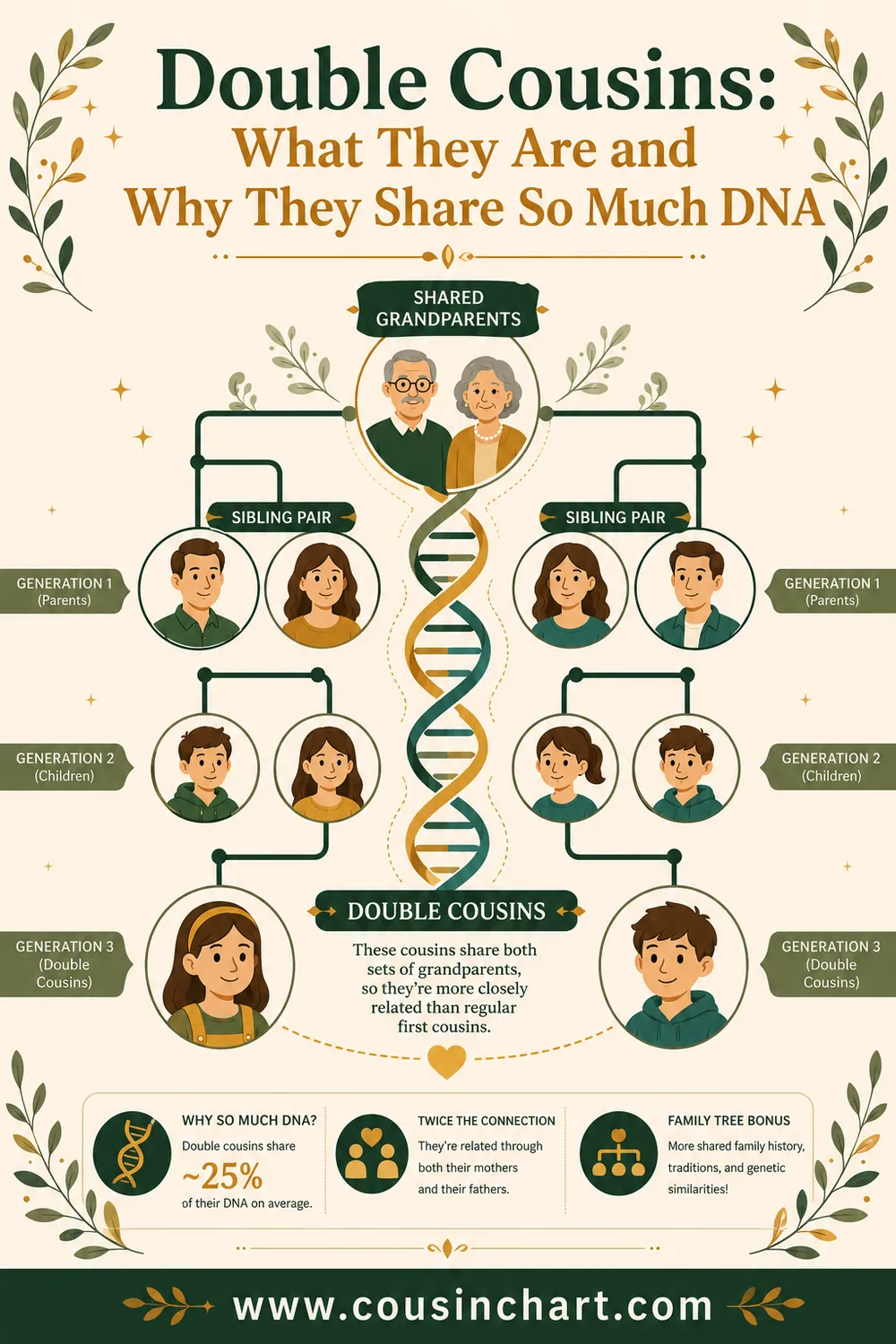
It's rare, but it happens: a pair of identical twin sisters marries a pair of identical twin brothers. Their children are double first cousins on the tree, but genetically they look like full siblings.
Here's why. Say Anna marries Dan, and Beth marries Dan's identical twin, Eli. Leo (Anna and Dan's son) and Mia (Beth and Eli's daughter) are now connected two ways:
- Through the mothers: Leo to Anna, Anna is Beth, Beth to Mia. 2 steps = 1/4.
- Through the fathers: Leo to Dan, Dan is Eli, Eli to Mia. 2 steps = 1/4.
- Total: 1/4 + 1/4 = 1/2, or 50%.
That's the same as full siblings, who are connected through one mother (1/4) and one father (1/4). Genetically, the two families' children are interchangeable with brothers and sisters. They'll also have the same pattern of matching that full siblings have: in some stretches they share one copy, in some they share both copies, and in some they share neither.
What a DNA test shows in this case
You might expect 50% of 6,800, or 3,400 cM. But full siblings don't usually show that much, and neither will these cousins. The Shared cM Project's full-sibling average is 2,613 cM, with a range of 1,613 to 3,488. The reason is how companies count. A shared cM total measures how much of the genome two people match on at least one copy. It doesn't count a stretch twice when they match on both copies.
Here's the arithmetic. One copy of the genome is about 3,400 cM long (half of 6,800). Full siblings are expected to match on at least one copy over about 75% of the genome (they match on both copies about 25% of the time and on one copy about 50% of the time). Timothy Thornton's University of Washington lecture slides on estimating relatedness give those same 1/4, 1/2 and 1/4 probabilities for full siblings sharing two, one or zero copies at any spot. So 0.75 x 3,400 = about 2,550 cM, which is close to the observed 2,613 average. Expect the children of two identical-twin couples to look like full siblings at roughly that level.
For more on the regular version of this family, see our guide to half-siblings vs. full siblings, which explains fully identical and half-identical stretches in more detail.
Other twin-and-sibling combinations
| Family setup | Children are, on the tree | Expected shared DNA | Genetically like |
|---|---|---|---|
| Identical twins each marry unrelated partners | First cousins | 25% | Half-siblings |
| Fraternal twins each marry unrelated partners | First cousins | 12.5% | First cousins |
| Identical twins marry identical twins | Double first cousins | 50% | Full siblings |
| Identical twins marry two ordinary (non-twin) siblings | Double first cousins | 25% + 12.5% = 37.5% | Three-quarter siblings |
| Ordinary siblings marry ordinary siblings | Double first cousins | 12.5% + 12.5% = 25% | Half-siblings (in expected amount) |
The fourth row is worth a quick check. Through the twin mothers: 1/4. Through the brother fathers, as ordinary first cousins: 1/8. Total: 1/4 + 1/8 = 3/8 = 37.5%. That's the same expected share as three-quarter siblings, who share one parent and have parents who are siblings to each other.
X, Y and mitochondrial DNA in twin families
Most DNA matching uses autosomal DNA, the 22 pairs of chromosomes everyone has. But three other kinds of DNA follow their own rules, and in twin families they create some striking matches.
Y-DNA: sons of identical twin brothers
Fathers pass their Y chromosome to their sons almost unchanged. Identical twin brothers have the same Y chromosome. So their sons will carry the same Y-DNA as each other, just as brothers or paternal half-brothers would. A Y-DNA test can't tell those cousins apart from brothers.
X-DNA: daughters of identical twin brothers
A father passes his single X chromosome to every daughter, whole. Identical twin brothers have the same X. So the daughter of one twin brother and the daughter of the other will share that entire paternal X, exactly like paternal half-sisters. Ordinary first cousins through brothers can't share X-DNA through their fathers at all, because a man doesn't get his X from his father. Our guide to X-DNA inheritance shows these paths in detail.
Daughters of identical twin sisters will also share more X-DNA than usual, since each mother passes on a random recombined mix of the same two X chromosomes. That's the same pattern as maternal half-sisters.
Mitochondrial DNA: children of identical twin sisters
Mitochondrial DNA (mtDNA) passes from a mother to all of her children. Identical twin sisters carry the same mtDNA, so all of their children match on it. That's no different from ordinary sisters, who also share their mother's mtDNA, so mtDNA won't reveal a twin connection by itself.
Telling twin cousins apart from half-siblings in DNA matches
Here's the practical problem. Say you're a genealogist, or an adoptee, or just someone looking at an unexpected 1,800 cM match. A testing company says "half sibling, grandparent, aunt or uncle." How would you know it's actually a first cousin whose parent is an identical twin of yours? From the DNA number alone, you can't. The amount of DNA is the same. You need other clues.
Clues that point to a twin family
- Ages and generations. A half-sibling is usually close to your generation. So is a first cousin. A grandparent or aunt is a generation or two older. If the match is your age, the possibilities narrow to half-sibling or a twin cousin.
- Shared matches. A half-sibling through your mother will share matches with your mother's whole family. A twin cousin through your mother will too. But a twin cousin will also match their own other parent's family, which has nothing to do with you. Look at who you both match and on which sides.
- Your parent's match. If your parent has tested, compare. A half-sibling through your mother would show up as your mother's child (around 3,485 cM). A twin cousin would show up as your mother's niece or nephew, and if your mother is the twin, the testing site will still call it parent/child. If your mother's identical twin has tested, she'll look like a second parent to you. That's the giveaway.
- Family records. Birth records, family stories and obituaries that mention twins are often the fastest answer. Before assuming a surprise half-sibling, check whether a parent or grandparent had a twin.
- Fully identical regions. Some tools show stretches where two people match on both copies of a chromosome. Half-siblings and twin cousins usually have very little of that (unless the other parents are related), while full siblings and the children of two twin couples have a lot. That helps separate the 25% cases from the 50% cases, but not twin cousins from half-siblings.
A worked example
Jordan, an adoptee, matches Casey at 1,820 cM. The site predicts "close family." Casey is 31; Jordan is 33. Casey's tree shows a mother, Rachel, who has an identical twin sister, Ruth. Jordan's non-identifying adoption papers say the birth mother had a twin.
- 1,820 cM / 6,800 = about 27%. That fits a 25% relationship.
- Casey and Jordan are about the same age, so grandparent and aunt or uncle are unlikely.
- The twin clue raises a second possibility beside half-siblings: Jordan could be Ruth's child, making Jordan and Casey first cousins who share DNA like half-siblings.
- If Rachel tests and matches Jordan at about 3,400 cM, she'll look like a parent either way. If Rachel is the birth mother, Jordan and Casey are half-siblings. If Ruth is, they're twin cousins. DNA can't separate those two stories. Records, conversations or a test from the birth father's side can.
That's the hardest edge case in genetic genealogy: when the twin is the one who might be the parent, DNA alone can't say which twin. Only non-DNA evidence can.
What to call them: family names vs. genetic reality
None of the DNA math changes what the kids call each other. Leo and Mia are first cousins. Beth is Leo's aunt. Their grandchildren are second cousins. Family relationship terms describe how people are connected through parents and marriages, not how many centimorgans they share.
That said, many twin families feel the closeness. Twins often raise their kids side by side, and some families say "cousin-siblings" or "twin cousins" informally. Those are fine nicknames, but they aren't standard genealogy terms, and they won't show up in a family tree program. If you're entering this family into software, record the real parent-child links and let the program label everyone as cousins. Then add a note that the parents are identical twins, so future researchers understand why the DNA looks the way it does.
Medical and family history
Because the twins' children share more DNA than ordinary cousins, some health conditions that run in families can be more relevant across the twin branches than they would be between typical cousins. A twin aunt or uncle's genetic health history is, in a sense, as close to the child as a parent's. If you're collecting a family health history, it's worth noting the twin relationship. This is general information, though. If a specific condition is a concern, a doctor or genetic counselor can tell you what it means for your family.
Relationships between the cousins
Families sometimes ask whether children of identical twins can marry. Laws on this are written around family relationships, not DNA, and they vary a lot by state and country, as our overview of cousin marriage laws explains. Genetically, though, these cousins are as closely related as half-siblings, so any health question is closer to that of half-siblings than to that of typical first cousins. Anyone in that situation should talk to a genetic counselor and check the law where they live.
Common mix-ups about children of identical twins
Mix-up 1: "They're genetically siblings."
Not quite. Children of identical twins are genetically like half-siblings (25%), not full siblings (50%). They only reach the full-sibling level if both of their parents are identical twins of each other's parents, as in the twins-marry-twins case.
Mix-up 2: "Twins' children share 50% because the twins are 100% the same."
Each child still only gets half of the twin's DNA, and each gets a different random half. The chance that any given stretch of one child's twin-side DNA matches the other's is 1/2, and the twin side is only half of each child. So 1/2 x 1/2 = 1/4.
Mix-up 3: "Fraternal twins count too."
They don't. Fraternal twins are genetically ordinary siblings who happen to share a birthday. Their children are ordinary first cousins at about 12.5%. Only identical twins create the half-sibling-level match. If you know a pair of twins is boy-girl, they're fraternal. (The NHGRI notes identical twins are nearly always the same sex.)
Mix-up 4: "The test says parent/child, so the lab is wrong."
When a niece or nephew tests against a parent's identical twin, a parent/child prediction is the genetically correct answer. The lab isn't wrong. The software just can't know the family tree.
Mix-up 5: Adding grandparent paths on top of the twin path
As shown earlier, the twin path already includes the grandparents' DNA. Counting both gives 37.5% for twins' children, which is wrong. The answer is 25%.
Mix-up 6: Expecting an exact number
Expected values are averages. Two specific twins' children might share 1,300 cM or 2,200 cM. Use the half-sibling range, not a single number, when you're judging a match.
Try it yourself
Work these out with the step-counting rule: count the parent-to-child steps on the path, skip from one twin to the other for free, and multiply 1/2 by itself once per step. Then multiply by 6,800 for expected cM. Answers follow.
- Twin brothers Sam and Tom are identical. Sam's daughter has a son. How much DNA is Tom expected to share with that boy?
- Same family. Sam's son and Tom's grandson: what's their family relationship, and how much DNA do they share?
- Twin sisters Ivy and June are fraternal. Ivy's daughter and June's son are first cousins. Expected share?
- Identical twins Pat and Lee each have a child. Those children each have a child. The two grandchildren take DNA tests. What should they expect to see?
Answers:
- Tom is the boy's great-uncle on the tree. Path: Tom is Sam, Sam to daughter, daughter to son. 2 steps = 1/4 = 25%, about 1,700 cM. Genetically he looks like a grandfather.
- They're first cousins once removed. Path: Sam's son to Sam, Sam is Tom, Tom to child, child to grandson. 3 steps = 1/8 = 12.5%, about 850 cM. That's like a half uncle and nephew.
- Fraternal twins are ordinary siblings, so it's the normal two-path calculation: 1/16 + 1/16 = 1/8 = 12.5%, about 850 cM.
- They're second cousins on the tree. Path: 4 steps through the twins = 1/16 = 6.25%, about 425 cM. They'll match like half first cousins, roughly double the usual second-cousin amount. The Shared cM Project's average for ordinary second cousins is 229 cM, while half first cousins average 449 cM.
Putting it all together
Children of identical twins are first cousins by family relationship and half-siblings by DNA. They're expected to share about 25%, or about 1,700 cM, which puts them in the same range as half-siblings, grandparents and aunts or uncles. Their twin aunt or uncle looks like a parent, their own children match like half first cousins, and if both sets of parents are identical twins, the kids look like full siblings. The family names don't change, but the DNA tells a very different story.
When you're working out how two people in your family connect, start with the tree and then layer the DNA on top. Our shared cM chart helps with the DNA side. For the family-tree side, try our free family relationship calculator: enter how each person connects to a common relative and it gives you the right name for the relationship.
Keep reading: Donor Siblings: What They Are, How Related You Are, and How Families Connect.
Frequently Asked Questions
Are the children of identical twins cousins or siblings?
They're first cousins. Their parents are siblings, so on the family tree and in everyday life they're cousins, and that's what they'd call each other. Genetically, though, they're closer than ordinary cousins. Because identical twins have the same genome, each twin's child gets a random half of the same DNA, which puts them at about 25% shared DNA. That's the same expected amount as half-siblings, and double the usual 12.5% for first cousins. So the accurate answer is cousins by relationship and half-siblings by DNA.
How much DNA do children of identical twins share?
They're expected to share about 25% of their DNA, which works out to roughly 1,700 centimorgans (cM). The Shared cM Project gives half-siblings, the genetically equivalent relationship, an average of 1,759 cM with a range of 1,160 to 2,436 cM. Real pairs will scatter around that average because DNA is shuffled at random each generation. Ordinary first cousins, by comparison, average 866 cM. If you see twins' children matching in the 1,200 to 2,400 cM range, that's exactly what you'd expect.
Will a DNA test say the children of identical twins are half-siblings?
Often, yes, or it will give a group of possibilities such as half-sibling, grandparent, aunt or uncle. Testing companies only see the amount of shared DNA, and twins' children share the same amount as those relationships. The software doesn't know your family tree, so it can't know the parents are identical twins. That's why it's important to add context yourself. Ages, shared matches and family records will tell you what the DNA number can't.
Why does my aunt show up as my parent on a DNA test?
If your aunt is your mother's identical twin, or your uncle is your father's identical twin, the DNA test is reading the genetics correctly. You got one full copy of each chromosome from your parent, and their identical twin has that same DNA, so you match your twin aunt or uncle along the whole length of one copy of every chromosome. That's the parent and child pattern, around 3,400 to 3,500 cM. The test isn't broken. It just can't tell an identical twin apart from your actual parent.
Are the children of fraternal twins more related than normal cousins?
No. Fraternal twins come from two separate eggs and two separate sperm, so genetically they're ordinary siblings who happen to be born together. They share about half their DNA, like any brother and sister. Their children are ordinary first cousins who share about 12.5% of their DNA, or roughly 850 cM on average. Only identical twins, who come from a single fertilized egg that split in two, create the extra-close half-sibling level of sharing in the next generation.
What if identical twins marry another set of identical twins?
Then the children are double first cousins on the family tree but genetically equivalent to full siblings. They're connected through the twin mothers, worth 25%, and through the twin fathers, worth another 25%, for a total of about 50%. On a DNA test they'd look like full siblings, who average 2,613 cM in the Shared cM Project. It's an unusual family setup, but it has happened, and the DNA in these families can be very confusing to anyone who doesn't know the backstory.
How related are the grandchildren of identical twins?
The grandchildren are second cousins on the family tree, but they share DNA like half first cousins. Count the steps: grandchild to parent to twin, then across to the other twin for free, then down to that twin's child and grandchild. That's four parent-to-child steps, so one half multiplied four times, or 1/16, which is 6.25%. That works out to around 425 cM. Ordinary second cousins average 229 cM, while half first cousins average 449 cM in the Shared cM Project.
Do identical twins have exactly the same DNA?
Almost, but not perfectly. Identical twins come from one fertilized egg, so they start with the same genome. A few new changes, called mutations, happen in the earliest cell divisions after the embryo splits. A large study from deCODE genetics found identical twins differ by about 5.2 of these early mutations on average. For family DNA testing, that difference is far too small to matter, so for genealogy you can treat identical twins as genetically identical.
Can DNA tell which identical twin is someone's parent?
Not with a standard consumer DNA test. A child matches both identical twins at the parent level, because the twins have the same DNA. That's one of the hardest problems in genetic genealogy, and it comes up in adoption and unknown-parent searches. To work out which twin is the parent, researchers rely on other evidence: records, family knowledge, timelines, and testing relatives on the other parent's side. Specialized lab testing for the tiny differences between twins exists in research settings, but it isn't part of ordinary genealogy tests.
Sources
We checked every source below while writing this guide. Last reviewed October 30, 2026, by Joan Ramos.
- Is the probability of having twins determined by genetics? (MedlinePlus Genetics, U.S. National Library of Medicine)
- Identical Twins (Talking Glossary of Genomic and Genetic Terms) (National Human Genome Research Institute)
- Genetic Studies of the Offspring of Identical Twins: A Model for the Analysis of Quantitative Inheritance in Man (Nance, 1976) (Acta Geneticae Medicae et Gemellologiae, Cambridge University Press)
- I am an identical twin. What percentage of genes do my children share with my twin's children? (Ask a Geneticist) (Stanford at The Tech, The Tech Interactive)
- The Shared cM Project, Version 4.0 (March 2020) (Blaine T. Bettinger, The Genetic Genealogist)
- The Shared cM Project 4.0 tool v4 (DNA Painter)
- Monozygous but not identical (deCODE genetics)
- Estimating Relatedness (Summer Institute in Statistical Genetics, Module 10) (Timothy Thornton, University of Washington)
- A genome-wide linkage screen of systolic blood pressure in Mexican-Americans (Puppala et al., 2011) (Human Heredity, via PubMed Central (NIH))