Coefficient of Relationship: How to Work Out How Related Two People Are
The coefficient of relationship is a number between 0 and 1 that tells you what share of their DNA two relatives are expected to have inherited from the same recent ancestors. A parent and child have a coefficient of 1/2 (50%), half-siblings 1/4 (25%), and first cousins 1/8 (12.5%). You work it out by counting the parent-to-child steps between two people through each shared ancestor, halving once for every step, and adding up the paths.
That's the whole idea in three sentences. The rest of this guide shows you how to do it by hand for any relationship, including tricky ones like double cousins, three-quarter siblings and the children of identical twins. It also explains how the coefficient connects to the centimorgan numbers you see on DNA tests, why your real results never match it exactly, and how it differs from two similar-sounding numbers: the kinship coefficient and the inbreeding coefficient.
What the coefficient of relationship means
The coefficient of relationship is usually written as r. It answers a specific question: on average, what fraction of one person's genome is a copy of DNA they share with another person because of common ancestry?
Geneticists call DNA shared this way "identical by descent," or IBD. Two stretches of DNA are identical by descent when both are copies of the same piece of DNA in a shared ancestor. That's different from DNA that just happens to look the same by coincidence. As Sethuraman explains in a 2018 paper on estimating genetic relatedness in G3, relatedness is defined in terms of the probability that alleles (versions of a gene) are identical by descent.
A few things to know up front:
- It's an expected value. The coefficient tells you the average you'd see across many pairs of relatives with the same relationship. Any one pair can share more or less.
- It's measured against a starting point. All humans share some DNA from very distant ancestors. The coefficient only counts sharing from the ancestors you include in the family tree, and it treats the oldest people in the tree as unrelated to each other.
- It runs from 0 to 1. Identical twins are 1. Unrelated people are 0. Everyone else is somewhere between.
Here are the most familiar values:
- Parent and child, full siblings: 1/2
- Grandparent and grandchild, aunt or uncle and niece or nephew, half-siblings: 1/4
- First cousins, great-grandparents, great-aunts and great-uncles: 1/8
These match published tables. For example, Puppala and colleagues' 2011 study in Human Heredity lists relationship coefficients of 0.5 for parent-offspring and siblings, 0.25 for grandparent-grandchild, avuncular (aunt or uncle) and half-sib pairs, 0.125 for first cousins and half-avuncular pairs, and 0.0625 for first cousins once removed.
Degrees of relationship
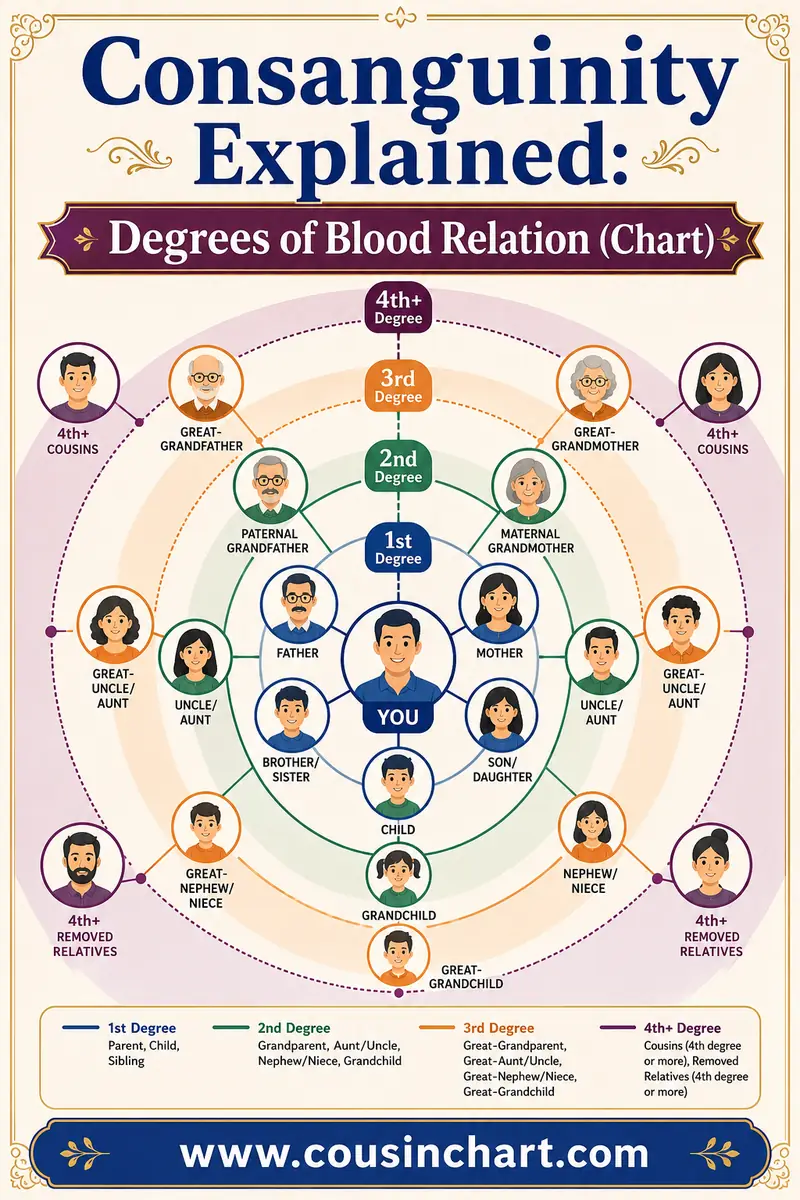
You'll often hear relatives grouped by "degree," especially in medicine. First-degree relatives (parents, children, full siblings) have r = 1/2. Second-degree relatives (grandparents, grandchildren, aunts, uncles, nieces, nephews, half-siblings) have r = 1/4. Third-degree relatives (first cousins, great-grandparents, great-aunts and great-uncles, half-aunts and half-uncles) have r = 1/8. Each degree halves the coefficient.
Where the coefficient of relationship came from
The geneticist Sewall Wright introduced the coefficient of relationship in his 1922 paper "Coefficients of Inbreeding and Relationship" in The American Naturalist. Wright was working on animal breeding, where it mattered a lot to know how closely related two animals were before pairing them. His method of tracing paths through a pedigree is still the way the number is calculated by hand today.
The idea spread well beyond breeding. In 1964, the biologist W. D. Hamilton used Wright's coefficient as the "r" in what became known as Hamilton's rule, an idea in evolutionary biology about when helping a relative can pay off genetically. That's why you'll sometimes see the coefficient of relationship in biology textbooks discussing why animals help their siblings.
For family historians, the coefficient took on a new life with consumer DNA testing. Every time a testing company predicts a relationship from shared DNA, it's comparing what it measured with what the coefficient says relatives should share on average.
How to calculate the coefficient of relationship, step by step
The standard hand method is called path counting. Steven Carr's teaching page at Memorial University, "Graphical calculations of the expectation of Identity by Descent", describes the core of it: trace each route from a common ancestor down through each parent-to-offspring transmission, give each step a probability of 1/2, multiply along the path, and add the paths together.
Here's the method as five plain steps.
- Draw or picture the family tree. Put the two people you're comparing at the bottom.
- Find every common ancestor. Only count the most recent ones on each line. For full first cousins, that's the shared grandmother and the shared grandfather. You don't count the great-grandparents separately, because their DNA reaches the cousins only through the grandparents.
- For each common ancestor, count the steps. Count every parent-to-child link from person A up to the ancestor, then from the ancestor down to person B. Call that number n.
- Work out (1/2) to the power n for each path. Each step is a 50% chance that a given piece of DNA was passed on, so the probability for the whole path is 1/2 multiplied by itself n times.
- Add up the paths. The total is the coefficient of relationship.
Each parent-to-child step is one meiosis, the type of cell division that makes eggs and sperm. So "count the steps" and "count the meioses" mean the same thing.
Example: full siblings
Two full siblings share a mother and a father.
- Through Mom: Sibling A to Mom (1), Mom to Sibling B (1). n = 2. (1/2) squared = 1/4.
- Through Dad: same thing. 1/4.
- Total: 1/4 + 1/4 = 1/2.
Example: half-siblings
Half-siblings share only one parent, so there's just one path.
- Through the shared parent: n = 2. (1/2) x (1/2) = 1/4.
That's the whole difference between full and half-siblings: one path instead of two. Our guide to three-quarter siblings covers the in-between case, which we'll also calculate below.
Example: first cousins
First cousins share two grandparents.
- Through Grandma: Cousin A to Parent A (1), Parent A to Grandma (1), Grandma to Parent B (1), Parent B to Cousin B (1). n = 4. (1/2) to the 4th = 1/16.
- Through Grandpa: also n = 4, also 1/16.
- Total: 1/16 + 1/16 = 1/8.
Example: a direct line
When one person descends from the other, there's no "up and over." You just count the steps down.
- Parent to child: n = 1. 1/2.
- Grandparent to grandchild: n = 2. 1/4.
- Great-grandparent to great-grandchild: n = 3. 1/8.
Coefficient of relationship values for common relatives
Here's the full table for the relationships most people care about. "Paths" is the number of shared ancestors connecting the two people, and "steps per path" is n.
| Relationship | Paths | Steps per path | Math | Coefficient (r) | Percent |
|---|---|---|---|---|---|
| Identical twins | n/a | n/a | Same genome | 1 | 100% |
| Parent / child | 1 (direct) | 1 | 1/2 | 1/2 | 50% |
| Full siblings | 2 | 2 | 1/4 + 1/4 | 1/2 | 50% |
| Half-siblings | 1 | 2 | 1/4 | 1/4 | 25% |
| Grandparent / grandchild | 1 (direct) | 2 | 1/4 | 1/4 | 25% |
| Aunt or uncle / niece or nephew | 2 | 3 | 1/8 + 1/8 | 1/4 | 25% |
| Half-aunt or half-uncle | 1 | 3 | 1/8 | 1/8 | 12.5% |
| Great-grandparent | 1 (direct) | 3 | 1/8 | 1/8 | 12.5% |
| Great-aunt or great-uncle | 2 | 4 | 1/16 + 1/16 | 1/8 | 12.5% |
| First cousins | 2 | 4 | 1/16 + 1/16 | 1/8 | 12.5% |
| Half first cousins | 1 | 4 | 1/16 | 1/16 | 6.25% |
| First cousins once removed | 2 | 5 | 1/32 + 1/32 | 1/16 | 6.25% |
| Second cousins | 2 | 6 | 1/64 + 1/64 | 1/32 | 3.125% |
| Second cousins once removed | 2 | 7 | 1/128 + 1/128 | 1/64 | 1.5625% |
| Third cousins | 2 | 8 | 1/256 + 1/256 | 1/128 | 0.78% |
| Fourth cousins | 2 | 10 | 1/1,024 + 1/1,024 | 1/512 | 0.20% |
If you're not sure how "once removed" works, our explainer on what once removed means walks through it. In short, each "removed" adds one generation, so one more step to the path, which halves the coefficient.
A shortcut formula for cousins
You don't need to draw a tree for every cousin. For full nth cousins m times removed, the shared ancestors are a couple, so there are always two paths. Each path has n + 1 steps up from the closer cousin, n + 1 + m steps up from the other cousin, so 2n + 2 + m steps in total. That gives:
- Full cousins: r = 2 x (1/2) to the power (2n + 2 + m) = (1/2) to the power (2n + 1 + m)
- Half cousins (one shared ancestor): r = (1/2) to the power (2n + 2 + m)
Check it: first cousins are n = 1, m = 0, so (1/2) to the 3rd = 1/8. Second cousins once removed are n = 2, m = 1, so (1/2) to the 6th = 1/64. Both match the table. Our guide to degrees of cousinship explains how to find n and m from a family tree.
Families with more than one connection
The path method really shows its value when people are related in more than one way. The rule doesn't change: find every path and add them up.
Double first cousins
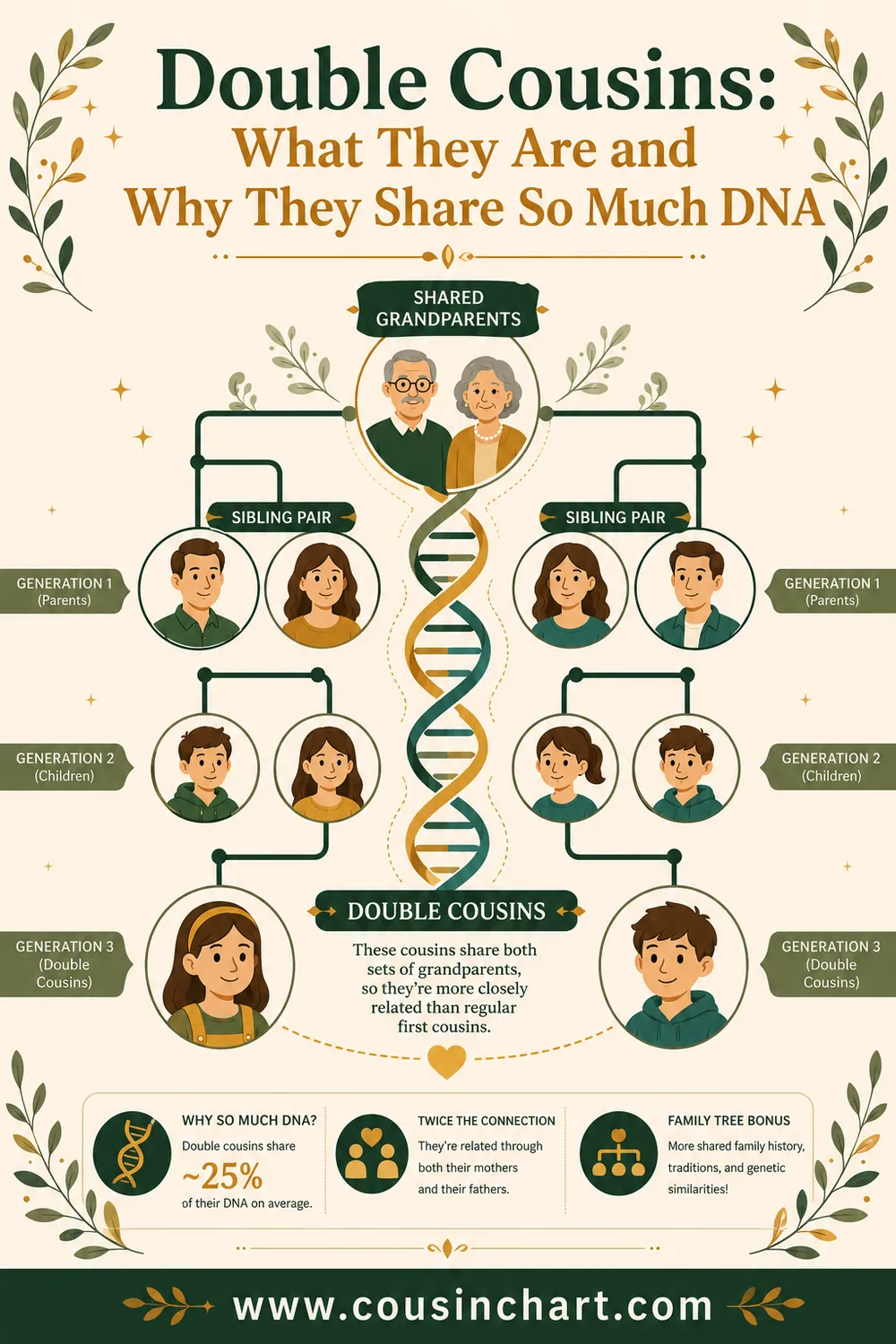
Double first cousins happen when two siblings from one family marry two siblings from another. The cousins share all four grandparents instead of two. That's four paths of four steps each:
- 4 x (1/2) to the 4th = 4 x 1/16 = 1/4.
So double first cousins have the same expected sharing as half-siblings, 25%. Our page on double cousins goes into what that looks like in real DNA results.
Three-quarter siblings
Three-quarter siblings share one parent, and their other parents are siblings of each other. For example, two children have the same mother, and their fathers are brothers.
- Through the shared mother: 2 steps = 1/4.
- Through the brothers' parents (the paternal grandmother): Child A to Father A to Grandma to Father B to Child B. 4 steps = 1/16.
- Through the paternal grandfather: another 1/16.
- Total: 1/4 + 1/16 + 1/16 = 4/16 + 2/16 = 6/16 = 3/8 = 37.5%.
That's halfway between half-siblings (25%) and full siblings (50%), which is where the name comes from.
Identical twins in the family
Identical twins come from one fertilized egg, and the National Human Genome Research Institute describes them as sharing the same genome. So between twins, r = 1. When a path runs through a pair of identical twins, you can step from one twin to the other for free: multiply by 1, not 1/2.
That has a surprising result for their children. Say twin sisters each have a child. The children are first cousins on the tree, but the path is:
- Child A to Twin A (1 step), Twin A is Twin B (multiply by 1), Twin B to Child B (1 step).
- 2 steps: (1/2) squared = 1/4.
That's the same as half-siblings, double the usual 1/8 for first cousins. A Stanford at The Tech "Ask a Geneticist" answer gives the same result: the children of identical twins share about 25% of their DNA instead of the usual 12.5%.
Watch out for one trap here. The twins also have parents, so you might be tempted to add the two grandparent paths (1/16 each) on top. Don't. The grandparents' DNA was locked in once, in the single egg that became both twins. The twin path already includes it. Adding the grandparent paths would double-count and give the wrong answer of 3/8.
Pedigree collapse and endogamy
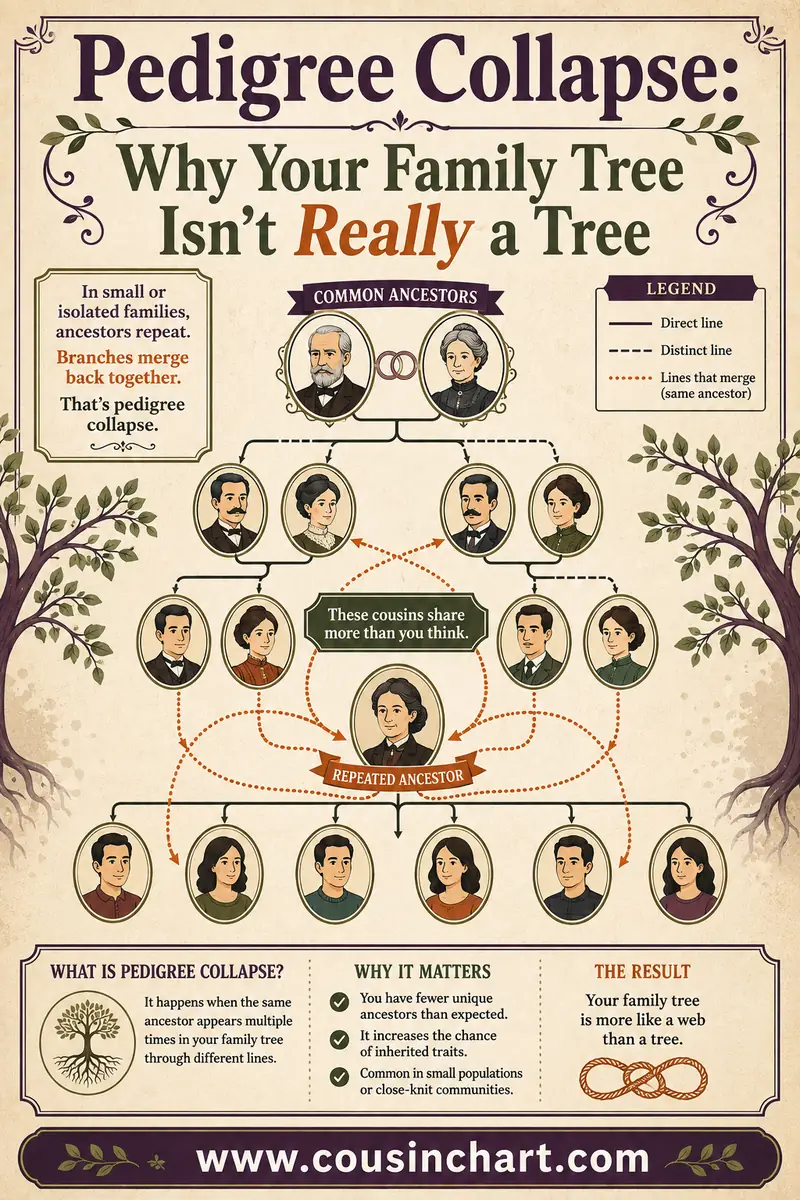
When cousins in earlier generations married each other, the same ancestor shows up in more than one place in your tree. Genealogists call this pedigree collapse. In communities where people married within a small group for many generations, called endogamy, it happens over and over.
The path method handles this automatically: each extra route to a shared ancestor is another path to add. That's why relatives in collapsed or endogamous trees share more DNA than the standard table predicts. The Shared cM Project, Version 4.0 warns about exactly this, noting that endogamy and pedigree collapse "will increase the amount of DNA shared" by people with a given relationship, and that many contributors won't know about it in their own trees.
When a shared ancestor is inbred
Wright's full formula has one more piece. If a common ancestor is themselves the child of related parents, that ancestor's two copies of a gene are sometimes already identical. So each path through them counts a little more. In the formal version, each path through an ancestor A gets multiplied by (1 + F), where F is that ancestor's inbreeding coefficient (explained below). For an ancestor whose parents were first cousins, F = 1/16, so each path through them is multiplied by 1 + 1/16 = 1.0625. For most family trees the adjustment is small, but in heavily intermarried families it adds up.
Coefficient of relationship vs. kinship coefficient vs. inbreeding coefficient
Three numbers get mixed up all the time. They're closely linked, but they're not the same.
The kinship coefficient
The kinship coefficient, also called the coefficient of coancestry and often written as phi or theta, is the probability that a gene copy picked at random from one person and a gene copy picked at random from the other are identical by descent. It's exactly half the coefficient of relationship when nobody involved is inbred. Puppala and colleagues put it simply in their table's footnote: "The relationship coefficient is 2 x coefficient of kinship." Sethuraman's paper makes the same point, describing relatedness as twice the coefficient of coancestry.
So if a study says half-siblings have a kinship of 1/8 and you read elsewhere that their relationship is 1/4, both are right. They're just measuring different things.
The inbreeding coefficient
The inbreeding coefficient, written F, belongs to one person, not a pair. It's the probability that the two copies of a gene that person carries (one from Mom, one from Dad) are identical by descent. It equals the kinship coefficient of that person's parents. That means, for parents who aren't inbred themselves, F is half the parents' coefficient of relationship.
- Parents who are first cousins: r = 1/8, so the child's F = 1/16 (6.25%). Carr's Memorial University page sets this exact result as an exercise, asking readers to show that children of first cousins have an inbreeding coefficient of 1/16.
- Parents who are second cousins: r = 1/32, so F = 1/64 (about 1.6%).
- Parents who are unrelated: r = 0, so F = 0.
If you're reading about health in families where relatives married, F is the number that matters, and our article on consanguinity covers the background in plain language.
| Measure | Describes | Half-siblings | First cousins | Child of first cousins |
|---|---|---|---|---|
| Coefficient of relationship (r) | A pair of people: expected share of DNA identical by descent | 1/4 | 1/8 | n/a (one person) |
| Kinship coefficient (phi) | A pair of people: chance that one random gene copy from each is identical by descent | 1/8 | 1/16 | n/a (one person) |
| Inbreeding coefficient (F) | One person: chance that their two gene copies are identical by descent | n/a (a pair) | n/a (a pair) | 1/16 |
Shared copies: the IBD probabilities
There's one more way geneticists describe relatedness, and it explains a lot about DNA test results. At any spot in the genome, two relatives can share zero, one or two copies identical by descent. Timothy Thornton's University of Washington lecture slides on estimating relatedness list these probabilities:
- Parent and child: share exactly one copy everywhere (0 / 1 / 0 for two, one or zero copies).
- Full siblings: 1/4 two copies, 1/2 one copy, 1/4 none.
- Half-siblings and uncle-nephew: 0 two copies, 1/2 one copy, 1/2 none.
- First cousins: 0, 1/4, 3/4.
- Double first cousins: 1/16, 6/16, 9/16.
- Second cousins: 0, 1/16, 15/16.
You can turn these into the coefficient of relationship with one line: r = (chance of sharing two copies) + half of (chance of sharing one copy). For full siblings: 1/4 + 1/2 x 1/2 = 1/2. For double first cousins: 1/16 + 1/2 x 6/16 = 1/16 + 3/16 = 4/16 = 1/4. Both match what the path method gave us.
From the coefficient of relationship to centimorgans
DNA tests don't report r. They report shared centimorgans (cM), a measure of the length of matching DNA segments. If that unit is new to you, start with how much DNA cousins share, which covers cousin cM numbers in more detail. Here's how to go from one to the other.
Step 1: Know the total
Blaine Bettinger's Shared cM Project report gives the key fact: the expected value for half-siblings is 25%, "or 1,700 cM." From that:
- 25% = 1,700 cM, so 100% = 1,700 / 0.25 = 6,800 cM (both copies of every chromosome).
- One copy of the genome is half of that: 3,400 cM.
Step 2: Multiply
For most relationships, expected shared cM = r x 6,800. First cousins: 1/8 x 6,800 = 850 cM. Second cousins: 1/32 x 6,800 = 212.5 cM.
Step 3: Adjust for relatives who share both copies
Testing companies count how much of the genome two people match on at least one copy. They don't count a stretch twice when the match is on both copies. For relatives who never share both copies (parents, half-siblings, aunts, cousins), that doesn't matter. For full siblings, double cousins and three-quarter siblings, it does. The more accurate formula is:
- Expected shared cM = 3,400 x (chance of sharing one copy + chance of sharing two copies)
Full siblings: 3,400 x (1/2 + 1/4) = 3,400 x 3/4 = 2,550 cM, not 3,400. Double first cousins: 3,400 x (6/16 + 1/16) = 3,400 x 7/16 = about 1,488 cM, not 1,700. Three-quarter siblings (same mother, fathers are brothers): they share two copies with probability 1/2 x 1/4 = 1/8 and at least one copy with probability 1/2 + 1/2 x 1/4 = 5/8, so 3,400 x 5/8 = 2,125 cM.
Expected vs. observed
How well does the math hold up? The table below compares the expected cM with the averages and ranges from DNA Painter's Shared cM Project 4.0 tool, built from nearly 60,000 submitted matches with known relationships.
| Relationship | r | Expected cM | Observed average cM | Observed range cM |
|---|---|---|---|---|
| Parent / child | 1/2 | 3,400 | 3,485 | 2,376 to 3,720 |
| Full siblings | 1/2 | 2,550 (both-copy adjustment) | 2,613 | 1,613 to 3,488 |
| Half-siblings | 1/4 | 1,700 | 1,759 | 1,160 to 2,436 |
| Grandparent | 1/4 | 1,700 | 1,754 | 984 to 2,462 |
| Aunt or uncle | 1/4 | 1,700 | 1,741 | 1,201 to 2,282 |
| Great-grandparent | 1/8 | 850 | 887 | 485 to 1,486 |
| Half-aunt or half-uncle | 1/8 | 850 | 871 | 492 to 1,315 |
| First cousin | 1/8 | 850 | 866 | 396 to 1,397 |
| Half first cousin | 1/16 | 425 | 449 | 156 to 979 |
| First cousin once removed | 1/16 | 425 | 433 | 102 to 980 |
| Second cousin | 1/32 | 213 | 229 | 41 to 592 |
| Second cousin once removed | 1/64 | 106 | 122 | 14 to 353 |
| Third cousin | 1/128 | 53 | 73 | 0 to 234 |
Two patterns stand out. For close relatives, the averages land within a few percent of the math. For more distant cousins, the observed averages run higher than expected: third cousins average 73 cM against an expected 53. Part of the reason is in the project's methods. For relationships where some pairs share nothing, the report says averages were calculated only for pairs sharing more than 0 cM. Leaving out the zeros pulls the average up. Testing company matching thresholds, which hide very small segments, and unknown pedigree collapse also play a part.
Why real DNA sharing varies from the coefficient
The coefficient of relationship is an average, and real families scatter widely around it. Look at the ranges in the table above: first cousins run from 396 to 1,397 cM. As shares of 6,800 cM, that's:
- 396 / 6,800 = about 5.8%
- 1,397 / 6,800 = about 20.5%
That's a big spread around the expected 12.5%. The reason is how DNA is passed on. A parent doesn't pass on a random scatter of tiny pieces. They pass on long chunks of chromosomes, shuffled by a few crossover points per chromosome each generation (the process is called recombination). Because the chunks are big and few, chance has a lot of room to swing the total up or down. Two half-siblings might happen to get mostly the same chunks from their shared parent, or mostly different ones.
Only parent and child are fixed
The one relationship that barely varies is parent and child. Every child gets exactly one copy of each chromosome from each parent, so they match a parent on one copy everywhere. The small spread you see in the parent/child range comes from how testing companies measure, not from real differences in inheritance.
Siblings can be "more" or "less" related
Full siblings all have r = 1/2 on paper, but real pairs of siblings vary. That's why one sibling might match a cousin at 900 cM while the other sibling matches the same cousin at 700 cM. Both are normal. It's also why genealogists test several siblings when they can: each one carries a different slice of the parents' DNA.
Distant cousins can share nothing
For third cousins and beyond, it's entirely possible to share no detectable DNA at all, even though the coefficient is above zero. The Shared cM Project's third-cousin range starts at 0 cM. A coefficient of 1/128 means a small expected share, not a guaranteed one.
Common mistakes with the coefficient of relationship
Counting people instead of steps
The most common slip is counting the people on a path instead of the parent-to-child links between them. For first cousins, the path is Cousin A, Parent A, Grandparent, Parent B, Cousin B. That's five people but four links. Use the links. If you count people, you'll get 1/32 per path instead of 1/16 and end up with half the right answer.
Forgetting the second path
Full relatives connect through a couple, so there are two paths. If you only follow one grandparent, first cousins come out at 1/16, which is the value for half first cousins. If a family is "full" on that line, double the single-path answer.
Counting ancestors behind ancestors
Only use the most recent common ancestors on each line. First cousins also share great-grandparents, but all of that DNA passes through the shared grandparents. Counting the great-grandparents as extra paths would double-count.
Mixing up r and kinship
If one source says first cousins are 1/8 and another says 1/16, check whether the second is a kinship coefficient. It probably is. Kinship is half of r.
Treating the coefficient as a guarantee
The coefficient predicts the average, not your result. A third cousin who shares 0 cM is still a third cousin.
Using r x 6,800 for full siblings
As shown above, that gives 3,400 cM, but full siblings average about 2,600. Use the both-copy adjustment for any relationship with two separate lines of descent.
Using the coefficient to read a DNA match
Here's how the coefficient helps with a real puzzle. Maria tests and finds a match, Daniel, at 460 cM. Neither knows how they're connected.
- Convert to a share. 460 / 6,800 = about 6.8%. The closest coefficient is 1/16, or 6.25%.
- List the relationships at 1/16. From the table: half first cousins, first cousins once removed, and also double second cousins or anyone connected through two sets of second-cousin paths. Great-great-grandparents are 1/16 too, but ages rule that out quickly.
- Check the ranges. DNA Painter's tool gives half first cousins 156 to 979 cM and first cousins once removed 102 to 980 cM. 460 fits both comfortably. It also fits the top part of the second-cousin range (41 to 592), so a high-sharing second cousin is still possible.
- Use the tree and ages. Maria is 40 and Daniel is 68. A generation gap points toward first cousins once removed: Daniel could be a first cousin of Maria's parent.
- Test the idea. If Maria's mother tests and matches Daniel at around 850 cM (the 1/8 level of a first cousin), the first-cousin-once-removed answer is strongly supported.
The coefficient doesn't solve the puzzle alone. It narrows a long list of possible relationships to a short one, and family records and other matches do the rest.
Try it yourself
Work these out with the path method, then check the answers below.
- What's the coefficient of relationship between you and your half-uncle (your parent's half-brother)?
- Two people are second cousins, and they're also second cousins through a second, unrelated set of shared great-grandparents. What's r?
- What's r between you and your great-great-grandmother?
- Your parents are second cousins. What's your inbreeding coefficient?
- Two half first cousins once removed: what's r, and about how many cM would you expect?
Answers:
- One shared ancestor (your grandparent, who is your half-uncle's parent). Path: you to parent (1), parent to grandparent (1), grandparent to half-uncle (1). n = 3, so r = 1/8 = 12.5%.
- Each set of shared great-grandparents gives two paths of 6 steps: 2 x 1/64 = 1/32. Two sets: 1/32 + 1/32 = 1/16 = 6.25%. That's the same as first cousins once removed or half first cousins.
- Direct line, 4 steps: (1/2) to the 4th = 1/16 = 6.25%.
- Second cousins have r = 1/32. Your F is half of that: 1/64, about 1.6%.
- Half cousins formula with n = 1, m = 1: (1/2) to the power (2 + 2 + 1) = 1/32. Expected cM: 6,800 / 32 = 212.5 cM. DNA Painter's tool gives half first cousins once removed an average of 224 cM, with a range of 62 to 469.
Putting the coefficient of relationship to work
The coefficient of relationship turns a family tree into a number: count the parent-to-child steps through each shared ancestor, halve once per step, and add the paths. It explains why full siblings are 1/2, cousins are 1/8 and double cousins are 1/4. It tells you what a DNA test should show on average, and the Shared cM Project's real data shows how close that average comes and how widely real families vary around it. Keep the kinship and inbreeding coefficients straight, watch for double paths in intermarried families, and you can work out almost any relationship by hand.
If you'd rather skip the math for the family-tree side, try our free family relationship calculator. Tell it how two people connect to a common relative and it names the relationship for you, which you can then plug into the table above.
Keep reading: Children of Identical Twins: Cousins on Paper, Half-Siblings in DNA and What Are the Odds? Using DNA Painter's WATO Tool to Place a DNA Match.
Frequently Asked Questions
What is the coefficient of relationship between first cousins?
First cousins have a coefficient of relationship of 1/8, or 12.5%. They share two grandparents, so there are two paths connecting them. Each path has four parent-to-child steps: up from one cousin to their parent, up to the grandparent, down to the other parent, and down to the other cousin. One half multiplied four times is 1/16, and two paths give 1/16 plus 1/16, which is 1/8. In DNA terms, that's about 850 cM expected, and the Shared cM Project's observed average for first cousins is 866 cM.
How do you calculate the coefficient of relationship?
Use the path method. Find every most-recent common ancestor the two people share. For each one, count the parent-to-child links from the first person up to the ancestor and back down to the second person. Raise one half to that number. Then add up the results from all the paths. For example, full siblings have two paths of two links each, so one quarter plus one quarter equals one half. Remember to count links, not people, and to include every shared ancestor.
What is the difference between the coefficient of relationship and the kinship coefficient?
The coefficient of relationship, r, is the expected share of DNA two people have inherited from common ancestors. The kinship coefficient, also called the coefficient of coancestry, is the chance that a gene copy picked at random from each person is identical by descent. When nobody involved is inbred, the kinship coefficient is exactly half of r. So half-siblings have r of 1/4 and a kinship coefficient of 1/8. Both numbers are correct; they just answer slightly different questions, so always check which one a source is using.
Is the coefficient of relationship the same as the percentage of DNA you share?
It's the expected average percentage of DNA you share by descent from common ancestors, not the exact amount any one pair shares. Real sharing varies because DNA is passed on in large shuffled chunks. First cousins have an expected 12.5%, but the Shared cM Project's observed range runs from 396 to 1,397 cM, or roughly 6% to 20%. Also note that all humans share most of their DNA sequence in general. The coefficient only counts DNA inherited from the recent ancestors in the family tree.
What is the coefficient of relationship for half-siblings?
Half-siblings have a coefficient of relationship of 1/4, or 25%. They share only one parent, so there's a single path with two steps: from the first sibling up to the shared parent, then down to the second sibling. One half times one half equals one quarter. That's the same expected value as grandparents and grandchildren, aunts or uncles and their nieces or nephews, double first cousins, and the children of identical twins. On DNA tests, half-siblings average 1,759 cM in the Shared cM Project.
Why do full siblings share less cM than the coefficient of relationship predicts?
Full siblings have r of 1/2, which would suggest about 3,400 cM, but they average about 2,613 cM. The reason is how DNA tests count. They measure how much of the genome two people match on at least one copy, and they don't count a stretch twice when siblings match on both copies. Full siblings match on at least one copy about three quarters of the time, so 3,400 times 3/4 gives about 2,550 cM, which is close to the observed average.
How is the inbreeding coefficient related to the coefficient of relationship?
The inbreeding coefficient, F, describes one person rather than a pair. It's the chance that the two copies of a gene that person carries, one from each parent, are identical by descent. It equals the kinship coefficient of the person's parents, which is half of the parents' coefficient of relationship when the parents aren't inbred themselves. So a child whose parents are first cousins, with r of 1/8, has an inbreeding coefficient of 1/16. A child of second cousins has an inbreeding coefficient of 1/64.
Who invented the coefficient of relationship?
The American geneticist Sewall Wright introduced it in 1922 in a paper called Coefficients of Inbreeding and Relationship, published in The American Naturalist. Wright developed it while studying animal breeding, where knowing how related two animals were mattered. His path-counting approach is still the standard way to calculate it by hand. The biologist W. D. Hamilton later used Wright's coefficient in his 1964 work on how evolution can favor helping relatives, which made the coefficient a staple of biology courses too.
What is the coefficient of relationship for second cousins?
Second cousins have a coefficient of relationship of 1/32, or about 3.1%. They share a pair of great-grandparents, so there are two paths, each with six parent-to-child steps. One half multiplied six times is 1/64, and two paths add up to 1/32. That gives an expected 212.5 cM, using 6,800 cM as the full total. The Shared cM Project's observed average for second cousins is 229 cM, with a range from 41 to 592 cM, so real pairs vary quite a bit.
Sources
We checked every source below while writing this guide. Last reviewed October 30, 2026, by Joan Ramos.
- Coefficients of Inbreeding and Relationship (Wright, 1922, The American Naturalist) (Zenodo (CERN))
- Graphical calculations of the expectation of Identity by Descent (Steven M. Carr, Memorial University of Newfoundland)
- Estimating Relatedness (Summer Institute in Statistical Genetics, Module 10) (Timothy Thornton, University of Washington)
- A genome-wide linkage screen of systolic blood pressure in Mexican-Americans (Puppala et al., 2011) (Human Heredity, via PubMed Central (NIH))
- Estimating Genetic Relatedness in Admixed Populations (Sethuraman, 2018) (G3: Genes, Genomes, Genetics, via PubMed Central (NIH))
- The Shared cM Project, Version 4.0 (March 2020) (Blaine T. Bettinger, The Genetic Genealogist)
- The Shared cM Project 4.0 tool v4 (DNA Painter)
- Identical Twins (Talking Glossary of Genomic and Genetic Terms) (National Human Genome Research Institute)
- I am an identical twin. What percentage of genes do my children share with my twin's children? (Ask a Geneticist) (Stanford at The Tech, The Tech Interactive)