Pedigree Collapse: Why Your Family Tree Isn't Really a Tree
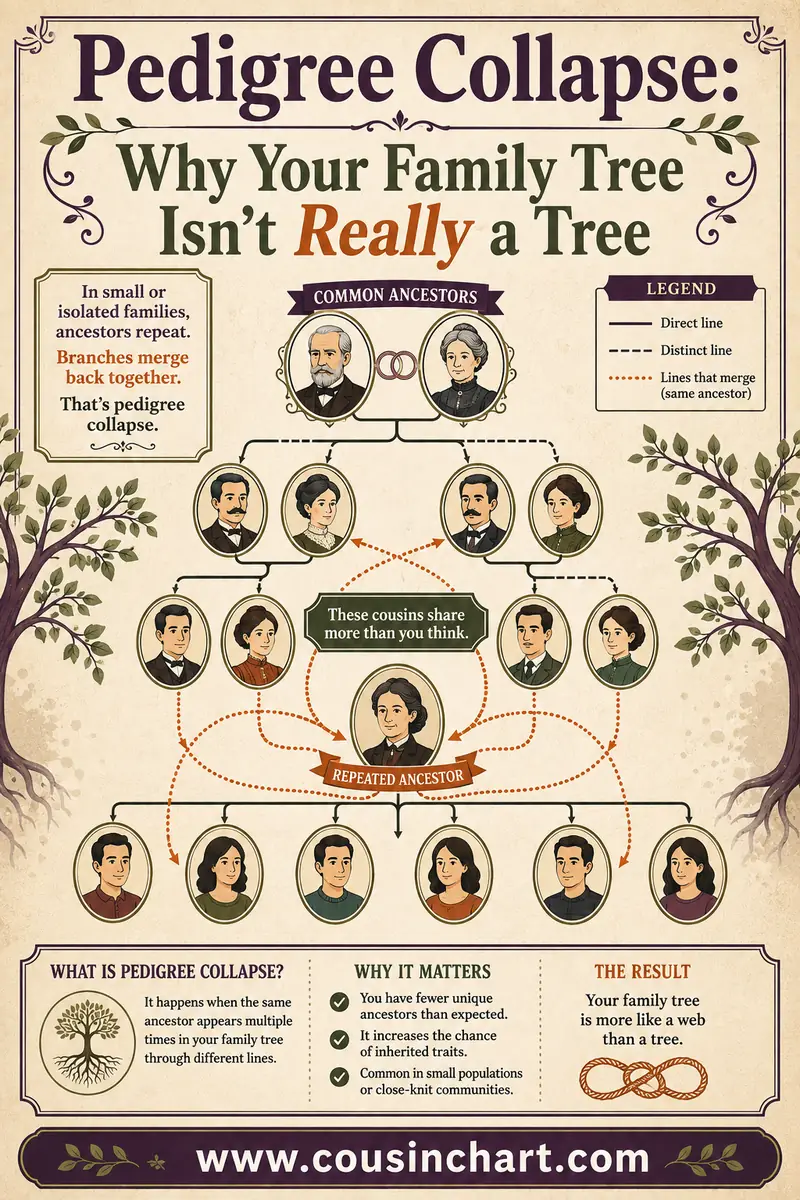
Pedigree collapse is what happens when the same person occupies more than one slot in your family tree — because two of your ancestors were related to each other. Instead of a tree whose branches double cleanly forever, your ancestry folds in on itself: one real great-great-great-grandmother might sit in three different positions on your chart. It's not rare, and it's not a scandal. It's mathematically guaranteed for every human being alive.
This guide explains why the collapse must happen, how cousin marriages cause it, the famous royal examples, and what it does to your DNA matches. And when a folded tree leaves you asking "so what actually is this person to me?", the free family relationship calculator on our homepage untangles any single path in seconds.
Relationship quick-check. Tap a phrase — these are the relationships that fold trees:
The answer will appear here.
The Math That Makes Collapse Inevitable
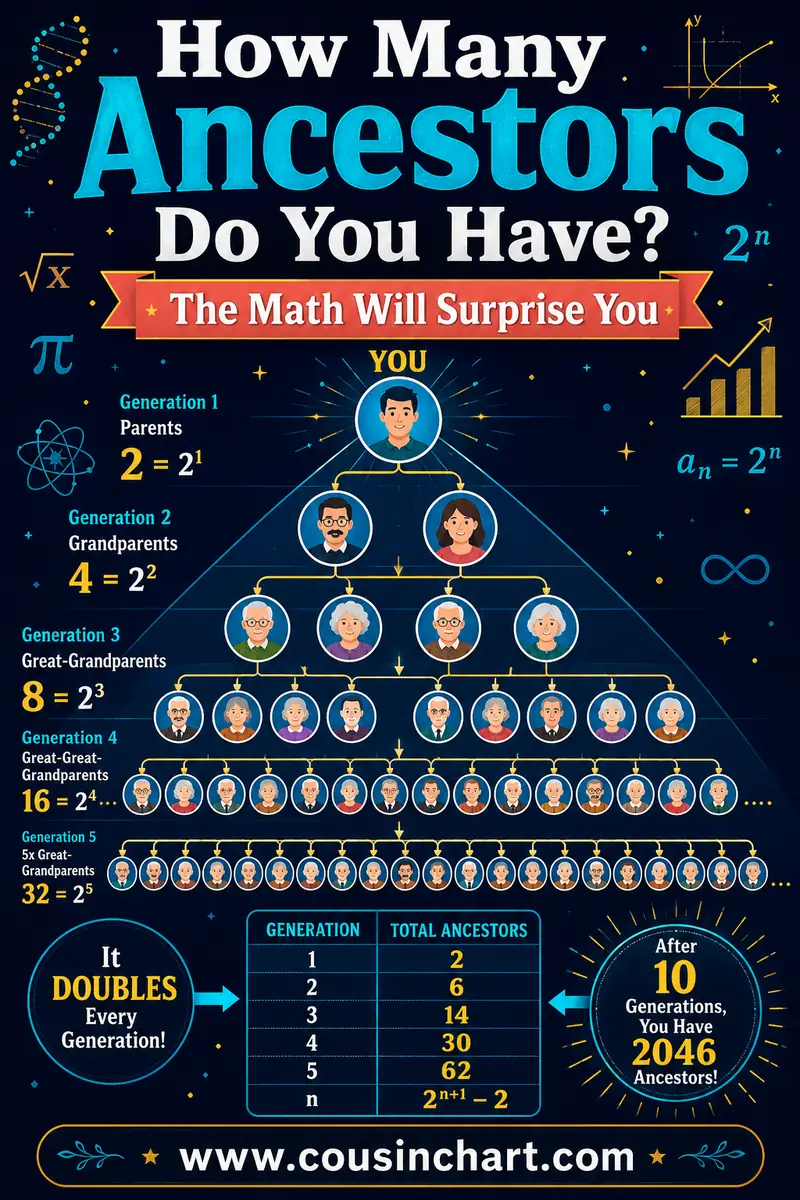
Start with the doubling rule: 2 parents, 4 grandparents, 8 great-grandparents — ancestor slots double every generation. Run that forward and by 30 generations (roughly the 1100s) your chart demands over a billion ancestors; by 40 generations, over a trillion. The world population in those centuries was a few hundred million, and only about 100 billion humans have ever lived. (The full doubling table is in our how many ancestors do you have guide.)
Two numbers that can't both be true — unless the slots aren't all filled by different people. And they aren't. Whenever two of your ancestors were blood relatives, their shared ancestors appear in your tree once per path. One physical person, multiple chart positions. Multiply that across dozens of generations and thousands of village marriages, and the chart's demand for a trillion ancestors gets satisfied by a few hundred thousand real people, endlessly reused.
That's pedigree collapse — the term was popularized by genealogist Robert C. Gunderson. The "tree" is actually a lattice, a web, a braid. Every human's is.
How It Actually Happens: Cousins Marrying Cousins
Pedigree collapse doesn't require anything eyebrow-raising. The overwhelming majority of it comes from distant cousins marrying without knowing it — which, for most of human history, was unavoidable:
- Before modern transportation, most people found spouses within a few miles of home. A village of 300 people simply is a big extended family after a few generations.
- Second-cousin and third-cousin marriages were unremarkable across most of history and most cultures. Many still are.
- Even in big modern populations, everyone has hundreds of fourth cousins and thousands of fifth cousins (most unknown to them). Some of those marry each other by pure chance.
The closer the cousin marriage, the earlier and harder the collapse:
| Spouses' relationship | Shared ancestors | Effect on their child's tree |
|---|---|---|
| First cousins | Grandparents | 6 distinct great-grandparents instead of 8 |
| Second cousins | Great-grandparents | 14 distinct 2nd-great-grandparents instead of 16 |
| Third cousins | 2nd-great-grandparents | 30 distinct 3rd-great-grandparents instead of 32 |
| Double first cousins' children | Both sets of grandparents | Collapse on two lines at once |
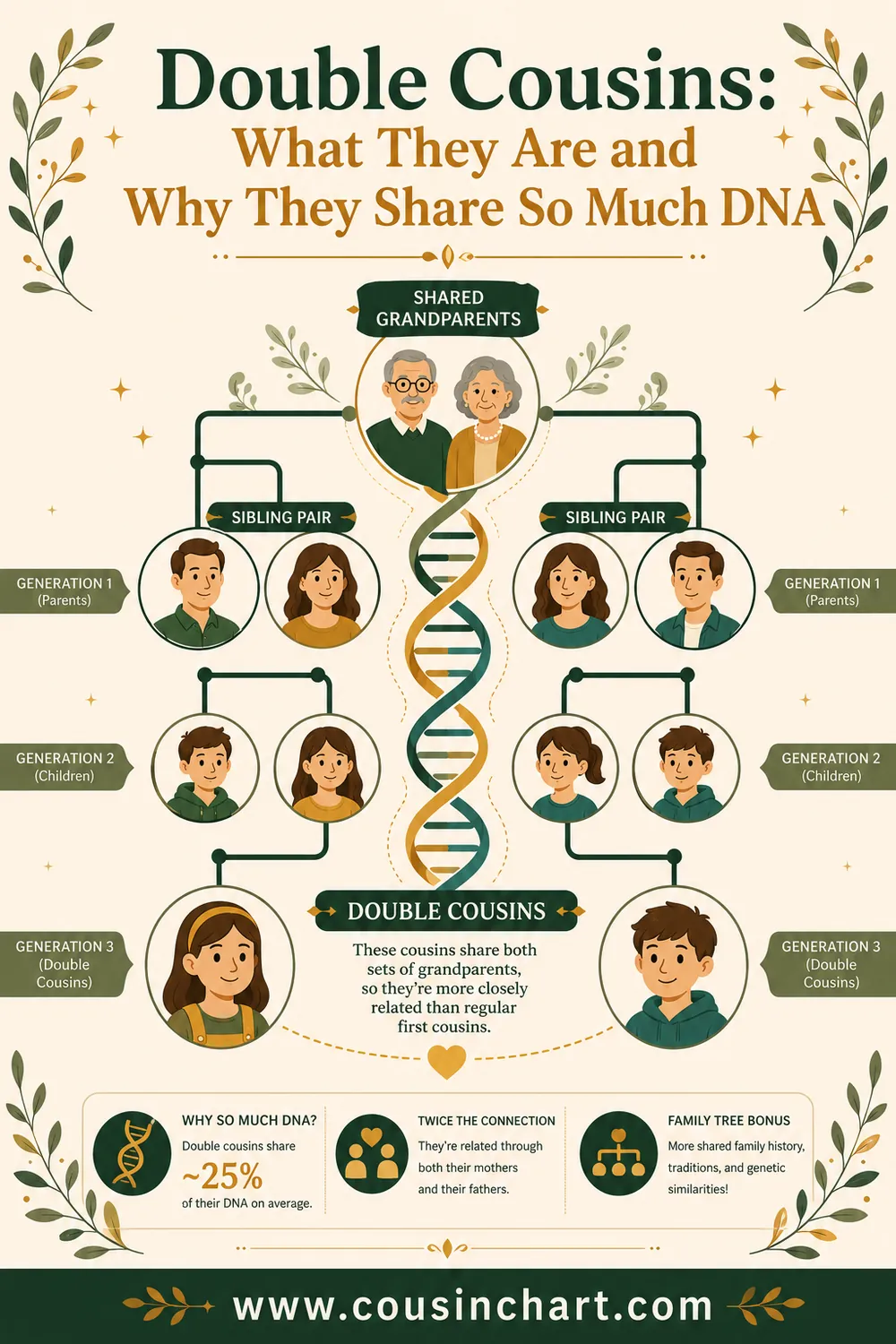
Special mention for double cousins — when two siblings from one family marry two siblings from another, their children are first cousins through both sides and share about 25% DNA. It's the fastest non-obvious way a tree folds; we've covered the whole phenomenon in our double cousins explainer.
Famous Collapses: Royals Did It on Purpose
Ordinary pedigree collapse is accidental. European royalty engineered it, marrying within a small circle of dynasties for centuries to keep crowns in the family.
The textbook case is Charles II of Spain (1661–1700), the last Habsburg king of Spain. Generations of uncle-niece and first-cousin marriages meant his ancestry collapsed dramatically — his mother was his father's niece, making one of his grandfathers also his great-grandfather. Researchers who computed his inbreeding coefficient found it comparable to that of a child of siblings, and he suffered lifelong health problems and died without an heir, ending the dynasty.
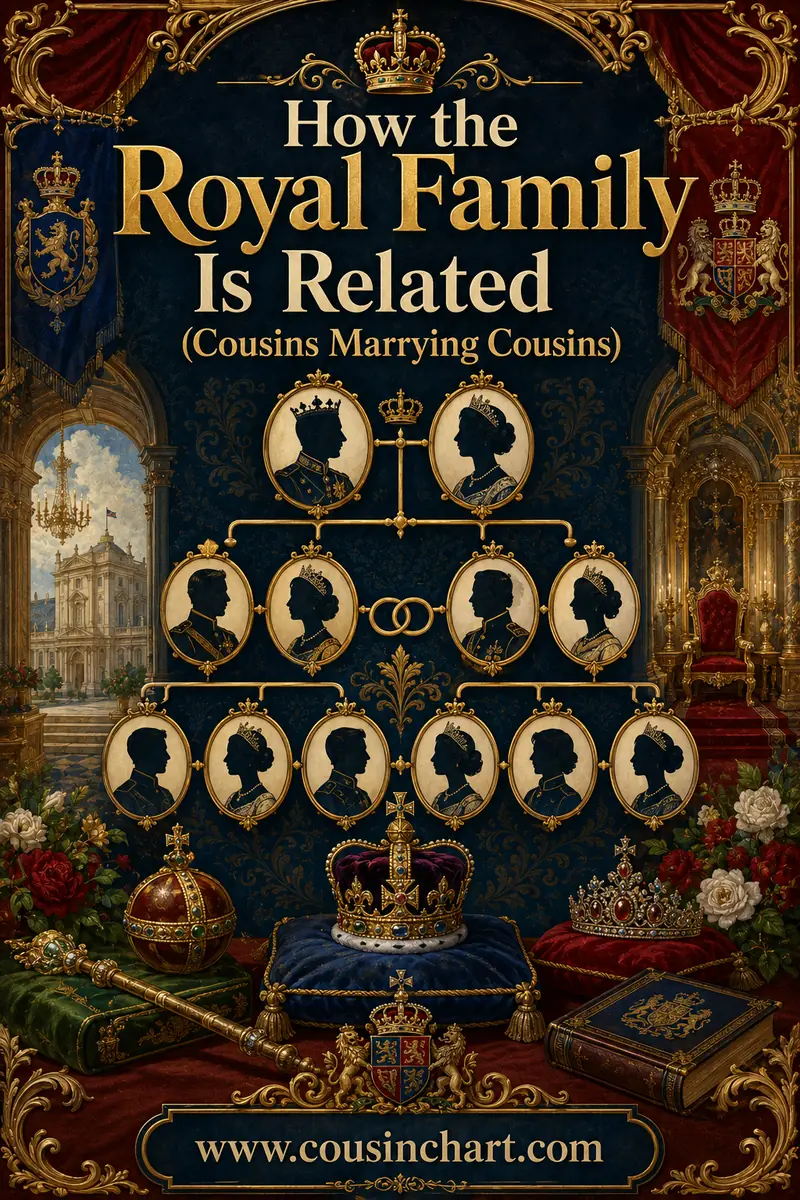
A gentler example: Queen Elizabeth II and Prince Philip were third cousins — both great-great-grandchildren of Queen Victoria (and also related through other lines). Victoria herself married her first cousin Albert. Trace almost any two European royals and you'll find multiple connecting paths — the family's whole chart is a case study, which is why we gave it its own article on how the royal family is related.
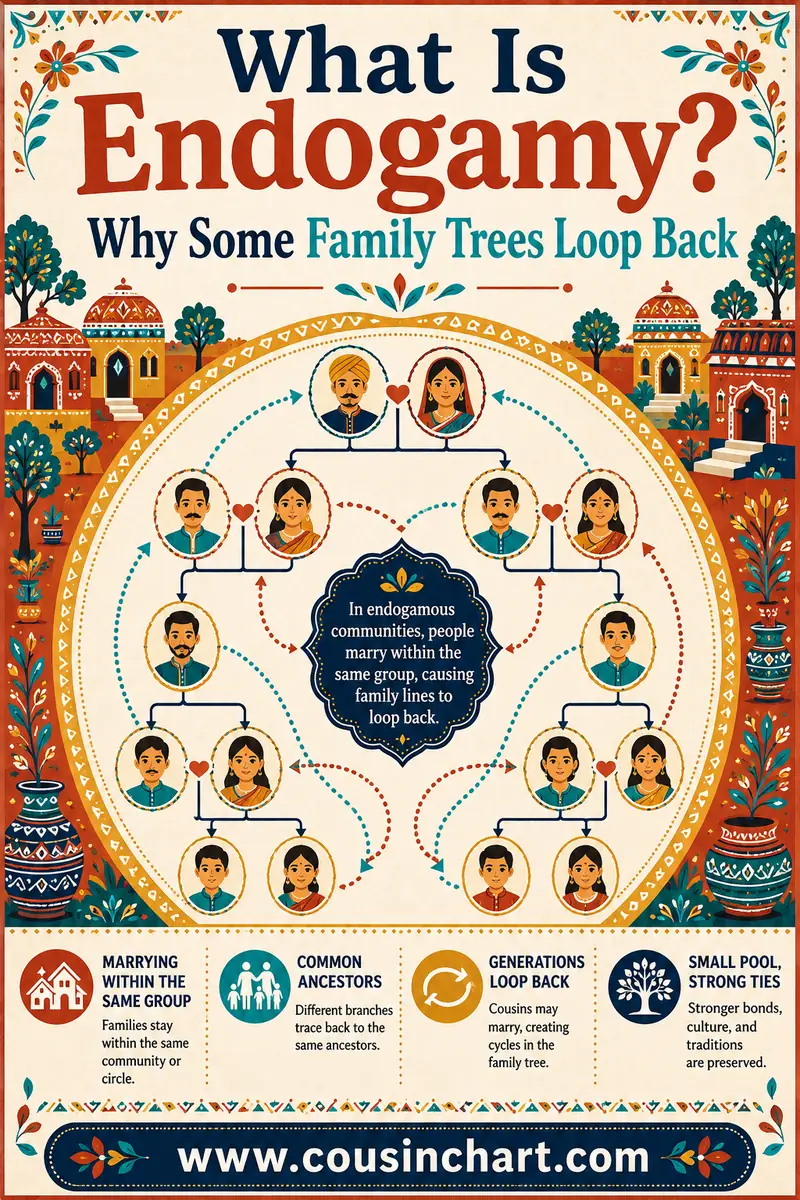
For the rest of us, collapse looks humbler: the same Appalachian, Québécois, Ashkenazi, Acadian, Mennonite, or island-village couple appearing on three branches of the chart. When a whole community marries within itself for centuries, the pattern gets its own name — endogamy — and its own genealogy headaches, covered in what is endogamy.
What Pedigree Collapse Does to Your DNA
Collapse isn't just a charting curiosity — it shows up in your DNA results:
- Matches look closer than they are. If you're related to someone through two or three paths, you share more DNA than a single path predicts. A "second cousin" match by centimorgans might really be a pair of third cousins connected twice. Estimate ranges in match lists assume single paths.
- Runs of homozygosity. When both your parents inherited the same segment from a shared ancestor, you can carry two identical copies. Testing companies can detect these runs; small amounts are common and normal in most populations.
- Ethnicity concentration. Collapse within a region concentrates that region's signal — part of why some people's estimates come back 90%+ from one small area.
- More matches, not fewer. A collapsed tree means fewer distinct ancestors, but each one is connected to you multiple ways, multiplying the descendants who share DNA with you.
Practical tip for researchers: when a match's shared centimorgans seem too high for the paper relationship, stop and look for a second connecting path before assuming the paper trail is wrong.
Is Pedigree Collapse Bad?
Mostly, no — it's just how human ancestry works. Some perspective:
- Everyone has it. The only question is how recently and how densely. Statistically, all humans are related within a surprisingly small number of generations.
- Distant collapse is genetically trivial. Spouses who are third cousins or further share so little DNA that the effect on children is negligible. It took the Habsburgs generations of stacked close marriages to engineer a problem.
- It's genealogically convenient, honestly. Fewer distinct ancestors means fewer lines to research. Quebec genealogists joke that everyone descends from the same 800 founding couples — because, more or less, everyone does.
The one context where recency matters is close-relative marriage, which is a legal and genetic topic of its own — see cousin marriage laws for the factual rundown.
How to Spot (and Chart) Collapse in Your Own Tree
- Watch for repeated surnames in the same region on different branches — the classic early clue.
- Let your software flag it. Most genealogy programs detect when one individual appears on multiple lines and will report "relationship: 5th cousin AND 6th cousin once removed."
- Check marriage dispensations. Catholic church records often note when a couple needed permission to marry as cousins — a collapse event documented in ink.
- Chart one person, multiple positions. The standard practice: enter the ancestor once in your database and let them link into every slot they occupy. On paper charts, note "same as #22" rather than duplicating.
- Name relationships path by path. A doubly-connected relative has two valid relationship labels. Work each path separately — the relationship calculator handles any single path instantly, and you can run it once per connection.
FAQ
What is pedigree collapse in simple terms?
It's when the same person fills more than one ancestor slot in your family tree because two of your ancestors were related to each other. Your chart says you should have 16 great-great-grandparents; if some of them were cousins of each other, you might have only 14 distinct people filling those 16 slots.
Does everyone have pedigree collapse?
Yes — it's mathematically unavoidable. Ancestor slots double every generation, quickly exceeding the entire historical population of Earth. The only way the math resolves is for real people to occupy multiple slots, which happens in every human lineage without exception.
Is pedigree collapse the same as inbreeding?
They overlap but aren't the same. Collapse is the neutral genealogical fact of repeated ancestors, usually from distant cousins marrying unknowingly — genetically insignificant. Inbreeding refers to close-relative unions with meaningful genetic consequences, like the stacked uncle-niece marriages of the Spanish Habsburgs.
How does pedigree collapse affect DNA test results?
Multiple connecting paths inflate shared DNA, so matches can look one relationship "closer" than the paper trail supports. It also produces runs of homozygosity and can concentrate ethnicity estimates. When centimorgans and paperwork disagree, look for a second connection.
What's the difference between pedigree collapse and endogamy?
Scale and pattern. Pedigree collapse is any repeated ancestor in one family's tree. Endogamy is a whole community marrying within itself over many generations — producing dense, community-wide collapse that makes everyone in the group appear related to everyone else in DNA databases.
Who coined the term pedigree collapse?
Genealogist Robert C. Gunderson is credited with popularizing the term. The underlying observation — that ancestor math outruns the human population — has been discussed by genealogists and mathematicians for much longer.
Your Tree Is a Web — Enjoy It
Pedigree collapse sounds like something going wrong, but it's really the discovery that your family tree is finite, interwoven, and connected to everyone else's. The same few ancestors, reused across branches, are the reason humanity's family chart holds together at all.
When the folding produces a genuinely confusing connection — a relative who's somehow your third cousin and your second cousin once removed — take it one path at a time. The free family relationship calculator names each connection precisely, so you can label the web instead of being tangled in it.