How Many Ancestors Do You Have? The Math Will Surprise You
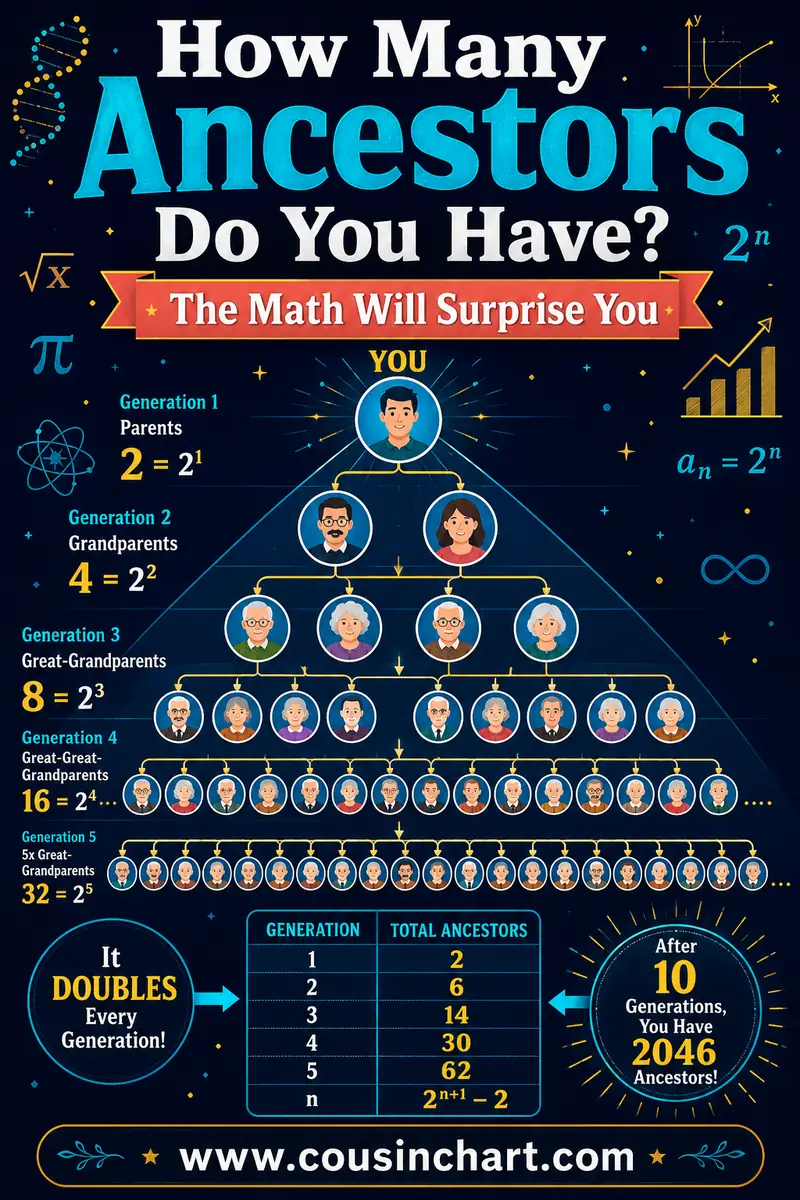
You have 2 parents, 4 grandparents, 8 great-grandparents, and 16 great-great-grandparents — the number doubles every generation. Go back 10 generations and the math says you have 1,024 ancestors in that generation alone; go back 30 and it demands over a billion. Add up every slot across 40 generations and you'd need more than two trillion ancestors — vastly more people than have ever lived.
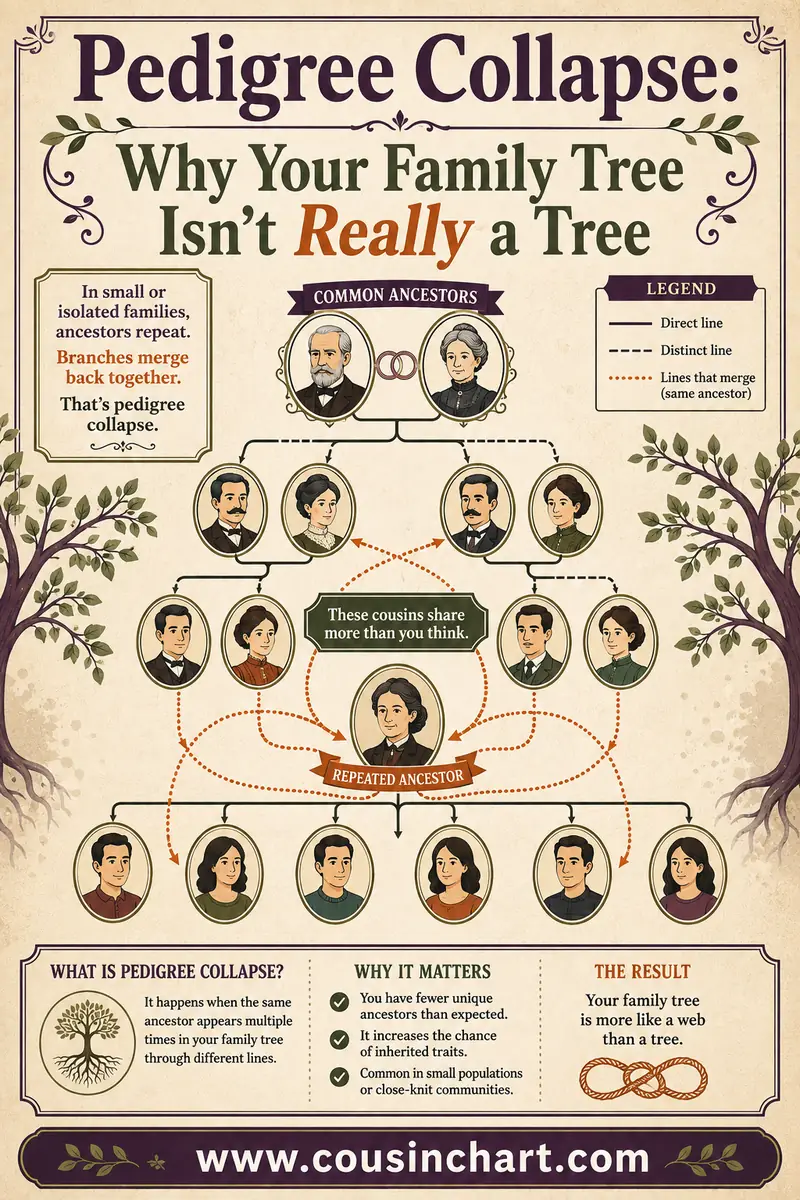
Obviously something has to give, and it does: the same real people fill multiple slots in your tree, a phenomenon called pedigree collapse. This guide walks through the doubling table, exactly when and why the math breaks, and the strange, wonderful conclusion it forces — that everyone on Earth is your cousin. When you find one of those cousins and need to name the relationship, the free family relationship calculator on our homepage does it instantly.
Ancestor quick-check. Tap a generation to see how many ancestor slots it holds:
The answer will appear here.
The Doubling Rule
Every person has exactly two biological parents. That single fact generates the entire ancestor math: each generation back, the number of ancestor slots doubles. In formula terms, generation n holds 2ⁿ slots — 2¹ = 2 parents, 2² = 4 grandparents, 2³ = 8 great-grandparents.
Here's the table, with rough calendar dates assuming about 25–30 years per generation:
| Generations back | Who they are | Ancestor slots | Approx. era |
|---|---|---|---|
| 1 | Parents | 2 | ~1970s–90s |
| 2 | Grandparents | 4 | ~1940s–60s |
| 3 | Great-grandparents | 8 | ~1910s–30s |
| 4 | 2nd-great-grandparents | 16 | ~1880s–1900s |
| 5 | 3rd-great-grandparents | 32 | ~1850s–70s |
| 6 | 4th-great-grandparents | 64 | ~1820s–40s |
| 7 | 5th-great-grandparents | 128 | ~1790s–1810s |
| 8 | 6th-great-grandparents | 256 | ~1760s–80s |
| 10 | 8th-great-grandparents | 1,024 | ~1700s |
| 15 | 13th-great-grandparents | 32,768 | ~1550s |
| 20 | 18th-great-grandparents | 1,048,576 | ~1400s |
| 30 | 28th-great-grandparents | 1,073,741,824 | ~1100s |
| 40 | 38th-great-grandparents | ~1.1 trillion | ~800s |
To get your total ancestors across all generations up to n, add the rows: the sum works out to 2ⁿ⁺¹ − 2. Within 10 generations that's 2,046 ancestor slots. Within 20, over two million. Within 40, about 2.2 trillion.
When the Math Breaks (Because It Must)
Around 1100 AD, the table above claims you had roughly a billion ancestors. The entire world population at the time was somewhere around 300–400 million. By 800 AD the table demands more than a trillion — against a world holding perhaps 200–300 million people, and only on the order of 100 billion humans having ever lived.
The resolution is not that the doubling rule is wrong — everyone really does have two biological parents. The resolution is that the slots aren't all filled by different people. When two of your ancestors were related to each other (say, third cousins — historically extremely common in villages of a few hundred people), their shared ancestors occupy multiple slots in your tree simultaneously. One real person, several branches.
This is pedigree collapse, and it's not a rare glitch; it's the normal condition of every human family tree. The deeper you go, the more the "tree" folds in on itself until it's better described as a web. We've given it a full article of its own: pedigree collapse explained.
So the honest answer to "how many ancestors do you have?" splits in two:
- Ancestor slots: 2ⁿ per generation, forever, by definition.
- Distinct ancestral people: far fewer — the number grows for a while, peaks (research on European populations suggests the widest point falls somewhere around the late medieval period), and then actually shrinks as you go further back, converging toward the whole breeding population of your ancestral regions.
The Other Surprise: DNA Doesn't Reach That Far
Here's the twist that startles even genealogy buffs: you carry DNA from only a fraction of your genealogical ancestors.
You inherit exactly 50% of your autosomal DNA from each parent, but from there randomness takes over. You get roughly 25% from each grandparent (it varies a few points either way), roughly 12.5% per great-grandparent — and by the time you reach 7 to 10 generations back, the expected contribution per ancestor is so small that many ancestors contribute no measurable DNA to you at all.
The arithmetic is stark. Your genome has a limited number of chunks that get shuffled each generation; meanwhile your ancestor slots double relentlessly. Around 10 generations back you have over a thousand ancestor slots but only a few hundred DNA segments to distribute among them. Statistically, most of your 8th-great-grandparents are your ancestors on paper while being genetic strangers.
Two practical consequences:
- A documented paper trail to a 10th-generation ancestor is genealogically real even if no DNA connects you — absence of shared DNA past about the fourth-cousin level proves nothing either way.
- Siblings inherit different fractions of the ancestral deck, which is why your brother's ethnicity estimate doesn't match yours.
Everyone Is Your Cousin (Literally)
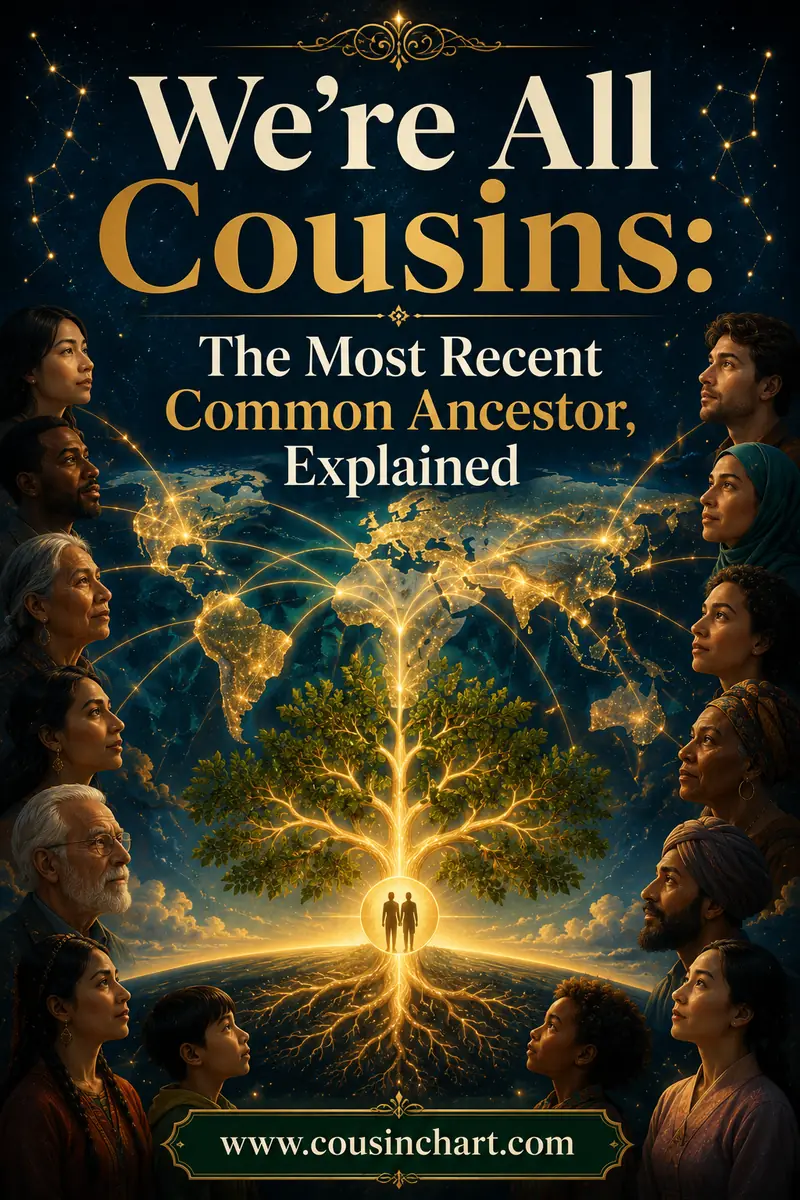
Push the logic to its endpoint and something remarkable falls out. Because ancestor slots double while the actual population stays finite, family trees don't just collapse — they interlock. Statistical models (notably work by Joseph Chang, later popularized by researchers including Adam Rutherford) show that the most recent common ancestor of everyone with European ancestry lived only about 600 years ago, and the most recent common ancestor of all living humans plausibly lived just a few thousand years ago.
Go back a bit further and you hit the "identical ancestors point": a time at which every person then alive who left any descendants is an ancestor of every person alive today. Your family tree and a stranger's family tree aren't separate trees — they're the same web, entered at different points.
Which means "are we related?" is never really the question — the question is only how closely. Our article we're all cousins digs into the common-ancestor math, and for the relatives close enough to name, the relationship calculator turns any connection into its proper term in a couple of clicks.
What This Means for Your Family Tree Research
Some grounded takeaways for actual genealogy:
- Set realistic goals. Documenting all 62 ancestors within five generations is a serious, achievable project. Documenting all 1,024 slots at ten generations is a life's work — and record survival makes complete coverage nearly impossible for most families.
- Expect repeat ancestors. When the same couple shows up on two branches, that's not an error — that's pedigree collapse working as designed. Good genealogy software handles one person occupying multiple slots.
- Don't panic over missing DNA. Beyond third cousins, real relatives frequently share no detectable DNA. Paper proof and DNA evidence answer different questions.
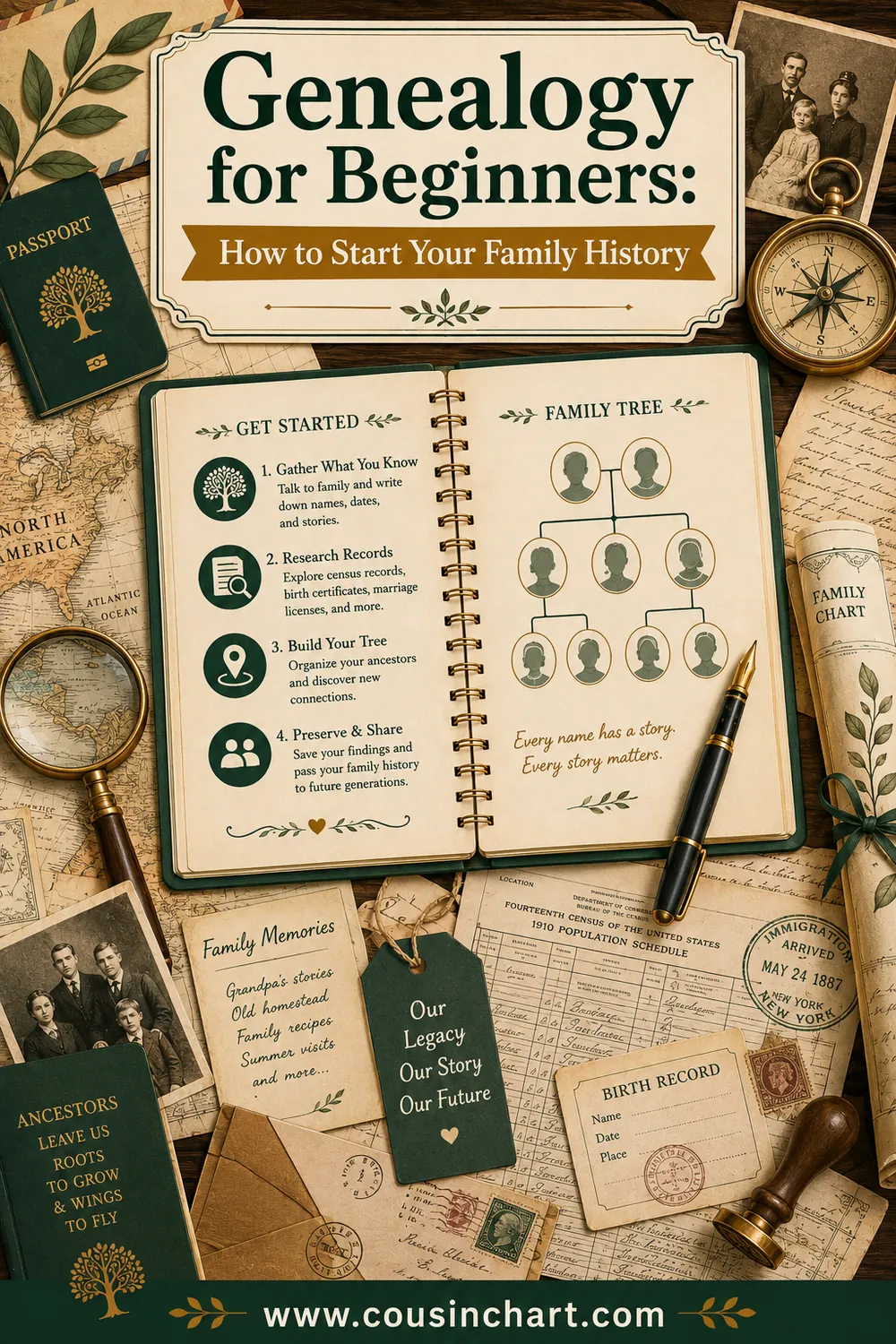
- Interview the living first. Every conversation with a grandparent can name people three or four generations back — data that no archive holds. If you're starting out, our genealogy for beginners guide lays out the whole process step by step.
FAQ
How many ancestors do I have in 10 generations?
1,024 ancestor slots in the tenth generation itself, and 2,046 total across all ten generations (2 + 4 + 8 + … + 1,024). Some slots may be filled by the same person more than once if your ancestors were related to each other.
How many great-grandparents does everyone have?
Eight — your four grandparents each have two parents. Extending the pattern: 16 great-great-grandparents, 32 third-great-grandparents, doubling every generation back.
Why does the ancestor math eventually become impossible?
Because slots double every generation while the human population is finite. Thirty generations back the math demands over a billion ancestors — more than the world population of that era. The same individuals fill many slots (pedigree collapse), so the number of distinct ancestors is far smaller than the number of slots.
Do I have DNA from all my ancestors?
No. DNA inheritance is a halving-and-shuffling process, and beyond roughly 7–10 generations, many genealogical ancestors contribute no detectable DNA to you at all. They're still your ancestors — you just didn't inherit any of their particular segments.
How far back until everyone is related?
Models suggest everyone with European ancestry shares a common ancestor from only about 600 years ago, and all living humans share one within a few thousand years. Further back sits the identical ancestors point, where every person who left descendants is an ancestor of everyone alive today.
How long is a generation in these calculations?
Genealogists typically use 25–30 years. That's why 10 generations lands around the early 1700s and 30 generations reaches the medieval period. Actual families vary — long generations of late children can stretch the timeline considerably.
Count Your Slots, Then Meet the Cousins
So: 2, 4, 8, 16 — doubling forever on paper, collapsing into a finite web in reality, with your DNA tracking only a sliver of it. The ancestor math is one of those rare places where a middle-school formula leads directly to a profound conclusion about the human family.
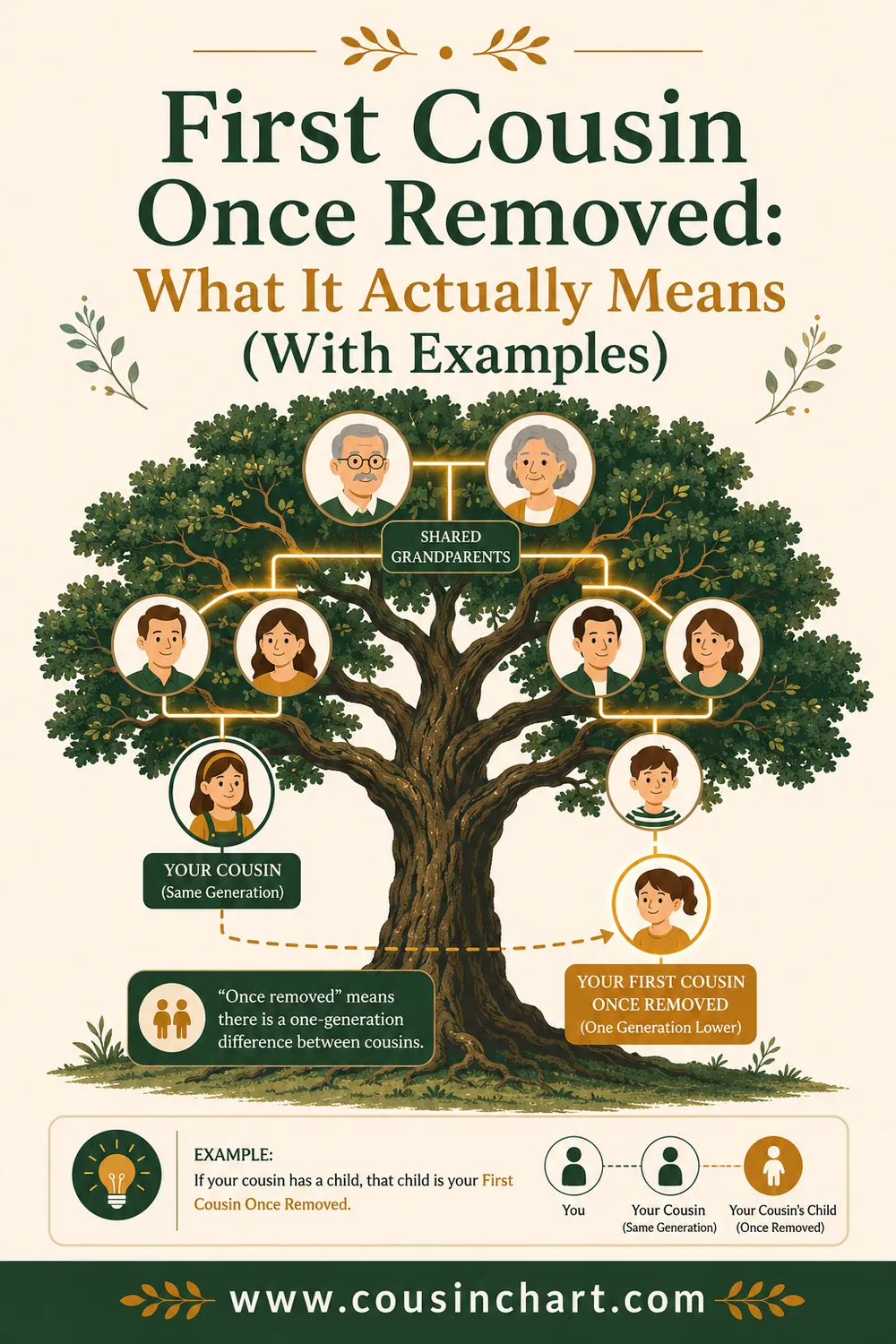
And every one of those millions of ancestors has other descendants walking around today — your cousins of every degree. When one of them turns up at a reunion or in a DNA match list, skip the head-scratching: the free family relationship calculator names the exact relationship, from first cousin to eighth cousin twice removed, instantly.