We're All Cousins: The Most Recent Common Ancestor, Explained
Everyone alive today shares a common ancestor who lived surprisingly recently — by many estimates only a few thousand years ago. That means every person on Earth is, quite literally, at least a distant cousin of every other person. The math behind this is called the most recent common ancestor (MRCA), and once you see it, "we're all cousins" stops being a warm cliché and becomes a provable fact.
This guide explains how that can possibly be true, why your family tree doubles every generation until it overflows the planet, and what an MRCA actually is. It's some of the most mind-bending math in genealogy — and it's genuinely fun. For the everyday version, when you want to know how your specific relatives connect, the free relationship calculator handles the near branches.
Relationship quick-check. Tap a claim to see whether it’s true:
The answer will appear here.
What "Most Recent Common Ancestor" Means
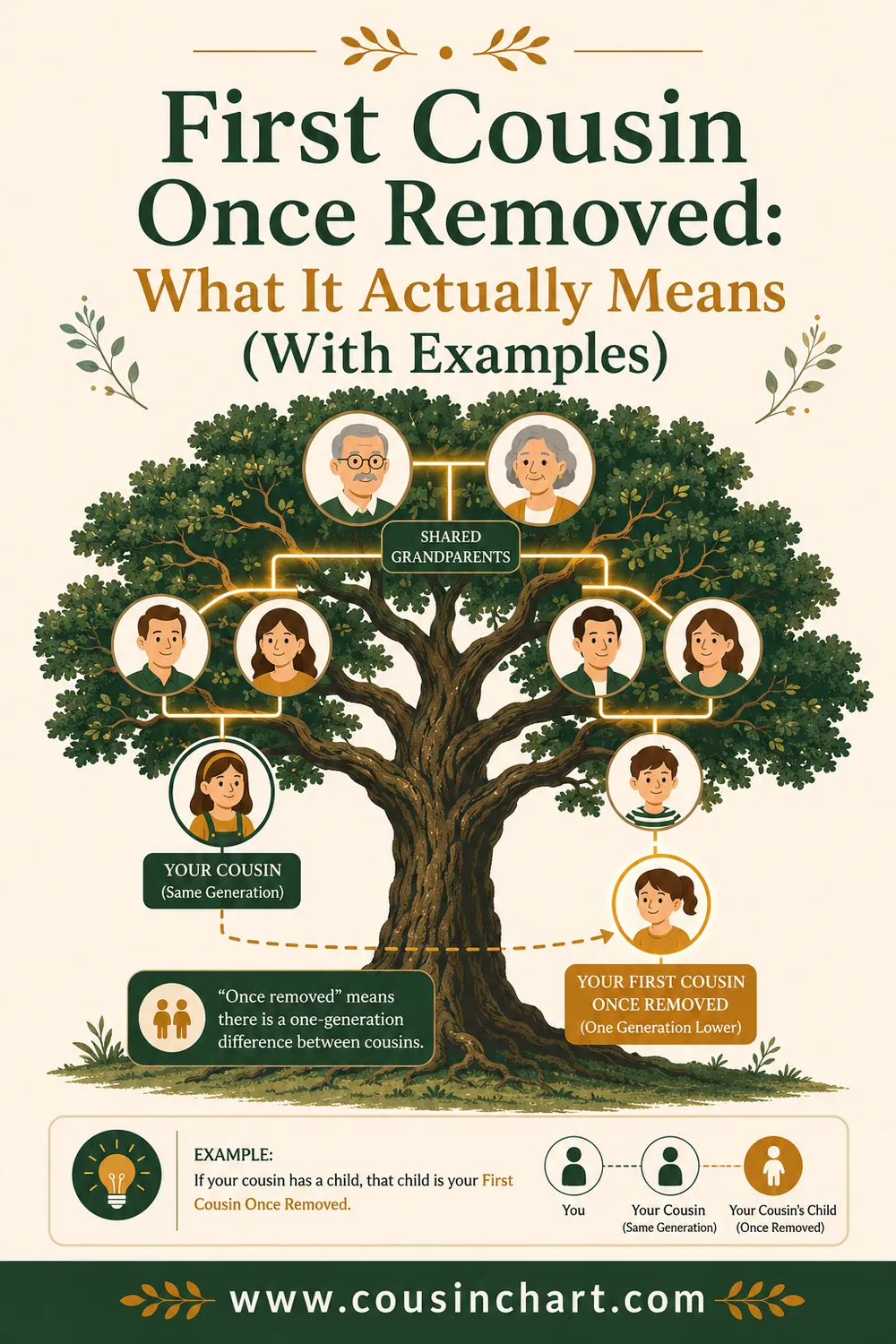
The most recent common ancestor of a group of people is the newest individual from whom every member of that group descends. For two cousins, the MRCA is a shared grandparent or great-grandparent. For an entire population — or all of humanity — it's a single person, far back in time, who sits at the point where everyone's family lines finally converge.
The startling result from mathematical genealogy is that the MRCA of everyone alive today is much more recent than intuition suggests. Because family lines branch and cross so freely over centuries, the point where all living people share at least one ancestor may be only a few thousand years back — not tens of thousands. Different models give different dates, but the "recent" part is robust.
Why Your Family Tree Overflows the Planet
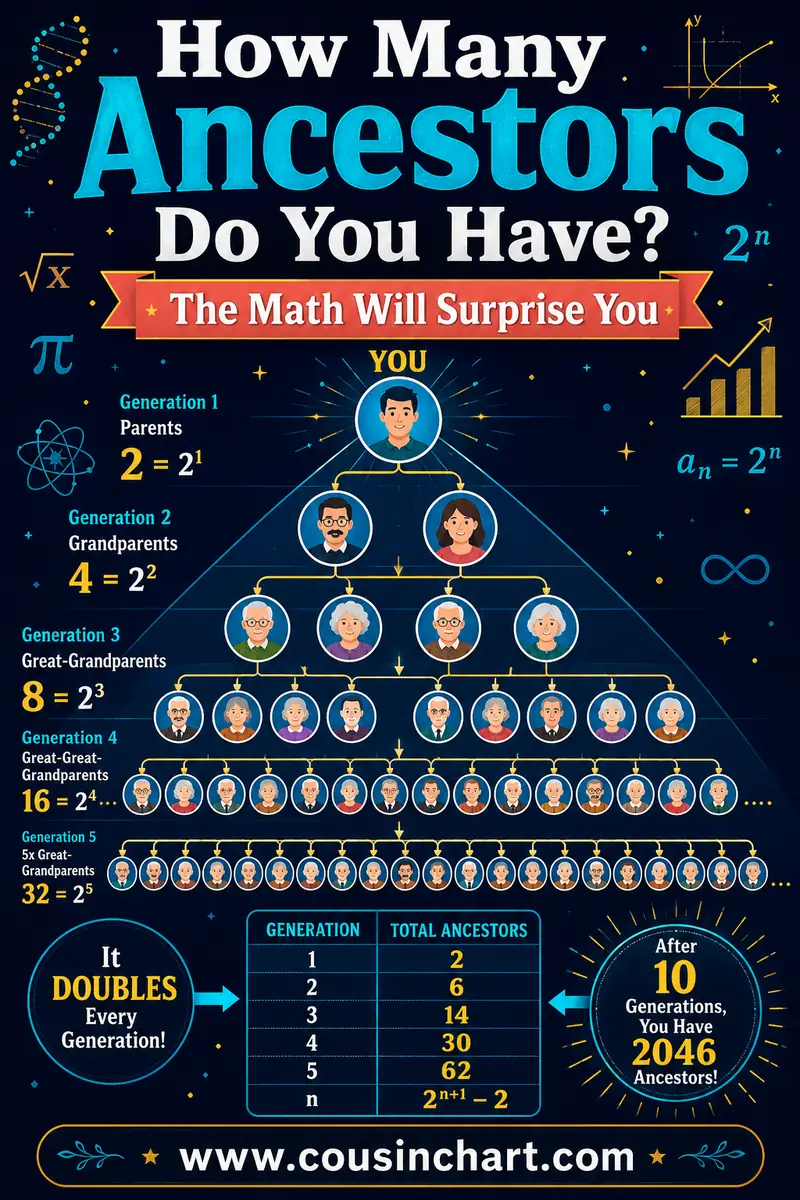
Here's the engine behind it all. Count your direct ancestors going back:
| Generations back | Direct ancestors | Roughly |
|---|---|---|
| 1 (parents) | 2 | — |
| 2 (grandparents) | 4 | — |
| 3 | 8 | — |
| 10 | 1,024 | ~1600s |
| 20 | ~1 million | ~1400s |
| 30 | ~1 billion | ~1200s |
| 40 | ~1 trillion | ~1000s |
The number doubles every generation. Go back just 40 generations — roughly a thousand years — and the arithmetic demands a trillion ancestors. But there have never been a trillion people alive at once. Around the year 1000, the entire world held only a few hundred million people.
Something has to give — and it does. We break the full explosion down in how many ancestors do you have, and the answer to the paradox is the next section.
The Resolution: Pedigree Collapse
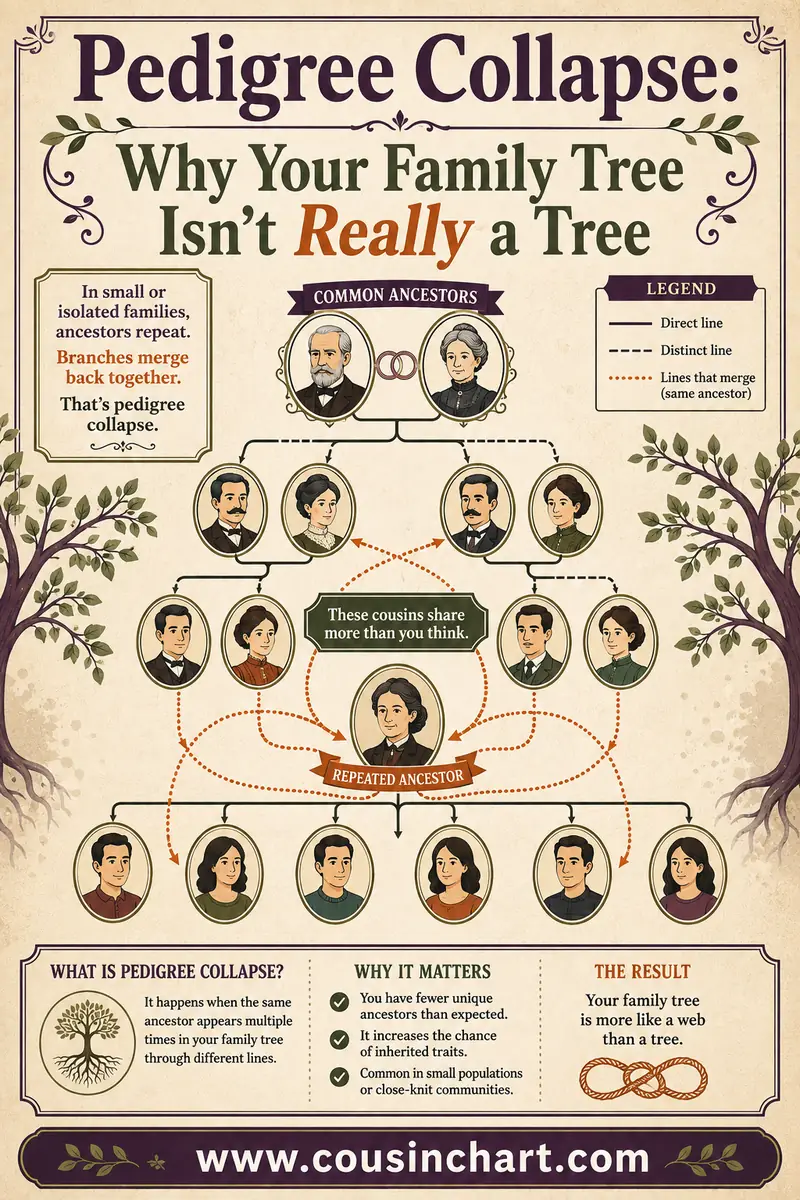
The reason your tree doesn't need a trillion distinct people is that the same ancestors appear many times over. Go back far enough and your father's line and mother's line inevitably share people. A great-great-...-grandparent on one branch is the same person as a great-great-...-grandparent on another branch. Your family "tree" is really a dense web that loops back on itself.
This is called pedigree collapse — the folding of a theoretically enormous tree back down into the actual, much smaller number of humans who ever lived. Every one of us is the product of it. It's also why distant cousins are so common: if the same ancestors keep reappearing across everyone's trees, then everyone is connected through them many times over. Our deeper dive lives at pedigree collapse explained.
So Are We Really All Cousins?
Yes — with a caveat about what "cousin" means at that distance. In the everyday sense, a cousin is someone you can trace to a shared grandparent or great-grandparent. In the mathematical sense, any two people who share any common ancestor are cousins of some degree, however remote.
By that broader definition, essentially everyone of broadly shared ancestry is a distant cousin — often a cousin many times over, connected through hundreds of shared ancestors. A frequently cited example: nearly everyone of European descent is estimated to descend from Charlemagne, who lived around 1,200 years ago. Not because he was special genetically, but because anyone that far back with surviving descendants tends to be an ancestor of almost everyone in the relevant population. The same logic applies to every populated region of the world.
A Quick Way to Picture the Convergence
If the doubling tables feel abstract, try this thought experiment. Imagine a single village a thousand years ago with a few hundred families. Fast-forward, and follow the descendants of just one couple in that village. Their children marry into other families; the grandchildren scatter to neighboring towns; the great-grandchildren cross borders. Every marriage stitches that couple's descent into another lineage.
Within twenty or thirty generations, the descendants of that one couple aren't a branch of the village anymore — they are the village, and much of the surrounding region too. Now run the same process for every couple whose line survived. Each one spreads the same way, and the spreading webs overlap completely. That total overlap is the recent MRCA, seen from the ground rather than from a spreadsheet.
The counterintuitive part is the speed. It doesn't take a special ancestor or a special event — just ordinary marriages, generation after generation, each one quietly weaving two family lines into one. Compounded over a thousand years, ordinary mixing is more than enough to connect everyone.
The DNA Catch: Related but Undetectable
Here's the twist that keeps "we're all cousins" honest. Sharing a common ancestor does not mean sharing detectable DNA. Every generation, a child inherits only half of each parent's DNA, so a specific ancestor's contribution halves and halves until it can vanish entirely from a given descendant.
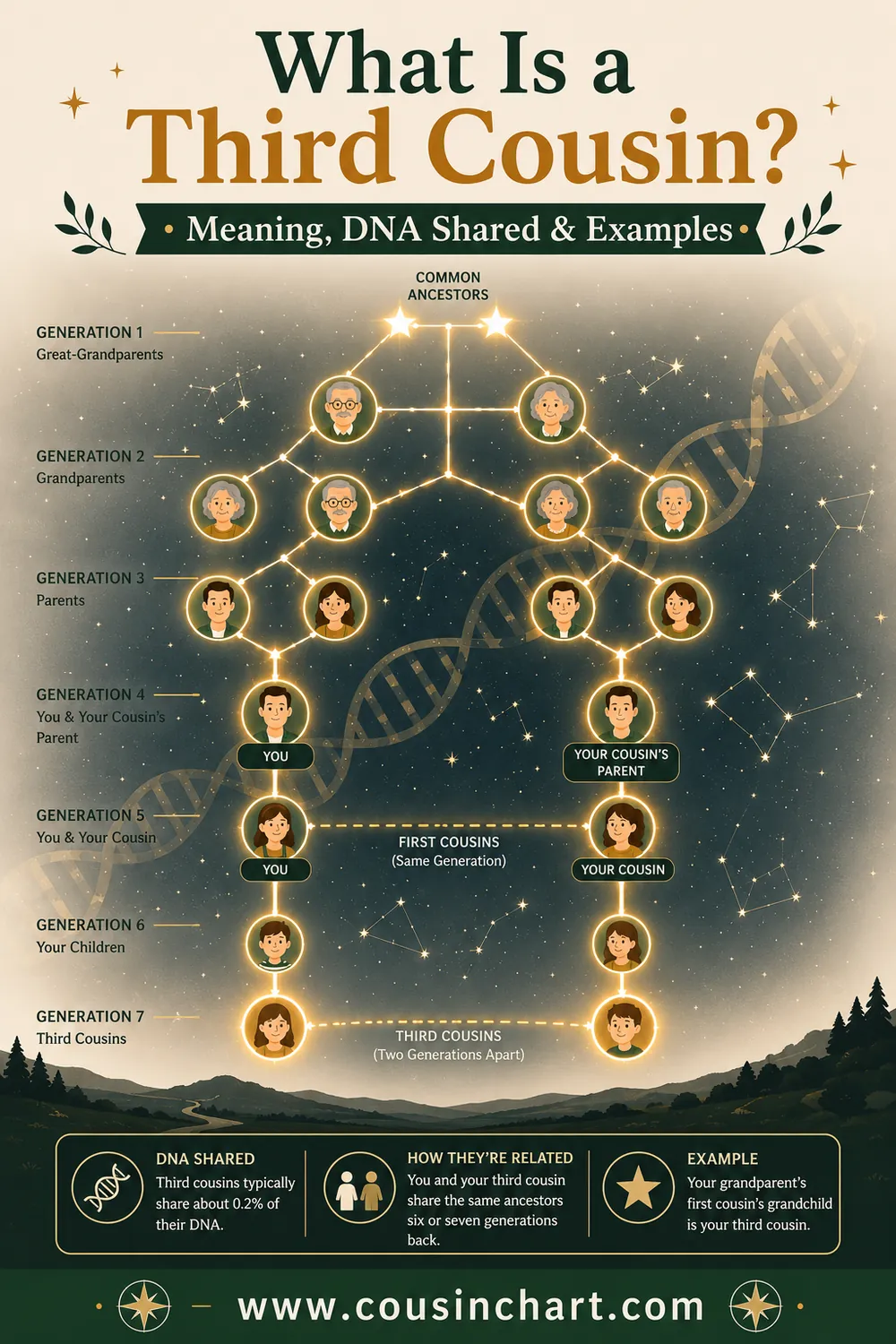
- Third cousins share a great-great-grandparent and usually still share measurable DNA — see what is a third cousin for the numbers.
- By around 6th to 8th cousins, most pairs share no detectable DNA at all, even though the paper-trail relationship is real.
So you can be a genuine 12th cousin of a stranger — sharing a documented ancestor — while sharing zero measurable genetic material with them. Genealogically related, genetically invisible. Both facts are true at once.
Mitochondrial Eve Is a Different Idea
People often confuse the all-humanity MRCA with "Mitochondrial Eve" — and they're not the same. Mitochondrial Eve is the most recent common ancestor along the purely maternal line (mother's mother's mother, all the way back), traced through mitochondrial DNA. She lived roughly 150,000+ years ago — far, far older than the genealogical MRCA of everyone alive, which counts all lines, not just the female one.
The reason the genealogical MRCA is so much more recent is exactly the doubling from earlier: when you allow every ancestral path (not just one strict line), the shared ancestors show up thousands of years back rather than hundreds of thousands. Two different questions, two very different answers.
The Identical Ancestors Point: Even Wilder Than the MRCA
The MRCA is startling, but there's a second date that's even stranger. Keep going back past the most recent common ancestor and you eventually reach the identical ancestors point (IAP) — the moment in history when every single person then alive falls into one of exactly two categories: either an ancestor of everyone living today, or an ancestor of no one living today (their line died out).
Think about what that means. At the MRCA date, you and any stranger share at least one ancestor. At the identical ancestors point, you and that stranger share your entire ancestral population — literally the same set of people, top to bottom, just recombined through different paths. Models place this point only a few thousand years further back than the MRCA. Beyond it, the very notion of "your ancestors versus my ancestors" stops meaning anything; there's just humanity's ancestors, shared by all.
It's the ultimate answer to "we're all cousins." Go back far enough and it isn't that we're related — it's that, from that horizon forward, we descend from the exact same pool of people.
Why Isolated Populations Are the Exception
The tidy "few thousand years" figure assumes populations that mixed, even a little, over time — and almost all of them did. A single migrant every few generations is enough to stitch a region into the global web, because that one person's descendants multiply and spread until the connection saturates the whole population.
But genuine, long-term isolation changes the math:
- Deeply remote groups. A population cut off for many thousands of years — certain historically isolated island or rainforest communities — pushes the global MRCA further back, because their lines only rejoin everyone else's at the point of original separation.
- The bottleneck effect. Once contact resumes, though, integration is astonishingly fast. Just a handful of shared individuals collapses the gap again within centuries.
So the headline stays true for the overwhelming majority of living people. The caveat is simply that "a few thousand years" is a floor that stretches for the most isolated branches of the family — and snaps back the moment those branches touch the rest of the tree.
Putting the Scale in Perspective
It helps to hold the two competing forces side by side, because the whole paradox lives in their collision:
| Force | Direction | Effect |
|---|---|---|
| Ancestor doubling | Explodes upward | Slots double every generation — a trillion "spots" in ~40 generations |
| Human population | Stays finite | Only hundreds of millions alive a thousand years ago |
| Pedigree collapse | Folds it back | The same real people fill the impossible number of slots |
The doubling wants a trillion ancestors; history only supplies a few hundred million people; pedigree collapse is what reconciles the two by reusing the same individuals thousands of times over across your tree. Once you internalize that three-way tension, the recent-MRCA result stops feeling like a trick and starts feeling inevitable.
And it reframes what a family tree even is. We draw trees — clean, branching, ever-widening. Reality is a lattice that widens for a while, then bends back and knots into itself, until a few thousand years up it's less a tree than a single shared root system that all of humanity grows out of.
What This Means for Your Own Research
This isn't only cosmic philosophy — it has practical consequences at the workbench:
- "Related to royalty" is nearly free. If you have ancestry from a region with any documented medieval nobility, descent from some king or noble is close to statistically guaranteed. Impressive-sounding, but shared with millions. The genealogical achievement is documenting the specific line, not the fact of descent.
- Distant DNA matches need paper, not just percentages. Since real ancestors vanish from your DNA past a handful of generations, a documented 10th-cousin connection will never show up in a spit test. Don't expect genetics to confirm the far reaches of your tree — that's the paper trail's job.
- Every brick wall has a way around. Because lines cross and re-cross, a single ancestor is usually reachable through multiple descent paths. When one line hits a dead end in the records, a parallel line through the same couple often gets you there anyway.
The takeaway is oddly freeing: you'll never "run out" of relatives, and any two branches you're chasing are far more likely to reconnect than to stay strangers.
FAQ
Are all humans really cousins?
In the mathematical sense, yes. Any two people who share a common ancestor are cousins of some degree, and the shared ancestry of everyone alive traces back only a few thousand years. Most people are distant cousins many times over, connected through countless shared ancestors.
What is the most recent common ancestor?
The most recent common ancestor (MRCA) is the newest person from whom an entire group descends. For two cousins it's a shared grandparent or great-grandparent; for all of humanity it's a single individual, likely a few thousand years back, where every living person's family lines converge.
If we're all related, why don't we share DNA?
Because DNA halves with each generation. A specific distant ancestor's genetic contribution shrinks until it disappears from many descendants. Beyond roughly 6th to 8th cousins, most people share no detectable DNA even though they share a real, documented ancestor.
Am I descended from Charlemagne?
If you have European ancestry, almost certainly. Anyone who lived that long ago (around 1,200 years) and has any living descendants tends to be an ancestor of nearly everyone in the relevant population — a consequence of how quickly ancestral lines multiply and overlap.
What is the identical ancestors point?
It's the moment in history, a few thousand years before the most recent common ancestor, when everyone then alive is either an ancestor of every living person today or an ancestor of no one. Past that point, all living people share not just one ancestor but their entire ancestral population — the same set of people, reached by different paths.
How can two people be cousins but share no DNA?
Every generation, a child inherits only half of each parent's DNA, chosen essentially at random. A specific ancestor's contribution halves with each step down, so past roughly six to eight generations, some descendants inherit none of a given ancestor's DNA at all. The paper-trail relationship stays perfectly real; the genetic signal simply washed out along the way.
Is Mitochondrial Eve the same as our common ancestor?
No. Mitochondrial Eve is the most recent common ancestor along the strictly maternal line and lived over 150,000 years ago. The genealogical MRCA of everyone alive counts all family lines, not just the female one, and is far more recent — only a few thousand years back.
From the Whole Species to Your Own Tree
"We're all cousins" turns out to be arithmetic, not sentiment: family lines multiply so fast that everyone alive shares ancestors within a few thousand years, and pedigree collapse folds our impossible trees back into the real human family. The grand scale is dazzling — but the near branches are where the fun is personal. When you want to know exactly how your own relatives connect, the free family relationship calculator names the tie and shows the ancestor you share.