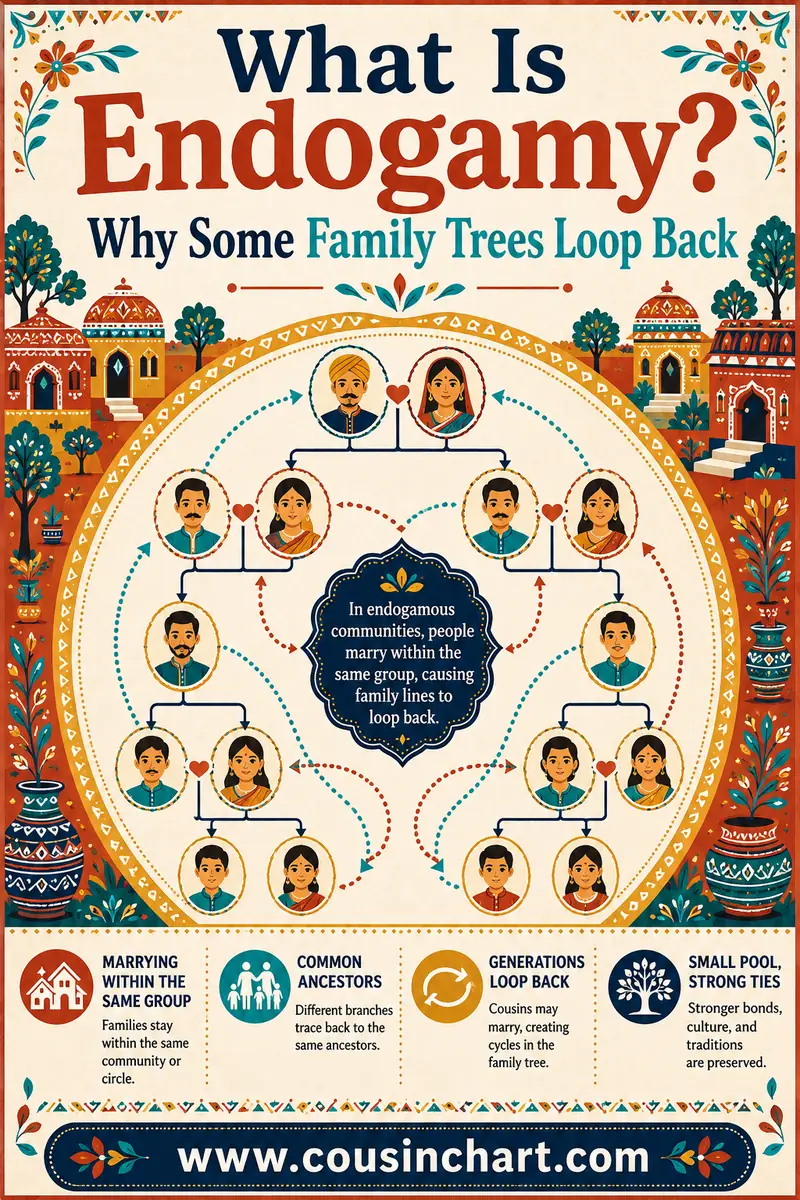
What Is Endogamy? Why Some Family Trees Loop Back
Endogamy is the practice of marrying within a defined community — the same religious group, village, island, caste, or ethnic enclave — generation after generation. In genealogy, the word describes what that pattern does to a family tree: after centuries of in-group marriage, everyone in the community descends from the same limited pool of ancestors through many overlapping paths, so the tree loops back on itself again and again.
The practical consequence, and the reason genealogists talk about endogamy constantly: it makes DNA matches look closer than they really are. A match predicted as your second cousin may actually be a fifth cousin connected to you eleven different ways. This guide covers which populations are endogamous, why the DNA math skews, and how to research through it. For naming any single relationship path, the free family relationship calculator on our homepage does the job in seconds.
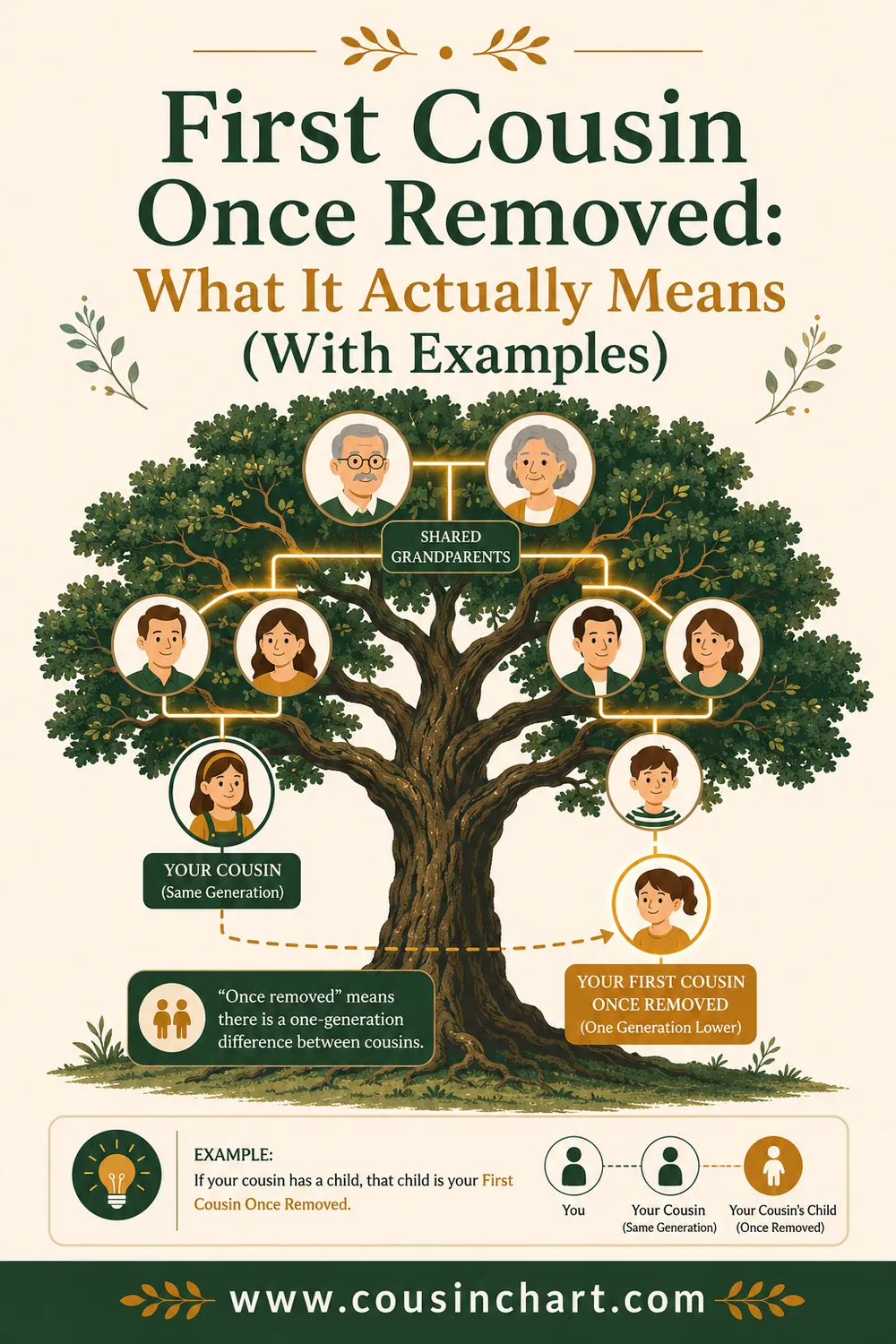
Relationship quick-check. Tap a phrase — endogamy makes these distinctions matter:
The answer will appear here.
Endogamy, Defined Properly
The word comes from Greek — endon (within) + gamos (marriage). Anthropologists use it for any social rule or strong custom that keeps marriage inside a group boundary. The boundary can be:
- Religious — marrying within the faith community.
- Geographic — an island, a mountain valley, an isolated village.
- Ethnic or linguistic — an immigrant enclave maintaining its identity.
- Social — castes, nobility, or closed communities.
One or two in-group marriages don't make endogamy. The genealogical meaning requires the pattern sustained over many generations, until the community's collective family tree becomes a dense web where every member connects to every other member multiple times.
It helps to place endogamy next to its neighbors:
| Term | What it means | Scale |
|---|---|---|
| Consanguinity | Two specific people are blood relatives | One pair |
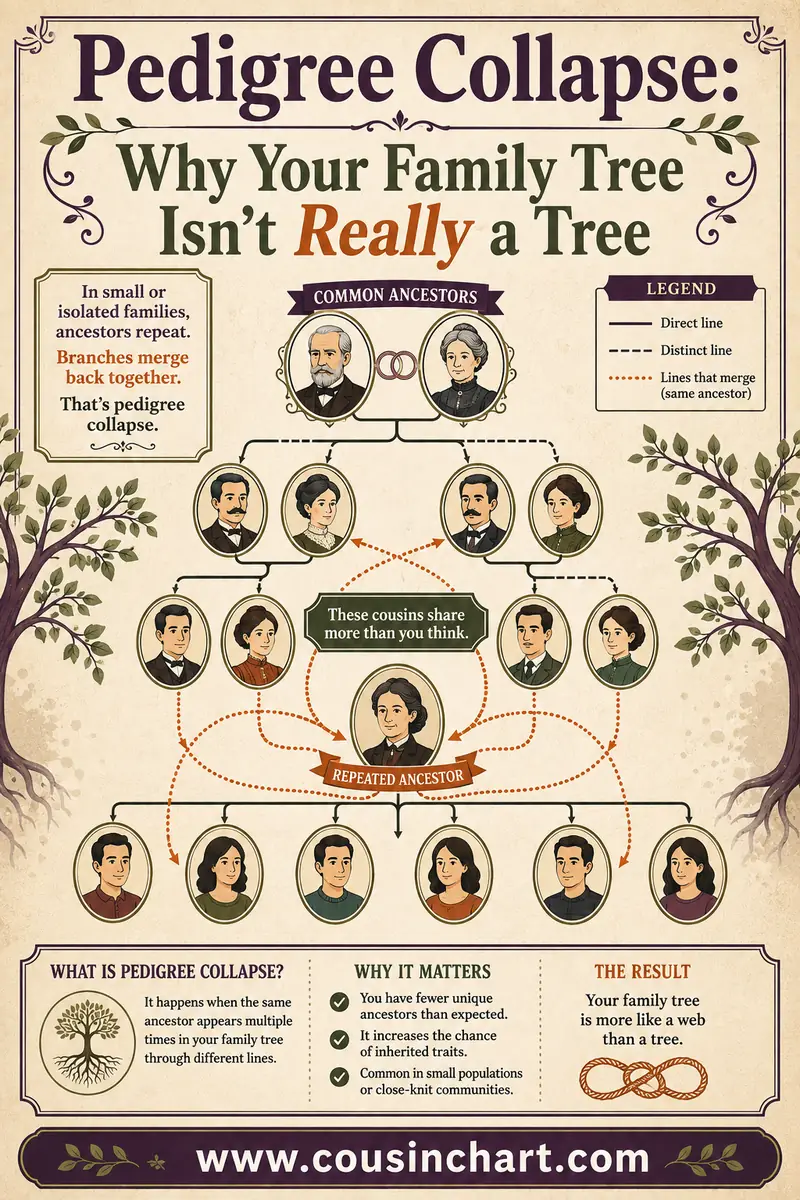
| Pedigree collapse | The same ancestor fills multiple slots in one tree | One family |
| Endogamy | A whole community intermarrying for generations | Whole population |
Endogamy is essentially pedigree collapse at community scale — the mechanics of individual collapse are covered in our pedigree collapse guide. Its opposite, exogamy, means marrying outside the group.
Populations Where Endogamy Shapes Genealogy
Genealogists and DNA testing companies routinely flag these groups as endogamous (a description of historical marriage patterns, nothing more):
- Ashkenazi Jewish communities — the best-documented case; centuries of in-community marriage across Central and Eastern Europe mean nearly all Ashkenazi descendants match each other in DNA databases. (Researching these lines has its own toolset — see our Jewish genealogy records guide.)
- Acadians and French Canadians — descended largely from a few thousand French founders in the 1600s; Québécois trees famously loop back to the same founding couples.
- Mennonite, Amish, and Hutterite communities — small founding groups plus religious in-marriage.
- Polynesian island populations — geography did the boundary-drawing.
- Newfoundland outport communities — small, isolated fishing settlements.
- Cajuns of Louisiana, descendants of the Acadian deportation.
- Many other groups — Parsis, some Arab and South Asian communities where cousin marriage is customary, isolated Appalachian valleys, and more.
Having endogamous ancestry is extremely common worldwide. For most of human history, nearly everyone's marriage pool was a village — the groups above are just the cases where the pattern was strong, recent, and well-documented enough to matter in modern DNA testing.
What Endogamy Does to DNA Results
Here's the core problem. DNA match predictions assume a single connecting path: second cousins share great-grandparents and average about 3% DNA (~230 centimorgans); the amounts for each relationship are laid out in our shared DNA chart.
Endogamy breaks the assumption. When you and a match descend from the same small ancestor pool through many paths, every path contributes segments. The total shared DNA rises — but the individual relationships are all distant. The result:
- Inflated predictions. A true fifth cousin can share second-cousin-level centimorgans. Match lists in endogamous populations are systematically over-optimistic.
- Thousands of matches. Ashkenazi testers routinely have tens of thousands of matches, nearly all distant despite decent centimorgan totals.
- Small, scattered segments. Endogamous sharing tends to come as many short segments (old, recombined pieces) rather than the few long segments a genuinely close cousin shares.
- "Everyone matches everyone." Two testers from the community will almost always share some DNA even with no findable paper connection — the connection is real but lies behind the record horizon.
How Genealogists Work Through Endogamy
The situation isn't hopeless — it just demands stricter evidence. Standard tactics from the DNA-genealogy playbook:
- Weight the longest segment, not the total. A single long segment (say 30+ cM) suggests a genuinely recent connection; a big total made of many 7–10 cM pieces suggests background endogamy. Most serious tools (GEDmatch, DNAPainter's relationship tools) let you inspect segment sizes.
- Raise your match thresholds. Where a non-endogamous researcher investigates every 20 cM match, endogamy researchers often ignore anything under 40–50 cM unless paper evidence points there first.
- Lead with the paper trail. In endogamous research, documents identify the connection and DNA merely supports it — the reverse of the usual workflow.
- Use known-relative comparisons. Testing a parent or known cousins lets you sort which matches come through which line, cutting the noise dramatically.
- Expect multiple truths. When you do map a match, don't stop at one path. "Third cousin on my grandfather's side and fourth cousin on my grandmother's side" is the normal endogamous answer. Name each path separately — the relationship calculator makes labeling each one painless.
Is Endogamy a Health Problem?
Mostly it's a statistics story, but there's a real genetic dimension worth stating plainly and calmly. Long-endogamous populations can carry elevated frequencies of specific recessive conditions, because a limited founder gene pool concentrates whatever variants the founders happened to carry — the founder effect. Well-known examples include Tay-Sachs screening programs in Ashkenazi communities and specific variants studied among the Amish.
Context that matters: this is about population-level frequencies, not individual destiny; modern carrier screening addresses exactly this; and distant-cousin connections — which is what most endogamous relatedness is — involve tiny amounts of shared DNA. Marrying someone from the same broad heritage community carries no meaningful elevated risk in itself; the medically relevant question is always the specific couple's carrier status, which is a conversation for doctors, not genealogy websites.
A Worked Example: One Match, Three Paths
Here's what endogamy looks like on an actual match, using a French-Canadian-style scenario.
You match Marc at 210 cM. The chart says that's classic second-cousin territory — you should share great-grandparents. But neither of you recognizes the other's surnames at that depth, and your trees are solid for four generations. In a non-endogamous family, that contradiction would scream "misattributed parentage." In an endogamous one, it usually means the total is a sum.
Dig deeper and the paper trail turns up three separate connections:
- Fourth cousins through the Gaudet line (expected ~13 cM)
- Fourth cousins once removed through the Landry line (expected ~7 cM)
- Fifth cousins through the Boudreau line (expected ~5 cM)
Those expectations only add to ~25 cM — but expectations are averages, and endogamy stacks the deck far beyond three findable paths. Behind the documented connections sit dozens more that predate the records, each contributing slivers. The segment view confirms the story: Marc shares fifteen segments with you, the longest just 18 cM. A genuine second cousin would typically show several segments of 30–80 cM. Long-segment logic beats the total every time.
The takeaway habits: treat surprising centimorgan totals in endogamous lines as sums to be decomposed, not single relationships to hunt; and record each documented path separately in your notes, because next year's new match may hang off any one of them.
How the Testing Companies Handle It
The major sites know about endogamy and compensate differently — which is why the same two testers can get noticeably different numbers on different platforms:
- AncestryDNA runs matches through its Timber algorithm, which down-weights "pile-up" regions — stretches of DNA shared by huge numbers of people in a population rather than through recent ancestry. For endogamous testers this trims inflated totals, sometimes aggressively; a match can lose a large share of its raw centimorgans to the filter.
- 23andMe and MyHeritage report less-filtered totals, so endogamous matches tend to look bigger there than on Ancestry. Cross-platform comparisons need that grain of salt.
- GEDmatch and DNAPainter don't decide anything for you, but they expose the segment-level detail — sizes, locations, overlaps — that endogamy work actually runs on. If your ancestry is heavily endogamous, segment visibility is worth more than any company's relationship label.
Two practical implications. First, don't average the platforms — understand what each is doing and prefer segment data over headline totals. Second, expect predicted relationships to be systematically too close on every platform, filters or not. The companies can dampen endogamy's noise; none of them can convert eleven distant paths into the single recent path their labels assume. That conversion is the researcher's job, done with records — and with honest labeling of every path found.
Endogamy and the "We're All Related" Picture
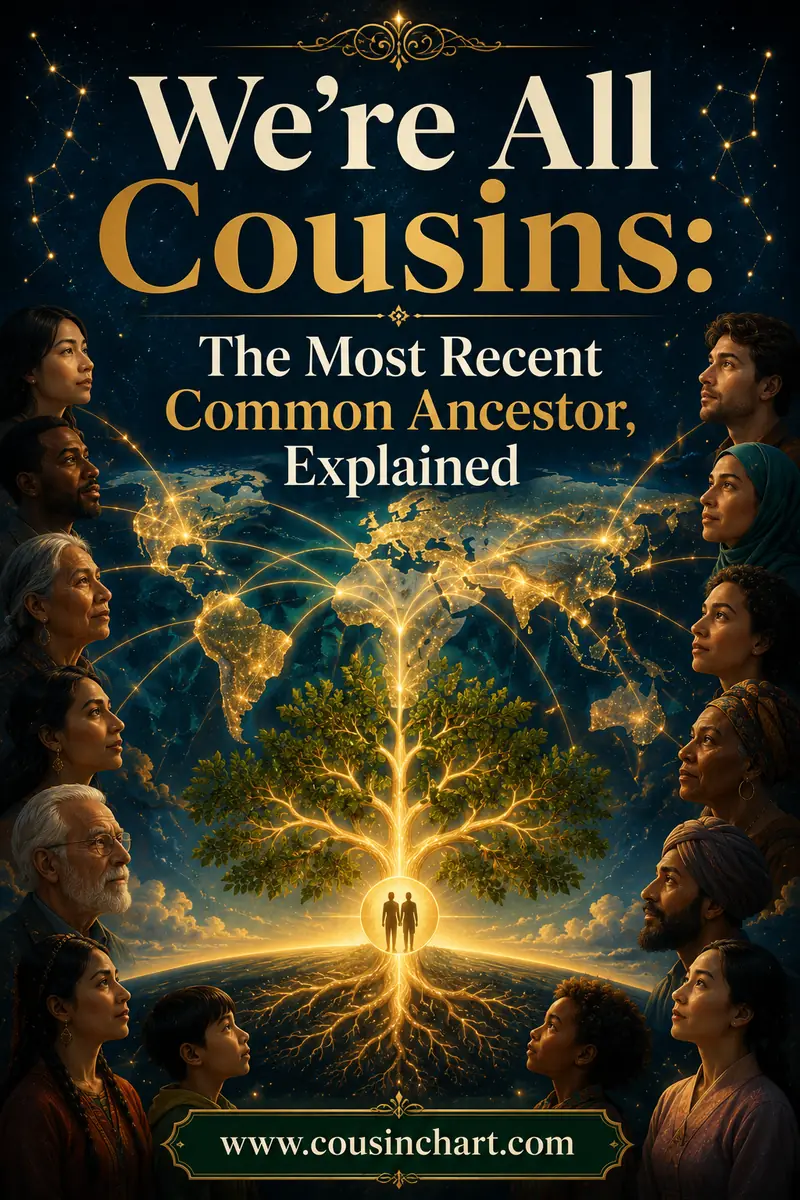
Zoom far enough out and endogamy is a local intensification of something universal: humanity's family trees all merge within a few thousand years. Everyone is everyone's cousin; endogamous communities are just cousins more ways and more recently. The mathematics of that bigger claim — most recent common ancestors and the identical ancestors point — gets its own treatment in we're all cousins.
That framing is also the kindest way to hold this topic: an endogamous tree isn't a defective tree. It's a tightly-woven one, often reflecting communities that preserved language, faith, and identity under real pressure. The loops in the chart are the genealogy of belonging.
FAQ
What does endogamy mean in genealogy?
It's the long-term practice of marrying within one community — a faith, village, island, or ethnic group — repeated over many generations. Genealogically it means the community's members all descend from a small ancestor pool through multiple overlapping paths, which tangles family trees and inflates DNA match predictions.
How is endogamy different from pedigree collapse?
Pedigree collapse is one family's tree containing repeated ancestors; endogamy is an entire community intermarrying until everyone's tree loops into everyone else's. Endogamy produces pervasive, community-wide pedigree collapse.
Why does endogamy make DNA matches look closer?
Match predictions assume one connecting path. Endogamous relatives connect through many paths at once, and every path adds shared segments — so total centimorgans suggest a closer single relationship than actually exists. Checking the longest single segment gives a truer signal than the total.
Which populations are considered endogamous?
Frequently cited examples: Ashkenazi Jewish communities, French Canadians and Acadians (including Cajuns), Amish and Mennonite groups, Polynesian islanders, Newfoundland outports, and various caste and cousin-marriage cultures worldwide. Mild endogamy — the village marriage pool — appears in almost everyone's deep ancestry.
Can DNA testing still work for endogamous families?
Yes, with adjusted methods: prioritize matches with long single segments, raise centimorgan thresholds, test known relatives to sort match clusters, and let documentary research lead. Close relationships (siblings, first and second cousins) still predict reliably; it's the distant range that blurs.
How do I know if my family tree is endogamous?
Common signs: your match list is enormous but full of unplaceable "2nd–3rd cousins," the same surnames recur on multiple branches of your tree, your ancestors' community was small or closed (an island, a faith community, an enclave), and matches share many short segments rather than a few long ones. Any two of those together is a strong hint.
Why did my match's centimorgans drop on AncestryDNA compared to GEDmatch?
AncestryDNA's Timber algorithm removes segments in "pile-up" regions that whole populations share, which especially trims endogamous matches. GEDmatch reports rawer totals. Neither number is wrong — they're answering slightly different questions, and segment sizes tell you more than either total.
Is endogamy the same as inbreeding?
No. Endogamy describes marrying within a community — the individual couples are usually distant cousins at most, sharing trivial DNA. Inbreeding refers to close-relative unions. A community can be strongly endogamous while its individual marriages are all between genetically distant partners.
Untangle One Loop at a Time
Endogamy turns "how are we related?" from a question with one answer into a question with several — all true at once. The way through is patience: verify paths on paper, respect what the segment data actually says, and label each connection precisely.
That last part is the easy bit. Whatever path you've uncovered — second cousin once removed on the Cohen side, fourth cousin through the Gaudet line — the free family relationship calculator turns it into the correct term instantly, as many times as your wonderfully loopy tree requires.