Consanguinity Explained: Degrees of Blood Relation (Chart)
Last updated: September 30, 2026
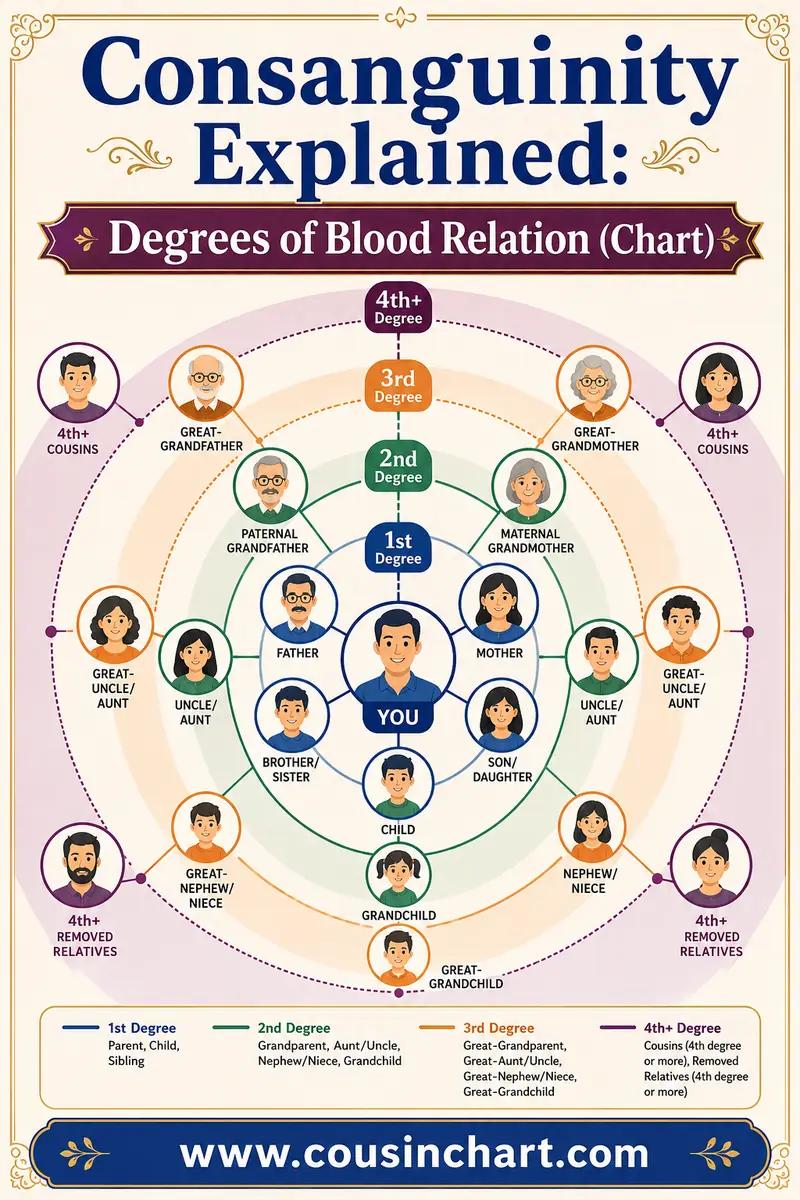
Consanguinity simply means being related by blood — descending from a common ancestor. The degree of consanguinity is a number that measures how close that blood tie is: your parent is a first-degree relative, your sibling is second degree, your aunt is third degree, and your first cousin is fourth degree under the most common counting system.
That's the short version. The longer version — how the counting actually works, why lawyers and priests historically used two different systems, and where these numbers still matter today — is what this guide covers. And if you'd rather skip the counting entirely, the free family relationship calculator on our homepage names any relationship (and its closeness) in a couple of clicks.
Relationship quick-check. Tap a relative to see their degree of consanguinity (civil-law count):
The answer will appear here.
What Consanguinity Actually Means
The word comes from Latin: con (with, shared) + sanguis (blood). Two people are consanguineous if they descend from at least one common ancestor. Your siblings, parents, cousins, and great-grandparents all qualify. Your spouse, your in-laws, and your step-relatives don't — those are relatives by affinity (marriage), not blood.
Genealogists, lawyers, geneticists, and religious authorities have all needed a way to say how related two people are, not just whether they're related. The answer is the degree of consanguinity: a single number, where smaller means closer.
One important thing up front: there are two historical counting systems, and they give different numbers for the same pair of people. Most modern legal codes (and most charts you'll find online) use the civil law method, so that's the one this guide leads with.
How to Count Degrees of Consanguinity (Civil Law Method)
The civil law method is beautifully simple: count every parent–child step along the path connecting two people, going up to the common ancestor and back down. Each step is one degree.
Three worked examples:
- You and your sibling. Up one step to your shared parents, down one step to your sibling. 1 + 1 = second degree.
- You and your aunt. Up two steps to your grandparents (her parents), down one step to her. 2 + 1 = third degree.
- You and your first cousin. Up two steps to your shared grandparents, down two steps to your cousin. 2 + 2 = fourth degree.
For direct ancestors and descendants there's no "down" leg — you just count the steps in the line. Parent = 1, grandparent = 2, great-grandparent = 3, and your own child = 1, grandchild = 2, and so on.
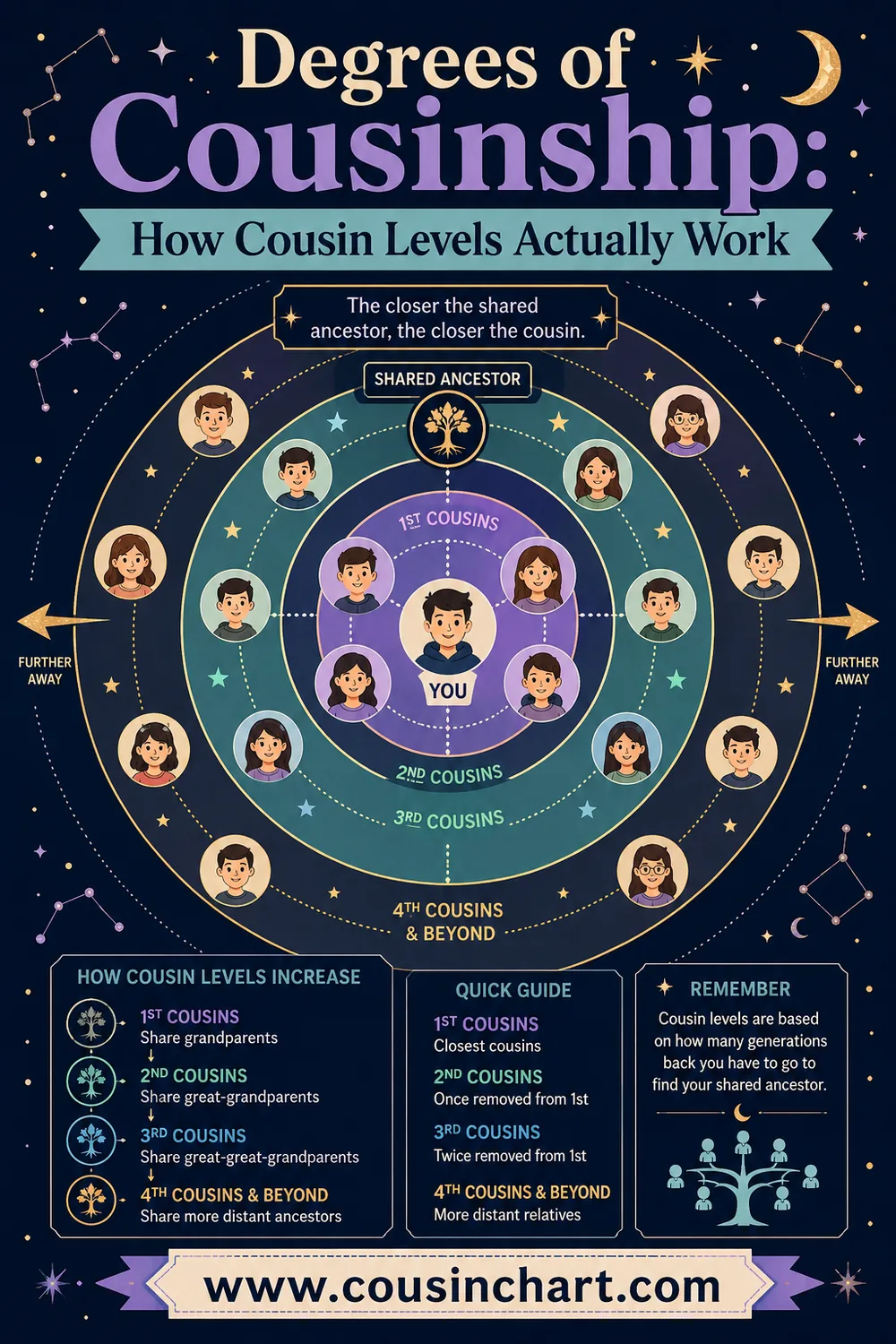
If you know cousin math already, the two systems connect neatly. Cousin degree is the shorter path to the common ancestor minus one, and "removed" counts the generation gap — our degrees of cousinship guide covers that. Civil-law consanguinity just adds both legs of the path together instead.
Consanguinity Chart: Degrees for Common Relatives
Here's the full chart for the relatives people actually ask about, with average shared DNA for context:
| Relative | Degree (civil law) | Steps counted | Avg. shared DNA |
|---|---|---|---|
| Parent / child | 1st | 1 | 50% |
| Sibling | 2nd | 1 up + 1 down | 50% |
| Grandparent / grandchild | 2nd | 2 | 25% |
| Aunt, uncle / niece, nephew | 3rd | 2 up + 1 down | 25% |
| Great-grandparent | 3rd | 3 | 12.5% |
| First cousin | 4th | 2 up + 2 down | 12.5% |
| Great-aunt, great-uncle | 4th | 3 up + 1 down | 12.5% |
| First cousin once removed | 5th | 3 up + 2 down (or 2 up + 3 down) | 6.25% |
| Second cousin | 6th | 3 up + 3 down | 3.125% |
| Second cousin once removed | 7th | 4 up + 3 down | ~1.56% |
| Third cousin | 8th | 4 up + 4 down | ~0.78% |
Notice something the chart makes obvious: the same degree can cover very different-feeling relationships. Your grandmother and your brother are both second-degree relatives. Your first cousin and your great-aunt are both fourth degree. The degree measures path length through the tree, not emotional closeness or even generation.
Also notice that shared DNA roughly halves with each added degree. That's not a coincidence — every parent–child step passes on about half of the relevant DNA, so each step in the path cuts the expected overlap in half.
The Canon Law Method (And Why Two Systems Exist)
Medieval church courts needed degrees too — mainly to enforce marriage prohibitions — and they counted differently. The canon law method counts only the longer leg of the path: the number of generations from the more distant person up to the common ancestor.
Under canon law:
- Siblings are first degree (each is one generation from the shared parents).
- First cousins are second degree (two generations from shared grandparents).
- A first cousin once removed is third degree (the longer leg is three generations).
- Second cousins are third degree as well.
This is why old records can look confusing. When a historical document says a couple needed a dispensation to marry "within the fourth degree," that's canon counting — it means they were third cousins or closer, which under civil counting would be eighth degree. If you do genealogy in European church records, expect the canon system; if you're reading a modern statute, expect civil.
There's also a third variant worth a sentence: some U.S. states historically used the "civil law" count as described here, while a few used collateral-degree tables of their own. The takeaway is always the same — check which system a document uses before you interpret its numbers.
Where Degrees of Consanguinity Matter Today
This isn't just trivia. The degree number does real work in several corners of modern life:
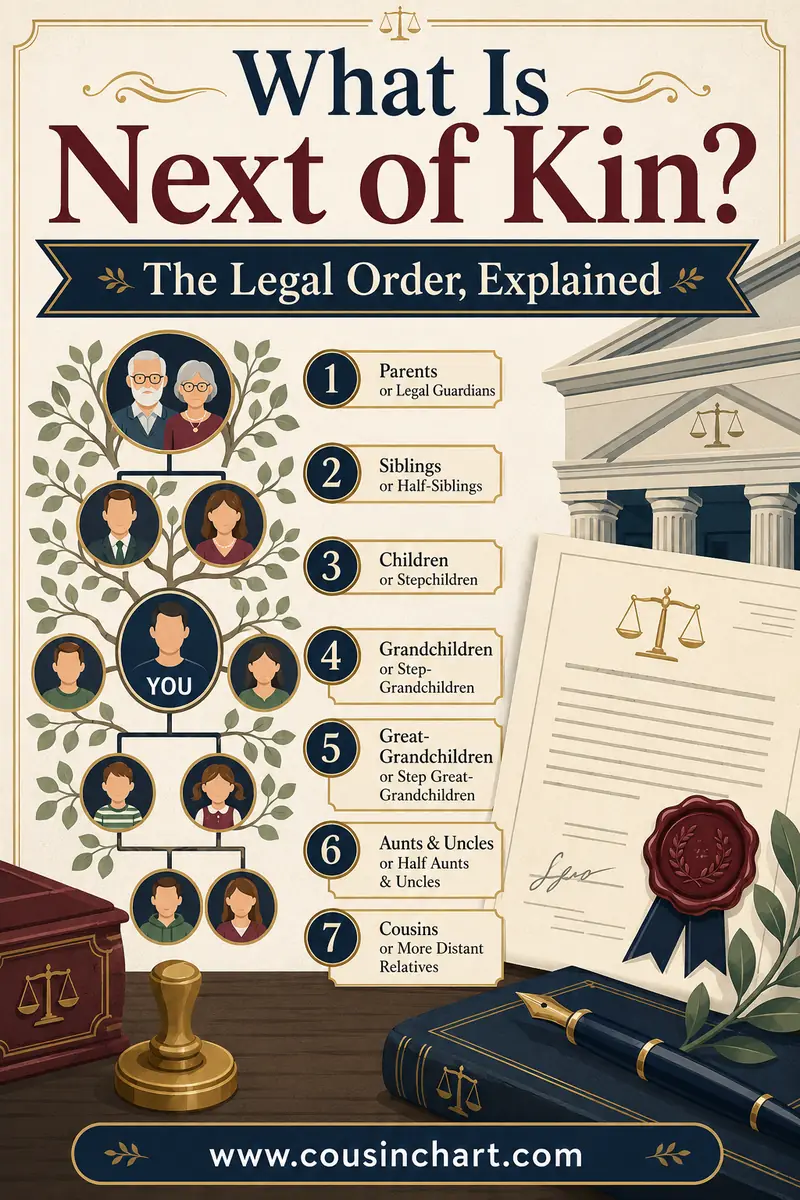
- Inheritance without a will. Intestate succession statutes distribute an estate to the closest relatives by degree, in a defined order. Understanding degrees is understanding who inherits — closely related to the rules covered in our next of kin guide.
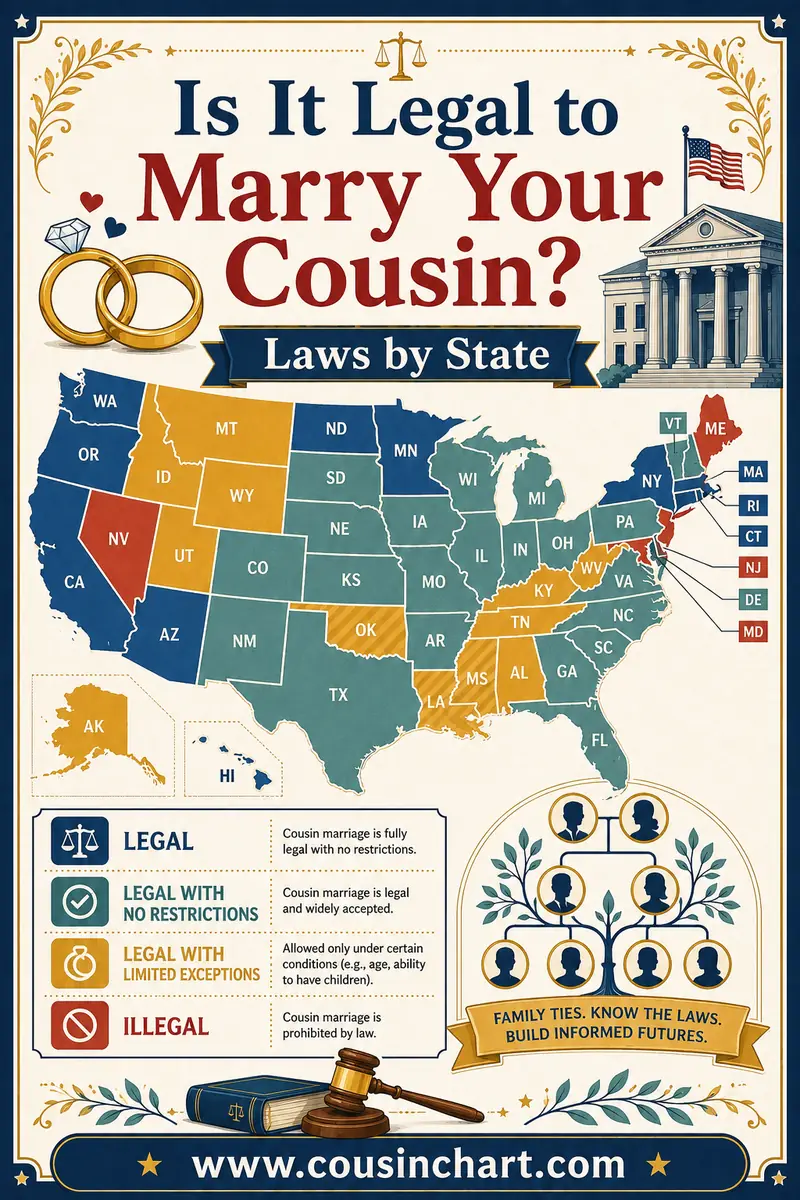
- Marriage law. Every U.S. state bars marriage between close blood relatives; where they draw the line varies, and the line is expressed in relationships that map to degrees. First cousins (fourth degree) are the boundary case — see cousin marriage laws for the state-by-state picture.
- Medical and genetic screening. Doctors ask about first-degree and second-degree relatives when assessing hereditary risk, because shared DNA drops predictably with each degree. A condition in a first-degree relative means more, statistically, than the same condition in a fourth-degree one.
- Courts and conflicts of interest. Judges, jurors, and officials are commonly disqualified from matters involving relatives "within the third degree" (or similar wording). The degree is the test.
- Immigration and benefits rules. Various programs define eligible "family members" by enumerating relationships, which trace back to degree logic.
Consanguinity vs Affinity: Blood vs Marriage
Two people can be close family without any consanguinity at all. Affinity is the legal term for relation by marriage: your spouse, your parents-in-law, your stepchildren, your brother-in-law. Affinity has its own degree system in some legal codes (your spouse's second-degree relative is your second-degree affine), but no DNA is shared and no common ancestor exists.
A few practical consequences:
- Step-relatives and in-laws generally don't inherit under intestacy statutes — no consanguinity, no default claim.
- Adoption is the big exception to the "blood" framing: adopted children are treated as full first-degree relatives of their adoptive parents in modern law, with the same inheritance rights as biological children. The law deliberately creates legal consanguinity where genetic consanguinity doesn't exist.
- Half-relatives count, at reduced genetic overlap: a half-sibling is still a second-degree relative in most legal counts, though a few inheritance statutes treat half-blood differently. Whether the degree changes varies by jurisdiction; the DNA is half (about 25% instead of 50%).
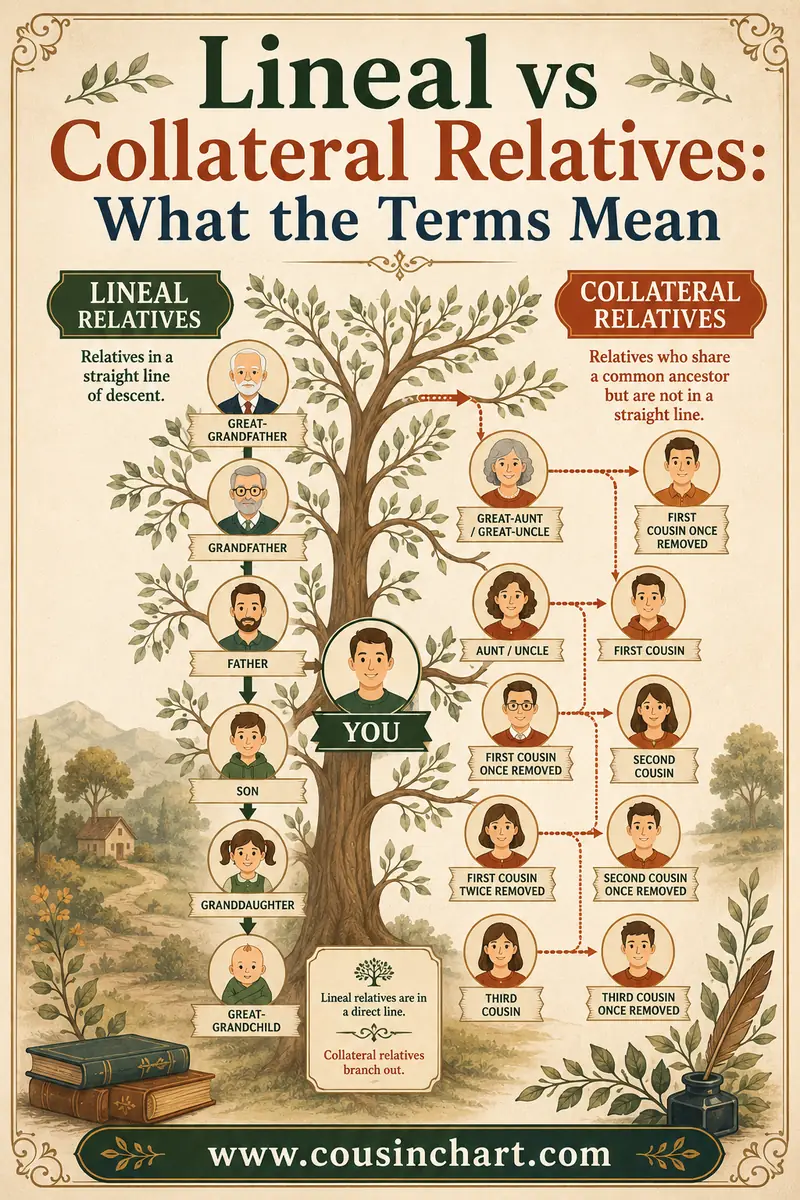
The blood-versus-marriage distinction runs through the whole family tree — our guide to lineal vs collateral relatives breaks down the other axis lawyers care about: whether a blood relative is in your direct line or off to the side.
How to Work Out Any Degree Yourself
The full method, in four steps:
- Find the nearest common ancestor (or ancestral couple) between the two people.
- Count the parent–child steps from person A up to that ancestor.
- Count the steps from the ancestor down to person B.
- Add the two legs. That sum is the civil-law degree.
Two tips that prevent most mistakes. First, always use the nearest common ancestor — going back further inflates the count. Second, don't count the common ancestor themselves as a step; count the links, not the people.
If the path is tangled — half-relations, multiple marriages, "my grandma's cousin's daughter" territory — do yourself a favor and let the relationship calculator trace it. You pick how each person connects to the shared ancestor, and it returns the exact relationship name instantly, no scratch paper involved.
Quick answer: To find the degree of consanguinity, count the parent-to-child steps from one person up to your nearest shared ancestor, then back down to the other person. That total is the civil-law degree, the method most modern laws use. The older church method (traditional canon law) counts only the longer side. This is general information, not legal advice. Rules differ from place to place, so check with a local lawyer before relying on a number for anything official.
Three Worked Examples, Counted Both Ways
Example 1: A family note about a great-uncle's estate
Your grandmother's brother, Uncle Walt, has passed away, and a relative says his state's inheritance rules list relatives "by degree." Where do you fall?
- Find the nearest shared ancestor. Walt's parents are your great-grandparents.
- Count your side. You, up to your parent, your grandmother, then your great-grandparents: 3 steps.
- Count his side. Your great-grandparents down to Walt: 1 step.
- Civil count: 3 + 1 = fourth degree. Older church count: the longer side, third degree.
Your degree is only a starting point. Who inherits depends on the state's full rules, where a spouse, children, and closer relatives usually come first, and some states sort relatives by family branch before counting degrees. Our page on how estates are shared among cousins explains the general ideas, and a local probate lawyer can tell you how they apply.
Example 2: An old church marriage record
You find an 1880s parish entry noting that a couple needed a dispensation for consanguinity "in the second degree." Using the older church count, second degree means the longer side is two steps, so each of them is a grandchild of the shared ancestors. They were most likely first cousins, which is fourth degree in the civil count. (An uncle and niece would also count as second degree under the older method.)
Example 3: A doctor's family history form
The form asks, "Has any first-degree relative had this condition?" Your sister had it. In the civil-law count your sister is a second-degree relative, but on a medical form she is first-degree. Doctors use their own scale (see the mix-ups below), so answer "yes."
How to Switch Between the Two Counts
- Count both sides up to the nearest shared ancestor, for example 2 and 3.
- Civil count: add them (2 + 3 = fifth degree).
- Older church count: take the larger number (third degree).
- Check which system the document uses. Older Catholic records usually use the longer-side count. The Church's current Code of Canon Law, in effect since 1983, adds both sides together the way civil law does. Modern statutes usually use the civil count.
Not sure where the shared ancestor sits? The relationship calculator on our homepage names the relationship first.
Common Mix-Ups
- Medical degrees aren't legal degrees. In medicine, first-degree relatives are your parents, siblings, and children. Second-degree relatives are grandparents, grandchildren, aunts, uncles, nieces, nephews, and half-siblings. Third-degree relatives include first cousins and great-grandparents. This scale follows shared DNA, not step counts.
- A "fourth-degree relative" isn't a fourth cousin. A first cousin is fourth degree in the civil count. A fourth cousin is five steps up and five down, which makes them a tenth-degree relative. See what a fourth cousin is for that branch.
- Marriage doesn't create consanguinity. In-laws and stepfamily are related by affinity. Our guide to blood relatives vs. relatives by marriage shows where that line falls.
FAQ
What does consanguinity mean in simple terms?
It means blood relationship — two people who descend from a common ancestor. The degree of consanguinity is a number measuring how close that relationship is: parents are first degree, siblings and grandparents second, aunts and uncles third, first cousins fourth.
What degree of consanguinity is a first cousin?
Fourth degree under the civil law method used by most modern statutes: two steps up to your shared grandparents plus two steps down to your cousin. Under the older canon law method, first cousins are second degree.
Is a spouse a consanguineous relative?
No. Spouses are related by affinity (marriage), not consanguinity (blood). The same goes for in-laws and step-relatives. Adopted children are the special case: legally they're treated as full blood-equivalent relatives of their adoptive family.
What is the difference between the civil and canon law methods?
Civil law counts every step in the path — up to the common ancestor and back down — so first cousins are fourth degree. The traditional canon law method, used by the Catholic Church until 1983, counts only the longer leg, so first cousins are second degree. Modern statutes almost always use the civil count; historical church records use canon.
Why do degrees of consanguinity matter legally?
They determine who inherits when someone dies without a will, which marriages a state permits, when a judge or juror must step aside, and which relatives count for various benefits. Medically, degree predicts shared DNA, which matters for hereditary risk assessment.
Are half-siblings the same degree as full siblings?
In most legal counting, yes — a half-sibling is still a second-degree relative, because the path through the one shared parent is the same length. Genetically they share about 25% DNA instead of a full sibling's 50%, and a minority of inheritance statutes give half-blood relatives a reduced share.
Is a first-degree relative in medicine the same as in law?
Not always. On medical forms, your parents, siblings, and children are all first-degree relatives. In the civil-law count, only parents and children are first degree, and a sibling is second degree. Use the medical meaning on health forms and the legal meaning when reading a law.
What does "within the third degree" mean?
Using the civil count, it covers everyone one, two, or three steps away. That means parents, children, siblings, grandparents, grandchildren, aunts, uncles, nieces, nephews, great-grandparents, and great-grandchildren. First cousins, at fourth degree, fall outside it. Always check which counting method the document uses.
What degree of relative is a fourth cousin?
Tenth degree in the civil count, because you each sit five generations below your shared ancestors (5 up plus 5 down). Under the older church count, a fourth cousin is fifth degree.
Does the Catholic Church still use the canon law method of counting?
Not the old one. The current Code of Canon Law, in effect since 1983, counts collateral relatives by adding both sides, like civil law, so first cousins are fourth degree. The longer-side count in older parish records came from earlier church law. For a specific marriage question, your parish or diocese is the right place to ask.
Put a Number on Any Relationship
Consanguinity sounds like a law-school word, but the idea is friendly: count the steps through the family tree, and you get a number that courts, doctors, and genealogists all understand. Parent, one. Sibling, two. Cousin, four. Everything else follows the same path-counting logic.
And when the path stops being obvious — someone at the reunion says "we're related through your great-grandma's sister" — don't count on your fingers. The free family relationship calculator traces the path, names the relationship, and settles it before the potato salad runs out.