Lineal vs Collateral Relatives: What the Terms Mean
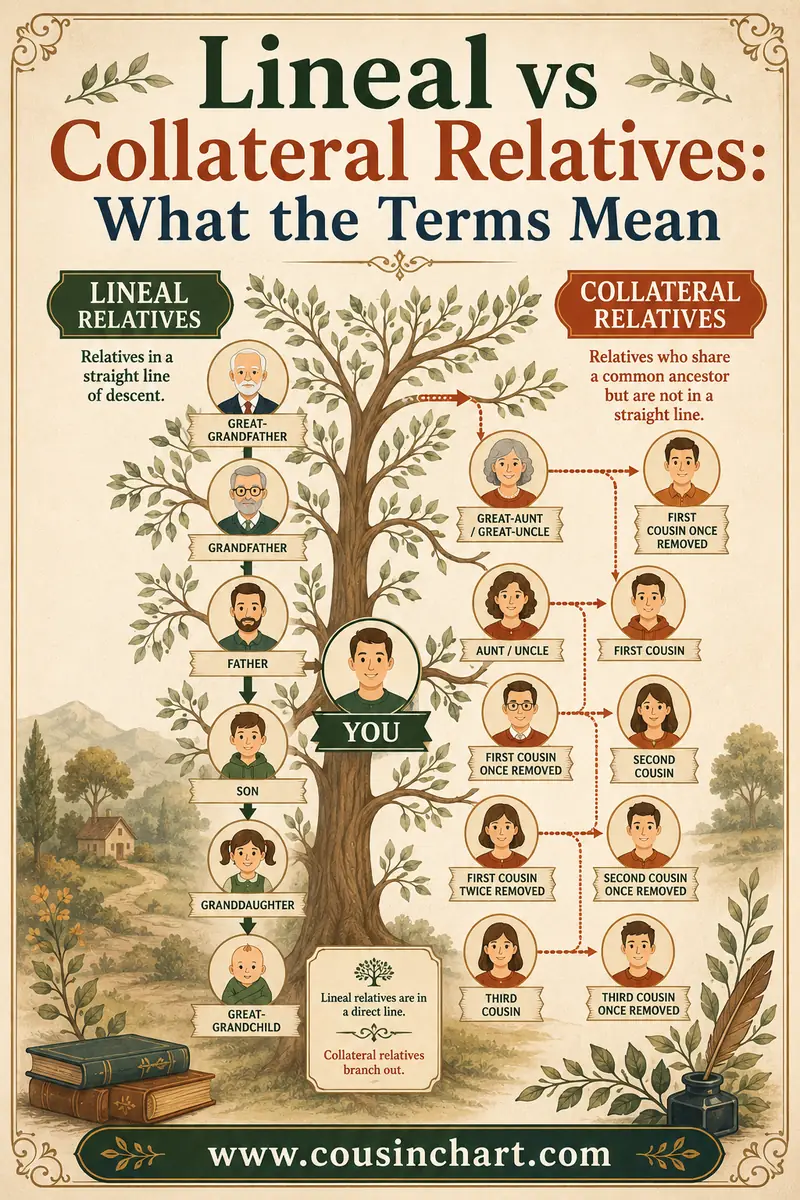
Lineal relatives are the people in your direct line of descent — your parents, grandparents, and great-grandparents going up, and your children, grandchildren, and great-grandchildren going down. Collateral relatives share an ancestor with you but sit off to the side of that line: siblings, aunts and uncles, nieces and nephews, and every kind of cousin.
That one distinction — straight line versus side branch — quietly runs through inheritance law, genealogy society applications, and every family tree chart you'll ever fill in. This guide walks through who lands in each bucket, the edge cases (half, step, adopted), and where the labels actually matter. If you're trying to name a specific relationship first, the free family relationship calculator on our homepage will identify anyone in your tree in seconds.
Relationship quick-check. Tap a relative — lineal or collateral?
The answer will appear here.
The Core Idea: One Line, Many Branches
Picture your family tree as an actual tree for a second. There's one trunk that runs through you: your parents below you feed into it, their parents below them, and so on down into the roots; your children grow out above you, then their children. That trunk is your direct line, and everyone on it is a lineal relative.
Everything else on the tree — and it's most of the tree — is a branch that split off from your trunk at some point. Your sibling split off at your parents. Your first cousin split off at your grandparents. Your third cousin split off way down at your great-great-grandparents. All of them are collateral relatives: from the Latin com- (together) + latus (side). Literally, "alongside."
The test is a single question: is this person my ancestor or my descendant? If yes, lineal. If they merely share an ancestor with you, collateral.
Who's Lineal: The Direct Line
Your lineal relatives form a surprisingly short list, because each generation contributes so few people to your direct line:
- Ascending (ancestors): parents, grandparents, great-grandparents, great-greats, and so on.
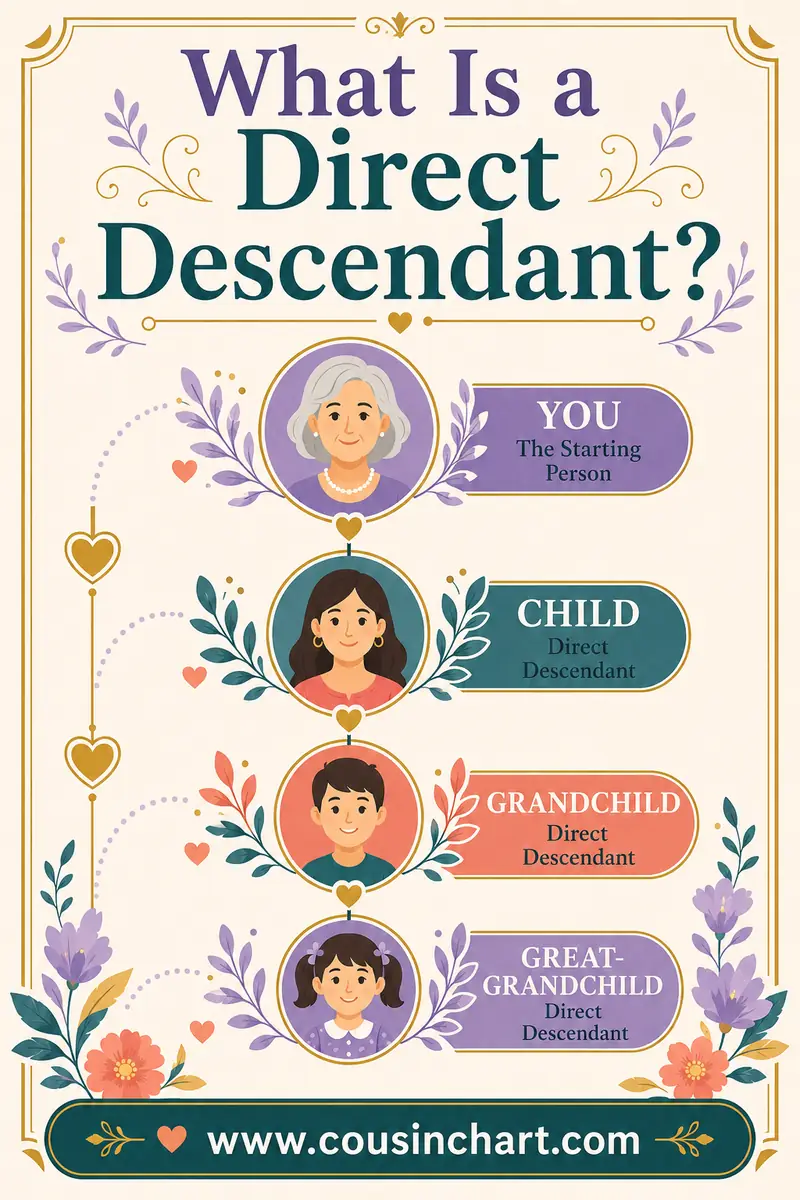
- Descending (descendants): children, grandchildren, great-grandchildren, onward.
That's it. No matter how enormous your extended family is, your lineal relatives are only the people you descend from and the people who descend from you. Genealogists call the descending group your direct descendants — a term with its own legal weight, covered in our direct descendant guide.
Two quick vocabulary notes. "Lineal ascendant" and "lineal descendant" are the formal legal phrasings you'll see in statutes and wills. And a "lineal generation" chart — the kind lineage societies ask for — is just your trunk drawn as a list: you, parent, grandparent, great-grandparent, back to the ancestor of interest.
Who's Collateral: Everyone Off to the Side
Collateral relatives are blood relatives who are neither your ancestors nor your descendants. The headline members:
- Siblings — share your parents, but you don't descend from each other.
- Aunts and uncles — your parents' siblings.
- Nieces and nephews — your siblings' children.
- First, second, third cousins (and all their once/twice-removed variations).
- Great-aunts and great-uncles, grand-nieces and grand-nephews.
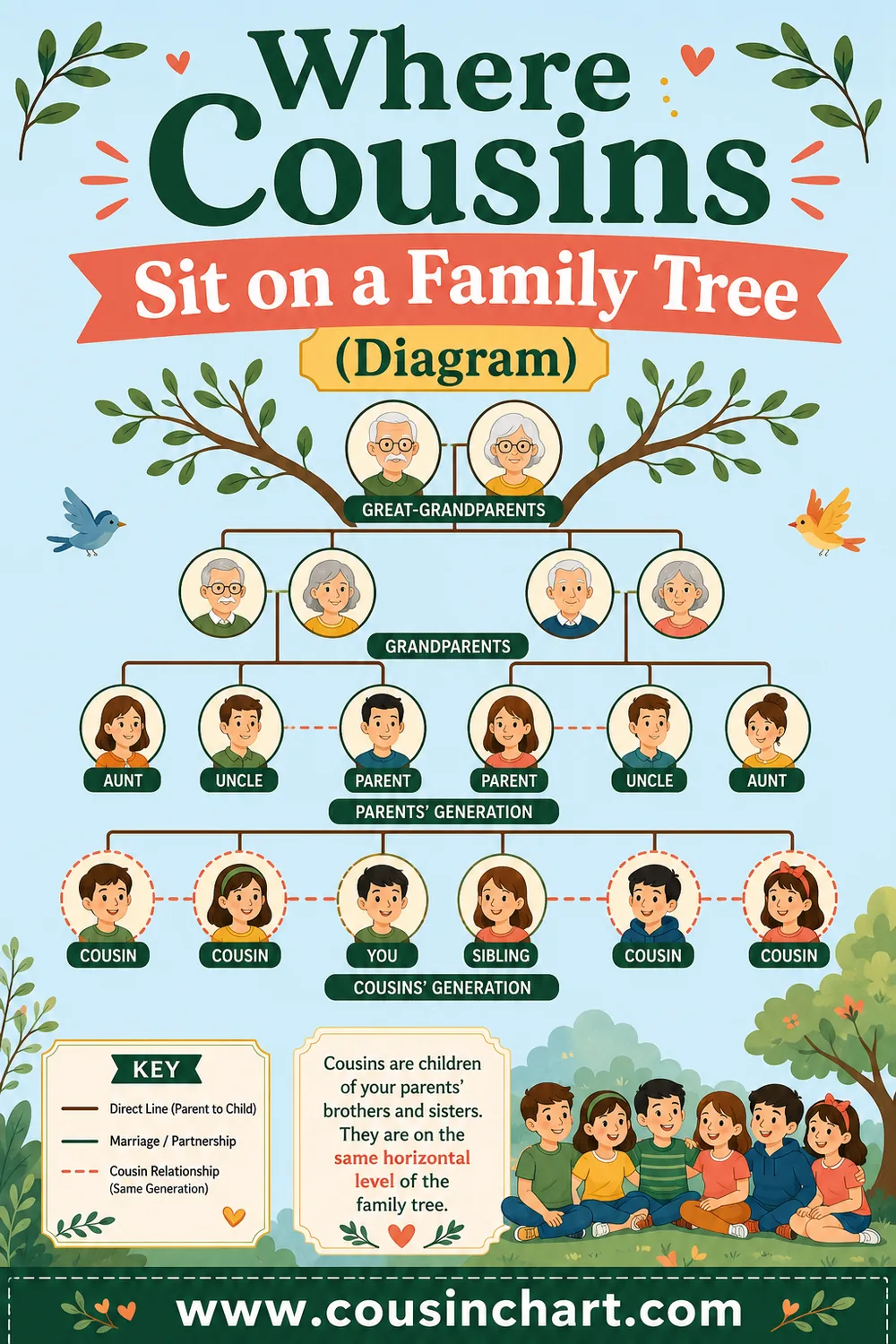
A common stumble: people assume "collateral" means distant. It doesn't. Your sister is a collateral relative and shares as much DNA with you as your mother does (about 50% on average). Collateral describes the shape of the connection — sideways rather than up-and-down — not its strength. Where cousins of every stripe sit is easiest to see visually; our guide to where cousins sit on a family tree maps the whole layout.
Side-by-Side: Lineal vs Collateral at a Glance
| Lineal | Collateral | |
|---|---|---|
| Definition | Your direct ancestors and descendants | Blood relatives who share an ancestor but aren't in your line |
| Examples | Mother, grandfather, daughter, great-grandson | Brother, aunt, nephew, first cousin, second cousin |
| Test question | "Do I descend from them, or they from me?" | "Do we merely share an ancestor?" |
| How many exist | Few — a single chain up and down | Many — every branch of the tree |
| Inheritance priority | Generally first (descendants, then ascendants) | Generally after lineal heirs |
| Can be same generation as you? | No — always above or below | Yes (siblings, cousins) or any offset |
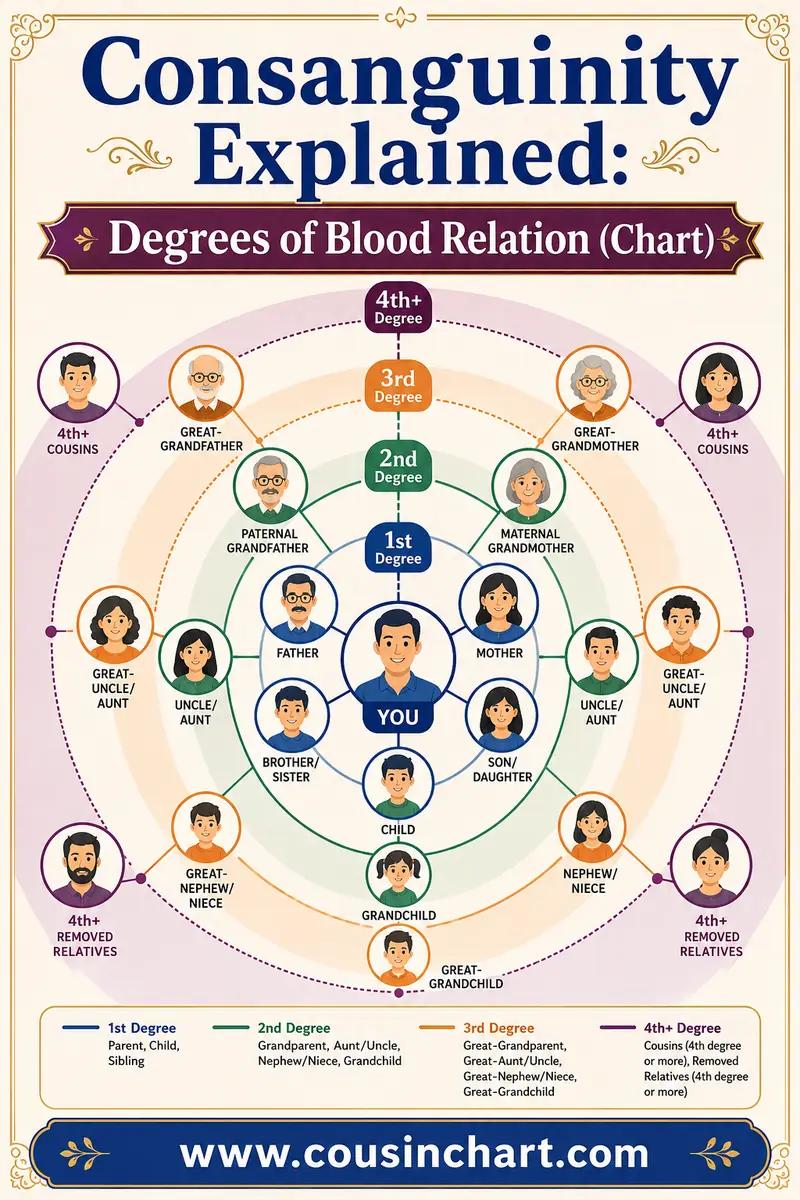
And the third category that's neither: relatives by affinity — spouses, in-laws, step-relatives. They're connected by marriage rather than blood, so the lineal/collateral question doesn't apply to them at all. The full blood-relation numbering system behind all of this is covered in our consanguinity guide.
Why the Distinction Matters
Inheritance and intestacy
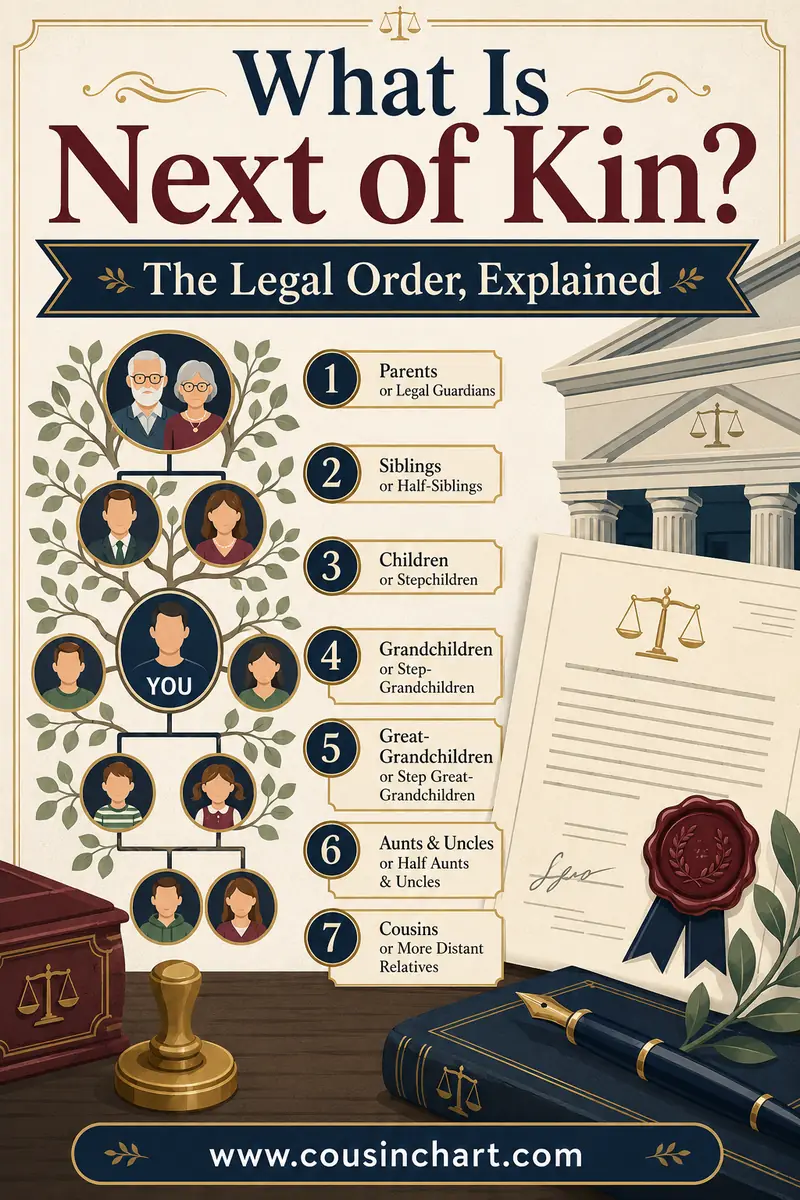
This is where the terms earn their keep. When someone dies without a will, state intestacy laws distribute the estate in a fixed order — and that order leans hard on the lineal/collateral split. Broadly: the surviving spouse and lineal descendants come first; if there are none, lineal ascendants (parents) and then collaterals (siblings, then their descendants, then more distant branches). A person's third cousin only inherits when every closer lineal and collateral heir is gone. The related concept of legal priority among relatives is the subject of our next of kin guide.
Lineage and heritage societies
Organizations like the Daughters of the American Revolution require proof of lineal descent from a qualifying ancestor — collateral connections don't count. Being the great-great-grandchild of a patriot's brother makes you a collateral relative of the patriot, and most lineal societies will decline that application (a few "collateral" societies exist precisely to welcome those lines).
Genealogy research strategy
Experienced researchers deliberately study collateral lines. When your direct ancestor left thin records, their siblings' marriage certificates, obituaries, and land deeds often name the same parents — proving your line by the side door. "Research the whole family, not just the trunk" is standard advice for exactly this reason.
Medicine and genetics
Doctors taking a family history distinguish first-degree relatives (parents, siblings, children — a mix of lineal and collateral) from more distant ones. Notice medicine slices the tree by degree, not by lineal/collateral — a reminder that each field picks the lens it needs.
The Edge Cases: Half, Step, and Adopted
Real families produce complications the tidy definitions don't mention:
- Half-siblings are collateral relatives — the connection through one shared parent still branches sideways. The "half" changes shared DNA (about 25% instead of 50%), not the category.
- Step-relatives are neither lineal nor collateral. A stepfather isn't your ancestor and shares no ancestor with you; he's a relative by affinity. If he legally adopts you, that changes everything.
- Adopted children are treated by modern law as full lineal descendants of their adoptive parents — same inheritance rights, same place in the legal line. Genetically the line differs, which matters for medical history but not for the law or for how most families draw the tree.
- Cousins who are also something else — in families where relatives married relatives, one person can connect to you through two paths, one lineal and one collateral. Genealogy software handles it by listing both; on paper, note each path separately.
How to Classify Anyone in Ten Seconds
Here's the whole method:
- Ask: am I descended from this person? If yes → lineal ascendant.
- Ask: is this person descended from me? If yes → lineal descendant.
- Ask: do we share a common ancestor at all? If yes → collateral. If no → related by marriage only (affinity), or not related.
That's genuinely all there is to it. The harder part is usually naming the specific collateral relationship — is your grandma's cousin's son your second cousin, or something once removed? (Second cousin, if you're both the same distance down; the relationship calculator confirms it and names any other path you throw at it, instantly and free.)
FAQ
What is a collateral relative?
A blood relative who shares a common ancestor with you but isn't your ancestor or descendant. Siblings, aunts, uncles, nieces, nephews, and all cousins are collateral relatives — they sit on side branches of your family tree rather than in your direct line.
Are siblings lineal or collateral?
Collateral. You and your sibling share parents, but neither of you descends from the other, so there's no direct line between you. It surprises people because siblings are so genetically close — but "collateral" describes the shape of the connection, not its strength.
Is an aunt a lineal relative?
No — aunts and uncles are collateral relatives. They share ancestors with you (your grandparents) but aren't in your line of descent. Your grandparents themselves, by contrast, are lineal.
What is a lineal descendant?
Anyone who descends directly from a person: children, grandchildren, great-grandchildren, and so on. Legally, adopted children count as full lineal descendants of their adoptive parents. Nieces, nephews, and cousins never qualify — they descend from a shared ancestor, not from you.
Why do wills and intestacy laws care about the difference?
Because inheritance follows a priority order: lineal descendants generally inherit first, then lineal ascendants, then collateral relatives by closeness. A will that leaves property "to my lineal descendants" deliberately excludes siblings, nieces, and cousins.
Do in-laws count as collateral relatives?
No. In-laws and step-relatives are related by affinity (marriage), not blood, so they're neither lineal nor collateral. Without a will or specific statute naming them, they generally have no default inheritance claim.
Sort Your Whole Tree in One Pass
Lineal: the short, straight line of people you descend from and who descend from you. Collateral: the wide, branching crowd of siblings, aunts, and cousins who share your ancestors from the side. Affinity: everyone who married in. Three buckets, and every relative you have fits one of them.
Naming the exact relationship inside those buckets is the fiddly part — and the part you never have to do by hand. The free family relationship calculator traces the path between you and any relative and hands you the precise term, from "grandmother" to "half second cousin once removed."