Where Cousins Sit on a Family Tree (Diagram)
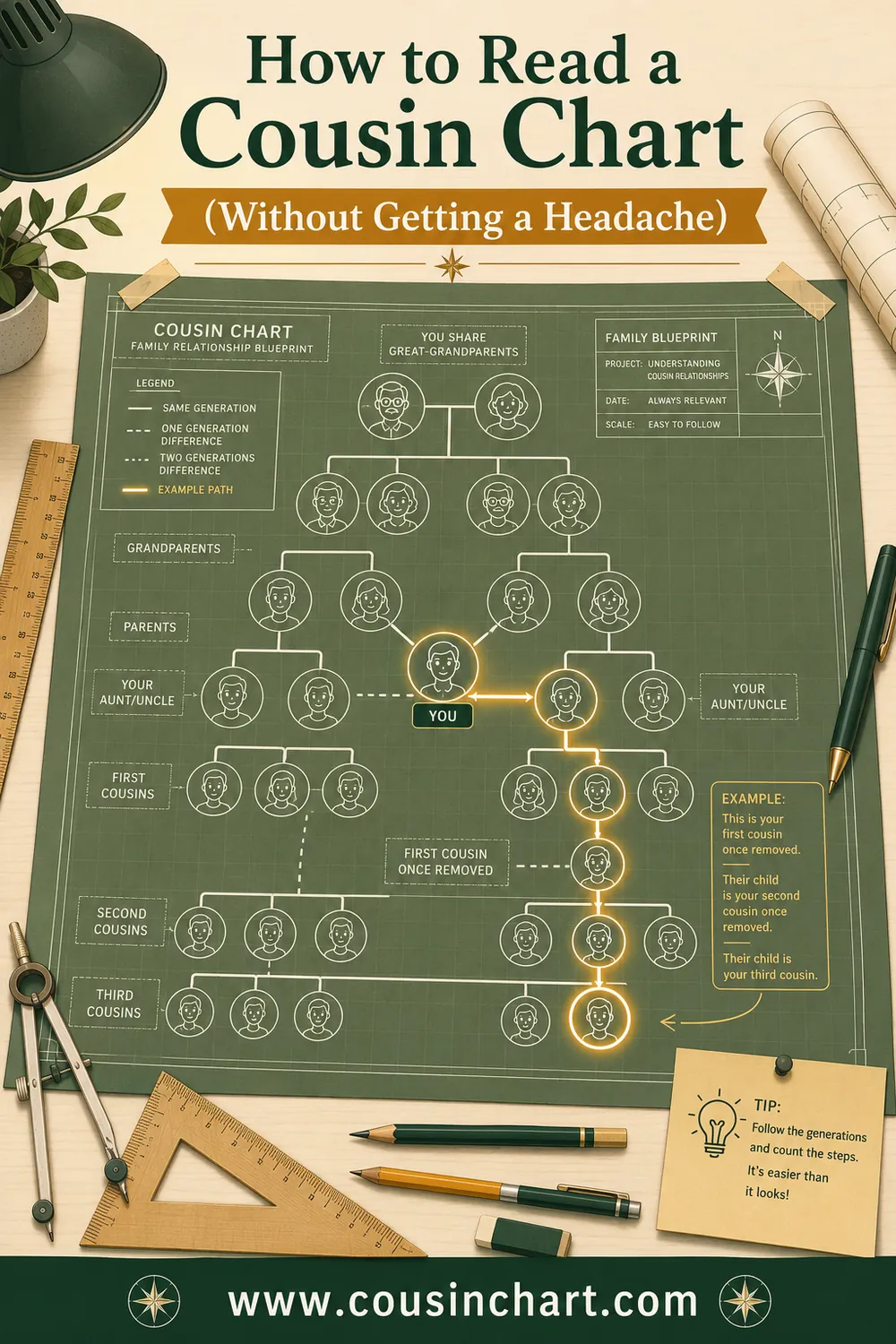
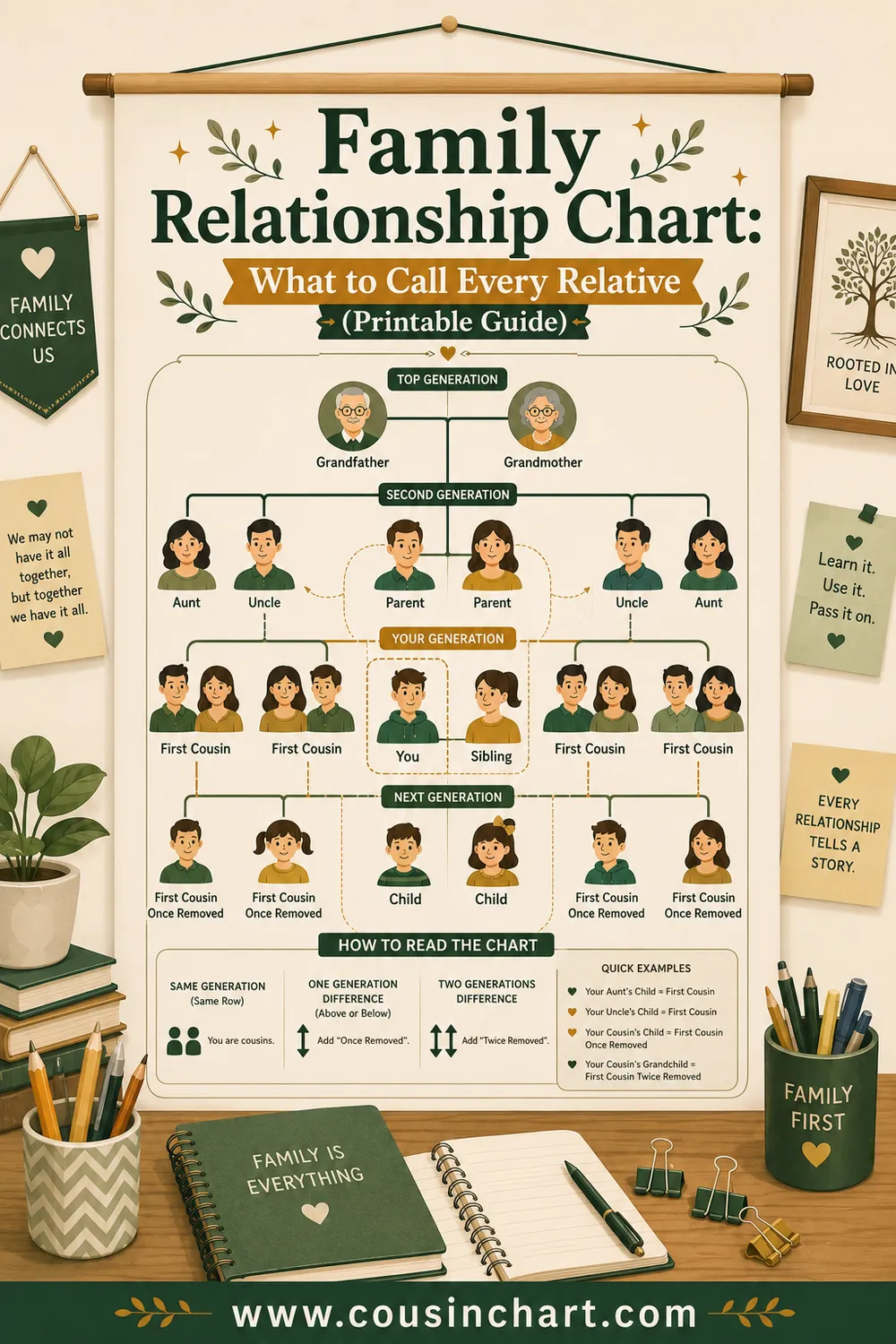
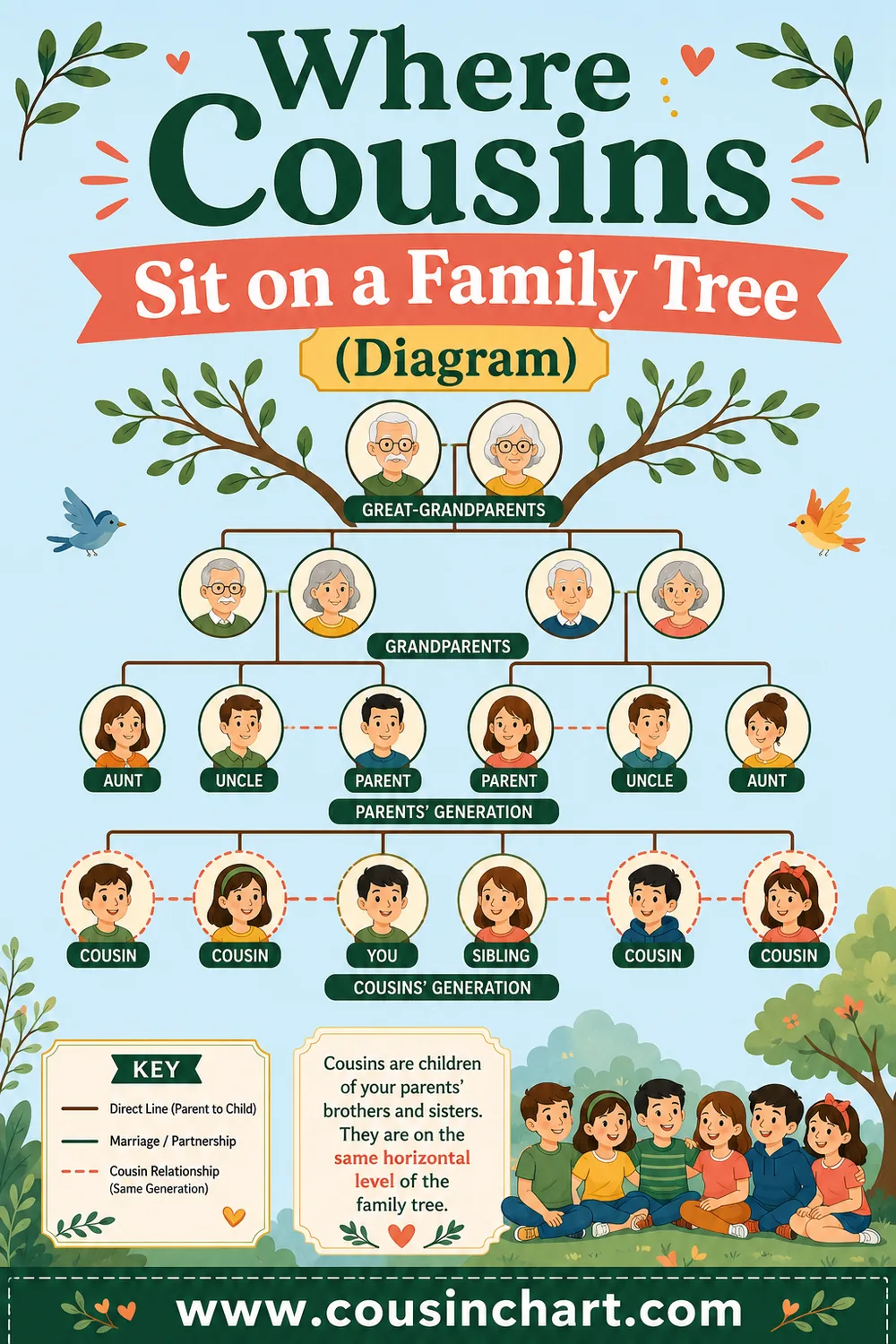
On a family tree, your cousins all sit on your own row — first cousins on the branch next to yours, second cousins one branch further out, third cousins further still. Anyone above or below your row isn't a plain cousin: they're an aunt, uncle, niece, nephew, or a cousin "removed."
Once you can see that layout, every cousin question becomes a matter of looking in the right place. This guide builds the cousin tree row by row, shows you how branches map to degrees and rows map to removals, and flags the drawing mistakes that scramble family charts. And when a relative doesn't fit neatly on paper, the free relationship calculator on our homepage places them for you instantly.
Relationship quick-check. Tap a phrase to see the correct term:
The answer will appear here.
Rows Are Generations
Every family tree, however fancy, is a stack of horizontal rows. Each row is one generation:
| Row | Who lives there |
|---|---|
| +3 | Great-grandparents, their siblings, their cousins |
| +2 | Grandparents, great-aunts/uncles, grandparents' cousins |
| +1 | Parents, aunts/uncles, parents' cousins |
| 0 (you) | You, siblings, ALL your plain cousins — first, second, third... |
| −1 | Children, nieces/nephews, cousins' children |
| −2 | Grandchildren, cousins' grandchildren |
The bolded row is the key insight of this whole article: every unremoved cousin you have, no matter how distant, stands on your row. "First," "second," and "third" don't measure vertical distance — they measure how far sideways you go before the branches meet.
Branches Are Degrees
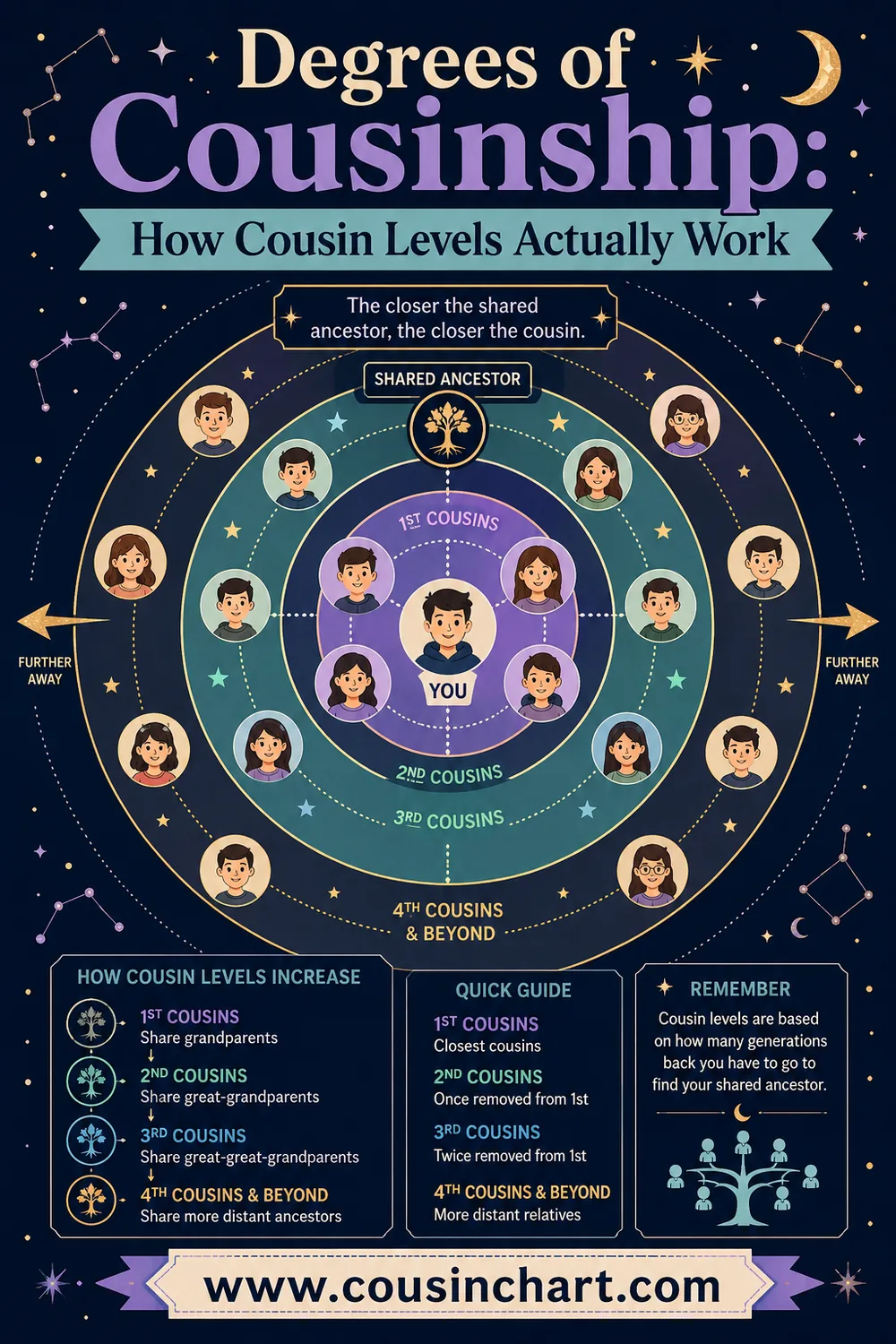
Now the horizontal direction. Standing on your row, look at who's next to you:
- Your siblings — same parents. Zero branches away.
- First cousins — the branches meet at your grandparents, one junction up.
- Second cousins — branches meet at your great-grandparents, two junctions up.
- Third cousins — branches meet at your great-great-grandparents.
Each cousin degree adds one "great" to the meeting point. That's the entire degrees of cousinship system drawn as geometry: the farther out along your row someone stands, the higher up the tree you must climb before your lines touch.
A concrete way to feel it: at a huge reunion, line up everyone in your generation. Cluster one: siblings. Cluster two: kids of your aunts and uncles. Cluster three: descendants of your great-grandparents through other branches. Same row, widening circles.
Diagonals Are Removals
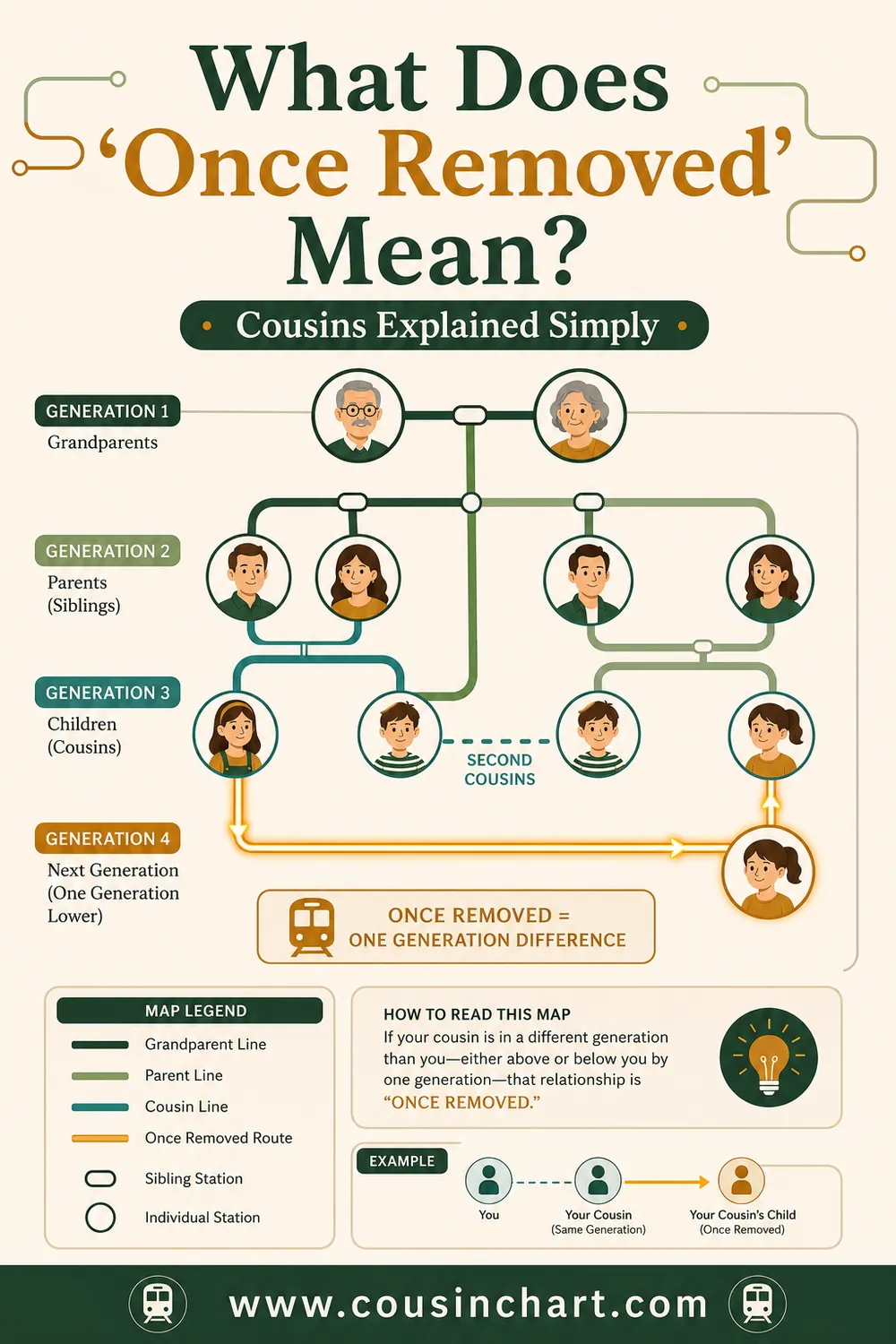
What about your cousin's kids, or your dad's cousin? They're off your row — and that's exactly what "removed" means: rows of vertical distance between two people whose branches meet at the same junction.
- One row down: your first cousin's child = first cousin once removed.
- One row up: your parent's first cousin = also first cousin once removed.
- Two rows up: your grandparent's first cousin = first cousin twice removed.
On the diagram these relationships form diagonals: same branch-meeting point, different rows. The degree comes from the branch, the removal from the rows. Two numbers, two axes — that's the whole coordinate system, and it's why a cousin chart works like a street map. (If "removed" is still fuzzy, our what does once removed mean explainer walks it through slowly.)
Worth repeating because it prevents the most common error: your cousin's child is NOT your second cousin. They're one row down on the same branch: first cousin once removed. Second cousins are on your row, one branch further out.
Drawing a Cousin Tree: A 5-Minute Recipe
Want the diagram on paper? Here's the fastest layout that stays accurate:
- Start with the shared couple at the top. For a first-and-second-cousin tree, that's your great-grandparents.
- Draw their children across row +2. Your grandparent and each of their siblings, left to right.
- Drop one row per generation. Each person's children hang below them; keep every generation strictly on its own horizontal line.
- Mark your row. Everyone on it descended from the top couple is your sibling (same parents), first cousin (same grandparents), or second cousin (same great-grandparents) — you can read the degree straight off which junction connects you.
- Read diagonals as removals. Anyone above or below your row: count the row gap, keep the branch's degree.
Rules four and five are why neat rows matter so much. The moment generations drift vertically — the baby of a big family drawn level with the next generation's kids — the visual logic breaks and people start misreading relationships that the layout would otherwise hand them for free.
The Three Mistakes That Scramble Family Trees
- Letting age set the row. Your grandfather's youngest sister might be younger than your mother — she still belongs on your grandfather's row. Generation, not birth year, decides placement. This single discipline prevents most "wait, how is she my great-aunt?" confusion.
- Calling everyone on a lower row "second cousin." Downward diagonals are removals, not higher degrees. The degree only grows when both branches add generations.
- Mixing marriage lines into descent lines. Spouses join the tree but don't descend from it. Draw marriages horizontally and keep bloodlines vertical, or your cousin count will quietly absorb a bunch of in-laws. (A full family relationship chart shows the standard notation.)
When a tree's already tangled — blended families, half-siblings, four generations at one wedding — you don't have to untangle it by eye. Enter the two people into the free cousin calculator and it walks the tree for you, naming the relationship and the path.
Reading Any Relative Off the Diagram
Put it all together and you get a two-question test that works for anyone on the tree:
- Which junction connects us? Grandparents → first cousin line. Great-grandparents → second. Great-great → third.
- How many rows apart are we? Zero → plain cousin. One → once removed. Two → twice removed.
Your grandmother's cousin? Junction: her grandparents (your great-greats) → first cousin line. Rows apart: two → twice removed. First cousin twice removed. Every "what is she to me?" at every reunion yields to those two questions — or to ten seconds with the calculator.
A Worked Tree: Reading the Alvarez Family
Rules are easier to trust once you've watched them work on real (well, realistic) people. Here's a small tree, top to bottom:
- Row +3: Rosa and Miguel Alvarez — the shared couple at the top.
- Row +2: their children: your grandmother Elena and her brother Tomás.
- Row +1: Elena's son (your father), and Tomás's daughter Lucía.
- Row 0: you, and Lucía's son Diego.
- Row −1: Diego's daughter Sofía.
Now read relationships straight off the geometry:
- You and Diego. Same row. Which junction connects you? Rosa and Miguel — your great-grandparents. Great-grandparent junction = second cousins. Done.
- You and Lucía. She's one row above you, and the junction is still Rosa and Miguel. From her side they're only grandparents, so she's on the first-cousin line with your father — which makes her your first cousin once removed. One diagonal step, one removal.
- You and Sofía. One row below you, same top junction. Diego is your second cousin, so his daughter is your second cousin once removed.
- You and Tomás. Two rows up, and he's a child of the top couple — that puts him on the sibling line with your grandmother, not the cousin lines. Sibling of a grandparent = great-uncle. This is the pattern from the mistakes section: people directly on the ancestor rows of your own branch-junction get aunt/uncle terms, not cousin terms.
Notice you never had to memorize a single pairing. Two questions — which junction, how many rows — answered all four, and they'll answer the next forty relatives too.
Why Row Zero Gets So Crowded
A family tree isn't just tall — it widens fast, and the widening explains why distant cousins outnumber close ones so dramatically.
Look at the ancestor rows first. You have 2 parents, 4 grandparents, 8 great-grandparents, 16 great-great-grandparents: the count doubles every row up. Now flip that around. Each cousin degree is fed by one of those ancestor rows:
| Cousin degree | Fed by | How many ancestor couples |
|---|---|---|
| First cousins | Grandparents' other children | 2 couples |
| Second cousins | Great-grandparents' other children | 4 couples |
| Third cousins | Great-great-grandparents' other children | 8 couples |
Every extra degree doubles the number of family branches that can drop descendants onto your row. That's why most people have a handful of first cousins, a few dozen second cousins, and often hundreds of third cousins they've never met — the geometry practically guarantees it. It's also why DNA sites can flood you with third-cousin matches: there are simply that many branches feeding your row from eight couples' worth of great-great-grandchildren.
The practical upshot for tree-drawing: don't try to fit every branch on one page. Draw one shared-ancestor couple per diagram — a "grandparents tree" for first cousins, a "great-grandparents tree" for second cousins — and your rows stay readable instead of becoming wallpaper.
Drawing the Tricky Cases Without Breaking the Rows
Real families throw curveballs that tempt people to bend the layout. Resist — every one of them has a standard drawing that keeps rows intact:
- Half-siblings. Two children who share one parent hang from that parent, with each child's line tracing to their own other parent. The kids still share a row; only the lines above them differ. Their descendants become half cousins, and the diagram shows why: the branches meet at one person, not a couple.
- Remarriages. Draw each marriage as its own horizontal link, in order, with children hanging from the marriage they came from. One person with two marriage lines and two sets of children is perfectly normal notation — and it's the picture that makes step- and half-relationships legible at a glance.
- Adoption. An adopted child sits on the family's child row like any other child — a dotted or annotated line is the genealogist's convention if you want to track biological lines separately for medical or DNA research. Socially and legally, the row placement is identical.
- Cousins who marry cousins. It happens in plenty of older trees. The couple gets a marriage line like anyone else, but their children descend from two junctions of the same tree. Don't redraw the whole diagram to force one path — just let the child's branch connect upward in two places. (DNA folks call the result "pedigree collapse.")
- The four-generation photo problem. When a great-grandmother, grandmother, mother, and baby are all alive at once, the tree has four occupied rows in one household. Nothing is wrong — rows track generations, not who shares a roof.
The common thread: rows never bend. People join sideways (marriage), hang from one parent instead of two (half lines), or connect with annotated lines (adoption) — but generation placement is non-negotiable, because it's the thing every cousin calculation reads from.
FAQ
Where do cousins go on a family tree?
On your own row (generation). First cousins connect through your grandparents, second cousins through your great-grandparents — the degree tells you how far up the branches meet, not how far up or down the person sits.
Is my cousin's child on my row of the tree?
No — one row below. That's why they're your first cousin once removed rather than any kind of plain cousin: "removed" counts rows between you.
What's the difference between a cousin tree and a cousin chart?
A tree shows actual people branching down from ancestors. A chart (or grid) is the generalized lookup table — relationship labels by generation, no names. The tree shows your family; the chart works for anyone's.
Why does my family tree look wrong even when it's accurate?
Usually because generations drifted off their rows — big age spreads inside one generation make correct trees look uneven. Keep each generation on one line and let the ages be surprising.
Do spouses and step-relatives belong on the tree?
Yes, if you want them — drawn with marriage lines (horizontal) or marked side branches, kept visually distinct from descent lines so cousin relationships stay readable.
How many generations should one diagram show?
Four or five is the sweet spot — one shared-ancestor couple at the top, down to the youngest row you care about. Beyond that, branches multiply faster than paper can hold (eight great-great-grandparent couples feed your third cousins alone). Split big families into one diagram per top couple and cross-reference between them.
What's the fastest way to place a confusing relative?
Answer two questions: which ancestor junction connects you, and how many rows apart you sit. Or skip the drawing and use the free relationship calculator, which does both counts and names the relationship.
The Short Version
Cousins live on your row; degrees measure how far out, removals measure how far off the row. Rows are generations, branches meet at shared ancestors, diagonals are removals — learn to see those three things and any family tree becomes readable at a glance.
And for the relatives who defy tidy diagrams, the free family relationship calculator turns any path — halves, steps, and removeds included — into the correct term in seconds.