Degrees of Cousinship: How Cousin Levels Actually Work
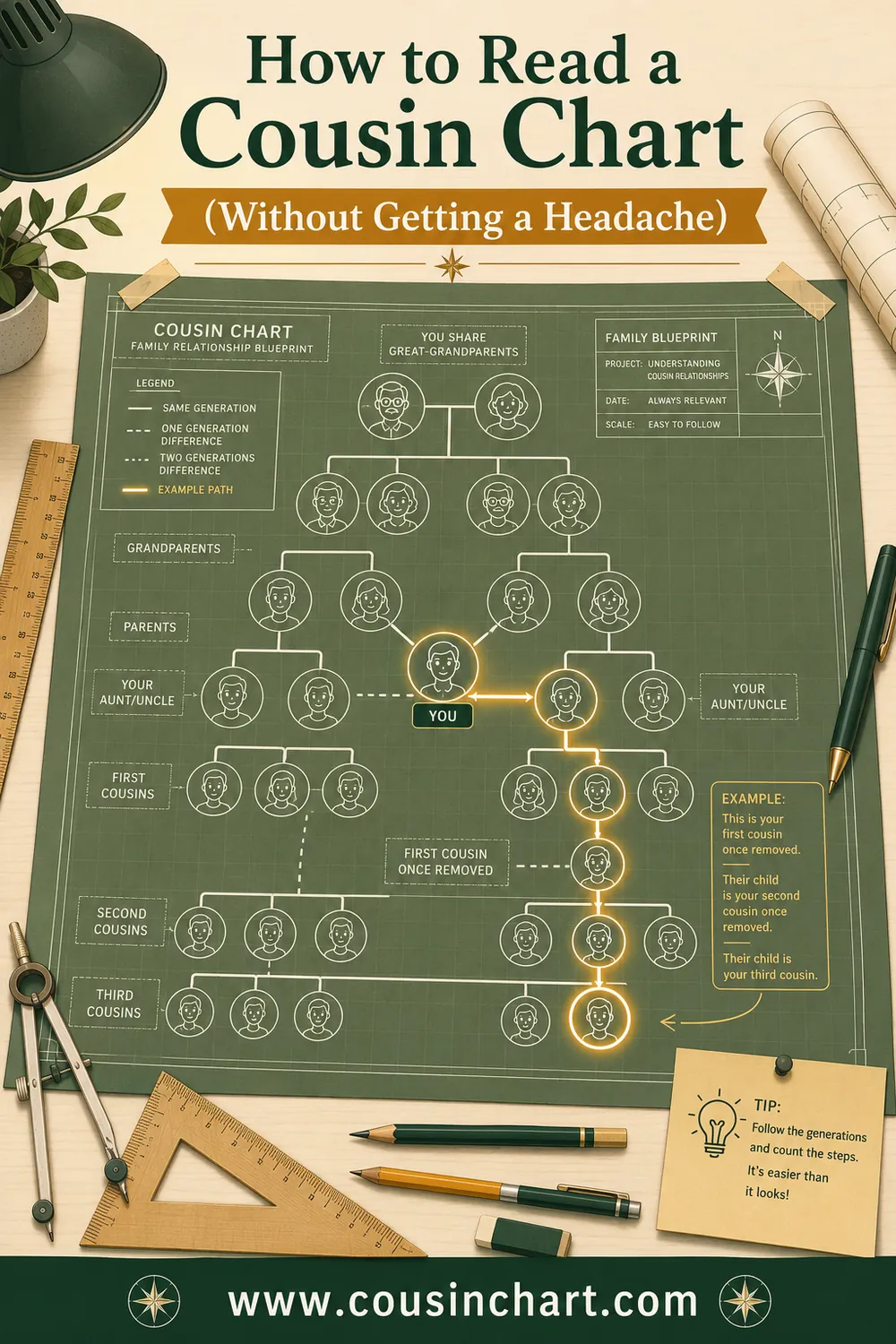
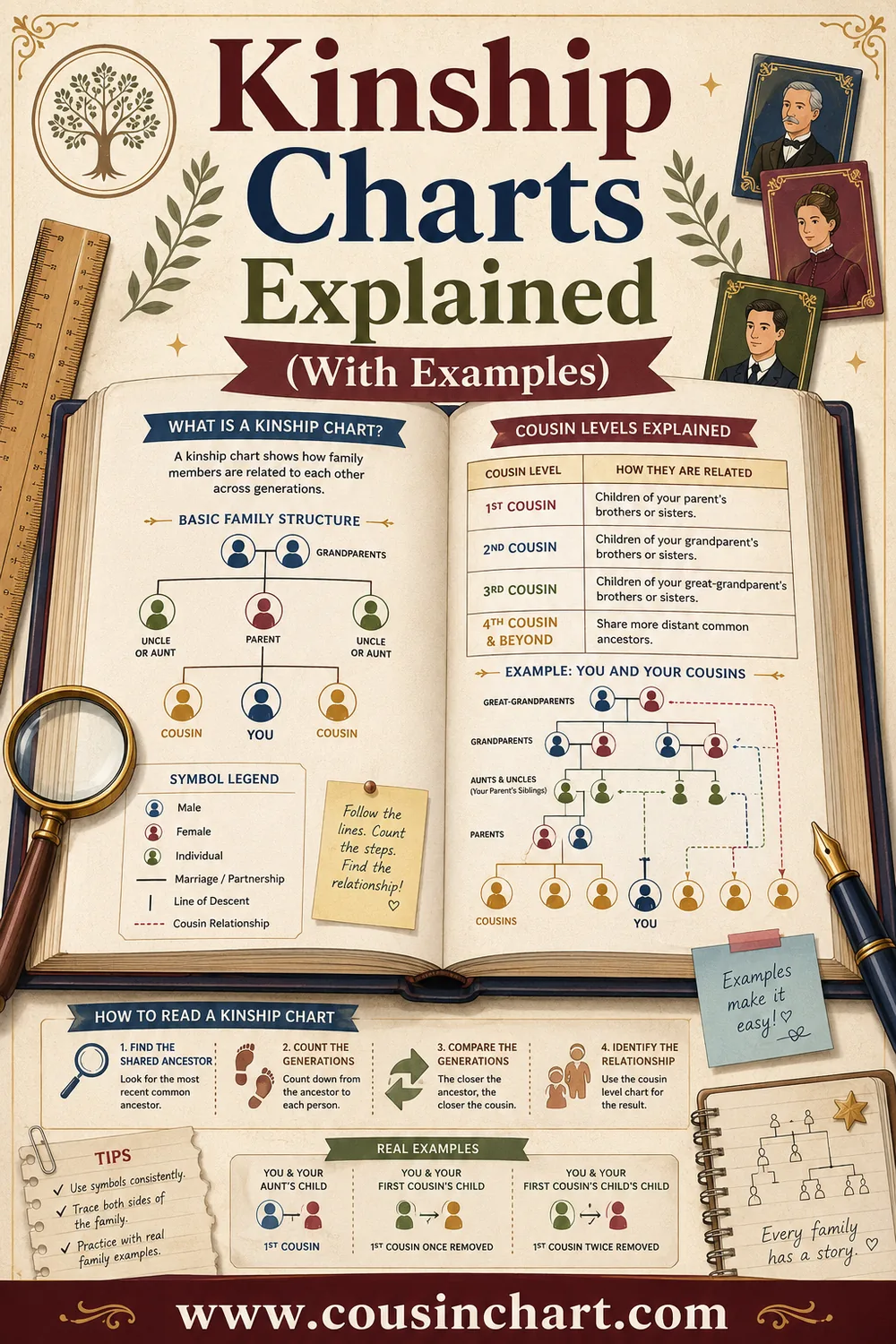
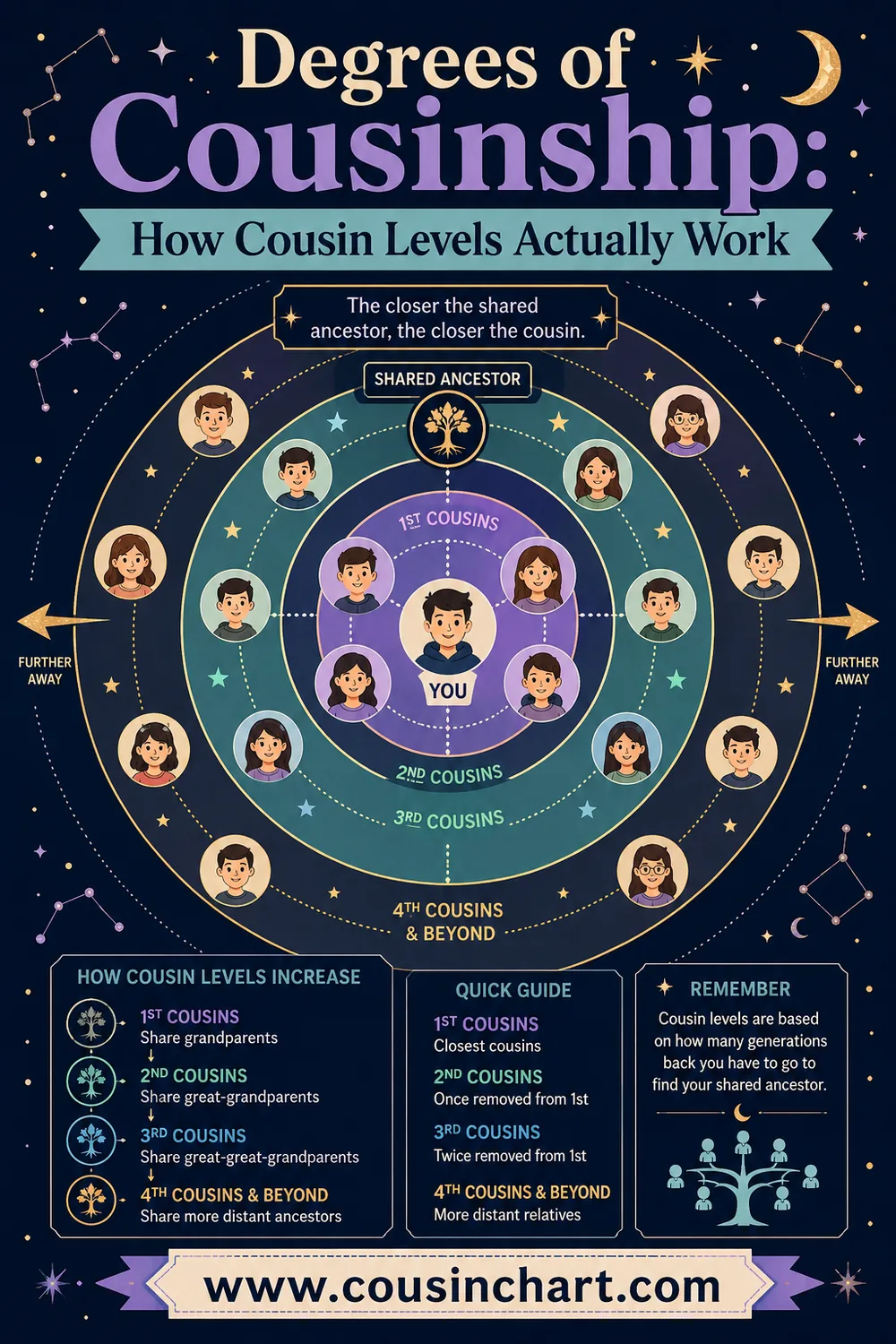
The degree of cousinship — first, second, third — comes from one count: how many generations sit between the shared ancestor and whichever cousin is closer to that ancestor, minus one. Grandparents shared? Two generations, minus one: first cousins. Great-grandparents? Three minus one: second cousins.
That single rule, plus a second small rule for "removed," generates every cousin term in English. This guide gives you the formula, the full cousin degree chart, worked examples that cover the tricky cases, and the legal degree systems genealogists bump into. When you'd rather not count at all, the free relationship calculator on our homepage applies the formula for you.
Relationship quick-check. Tap a phrase to see the correct term:
The answer will appear here.
The Formula (Two Rules, That's All)
Take any two blood relatives who aren't in a direct ancestor-descendant line or a sibling/aunt/uncle line. To name their cousinship:
- Find the most recent common ancestor (usually a couple).
- Count generations from that ancestor down to each person. Child = 1, grandchild = 2, great-grandchild = 3, and so on.
- Degree = the smaller count − 1.
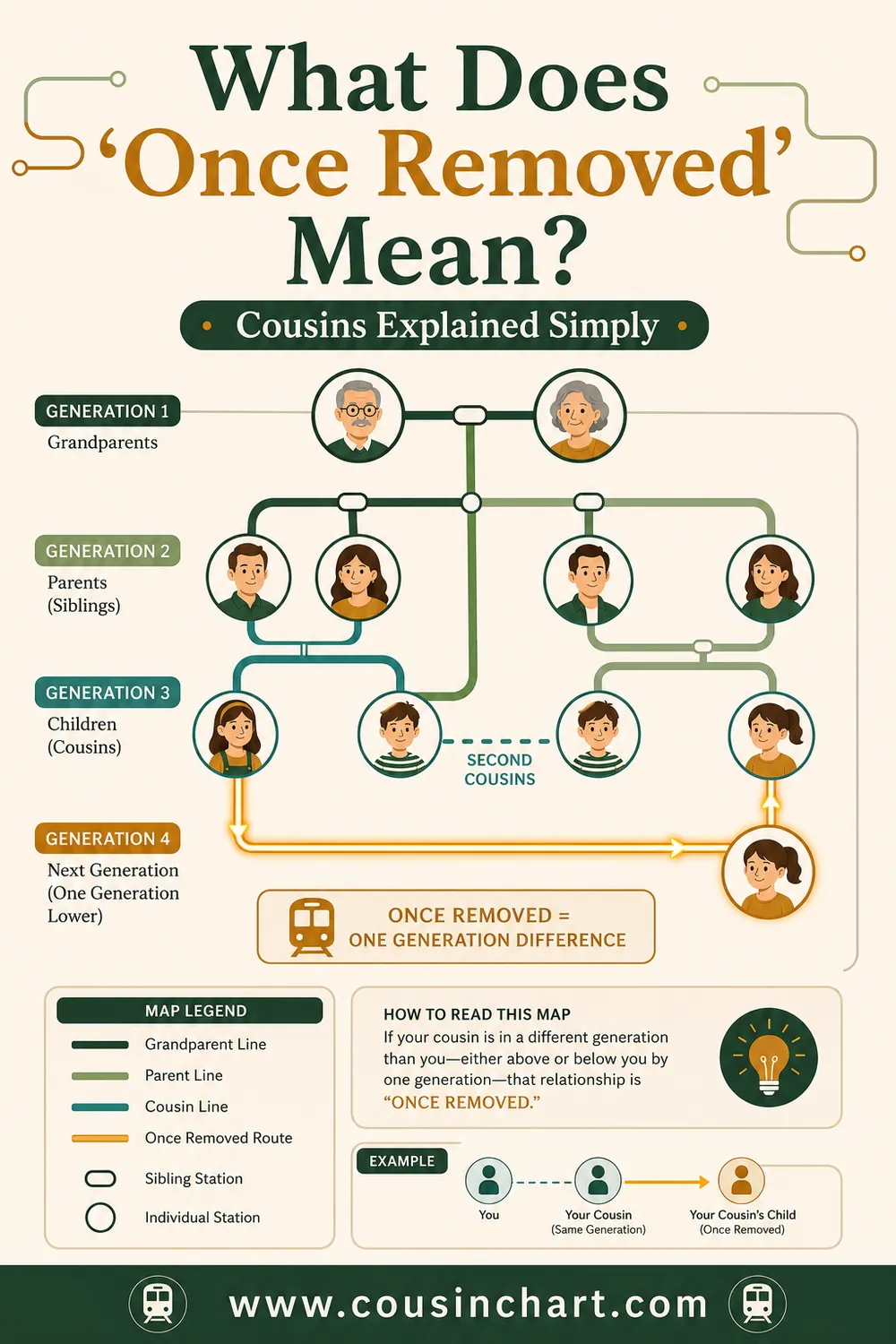
- Removal = the difference between the two counts.
Example: you're the great-great-grandchild of a couple (count: 4); your relative is their grandchild (count: 2). Degree: 2 − 1 = 1 → first cousin. Removal: 4 − 2 = 2 → twice removed. Done: first cousin twice removed.
Why "minus one"? Because the first generation below the shared couple are siblings, not cousins — cousinship starts with their children. The count effectively asks "how many generations past the sibling level are we?"
The Cousin Degree Chart
When both people are the same distance from the shared couple (no removal), the chart is beautifully regular:
| Shared ancestors | Generations down (each) | Degree | Your parents are... |
|---|---|---|---|
| Grandparents | 2 | First cousins | Siblings |
| Great-grandparents | 3 | Second cousins | First cousins |
| Great-great-grandparents | 4 | Third cousins | Second cousins |
| 3×great-grandparents | 5 | Fourth cousins | Third cousins |
| 4×great-grandparents | 6 | Fifth cousins | Fourth cousins |
Two patterns to internalize:
- Degree = number of "greats" in the shared couple, plus one. Zero greats (grandparents) → first. One great → second.
- Each generation of parents who are cousins produces kids one degree further apart. Children of first cousins are second cousins; children of fifth cousins are sixth cousins. The ladder never skips.
Removals: The Second Axis
Degrees measure how far up the split is; removals measure how far the two people are from each other vertically. The two are independent — any degree can carry any removal:
| Same generation | 1 apart | 2 apart | |
|---|---|---|---|
| First-cousin line | First cousin | 1C once removed | 1C twice removed |
| Second-cousin line | Second cousin | 2C once removed | 2C twice removed |
| Third-cousin line | Third cousin | 3C once removed | 3C twice removed |
One subtlety the formula handles automatically: for removed relationships, the degree comes from the person closer to the shared ancestor. Your parent's second cousin is three generations below the shared couple while you're four — the smaller count (3) sets the degree (second), and the gap (1) sets the removal. Our once removed explainer covers why the same term applies both up and down the tree.
Worked Examples, Including the Traps
The straightforward one. Your mom's cousin's daughter: shared ancestors are your great-grandparents. She's three generations down; so are you. 3 − 1 = 2, gap 0 → second cousin.
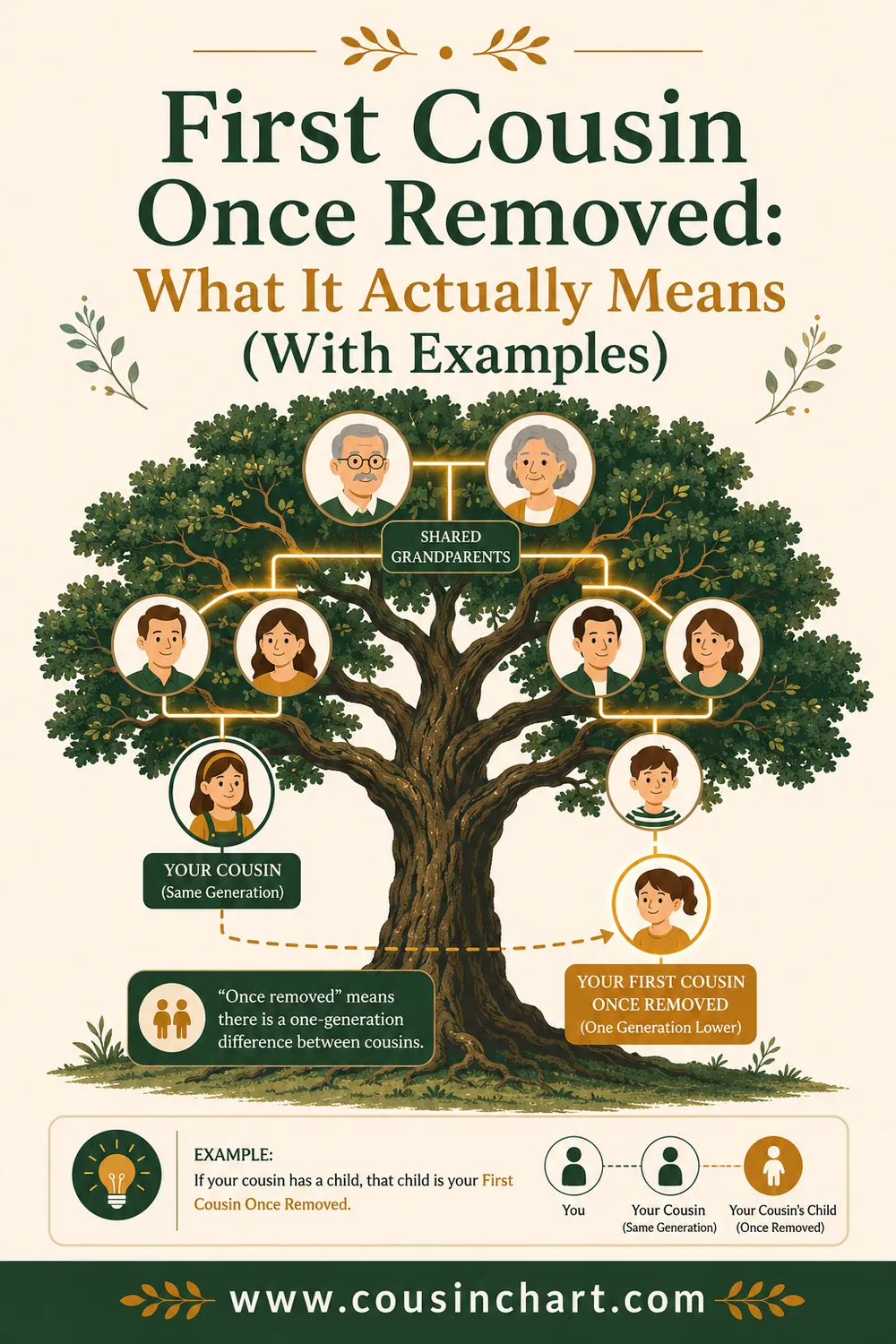
The classic trap. Your cousin's child: shared ancestors are your grandparents. You're two down, the child is three. Smaller count 2 → first cousin; gap 1 → first cousin once removed. Not a second cousin — the degree can't grow unless both sides add generations.
The sneaky one. Your grandparent's second cousin's child. Shared couple: your 3×great-grandparents. That child is four generations down; you're five. Smaller count 4 → third cousin, gap 1 → once removed. People guess "second cousin something" because the phrase contains "second cousin" — but the formula doesn't care what the path sounds like, only where the counts land.
The sibling boundary. Your grandparents' other grandchild (through a different child of theirs) is two-and-two: first cousin. Through the same child of theirs? That's your sibling or half-sibling — the formula only applies once the two lines pass through different children of the shared couple.
If you felt your eyes cross on the third example, that's normal — it's exactly the class of problem the free cousin calculator was built to answer without counting.
Degrees in Law: Canon vs Civil Counting
Genealogy's "first/second cousin" system isn't the only degree system out there. Two older schemes still matter in law and church contexts, and they count differently:
- Civil law degrees count every step up to the common ancestor and back down. First cousins: two steps up + two steps down = 4th degree civil. This is the system many US intestacy statutes and courts use for "next of kin" distance.
- Canon law degrees (historically used by the Catholic Church for marriage rules) count only the longer leg — generations from the common ancestor down to the more distant relative. First cousins = 2nd degree canon.
So "fourth-degree relatives" in a legal document and "fourth cousins" in a family tree are wildly different distances — a regular source of confusion in inheritance research. When a statute, dispensation record, or old church register mentions degrees, identify the counting system before mapping it to cousin terms. (Our consanguinity explainer goes deeper on blood-relation degrees and where each system applies.)
Why Aunts Use "Great" but Cousins Use "Removed"
A frequent puzzle: your grandparent's sister is your great-aunt, but your grandparent's cousin is your first cousin twice removed. Why two vocabularies?
Because the two families of terms encode different geometry. Aunt/uncle terms describe siblings of your direct ancestors — a vertical ladder with a one-step sideways hop, so each rung up just adds a "great." Cousin terms describe parallel descent lines, which need two numbers: where the lines split (degree) and the vertical offset (removal). One-dimensional relationships get one modifier; two-dimensional ones get two.
Handy corollary: if someone is a sibling of your ancestor or a descendant of your sibling, no "removed" is ever involved — reach for aunt/uncle/niece/nephew words with "great" (or "grand") stacked as needed.
How Degrees Map to DNA
The degree ladder isn't just naming — it predicts genetics with satisfying precision. Each step outward roughly quarters the expected shared DNA (because both branches added a generation), and each removal roughly halves it (one branch added a generation):
| Relationship | Average shared DNA |
|---|---|
| First cousins | ~12.5% |
| First cousins once removed | ~6.25% |
| Second cousins | ~3.1% |
| Second cousins once removed | ~1.6% |
| Third cousins | ~0.78% |
| Fourth cousins | ~0.20% |
Two caveats keep this honest. First, these are averages — real results scatter widely, and by the third-cousin level the range is huge (some third cousins share triple the average; a few share almost nothing). Second, from about the fourth degree onward, it's genuinely possible to share no detectable DNA at all with a documented cousin. Recombination is random, and distant segments simply fail to survive the shuffle. So a paper-trail fourth cousin who doesn't appear in your DNA matches isn't evidence the tree is wrong — it's expected behavior for that degree.
The practical use runs the other direction: a match's centimorgan total suggests a set of possible degrees and removals (since, say, a half first cousin once removed and a second cousin average the same amount), and the tree work picks the right one.
Try It Yourself: Five Quick Puzzles
The formula only becomes reflex with reps. Cover the answers and count — smaller count minus one, then the gap.
- Your dad's cousin's grandson. Shared couple: your great-grandparents. You're 3 down; the grandson is 4. Smaller count 3 → second-cousin line; gap 1. Second cousin once removed.
- Your great-grandmother's sister's great-granddaughter. Shared couple: your great-great-grandparents. You're 4 down; so is she. 4 − 1 = 3, gap 0. Third cousins.
- Your second cousin's mother. She's 2 generations below the shared couple; you're 3. Smaller count 2 → first-cousin line; gap 1. First cousin once removed — she's your parent's first cousin, approached from a direction that hides it.
- Your first cousin once removed's child. Trick question: it depends which 1C1R. If it's your cousin's child, their child is your first cousin twice removed. If it's your parent's cousin, their child is your second cousin. Same starting term, two different answers — which is exactly why genealogists name the path, not just the label.
- Your half-uncle's grandchild. Shared ancestor: one grandparent (a single person, since "half" entered at the sibling link). You're 2 down; the grandchild is 3. Smaller count 2 → first-cousin line, gap 1, half prefix carried along. Half first cousin once removed.
If you got four out of five, you've internalized the system. If puzzle four caught you, you're in good company — the up/down ambiguity of removed terms catches everyone once, and it's the single best argument for the calculator approach: it asks which person you mean before it answers.
FAQ
What does "degree of cousinship" mean?
It's the cousin number — first, second, third — determined by how far back the shared ancestor sits. Count generations from the shared ancestor to the closer cousin and subtract one.
What's the difference between degree and removal?
Degree measures where the family lines split (grandparents = first, great-grandparents = second). Removal measures the generation gap between the two individuals. They're independent: a first cousin can be twice removed; a fourth cousin can be zero removed.
Is there a quick formula for any cousin relationship?
Yes: count generations from the common ancestor to each person; the smaller count minus one is the degree, and the difference between counts is the removal. It works for every case, including halves (same math, one shared ancestor instead of a couple).
Why is my cousin's child not my second cousin?
Because only one side added a generation. Degree grows when both branches step down; a one-sided step is a removal. Your cousin's child is your first cousin once removed.
What is a 4th-degree relative — a fourth cousin?
Usually not. Legal "degrees" often use civil-law counting (steps up plus steps down), where first cousins are already 4th-degree relatives. Check which system a document uses before translating to cousin terms.
Do half relationships change the degree?
No — a half cousin has the same degree and removal as the full version; "half" just notes one shared ancestor instead of a couple, and roughly halves the expected shared DNA.
The Short Version
Two rules run the whole system: smaller count minus one = degree; difference between counts = removal. The chart above is that formula written out, and every scary term — half second cousin twice removed included — is just the formula's output with modifiers attached.
Or let the machine count: the free family relationship calculator takes any path through the tree and returns the exact degree, removal, and term — with the reasoning shown.