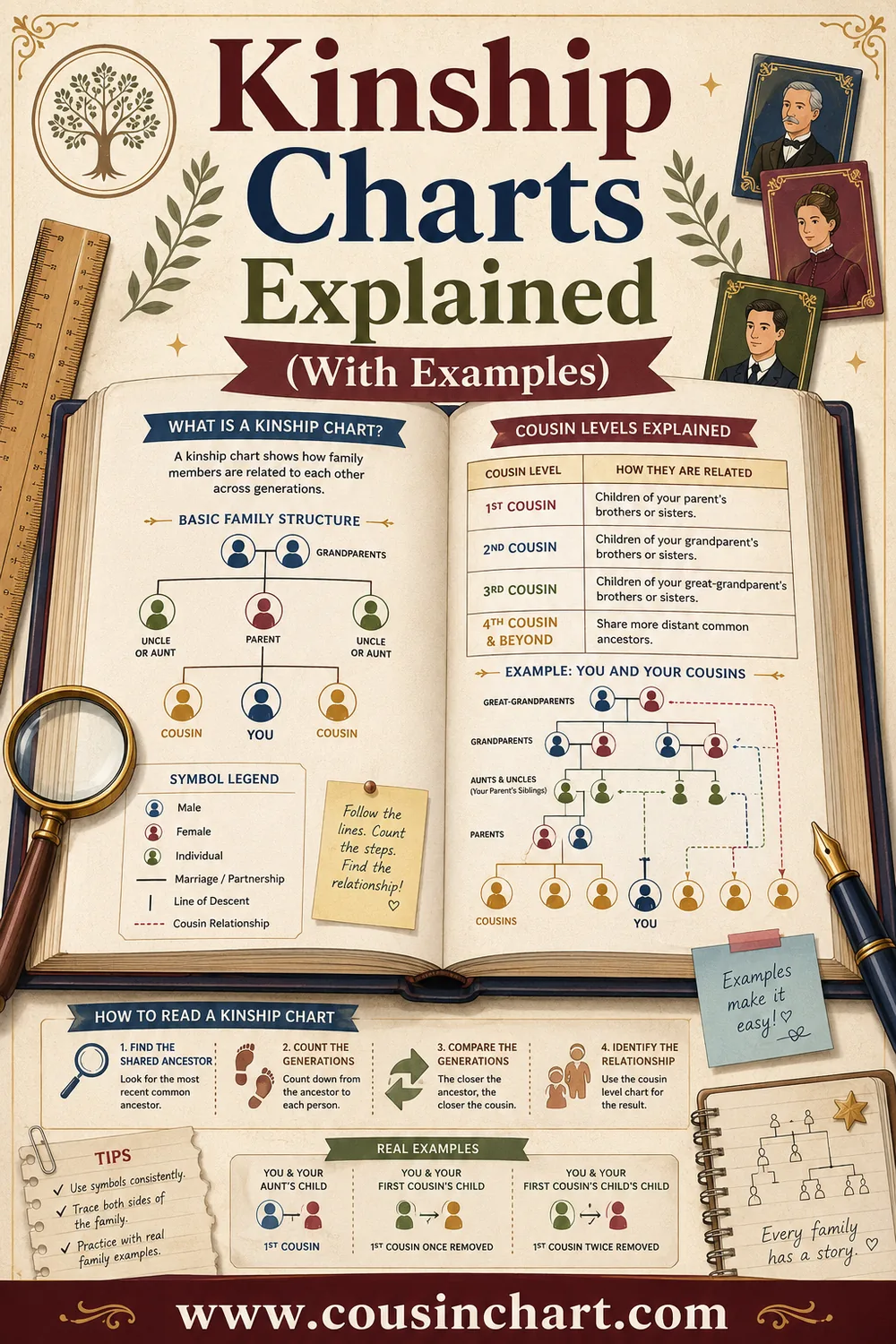
Kinship Charts Explained (With Examples)
A kinship chart is a diagram that shows how people in a family are related to one another. The term covers two tools that share a name: the genealogist's relationship grid (the table that tells you your grandma's cousin is your first cousin twice removed) and the anthropologist's kinship diagram (the circles-and-triangles map of a family built around one person, called Ego).
Both answer the same question — what is this person to me? — with different pictures. This guide explains how to read each one, with worked examples, the symbol key, and the shortcuts that make the grid actually usable. And when you want the answer without any chart at all, the free relationship calculator on our homepage produces it in seconds.
Relationship quick-check. Tap a phrase to see the correct term:
The answer will appear here.
The Genealogy Kinship Chart: A Lookup Grid
The genealogist's kinship chart (also called a relationship chart, cousin chart, or "table of consanguinity") is a grid that works like a multiplication table for relatives:
- The top-left cell is the common ancestor.
- The top row lists how one person descends from that ancestor: child, grandchild, great-grandchild...
- The left column lists how the other person descends: child, grandchild, great-grandchild...
- Each inner cell names the relationship between those two descendants.
To use it: identify the ancestor two people share, work out what each person is to that ancestor, find the row and column, and read the cell where they cross.
Here's a compact version of the heart of the grid:
| ↓ Person B / Person A → | Child | Grandchild | Great-grandchild |
|---|---|---|---|
| Child | Sibling | Niece/nephew | Grandniece/-nephew |
| Grandchild | Aunt/uncle | First cousin | First cousin once removed |
| Great-grandchild | Great-aunt/-uncle | First cousin once removed | Second cousin |
Two features worth noticing. The diagonal (grandchild × grandchild, great-grandchild × great-grandchild) holds the plain cousins — first, second, third — because equal distances from the ancestor mean no removal. And everything off the diagonal is either an aunt/uncle-type term (when one person is the ancestor's child) or a removed cousin (everywhere else). The grid is just the degrees of cousinship formula printed out cell by cell.
Worked Example: Reading the Grid
Question: what is your grandmother's cousin's granddaughter to you?
- Find the shared ancestor. Your grandmother and her cousin shared grandparents — your great-great-grandparents. That couple anchors the chart.
- Place yourself. You're their great-great-grandchild: four generations down. Column four.
- Place her. The cousin is their grandchild; the cousin's granddaughter is four generations down too. Row four.
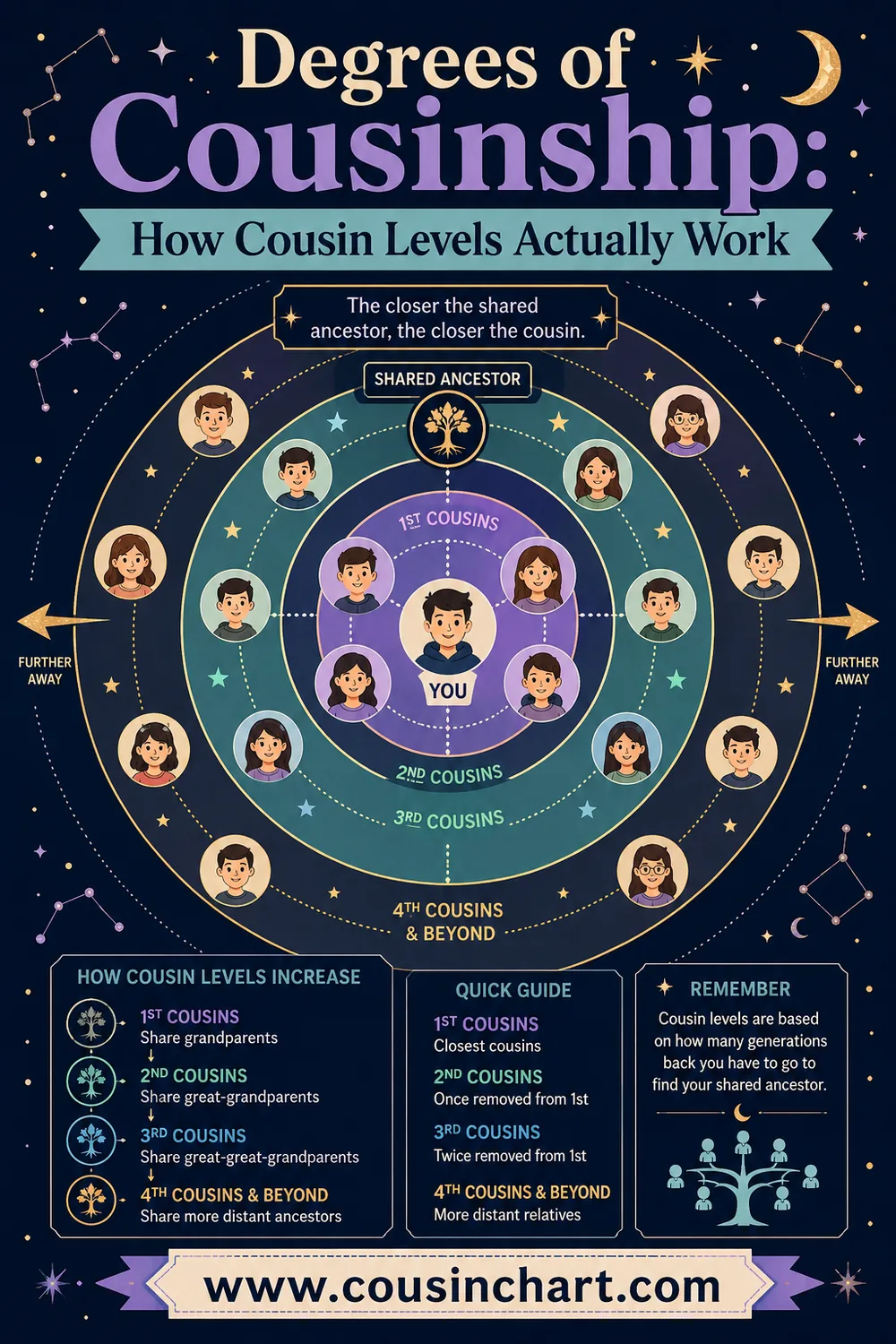
- Read the cell. Four-by-four on the diagonal: third cousins.
The grid rewards this discipline: never guess from the phrase ("cousin's granddaughter" sounds removed), always place both people relative to the shared ancestor. When the placing itself is the hard part — blended families, unclear generations — the free cousin calculator does the placement and the lookup in one step.
The Anthropology Kinship Diagram: Circles and Triangles
Anthropologists draw kinship differently. Instead of a lookup grid, they map an actual family with standard symbols, centered on one reference person:
| Symbol | Meaning |
|---|---|
| △ Triangle | Male |
| ○ Circle | Female |
| □ Square | Person of unspecified gender |
| EGO | The reference person — all relationships read from here |
| = (or double line) | Marriage/partnership |
| Vertical line | Descent (parent to child) |
| Horizontal bracket | Siblings |
| Diagonal slash through symbol | Deceased |
A kinship diagram of your family would put Ego (you) at the center of your generation's row, your siblings beside you along a sibling bracket, your parents connected above by a marriage line, and so on outward. Every person is then labeled by their relationship to Ego — often with shorthand like M (mother), F (father), MB (mother's brother), FZD (father's sister's daughter — a first cousin).
Why bother with a different system? Because anthropologists compare kinship across cultures, and many languages carve up the family differently than English — some use separate words for your father's brother versus your mother's brother, or for cousins on each side. The diagram records actual genealogical positions (like MBD, "mother's brother's daughter") so terms from any culture can be mapped onto them. English, for the record, uses what anthropologists call the Eskimo system: we lump all four grandparent-level cousin paths into one word, "cousin," and distinguish the nuclear family sharply from everyone else.
Reading Kinship Notation: FZD, MBS, and Friends
Those letter strings anthropologists attach to diagram positions look like license plates, but the code is tiny — eight letters, read left to right, each one a step through the family:
F = father, M = mother, B = brother, Z = sister (Z, because S was taken), S = son, D = daughter, H = husband, W = wife.
Chain them and you get a path from Ego to anyone:
- MB — mother's brother. Your maternal uncle.
- FZD — father's sister's daughter. Walk it: your father → his sister → her daughter. That's your first cousin on your dad's side.
- MZS — mother's sister's son. Another first cousin, mom's side this time.
- FFBSD — father's father's brother's son's daughter. Longer walk: your grandfather's brother is your great-uncle; his son is your father's first cousin (your first cousin once removed); his daughter lands back on your generation — your second cousin. Five letters, one precise person.
- MHZ — mother's husband's sister. Note this isn't necessarily your aunt by blood: if mother's husband isn't your father, MHZ is a step-aunt. The notation doesn't care — it records the actual path, and lets the labels fall where they may.
That last example is the whole point of the system. English words like "aunt" blur four different positions (FZ, MZ, FBW, MBW — two blood, two by marriage). The letter strings keep them separate, which matters enormously once you're comparing cultures... which brings us to the systems themselves.
The Six Classic Kinship Systems
Here's the part that makes kinship charts genuinely fun: English's way of slicing up the family is just one of six broad patterns anthropologists have documented, each named after a culture where it was first described. Same biological positions, wildly different vocabularies:
- Eskimo (lineal) — English's system, also most of Europe's. The nuclear family gets sharp, unique terms (mother, father, sister, brother), and everyone outside it gets lumped: all four cousin paths are just "cousin," both parents' sisters are just "aunt." No distinction between your mother's side and your father's side.
- Hawaiian (generational) — the opposite extreme, and the simplest. Essentially two questions matter: generation and gender. Everyone in your parents' generation is called by parent terms; everyone in your own generation is called by sibling terms. Your first cousin? Terminologically, a brother or sister.
- Sudanese (descriptive) — the most precise. A different word for each position: father's brother, father's sister, mother's brother, and mother's sister all get distinct terms, and each of their children does too. Turkish works this way — where English says "cousin" eight ways, Turkish speakers specify.
- Iroquois — built on the parallel/cross distinction. Your father's brother is called "father" and your mother's sister "mother"; their kids (your parallel cousins) are termed siblings. But your father's sister and mother's brother get distinct aunt/uncle terms, and their kids (your cross cousins) are the only ones called cousins.
- Omaha — an Iroquois-style base with a patrilineal twist: relatives in your mother's patriline get "skewed" across generations. Your mother's brother's son is addressed with the same term as your mother's brother — a cousin called by an uncle term — because what matters is his lineage membership, not his generation.
- Crow — the matrilineal mirror of Omaha. Here your father's sister's son can carry the term "father," because he belongs to your father's matriline. First-time students always think it's a mistake. It isn't — it's consistent, just organized around lineage instead of generation.
Two takeaways travel well beyond the exam question. First, "cousin" is not a natural category — it's an Eskimo-system artifact, which is why kinship diagrams record paths (MBD, FZS) rather than words. Second, if your family speaks a language with distinct terms for maternal and paternal relatives — Mandarin, Hindi, Tagalog, Arabic, and many others preserve pieces of the descriptive pattern — the "translation problems" at multilingual family gatherings are two kinship systems politely colliding.
Where Kinship Charts Earn Their Keep
Beyond settling reunion arguments, the grid does real work in three fields:
- Probate and heir research. When someone dies without a will, intestacy laws distribute the estate by kinship distance — and heir researchers use exactly this chart to rank claimants. Establishing that one claimant is a first cousin once removed while another is a second cousin can decide who inherits. (Courts typically translate to civil-law degree counts, but the grid positions are the raw material.)
- DNA match mapping. Serious testers keep a kinship grid beside their match list. Once a shared ancestor couple is identified, placing each match on the grid — grandchild, great-grandchild — converts a pile of centimorgan numbers into named relationships, and mismatches between the predicted and observed DNA amounts flag the half relationships and misattributed parents.
- Oral history interviews. Family historians interviewing elders use a blank kinship diagram as a prompt: start with Ego, add symbols as names come up. It catches people written records miss — the baby who died young, the first marriage nobody discusses — because the diagram makes an empty position visible. An unexplained gap in a sibling bracket is a question waiting to be asked.
In all three cases the chart's job is the same: turn vague relatedness into a position, because positions can be compared, ranked, and verified. Vibes can't.
Kinship Chart vs Family Tree vs Pedigree Chart
Three tools, three jobs — they get confused constantly:
| Kinship chart (grid) | Family tree | Pedigree chart | |
|---|---|---|---|
| Shows | Relationship terms by position | A real family's people | One person's ancestors only |
| Contains names? | No — it's generic | Yes | Yes |
| Direction | Any two descendants of one ancestor | Downward from ancestors | Upward from one person |
| Best for | Naming a relationship | Seeing the whole family | Ancestry research |
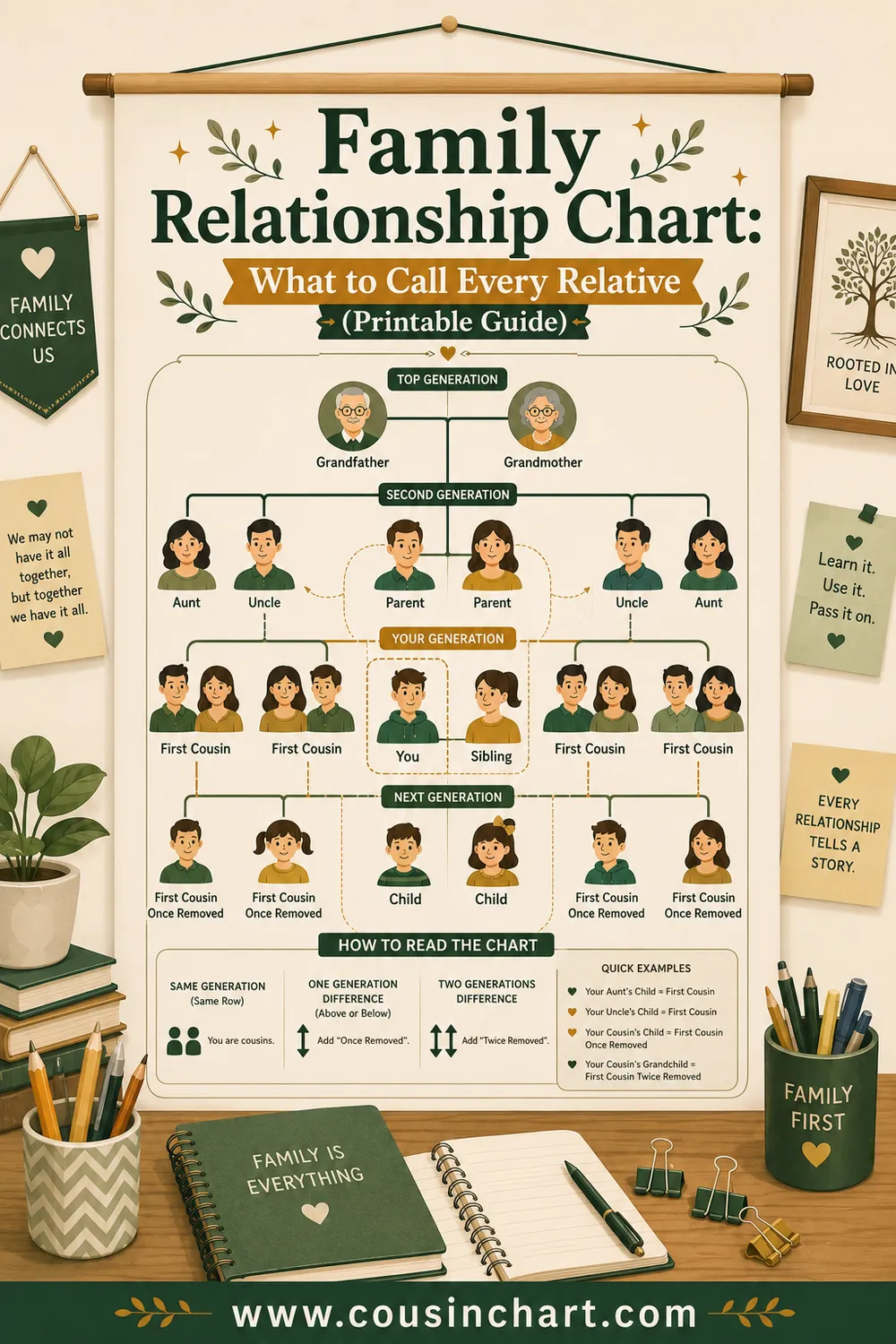
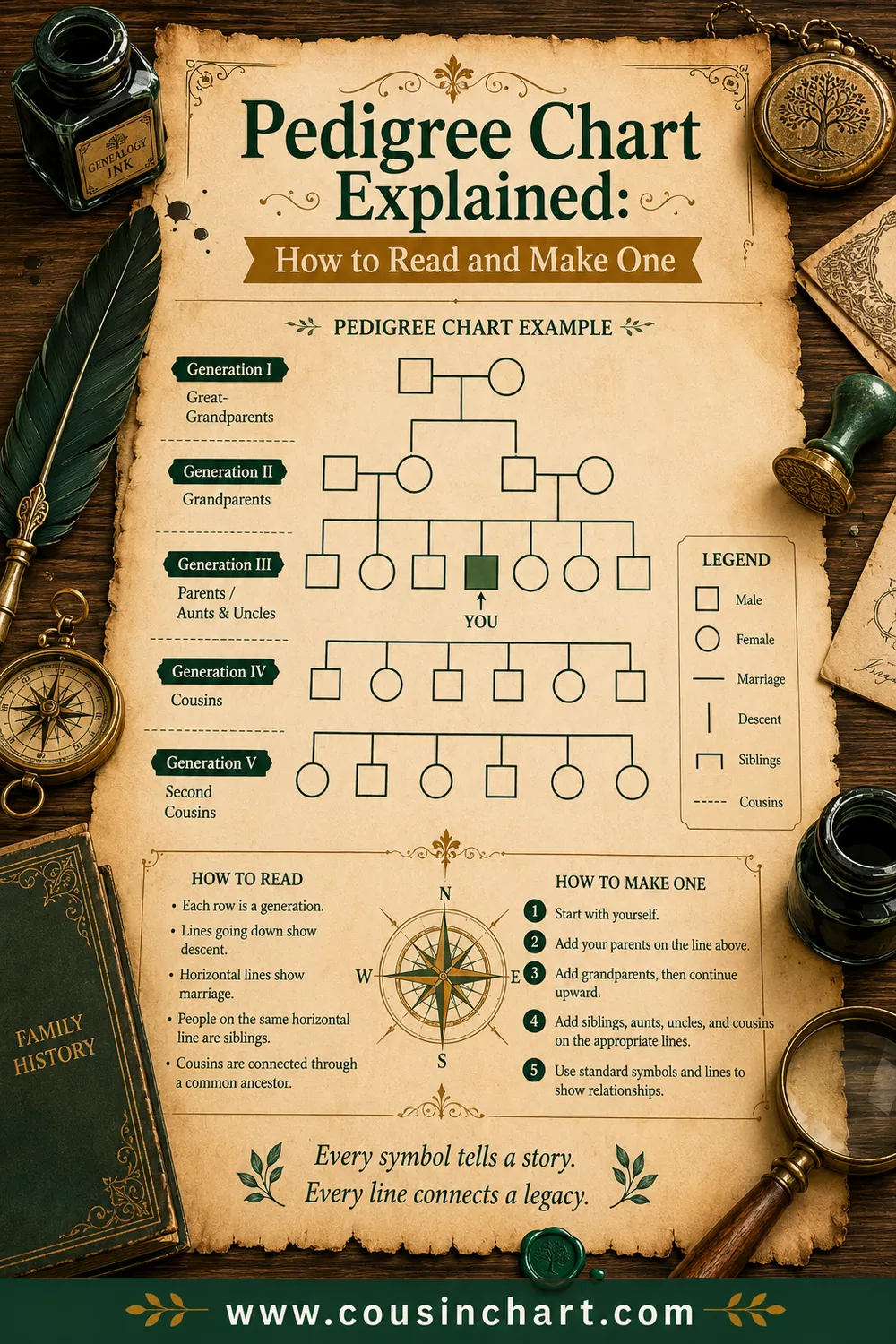
Use the grid when you have two people and need the term. Use a tree when you're mapping everybody. Use a pedigree chart when you're climbing your own ancestry line by line — and see our family relationship chart guide for a printable version of the grid itself.
Making Your Own Kinship Chart
For a family reunion handout or a genealogy binder, a homemade kinship chart takes about fifteen minutes:
- Pick the anchor couple — usually the most recent ancestors everyone at the gathering shares.
- Draw the grid: their descendants' generation labels across the top and down the side (child, grandchild, great-grandchild, 2×great-grandchild covers most living families).
- Fill the diagonal first — sibling, first cousin, second cousin, third cousin — then fill outward: each step off the diagonal adds one "removed."
- Add the aunt/uncle edge: the first row and column (the ancestor's children versus everyone) use aunt/uncle and niece/nephew terms with "great" stacked as needed.
- Test it with a few known pairs before you print. If your grandmother's cousin doesn't come out as your first cousin twice removed, a row slipped.
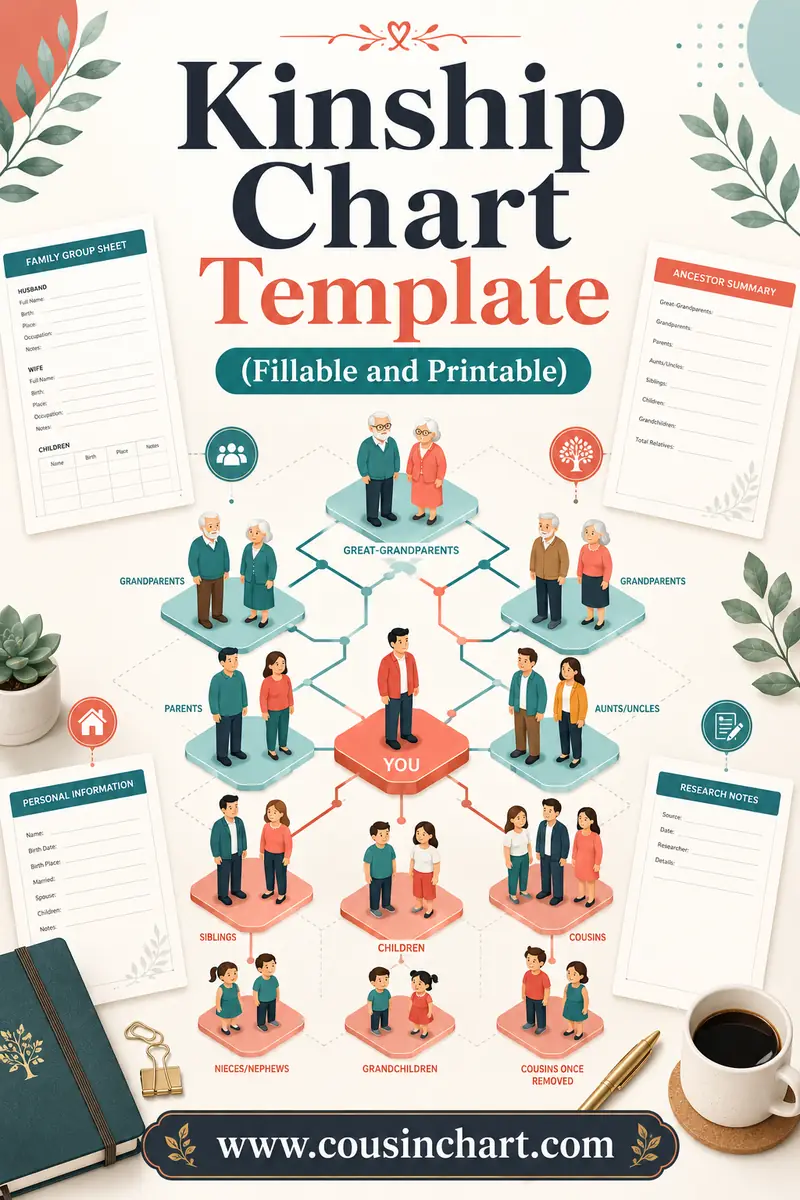
Prefer a ready-made version? There's a fillable kinship chart template for that — or skip paper entirely and let people tap out their connection on the relationship calculator at the party.
FAQ
What is a kinship chart?
A diagram of family relationships. In genealogy it usually means the relationship grid that names what any two descendants of a shared ancestor are to each other; in anthropology it means the circle-and-triangle diagram of a family centered on one person (Ego).
How do I read a kinship chart?
Find the ancestor two people share, determine what each person is to that ancestor (child, grandchild, great-grandchild...), then find where that row and column intersect. The cell names the relationship.
What do the triangles and circles mean on a kinship diagram?
Triangles are males, circles are females, squares are unspecified. An equals sign or double line marks marriage, vertical lines mark descent, and Ego marks the person all relationships are read from.
What's the difference between a kinship chart and a family tree?
A family tree shows real, named people. The kinship grid is generic — it names relationship terms by position and works for any family. Trees show who; charts show what.
What are parallel and cross cousins?
Parallel cousins come through a same-sex sibling pair — your father's brother's kids or mother's sister's kids. Cross cousins come through an opposite-sex pair — father's sister's or mother's brother's kids. English ignores the distinction entirely, but several kinship systems (Iroquois, Omaha, Crow) treat parallel cousins like siblings and reserve cousin terms for cross cousins only.
What kinship system does English use?
The one anthropologists call the Eskimo (or lineal) system: sharp terms for the nuclear family, and broad lumped terms — like "cousin" and "aunt" — for everyone outside it, with no distinction between mother's and father's sides.
What do notation strings like MBD or FZS mean?
They're paths from Ego, one letter per step: F father, M mother, B brother, Z sister, S son, D daughter, H husband, W wife. MBD = mother's brother's daughter; FZS = father's sister's son — both first cousins in English, but distinct positions the notation keeps separate.
Is there a faster way than reading the grid?
Yes — a relationship calculator. Enter how each person connects to the shared ancestor and the free tool returns the exact term, including removals and half relationships, with the reasoning spelled out.
The Short Version
A kinship chart turns "how are we related?" into a lookup: ancestor at the corner, generations along the edges, term in the cell — while the anthropologist's version maps the same facts as symbols around Ego. Both encode one idea: relationships are just positions relative to shared ancestors.
Next time a wedding table debates what a grandmother's cousin's granddaughter is, you can draw the grid — or settle it in ten seconds with the free family relationship calculator.