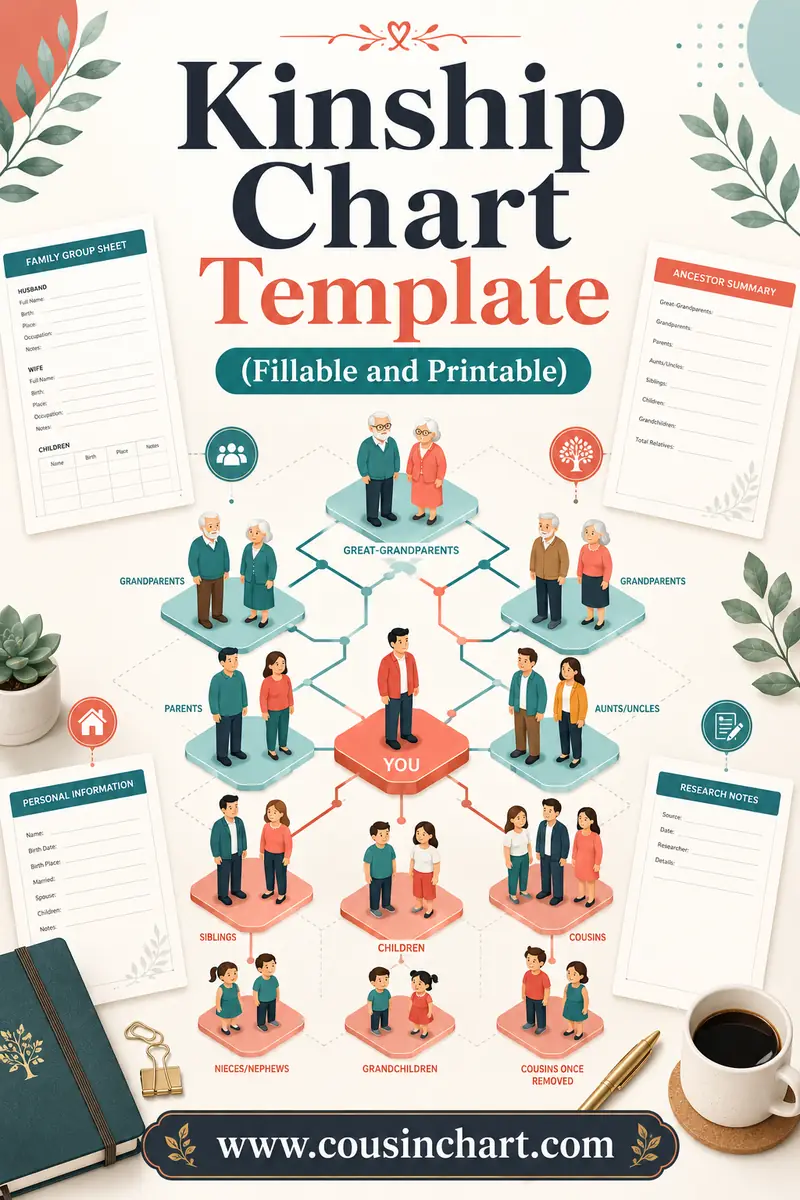
Kinship Chart Template (Fillable and Printable)
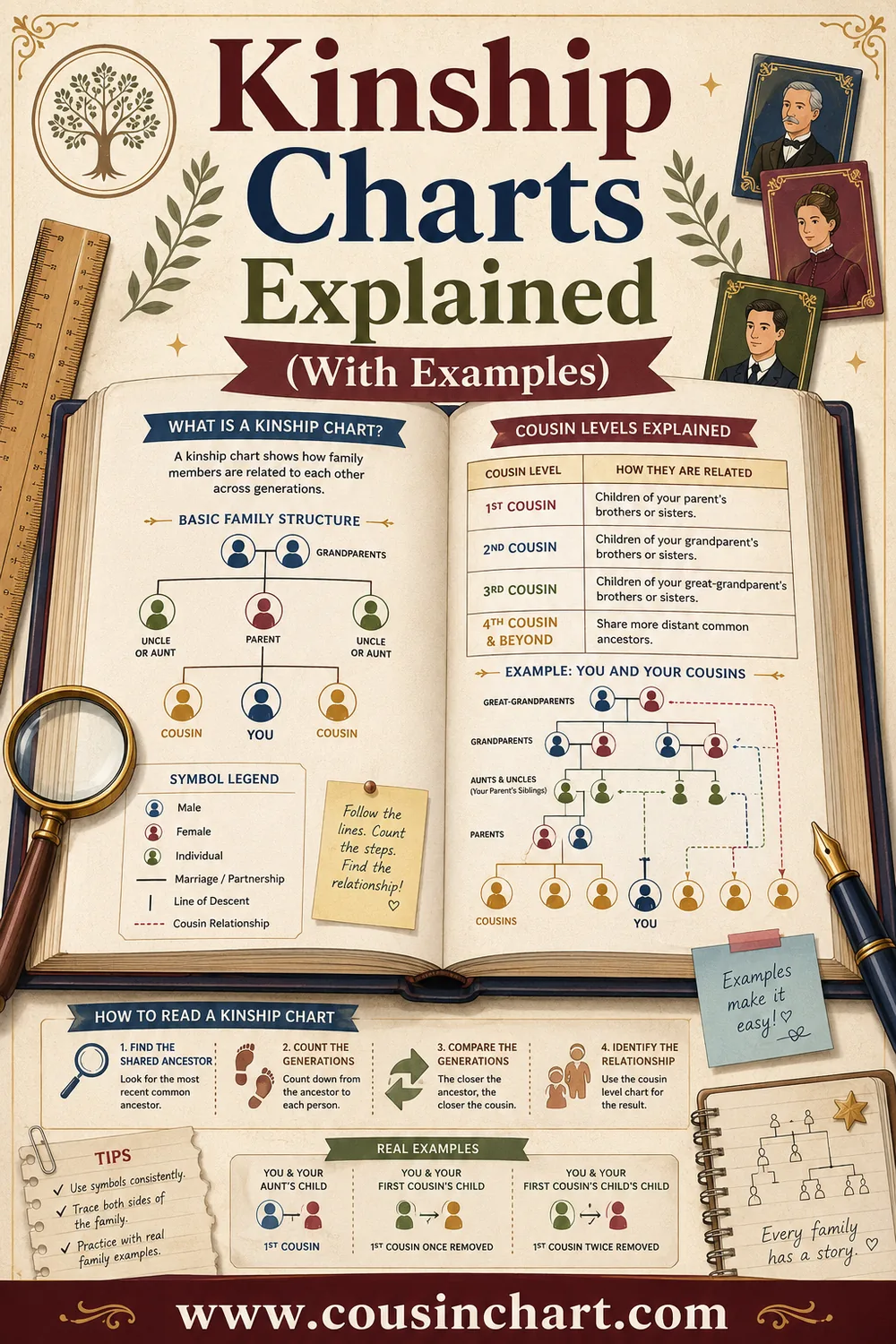
A kinship chart template is a relationship grid: the ancestor you share with someone sits in the top-left corner, your line of descent runs down the side, theirs runs across the top, and the cell where your row meets their column names the relationship — first cousin, great-grandnephew, second cousin once removed. Unlike a family tree, it holds no names until you add them; it's a universal answer table that works for every family on earth, which is exactly why it's the sheet worth laminating.
This guide explains how to read the grid, how the fillable version turns it into a personalized family reference, the ten-second tracing method, and the other thing "kinship chart" means (the anthropology diagram with circles and triangles — covered below, since half the people searching this term are students who need that one). The printable and fill-in kinship charts both ship in the free CousinChart printable pack, and the grid's big sibling — the free relationship calculator — handles every path too tangled to trace with a finger.
Free printables for this page
Download a blank PDF (US Letter or A4) — free, no sign-up — or customize it in the maker above before printing.
 Cousin Relationship ChartThe classic cousin grid: 1st cousin, 2nd cousin, times removed.
 Kinship Chart (Fill-In)
Relationship quick-check: tap a phrase — each answer is a cell on the kinship grid.
Tap a phrase above to see the answer.
Work out any family relationship →How the kinship grid works
The grid is built on the one fact that determines every blood relationship: who the most recent common ancestor is, and how many generations each of you sits below them. That's it. Two numbers in, one relationship out — which is why the whole system fits on a single page.
The template's layout:
- Top-left corner cell: the common ancestor (the grid says "common ancestor"; the fillable version has a blank to write "Grandma Rosa" or "the Delgado great-greats").
- Column headers, running right: the ancestor's child, grandchild, great-grandchild, and so on — the other person's line of descent.
- Row headers, running down: the same sequence — your line of descent.
- Every interior cell: the relationship between someone in that row and someone in that column.
The diagonal — where row number equals column number — is the cousin ladder: siblings, then first cousins, second cousins, third cousins. Step off the diagonal and each row of difference adds a "removed":
| Child | Grandchild | Great-grandchild | 2×great-grandchild | |
|---|---|---|---|---|
| Child | Sibling | Niece/nephew | Grandniece/nephew | Great-grandniece/nephew |
| Grandchild | Aunt/uncle | First cousin | 1st cousin once removed | 1st cousin twice removed |
| Great-grandchild | Grandaunt/uncle | 1st cousin once removed | Second cousin | 2nd cousin once removed |
| 2×great-grandchild | Great-grandaunt/uncle | 1st cousin twice removed | 2nd cousin once removed | Third cousin |
(Headers are each person's relationship to the common ancestor.) Notice the symmetry: the cells mirror across the diagonal because kinship runs both ways — if she's your first cousin once removed, you're her first cousin once removed too; only aunt/niece-type pairs swap labels depending on who's asking.
The ten-second tracing method
With the printed grid in hand, any relationship takes three moves:
- Name the shared ancestor. "Me and Tessa both come from Great-Grandpa Emilio."
- Count your steps down from that ancestor and find your row. You: Emilio → Grandma → Dad → you = 3 steps, row "great-grandchild."
- Count their steps down and find their column, then read the cell. Tessa: Emilio → her grandfather → Tessa? That's 2 steps, column "grandchild." Row 3, column 2: first cousin once removed.
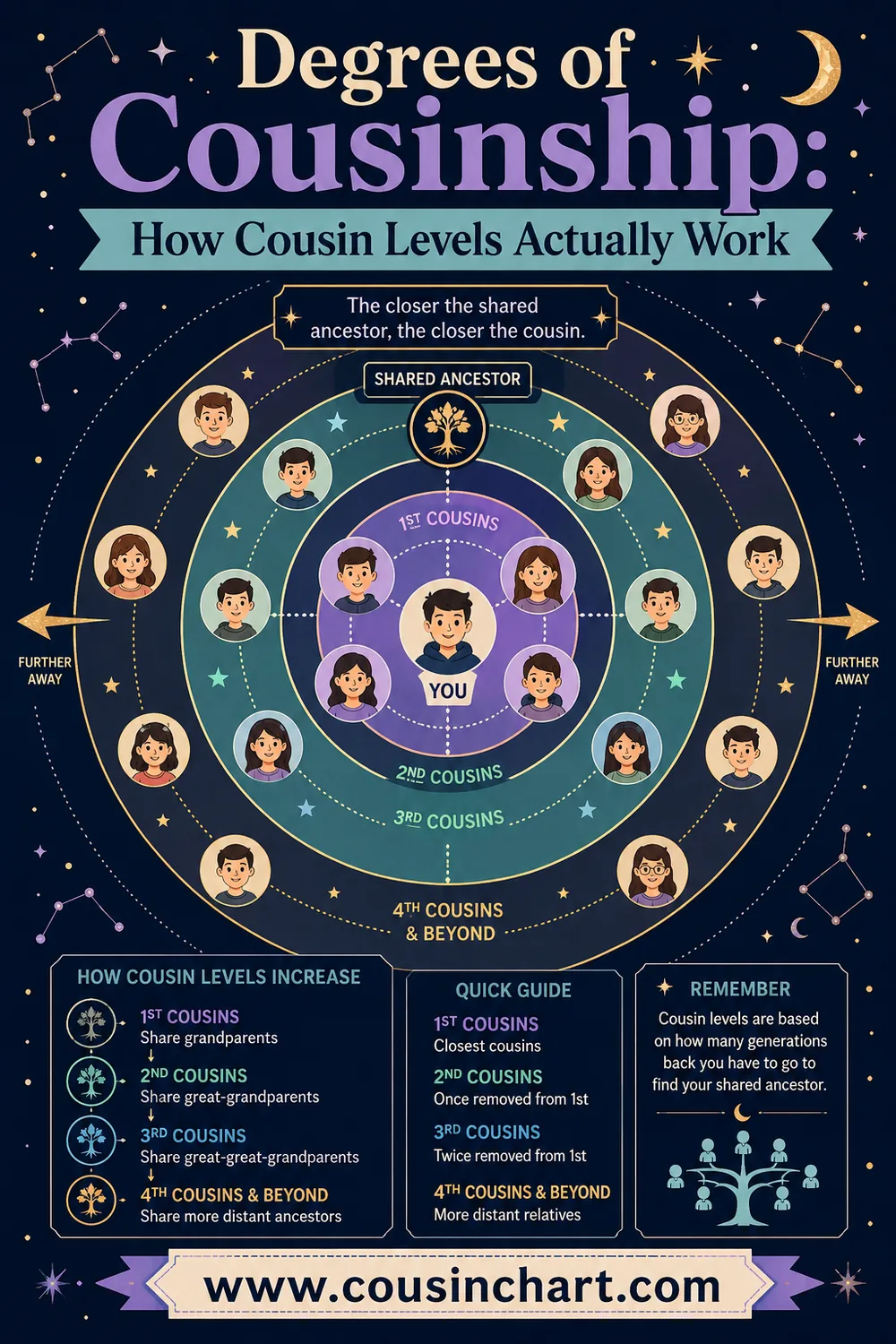
Wait — shouldn't two great-grandchildren of Emilio be second cousins? Yes, and that's the method demonstrating its value: Tessa being only two steps down means she's of your dad's cousin generation, so once removed is correct. The grid's whole job is making that generation mismatch impossible to fumble. The counting logic behind it — why cousin number tracks the closer person's distance and "removed" tracks the difference — is unpacked in degrees of cousinship.
Reading the edges: aunts, nieces, and the grand- ladder
The cousin diagonal gets the attention, but the grid's first row and first column — the cells nearest the common ancestor's own child — are where most everyday questions actually land, so they're worth reading closely.
Move along the first column (the other person is the ancestor's child, i.e., your parent's sibling's generation and above) and the labels climb a ladder: aunt/uncle, then grandaunt/granduncle (your grandparent's sibling), then great-grandaunt/great-granduncle. Each row you drop adds a "grand" or "great" — the same prefixes your direct ancestors use, shifted one branch sideways. The mirror cells across the diagonal do the same going down: niece/nephew, grandniece/grandnephew, great-grandniece/great-grandnephew for your sibling's descendants.
Two usage notes the grid quietly settles:
- "Great-aunt" and "grandaunt" are the same person. Genealogists prefer grandaunt for your grandparent's sister because it keeps the prefixes parallel with grandmother — but the everyday "great-aunt" isn't wrong, and the cell answers to both names.
- There's no such thing as an "aunt once removed" in standard usage. The aunt/uncle and niece/nephew arms absorb the generation differences with their grand-/great- prefixes; "removed" is vocabulary reserved for the cousin cells. If someone's your "aunt's cousin," that person is off the aunt arm entirely — they're your first cousin once removed, via the grid's cousin cells.
Half and double relations on the grid
Two special cases come up at every reunion, and both keep their normal grid position:
- Half-relations descend from one shared ancestor instead of a couple — your grandfather's daughter from his second marriage is your half-aunt; her kids are your half-first-cousins. Position on the grid: identical to the full version. The "half" changes shared DNA (about half as much) and sometimes family politics, but not the seat or the term. Mark them ½ on a fillable sheet if the distinction matters to your record-keeping.
- Double relations descend from two shared couples — classically, two brothers from one family marrying two sisters from another. Their children are double first cousins: first cousins through both grid sheets at once, sharing all four grandparents and roughly double the usual cousin DNA. The grid can't show doubleness on one page (each sheet has one ancestor corner), which is a genuine limit of the format — note it in the margin, or let the calculator carry it.
None of this requires memorizing: it's all printed in the cells of the reference grid. But knowing the edges' logic means you can reconstruct the chart from scratch on a napkin — which, at a certain kind of family party, is a legitimate social skill.
Printable vs. fillable: two templates, two jobs
The printable reference grid comes pre-filled with relationship names, like the table above but extended to fifth cousins and four removes. Print it, laminate it, and it answers picnic-table questions for a decade — this is the same beloved format as our printable cousin chart, organized ancestor-first.
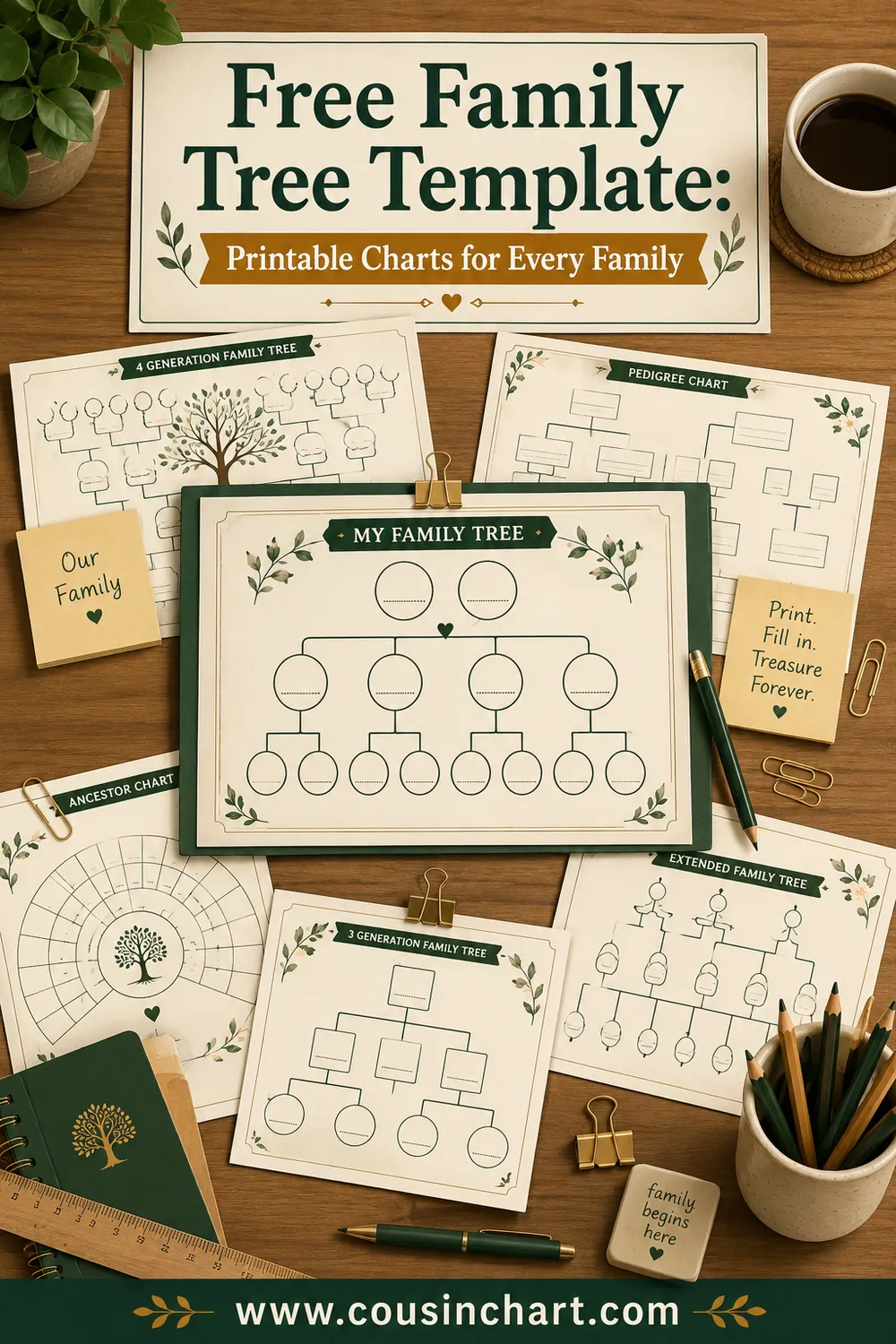
The fillable kinship chart is the same grid with blank cells and header lines. Instead of generic labels you write actual names: "Grandma Rosa" in the corner, her children across the top ("Tito Ben," "Mom…"), and real cousins in the cells where their generation lands. A filled sheet becomes a one-page map of a whole branch — every descendant of one couple, each labeled with what they are to you. Families make one per grandparent couple; four sheets covers everyone you're related to by blood within reunion range.
Filling tips: work one column at a time (one aunt or uncle's descendants top to bottom), use pencil until the generations are confirmed, and mark half-relations with a small ½ — half-cousins are real cousins with half the shared ancestry, and the grid position is identical.
The other kinship chart: circles and triangles
If you landed here for anthropology class, this section's yours. In anthropology and social work, a kinship chart (kinship diagram) is a symbol-based map: triangles for men, circles for women, a square for unspecified sex, an equals sign between spouses, a vertical line for descent, a horizontal bracket over siblings, and Ego — the person whose viewpoint the chart takes — shaded or labeled. A diagonal slash through a symbol marks a death; a slashed equals sign marks a divorce.
The genealogy grid and the anthropology diagram answer different questions: the grid names relationships from shared ancestors; the diagram maps household and descent structure around Ego — including relationships the grid can't hold, like in-laws, step-links, and fictive kin. The free pack includes a blank Ego-centered diagram worksheet alongside the grid, because students and genogram-makers keep asking for exactly that. (For the deeper background on kinship systems and terminology, see kinship charts explained.)
Printing and using yours
- Landscape, 100% scale. The grid is wider than tall — portrait printing shrinks every cell.
- Letter/A4 covers cousins through the fifth degree; the extended grid enjoys 11×17" if your family reliably argues about sixth cousins.
- Laminate the reference copy. A wet-erase marker turns it into a reusable tracing tool: circle your row, circle their column, draw the two lines, tap the cell. Wipe. Next relative.
- Print a stack of fillable blanks before a reunion — they disappear. Older relatives in particular love filling the grid for their generation's viewpoint, which incidentally documents relationships one generation deeper than you could alone.
- The grid handles what a grid can: two people, one shared ancestor, blood relations. For chains involving marriages, half-relations stacked on removes, or "my cousin's cousin's kid," skip the finger-tracing — the free CousinChart calculator exists precisely for the paths that fall off the page.
FAQ
What is a kinship chart template?
A printable grid for naming family relationships: the common ancestor sits in the corner, each person's generation of descent runs along an edge, and the intersecting cell names the relationship (first cousin, grandniece, second cousin once removed). Fillable versions let you write real relatives' names into the cells.
How do I read a kinship chart?
Identify the ancestor you both descend from, count how many generations below them each of you is, then find where your row and their column cross. Equal counts land on the cousin diagonal; unequal counts add one "removed" per generation of difference.
What's the difference between a kinship chart and a cousin chart?
They're near-twins. A cousin chart is the version focused on the cousin grid; kinship charts typically extend to aunt/uncle, niece/nephew, and grand-generations too, and "kinship chart" also names the anthropology diagram drawn with circles, triangles, and Ego.
What do the triangles and circles mean on a kinship diagram?
In the anthropology format: triangle = male, circle = female, equals sign = marriage, vertical line = descent, horizontal bracket = siblings. "Ego" marks the person whose perspective the diagram takes, and a slash through a symbol indicates death.
Can a kinship chart show in-laws or step-relatives?
The ancestor-grid version can't — no shared ancestor, no cell. In-law and step connections need the diagram format or a relationship calculator, which traces through marriage links as well as blood.
Print the grid and settle it for good
One laminated kinship chart on the fridge ends about ninety percent of family relationship debates; the free CousinChart printable pack has the reference grid, the fill-in version, and the student diagram in one download. Fill a sheet per grandparent couple before the next reunion, and keep the free relationship calculator loaded for the tenth-percentile arguments — the ones involving somebody's step-grandmother's cousin — that no single page was ever going to win.