5 Generation Family Tree Chart: What It Holds and How to Fill It In
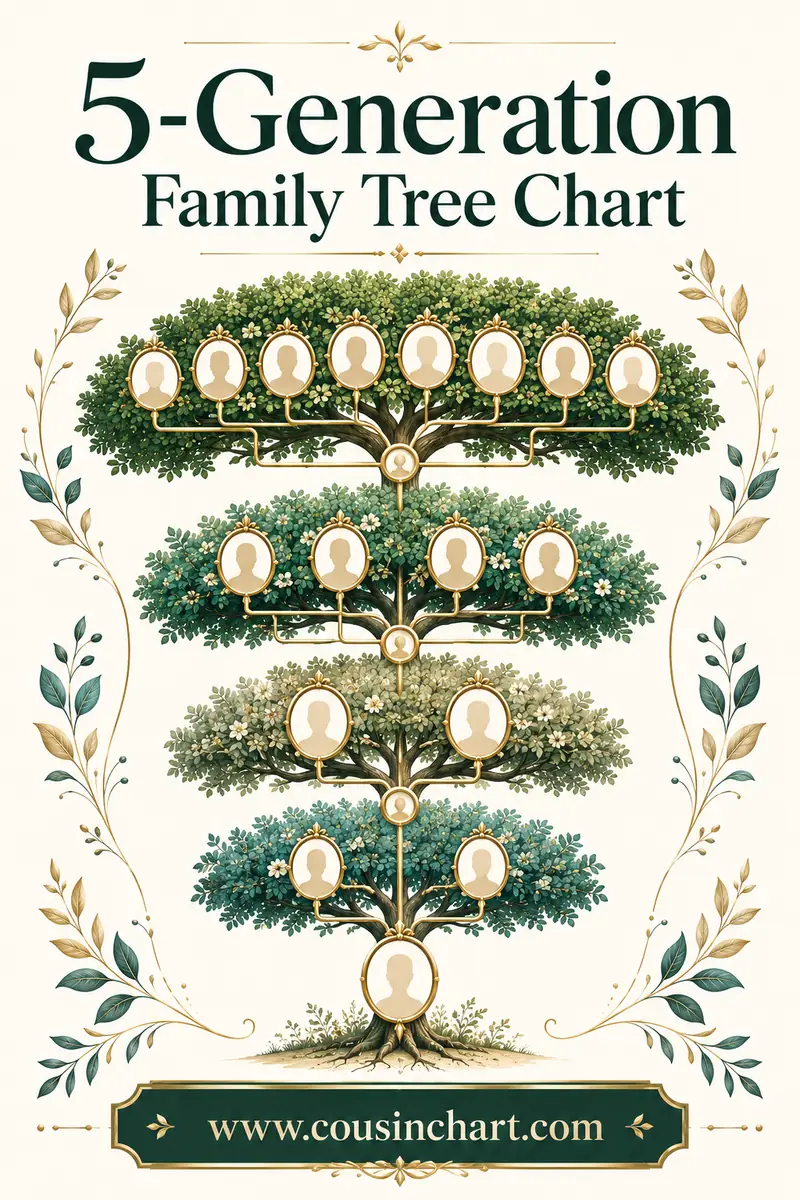
A 5 generation family tree chart holds 31 direct ancestors: you, your 2 parents, your 4 grandparents, your 8 great-grandparents and your 16 great-great-grandparents. You are generation 1 — that's the part that trips almost everyone up. It's the sweet spot chart for most families: big enough to feel like real genealogy, small enough that you can genuinely fill most of it in.
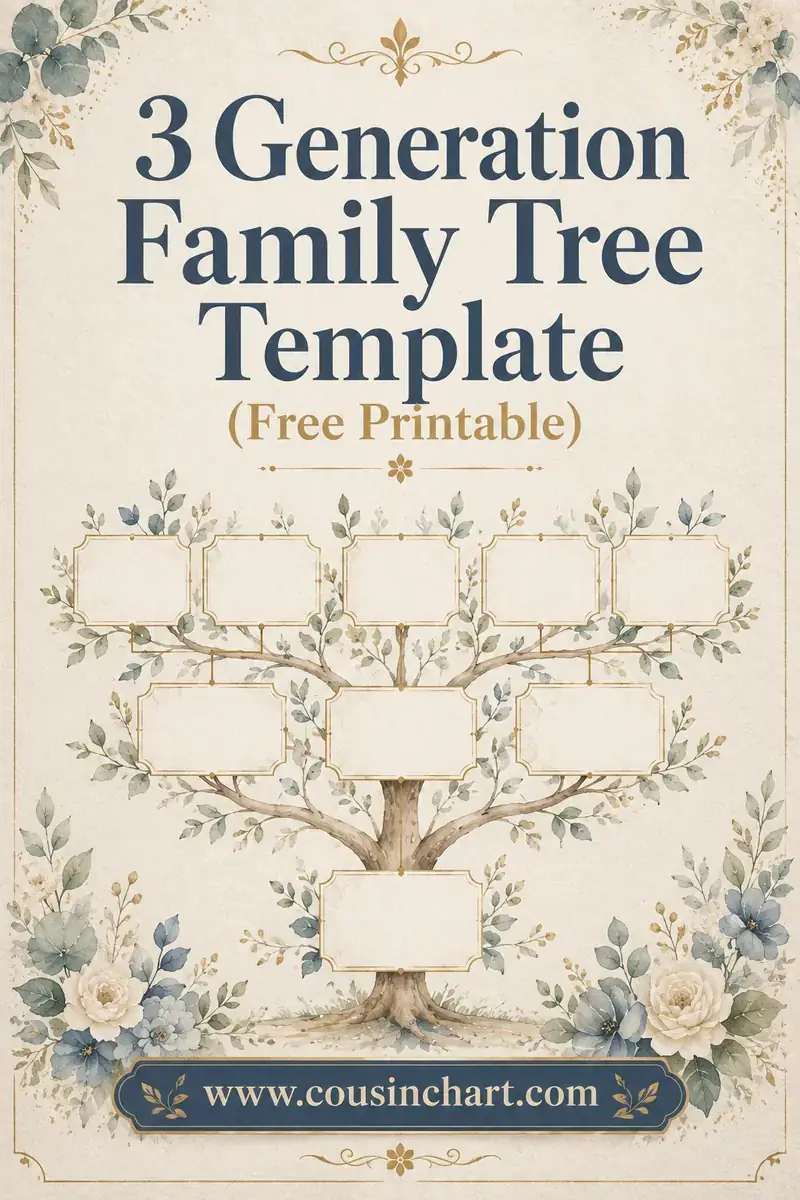
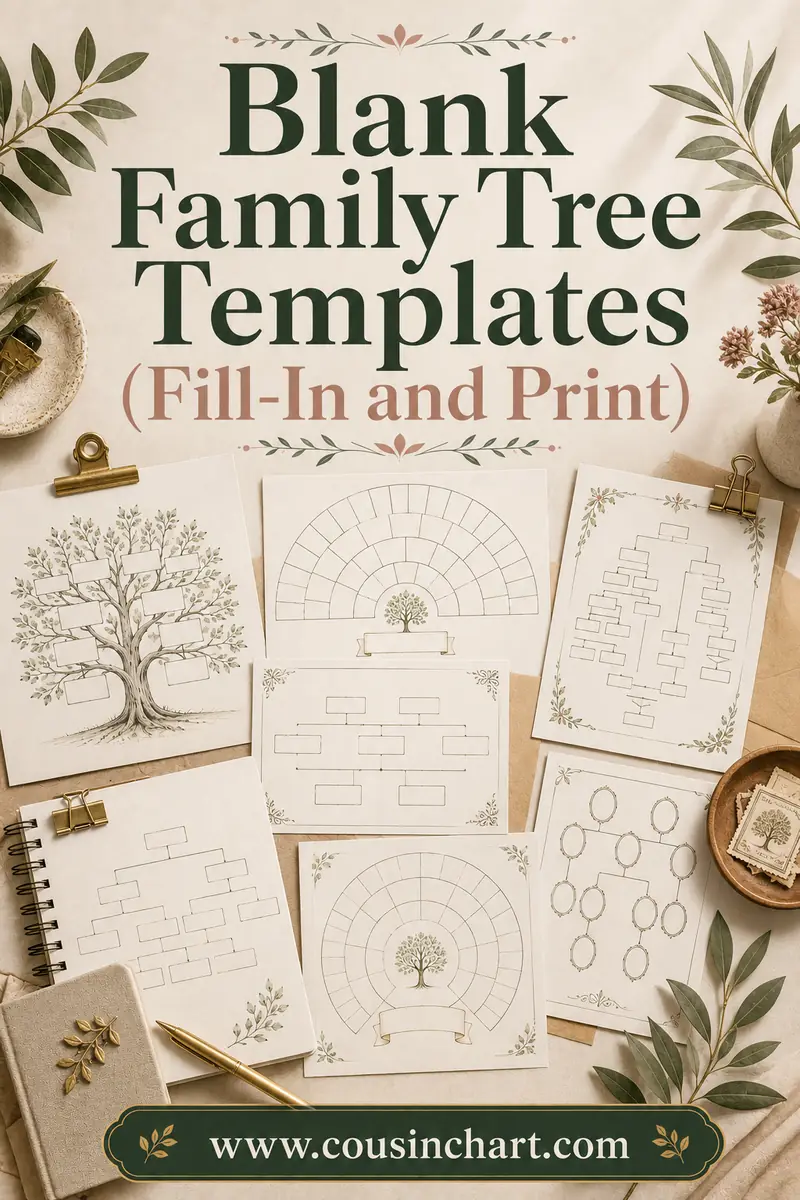
If you want to start filling one in tonight, grab a blank one from our printable family tree chart pack. Print it, put your own name in the first box, and work left to right.
Free printables for this page
Download a blank PDF (US Letter or A4) — free, no sign-up — or customize it in the maker above before printing.
 5-Generation Pedigree Chart
 Numbered Fan Chart (5 Generations)
 Pedigree Continuation Sheet
 Ahnentafel Ancestor List
Which generation is which? Tap a level to see who belongs there and how many boxes it needs.
Tap a generation above to see who goes there.
Print a blank 5-generation chart →What is a 5 generation family tree chart?
It's an ancestor chart — a pedigree chart — sized to five levels. One person sits at the left edge, and every box to the right is a direct ancestor of that person: parents, then their parents, then theirs again, twice more.
It only holds your direct line. No aunts, no uncles, no cousins, no siblings, not even your own brothers and sisters. That surprises people the first time. A pedigree chart answers exactly one question — who did I descend from? — and it answers it cleanly by leaving everyone else off. If you want whole households with all their children, that's a different form: a family group sheet, one page per couple.
The five-level version is the most popular size in genealogy for a simple reason. Four generations feels thin once you've done a bit of digging. Six generations spills off the page. Five sits right on the line where the chart is still readable and still fillable.
Why "5 generations" means 31 people, not 32
The count includes you. Generation 1 is a single person; every level after that doubles: 1, 2, 4, 8, 16. Add them up and you get 31.
People often expect a round number and assume they've miscounted. You haven't. The doubling sequence never lands on a round total, because you're always adding one more than everything before it combined. It's the same reason a 12 generation family tree chart holds 4,095 ancestors rather than 4,096.
How many people are on each chart size?
Here's the whole picture, including what you'll actually need to print it. This table is worth screenshotting before you buy paper.
| Generations | Direct ancestors on the chart | Total people (incl. you) | Comfortable paper size |
|---|---|---|---|
| 3 | 6 | 7 | US Letter / A4, portrait or landscape |
| 4 | 14 | 15 | US Letter / A4, landscape is easiest |
| 5 | 30 | 31 | US Letter / A4 landscape — tight but workable; 11×17 is luxurious |
| 6 | 62 | 63 | 11×17 (tabloid) / A3, or a fan chart |
| 7 | 126 | 127 | 11×17 / A3 minimum, fan chart, or continuation sheets |
| 8 | 254 | 255 | Fan chart or multi-sheet system only |
The pattern is brutal and it never lets up: every generation back doubles the number of ancestors. Going from 5 to 6 generations doesn't add a bit of work — it adds as much work as the entire chart you've already filled in. Our guide to how many ancestors you have follows that doubling out to its genuinely strange conclusion.
Who goes in each box on a 5 generation chart?
Standard pedigree layout puts you on the left and reads left to right. Every fork splits the same way: father on the upper branch, mother on the lower branch. That convention holds all the way across the chart, and once you trust it you can read any pedigree chart in the world without a legend.
Column 1 — you
One box. Your full name, birth date, birthplace. If you're making this as a gift for a child or a grandchild, put them in box 1 and everyone else shifts one column right — which means your own grandparents land in the great-grandparent column.
Column 2 — your parents
Two boxes. Father above, mother below. Write her maiden name. Not "Mary Johnson" if Johnson is her husband's surname — write "Mary Reilly." Maiden names are the doors into new family lines, and a chart full of married surnames is a chart that dead-ends.
Column 3 — your grandparents
Four boxes. Two came from your father's line, two from your mother's. Most people fill this column from memory. If you can't, one phone call usually does it, and that phone call tends to produce three other useful facts you weren't expecting.
Column 4 — your great-grandparents
Eight boxes. For an adult filling this in today, these people were typically born somewhere between the 1890s and the 1930s. You'll find them named on your grandparents' birth certificates, marriage records and obituaries, and sitting in census households as children.
Column 5 — your great-great-grandparents
Sixteen boxes, and the actual point of the exercise. This is where you stop knowing and start researching. Census returns are the workhorse here — one page hands you a whole household with approximate birth years and birthplaces for everyone in it.
Be realistic about this column. Half filled is a good honest result for a first pass. All sixteen filled, with sources, is months of work for most families.
What do you write in each box?
Every box on a well-made chart carries the same five things. Keep it consistent and the chart stays readable; improvise and it turns into a puzzle.
- Full name — including middle names, and maiden name for every married woman
- Born — date and place
- Married — date and place (usually written between the couple, or on the man's box)
- Died — date and place
- Buried — if you know it, though many chart designs leave this off for space
Small boxes force you to be brief. Write the essentials on the chart and keep everything else — occupations, stories, immigration dates, source citations — in your files. A printable chart is a display and planning tool. The real research lives in your notes.
Use the DD MMM YYYY date format
Genealogists write dates as 3 Mar 1885, not 3/3/85 or 03/03/1885. There's a good reason: 03/04/1885 means March 4th in the United States and April 3rd in Britain, and family history crosses borders constantly. Spelling the month out kills the ambiguity permanently.
Write the year in full, all four digits. And if a date is uncertain, say so on the chart — "abt 1885" for approximate, "bef 1890" for before, "aft 1880" for after. An honest approximation is worth ten times a confident guess.
Record places as they were at the time
Write the place name that existed when the event happened, not today's name. A birth in 1885 in what's now Poland may have been recorded in the German Empire or Austria-Hungary — and the record you need is filed under whichever country administered it then.
Include the county or district where you can. In US research, the county is usually the level that actually holds the records, so "Marion County, Indiana" is far more useful to future-you than "Indiana."
What order should you fill the chart in?
Left to right, one full column at a time. Don't jump ahead to chase the interesting ancestor.
- Fill in yourself and your parents. Two minutes.
- Fill in all four grandparents before touching the next column. Whatever you actually know goes in; unknowns get a question mark.
- Work the great-grandparent column as a set. Find one, note where you found them, move to the next box.
- Only then start on the great-great-grandparents — and only for lines where the previous generation is properly proven.
- Mark every gap with a "?" rather than leaving it blank. A question mark is a to-do item. A blank looks like you finished.
The temptation is to sprint up one line — the surname line, usually — because it's going well, and leave the other seven half-done. Resist it. A chart that's complete to generation 4 across the board tells you far more about your family than one spike back to 1790 with everything else empty.
Prove each generation before you climb
Each box should rest on something — a certificate, a census entry, an obituary, a headstone photo, at minimum a relative who genuinely knew. A matching name in someone else's online tree is a lead, not proof. One wrong link at generation 3 makes columns 4 and 5 into somebody else's family, and you won't notice for a year.
How do you print a 5 generation chart properly?
Five generations on US Letter or A4 is doable, but it's the size where printing choices start to matter.
- Print landscape. A chart grows sideways, so landscape orientation buys you a whole extra column's worth of readable width compared to portrait.
- Set margins to minimum in your printer dialogue, and turn off "fit to page" scaling if it's shrinking your text into illegibility.
- Print in black and white first. Charts get reprinted a lot as you learn things. Save the good paper for the final version.
- Go up to 11×17 (tabloid) or A3 if you can. Most print shops do it cheaply, and the extra room turns cramped 6pt boxes into boxes you can actually write in. If your household printer maxes out at Letter, a PDF on a USB stick and a five-minute trip solves it.
- Use cardstock for the display copy. 65–110 lb cardstock takes ink without bleeding and survives being handled at a family reunion.
Fill it in in pencil first
Genealogy changes its mind. You will discover that a birth year was off by three years, or that a great-grandmother was married twice and you had the wrong husband. Pencil for the working copy, pen for the framed copy. Every experienced researcher has a working chart covered in eraser smudges and it's the most valuable page they own.
When should you move up to 6 or 7 generations?
Move up when your fifth column is genuinely full — not when you're bored of five.
The honest test: can you name all 16 great-great-grandparents, with a birth date or place for most of them, and point to where each fact came from? If yes, a 6-generation chart is your next step (63 people) and it wants 11×17 or A3 paper. If no, a bigger chart just gives you more blank space to feel bad about.
There is one exception. If you're building a chart as a display piece — a framed gift, a reunion poster — bigger looks better even part-filled, and a genealogy fan chart handles six or seven generations far more gracefully than a rectangular chart does. Fan charts curve the outer generations around an arc, which is why they stay readable when a boxes-and-lines chart would need wallpaper.
Chart sizes compared
| Chart | Best for | Realistic to complete? |
|---|---|---|
| 3 generations | Kids' school projects, quick gifts | Yes, in an evening |
| 4 generations | First real genealogy chart, most family gifts | Yes, in a week or two |
| 5 generations | The standard researcher's working chart | Mostly — expect gaps in the last column |
| 6 generations | Established researchers with sources | Rarely complete; that's normal |
| 7+ generations | Display pieces, fan charts, long-term projects | Almost never complete |
Numbering your chart: the Ahnentafel system
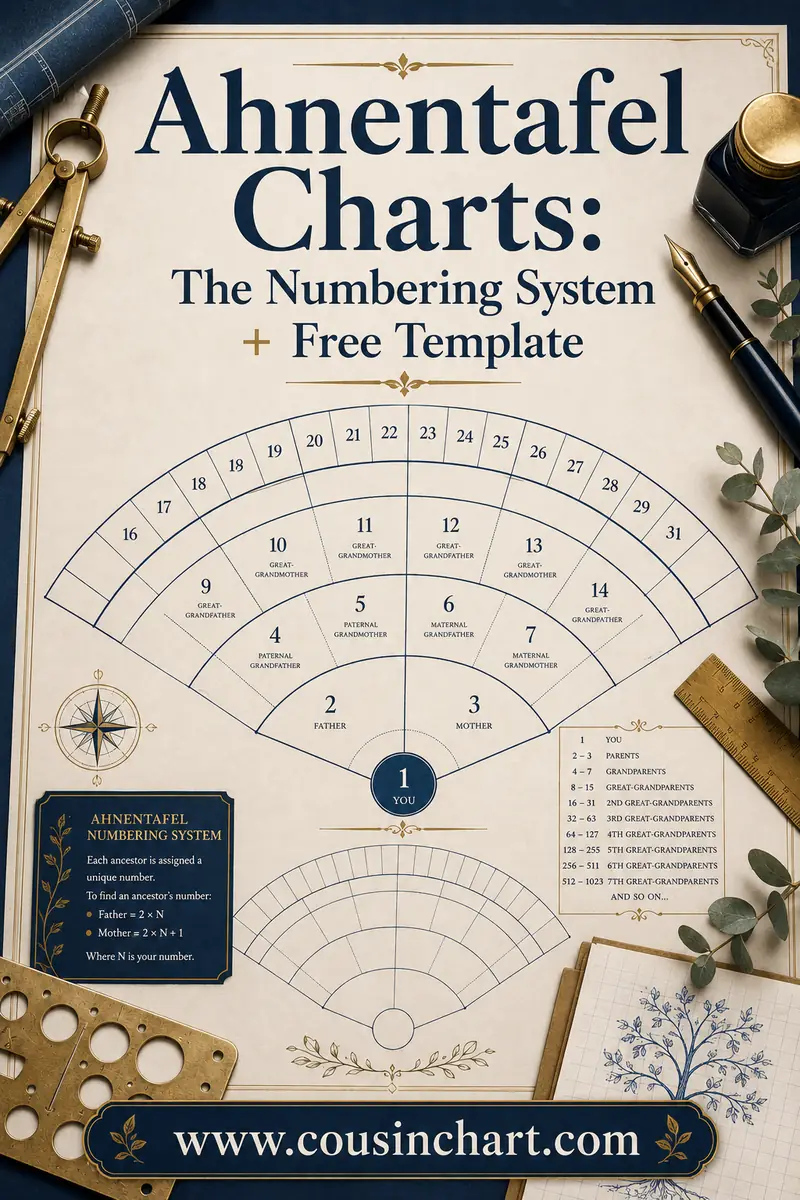
Once you're past four generations it's worth numbering the boxes. The standard is Ahnentafel numbering, and it's elegant:
- You are 1
- Your father is 2, your mother is 3
- Anyone's father = their number × 2. Anyone's mother = their number × 2 + 1
So your paternal grandfather is 4, his father is 8, his father is 16. Your mother's mother is 7. Every man on the chart carries an even number and every woman carries an odd one, which makes proofreading almost automatic — an odd number on a male ancestor means you've misnumbered something.
On a 5-generation chart the numbers run 1 to 31, with 16–31 filling the great-great-grandparent column. Our Ahnentafel chart guide covers the full system, including how to use those numbers to file documents and name scanned images so everything sorts itself.
Mistakes people make on 5 generation charts
- Counting generations from the top. Five generations means you plus four levels of ancestors, not you plus five. If your chart has 31 boxes, it's a 5-generation chart, whatever you were expecting.
- Writing married surnames for women. Maiden names or the line stops. This is the number one killer.
- Adding siblings. They don't belong on a pedigree chart. Put them on a family group sheet instead, which has a row for every child.
- Ambiguous dates. 04/05/1902 is meaningless to anyone but you. Write 4 May 1902.
- Guessing to fill a box. An empty box is fine. A wrong box propagates outward into everything to the right of it.
- Using today's place names. Borders moved constantly. Record what it was called then, and add today's name in brackets if you like.
- No source notes anywhere. The chart is the summary. Keep the citations in a research log or a notes column, or in a year you won't know whether a date came from a certificate or from Aunt Linda.
What people actually use these charts for
Working researchers print one and keep it on the desk, gaps marked in pencil, because a wall of boxes shows you your holes faster than any software screen does.
Beyond research, five generations is the size that works as a gift. Filled in neatly on cardstock, framed, it's a genuinely good wedding or milestone-birthday present — and it usually starts a conversation that produces three more names for your files. Reunions are the same story: pin one up, leave pens out, and watch relatives correct each other. You'll get better data from that hour than from a month of solo searching.
For school projects, five generations is usually too many. Kids can rarely fill past their grandparents without a lot of help, so a 3 generation template or a simple family tree is the kinder choice.
FAQ
How many people fit on a 5 generation family tree chart?
Thirty-one. That's you (1), your parents (2), your grandparents (4), your great-grandparents (8) and your great-great-grandparents (16). The count includes you as generation 1, which is why the total is 31 rather than 30 or 32.
Does a 5 generation chart include cousins, aunts and uncles?
No. A pedigree-style 5 generation chart shows only your direct ancestors — the people you descend from. Siblings, aunts, uncles and cousins go on other forms, like a family group sheet for each household or a descendant chart if you're tracing a family forward.
What paper size do I need for a 5 generation family tree chart?
US Letter or A4 in landscape orientation works, though the fifth column gets tight. If you want room to write comfortably, print at 11×17 inches (tabloid) or A3 — most print shops do this for a couple of dollars from a PDF.
Who goes in the top branch and who goes in the bottom?
By convention the father goes on the upper branch at every fork and the mother goes on the lower branch. That rule repeats all the way across the chart, so anyone can read it without a legend.
How do I write dates on a family tree chart?
Use the day-month-year format with the month spelled out: 3 Mar 1885. Numeric formats like 03/04/1885 mean different dates in the US and the UK. For uncertain dates, use "abt", "bef" or "aft" — an honest approximation beats a confident guess.
What should I do about boxes I can't fill?
Leave a question mark rather than a blank, and treat each one as a research task. Gaps are completely normal — most people can't complete all 16 great-great-grandparent boxes without months of record work, and some lines never fill in at all because the records didn't survive.
Print one and start tonight
Five generations is the chart size where family history stops being a vague idea and turns into a page you can point at. Print a blank one, fill in everything you already know in pencil, mark every gap with a question mark, and you've got a research plan that fits in a folder.
Grab a chart from our printable family tree collection, or start with a blank family tree template if you want the plainest possible version. And when a name turns up and nobody can agree whether she's your second cousin or your first cousin once removed, our family relationship calculator settles it in two clicks.