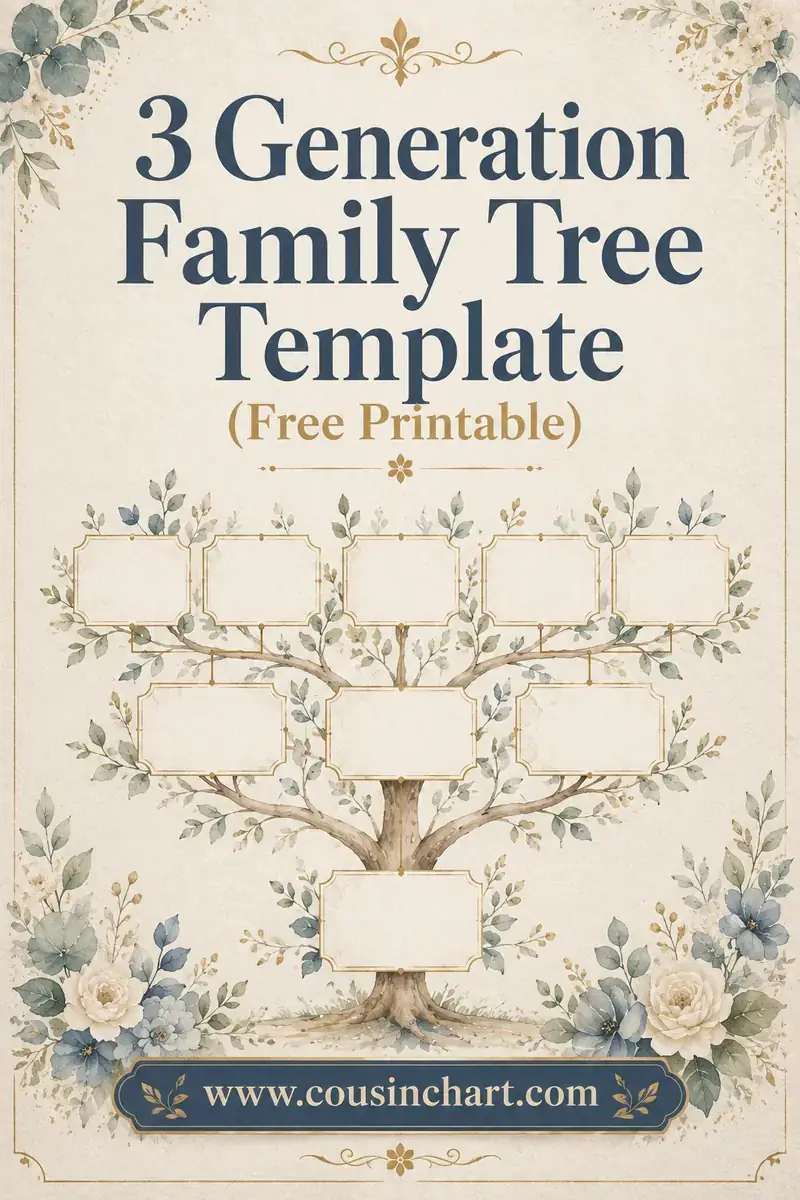
3 Generation Family Tree Template (Free Printable)
A 3 generation family tree template has exactly seven boxes: one for you, two for your parents, four for your grandparents. It fits a portrait Letter or A4 page, takes about ten minutes to fill in from memory, and it's the layout in the free printable you can grab from the CousinChart chart pack right now — no signup, no watermark, boxes sized for real handwriting.
Three generations is the "everyone finishes" chart, which is why schools assign it and why it makes such a reliable gift base. This guide covers who goes in each box, the sibling and photo variations, and when to graduate to four generations. And for the questions a small chart can't answer — where an aunt goes, what a cousin's kid is to you — the free relationship calculator on our homepage fills the gap.
Free printables for this page
Download a blank PDF (US Letter or A4) — free, no sign-up — or customize it in the maker above before printing.
 3-Generation Family TreeYou, parents and grandparents. Portrait, big boxes, 10 minutes to fill.
 Photo Family Tree
 Kids' Family Tree
 4-Generation Pedigree Chart
 5-Generation Pedigree Chart
Relationship quick-check: tap a phrase to see who they are — and whether they fit on a 3-generation chart.
Tap a phrase above to see the answer.
Work out any family relationship →The box math: why 7, and where each person sits
Ancestor charts double every generation: 1 of you, 2 parents, 4 grandparents. Three generations therefore means 1 + 2 + 4 = 7 boxes, stacked in three rows on a portrait page:
| Row | Boxes | Who | Box width (approx.) |
|---|---|---|---|
| Bottom | 1 | You | 2.5" |
| Middle | 2 | Mother and father | 2" each |
| Top | 4 | All four grandparents | 1.8" each |
Convention puts the father's parents above the father and the mother's parents above the mother, so each side of the page reads as one family line. Which side is left and which is right doesn't matter — consistency does. Lines run child-to-parents only: one from your box splitting to both parents, one from each parent splitting to their pair.
The generous box widths are the quiet advantage of stopping at three generations: 1.8-inch grandparent boxes hold a full name, a maiden name, and a birth year in a child's handwriting. The equivalent boxes on a five-generation chart are half that size.
Filling it in: a 10-minute walkthrough
- Start at the bottom with yourself — full name, birth year. If the tree is for a child, they go here (the chart's "root" is whoever the tree belongs to).
- Parents next, middle row. Full names, and mom under her maiden name — "Elena MARTINEZ" not "Elena Reyes" — because her box is the doorway to her parents above.
- Grandparents last, top row, and here's where the value hides: most kids (and plenty of adults) have never actually asked a grandparent's full formal name. "What was Grandma's last name before she married?" is the single most genealogically productive question a family ever asks at dinner.
- Add birth years under each name. Seven names with years is a real historical document; seven bare names is a nice drawing.
- Pencil first. Someone will correct a spelling within the week. That's the chart working as intended.
Variations that keep it one page
- The sibling version. Widen the bottom row: one box per child, oldest on the left, all connected to the same parents. Three kids makes it a 9-box chart, still comfortably portrait. Most school assignments secretly want this version — check whether "your family" means ancestors or household before printing. (Our simple family tree guide covers both readings.)
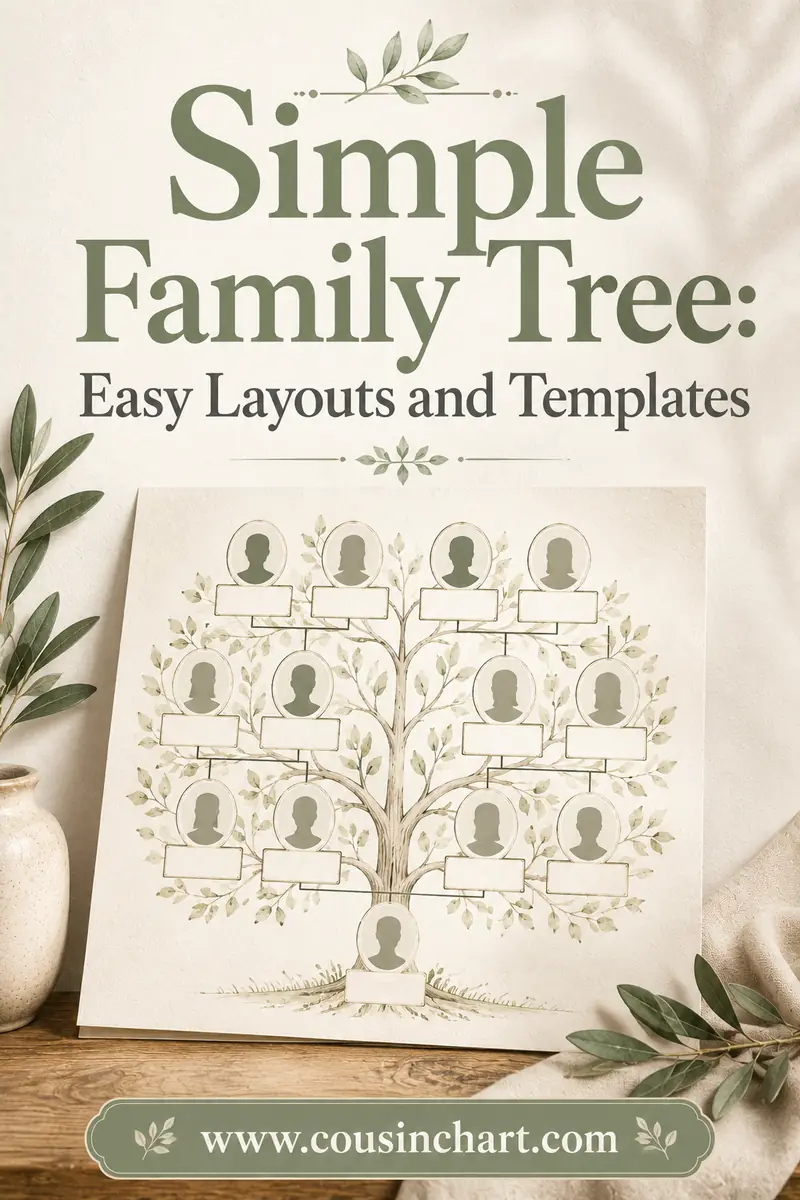
- The photo version. Same seven boxes, each with a circular photo frame above the name line. Grandparent gift, nursery art, and the classic first-day-of-school project. Print on cardstock if photos are being glued.
- The kids' decorated version. Trunk-and-leaves artwork where the seven "boxes" are apples or leaves. Same structure wearing a costume — the family tree template for kids roundup has the age-by-age options.
- The blended-family version. Add a second marriage line beside a parent where needed and hang half-siblings from the correct pairing. Three generations stays manageable even blended — it's the level where every child can still see themselves connected to every grandparent figure they know.
What a 3-generation chart teaches (and what it can't)
Fill one with a child and the doubling pattern does the teaching: two parents each had two parents, and everyone on the top row is equally "grandma and grandpa" even though they come from different families. It's the first time many kids grasp that mom and dad were kids too.
What it can't do is hold the wider family — no aunts, uncles, or cousins have boxes here, and the moment a child asks "where's Uncle Marco?" you've hit the template's edge. Two good answers: widen into the sibling-style layout at the parents' row, or keep the chart clean and show them the connection on the free CousinChart calculator — type the path, see the term, no redrawing. When the follow-up question is "and where does great-grandma go?", that's your cue for the 4 generation family tree template, which adds the eight boxes above the top row.
Running it as a classroom or group activity
Teachers and scout leaders use the 7-box chart because it works with zero prep, but a few adjustments make it work well:
- Send it home, don't fill it in class. The chart's value is the dinner-table conversation it forces; in class it becomes a memory test some kids lose through no fault of their own.
- Brief the flexibility up front. "Fill the boxes with the people who raise you and their parents" covers adoptive, blended, grandparent-led, and two-mom families without singling anyone out. A grandparent can sit in a parent box; a box can stay empty; a step-parent can share a box or take a second line. The structure serves the family, never the reverse.
- Ask for one fact beyond names. "Add where each person was born" turns seven names into a geography lesson — most classes discover they collectively span a dozen countries.
- Display them side by side. Thirty 7-box trees on a wall teach the doubling pattern better than any lecture: every single tree, whatever the family's shape, holds the same three-row architecture.
Making the finished chart worth keeping
Ten minutes of finishing separates homework from heirloom. Have the child (or yourself) date the chart and sign it as "compiled by" — future family will care who made it. Photograph it before it goes anywhere near a backpack. If it came out well, re-do the fair copy on cardstock with photos in the boxes: the 3-generation size is the only chart small enough that every box can hold a face at printable size, which is exactly why it makes the best grandparent gift of all the layouts. Frame sizes work out neatly too — a portrait Letter chart drops into a standard 8.5×11" or matted 11×14" frame from any dollar store.
And keep the original pencil version, corrections and all. The chart with grandma's handwriting fixing her own birth year is worth more than the neat copy — it's evidence of an afternoon, not just a diagram.
When a box has to stay empty
Sometimes a grandparent's name genuinely isn't known — estrangement, adoption, a parent who never said. Handle it the way genealogists do: leave the box visibly blank or write what is known ("Maria's father — name unknown, from Naples"). An honest gap is information; a made-up name is a landmine for whoever inherits the chart. For kids' versions, the gentler framing works: "that's a branch we're still learning about." More than one family has started real research — the record-hunting kind — because a seven-box chart had one box nobody could fill.
Printing notes
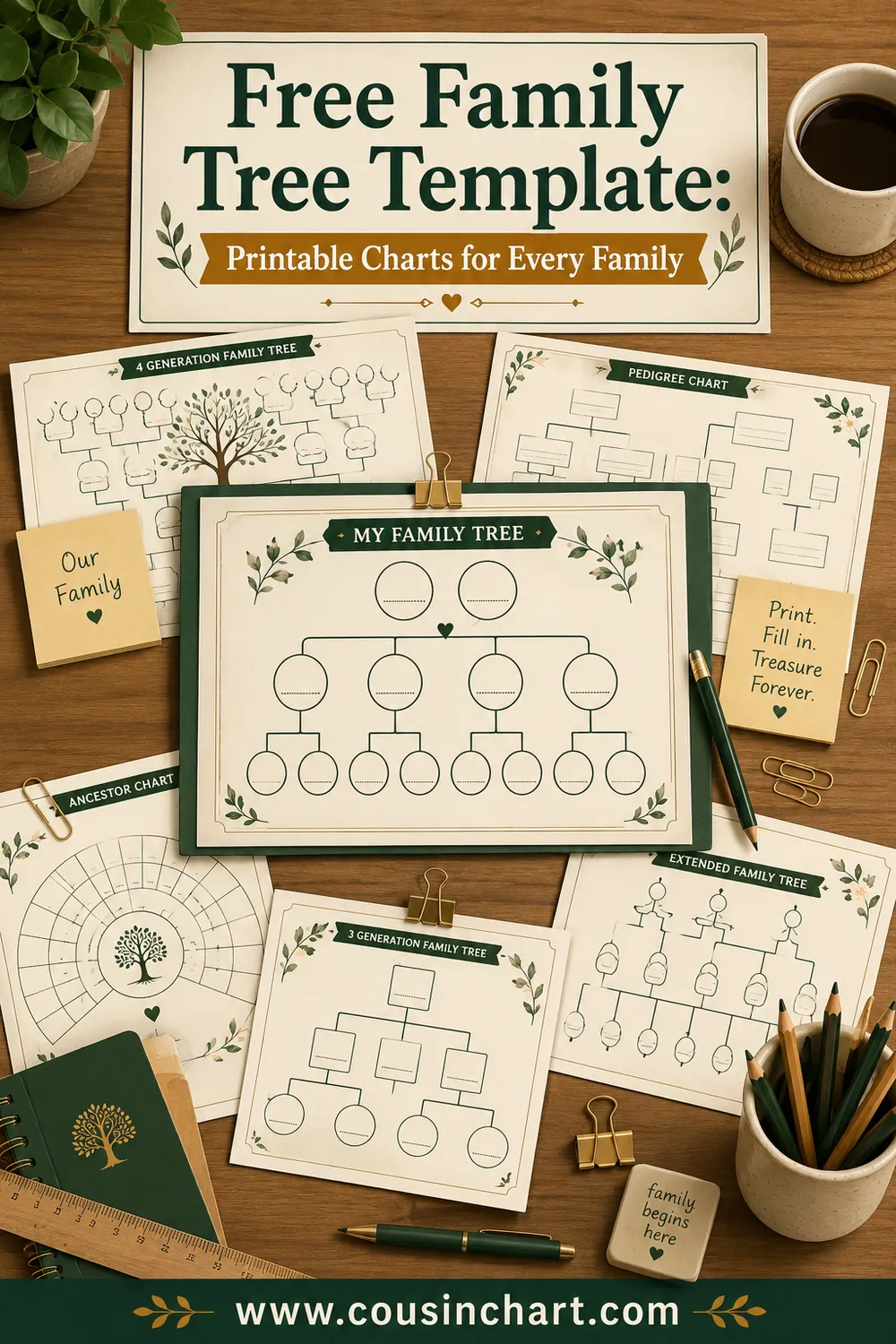
Portrait, Letter or A4, 100% scale ("actual size" — never "fit to page," which shrinks every box). Ordinary paper is fine for drafts and classrooms; step up to 65 lb cardstock for photo versions and gifts. The PDF is part of the wider free family tree template pack, so grab the 4- and 5-generation charts in the same download for when this one fills up — and pin the pack to a family Pinterest board, because somebody asks for it every school year.
FAQ
What does a 3 generation family tree include?
Seven people: you, your two parents, and your four grandparents, arranged in three rows on one portrait page. Direct ancestors only — no aunts, uncles, or cousins unless you use a widened sibling variation.
Who counts as the three generations?
You are generation one, your parents are generation two, and your grandparents are generation three. Counting always starts from the chart's root person — whoever the tree belongs to — not from the oldest people on it.
How do I add brothers and sisters to a 3 generation template?
Widen the bottom row with one box per sibling, oldest to youngest from the left, each connected upward to the same parents. Half-siblings connect to the one parent you share.
Is a 3 generation family tree enough for a school project?
Almost always, yes — it's the standard assignment size because every student can complete it from family knowledge. Check whether the teacher wants siblings included; if so, use the sibling variation rather than the strict ancestor layout.
Where do great-grandparents go on a 3 generation chart?
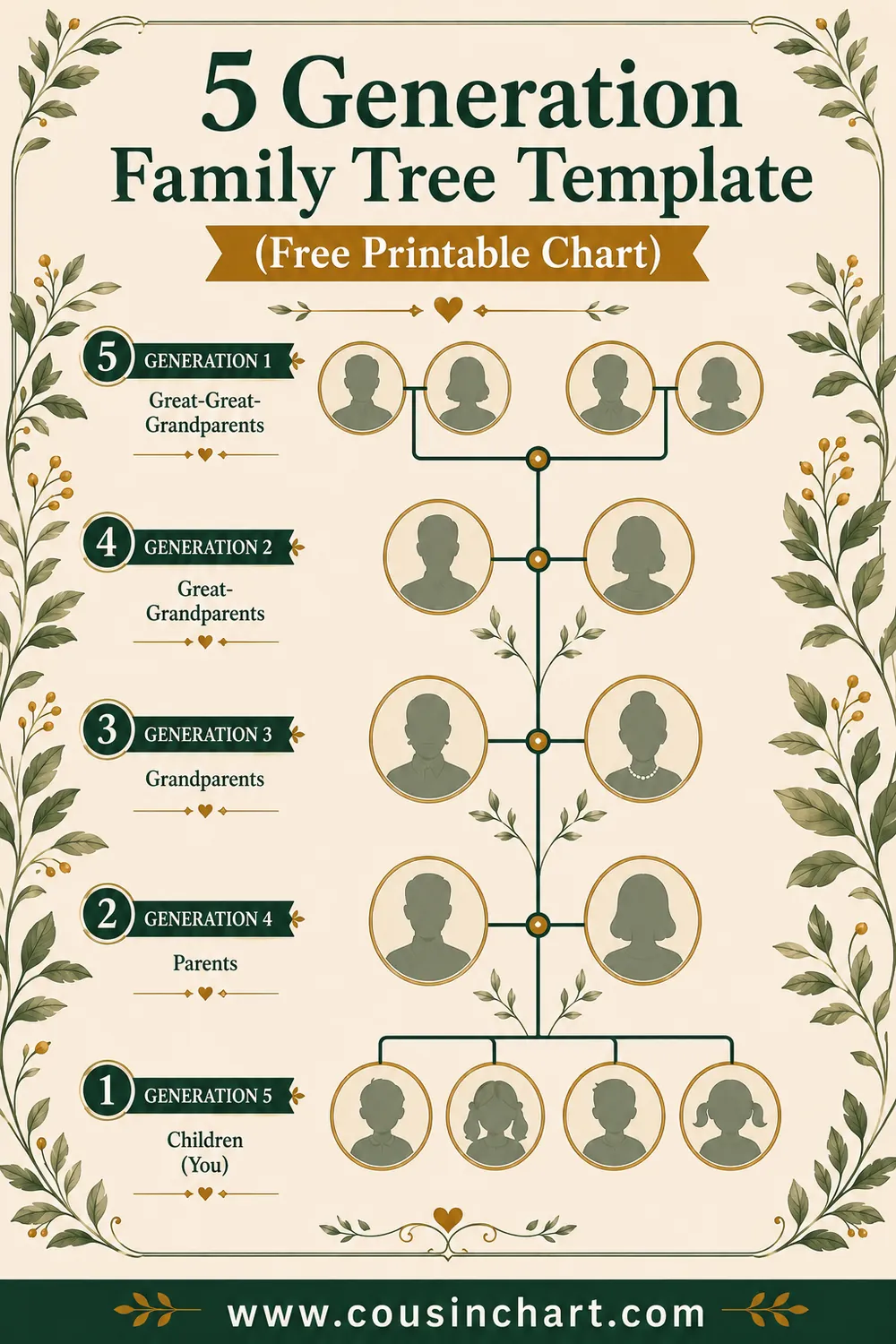
They don't — great-grandparents are generation four. When you're ready for them, move to a 4-generation template, which adds eight boxes in a new top row and switches the page to landscape.
Seven boxes between you and done
Print the free 3-generation template from the CousinChart pack, ask the grandparents their full names — maiden names too — and you'll finish the whole chart before the conversation runs out of stories. And when the small chart raises big questions about aunts, cousins, and everyone beyond its seven boxes, the free relationship calculator picks up exactly where the paper leaves off.