Pedigree Chart Templates: Blank, Printable, Up to 15 Generations
A pedigree chart is the ancestors-only family tree: you on the left, parents branching right, then grandparents, doubling every column — no siblings, no spouses of siblings, no cousins, just your direct bloodline. The standard printable template is the 4-generation, 15-box chart on one landscape page, and larger trees chain those pages together ("cascading charts") all the way to 15 generations if your research holds out.
Below: what goes in every box, the box-count math for each size, how cascading chart numbering works so a 60-page binder stays navigable, and the print settings that keep the boxes writable. The free CousinChart printable pack includes blank pedigree charts ready to go — and when the chart raises a relationship question it can't answer (pedigree charts are famously silent about cousins), the free relationship calculator picks up exactly there.
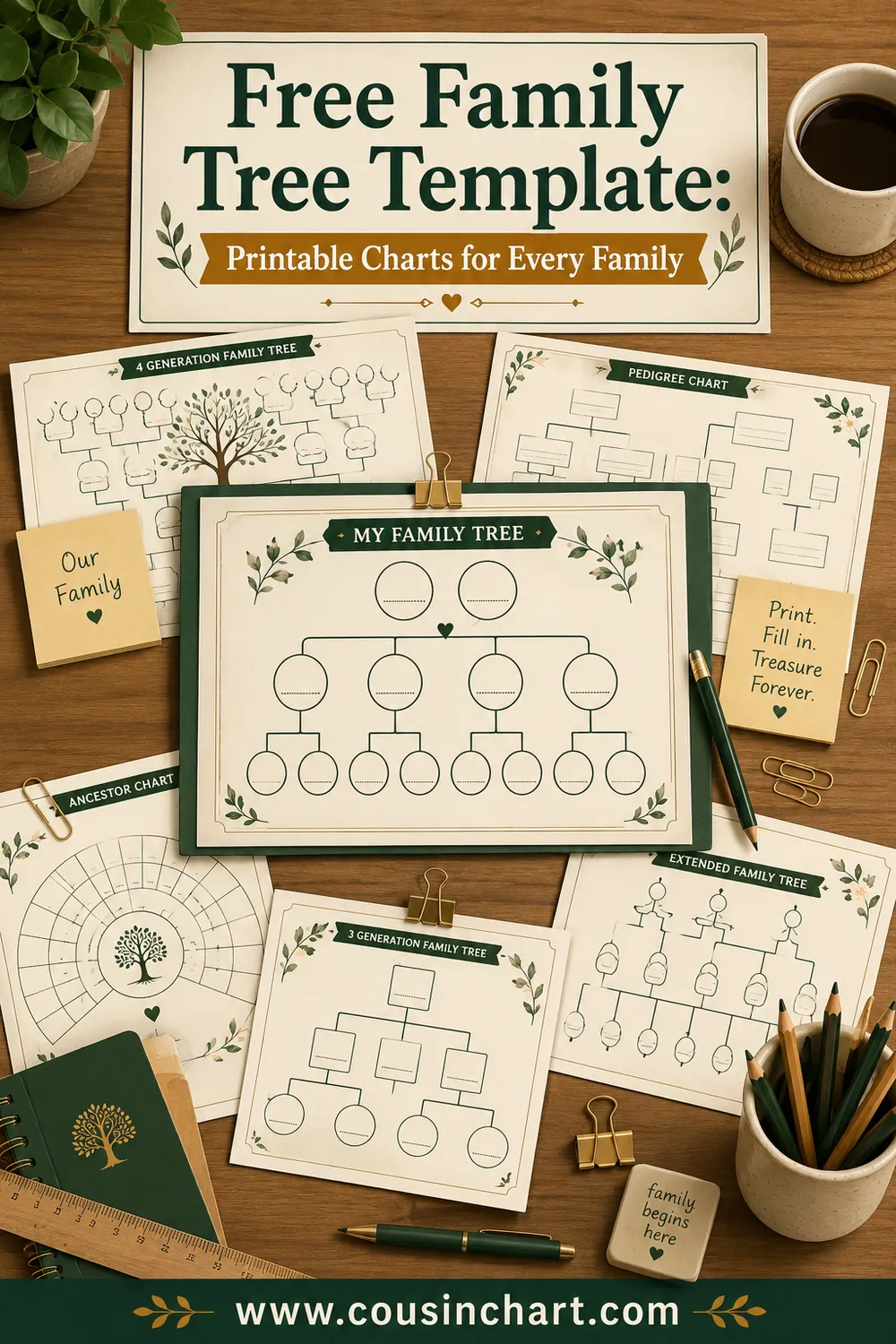
Free printables for this page
Download a blank PDF (US Letter or A4) — free, no sign-up — or customize it in the maker above before printing.
 4-Generation Pedigree Chart
 5-Generation Pedigree Chart
 6-Generation Pedigree Chart63 ancestors on one portrait page; names-only outer column.
 Pedigree Continuation Sheet
 Ahnentafel Ancestor List
Relationship quick-check: tap a phrase to see who they are — and whether they get a box on a pedigree chart.
Tap a phrase above to see the answer.
Work out any family relationship →What makes a chart a "pedigree" chart
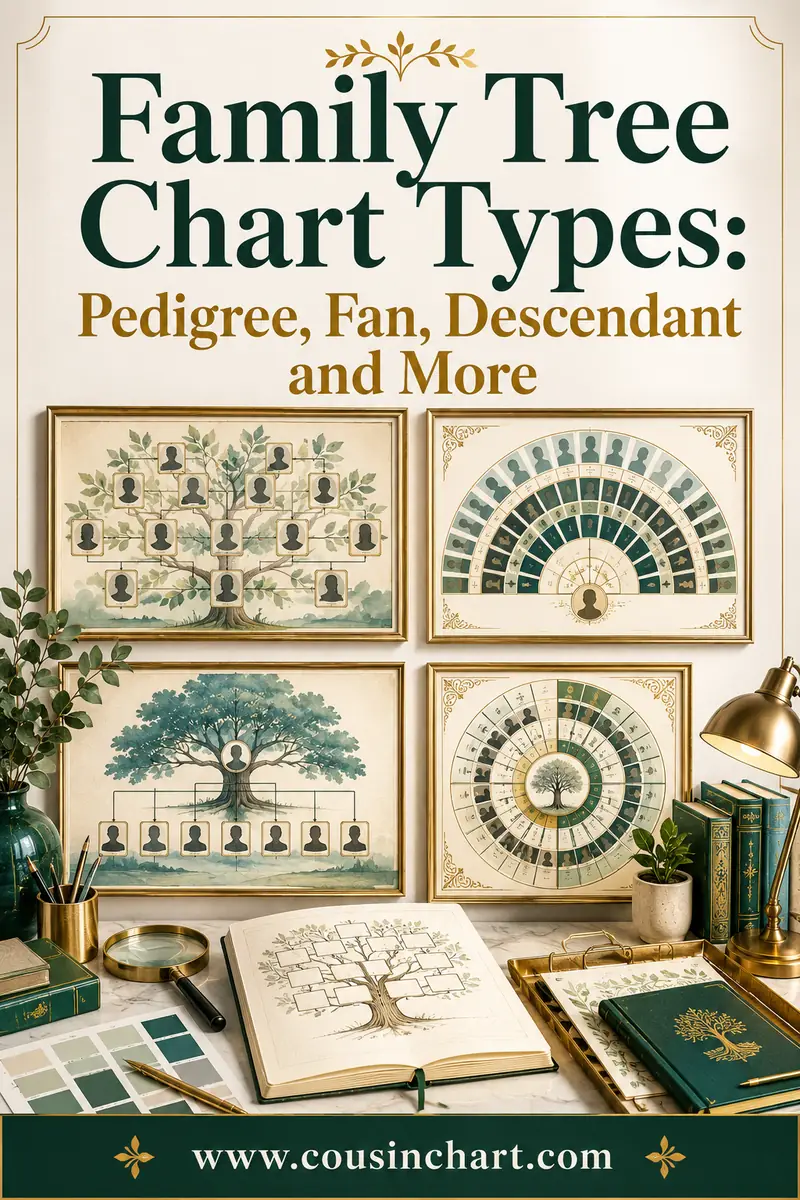
Family tree charts come in several shapes — descendant charts, fan charts, bow ties, hourglasses (the full taxonomy is in our family tree chart types guide). The pedigree chart is the strictest of them: it answers exactly one question, "who did this person descend from?", and refuses to answer anything else.
That strictness is a feature. Because every person has exactly two biological parents, a pedigree chart's shape is perfectly predictable — every box branches into precisely two — which means blank templates work for every family on earth. Descendant charts can't promise that; nobody knows in advance how many children each couple had.
The trade-off: whole categories of relatives never appear. Siblings, aunts and uncles, cousins, and in-laws all live off-chart. When someone points at your pedigree binder and asks "so where's Uncle Ray?", the answer is "on a family group sheet" — and when they ask "what exactly is grandma's cousin's grandson to me?", the answer is the free CousinChart calculator, because no ancestor chart will ever tell you.
Box counts by size
| Template | Generations | Total boxes | Farthest ancestor | Fits on |
|---|---|---|---|---|
| Starter | 3 | 7 | Grandparents | Letter/A4 portrait |
| Standard | 4 | 15 | Great-grandparents | Letter/A4 landscape |
| Research | 5 | 31 | Great-great-grandparents | Letter, better at 11×17" |
| Deep | 6 | 63 | 3rd-great-grandparents | 11×17" landscape |
| Poster | 8 | 255 | 5th-great-grandparents | 24×36" poster |
| Cascading set | up to 15 | 32,767 slots | 12th-great-grandparents | Letter pages, chained |
Two of those numbers deserve a pause. The 4-generation, 15-box chart is the standard because it's the largest size where every box still holds three written lines comfortably on home paper — that's why it's the workhorse of the free pack and of our 4 generation family tree template guide. And 15 generations at 32,767 slots is not a poster you'll ever print whole; it's the theoretical ceiling of a cascading system, reached one 15-box page at a time.
The fields inside each box
Genealogy settled on a standard trio, one line each:
- Name — full name at birth. Women are recorded under their maiden names, always; it's the single most important convention on the chart, because "Grandma Miller" was born a Kovach, a Reyes, or an O'Brien, and that name is the doorway to her whole line.
- b. — birth date and place.
- m. — marriage date and place (conventionally written under the husband's box, on the line joining the couple).
- d. — death date and place.
Dates go in genealogy format — 4 Jul 1921, day-month-year with the month spelled — because 07/04/1921 means two different days on two sides of the Atlantic. Places go smallest-to-largest: town, county, state or province, country. Leave anything unknown blank rather than guessed; a pedigree chart's blanks are its to-do list.
Chart numbering: how the boxes get their numbers
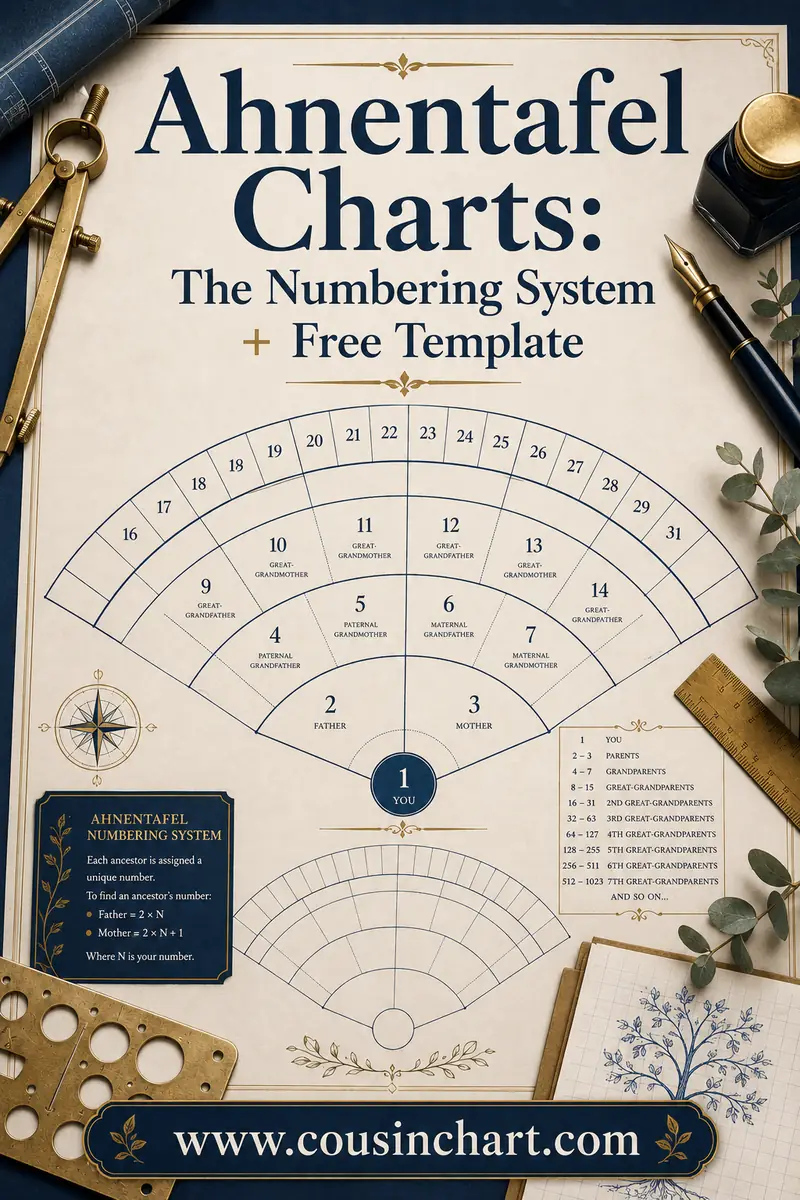
Standard pedigree templates number the boxes 1 through 15 (or 31), and the numbering isn't arbitrary — it's the ahnentafel system. You are 1. Any person's father is their number doubled; their mother is doubled plus one. So your father is 2, mother 3, paternal grandfather 4, maternal grandmother 7, and the eight great-grandparents run 8 through 15. Men land on even numbers, women on odd, forever.
The payoff is that numbers alone identify anyone. "Number 13" can only be your mother's father's mother (13 = mother of 6; 6 = father of 3; 3 = your mother). The full system — including the party trick where you convert a number to binary and read the relationship straight off the digits — gets its own article: ahnentafel charts.
Cascading charts: going past one page
Here's the mechanism that takes a stack of Letter pages to 15 generations:
- Chart 1 holds generations 1–4: you in box 1, great-grandparents in boxes 8–15.
- Each great-grandparent with a traced line becomes box 1 of their own continuation chart. Old great-grandpa in box 8 of chart 1 reappears as box 1 of (say) chart 2, and his great-grandparents fill that chart's boxes 8–15 — which are generations 7 back from you.
- In box 8–15 of chart 1, you write "continued on chart 2" (most templates have a printed blank for it), and chart 2's box 1 carries "see chart 1, box 8."
- Repeat. Each layer of continuation charts adds three generations: charts starting at generation 4 reach 7, the next layer reaches 10, the next 13, and one more clears 15.
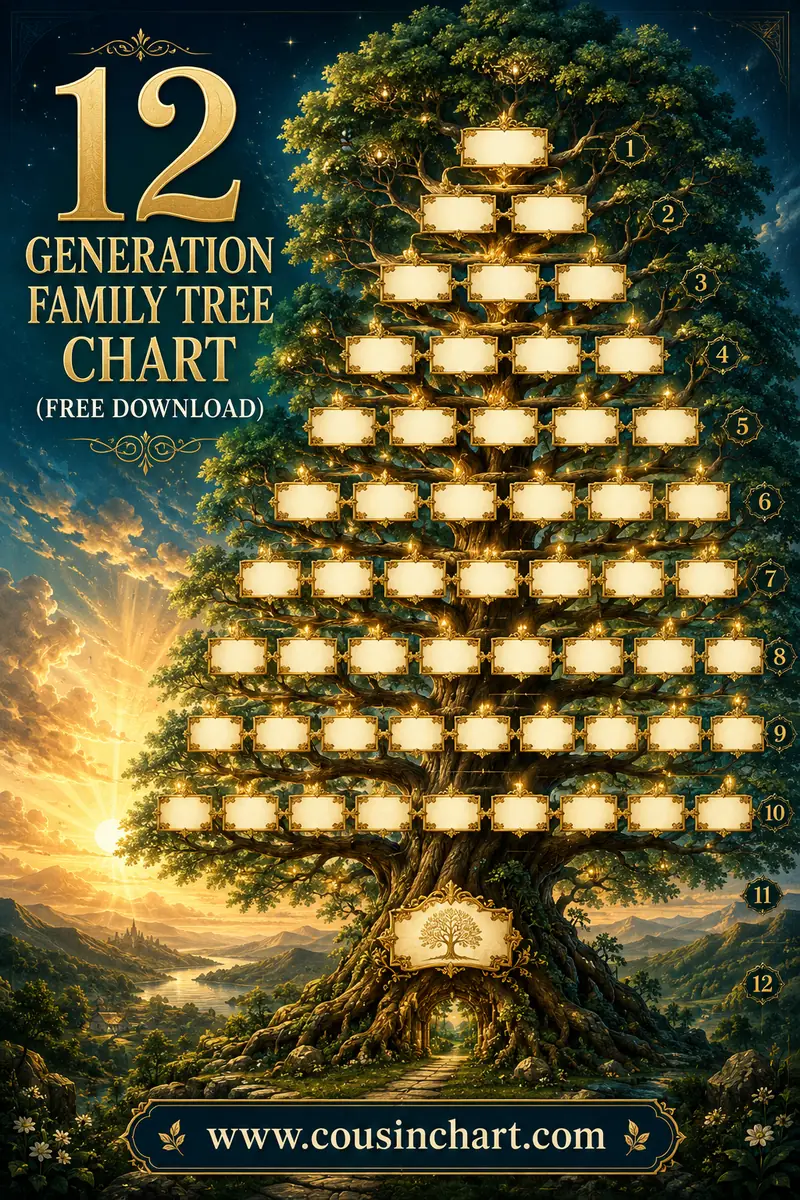
Fully filled, the page count explodes (1 + 8 + 64 + 512 charts by generation 13) — but trees are never fully filled that deep. A serious multi-year research binder typically runs 30 to 80 cascading pages covering the lines that actually have records. Number the charts in the order you create them, keep a one-page index in the front of the binder, and the system scales indefinitely. For the wall-display version of deep ancestry — same slots, no page-flipping — see the 12 generation chart formats instead.
Filling one in: a sensible order
- Pencil first. Everything starts in pencil; ink is for facts with a document behind them.
- Yourself, parents, grandparents — boxes 1–7 from memory.
- Call the rememberer. Every family has one. Boxes 8–15 usually live in one phone call, along with three stories you didn't ask for. Take the stories too.
- Verify against paper. Certificates in the drawer, the family Bible, obituaries. Ink what's confirmed.
- Start continuation charts only for lines with a real lead — a known parish, an immigration record, a surname someone already researched.
A half-day gets most people through step 3. The chart then becomes the tidy front page of a research habit, which is the actual point of the template.
Printing your pedigree charts
- Scale 100% / Actual Size. "Fit to page" shrinks every box 5–10%, and these boxes have no slack — they're sized for three handwritten lines exactly.
- Landscape for the 15-box chart. Print it portrait and the auto-rotate squeeze makes box 1 unreadable.
- Normal or high quality, never draft. Draft-mode connector lines vanish under pencil.
- 28–32 lb paper for the binder copies. They get handled for years. Standard 20 lb copy paper is fine for one-session drafts.
- Three-hole punch on the left margin of landscape charts — the pack's templates leave a punch-safe margin, so nothing gets swallowed by the binder rings.
Five mistakes that quietly ruin pedigree charts
After enough reunion tables, the same five errors show up on almost every first chart:
- Married names in women's boxes. "Grandma Elena Santos" — except Santos is grandpa's name. Her line is unfindable until someone recovers the maiden name. If it's genuinely unknown, write the first name and leave the surname line blank as a visible research target; a wrong surname hides the gap.
- Guessed dates written as facts. "b. 1902" penciled from a hunch becomes ink, gets photocopied, and ten years later three cousins are defending a date nobody ever verified. The fix is notation: "abt 1902" or "1902?" costs four characters and preserves the truth about certainty.
- The two-people-one-box merge. A great-grandfather and his brother, both named for their grandfather, born a few years apart in the same town, quietly fused into one person with two wives and an impossible timeline. When an ancestor's facts stop making sense, suspect a merge — it's the most common deep-tree error there is.
- Skipping the marriage line. The "m." field feels optional and isn't: marriage records are often the only document naming a woman's father, which makes that little line the bridge to the entire maternal box above it.
- Charting assumptions as biology. The chart records documented parentage. Where a birth father is unknown or an adoption is in the line, the honest chart says so — dashed line, note, or a candid blank — rather than printing the assumed name. Blended and complicated families are the norm across four generations, not the exception.
None of these are moral failings; they're what happens when a chart moves faster than its evidence. The pencil-then-ink rule catches nearly all of them.
Pedigree chart vs. family tree: the quick distinction
People use "family tree" for everything, so here's the clean split. A pedigree chart is ancestors-only, one person's bloodline running in one direction. A general family tree usually means a descendant-style chart — an ancestral couple at the top, spreading downward through children, their spouses, grandchildren, and yes, all the cousins. Pedigree charts are for research; descendant trees are for reunions. Most family historians maintain both, and the printable pack covers both shapes.
FAQ
What is a pedigree chart template?
A blank, printable form showing one person's direct ancestors: the subject on the left, two parents, four grandparents, doubling each generation. The standard version holds 4 generations (15 boxes) on one landscape page, with fields for each ancestor's name, birth, marriage, and death.
How do I get a blank pedigree chart for free?
The free CousinChart printable pack includes blank pedigree charts in the standard sizes as PDFs — no account, no watermark. Print at 100% scale on Letter or A4, landscape orientation for the 4-generation chart.
How are pedigree charts numbered?
By the ahnentafel system: you are 1, and any person's father is double their number, mother double-plus-one. Father 2, mother 3, grandparents 4–7, great-grandparents 8–15. Men take even numbers, women odd.
How do I make a pedigree chart bigger than 4 generations?
Chain pages: each great-grandparent (boxes 8–15) becomes box 1 of their own continuation chart, and each chart notes where its lines continue. These "cascading charts" extend a tree to 15+ generations using ordinary Letter pages in a binder.
Do siblings and cousins go on a pedigree chart?
No — pedigree charts record direct ancestors only. Siblings and children belong on family group sheets, and cousin relationships are read from a cousin chart or worked out with a relationship calculator.
What's the difference between a pedigree chart and a family tree?
A pedigree chart runs backward from one person through ancestors only. A family tree (descendant style) runs forward from an ancestral couple through all their descendants, including siblings, spouses, and cousins.
Print a chart and fill box 1
That's the whole barrier to entry: one landscape page, fifteen boxes, your own name in box 1. Download the blank pedigree chart from the free CousinChart pack, pencil in the seven names you know tonight, and let boxes 8–15 schedule the phone call they always schedule. And keep the free relationship calculator handy for everyone the chart deliberately leaves out — the cousins will come up at the very first family gathering where the binder appears.