Family Tree Chart Types: Pedigree, Fan, Descendant and More
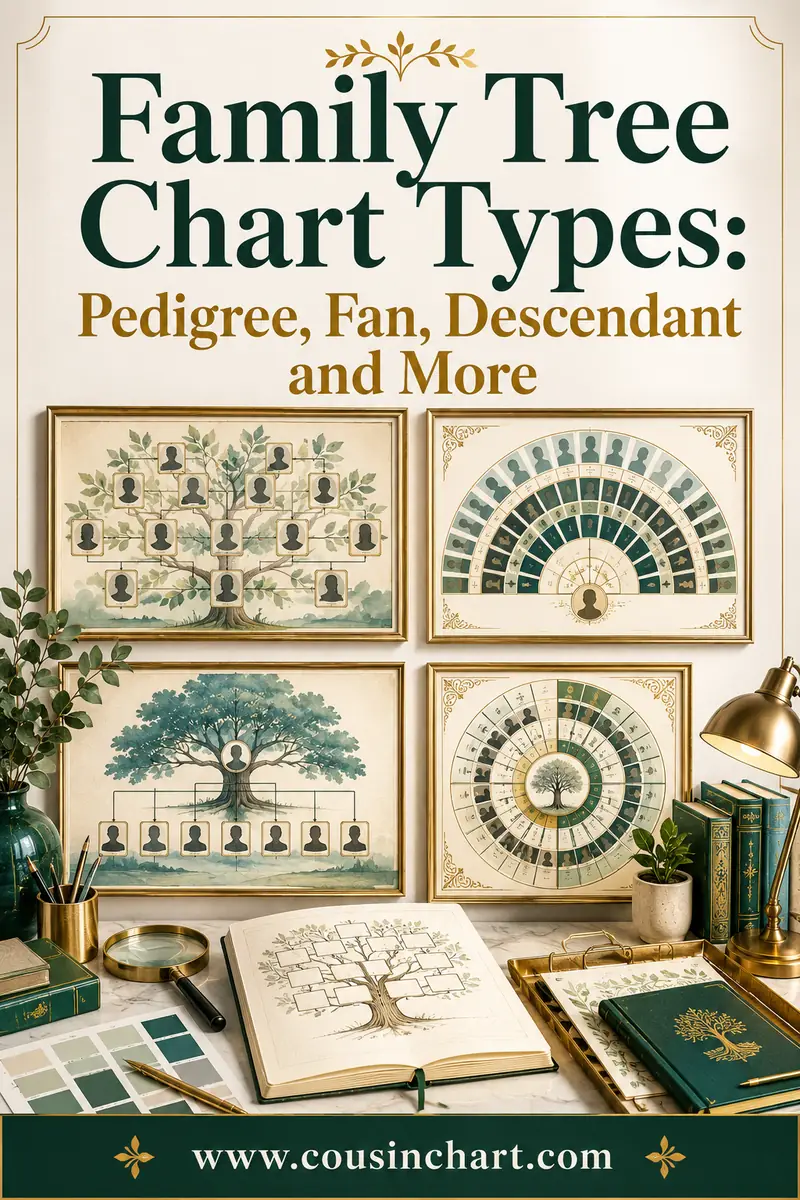
There are six family tree chart types you'll actually meet: the pedigree chart (your ancestors, doubling each generation), the fan chart (same data in a semicircle), the descendant chart (everyone down from one ancestor), the hourglass (both directions at once), the bow tie (dad's side left, mom's side right), and the genogram (relationships plus medical and emotional patterns). Which one you need depends on a single question — are you looking up at ancestors, down at descendants, or sideways at the living family?
This guide walks through each type with its box math, best paper orientation, and the job it does better than the others, so you can print the right chart the first time — our free chart pack covers the common ones as fill-in PDFs. And whichever chart you pick, the free relationship calculator on our homepage is the companion tool: charts show where people sit, the calculator names what they are to you.
Free printables for this page
Download a blank PDF (US Letter or A4) — free, no sign-up — or customize it in the maker above before printing.
 5-Generation Pedigree Chart
 Blank Fan Chart (5 Generations)
 Descendant Chart
 Bow Tie Family Tree
 Family Tree With Siblings
 Cousin Relationship ChartThe classic cousin grid: 1st cousin, 2nd cousin, times removed.
Relationship quick-check: tap a phrase to see the relationship — and which chart type it shows up on.
Tap a phrase above to see the answer.
Work out any family relationship →The six chart types at a glance
| Chart type | Direction | People shown | Typical size | Best for |
|---|---|---|---|---|
| Pedigree | Up (ancestors) | 15–31 (4–5 gens) | Letter/A4 landscape | Research, record-keeping |
| Fan | Up (ancestors) | 15–63 | Letter to poster | Wall display, gifts |
| Descendant | Down (from one ancestor) | Varies widely | Landscape, often wide | Reunions, cousin-mapping |
| Hourglass | Both | Ancestors + descendants of one person | Tabloid+ | Milestone gifts, obit research |
| Bow tie | Up, split sideways | 15–31 | Letter/A4 landscape | Separating mom's and dad's sides |
| Genogram | Sideways (living family) | 3 generations typical | Letter/A4 | Medical history, counseling |
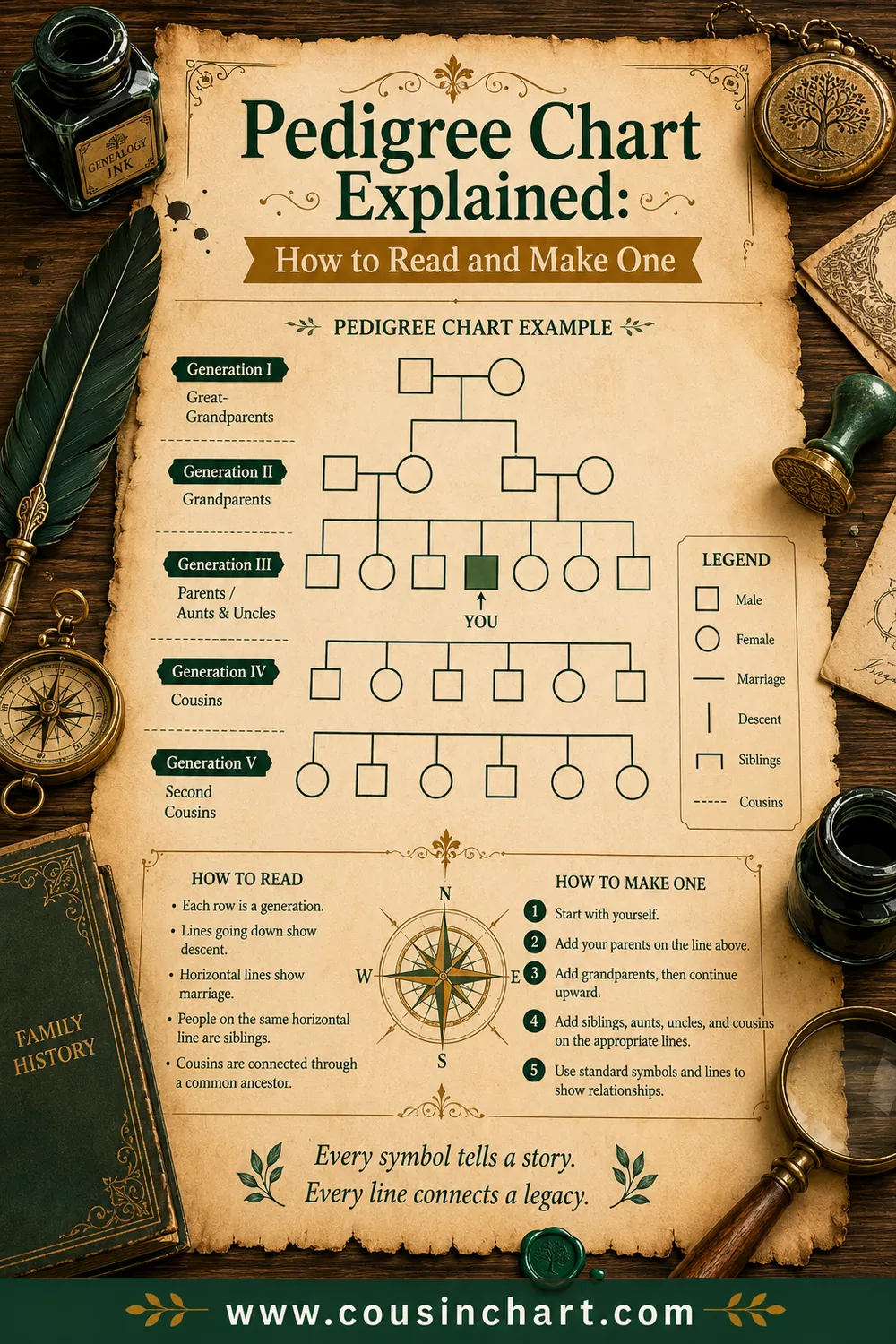
Pedigree chart: the workhorse
The pedigree chart (also called an ancestor chart) starts with you and doubles every column: 2 parents, 4 grandparents, 8 great-grandparents. A 4-generation version holds 15 people; 5 generations holds 31. Only direct ancestors get a line — no siblings, no aunts, no cousins.
Layout guidance: landscape orientation, root person at the left, generations marching right. Four generations fits Letter paper comfortably; five generations fits but the boxes shrink to name-and-year size, which is why serious researchers chain multiple numbered pedigree sheets together instead of cramming. Each person carries a standard number (you're 1, father 2, mother 3, and each father is double his child's number), which is what lets page 2 continue where page 1 ran out of room.
It's the chart to start with, full stop. Our pedigree chart guide covers the numbering in detail, and the fill-in version in our free chart pack prints on any home printer.
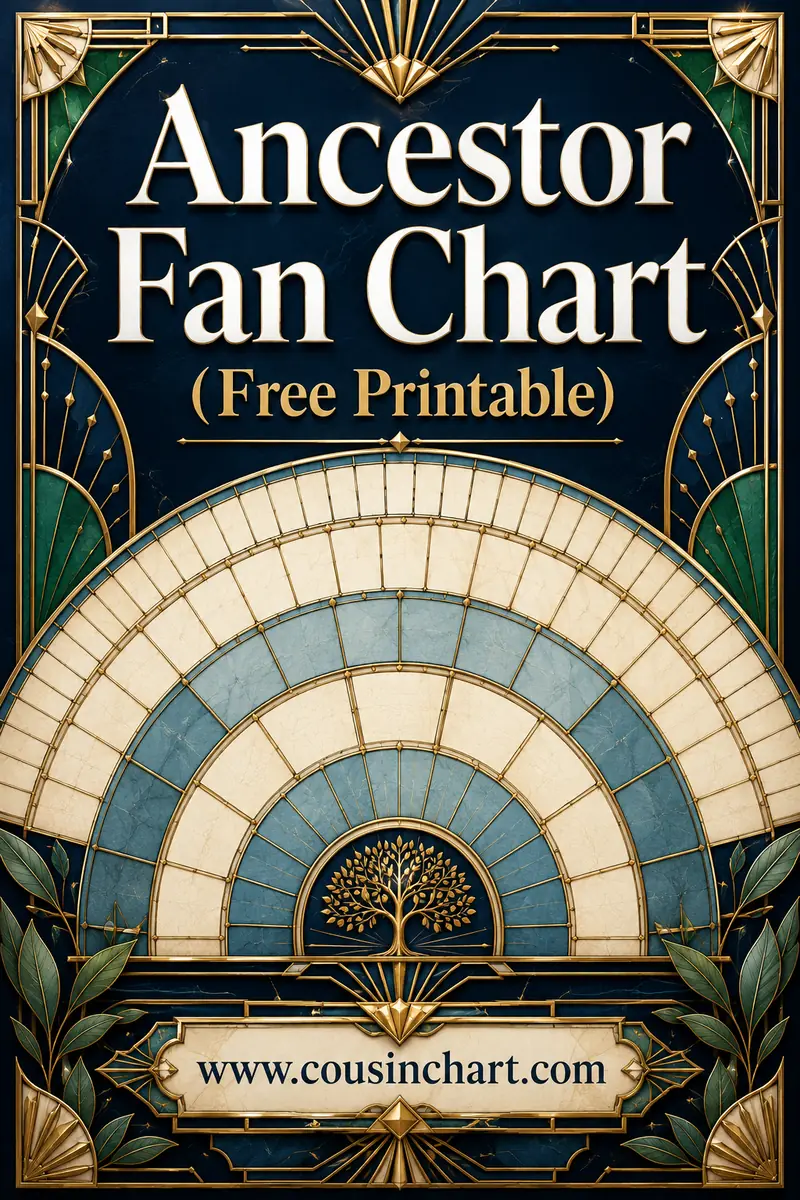
Fan chart: the pretty one
A fan chart is a pedigree chart bent into a semicircle — you at the center, each generation an arc. Same doubling math (a 5-generation fan holds 31 people; a 6-generation fan holds 63), but the radial layout uses space so efficiently that six generations fit on a page that a box chart couldn't manage.
Layout guidance: the outer arcs get narrow, so fans switch from full names to surnames-only past generation five. Portrait orientation for half-circle fans; full-circle fans (you in the middle, ancestors radiating 360°) want a square canvas. Print at 11×17" or larger if you plan to hand-write the wedges — Letter-size wedges beyond generation four are calligraphy-pen territory.
Fans are the display chart: the one that gets framed, gifted, and pinned to Pinterest boards endlessly. Details and a printable in our genealogy fan chart article.
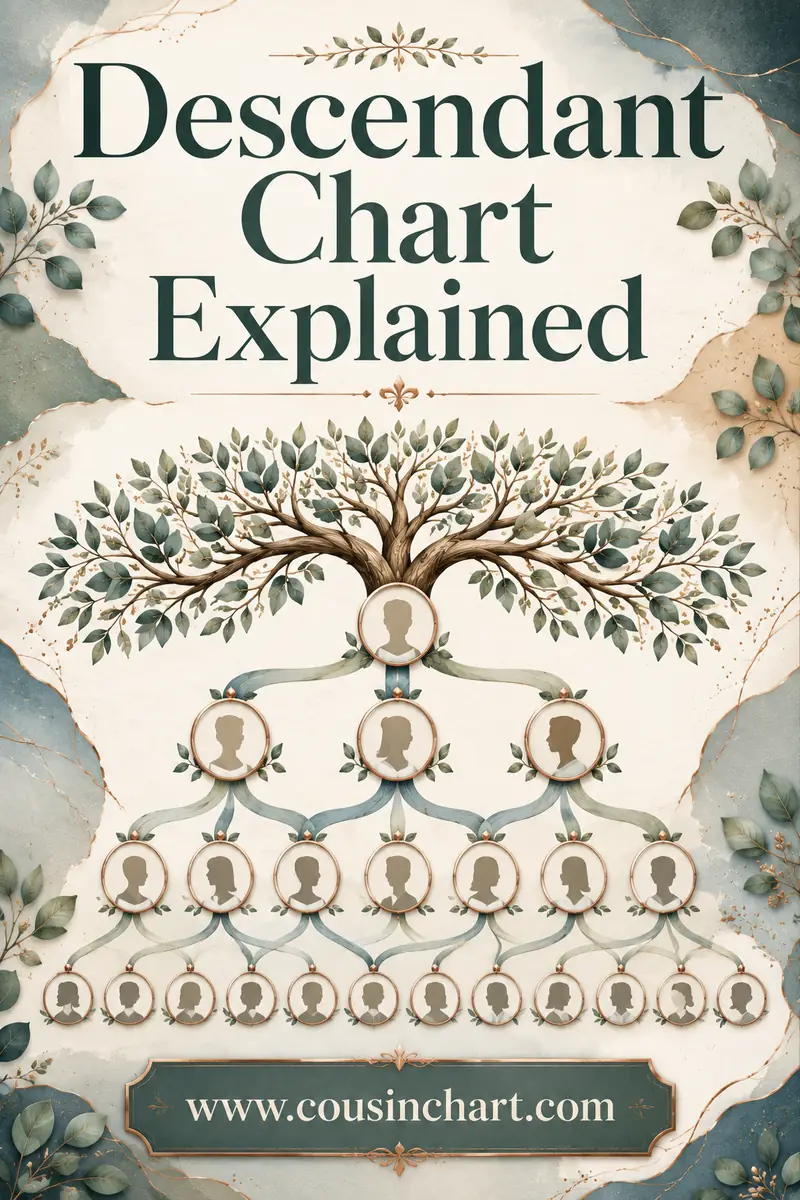
Descendant chart: the reunion chart
Flip the direction: start from one ancestor couple at the top and chart everyone descended from them — children, grandchildren, great-grandchildren, with spouses in attached boxes. This is the only standard chart where cousins appear, which makes it the family-reunion favorite: everyone at the picnic is on one page, and you can trace with a finger exactly how any two people connect.
Layout guidance: width is the enemy. Each generation multiplies unpredictably (one couple's four children might produce nineteen grandchildren), so descendant charts are built landscape and often taped together from multiple sheets. A practical home-printer approach: one page per child of the founding couple, each carrying that branch downward. Box math worth knowing: siblings share a horizontal line, spouses attach with an equals sign or double line, and each new generation drops one row.
Reading one is also the fastest way to learn cousin math — two people's rows tell you the relationship. Same row, shared grandparents on the chart? First cousins. One row apart? Once removed. Check yourself against the calculator as you go; it's how the penny drops. Template and walkthrough: descendant chart template.
Hourglass chart: both directions
An hourglass puts one person at the center — ancestors fanning up, descendants spreading down. It's the right chart for exactly one job: honoring a person. Grandma's 90th birthday poster, a memorial display, an anniversary gift showing everything that led to a couple and everything that came from them.
Layout guidance: portrait orientation, the center person at the vertical middle. Keep it to 3 generations up and 2–3 down or the page fights itself — that's still up to 30+ people on one sheet. Tabloid (11×17") is the comfortable minimum for hand-lettering.
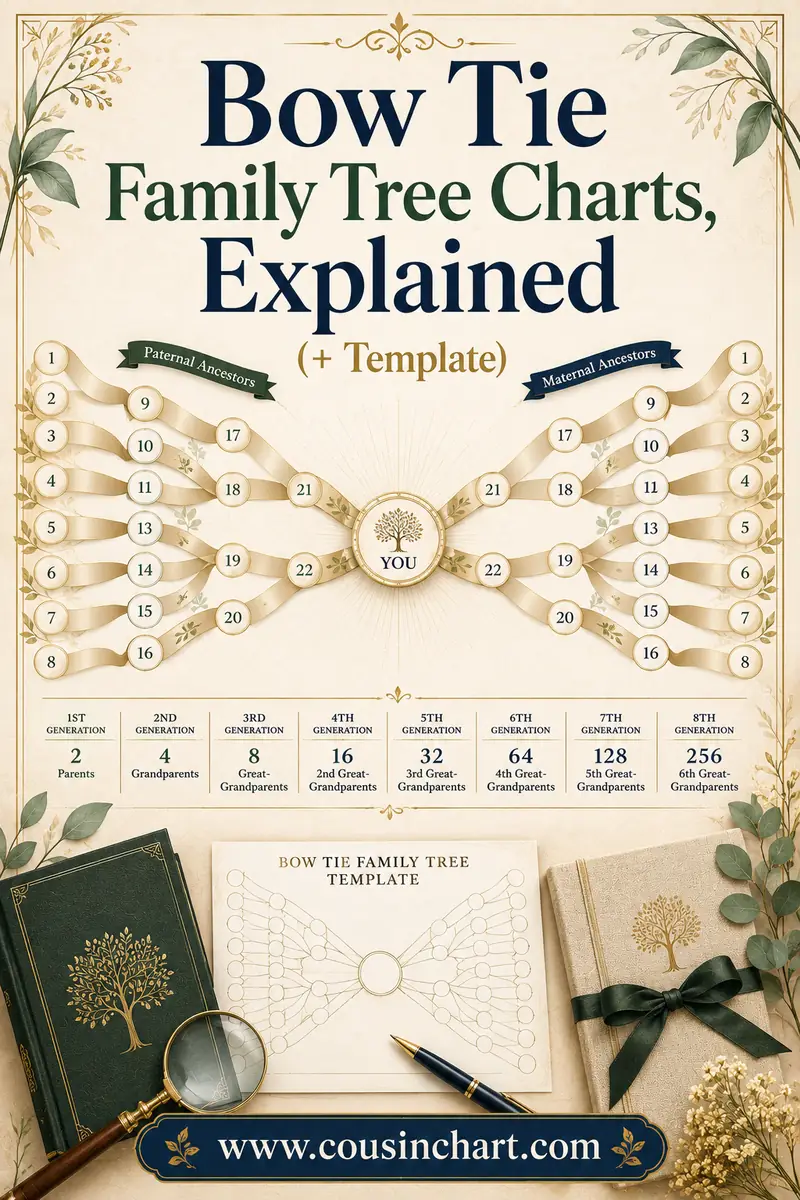
Bow tie chart: two families, one page
A bow tie chart puts you (or a couple) in the center with the father's ancestors extending left and the mother's extending right — like a bow tie's two wings. The content is identical to a pedigree chart; only the geometry changes. Its superpower is visual separation of the two family lines, which makes it the chart of choice for wedding displays (her tree meets his tree at the center) and for explaining "maternal side vs paternal side" to kids.
Layout guidance: landscape, always. Four generations per side fits Letter paper with 8 boxes at each outer edge. More on when it beats a standard pedigree: bow tie family tree chart.
Genogram: the chart with feelings
A genogram looks like a family tree drawn by a doctor — because it usually is. Squares for men, circles for women, marriage bars, and an extra vocabulary of symbols for divorce, twins, illness, and even relationship quality (conflict lines, closeness lines). Therapists and physicians use them to spot patterns across generations; genealogists borrow them for blended families that break normal charts.
Layout guidance: three generations is standard, portrait or landscape, biggest shapes for the youngest generation at the bottom. It's the one chart where relationship lines carry meaning, so a legend box is mandatory.
The seventh format: the family group sheet
One more format deserves a mention even though it isn't a chart at all. The family group sheet is a one-page form covering a single couple: husband, wife, marriage date and place, and a numbered list of every child with birth, marriage, and death details. No boxes, no branches — just fields.
Why bother? Because charts compress and sheets preserve. A pedigree chart gives great-grandpa one small box; his family group sheet records his wife's parents, all nine children, and the note that the third child died young — details no chart has room for. Serious researchers run both: charts as the map, one group sheet per couple as the file cabinet. If you fill a pedigree chart and find yourself scribbling in the margins, that's the sign you're ready for group sheets.
Matching chart to paper: a quick sizing guide
Every chart type has a paper size where it stops fighting you:
- Letter/A4 portrait — 3-generation trees, genograms, half-circle fans to 5 generations.
- Letter/A4 landscape — 4-generation pedigree and bow tie charts (8 boxes at the wide edge is the practical Letter limit).
- 11×17" (tabloid) — 5-generation pedigrees, hourglasses, small descendant charts. Most home projects that feel cramped on Letter are fixed by this one size, and any copy shop prints it for pocket change.
- 18×24" and up — 6-generation anything, reunion descendant charts, display fans. Poster printing turns a chart into furniture; use cardstock and matte finish.
The failure mode to avoid is squeezing: when boxes drop below about three-quarters of an inch wide, handwriting becomes initials, and initials become next decade's mystery. Go up a paper size before you go down a font size.
Three habits that make any chart readable
- One generation per row (or ring), no exceptions. Every chart type above works because vertical position means generation. The moment an aunt floats between rows, the chart starts lying.
- Standard name form everywhere. Surname in CAPITALS, women under maiden names, birth–death years beneath: "MARTINEZ, Elena (1931–2019)." Pick the format once; apply it to every box, wedge, and symbol.
- Date the chart itself. A small "compiled June 2026" in the corner turns every future discrepancy from a confusion into a chronology. Trees grow; dated snapshots show how.
Which chart should you print?
- Starting research? Pedigree, 4 generations, landscape.
- Making a gift or wall art? Fan chart, cardstock, pencil first.
- Family reunion coming? Descendant chart from the great-grandparents everyone shares.
- Honoring one person? Hourglass.
- Explaining the two sides to kids? Bow tie.
- Tracking medical history or a blended family? Genogram.
All the fill-in versions live in our free printable chart pack — print at 100% ("actual size") so the boxes keep their designed dimensions, and use pencil for anything older than your grandparents.
FAQ
What is the most common family tree chart type?
The pedigree (ancestor) chart — you at the left, parents, grandparents, and great-grandparents doubling to the right. A 4-generation pedigree holding 15 people on one landscape page is the standard first chart in genealogy.
Which family tree chart shows cousins?
The descendant chart. It starts from an ancestor couple and charts every descendant, so cousins, aunts, and uncles all appear. Pedigree and fan charts show only your direct ancestors — no cousins anywhere.
What's the difference between a pedigree chart and a fan chart?
Content is identical — your direct ancestors — but a pedigree chart uses rows of boxes while a fan chart arranges the same people in concentric arcs around you. Fans fit more generations per page and look better framed; boxes are easier to write in.
How many generations fit on one page?
Boxes: four generations (15 people) on Letter/A4 landscape comfortably, five (31) if the boxes shrink. Fans: five to six generations on the same paper because arcs use space efficiently. Beyond that, chain numbered sheets or print poster-size.
What chart works best for blended families?
A genogram. Its symbol system handles divorce, remarriage, half-siblings and step-relationships explicitly, where rigid pedigree layouts have no place to put a second marriage. For a display-friendly compromise, a descendant chart with dashed lines for step-links also works.
Do I need software to make these charts?
Not for four or five generations — printable fill-in PDFs handle that beautifully. Software earns its keep past about 50 people, when hand-drawn descendant charts stop fitting on tape-able paper.
Print the right chart the first time
Grab the layout that matches your job from the free CousinChart printable pack — pedigree for the research binder, fan for the wall, descendant for the reunion table. Then keep the free relationship calculator open while you fill it in: the chart shows where everyone sits, and the calculator settles what to call them, from plain first cousins to the second-cousin-once-removed at the far edge of the page.