Descendant Chart Template (Free Printable)
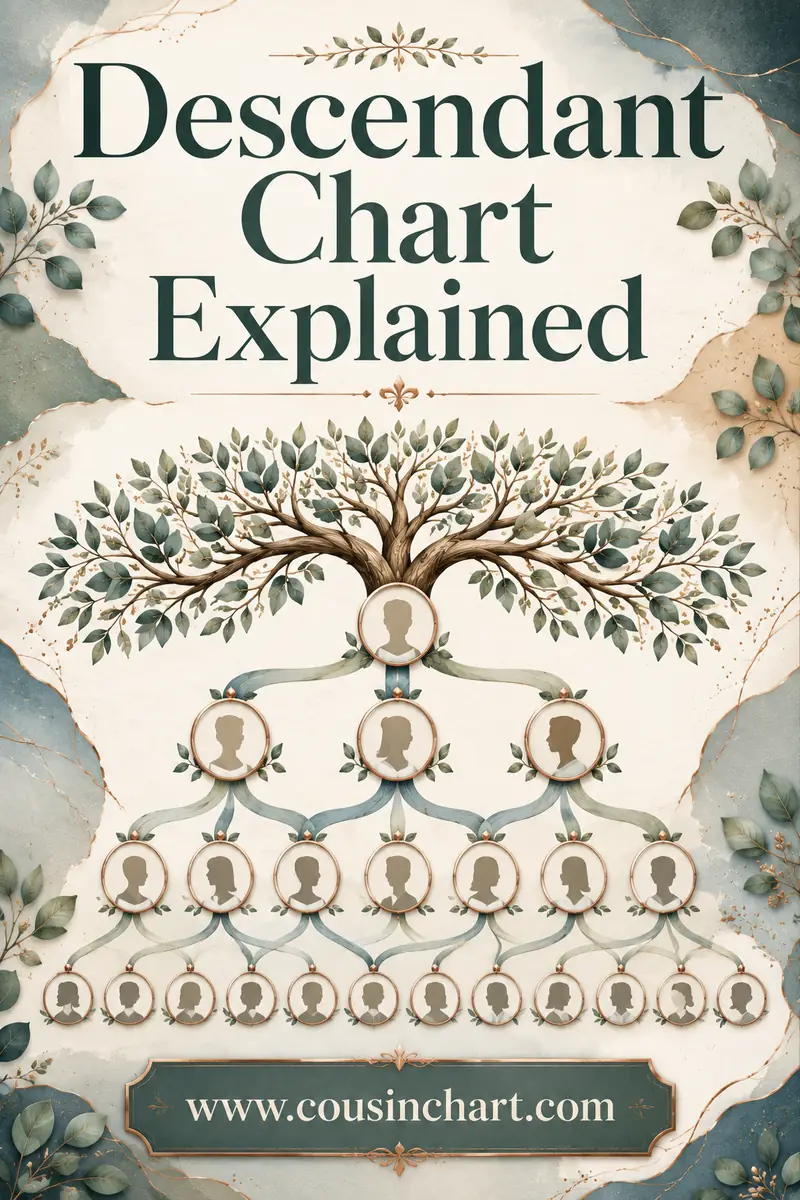
A descendant chart is the family tree drawn in the direction families actually grow: one ancestral couple at the top, their children in a row beneath, then grandchildren, then great-grandchildren — everyone who descends from that couple, spouses included. It's the opposite of a pedigree chart, which climbs backward from one person; a descendant chart pours forward from one couple, and it's the only standard chart where cousins actually appear together on the same page.
Here's how the layout works, why blank descendant templates behave differently from ancestor templates, the drawing conventions that keep big families legible, and the print settings for each size. A blank descendant chart ships in the free CousinChart printable pack — and since this is the chart where two people can point at their own boxes and ask "so what are we?", keep the free relationship calculator open while you fill it.
Free printables for this page
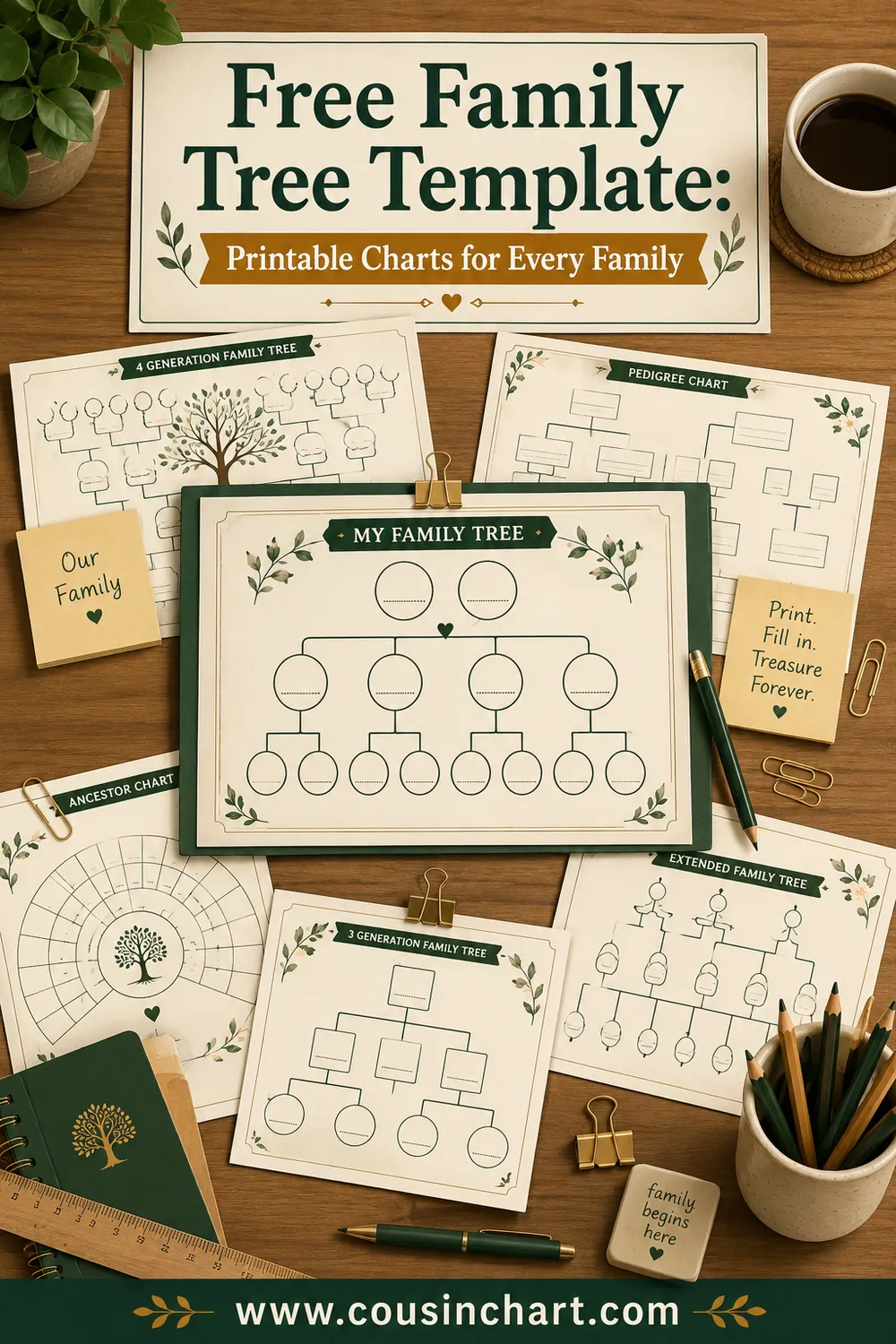
Download a blank PDF (US Letter or A4) — free, no sign-up — or customize it in the maker above before printing.
 Descendant Chart
 Family Group Sheet
 Family Tree With Siblings
Relationship quick-check: tap a phrase to see who they are — all of them share a descendant chart with you.
Tap a phrase above to see the answer.
Work out any family relationship →How the layout works
The standard format is the drop-line chart. The founding couple shares the top box (or two joined boxes). A vertical line drops to a horizontal rail; their children hang from that rail in birth order, oldest on the left. Each child who married gets a spouse box beside them, and their own drop-line to their own children's rail. Repeat until you reach the present day — or the edge of the paper, whichever comes first.
Reading it is instinctive because generations align: everyone in a horizontal row is the same number of steps from the founders — a rule worth protecting even when it costs layout space, because it's what lets relatives find themselves on the wall without instructions. And that alignment is the quiet superpower. On a descendant chart, cousin relationships become geometry: people in the same row who branch apart at the top couple are cousins, and the row where their branches split tells you which kind. Split at the children's rail: first cousins' descendants. Same row, branches splitting one rail further back: add a cousin degree. Different rows: that's a "removed," one per row of difference.
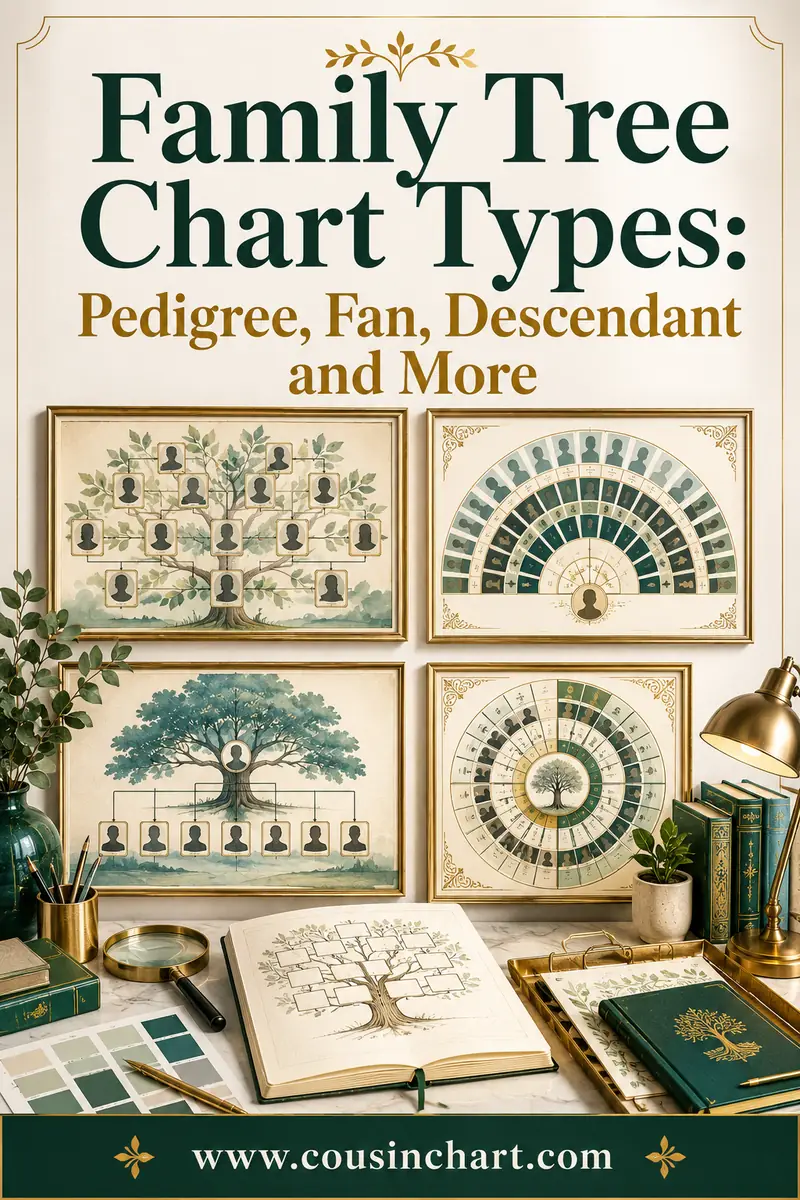
If you're wondering where the descendant chart sits among the other standard forms, here's the family of charts side by side:
| Chart | Direction | Best use |
|---|---|---|
| Descendant chart | One couple downward to everyone descended from them | Reunions and wall displays — the only chart where cousins share a page |
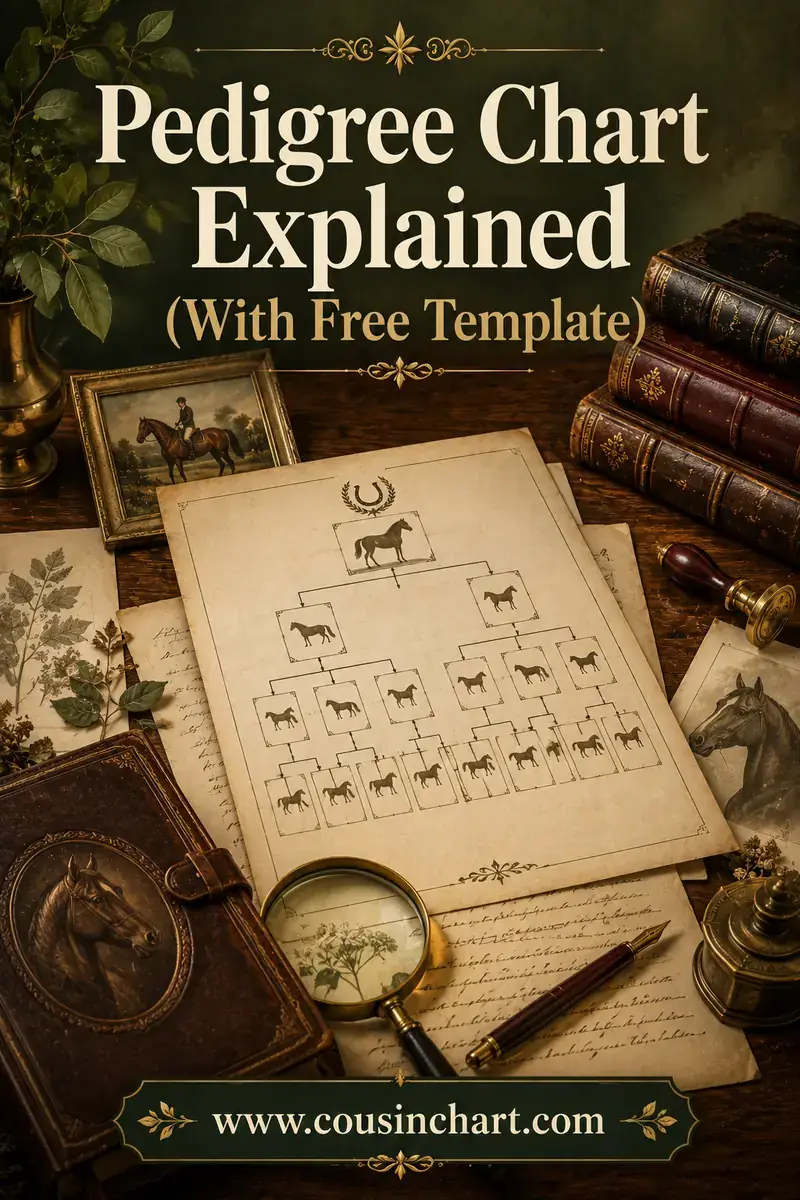
| Pedigree chart | One person upward through direct ancestors only | The research backbone; predictable 2-4-8-16 box counts |
| Fan chart | Ancestors, radiating outward in a half-circle | Compact display; spotting empty branches to research next |
| Family group sheet | One couple and their children, as a flat form | The detail record behind every box on the other three |
Why descendant templates can't promise box counts
An ancestor chart is perfectly predictable — everyone has exactly two biological parents, so a 4-generation template always holds 15 boxes. Descendants refuse to cooperate: one couple's three children might produce two grandchildren or nineteen. So a descendant chart template is really a framework — a top box, pre-ruled rails, and generous blank space — rather than a fixed grid.
The free pack's template handles this with a three-generation frame on landscape Letter/A4: founders at top, a rail sized for up to six children with spouses, and a third row with flexible space for around fifteen grandchildren. That fits most single-family trees. When one branch outgrows its slot, the convention is a tidy "continues on sheet 2" note and a fresh template for that child's family — exactly like cascading pedigree pages, but running downhill.
For truly prolific families — the couple with nine children and sixty grandchildren — no Letter-size layout survives contact. Jump to poster sizes and the strategies in our large family tree template guide.
Drawing conventions worth keeping
Decades of hand-drawn charts settled on marks that keep a crowded page readable:
- Birth order flows left to right. Oldest child leftmost, always. Break this and every reader's instincts break with it.
- Spouses get an equals sign or double line: "Elena Cruz = Marco Reyes." A second marriage gets a second equals sign, numbered: =1, =2.
- Vertical lines mean descent; horizontal rails mean siblings. Never let a descent line touch a spouse box — descent comes from the couple's joint line.
- Dashed drop-lines for adoptive or step connections, solid for biological — noted in a small key at the chart's corner.
- Years under names, "1912–1988" style, rather than full dates. Descendant charts trade per-person detail for headcount; full dates live on the family group sheets.
- Daughters keep their birth surname in their own box; the married surname shows up in the spouse's box beside them.
Numbering systems, briefly
Genealogists number descendant charts too, though no single scheme won the way ahnentafel numbering did for ancestors. The two you'll meet: d'Aboville, where the founder is 1, children are 1.1, 1.2, 1.3, and grandchildren stack another dot (1.2.4 = fourth child of the second child); and Henry numbering, the same idea without dots (124). Both make a box's ancestry readable straight from its number — 1.2.4's parent is necessarily 1.2. For a reunion wall chart you can skip numbering entirely; for a multi-sheet research set, d'Aboville numbers are what keep sheet 7 connectable to sheet 2. (Where descendant charts sit among all the other layouts — pedigree, fan, bow tie, hourglass — is covered in family tree chart types.)
The text version: descendant outlines
When a family outgrows boxes entirely, descendant data moves into an indented outline — the format published family histories use. The founder sits at the left margin; each generation indents one step; children list in birth order under their parent with their own descendants nested beneath them, like a table of contents for a family:
1. Emilio Reyes (1878–1940) = Corazon Diaz — 1.1 Ramon Reyes (1901–1977) = Luz Santos —— 1.1.1 Teodoro Reyes (1925–2001) —— 1.1.2 Maria Reyes (1928– ) = Carlos Tan — 1.2 Felipa Reyes (1904–1990) = Andres Cruz
An outline holds unlimited people on ordinary pages — the sixty-grandchild family that breaks every drawn chart is just sixty lines here — and it pairs naturally with d'Aboville numbers, which are the indentation written as digits. The trade-off is the reverse of the drawn chart's: outlines store everything and show nothing; nobody gasps at an indented list taped to the reunion wall. The working combination is outline as the master record, drawn chart as the display generated from it — the same list-plus-chart pairing ancestor research uses with ahnentafels and pedigree charts. The free pack includes a ruled outline form alongside the drawn template for exactly this division of labor.
The reunion chart, done right
Descendant charts are the reunion format — the one chart where every attendee has a box. The proven recipe:
- Pick founders two or three generations up — usually the reunion's honored grandparents or great-grandparents. Founders four generations up produce charts wider than the pavilion.
- Print big and laminate: 24×36" from a copy shop, laminated, hung by the food table with a wet-erase marker on a string.
- Pre-fill what you know; let the family finish it. Empty grandchild boxes get filled by their owners, spellings get corrected loudly, and at least one branch nobody had records for walks up and completes itself. This is the highest-yield genealogy event that exists.
- Photograph the chart before teardown. The marked-up laminate is the data. Transcribe corrections onto fresh sheets or into software within the week.
And station the chart next to a phone with the free CousinChart calculator open, because the chart triggers the question nonstop: two people find their boxes, count rows, and still want confirmation that "same row, branches split at the top couple" really does make them second cousins. (It does.)
Printing settings
- Landscape, always. Descendant charts grow sideways; portrait printing wastes the dimension they need most.
- 100% scale on the template pages — the name boxes are sized for two written lines and shrink badly.
- 11×17" is the sweet spot for three full generations of an average family; Letter works for a starter chart of two generations plus a partial third.
- Poster sizes at a copy shop for anything with more than about 40 living descendants — engineering prints make 24×36" drafts cheap enough to reprint after every correction round.
- Cardstock for the fair copy, standard paper for working drafts that will be scribbled on and superseded.
FAQ
What is a descendant chart?
A family tree that starts with one ancestral couple at the top and shows everyone descended from them — children, grandchildren, and beyond, with spouses — arranged in generation rows. It's the reverse of a pedigree chart, which shows one person's ancestors only.
What's the difference between a descendant chart and a family tree?
"Family tree" casually means any family diagram, but the classic tree people picture — a couple at the top, family spreading below — is a descendant chart. Pedigree charts, fan charts, and bow tie charts are ancestor-direction layouts.
How many generations fit on a printable descendant chart?
Three generations of a typical family fit on landscape 11×17"; two and a half fit on Letter. Beyond that, either continue individual branches on fresh sheets or print poster-size — descendant charts widen unpredictably because family sizes vary.
Do spouses and cousins appear on a descendant chart?
Yes — that's its distinguishing feature. Spouses appear beside each married descendant, and cousins appear naturally because every branch of the founding couple's line is drawn. It's the only standard chart where you and your second cousin both have boxes.
How are descendant charts numbered?
Most commonly with d'Aboville numbers: the founder is 1, children are 1.1, 1.2, 1.3, and each further generation adds a segment (1.2.4 = fourth child of 1.2). Henry numbering does the same without dots. Numbering matters mainly for multi-sheet research charts.
Print the template and start at the top
Pick the couple everyone at your next gathering descends from, put their names in the top box of the free CousinChart descendant template, and rail out their children from memory — the chart fills itself from there, one relative's corrections at a time. When two boxes want to know what they are to each other, the free relationship calculator settles it faster than counting rails.