Genealogy Fan Charts: Templates and How to Fill One In
A genealogy fan chart puts you at the center of a set of arcs, with each ring outward holding one generation of ancestors — 2 parents in the first ring, 4 grandparents in the next, doubling ring by ring. It shows exactly the same people as a rectangular pedigree chart, but the circular layout fits more generations on one page and turns your research into something people actually frame.
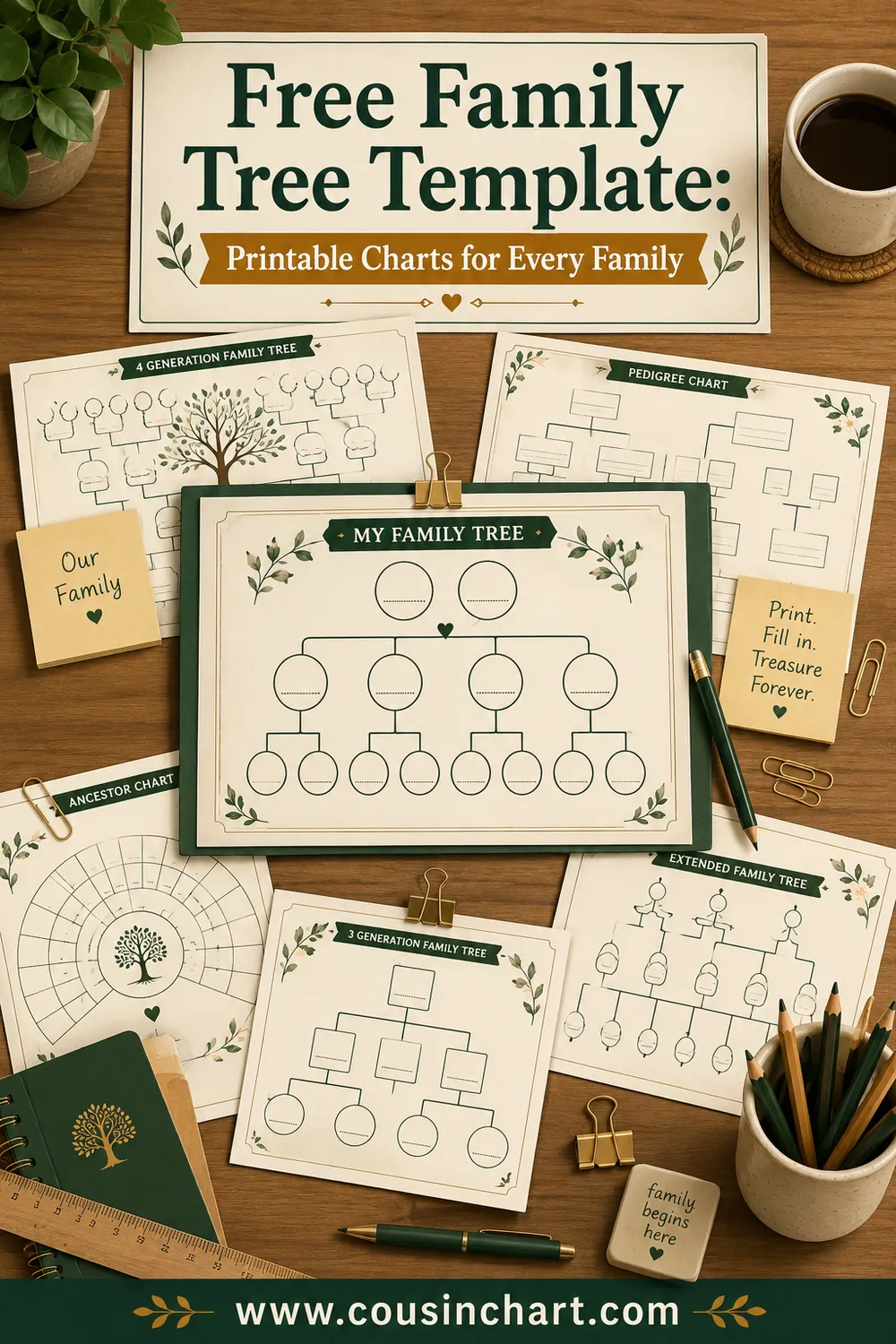
This guide covers the three fan shapes (quarter, half, full circle), how many generations each printable size can hold before the wedges get unwritable, the filling technique for curved boxes, and print settings. Blank fan charts are part of the free CousinChart printable pack — and for every relative the fan can't show (it's ancestors-only, so cousins are invisible), the free relationship calculator fills the gap.
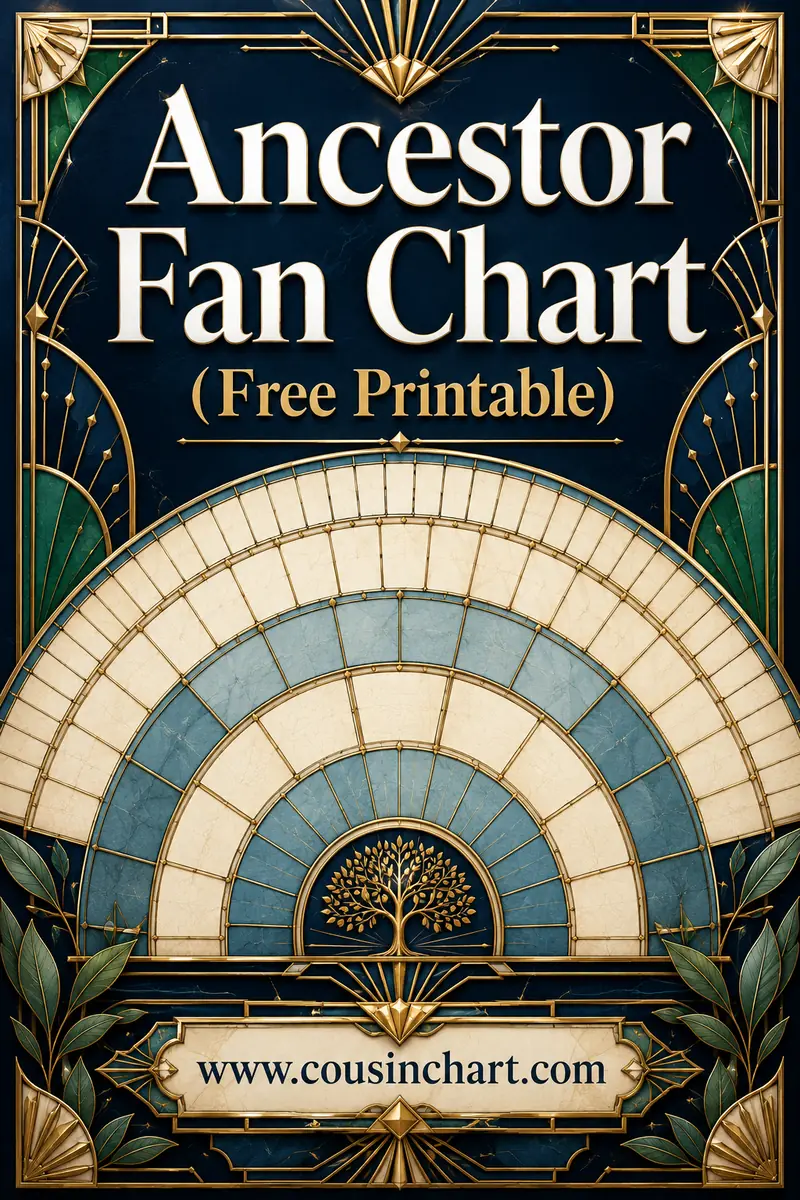
Free printables for this page
Download a blank PDF (US Letter or A4) — free, no sign-up — or customize it in the maker above before printing.
 Numbered Fan Chart (5 Generations)
 Blank Fan Chart (5 Generations)
 Numbered Fan Chart + Name ListFan as a page header, numbered lines 1–31 below for details.
 6-Generation Fan Chart
 7-Generation Fan Chart (Poster)127 wedges, sized for 11×17 tabloid; also prints on Letter.
Relationship quick-check: tap a phrase to see who they are — and which ring of the fan they sit in.
Tap a phrase above to see the answer.
Work out any family relationship →How a fan chart works
Count yourself as generation 1 at the center. Each ring outward is one generation, and each wedge splits into two in the next ring — father on one side, mother on the other. Most templates put the paternal half on the left and the maternal half on the right, so a single glance separates "dad's people" from "mom's people."
The circular geometry is the whole trick. On a rectangular chart, every generation gets the same amount of page height, so the 32-person generation is squeezed into the same space as the 2-person one. On a fan, each ring is longer than the last — the chart grows exactly where the ancestor count grows. That's why a fan fits six generations on paper that holds a rectangular chart only four.
Quarter, half, or full circle?
- Half circle (180°) — the standard. You at the bottom center, ancestors arcing overhead. Best balance of wedge width and page use; this is the shape in the free pack and the shape you see framed.
- Full circle (360°) — you at the dead center, ancestors radiating all around. Striking as wall art and the most compact use of a square poster, but the innermost wedges get tight, and there's no obvious "top," which bothers some readers.
- Quarter circle (90°) — one grandparent's line only, or a design choice for narrow frames. Wedges stay wide and writable the deepest; the trade-off is showing a quarter of your ancestry per chart.
Generations per size: the writability table
The limiting factor is the outer ring's wedge width — the arc has to hold a name written along it. Here's what stays hand-writable:
| Fan size | Generations | Total ancestor slots | Outer ring holds |
|---|---|---|---|
| Letter/A4, half circle | 5 | 31 | 16 great-great-grandparents |
| 11×17", half circle | 6 | 63 | 32 3rd-great-grandparents |
| 18×24" poster | 7 | 127 | 64 4th-great-grandparents |
| 24×36" poster | 8–9 | 255–511 | 128–256 wedges, surname-only |
| 36×36" full circle | 10+ | 1,023+ | Surnames or color-coding only |
The slot math is the ancestor doubling: ring n holds 2 to the power n minus 1 people, and a fan of g generations shows 2 to the g, minus 1, people including you. Past ring 7 or so, wedges stop fitting full names — big display fans handle this by design, printing only surnames in the outer rings or shading wedges by research status.
Filling technique for curved boxes
Writing along an arc is the part nobody warns you about. What works:
- Rotate the paper, not your wrist. Turn the chart so each wedge you're writing sits horizontal in front of you. Framed calligraphers do it; you can too.
- Pencil guidelines first. A light line along each arc keeps names from drifting toward the wedge's edge.
- Name on the outer curve, dates on the inner. Convention is name along the wedge's wider outer edge, birth–death years tucked beneath: "1874–1931" fits where "b. 12 Mar 1874, d. 2 Nov 1931" doesn't.
- Maiden names, always. Same rule as every ancestor chart — women appear under their birth names, or their lines dead-end.
- Fine-tip pens (0.4mm or finer) for rings 4+. A medium ballpoint fills a ring-5 wedge with two words. Fine liners fit four.
- Fill inside-out. Rings 1–3 are memory; ring 4 is the phone call; rings 5+ are research. The fan wears its progress visibly, which is half its charm.
Why fans became the genealogy status symbol
Three honest reasons. First, empty wedges look intentional — a half-researched rectangular chart looks abandoned, but a fan filled through ring 4 with a few ring-5 spikes reads as "research in progress," and photographs beautifully at every stage. Second, the shape flatters walls: half circles fit over beds and desks the way rectangles don't. Third, gaps become visible strategy — one look shows which quarter of your ancestry is thin, which is why researchers keep a working fan even when their real data lives in software. The Pinterest genealogy scene runs heavily on filled-in fan photos, and a hand-lettered fan on cream cardstock is the cheapest heirloom-looking gift the hobby produces.
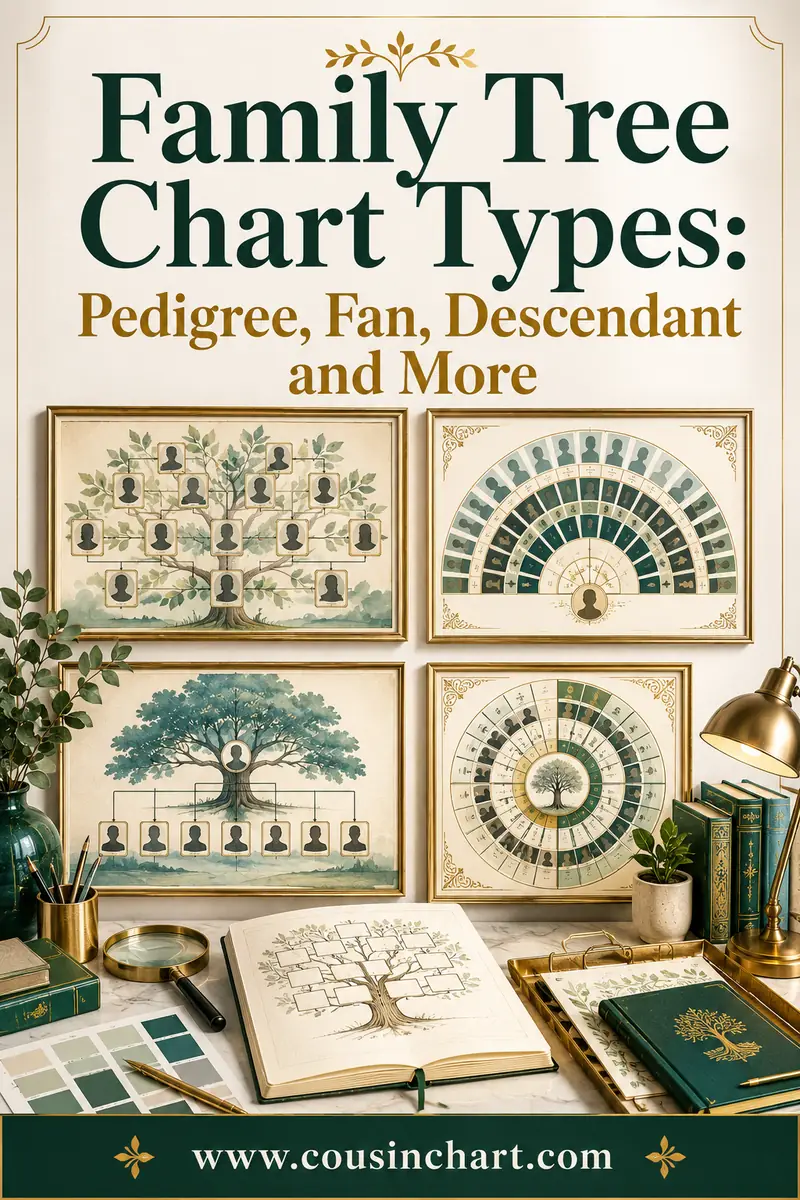
For how the fan compares against pedigree, descendant, bow tie, and hourglass layouts — and when each wins — see the full family tree chart types rundown.
Fan chart variants worth knowing
Once the basic half-circle is familiar, three variants earn their popularity:
- The color-coded research fan. Instead of (or alongside) names, each wedge gets shaded by status: green for documented, yellow for "named but unverified," red for brick wall, white for untouched. The result is a one-glance map of an entire research project — this is the fan serious genealogists pin over their desks, and it's become the standard way DNA researchers visualize which ancestral lines their matches confirm.
- The four-color grandparent fan. Tint every wedge by which of your four grandparents it descends from — four pastel quadrants radiating outward. Instantly answers "which side is that from?" for every ancestor on the chart, and it's the most kid-legible version of deep ancestry ever devised: one grandparent, one color, follow it to the rim.
- The photo fan. Inner rings (1–3) get small portrait photos in the wedges, outer rings stay text. Only works at poster size — faces need at least an inch — but as a grandparent's milestone-birthday gift it has no rival. Print the base fan, glue or digitally place the photos, frame.
There's also a naming decision hiding in every fan: text direction. Cheaper templates print all names horizontally, which wastes wedge space and collides in the outer rings; well-designed fans run names along the arc (curved with the ring) or radially (reading outward like spokes). Radial text fits the most characters in a narrow wedge — it's why 8-generation fans are readable at all — but half the names print upside-down-ish unless the design mirrors them at the vertical centerline. The pack's fans use arc text through ring 5 and radial beyond, which is the convention most researchers find easiest to read without rotating the frame off the wall.
Printing your fan chart
- Actual size, 100% scale. Fit-to-page shrinks wedge heights that are already tight in the outer rings.
- High quality, not normal. Fans are fine curved lines; normal mode prints ring boundaries faintly, and they vanish under handwriting.
- Portrait for half circles on Letter/A4 — the flat edge sits at the bottom.
- Cardstock (65 lb+) for keepers. Fans get framed more than any other chart; print the fair copy on cardstock from the start and skip the re-copying step.
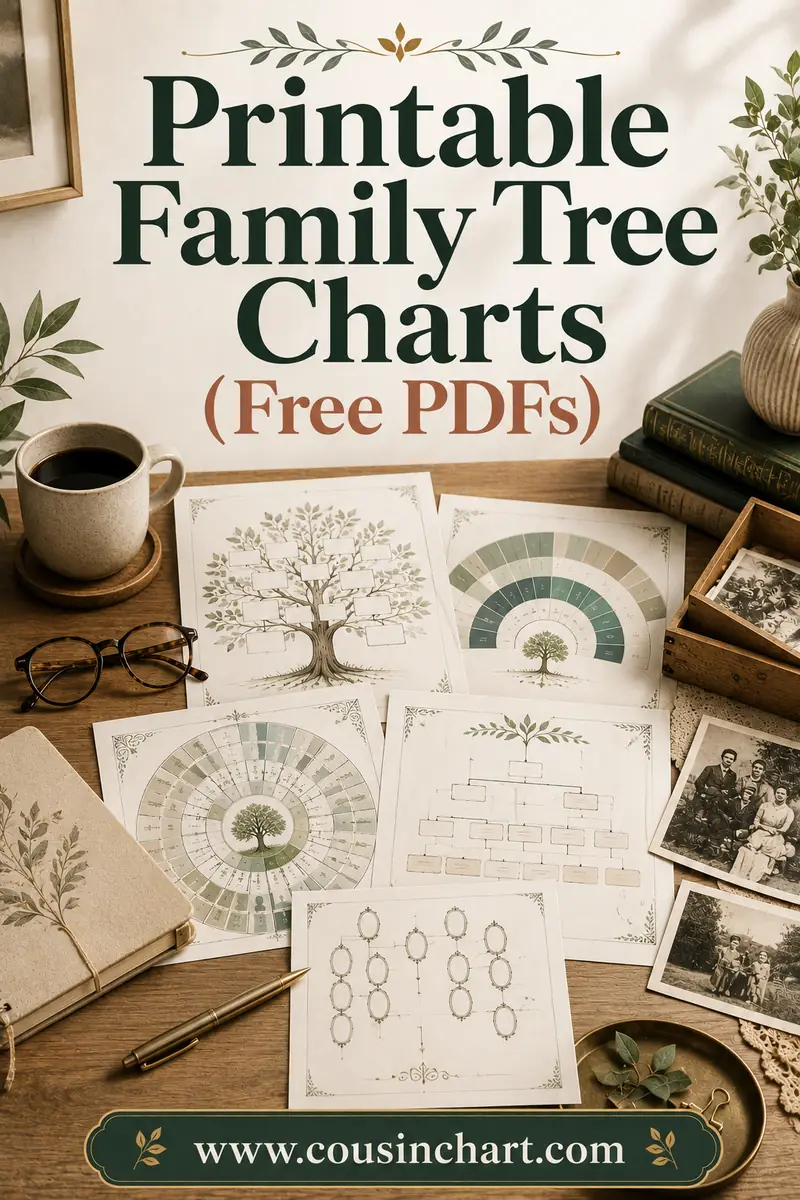
- Copy-shop enlargement is cheap. The same PDF prints at 18×24" at a copy shop, which turns ring 5 from fine-liner territory into comfortable handwriting. The whole printable chart lineup enlarges the same way.
FAQ
What is a genealogy fan chart?
An ancestor chart drawn as concentric arcs: you at the center, parents in the first ring, grandparents in the second, each ring outward holding one generation. It shows the same direct-ancestor data as a pedigree chart in a more compact, display-friendly circular layout.
How many generations fit on a printable fan chart?
On home paper, 5 generations (31 ancestors) stays comfortably writable; 6 generations works at 11×17 inches. Poster sizes handle 7–9 generations, and beyond that the outer wedges only fit surnames.
Are fan charts better than pedigree charts?
They hold the same information. Fans fit more generations per page and look better displayed; rectangular pedigree charts are easier to write in, easier to chain into multi-page research binders, and standard at archives. Many researchers keep both — pedigree pages for work, a fan for the wall.
How do I write names along the curved lines?
Rotate the paper so the wedge you're filling sits horizontal, pencil a light guideline along the arc, write the name on the outer curve with years beneath, and use a fine-tip pen for the outer rings. Fill from the center outward.
Do cousins appear on a fan chart?
No — fan charts show direct ancestors only. Your cousins share ancestors with you (their grandparents occupy some of the same wedges), but the cousins themselves never appear. Use a cousin chart or relationship calculator for those connections.
Print one and start at the center
A fan chart starts with the easiest genealogy there is: your own name in the middle wedge. Grab the blank fan from the free CousinChart printable pack, fill rings 1–3 from memory tonight, and let the empty outer arcs do what they do best — quietly nag you into one more phone call, one more record search. And when a name in ring 4 leads you to a living stranger who shares it, the free CousinChart calculator will tell you precisely what the two of you are.