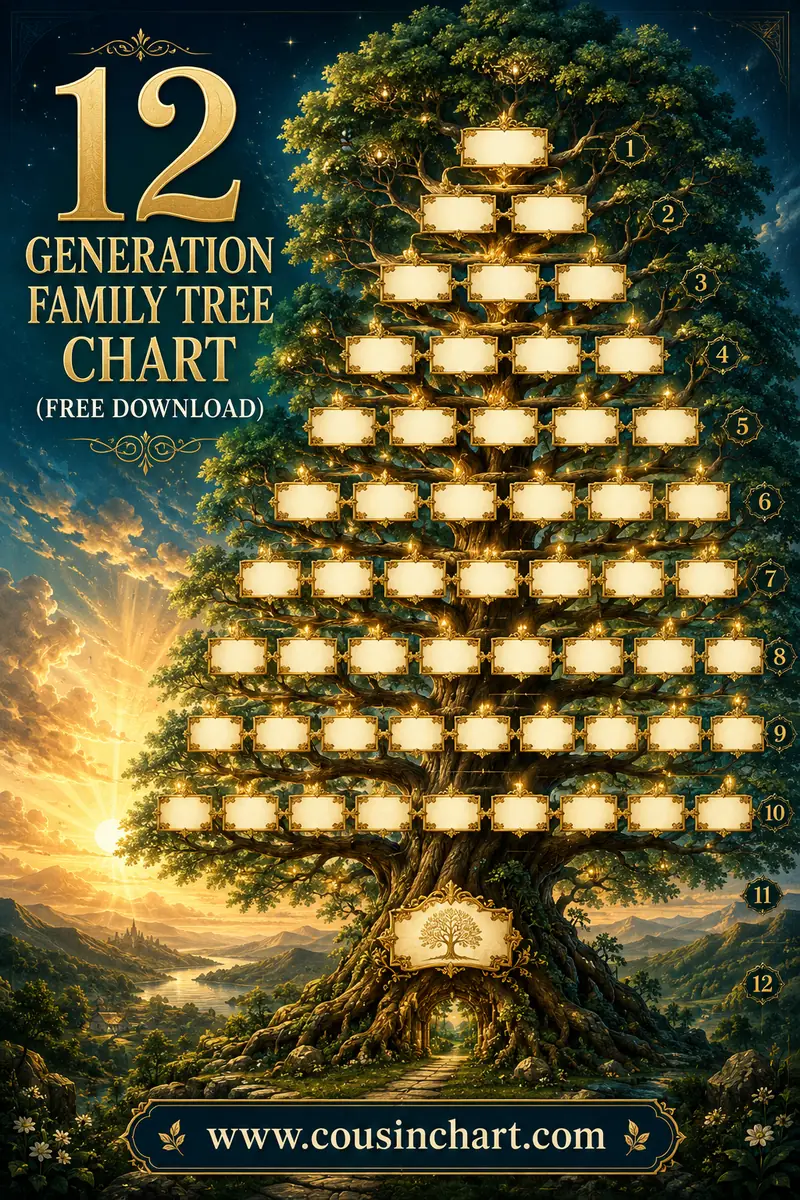
12 Generation Family Tree Chart (Free Download)
A 12 generation family tree chart holds you plus 4,094 ancestor slots — 2,048 of them in the top row alone — which is why nobody prints one on a single sheet of Letter paper with readable boxes. The formats that actually work are a large-format poster, a circular fan chart, or a cascading set of standard pedigree pages, and the free CousinChart printable pack gives you the building blocks for all three.
This guide covers the honest math, the three layouts, the print sizes each one needs, and a filling strategy that won't burn you out by generation six. And whenever a name on the chart raises the inevitable "wait, what is my 5th-great-grandmother's other descendant to me?" question, the free relationship calculator answers it in a couple of taps.
Free printables for this page
Download a blank PDF (US Letter or A4) — free, no sign-up — or customize it in the maker above before printing.
 7-Generation Fan Chart (Poster)127 wedges, sized for 11×17 tabloid; also prints on Letter.
 6-Generation Fan Chart
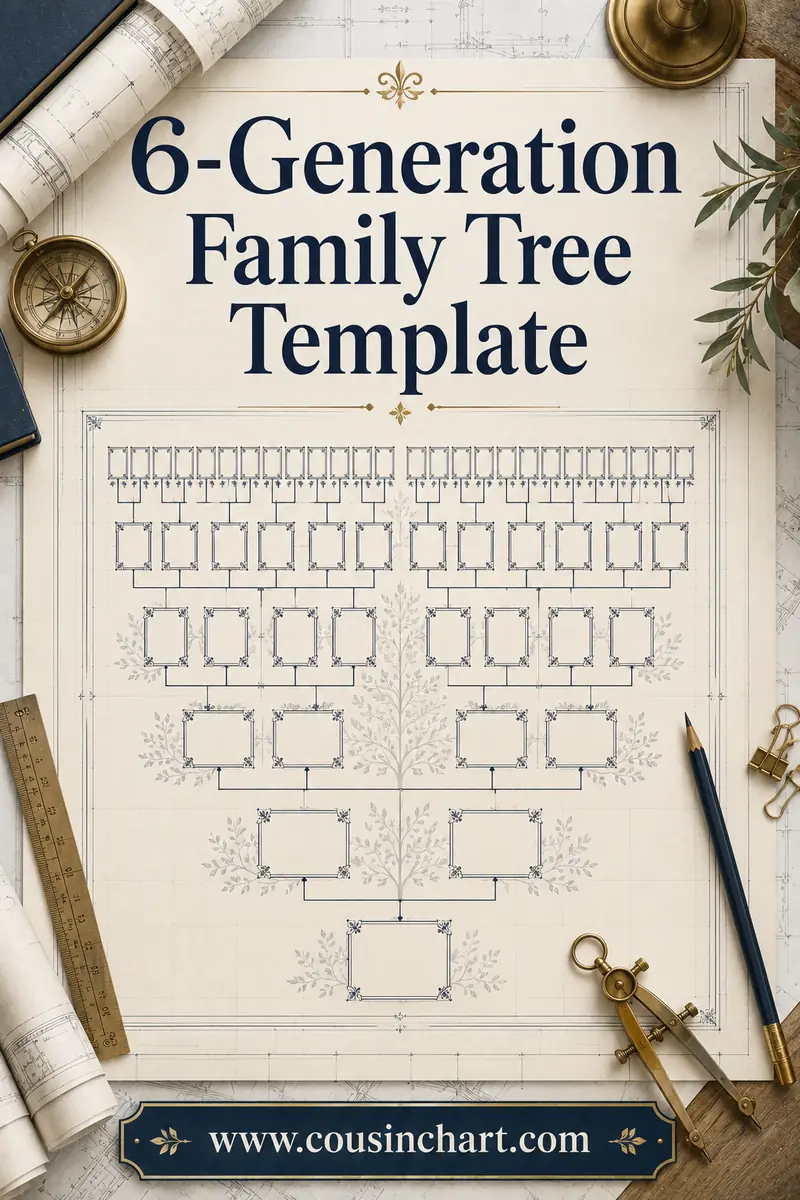
 6-Generation Pedigree Chart63 ancestors on one portrait page; names-only outer column.
 Pedigree Continuation Sheet
 Ahnentafel Ancestor List
Relationship quick-check: tap a phrase to see who they are — and where they'd sit on a 12-generation chart.
Tap a phrase above to see the answer.
Work out any family relationship →The math: what 12 generations actually holds
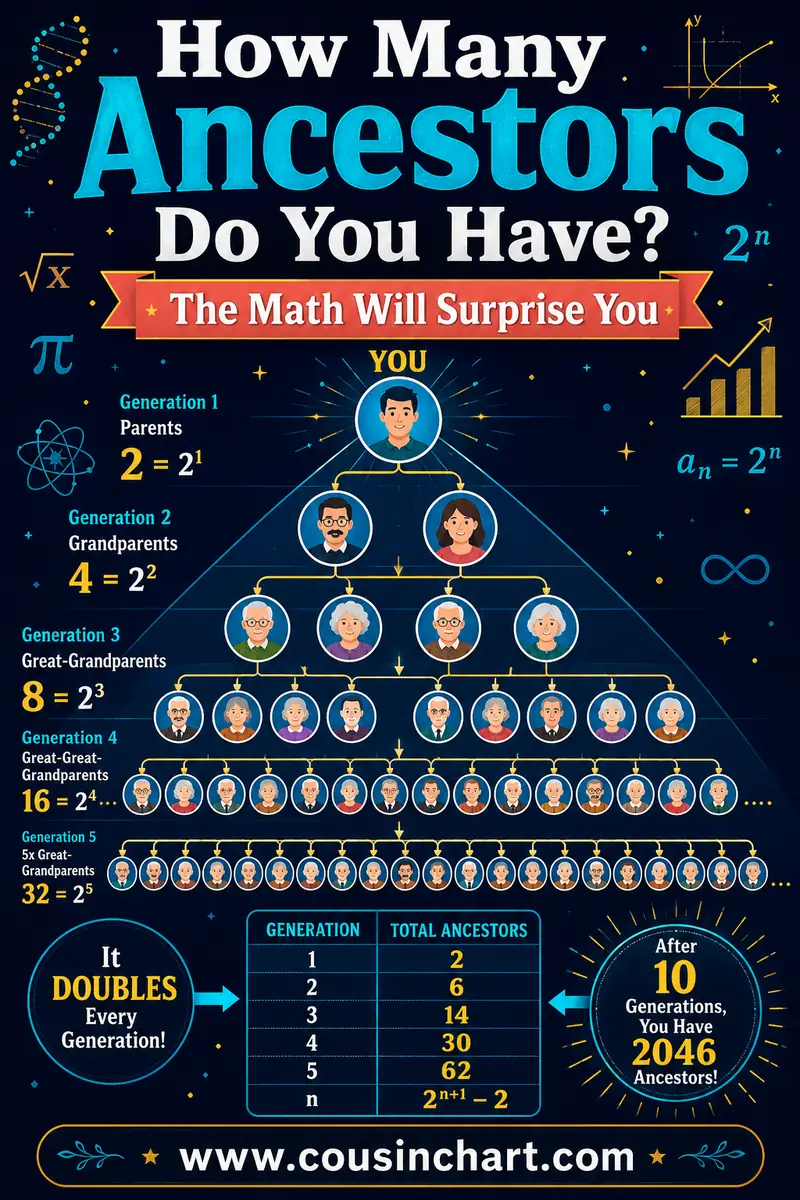
Every generation back doubles. Counting yourself as generation 1, here's the full ladder:
| Generation | Who they are to you | Slots in that row |
|---|---|---|
| 1 | You | 1 |
| 2 | Parents | 2 |
| 3 | Grandparents | 4 |
| 4 | Great-grandparents | 8 |
| 5 | Great-great-grandparents | 16 |
| 6 | 3rd-great-grandparents | 32 |
| 7 | 4th-great-grandparents | 64 |
| 8 | 5th-great-grandparents | 128 |
| 9 | 6th-great-grandparents | 256 |
| 10 | 7th-great-grandparents | 512 |
| 11 | 8th-great-grandparents | 1,024 |
| 12 | 9th-great-grandparents | 2,048 |
Add the rows and you get 4,095 slots including yourself — 4,094 ancestors. At a typical 25–30 years per generation, the top row was born roughly 275 to 330 years before you, which for most adults today means the late 1600s or early 1700s. That's colonial America, pre-Famine Ireland, the tail end of the Qing dynasty's first century — genuinely deep history, hanging off your own name. (If the doubling math delights you, our how many ancestors do you have article follows it all the way to the absurd conclusion — and explains pedigree collapse, the reason the real number is smaller.)
Why one normal page can't hold it
Quick reality check: 2,048 boxes in a single column, at even a quarter-inch per box with no gaps, needs a sheet over 42 feet tall. Shrink the boxes until the chart fits on Letter paper and each ancestor gets a space smaller than this letter "o." That's not a chart, it's a texture.
So a real 12 generation family tree chart takes one of three shapes.
Format 1: the large-format poster
A drop-line or box chart printed at 24×36 inches or larger. This is the "reunion wall" format — the first seven or eight generations get writable boxes, and the outer generations compress into narrow slots meant for surnames only. Print shops handle 24×36 engineering prints cheaply (often a few dollars in black and white), and the visual impact is unbeatable: one glance tells every relative in the room exactly how big "12 generations" really is.
Format 2: the circular fan chart
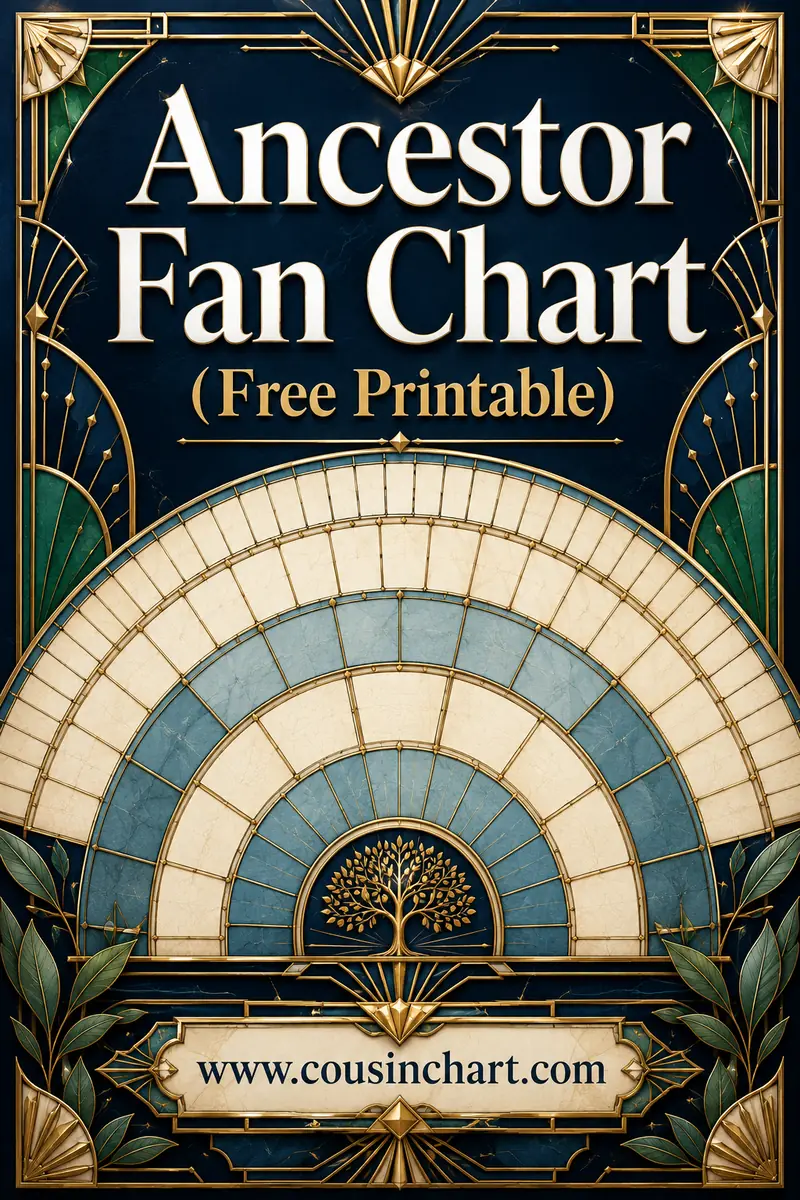
The fan solves the space problem geometrically — every generation gets a full ring, and the rings grow as they move outward, exactly where the chart needs more room. A 12-generation full-circle fan at 36×36 inches gives the outer ring 2,048 wedges of a bit over 1.5 millimeters each: enough for a surname written along the arc. Fans are also the format people frame, because an even half-filled fan looks intentional — the empty wedges read as "research in progress," not failure. Our genealogy fan chart guide covers filling technique and which arc sizes stay writable.
Format 3: the cascading pedigree set
The traditional archival answer: no giant paper at all. You print a stack of standard 4-generation pedigree chart pages and chain them. Chart 1 holds generations 1–4. Each of your 8 great-grandparents then becomes person 1 on their own continuation chart covering generations 4–7. Each generation-7 ancestor starts another, covering 7–10, and one more layer reaches generation 12 and beyond.
Fully populated, that's hundreds of pages — but nobody's tree is fully populated at 12 generations, and that's the format's quiet advantage: you only print a continuation chart when a line actually extends. A binder of 30–60 cascading pages representing your proven lines is more honest, more portable, and more usable at a records office than any poster.
Which format for which person
| You are... | Print this | Size |
|---|---|---|
| Decorating a wall / making a gift | Fan chart | 24×36" or 36×36" |
| Hosting a reunion | Box-chart poster | 24×36" minimum |
| Actively researching | Cascading pedigree set | Letter/A4 pages in a binder |
| Just curious how deep your tree goes | Start with a 6-generation chart | 11×17" |
That last row is real advice, not an upsell to a smaller number. Most people who download a 12-generation chart have solid names to about generation five. Filling a 6-generation chart first shows you exactly which lines have legs — then the big chart becomes a display of research you've done rather than a wall of blanks.
Print settings for the big formats
- Poster and fan PDFs: take the file to a copy shop or online print service on a thumb drive or upload. Ask for "actual size, no scaling." Engineering prints (black and white on lightweight bond) are the budget option; color on 32 lb or cardstock is the display option.
- Cascading pages at home: 100% scale, never "fit to page," normal quality or better. The boxes are designed to fit a full name plus birth–death years; scaling down 8% costs you the years.
- Laminate the working copy. A 12-generation project spans years of research. A laminated poster plus wet-erase markers survives the whole journey; pencil on paper smudges away by generation eight.
A filling strategy that survives past generation six
The doubling that makes the chart impressive also makes it exhausting: generations 1–6 total just 63 people, but generations 7–12 add 4,032 more slots. Nobody fills those breadth-first. Do this instead:
- Fill 1–5 completely (31 people). Memory plus one phone call to the family's best rememberer usually gets you close.
- Pick two or three lines to chase deep — usually the surname line and whichever branch has the best records (a family Bible, an immigrant story, an old country parish). Push each chosen line vertically toward generation 12, one ancestor couple at a time.
- Ignore the rest without guilt. A chart that's dense in three wedges and empty elsewhere is what real genealogy looks like. Even professional researchers rarely document more than a fraction of generation 10.
- Expect duplicates. Around generations 8–12, the same ancestor often appears in two slots because cousins married cousins somewhere upstream. That's pedigree collapse, it's universal, and the convention is to fill both slots and mark them "see #N."
And when a deep ancestor connects you to a living person — a match from a DNA site, a stranger researching the same 4th-great-grandfather — the free CousinChart calculator turns "we both descend from Josiah, born 1721" into "we're 7th cousins once removed" without any finger-counting across 2,000 boxes.
What records actually reach the 1600s
A 12-generation chart quietly promises something records have to deliver, so it helps to know what survives from each era before you buy the poster:
- Generations 1–5 (roughly the last 130 years): civil registration — government birth, marriage, and death certificates — plus censuses. This is the easy stratum; most lines fill from indexes and family paper.
- Generations 5–8 (1800s): church registers do the heavy lifting as civil records thin out, alongside land deeds, wills, and immigration manifests. Progress slows but stays steady for most lines.
- Generations 8–12 (1600s–1700s): parish registers become nearly the only game — baptisms, marriages, and burials kept by churches, some series running back to the 1500s in parts of Europe. Whether your line reaches generation 12 depends almost entirely on whether an ancestor's parish books survived fire, war, and mold. Some did beautifully; many didn't.
The practical upshot: lines connecting to well-kept record regions (much of Scandinavia, parts of Germany, England, Spain and its colonial parishes) can genuinely fill their wedge to the rim, while lines through burned counties or undocumented migrations may stop at generation 6 forever. Both outcomes belong on the chart. Genealogists write "records end — parish destroyed 1862" in a slot with the same pride as a name; it's an answer, not a blank.
Display ideas (and the Pinterest angle)
A finished — or honestly half-finished — 12-generation chart is the single most pinned genealogy format for a reason: it photographs like an achievement. Framing the fan version in a square frame over a desk is the classic. For posters, office supply stores sell 24×36 frames cheap, or use poster rails for a softer look. Photograph it straight-on in daylight for the family chat, and at a slight angle with a pen in frame for Pinterest — in-progress shots consistently out-save finished ones. Grab the free printable chart pack from CousinChart, pin the blank, and you'll see the same effect on your own board.
FAQ
How many ancestors are in a 12 generation family tree?
4,094 ancestors plus yourself: 2 parents, 4 grandparents, 8 great-grandparents, doubling every generation up to 2,048 ninth-great-grandparents in generation 12. In practice the true count is somewhat lower because distant cousin marriages put the same ancestor in more than one slot.
How many years does a 12 generation chart cover?
At the typical 25–30 years per generation, 11 steps back spans roughly 275–330 years. For most adults today, generation 12 was born in the late 1600s or early 1700s.
Can I print a 12 generation family tree on regular paper?
Not as one readable page — the top row alone holds 2,048 names. Print it as a 24×36-inch (or larger) poster, as a circular fan chart, or as a cascading set of standard 4-generation pedigree pages in a binder.
What relationship is a generation-12 ancestor to me?
An ancestor in generation 12 (counting yourself as generation 1) is your 9th-great-grandparent — your grandparent with the word "great" applied nine times.
Is it realistic to fill in all 12 generations?
Almost never, and that's fine. Most researchers fill generations 1–6 solidly, then push two or three well-documented lines deep. A chart that's complete in a few branches and blank elsewhere accurately reflects how records survive.
Download the chart and start the climb
Twelve generations is a project measured in years, but it starts with one sheet: print a chart from the free CousinChart pack, fill the 31 names of generations 1–5, and pick the line you'll chase first. Keep the free relationship calculator beside the chart for every "so what does that make us?" the climb produces — there will be many, and they're the fun part.