6 Generation Family Tree Template (Free Printable)
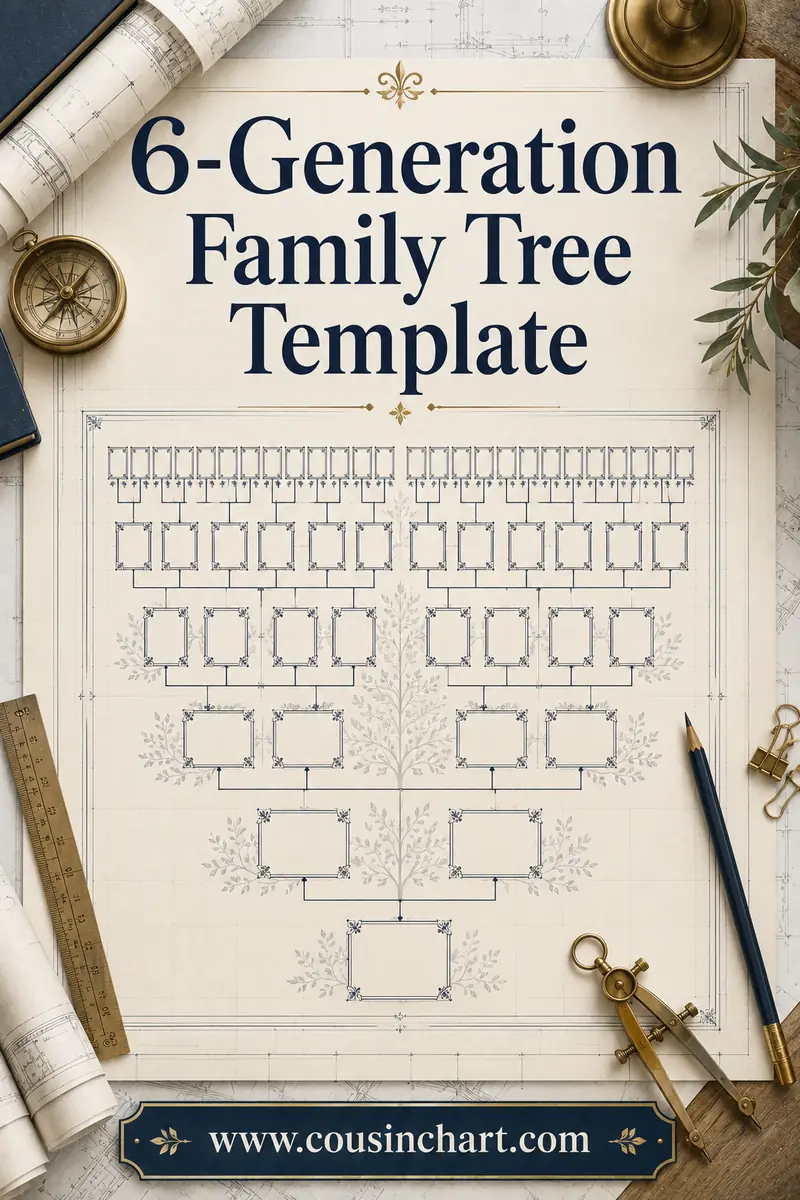
A 6 generation family tree template holds 63 people: you, 2 parents, 4 grandparents, 8 great-grandparents, 16 great-great-grandparents, and 32 great-great-great-grandparents across the top. That 32-box row is the whole story of this chart — it's too wide for a Letter page, so six generations means choosing between a poster print, a multi-page numbered set, or a fan layout. The free CousinChart chart pack includes six-generation versions built for all three routes.
This guide covers the box math, the three layout strategies with actual sizes, and how to keep 63 ancestors organized without losing your mind (spoiler: pedigree numbers). And since a chart this deep guarantees you'll bump into distant-cousin questions — anyone sharing that top row with you is your fifth cousin or closer — keep the free relationship calculator handy for naming whatever the research turns up.
Free printables for this page
Download a blank PDF (US Letter or A4) — free, no sign-up — or customize it in the maker above before printing.
 6-Generation Pedigree Chart63 ancestors on one portrait page; names-only outer column.
 6-Generation Fan Chart
 Pedigree Continuation Sheet
 Ahnentafel Ancestor List
Relationship quick-check: tap a phrase to see who they are — six generations produces all of these.
Tap a phrase above to see the answer.
Work out any family relationship →The box math at six generations
| Generation | Relation to you | Boxes | Running total |
|---|---|---|---|
| 1 | You | 1 | 1 |
| 2 | Parents | 2 | 3 |
| 3 | Grandparents | 4 | 7 |
| 4 | Great-grandparents | 8 | 15 |
| 5 | Great-great-grandparents | 16 | 31 |
| 6 | Great-great-great-grandparents (3rd-great) | 32 | 63 |
For most adults today, generation 6 was born roughly in the early-to-mid 1800s — census-era, immigration-era people whose records genuinely exist. Sixty-three ancestors is also where family history stops being a memory exercise entirely: you'll know perhaps a dozen of these names from relatives, and the other fifty come from research. That's the fun, but plan for it — a 6-generation chart is a season's project, not a weekend's.
Three ways to lay out 63 boxes
Option 1: one big poster (18×24" or 24×36")
The whole tree on a single sheet, you at the left or bottom, the 32-box row along the far edge. At 24×36", each top-row box gets about one inch of width — name plus year, surnames in caps. This is the reunion and wall-display route: print shops output a PDF at this size for a few dollars, and the finished chart is genuinely impressive in a way smaller charts aren't.
Practical sizing: at 18×24", top-row boxes drop to about 0.7" — fine for typed names, tight for handwriting. If you're filling by hand, buy the bigger print.
Option 2: the numbered multi-page set (the genealogist's way)
Chain standard pedigree chart pages. Page one holds you through generation four (15 boxes, Letter landscape); each great-grandparent's line then continues as the root of its own fresh page. The glue is ahnentafel numbering: you're 1, your father 2, mother 3, and every person's father is double their number, mother double-plus-one. Your 3rd-great-grandparents are numbers 32 through 63 — notice how the numbers themselves tell you the generation.
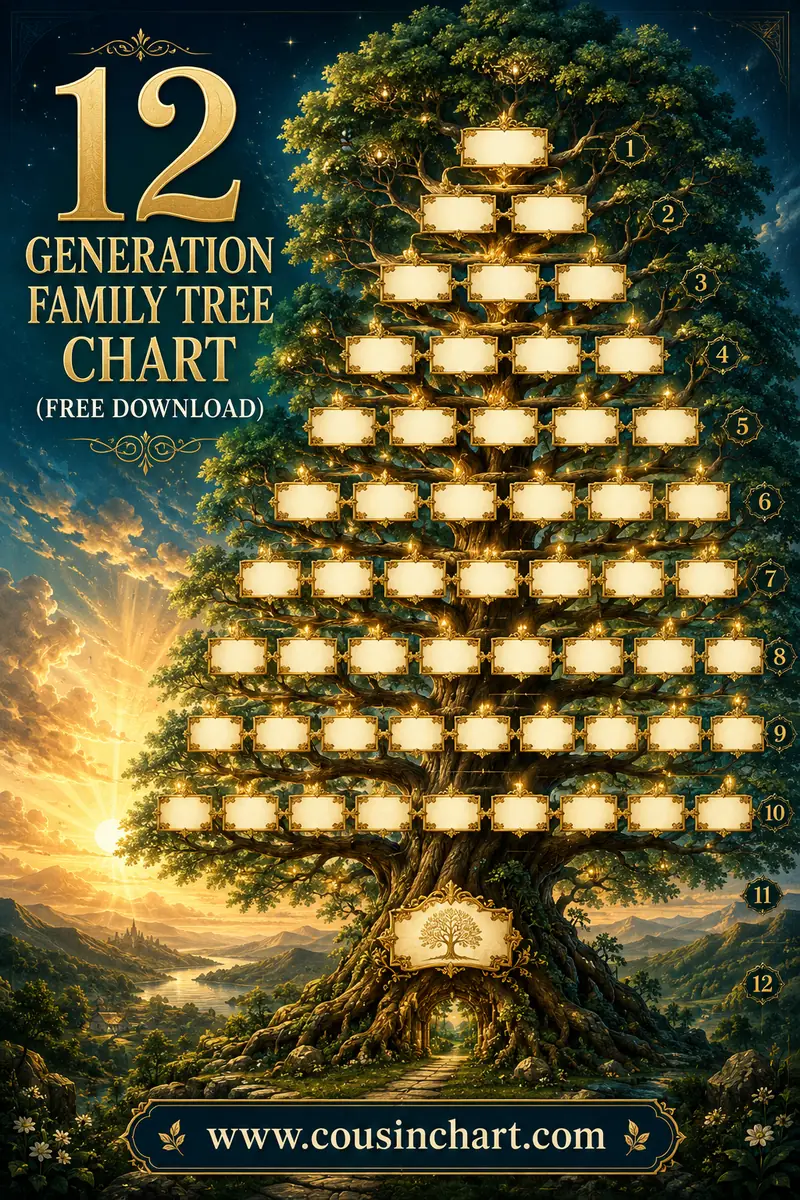
This is the route for research binders: home printer only, infinitely extensible (it's how people eventually reach a 12 generation chart), and each page stays legible. The cost is that nobody at the party gasps at a binder.
Option 3: the fan
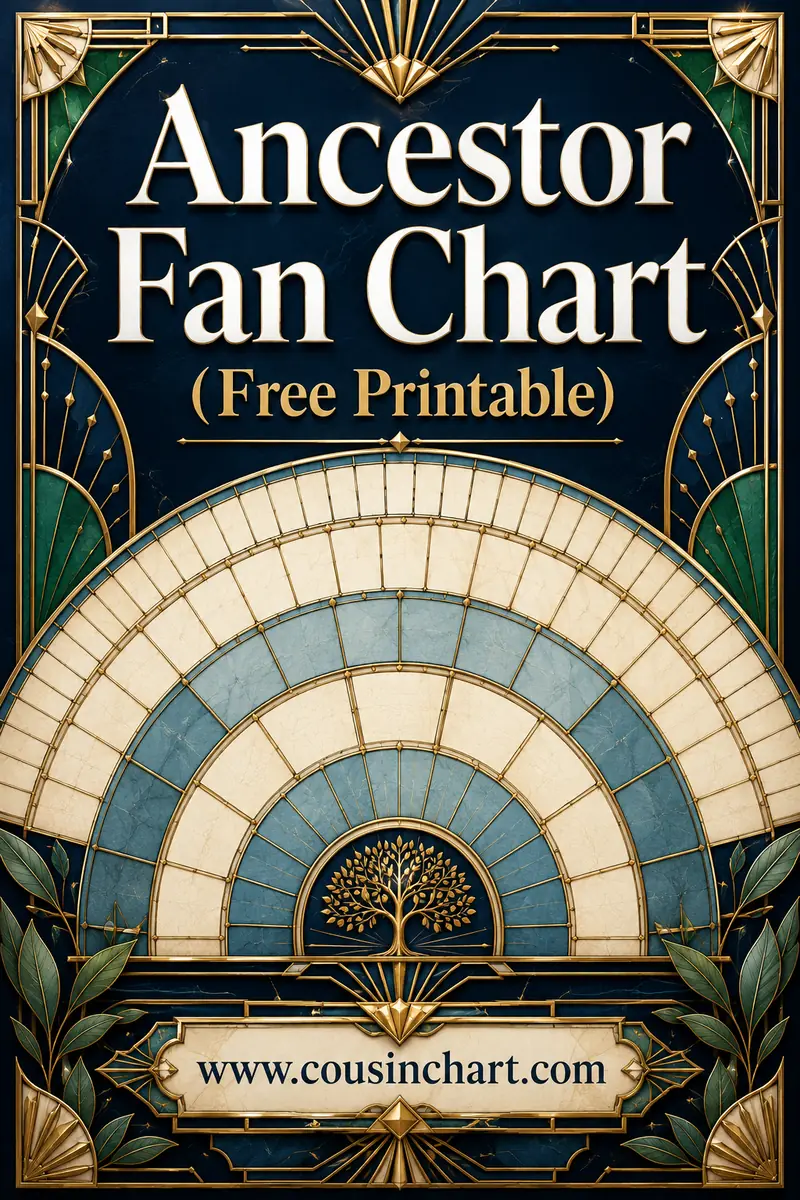
A 6-generation fan chart puts the same 63 people in concentric arcs — and because arcs share space efficiently, six generations fits a single Letter or A4 page in a way boxes never could. Outer-arc wedges hold surnames only, so pair the fan with a numbered page set for the full details. It's the best-of-both display answer, and our genealogy fan chart guide covers filling one without smudging.
Rule of thumb: poster for display, numbered pages for research, fan for both-on-a-budget. Many people run options 2 and 3 together — binder for the data, fan on the wall.
Filling it in without chaos
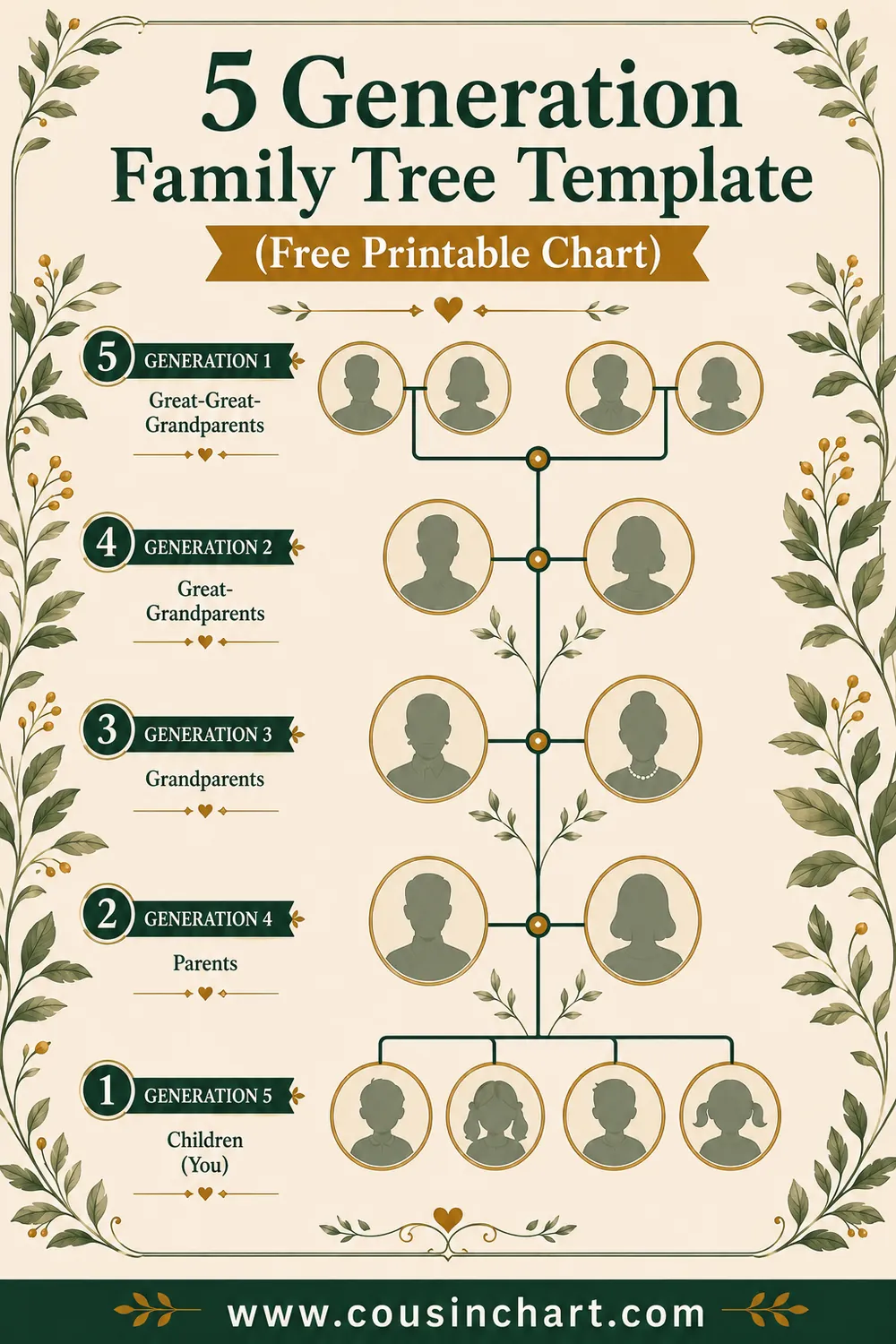
- Start from a completed 5-generation chart. Six generations is exactly one doubling past five; if you haven't filled the 5 generation family tree template, do that first — it's the same work minus the hardest row.
- Work one line at a time, not one generation at a time. Chase your father's father's line to the top, then the next line. Generations-at-a-time means juggling 16 unrelated research problems at once.
- Pencil everything in generation 5 and 6. These rows get revised constantly as records correct family lore.
- Note sources in the margins. "1860 census" next to a name saves future-you a repeat search.
- Expect DNA matches to start making sense. Third and fourth cousins — the bulk of everyone's DNA match list — share generations 5 and 6 with you. When a match says "my great-great-grandmother was Josefa from the same village," the CousinChart calculator turns the paper trail into a named relationship.
What generation six actually looks like
Filling this chart teaches a few things no smaller template can:
- The immigration generation appears. For a large share of American families, generations 5 and 6 are the ocean-crossers — which means the top rows introduce naturalization papers, passenger manifests, and surname spellings that shift mid-row. Write the spelling as the record gives it, with the family's later version in parentheses; "Kowalczyk (Kowalski)" in one box is a research trail, not a mistake.
- The math starts bending. In theory you have 32 distinct 3rd-great-grandparents. In practice, families from small villages or close-knit communities sometimes have fewer, because the same couple appears in two slots — cousins married cousins somewhere upstream. Genealogists call it pedigree collapse, and finding your first duplicate ancestor is a rite of passage, not an error. Chart them in both slots and add a margin note.
- Half the top row is women whose maiden names are the challenge. Maiden names get harder to recover each generation back; church marriage registers and children's death certificates (which often name the mother) are the standard rescues.
- Your cousin horizon opens wide. Everyone descended from that top row is your fourth cousin or closer — statistically hundreds of living people. This is why six-generation researchers suddenly find DNA match lists comprehensible, and why the calculator gets heavy use at this depth: "shares my 3rd-great-grandmother, two generations shallower than me" is a real sentence with a real answer (fourth cousin twice removed... or let the tool say it).
A season-of-Sundays plan
Sixty-three boxes divides neatly into a plan that respects weekends:
- Sunday 1: copy your completed 5-generation chart onto the new layout — 31 boxes filled in an hour, momentum established.
- Sundays 2–3: interview the oldest relatives on each side about the great-great-grandparents' parents. Expect names for a handful of the 32; expect stories pointing at several more.
- Sundays 4–9: one paternal or maternal line per week through the records — each generation-6 couple typically needs a marriage record and one census to confirm.
- Sunday 10: the fair copy. Poster or fan, best handwriting, tilde marks on the still-approximate dates, and a compiled-on date in the corner.
Some lines will stall at a missing record — normal. A 6-generation chart that's 80% full is a strong chart; the empty boxes are next season's plan.
Print settings and paper
Poster route: export/print at 100%, ask for 100 lb paper or cardstock, matte finish (glossy glares under reunion lighting and won't take pencil). Multi-page route: Letter landscape, 100% scale, ordinary paper — it lives in sleeves. Fan route: cardstock, high print quality so the fine arc lines survive. All the PDFs in the free chart pack are pre-margined for home printers, and the poster files upscale cleanly because the layouts are vector-based.
One Pinterest note: six-generation fans are among the most-saved genealogy printables there are. If you pin your filled-in one, photograph it in the frame — context outperforms flat scans every time.
FAQ
How many people are in a 6 generation family tree?
Sixty-three: you, 2 parents, 4 grandparents, 8 great-grandparents, 16 great-great-grandparents, and 32 great-great-great-grandparents. Each generation doubles the row above it.
What do you call the sixth generation back?
Your great-great-great-grandparents, usually shortened to 3rd-great-grandparents. You have 32 of them, and for most adults they were born in the early-to-mid 1800s.
Can a 6 generation family tree fit on one page?
As boxes, only at poster size — the 32-box top row needs 18×24" minimum for readable text. As a fan chart, yes: concentric arcs fit six generations on a single Letter or A4 page with surnames in the outer ring.
What paper size should I print a 6 generation chart on?
18×24" for typed names, 24×36" if you're hand-writing, from any print shop for a few dollars. For home printers, use the multi-page numbered set (Letter landscape) or the one-page fan version instead.
How long does it take to fill a 6 generation family tree?
Copying a finished 5-generation chart takes an hour; the new 32-box top row typically takes a season of casual research, since most of those names come from records rather than memory. A chart that reaches 80% full is a genuinely strong result.
What's the numbering system for big family tree charts?
Ahnentafel numbering: you're 1, each person's father is double their number, each mother is double-plus-one. Your parents are 2–3, grandparents 4–7, and your 3rd-great-grandparents are 32–63 — the number instantly reveals generation and line.
Sixty-three ancestors, one chart
Download the free 6-generation set from the CousinChart pack — poster, numbered pages, and fan — and start by copying over your finished five-generation names. The top row will take a season of records to fill, and it's a good season. Along the way, every newly discovered branch raises the same happy question — so what's this person to me? — and the free relationship calculator answers it as fast as you can find them.