Ahnentafel Charts: The Numbering System + Free Template
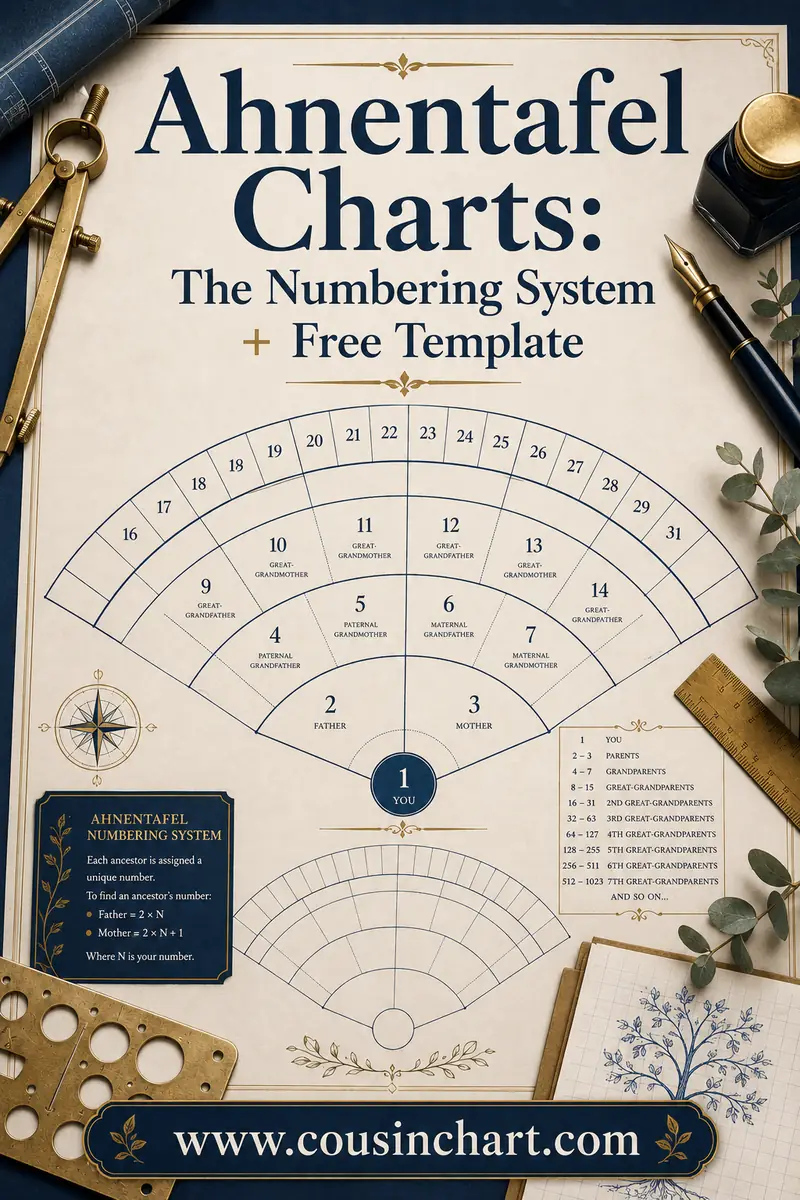
An ahnentafel (German for "ancestor table") is a numbered list of your direct ancestors built on one elegant rule: you are number 1, and any person's father is their number doubled while their mother is their number doubled plus one. Your father is 2, your mother 3, your four grandparents 4 through 7, and so on forever — every ancestor gets a unique number, men always even, women always odd, and the number alone tells you exactly who someone is.
It's the most compact format genealogy ever invented: six generations of ancestors — 63 people — fit on two typed pages that would need a poster as a boxes-and-lines chart. This guide explains the numbering rules, the binary trick that decodes any number instantly, a worked example, where the system came from, and how to use the free ahnentafel template in the CousinChart printable pack. And since an ahnentafel deliberately ignores every relative who isn't a direct ancestor, keep the free relationship calculator nearby for the cousins.
Free printables for this page
Download a blank PDF (US Letter or A4) — free, no sign-up — or customize it in the maker above before printing.
 Ahnentafel Ancestor List
 Numbered Fan Chart + Name ListFan as a page header, numbered lines 1–31 below for details.
 5-Generation Pedigree Chart
 Numbered Fan Chart (5 Generations)
Relationship quick-check: tap an ahnentafel number to see exactly who it is. Remember: father = double, mother = double plus one.
Tap a number above to see the answer.
Work out any family relationship →A list, not a tree
The first thing to understand about an ahnentafel is what it looks like on paper: not boxes and lines, just a numbered list, grouped by generation.
Generation 1 1. Maria SANTOS, b. 12 Aug 1990, Cebu City Generation 2 2. Ricardo SANTOS, b. 3 Feb 1961, Cebu City 3. Elena CRUZ, b. 27 Nov 1963, Iloilo Generation 3 4. Jose SANTOS, b. abt 1932, Cebu 5. Carmen REYES, b. 1935, Cebu 6. Antonio CRUZ, b. 14 Jun 1930, Iloilo 7. Rosario LIM, b. 2 Jan 1938, Iloilo
That's it — the whole format. Each entry carries the person's number, name (surnames traditionally in capitals, women under maiden names), and whatever vital facts you have: birth, marriage, death, places. No drawing skills, no giant paper, no software. A tree that would sprawl across a wall as a 12-generation chart compresses into a few sheets you can email, photocopy, or read aloud over the phone to a cousin who's researching the same line.
The structure lives entirely in the numbers. Which brings us to the rules.
The three rules of ahnentafel numbering
- The subject is 1. You, or whoever the table is about — the one number that can be either sex.
- Anyone's father is their number × 2. Your father is 2. His father is 4. His father is 8. The straight paternal line marches through the powers of two forever: 2, 4, 8, 16, 32, 64.
- Anyone's mother is their number × 2 + 1. Your mother is 3. Your father's mother is 5. Your mother's mother is 7. And the straight maternal line always holds the last number of each generation: 3, 7, 15, 31, 63.
Two properties fall out immediately. Every man is even, every woman is odd (except possibly you at number 1) — so the number's parity tells you an ancestor's sex before you read the name. And couples always sit side by side: any even number n and n+1 are husband and wife. Numbers 12 and 13 are a married couple; so are 88 and 89, sight unseen.
One more useful pattern: each generation occupies a fixed, predictable block of numbers.
| Generation | Who | Numbers | Count |
|---|---|---|---|
| 1 | You | 1 | 1 |
| 2 | Parents | 2–3 | 2 |
| 3 | Grandparents | 4–7 | 4 |
| 4 | Great-grandparents | 8–15 | 8 |
| 5 | Great-great-grandparents | 16–31 | 16 |
| 6 | 3rd-great-grandparents | 32–63 | 32 |
| 7 | 4th-great-grandparents | 64–127 | 64 |
| 8 | 5th-great-grandparents | 128–255 | 128 |
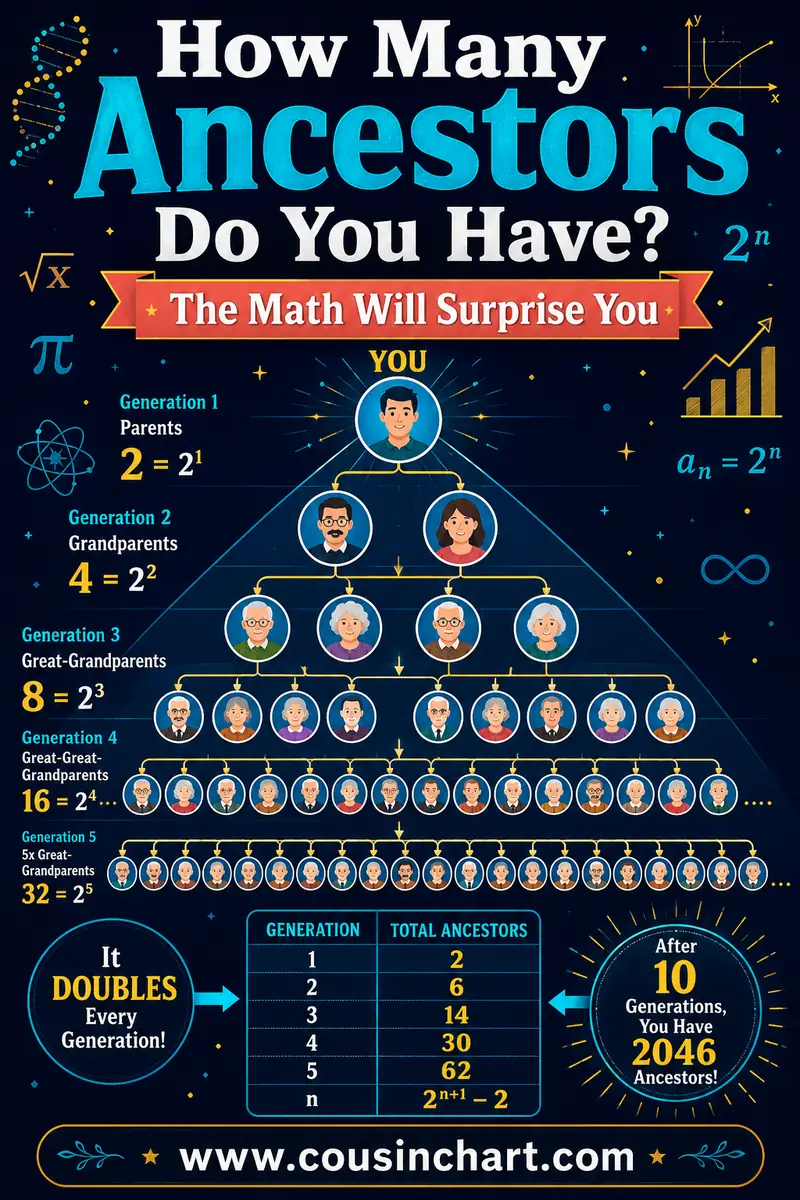
Generation g starts at 2 to the power (g - 1) and ends one short of the next power of two. So the moment you see number 47, you know: generation 6 (it falls between 32 and 63), a woman (odd), one of your 32 third-great-grandparents. That's a lot of information from two digits — and if the doubling totals make you curious how fast ancestors pile up, how many ancestors do you have runs the full math.
The binary trick: decode any number to an exact relationship
Here's the party trick that makes genealogists love this system. Any ahnentafel number converts to the exact chain of "father's/mother's" in three steps:
- Write the number in binary. Take 13: in binary, 13 is 1101.
- Drop the leading 1. You're left with 101.
- Read the remaining digits left to right: 0 = father, 1 = mother. So 101 reads mother (1), father (0), mother (1): number 13 is your mother's father's mother.
Check it against the doubling rules: your mother is 3, her father is 6 (3 × 2), his mother is 13 (6 × 2 + 1). It works for any number, at any depth. Number 100 in binary is 1100100; drop the leading 1 to get 100100, and read: mother, father, father, mother, father, father — your mother's father's father's mother's father's father, a 4th-great-grandfather in generation 7.
Bonus fact hiding in the same math: the number of binary digits equals the generation number. 13 has four binary digits, so number 13 is in generation 4 — a great-grandparent. No chart required; the number is the chart.
Why researchers use ahnentafels
Compactness. Sixty-three ancestors on two pages. Serious researchers with ten documented generations can hand their entire ancestry to a relative as a thin stapled packet. No boxes-and-lines format comes close.
Gaps cost nothing. Don't know who number 21 is? Skip the number. The list just goes 20, 22, and every other ancestor keeps their correct number. On a drawn chart, an unknown ancestor still consumes an empty box; in an ahnentafel, unknowns are simply absent, and the missing numbers double as your research to-do list.
Numbers survive translation. Tell a fellow researcher "I'm stuck on number 22" and they can decode exactly who that is — 22 in binary is 10110, drop the leading 1 for 0110, read father-mother-mother-father: your father's mother's mother's father. The number carries the identity precisely, even between people who've never seen each other's files, with none of the ambiguity that sinks a spoken chain of "his mother's father's… no wait, her father's mother's…" halfway through.
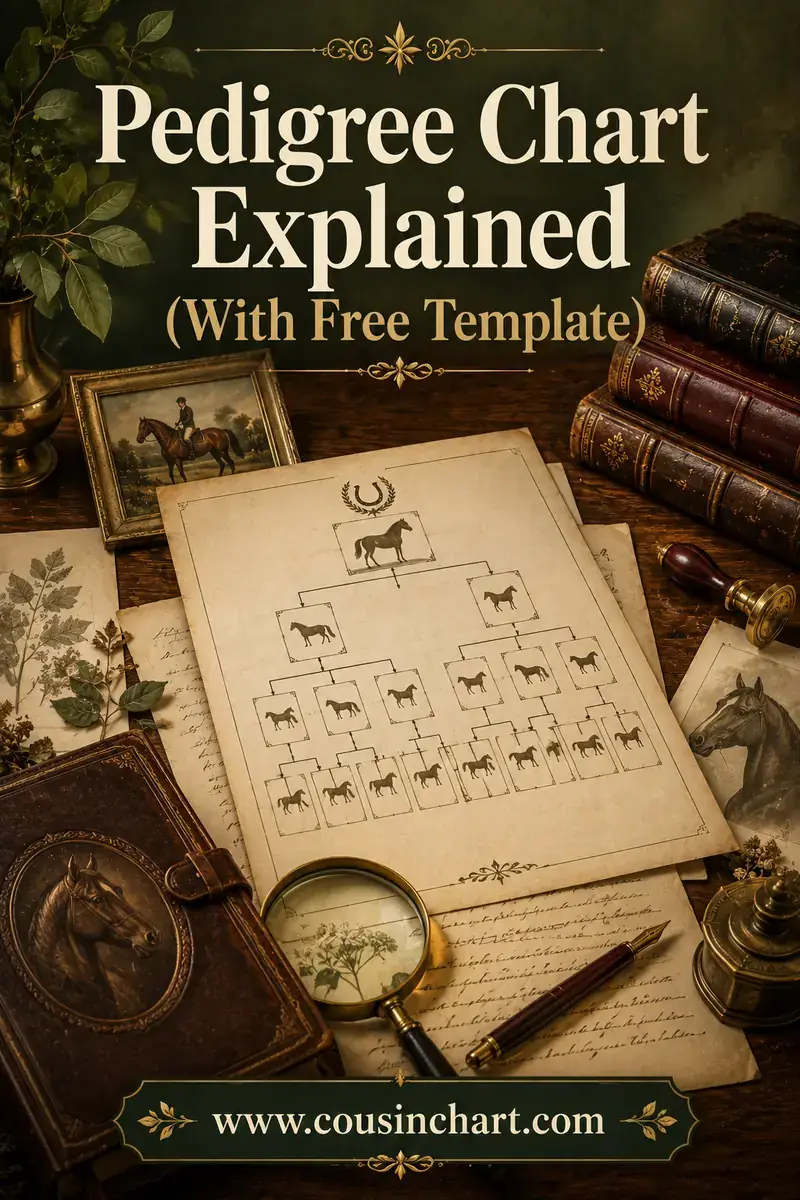
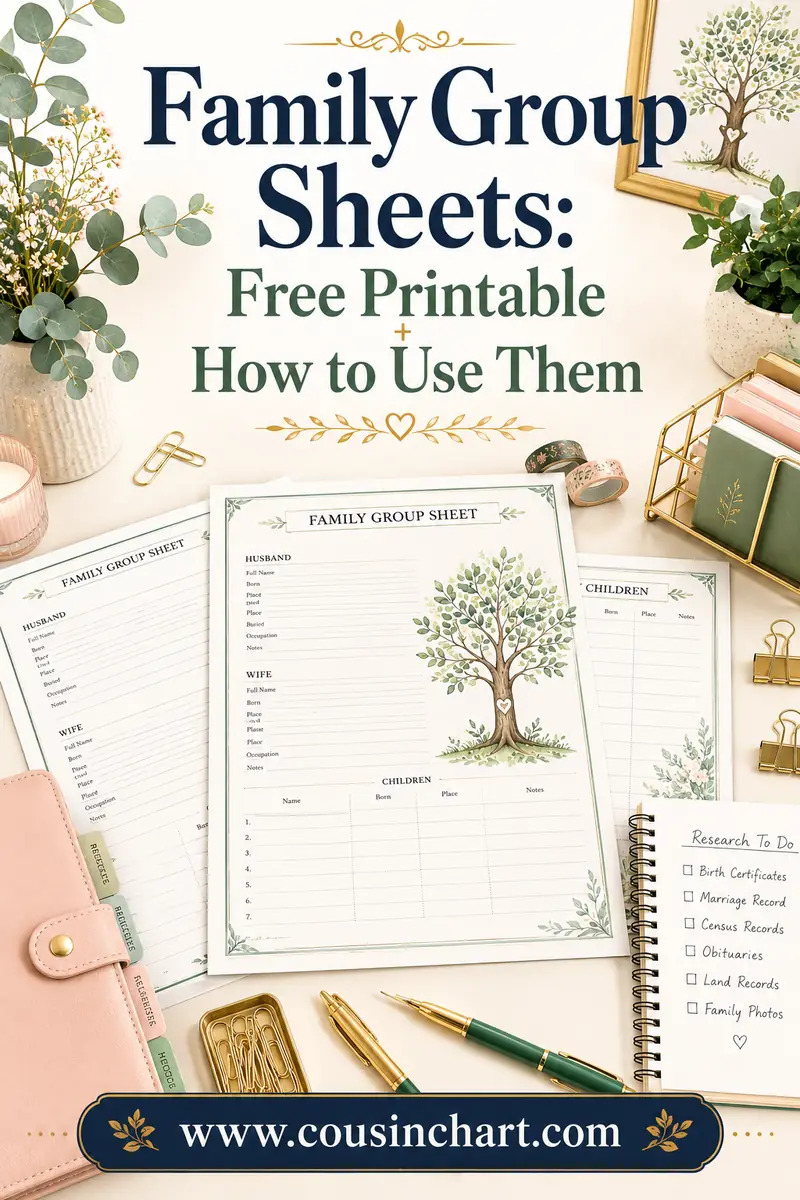
It plugs into everything else. The numbered boxes on a standard pedigree chart are ahnentafel numbers — the chart is just the same system drawn instead of listed. Cascading chart binders, genealogy software exports, and published family histories all lean on the same numbering, so an ahnentafel is the master index of a research project. Pair each couple's numbers with a family group sheet holding their children and you've got the complete classical genealogy filing system in two printable forms.
Filling in the free template
The CousinChart printable pack includes a blank ahnentafel form — pre-numbered lines grouped by generation, five generations per page, with continuation pages for deeper lines. The workflow:
- Write yourself at 1 — full name, birth date and place. Women throughout go under maiden names, surnames in capitals (SANTOS, O'BRIEN) so they're scannable.
- Fill 2–7 from memory — parents and grandparents, with birth, marriage, and death facts where known. Genealogy date format: 4 Jul 1921, day-month-year, month spelled out.
- Take 8–15 to the family's best rememberer. Eight great-grandparent lines is one good phone call. Pencil what's remembered; ink what a document confirms.
- Leave unknowns blank — the number stays printed on the form, waiting. A half-empty ahnentafel is a research plan, not a failure.
- Add source notes. The template leaves a short line under each entry; "b. cert, Iloilo civil registry" today saves re-finding the record in five years.
Print at 100% scale, portrait, on 24–32 lb paper if the sheets will live in a working binder. The form is deliberately boring to look at — this is the format for accuracy; print a fan chart from the same pack when you want something for the wall.
Going the other way: from relationship to number
The binary trick also runs in reverse, and the reverse direction is the one you'll use while filing. To find any ancestor's number from the chain of parents: start with 1, then append a digit for each step — 0 for father, 1 for mother — and read the result as binary.
Your father's mother's father: start 1, then 0 (father), 1 (mother), 0 (father) → binary 1010 → number 10. Your mother's mother's father's mother: 1, then 1, 1, 0, 1 → binary 11101 → number 29. Once this clicks, you can label any photograph, certificate, or DNA note with its exact ancestor number in seconds, without a chart in sight.
That labeling habit is the system's everyday payoff:
- File names that sort themselves. "008-santos-jose-baptism-1878.jpg" files every document by ancestor, and an alphabetical folder listing becomes a generation-ordered archive for free.
- Marginal notes that stay unambiguous. "Photo shows 10 and 11, taken abt 1910" survives decades better than "great-grandpa and great-grandma on mom's side," which has four possible meanings.
- Software compatibility. Every major genealogy program exports ahnentafel reports and displays Sosa numbers, so a paper file organized by number drops into software — or into another researcher's files — without translation.
One caution as trees deepen: when pedigree collapse puts the same person in two slots (a 5th-great-grandmother who is both number 145 and number 153, because two of her descendants married), convention keeps both numbers and cross-references them — "153: see 145." The duplicate numbers aren't an error; they're the honest record of a family tree folding in on itself, which almost every tree does eventually.
Where the system came from
The ahnentafel is genuinely old. Austrian historian Michaël Eytzinger published the earliest known version of the numbering in 1590, using it to lay out the ancestry of European rulers. Spanish genealogist Jerónimo de Sosa refined the method in 1676, and Stephan Kekulé von Stradonitz popularized the modern form in his 1898 Ahnentafel-Atlas, which charted the ancestries of Europe's sovereigns. That lineage of authors is why you'll also see the numbering called the Sosa-Stradonitz system — same rules, fancier name. When a genealogy program offers a "Sosa number" or an "ahnentafel report," it's this exact 400-year-old arithmetic.
Ahnentafel vs. pedigree chart: same data, different jobs
Both formats hold direct ancestors only, numbered identically. The difference is presentation and what it's good for:
| Ahnentafel (list) | Pedigree chart (boxes) | |
|---|---|---|
| Six generations fits on | ~2 pages | 11×17" paper, tight |
| Best for | Research, sharing, archiving | Seeing structure at a glance |
| Unknown ancestors | Skipped numbers, invisible | Empty boxes, visible |
| Wall-display appeal | None whatsoever | Decent (fan chart: high) |
| Data per person | As much as you like | Three short lines |
The honest answer is that they're partners: researchers keep the ahnentafel as the master record precisely because each entry can hold unlimited notes and sources, then generate charts from it when a reunion or a wall calls for a visual. Neither shows siblings, aunts, uncles, or cousins — for "what is my grandmother's cousin's daughter to me?", no ancestor-only format will ever help, and the free CousinChart calculator exists for exactly that overflow.
FAQ
What does "ahnentafel" mean?
It's German for "ancestor table." An ahnentafel is a numbered list of one person's direct ancestors, where the subject is 1, each person's father is double their number, and each mother is double plus one.
How does ahnentafel numbering work?
You are 1; your father is 2 and mother 3; then any ancestor's father is their number × 2 and mother is × 2 + 1. Men always get even numbers, women odd, couples sit on consecutive numbers, and generation g occupies numbers 2^(g-1) through 2^g - 1.
How do I figure out who an ahnentafel number refers to?
Write the number in binary, drop the leading 1, then read the digits left to right with 0 = father and 1 = mother. Number 13 → 1101 → 101 → mother's father's mother. The count of binary digits equals the generation number.
What's the difference between an ahnentafel and a pedigree chart?
Same people, same numbers, different format. An ahnentafel is a compact numbered list (six generations in about two pages, unlimited notes per person); a pedigree chart draws the same ancestors as boxes and lines, which is better for visualizing and worse for storage and detail.
What is the Sosa-Stradonitz system?
Another name for ahnentafel numbering, crediting Jerónimo de Sosa (1676) and Stephan Kekulé von Stradonitz (1898), who standardized and popularized the method. Genealogy software's "Sosa numbers" are ahnentafel numbers.
Do cousins or siblings appear in an ahnentafel?
No — it records direct ancestors only. Siblings, aunts, uncles, and cousins are all off-list; genealogists pair the ahnentafel with family group sheets for whole families, and use a cousin chart or relationship calculator for cousin questions.
Start your table tonight
Number 1 is the easiest genealogy entry you'll ever make. Print the ahnentafel form from the free CousinChart printable pack, fill 1 through 7 from memory, and let the blank numbers 8–15 tell you exactly who to call this weekend. The numbering will quietly organize everything you find for years — and for every relative the table leaves out, the free relationship calculator is one tap away.