Family Group Sheets: Free Printable + How to Use Them
A family group sheet is one page that records one couple and all their children — names, birth, marriage, and death facts for a single household. It's the workhorse form of genealogy: pedigree charts show your bloodline's skeleton, but family group sheets hold the actual flesh of every family on it, including all the siblings, which no ancestor chart will ever show.
This guide walks through every field on the form, the one-sheet-per-couple rules that keep a growing file sane, how sheets cross-link with your charts, and the filing habits that scale from three sheets to three hundred. A blank family group sheet is included in the free CousinChart printable pack — and when a completed sheet makes you wonder what some child's grandchild is to you, the free relationship calculator turns the puzzle into a name in seconds.
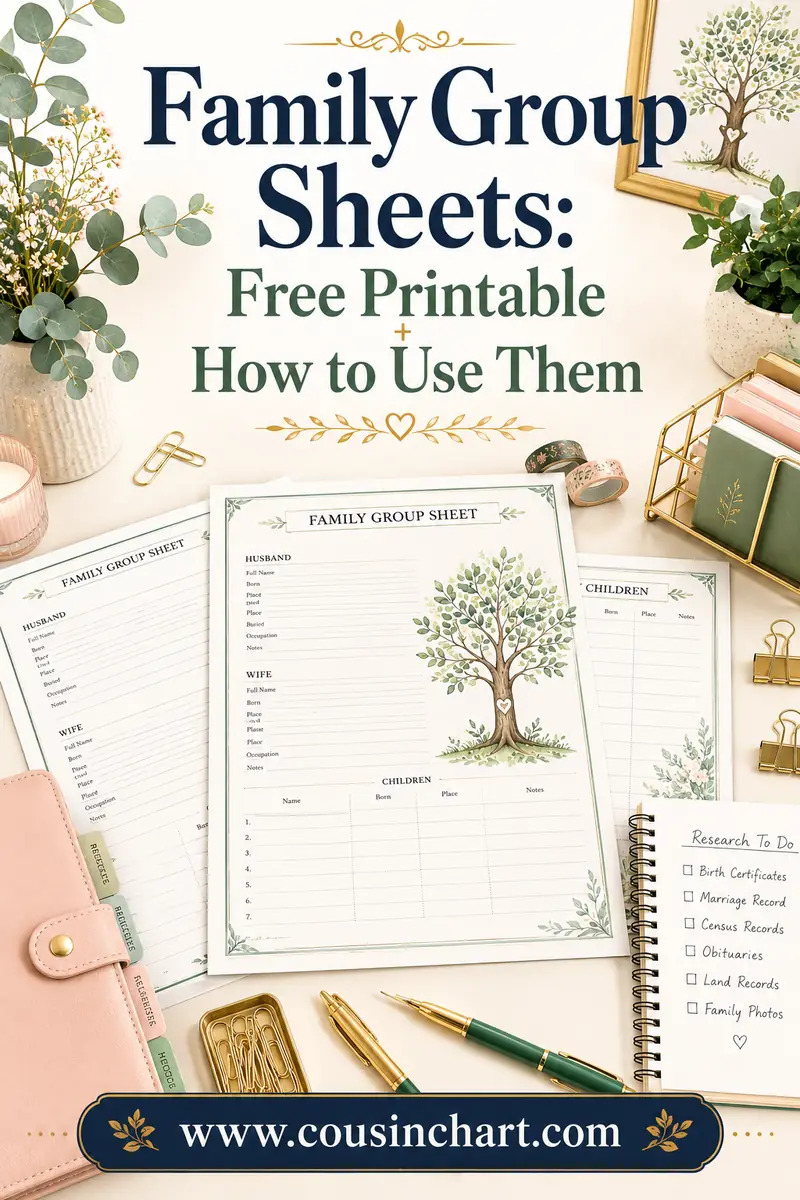
Free printables for this page
Download a blank PDF (US Letter or A4) — free, no sign-up — or customize it in the maker above before printing.
 Family Group Sheet
 5-Generation Pedigree Chart
 Research Log
 Source Citation Log
Relationship quick-check: tap a phrase to see who they are — every one of them appears on some family group sheet in your file.
Tap a phrase above to see the answer.
Work out any family relationship →What's on the form
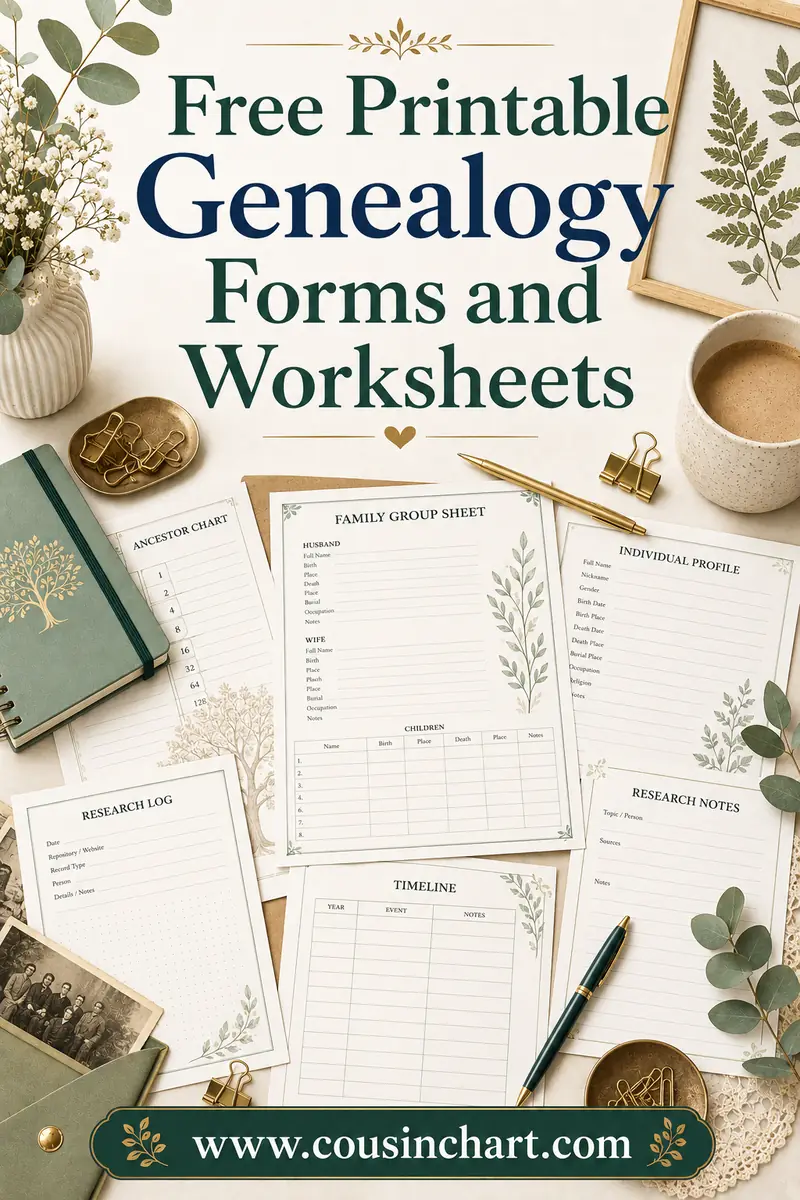
Every family group sheet, whatever its styling, carries the same three blocks:
The husband/father block and wife/mother block, each with:
- Full name — hers at birth (maiden name), always
- Birth date and place
- Marriage date and place (usually printed once, between the two blocks)
- Death date and place, and burial place
- His parents' names and her parents' names — the little lines that link this sheet upward to the previous generation
The children block: a numbered list, in birth order, typically 8–12 rows, each with:
- Name and sex
- Birth date and place
- Death date and place, if applicable
- Spouse's name and marriage date — the line that links each child forward to a sheet of their own
The housekeeping strip — often skipped, always regretted later: who prepared the sheet, the date prepared, and a sources section listing where each fact came from ("child 3 birth: St. Anne's parish register, 1911"). Ten seconds per fact now saves an evening of re-research in five years.
Dates go in genealogy format — 4 Jul 1921, day-month-year, month spelled out — and places smallest-to-largest: town, county, state, country. Unknown stays blank, never guessed.
Field by field, here's why each line earns its place on the form:
| Field | Why it matters |
|---|---|
| Full names (maiden name for the wife) | The maiden name is the link to her own parents' sheet — lose it and a whole line goes dark |
| Birth date and place | Anchors identity and separates same-name relatives |
| Marriage date and place | Dates the couple — and points to a record that often names both fathers |
| Death date, place, and burial | Closes each life; the burial place leads to headstones and obituaries |
| Both sets of parents' names | The upward links that stitch individual sheets into a connected tree |
| Children in birth order, all of them | The full family — including children no census ever caught; gaps in spacing flag missing babies |
| Each child's spouse and marriage date | The forward link to that child's own sheet |
| Preparer, date, and sources | Makes every fact answerable to "says who?" years later |
The rules that keep a file consistent
Four conventions do all the heavy lifting:
- One sheet per couple. Not per person — per couple. The sheet is fundamentally a record of a marriage and its children.
- Remarriage means a new sheet. If your grandfather married twice, he gets two sheets — one per wife, each listing only that marriage's children. His second sheet is where your half-relatives suddenly make organizational sense.
- Every person appears twice. Once as a child on their parents' sheet, once as a parent on their own. That double appearance is the chain that stitches individual pages into a connected tree: your mother is child #2 on one sheet and the mother block on another.
- Children in birth order, all of them. Including infants who died young and children who never married. Group sheets are where the family's full story lives — the pedigree chart's silent siblings all get their line here.
How sheets and charts work together
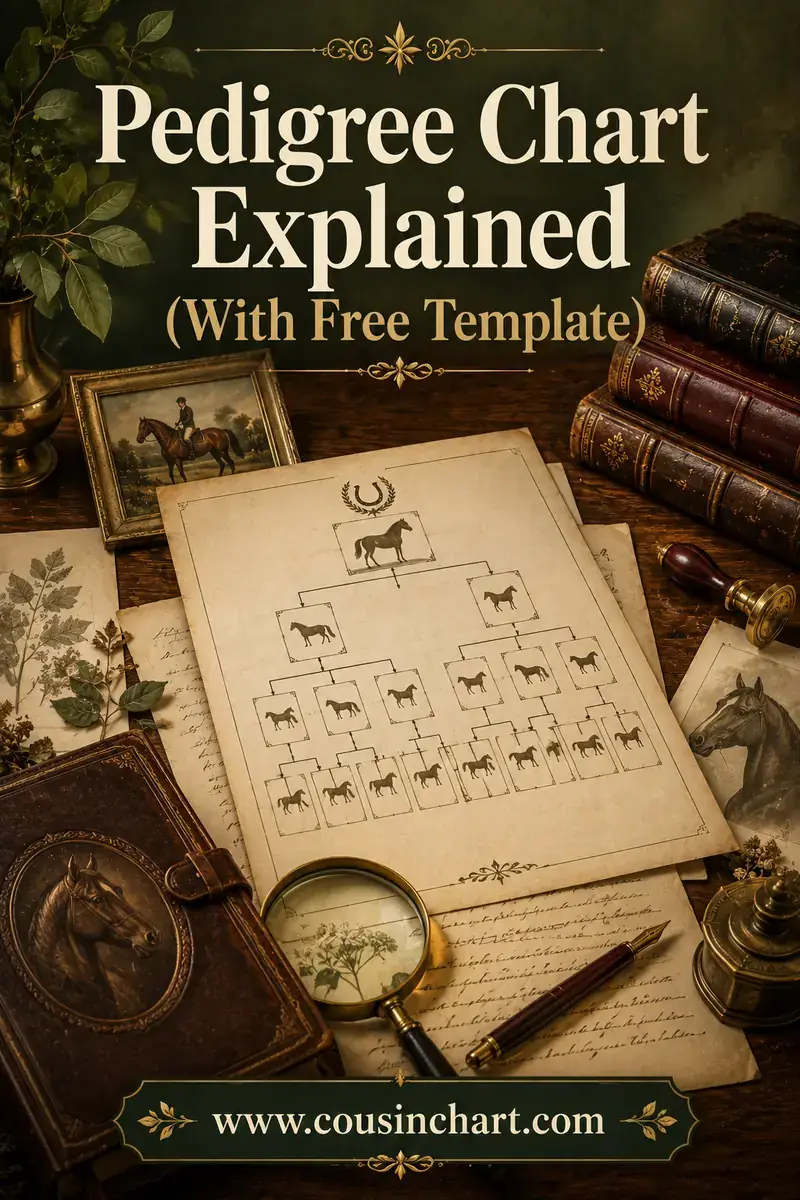
The classical paper system has exactly two forms, doing opposite jobs. The pedigree chart is vertical — your direct line climbing back through numbered ancestor boxes. The family group sheet is horizontal — one generation of one family, in full width, siblings and all.
The link between them is the numbering. Each couple on your pedigree chart is a pair of adjacent numbers (4 and 5, 12 and 13), so you label each group sheet with the couple's chart numbers, file the sheets in number order, and navigation becomes automatic: reading the chart, you can pull the full household of any ancestor couple in seconds; reading a sheet, the numbers jump you back to the right branch of the chart.
That's the entire filing system used by a century of genealogists, and it still beats most software for kitchen-table research. A binder per surname line, chart in front, group sheets behind in number order — the rest of the supporting cast (research logs, census extraction forms, and the other printables) files behind the sheet it supports.
Filling one in: the interview trick
A blank group sheet is the single best interview form genealogy has, because it asks small, answerable questions in a natural order. Sit down with the oldest relative available and fill a sheet for their parents' family:
- Start with what they know cold — their parents' names, where the family lived.
- Walk the children block together: "So it was your mother, then Uncle Fredo, then who?" Birth order is powerful memory scaffolding; siblings return to mind in sequence, along with who married whom.
- Let the dates be approximate — "abt 1930" is a legitimate genealogy entry, and the census will sharpen it later.
- Note the stories in the margins. The form asks for facts; the visit produces the rest. Both are the point.
One visit typically completes two or three sheets — the relative's parents, grandparents, and often a fair start on an aunt's or uncle's family. And every completed sheet quietly maps your cousin network: each child row on your grandparents' sheet is an aunt or uncle whose descendants are your first cousins; each row on your great-grandparents' sheet leads to second cousins. When a reunion produces someone claiming descent from row 6, the free CousinChart calculator names the relationship before the coffee's poured.
Turning old records into filled sheets
After the interviews, group sheets become the landing pad for document research — and censuses in particular map onto the form almost line for line. A census household lists a couple and their children with ages, which is a family group sheet with the dates fuzzed: a child "age 8" in a 1920 census was born about 1911 or 1912, and "abt 1911" goes straight into the child's birth line with the census cited underneath. Each fresh census year then tightens or challenges the estimate, and the sheet accumulates precision the way sediment accumulates — layer by dated layer.
The same landing-pad logic applies to the other big sources. A marriage record fills the couple's marriage line and often names both fathers, feeding the parents' lines at the top of the sheet. An obituary is frequently a pre-written children block — "survived by sons Ramon and Felipe, daughters Corazon and Luz" — that hands you the birth-order list to verify. A will does the same in legalese. The workflow is always: read the document once, harvest every name and date onto the relevant sheets, cite the source under each fact.
Three pitfalls to dodge while harvesting:
- A census is a snapshot, not a roster. Children who died before the census, or who'd already left home, are invisible. A suspicious three-or-four-year gap in the birth spacing usually marks a child the census never met — note the gap; later records often fill it.
- Same-name reuse was normal. Families commonly gave a new baby the name of an older sibling who had died in infancy. Two children named Jose on one sheet is not an error; it's two children, and collapsing them into one erases a life and breaks the timeline.
- Ages lie politely. Census ages drift a year or two (and adult women's sometimes more, for reasons the enumerator didn't argue with). Treat every age-derived date as "abt" until a birth or baptismal record settles it.
A sheet built this way — interview skeleton, then documents layered on — ends up being the most trustworthy page in the binder, because every line can answer the question "says who?"
Printing and paper
- Print at 100% scale, portrait, Letter or A4. The child rows are sized for handwriting; fit-to-page shrinks them below a comfortable hand.
- 28–32 lb paper for working sheets — they're the most-handled page in a research binder.
- Print plenty. Sheets get consumed fast: every couple you touch needs one, and interview visits burn through spares. Ten sheets is a starter; a serious session wants twenty.
- Punch the left margin for the binder — the free pack's template keeps its fields clear of the punch line.
The blank sheet also earns its keep outside the research binder: filed with important documents, a current-family group sheet is the one-page summary every household wishes it had during estate paperwork, and a filled set makes a surprisingly loved handout at reunions alongside a blank family tree for the kids' table.
FAQ
What is a family group sheet?
A one-page genealogy form recording a single couple and all their children: names, birth, marriage, death, and burial facts, plus each child's spouse. It's the standard companion to the pedigree chart, capturing the siblings and spouses that ancestor charts leave out.
Where can I get a free printable family group sheet?
The free CousinChart printable pack includes a blank family group sheet PDF — no account, no watermark. Print at 100% scale on Letter or A4, one sheet per couple.
Do I make one sheet per person or per couple?
Per couple. A person who married twice gets a separate sheet for each marriage, listing only that marriage's children. Every person ultimately appears on two sheets: as a child on their parents' sheet and as a parent on their own.
What's the difference between a family group sheet and a pedigree chart?
A pedigree chart traces one person's direct ancestors — no siblings, no children's names. A family group sheet documents one complete nuclear family in full. Genealogists use both, cross-referenced by the couple's chart numbers.
Should children who died young be listed?
Yes — all children go on the sheet in birth order, including infants and children who never married. Recording them is often the only place their existence gets preserved, and gaps in birth spacing are how researchers spot a child the family stopped mentioning.
Print a sheet and start with your grandparents
The best first sheet is your own grandparents' family: you know the couple, you half-know the children block, and the gaps are exactly one phone call wide. Print a few blanks from the free CousinChart printable pack, fill what you can tonight, and take the rest to the family rememberer this weekend. Then keep the free relationship calculator beside the binder — every completed sheet adds a row of aunts, uncles, and cousins whose exact relationship to you is suddenly a question someone will ask.