Free Printable Genealogy Forms and Worksheets
Genealogy runs on about a dozen standard paper forms, and you only truly need two to start: a pedigree chart for your direct line and a family group sheet for each couple on it. The other ten — research logs, census extraction sheets, correspondence logs, interview worksheets — exist to save you from the hobby's real enemy, which isn't missing records but re-finding things you already found. All of them are free to print, and the core set ships in the CousinChart printable pack.
This is the full tour: what each form does, which ones matter at which stage, and the binder system that keeps three hundred pages findable. Print what the next month of research needs, not the whole list — and keep the free relationship calculator beside the binder, because every form below eventually produces the question paper can't answer: "so what is this person to me?"
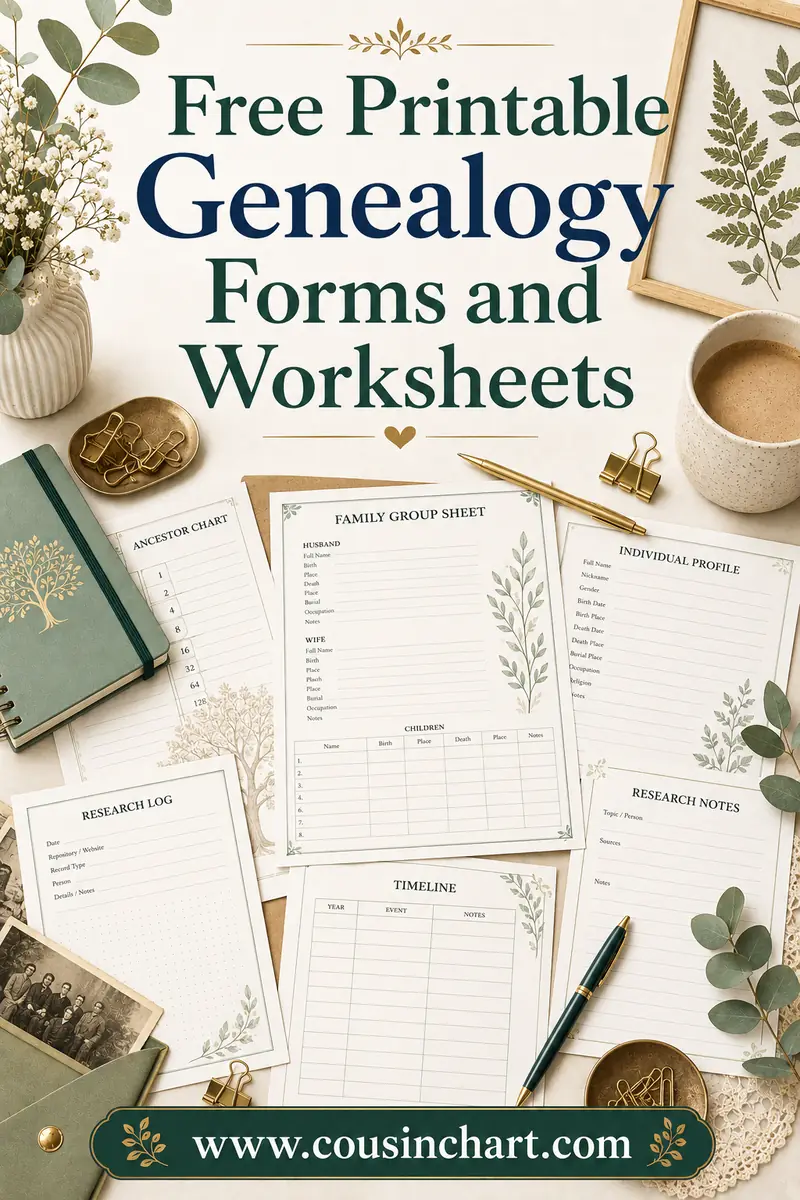
Free printables for this page
Download a blank PDF (US Letter or A4) — free, no sign-up — or customize it in the maker above before printing.
 Family Group Sheet
 5-Generation Pedigree Chart
 Ahnentafel Ancestor List
 Research Log
 Source Citation Log
 Family Interview Worksheet
Relationship quick-check: tap a phrase to see who they are — the kind of answers your forms will keep generating.
Tap a phrase above to see the answer.
Work out any family relationship →The full form lineup at a glance
| Form | What it records | When you need it |
|---|---|---|
| Pedigree chart | Your direct ancestors, 4–5 generations per page | Day one |
| Family group sheet | One couple + all their children | Day one |
| Ahnentafel form | Ancestors as a numbered list | When the tree passes ~4 generations |
| Research log | Every search you make, hit or miss | Week two, before amnesia sets in |
| Census extraction forms | One household from one census year | Your first census dive |
| Source/citation log | Where every fact came from | The first time you cite anything |
| Correspondence log | Letters, emails, DNA messages sent | First contact with a stranger-cousin |
| Interview worksheet | Questions + answers from a relative | Before the next family visit |
| Timeline worksheet | One ancestor's life, year by year | When an ancestor stops making sense |
| Cemetery transcription form | Headstone details, plot locations | Your first graveyard trip |
| Surname/locality checklist | Sources checked per family line | When one line becomes an obsession |
| DNA match log | Matches, shared cM, working theories | After the test results land |
Twelve forms sounds like bureaucracy; in practice they arrive one at a time, each solving a pain you've just felt. Here's each one, in the order the pain usually shows up.
The two day-one forms
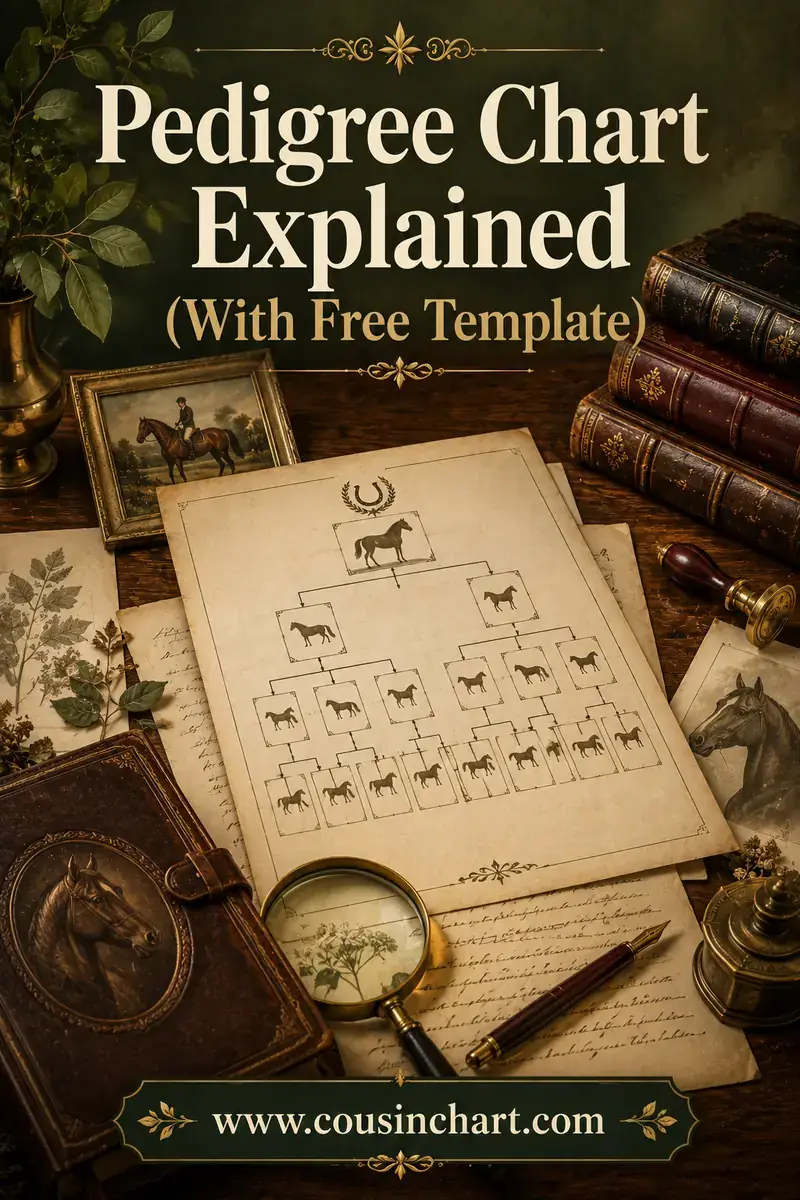
The pedigree chart is the spine — you in box 1, ancestors doubling to the right, 15 boxes per landscape page, chaining to further pages as lines extend. Everything else in the binder hangs off its numbering. Full field-by-field instructions live in the pedigree chart template guide.
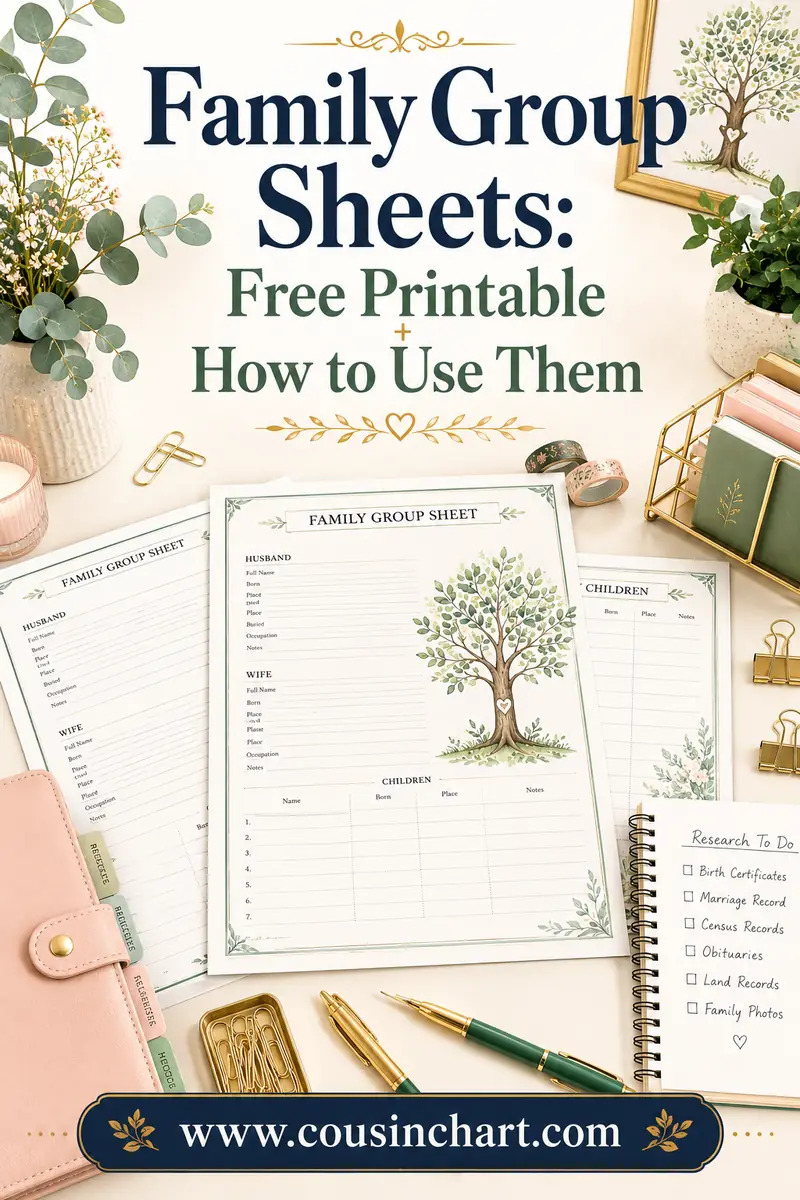
The family group sheet is the flesh — one page per couple, all their children in birth order, with birth/marriage/death facts for everyone. This is where siblings live, since the pedigree chart refuses to show them. One per ancestor couple, filed behind the chart; the complete how-to is in the family group sheet article.
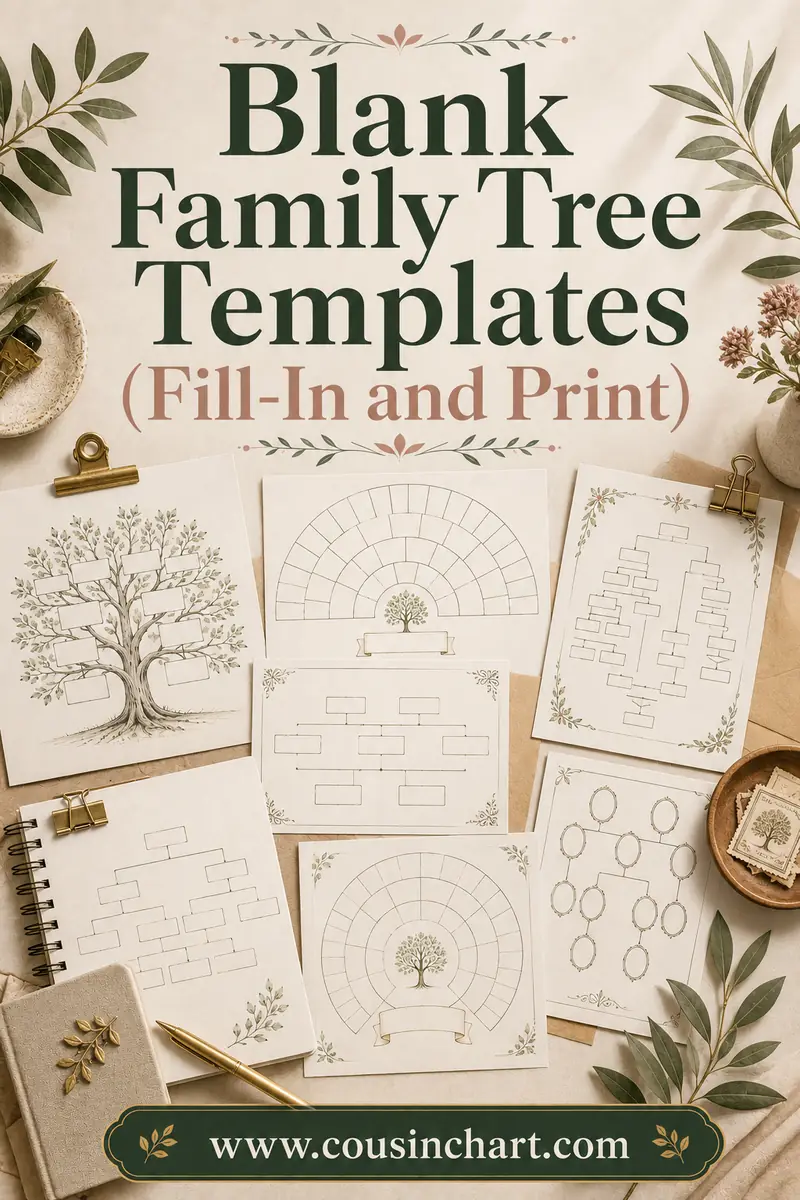
Those two, cross-referenced, were the entire filing system of pre-software genealogy, and they're still the fastest way to start. (If you want friendlier, decorative versions for a family project rather than research — a kid's school tree, a reunion handout — the blank family tree templates are the same data in warmer clothes.)
The memory-protection forms
The research log is the form everyone skips and then adopts with religious fervor around week three. One line per search: date, place searched ("FamilySearch, Iloilo civil registration index"), what you were looking for, and — critically — what you found, including nothing. Negative results are the whole point: without the log, you will re-search the same index for the same great-grandfather four times across two years. With it, you glance at a page and know the well is dry.
The source/citation log records where each fact came from, numbered so your charts can carry tiny superscripts. "B. 4 Jul 1921" is a claim; "b. 4 Jul 1921 ⁽³⁾" pointing to "source 3: baptismal register, St. William's Cathedral" is genealogy. When two documents disagree — and they will — the citations are how you re-weigh the evidence instead of shrugging.
The correspondence log tracks humans instead of records: the second cousin you emailed about photos, the parish office you wrote to, the DNA match who half-replied. One line each — date, who, what you asked, what came back, follow-up owed. Family research runs on slow replies, and this form is the difference between "following up warmly after two months" and "accidentally asking the same favor twice."
The record-extraction forms
Census extraction forms are gridded worksheets matching the columns of a specific census year, one household per sheet. Copying a record field-by-field into the grid forces you to actually read every column — occupation, literacy, immigration year, "mother of how many children" — instead of grabbing the names and moving on. Those overlooked columns are where the clues hide; extraction forms exist because skimmers miss them. Print the form for the year you're working; the pack's set covers the commonly searched decades.
The cemetery transcription form does the same job standing in a graveyard: exact inscription (spelling preserved, even when wrong), stone condition, plot location, neighbors — because who's buried adjacent is often the genealogical payload — plus a checkbox for "photographed." Fill it on-site; the phone photo alone always seems sufficient until you're home and can't read the stone's fourth line.
The timeline worksheet is the diagnostic form: one ancestor, one page, every known event and document year by year down the margin. Timelines expose the impossible (children born two years after a death), the invisible (a nine-year gap with no records — where were they?), and the mislabeled (two same-named cousins fused into one impossible person). When an ancestor "stops making sense," a timeline is the standard cure.
The people-work forms
The interview worksheet turns a family visit into a record: pre-printed prompts (full names, birthplaces, sibling lists, "who's older, your mom or Tito Ben?") with room for answers and for the stories that arrive uninvited. The best version is simply a family group sheet for the interviewee's parents plus a page of open questions — see the interview trick in the group sheet guide.
The surname/locality checklist manages an obsession: one surname or one town, with a checklist of source types — civil registration, parish books, censuses, land records, newspapers — ticked off as searched. It's the research log's strategic cousin: the log records what you did; the checklist shows what's left.
The DNA match log is the newest arrival: match name, testing site, shared centimorgans, predicted range, and your working theory of the connection. The theory column earns its ink — matches make sense in bursts months apart, and the log is where a half-formed hunch waits for its missing piece. When a theory firms up ("we both descend from the Navarro great-great-grandparents"), the free CousinChart calculator converts it to the actual relationship — third cousin, or third once removed — faster than counting on the chart.
A starter month with the forms
Abstract form lists don't start anybody, so here's the first month as an actual schedule — about two hours a week, forms named:
Week 1 — the memory dump. Print one pedigree chart and three family group sheets. Fill the chart's boxes 1–7 (you, parents, grandparents) from memory, then start a group sheet for each set of grandparents: the couple's block plus every child (your aunts and uncles) in birth order. Pencil throughout, question marks welcome. Most people finish with a chart two-thirds full and a sudden, specific awareness of what they don't know — which is the point.
Week 2 — the phone call. Take the question marks to the family's best rememberer with an interview worksheet (or just the blank group sheets — they're the better interview form anyway). Target boxes 8–15 of the chart: the eight great-grandparents. One good hour usually fills most of them and produces two more group sheets' worth of names. Log the call in the correspondence log — including what the rememberer couldn't answer, because that's next month's records list.
Week 3 — first records, first citations. Pick the great-grandparent with the most promising details and search the free index sites for one document — a census entry, a birth index line. Copy any census hit onto an extraction form, add the fact to the right sheets, and start the source log with citation #1. Also start the research log this week, with the searches that found nothing; future-you will thank present-you within the season.
Week 4 — file and aim. Set up the binder (next section), refile everything from the month, and write the top three open questions inside the front cover — "Who were Lola Carmen's parents?" beats "research more" as a mission statement. If a DNA test is in the picture, this is the week to start the match log with your top ten matches and zero theories, which is how every match log legitimately begins.
A month in, you'll have maybe fifteen filled pages — a spine, flesh on two generations, one cited document, and named targets. That's not a modest start; that's further than most "I should really do our family tree someday" projects ever get, and every later form joins a system that already works.
The binder system that keeps it findable
Three hundred filled forms with no system is a second research problem. The standard setup:
- One binder per grandparent line — four binders, four surnames, matching how research naturally splits.
- Front of binder: the pedigree chart pages for that line, then an index of chart numbers.
- Behind the charts: family group sheets in ahnentafel-number order — couple 4/5, then 8/9, and so on.
- Behind each group sheet: that family's supporting forms — extractions, timelines, correspondence — so everything about one household sits together.
- Back pocket: the logs (research, source, DNA), which span the whole line.
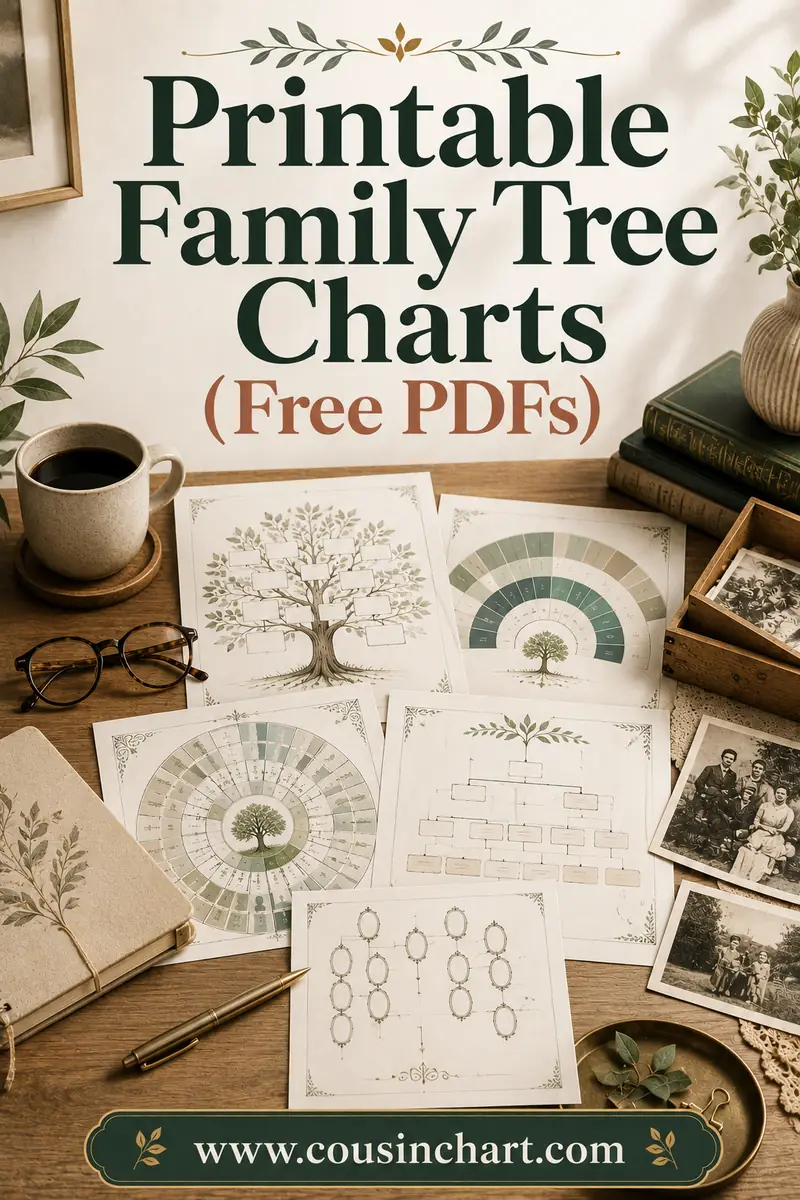
Print working forms on 24–32 lb paper (they're handled for years), punch the pre-margined edge, and refile the same evening you research — the system fails exactly as fast as the refiling does. Two refinements once the binders thicken: a colored divider tab per family group sheet, so a binder flips open to any couple in seconds, and a photocopied "master pedigree" in each binder's very front showing all four lines at once — the map that tells a future reader (or future you) which binder holds what. The display-worthy charts — the fan for the wall, the reunion poster — aren't binder forms at all; they're covered in printable family tree charts.
FAQ
What genealogy forms do I actually need to start?
Two: a pedigree chart for your direct ancestors and family group sheets for each couple on it. Add a research log within the first few weeks — it's the form that prevents repeating searches — and let the specialized forms join as the research demands them.
Where can I get free printable genealogy forms?
The free CousinChart printable pack includes the core set — pedigree charts, family group sheets, an ahnentafel form, research and source logs, and interview worksheets — as PDFs with no account required. Print at 100% scale on Letter or A4.
What is a genealogy research log for?
Recording every search you make — where, when, what for, and what you found, including negative results. Its job is preventing the most common waste in genealogy: re-searching a source you already exhausted months ago.
What is a census extraction form?
A worksheet whose grid matches the exact columns of one census year, used to copy a household's record field by field. Extracting forces you to read every column — occupation, immigration year, children born — which is where overlooked clues usually hide.
How should I organize completed genealogy forms?
The classic system: one binder per grandparent surname, pedigree charts up front, family group sheets behind them in chart-number order, each family's supporting forms filed behind its sheet, and the ongoing logs in the back. Refile the day you research.
Are paper forms still worth using instead of genealogy software?
For gathering, interviewing, and kitchen-table work, yes — paper needs no login, survives being passed around, and relatives correct a paper chart far more readily than a screen. Most researchers use both: forms to collect and verify, software to store at scale.
Print the starter set tonight
Start embarrassingly small: one pedigree chart, three family group sheets, one research log — the free CousinChart printable pack has all three waiting. Fill the chart's first seven boxes from memory, start a group sheet for your grandparents, and log your first search this week. The other forms will introduce themselves the moment you need them. And when the forms start surfacing relatives with complicated labels — the half-granduncles, the cousins twice removed — the free relationship calculator names every one of them.