What Is Next of Kin? The Legal Order, Explained
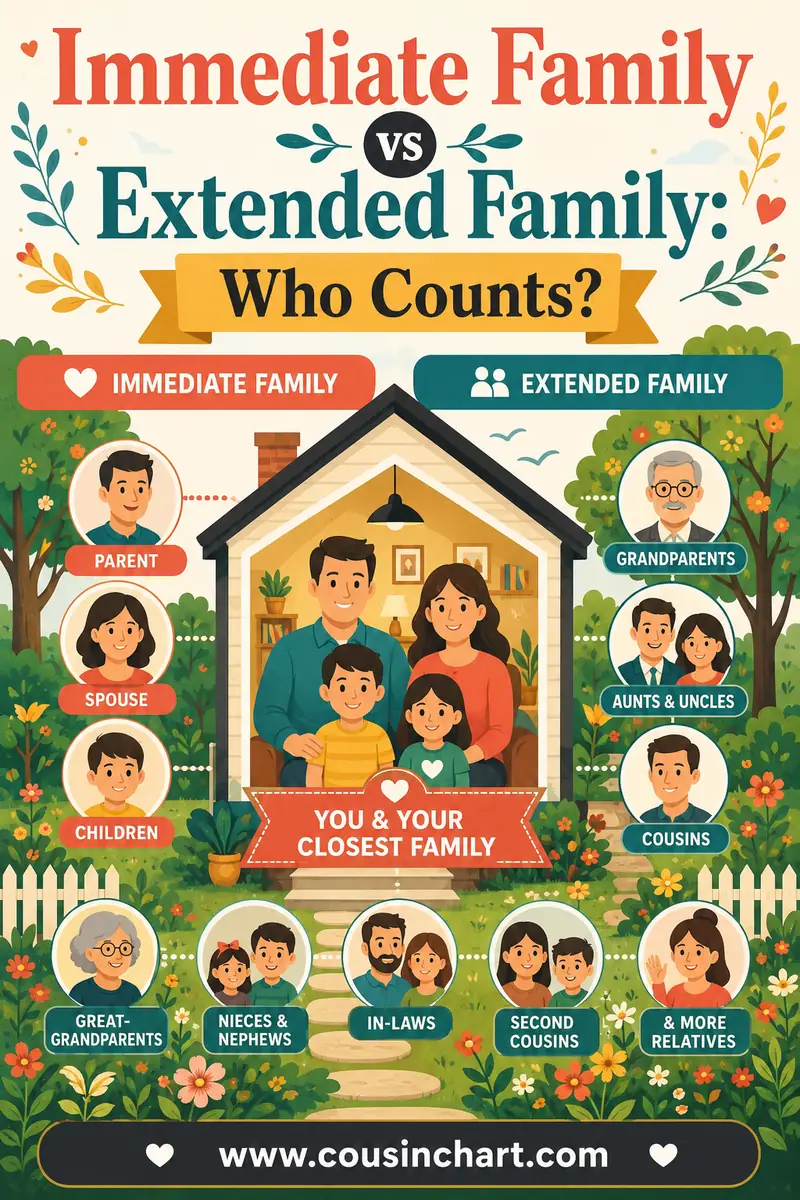
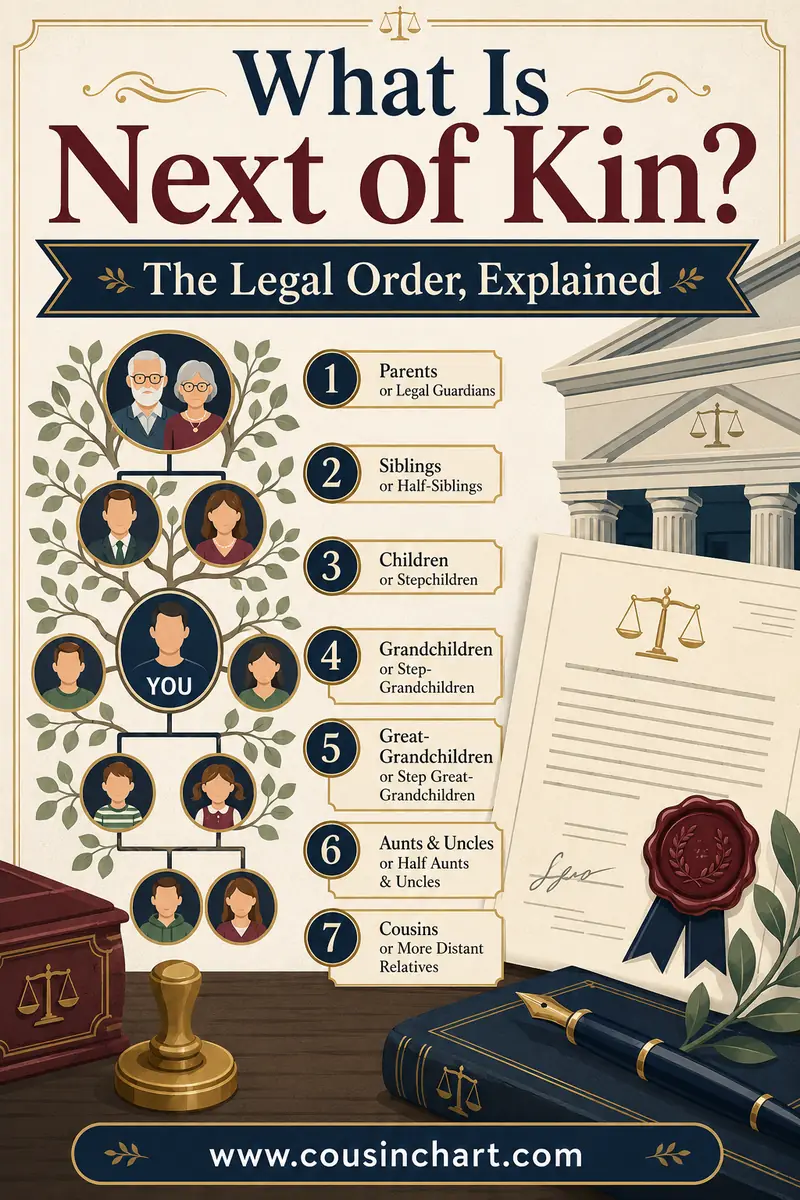
Next of kin means a person's closest living relatives — and in US practice the order typically runs: spouse, then children, then parents, then siblings, then outward to grandchildren, grandparents, nieces and nephews, aunts and uncles, and finally cousins. The exact order and its tie-breakers are set by each state's laws and differ by context (inheritance, medical decisions, funeral arrangements), so the list here is the common pattern, not a substitute for the current law where you live.
Understanding the ladder matters because it decides real things when someone hasn't left instructions: who inherits, who's consulted in a hospital, who claims remains. This guide walks the typical order, the special cases (half-siblings, adoption, steps), and how to override the defaults. And when a form asks how exactly you're related to someone, the free family relationship calculator on our homepage gives you the precise term instantly.
Relationship quick-check. Tap a phrase to see where they typically stand:
The answer will appear here.
What "Next of Kin" Actually Means
The phrase does double duty, and it helps to separate the jobs:
- Everyday meaning: your closest living relatives — the people a hospital calls, the names on an emergency form.
- Legal meaning: the relatives who, in a specific ranked order, get rights and responsibilities when someone dies without a will (intestate) or can't speak for themselves — inheriting property, making funeral decisions, sometimes being consulted on medical care.
The crucial thing about the legal version: it's a default, not a destiny. The order only takes over where no document — will, healthcare proxy, beneficiary designation — says otherwise. Nearly every hard next-of-kin story is really a missing-paperwork story.
The Typical Order, Rung by Rung
Most US states' intestacy and kinship rules follow this general shape:
| Rank | Who | Notes |
|---|---|---|
| 1 | Spouse | Legal spouse; shares vary when children exist |
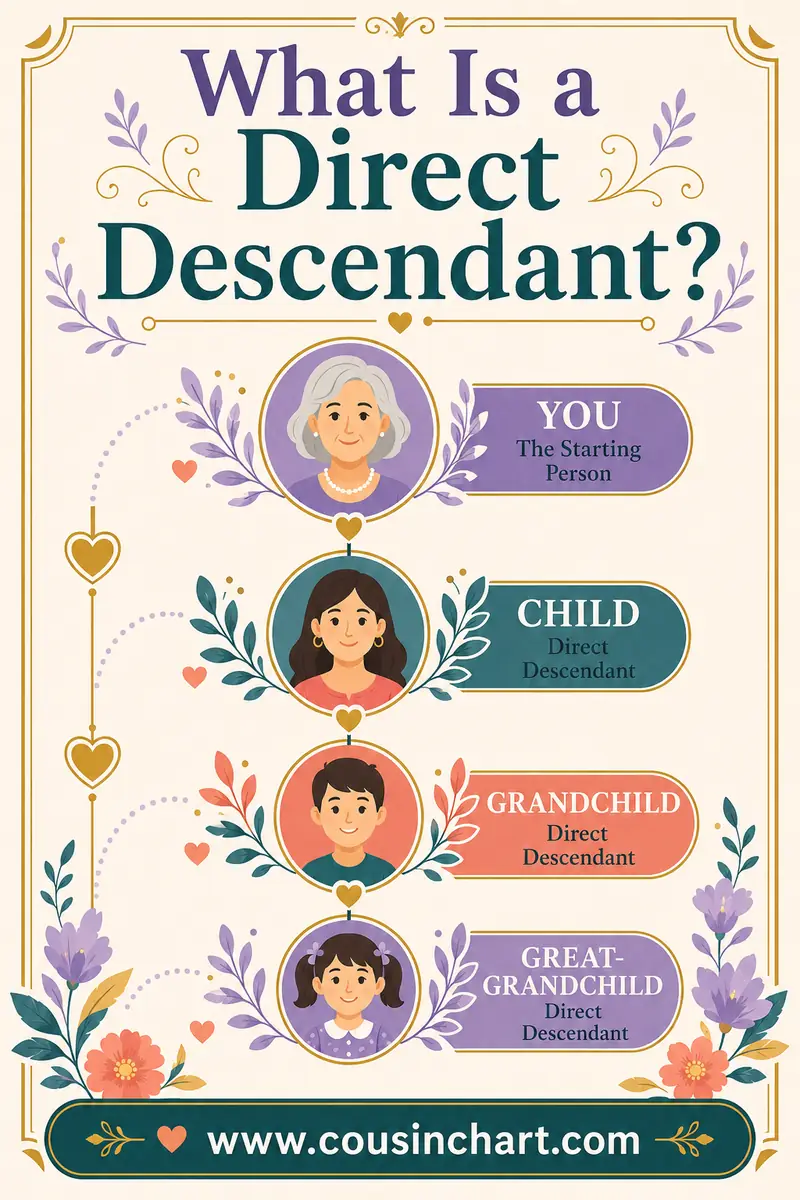
| 2 | Children | Biological and adopted equally; grandchildren step into a deceased child's place |
| 3 | Parents | Often split if both living |
| 4 | Siblings | Half-siblings often count fully (varies); nieces/nephews step into a deceased sibling's place |
| 5 | Grandparents | Sometimes split maternal/paternal |
| 6 | Aunts, uncles | Then their descendants — your first cousins |
| 7 | Cousins and beyond | Increasingly remote "laughing heirs"; if truly no one, property escheats to the state |
Three structural rules make the ladder work:
- Closer ranks exhaust before farther ones. If any children exist, siblings inherit nothing by default.
- Representation (per stirpes): descendants of a deceased person in a rank take that person's share — your late sister's kids stand in her spot.
- Degrees break ties at the far end. When only distant relatives remain, states count degrees of kinship — steps up to the common ancestor and back down — to decide who's "nearest."
Every state customizes this machine (spousal shares especially), and community-property states have their own math. Treat the table as the melody, not the sheet music.
Where the Order Shows Up in Real Life
- Dying without a will. Intestate succession distributes the estate down the ladder. This is the biggest and most rule-bound use.
- Medical decisions. If you can't consent and named no healthcare agent, most states have a surrogate hierarchy — typically spouse, adult children, parents, siblings — that clinicians consult. Details differ meaningfully by state.
- Funeral and remains. The right to arrange burial or cremation generally follows a similar order.
- Notification. Hospitals, coroners, and the military notify next of kin first; here the phrase is practical, not property-related.
- Miscellaneous law. Unclaimed property, wrongful-death claims, and some benefits programs each carry their own kin definitions.
The same two words, five different rulebooks — which is why "who is the next of kin?" has no single answer without asking "for what purpose, in which state?"
The Cases People Get Wrong
- Unmarried partners. However long the relationship, a partner is generally not next of kin without marriage (or a state-recognized partnership). This is the single most consequential surprise on the list — and entirely fixable with documents.
- Stepchildren and step-parents. Step-relationships usually carry no default inheritance or surrogacy rights unless there was a legal adoption. A step family can be someone's whole world and still be invisible to intestacy law.
- Adopted children. The clean opposite: adoption creates full legal kinship — adopted children rank identically to biological ones, and in most states an adopted-out child inherits from the adoptive family, not the birth family.
- Half-siblings. Blood relatives at half the usual share of DNA — but many states rank them equally with full siblings for inheritance, while some discount them. A classic "check your state" line item.
- Ex-spouses. Divorce removes spousal status; in most states it also automatically revokes will gifts to the ex. Separation without divorce usually doesn't — another paperwork trap.
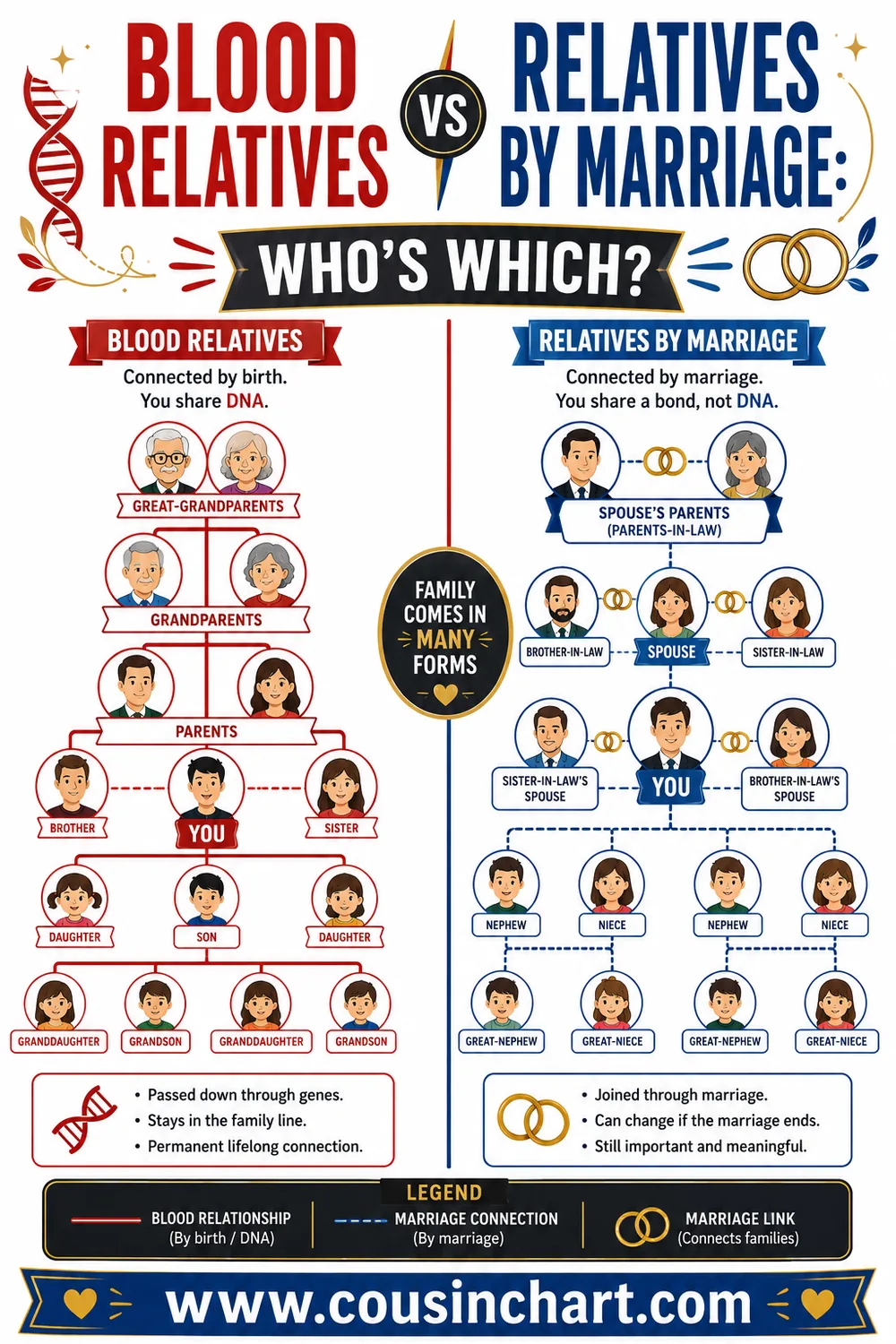
- In-laws. Relatives by marriage sit outside the blood-and-adoption ladder entirely. Your mother-in-law is never your legal next of kin.
Degrees of Kinship: How the Law Counts "Closeness"
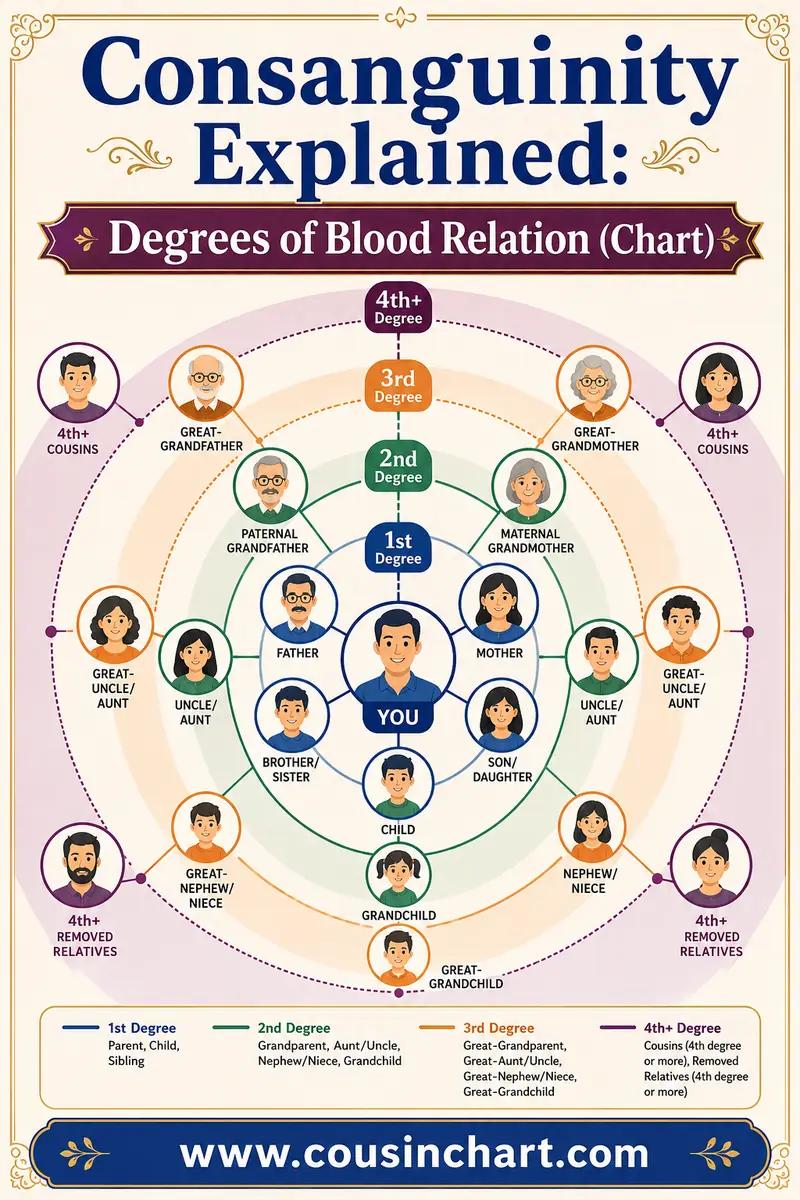
When courts need to rank distant relatives, most use civil-law degree counting: count the steps from the deceased up to the common ancestor, then down to the claimant. Each step is one degree; lowest total wins.
| Relative | Count | Degree |
|---|---|---|
| Child / parent | 1 | 1st |
| Sibling | up 1, down 1 | 2nd |
| Grandparent / grandchild | 2 | 2nd |
| Aunt, uncle, niece, nephew | 3 | 3rd |
| First cousin | up 2, down 2 | 4th |
| First cousin once removed | 5 | 5th |
| Second cousin | 6 | 6th |
Notice the quirk: a first cousin (4th degree) and a great-great-grandparent (4th degree) tie, even though they feel nothing alike. Degree math is exactly the kind of counting humans fumble and calculators don't — if a probate notice ever asks how you relate to a distant decedent, work the path out with the relationship calculator before you fill anything in.
How to Override the Defaults (The Part That Actually Matters)
The entire next-of-kin ladder is a fallback. A modest stack of documents replaces it with your actual wishes:
- A will — directs your property, names an executor, and can name guardians for minor children.
- A healthcare proxy / medical power of attorney — names your medical decision-maker, jumping every rung of the surrogate ladder.
- Beneficiary designations — life insurance and retirement accounts pass by their named beneficiaries, outside the will entirely; keep them current.
- A financial power of attorney — covers money decisions while you're alive but incapacitated.
If you remember one sentence from this article: next of kin is who the law guesses you'd choose; documents are how you stop it from guessing. None of this page is legal advice — for real planning, state-specific rules and a local professional are the way.
A Worked Scenario: One Estate, Down the Ladder
Watch the machine run once and the rules stop feeling abstract. Ruth dies without a will. Applying the typical order:
- Is there a spouse? Ruth was widowed — rung 1 is empty, move down.
- Children? She had two: Dana, living, and Mark, who died before her leaving two kids. Rung 2 has takers, so the search stops here — parents, siblings, and everyone below get nothing by default.
- How does it split? Representation kicks in: Dana takes half, and Mark's half passes down to his two children — a quarter each. Mark's widow, being an in-law, takes nothing through intestacy.
Now rewind and change one fact: Ruth had no children. Her parents are deceased, so the estate drops to rung 4 — her brother Al, plus the children of her late sister standing in their mother's place. Change one more fact — no siblings or their descendants either — and suddenly the probate court is counting degrees among cousins, and a genealogist may be hired to prove who exists. Estates really do resolve this way every day, one empty rung at a time.
FAQ
What is the usual next of kin order?
Spouse, children, parents, siblings — then grandchildren, grandparents, nieces/nephews, aunts/uncles, and cousins. Every state sets its own version and context (inheritance vs medical) changes the details, so always check current local law.
Is my spouse automatically my next of kin?
A legal spouse is at or near the top of essentially every state's order for inheritance, medical surrogacy, and remains. An unmarried partner is generally not next of kin — naming them in documents is what gives them standing.
Do stepchildren count as next of kin?
Usually not, unless legally adopted. Step-relationships generally carry no default inheritance or decision-making rights — one of the most common and painful surprises in blended families.
Are half-siblings next of kin?
Yes — they're blood relatives and appear in the sibling rank. Many states count them equally with full siblings for inheritance; a minority give them reduced shares. It varies, so check your state.
Who is next of kin if someone is single with no kids?
Typically their parents; if the parents are deceased, their siblings (with nieces and nephews stepping into a deceased sibling's place); then outward to grandparents, aunts and uncles, and cousins.
Can I choose my own next of kin?
You can't rewrite the statutory ladder, but you can outrank it: a will, healthcare proxy, and beneficiary designations put your chosen people in charge for nearly every purpose the ladder would otherwise decide.
Know Exactly Where Everyone Stands
So: next of kin = closest living relatives, typically spouse → children → parents → siblings and outward, always subject to your state's rules — and always trumped by good paperwork. The ladder runs on precise relationship definitions, which is where most of us get shaky past the second rung. Whenever you need to know exactly what someone is to you — for a form, a family tree, or a probate letter — the free family relationship calculator traces the connection and names it in seconds.