Blood Relatives vs Relatives by Marriage: Who's Which?
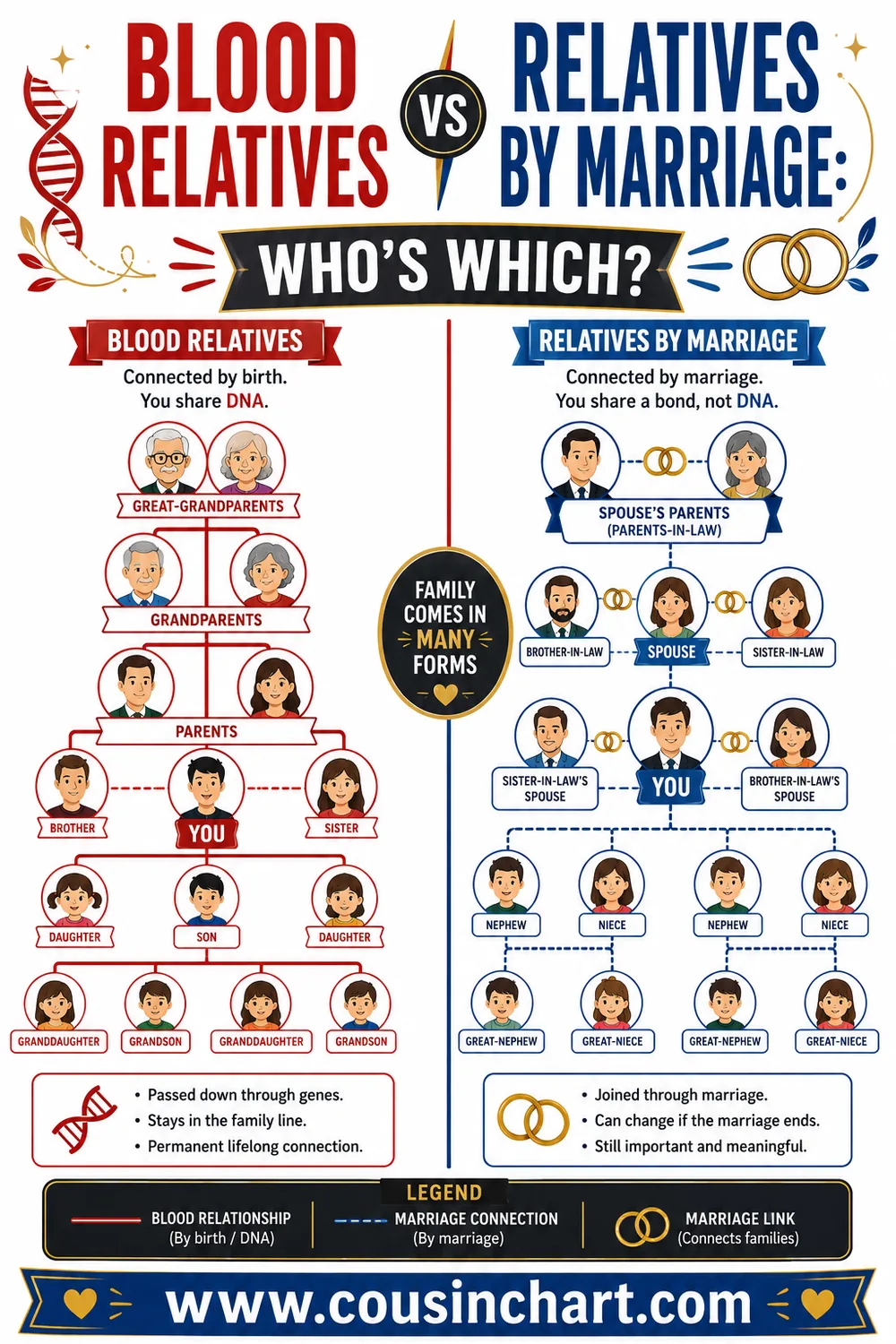
A blood relative shares a common ancestor with you — a parent, grandparent, or someone further back — which means you share DNA. A relative by marriage is connected to you only through a wedding: your in-laws, step-relatives, and everyone who "married in." They can be family in every way that matters daily, but no ancestor links you and no DNA passes between you.
That single line sorts almost everyone at your reunion into two columns. This guide draws the full chart, covers the tricky middle cases (half-siblings, step-siblings, adoption), and explains the three situations where the blood/marriage distinction genuinely matters. To trace any specific person, the free family relationship calculator maps the connection — blood or marriage — in seconds.
Relationship quick-check. Tap a relative to see which side of the line they're on:
The answer will appear here.
The Two Kinds of Kinship (Plus a Third)
Anthropologists and lawyers use the same two technical words for this split:
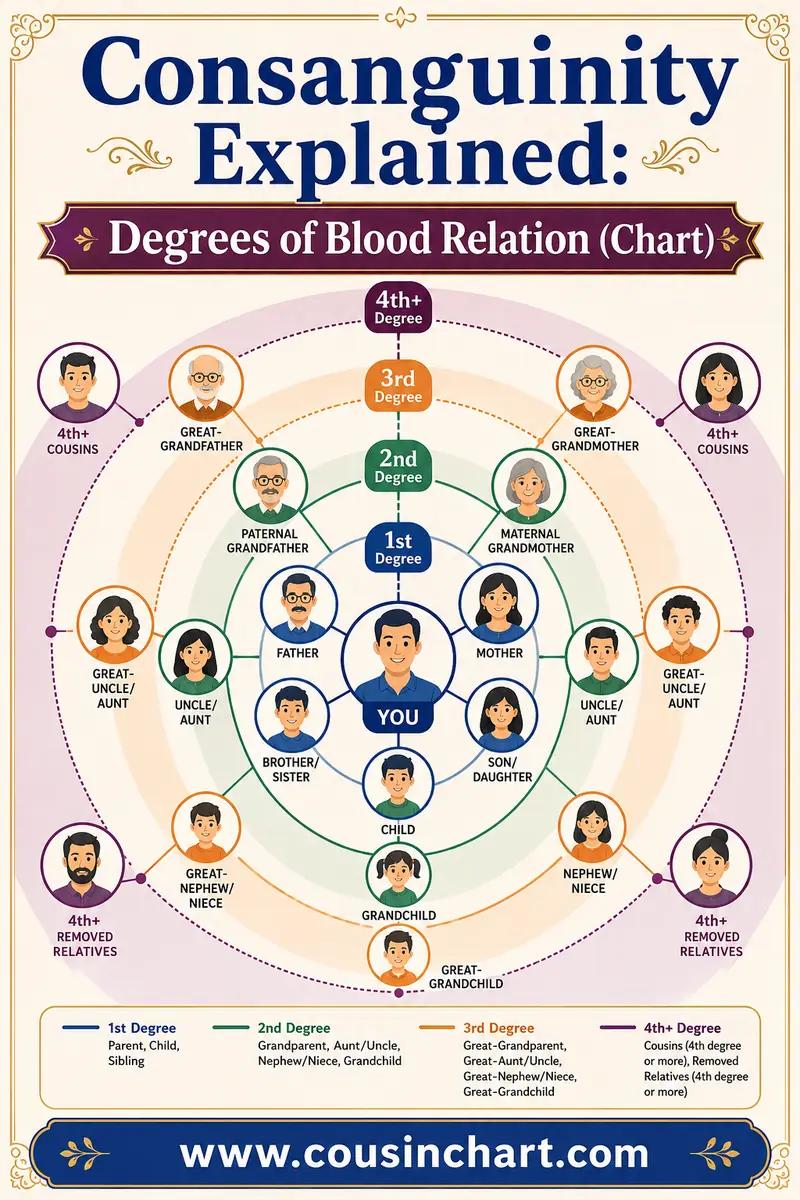
- Consanguinity — kinship by blood, from the Latin for "shared blood." Anyone who descends from a common ancestor with you. The closeness is measured in degrees, which we chart fully in consanguinity explained.
- Affinity — kinship by marriage. Your spouse, and the bridge relationships marriage creates: in-laws on their side, and the spouses who joined your side.
And there's a third category modern law treats as its own thing: legal kinship by adoption. An adopted child is not a blood relative of the adoptive parents, but the law makes the relationship complete — inheritance, next-of-kin status, everything. On paper, adoption outranks affinity: an adopted child is simply a child.
The Family Blood Relation Chart
Here's where common relatives fall, with average shared DNA for the blood column:
| Relative | Blood or marriage? | Avg. shared DNA |
|---|---|---|
| Parent, child | Blood | 50% |
| Full sibling | Blood | ~50% |
| Half-sibling | Blood | ~25% |
| Grandparent, aunt/uncle, niece/nephew | Blood | ~25% |
| First cousin | Blood | ~12.5% |
| Great-grandparent, great-aunt/uncle | Blood | ~12.5% |
| First cousin once removed | Blood | ~6.25% |
| Second cousin | Blood | ~3.125% |
| Spouse | Marriage (affinity) | 0% |
| Mother-/father-in-law | Marriage | 0% |
| Brother-/sister-in-law | Marriage | 0% |
| Aunt/uncle by marriage | Marriage | 0% |
| Step-parent, step-sibling, step-child | Marriage | 0% |
| Adopted sibling/child | Legal (adoption) | 0%* |
*Unless the adoption happened within the biological family — a grandparent adopting a grandchild, for instance — in which case blood and legal kinship overlap.
One row surprises people every time: your spouse shares none of your DNA (outside of cousin marriages), yet your children are blood relatives of both of you. Marriage doesn't mix blood; children do.
The Tricky Middle Cases
Half-siblings: fully blood
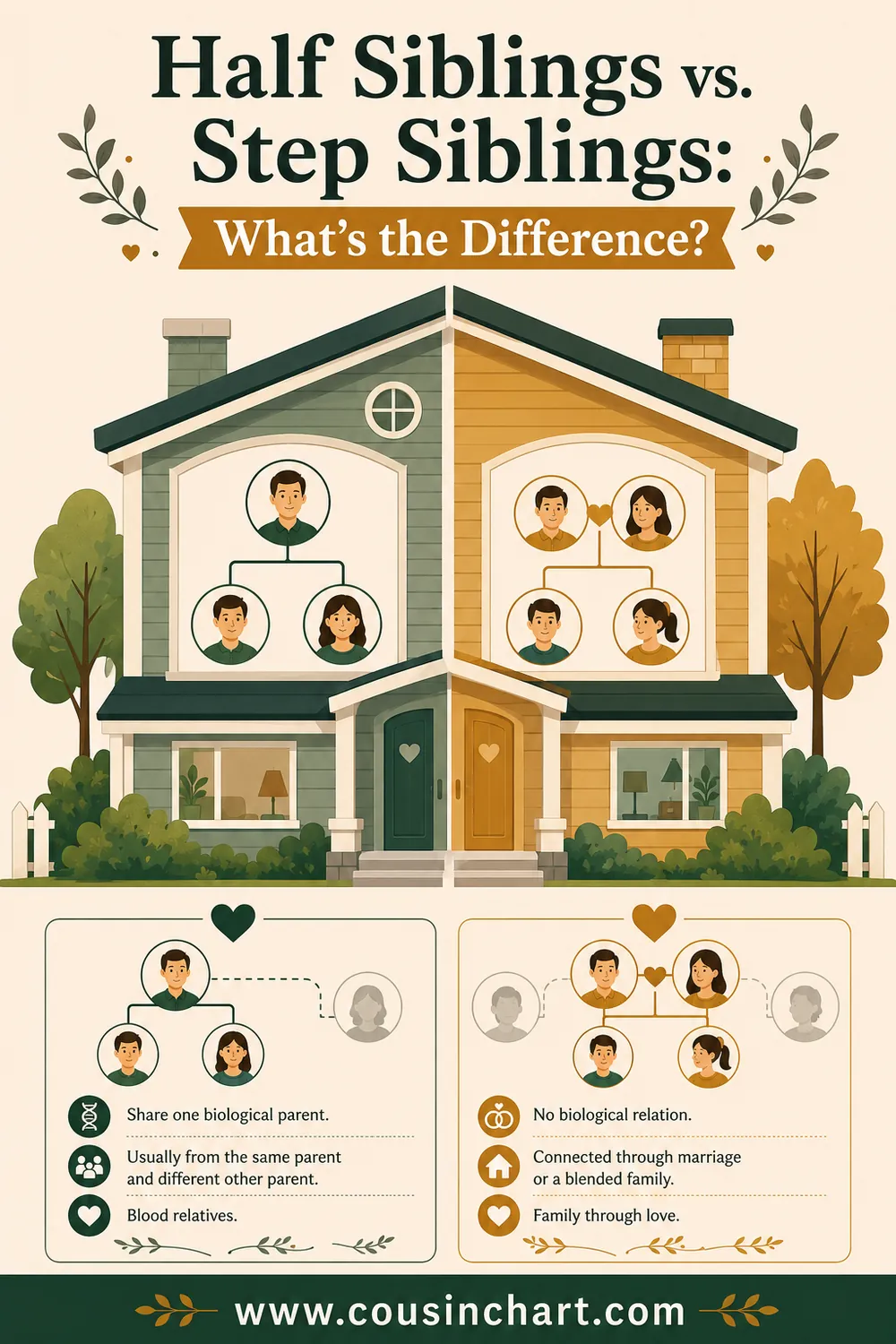
A half-sibling shares one parent with you — a genuine common ancestor — so they're unambiguously a blood relative, at about 25% shared DNA. The "half" describes the genetic quantity, not the realness. Step-siblings, by contrast, share zero ancestors with you: they're the children your step-parent brought along. The full comparison lives at half siblings vs step siblings.
Step-relatives: marriage, with an asterisk
Step-kinship comes from a parent's remarriage, so it's affinity. But note the generational twist: if your parent and step-parent have a child together, that child is your half-sibling — blood. One household can easily hold blood, step, and half relationships around one dinner table, all real family.
Cousins' spouses and spouses' cousins
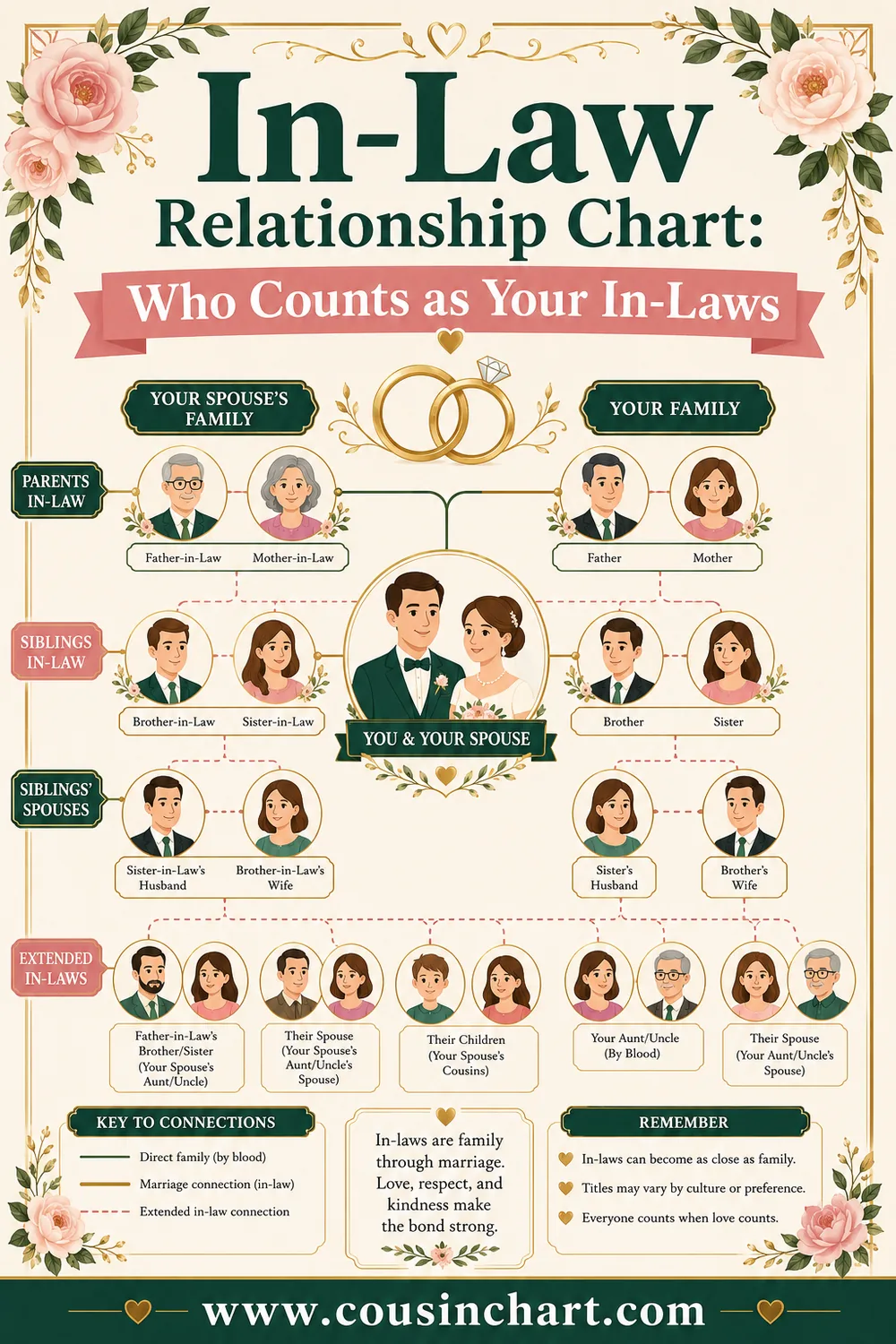
Everyone your cousins marry, and everyone your spouse is related to, lands in the marriage column. The full map of who formally counts is in the in-law relationship chart.
Double cousins: blood, doubled
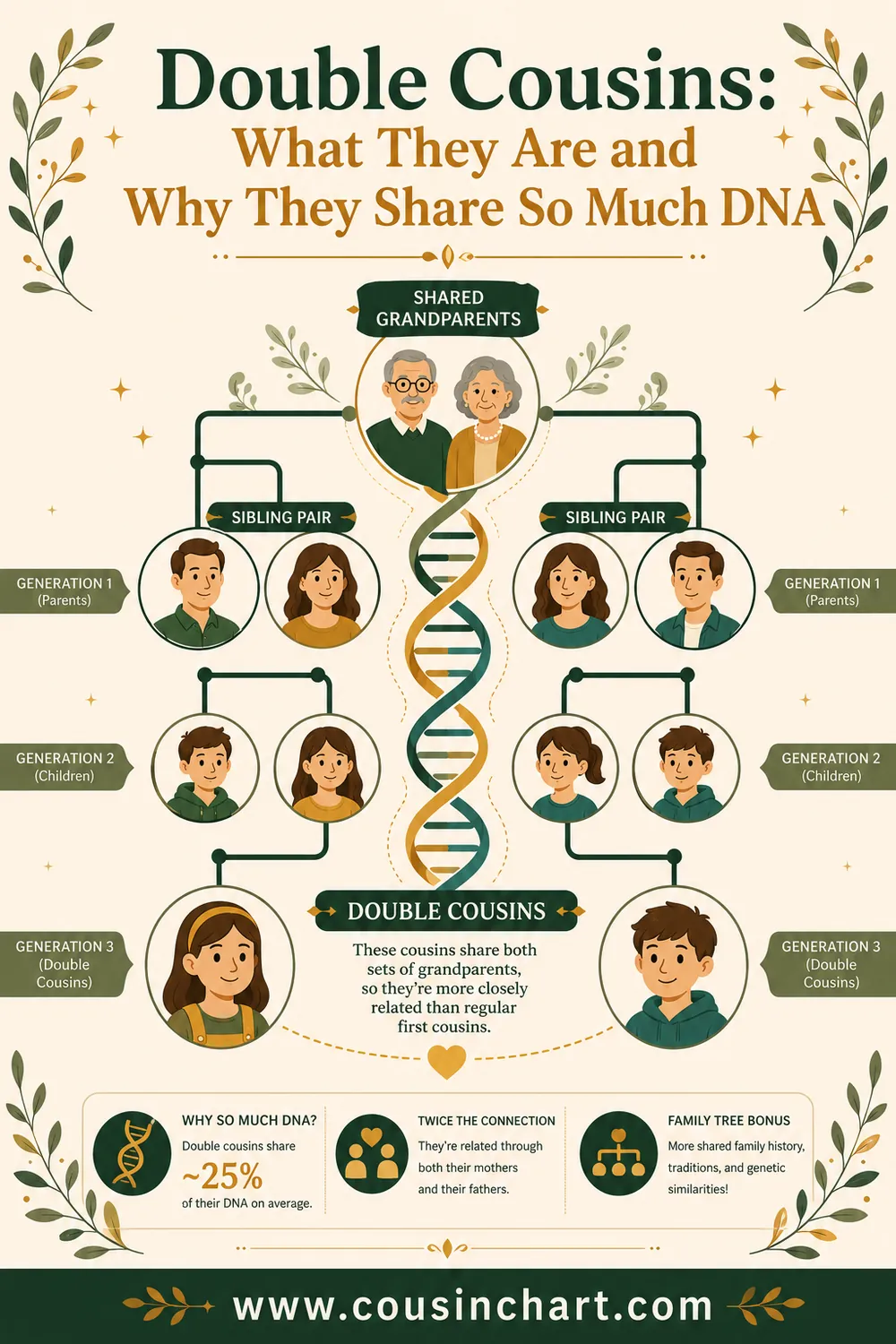
When two siblings from one family marry two siblings from another, their children are double first cousins — blood relatives through both parents, sharing about 25% DNA instead of the usual 12.5%. It's the rare case where the blood column gets more concentrated than the chart predicts. Details in double cousins.
When the Difference Actually Matters
Most of the time, family is family. Three contexts make the blood/marriage line genuinely important:
- Family health history. When a doctor asks about heart disease or cancer "in your family," they mean blood relatives only — and mainly first-degree (parents, siblings, children) and second-degree (grandparents, aunts/uncles, half-siblings, nieces/nephews). Your beloved uncle-by-marriage's diabetes tells your doctor nothing about your risk. Knowing which column each relative sits in makes your medical intake forms meaningfully more useful.
- Inheritance without a will. Intestacy laws distribute estates through blood and adoptive kin, in order of closeness — spouse first (the great exception in the marriage column), then children, parents, siblings, and outward through the cousin grid. In-laws and step-relatives generally inherit nothing by default. A stepchild who was never legally adopted can be left out entirely, no matter how close the relationship was — one of the most common and painful surprises in probate.
- DNA testing. Your match list is a pure blood-column document. A step-sibling or a cherished aunt-by-marriage simply won't appear, while a stranger sharing your great-great-grandparents will. If a "sibling" match comes back at ~25% instead of ~50%, that's the genetics of a half-sibling — the test can't see household history, only ancestry.
Worked Household: Sorting One Blended Family
Try the two-column test on a realistic household. Rita and Sam married five years ago, each bringing history. Around their table on a given Sunday: Rita's daughter Nina (from her first marriage), Sam's son Cole (from his), their shared toddler Ben, Rita's brother Leo, Leo's wife Dana, and Sam's mother.
Sort them from Nina's point of view:
- Rita — blood. Her mother, 50% shared DNA.
- Sam — marriage. Step-father: affinity through Rita's remarriage.
- Cole — marriage. Step-brother; no shared ancestor anywhere.
- Ben — blood. Half-brother through Rita, ~25% shared DNA. The one bridge person: Ben is blood kin to everyone at the table except Dana.
- Leo — blood. Maternal uncle, ~25%.
- Dana — marriage. Aunt by marriage: full title, zero DNA.
- Sam's mother — marriage. Step-grandmother to Nina; blood grandmother to Cole and Ben.
Now re-sort from Cole's point of view and watch half the labels flip: Rita becomes the step-parent, Nina the step-sibling, Leo and Dana disappear into "step-uncle territory" (no formal term at all), and Sam's mother crosses into the blood column. Same table, two different charts — because blood/marriage status is always a property of a pair, never of a person.
The toddler is the useful oddity. Ben shares ~25% DNA with Nina, ~25% with Cole — yet Nina and Cole share 0% with each other. DNA doesn't flow through Ben; he's simply the one person whose ancestors include both Rita's line and Sam's. On a DNA test, Nina and Cole would each match Ben strongly and each other not at all. If you ever need to explain blended-family genetics in one sentence, that's the sentence.
"Blood Is Thicker Than Water" — a Quick Fact-Check
Since the proverb props up half the arguments about this topic, it's worth checking its papers. The saying, in its familiar meaning — family bonds beat other bonds — is genuinely old: versions appear in medieval German (the fox epic Reinhart Fuchs, around 1180) and it entered English centuries ago with the same sense it has now.
You may also have seen a viral claim that the "original" phrase was "the blood of the covenant is thicker than the water of the womb" — supposedly meaning chosen bonds outrank birth family. It's a satisfying reversal, but there's no historical evidence for it: that version appears nowhere before the modern era, and etymologists treat it as an internet-age invention. If you like the sentiment, keep it — plenty of true things were coined last week — just don't cite it as the proverb's secret original meaning.
The genealogist's verdict on the proverb itself: unhelpful either way. Blood measures ancestry, not loyalty. The chart above tells you who shares your DNA; it has never once predicted who shows up to help you move.
The Third Column Nobody Charts: Fictive Kin
Beyond blood, marriage, and adoption, most cultures maintain a thriving category anthropologists call fictive kinship — people who hold family roles without any genealogical or legal link:
- Godparents. In many Catholic and Orthodox communities, godparenthood is a serious, named bond — Spanish compadre/comadre and Filipino kumpare/kumare literally make the parents and godparents co-relatives of a sort, a relationship (compadrazgo) with real social obligations.
- Honorary aunts and uncles. A parent's best friend who has attended every birthday since your first. No chart position, decades of service.
- Milk kinship and sworn brotherhood. Historically, being nursed by the same woman or swearing formal brotherhood created recognized kin ties in many societies — some with marriage restrictions attached, treated as seriously as blood.
Fictive kin never appear on a DNA test, rarely appear in intestacy law, and don't belong on a pedigree chart — yet they routinely outperform both official columns at actual family work. Genealogy has no cell for them, and that's fine: the chart's job is to track descent and law, not devotion. Just don't let anyone use the chart to demote them.
How the Law Actually Uses the Two Columns
"Related by blood or marriage" is boilerplate in an astonishing number of legal documents, and the two columns behave differently once lawyers get involved:
- Blood (consanguinity) is measured in degrees. Courts typically use civil-law counting — steps up to the common ancestor plus steps back down — so a parent is 1st degree, a sibling 2nd, an aunt 3rd, a first cousin 4th. Statutes then draw lines at a degree: "no juror related to a party within the 6th degree," marriage prohibitions "within the 4th degree," and so on.
- Marriage (affinity) is measured by borrowing. Your affinity degree to your spouse's relatives mirrors your spouse's blood degree to them: your mother-in-law is 1st-degree affinity because she's your spouse's 1st-degree blood relative. Conflict-of-interest and nepotism rules often cover both columns to the same depth for exactly this reason.
- Affinity usually dies with the marriage; blood never does. Divorce generally ends legal affinity (with carve-outs — some courts have held that affinity persists for certain purposes while children of the marriage are alive). Death is murkier and jurisdiction-dependent. Blood degrees, by contrast, are permanent facts: no paperwork can un-cousin anyone.
- Adoption rewires the blood column itself. Legally, an adopted person's kinship transfers to the adoptive family — degrees and all — which is why an adopted child's adoptive first cousin is, for legal purposes, simply a first cousin.
None of this changes who brings the potato salad. But if you ever meet the phrase "within the third degree of consanguinity or affinity" on a form — jury duty, government hiring, notary rules — you now know it's asking you to run both columns of this chart, three steps deep.
Both Columns Are Real Family
A quick word against snobbery in either direction. "Blood is thicker than water" gets quoted as if the blood column outranks the other — but the marriage column contains your spouse, quite possibly the most important relative you'll ever have, and the adoptive column contains parent-child bonds as complete as any on earth. Genealogy needs the distinction because ancestry, genetics, and probate law need it. Daily life mostly doesn't.
That's also how our relationship calculator treats it: trace any path — through a marriage, a half-sibling, a great-grand-aunt — and it names the relationship and tells you whether DNA flows along it, without ranking anybody's family.
FAQ
Is my sister-in-law a blood relative?
No — whether she's your spouse's sister or your brother's wife, the connection runs through a marriage, so you share no common ancestor and no DNA. Her children with your brother, however, are your blood nieces and nephews.
Are half-siblings blood relatives?
Yes, completely. You share a parent, which makes you consanguine kin at about 25% shared DNA — the same average as a grandparent or an aunt. Only step-siblings fall in the marriage column.
Is my husband my blood relative?
No (assuming you're not cousins). Spouses are related by affinity — marriage — and share no DNA. Your children are blood relatives of you both, which is how two unrelated family trees braid into one.
Do relatives by marriage inherit from me?
By default, generally not — intestacy laws pass estates through your spouse, then blood and adoptive relatives. Your spouse is the big exception with strong statutory rights. To leave anything to other in-laws or step-relatives, you need a will. Laws vary by state, so check current local law.
Which relatives count for family medical history?
Blood relatives only, and the closer the better: parents, siblings, and children first; then grandparents, aunts and uncles, half-siblings, nieces and nephews. Conditions among in-laws and step-relatives don't affect your genetic risk.
Are godparents relatives?
Not in either column — godparenthood is fictive kinship: a socially (and often religiously) recognized bond with no genealogical or default legal standing. In compadrazgo cultures it carries serious obligations and honored titles, but a godchild doesn't inherit by intestacy and won't share DNA unless the godparent was also chosen from among blood kin, which many families deliberately do.
Is an adopted child a blood relative?
Genetically no, legally yes — adoption creates full legal kinship, equal to a biological child for inheritance and next of kin. Most families, sensibly, never think about the distinction again.
Sort Your Whole Tree in Seconds
The test is always the same question: do we descend from a common ancestor? Yes → blood, with DNA shared in halving doses. No → marriage or adoption, which can carry every bit as much love and (in adoption's case) full legal weight. When a particular relative resists easy sorting — your step-dad's brother, your half-aunt's husband — open the free family relationship calculator, tap out the path, and get the exact term plus which column it belongs to. Faster than the argument, and it settles it permanently.