In-Law Relationship Chart: Who Counts as Your In-Laws
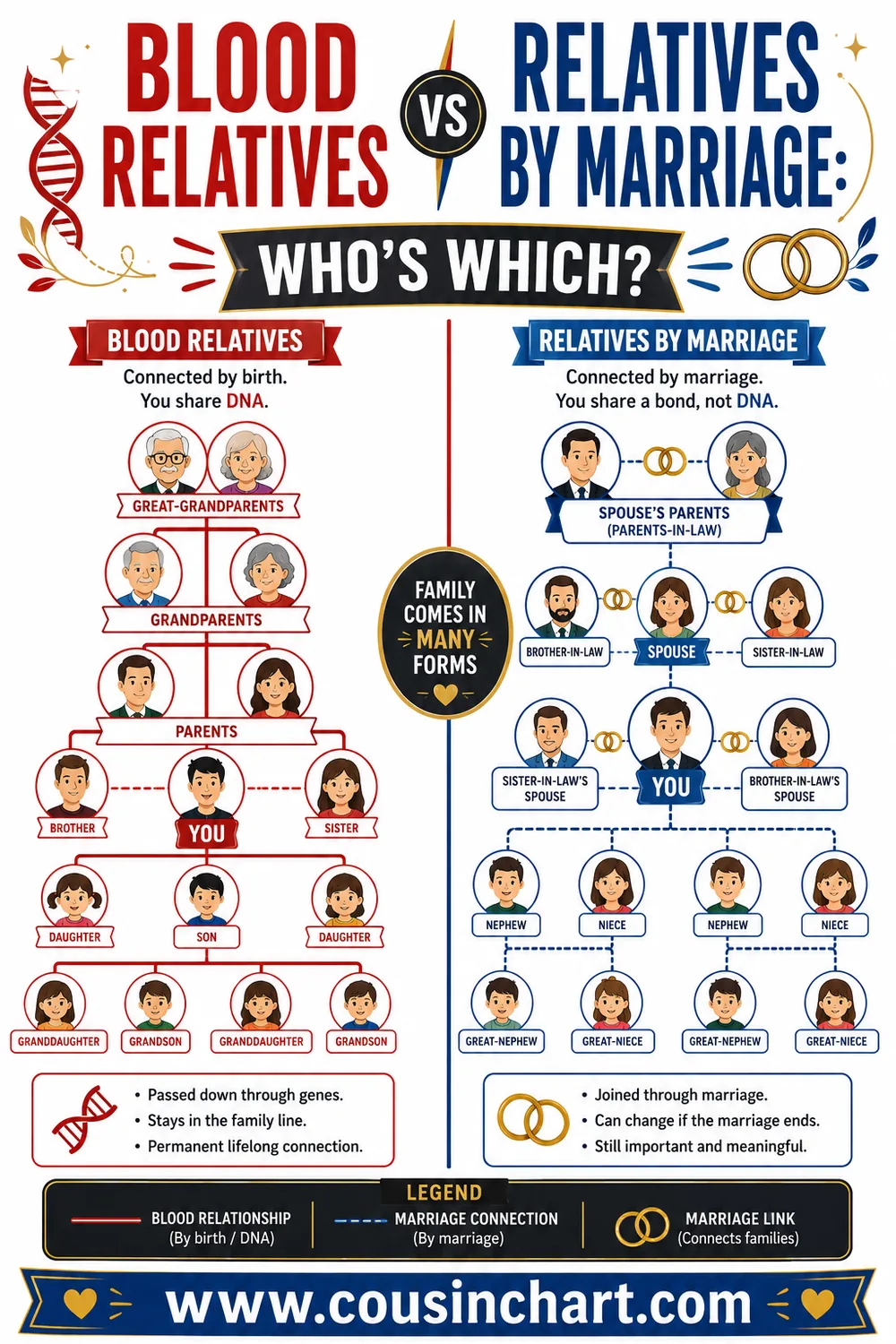
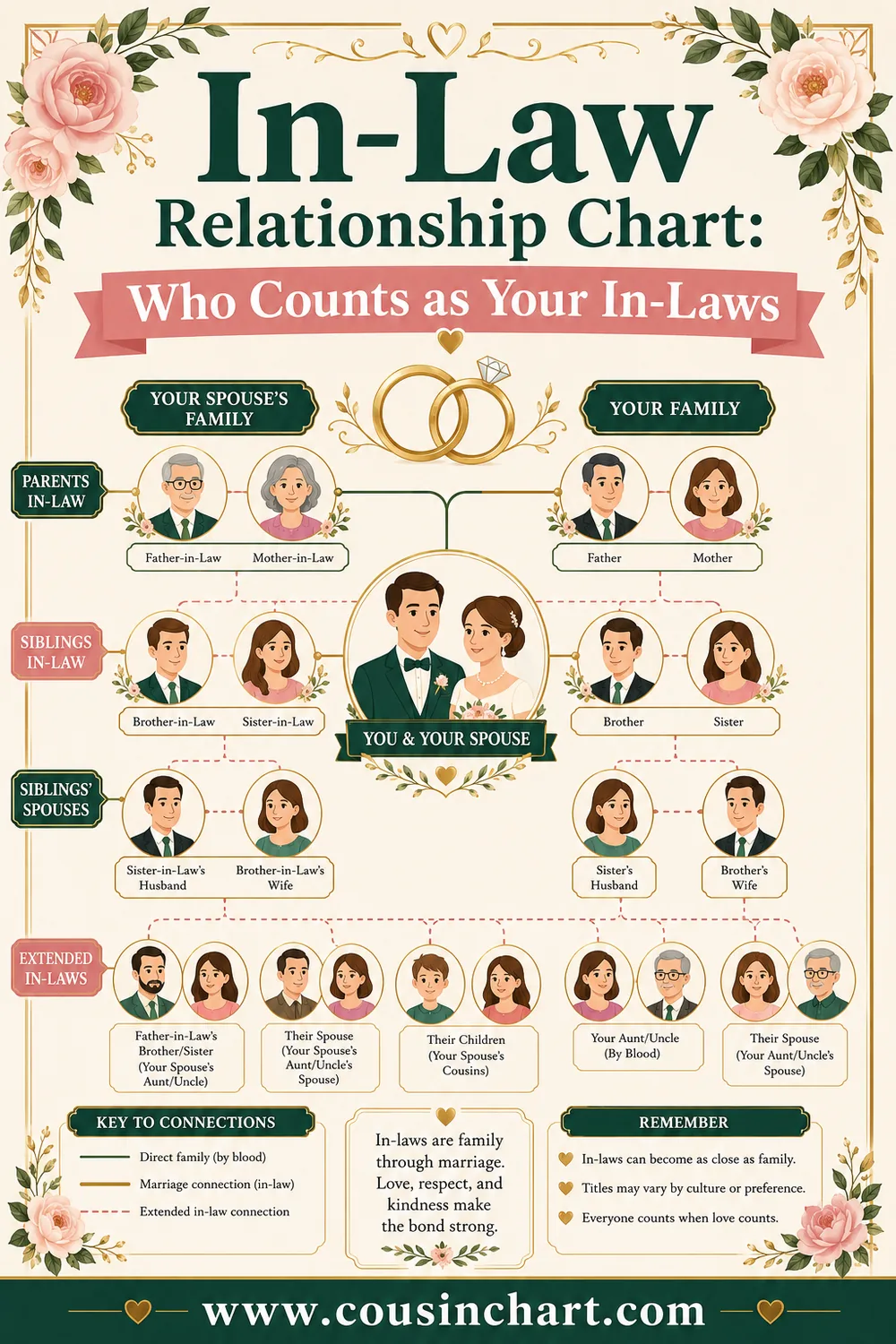
Your in-laws are the people connected to you by marriage instead of blood: your spouse's blood relatives, and the spouses of your own blood relatives. So your wife's mother is your mother-in-law, and your brother's wife is your sister-in-law — but your wife's sister's husband is technically not your in-law at all.
That last one surprises almost everyone, and it's exactly the kind of question this chart settles. Below you'll find the full in-law relationship chart, the two rules that generate every in-law term, and the gray-zone relatives English never bothered to name. If you'd rather just tap out the answer, the free family relationship calculator on our homepage names any connection — blood or marriage — in a few seconds.
Relationship quick-check. Tap a phrase to see the correct term:
The answer will appear here.
The Two Rules That Create Every In-Law
Strip away the awkward Thanksgiving seating charts and in-law logic comes down to two rules:
- Your spouse's blood relatives are your in-laws. Their parents, siblings, grandparents, aunts, uncles, and cousins all pick up the "-in-law" suffix from your point of view.
- The spouses of your blood relatives are your in-laws. Your sibling's husband or wife, your child's husband or wife.
Notice what's not covered: the relatives of your in-laws. Your brother's wife is your sister-in-law, but her parents and siblings have no formal relationship to you at all. The in-law connection doesn't chain — it stops one marriage away from your bloodline. That single fact explains nearly every "wait, what do I call them?" moment at a wedding.
The term itself comes from canon law: medieval church law treated these marriage relatives as if they were blood family for purposes like marriage restrictions — related "in law" rather than in blood. We cover the blood-versus-marriage divide fully in blood relatives vs relatives by marriage.
The Full In-Law Relationship Chart
Here's every common in-law term in one table. "Route" tells you which of the two rules created it.
| Person | Your term for them | Route |
|---|---|---|
| Spouse's father / mother | Father-in-law / mother-in-law | Spouse's blood relative |
| Spouse's brother / sister | Brother-in-law / sister-in-law | Spouse's blood relative |
| Sibling's husband / wife | Brother-in-law / sister-in-law | Relative's spouse |
| Son's wife | Daughter-in-law | Relative's spouse |
| Daughter's husband | Son-in-law | Relative's spouse |
| Spouse's grandparents | Grandfather-in-law / grandmother-in-law | Spouse's blood relative |
| Grandchild's spouse | Grandson-in-law / granddaughter-in-law | Relative's spouse |
| Spouse's aunt / uncle | Aunt-in-law / uncle-in-law (informal) | Spouse's blood relative |
| Spouse's cousin | Cousin-in-law (informal) | Spouse's blood relative |
| Cousin's spouse | Cousin-in-law (informal) | Relative's spouse |
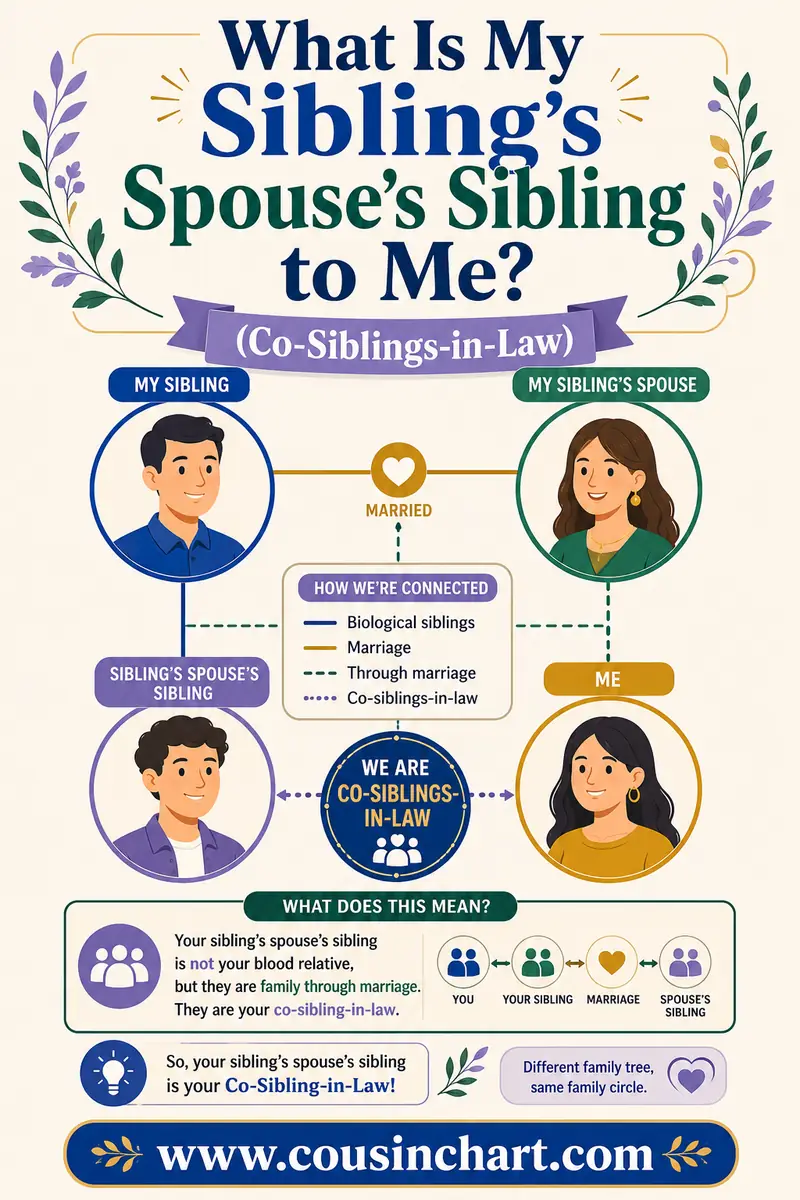
| Spouse's sibling's spouse | Co-brother/sister-in-law (no everyday English word) | Neither — one step beyond |
| Child's spouse's parents | Co-parents-in-law (no everyday English word) | Neither — one step beyond |
The last two rows are the famous gaps. English simply never coined household words for them, even though other languages did — Spanish has concuñado for your spouse's sibling's spouse and consuegros for your child's parents-in-law, and Yiddish has machatunim for the same idea. If your family has ever fumbled through "my son's wife's parents... the other grandparents," you've felt the gap firsthand.
Your Spouse's Family: The "Married In" Direction
When you marry, you gain your spouse's family tree in one stroke. The suffix drops onto their closest relatives automatically:
- Parents-in-law — the big one. Note that your mother-in-law is only your spouse's mother; your sibling's spouse's mother gets no title from you.
- Siblings-in-law — your spouse's brothers and sisters.
- Grandparents-in-law — real term, rarely needed; most people just say "my wife's grandma."
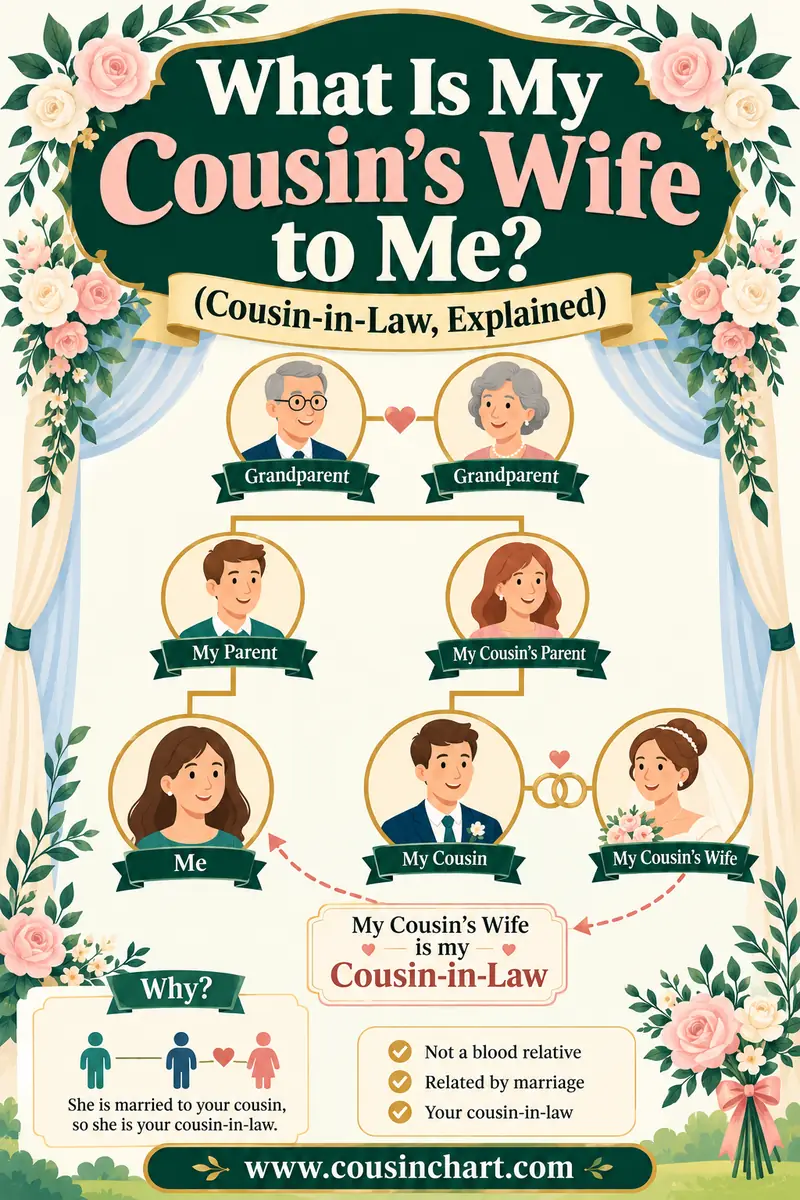
- Aunts, uncles, cousins — "aunt-in-law" and "cousin-in-law" are informal but perfectly understood. In practice most families drop the suffix within a few years and just say "my aunt" or "my cousin." We look at the cousin case in detail in what is my cousin's wife to me.
One thing marriage does not do: make you blood-related to any of these people. In-law relationships carry no shared DNA, which matters for family health history — your children share DNA with your spouse's family, but you don't.
Your Family's Spouses: The "Married My People" Direction
The second rule runs the opposite way — people who married into your bloodline:
- Your sibling's spouse becomes your brother- or sister-in-law. Interesting quirk: this means "sister-in-law" covers two completely different people — your husband's sister and your brother's wife — who are not related to each other at all.
- Your child's spouse becomes your son- or daughter-in-law.
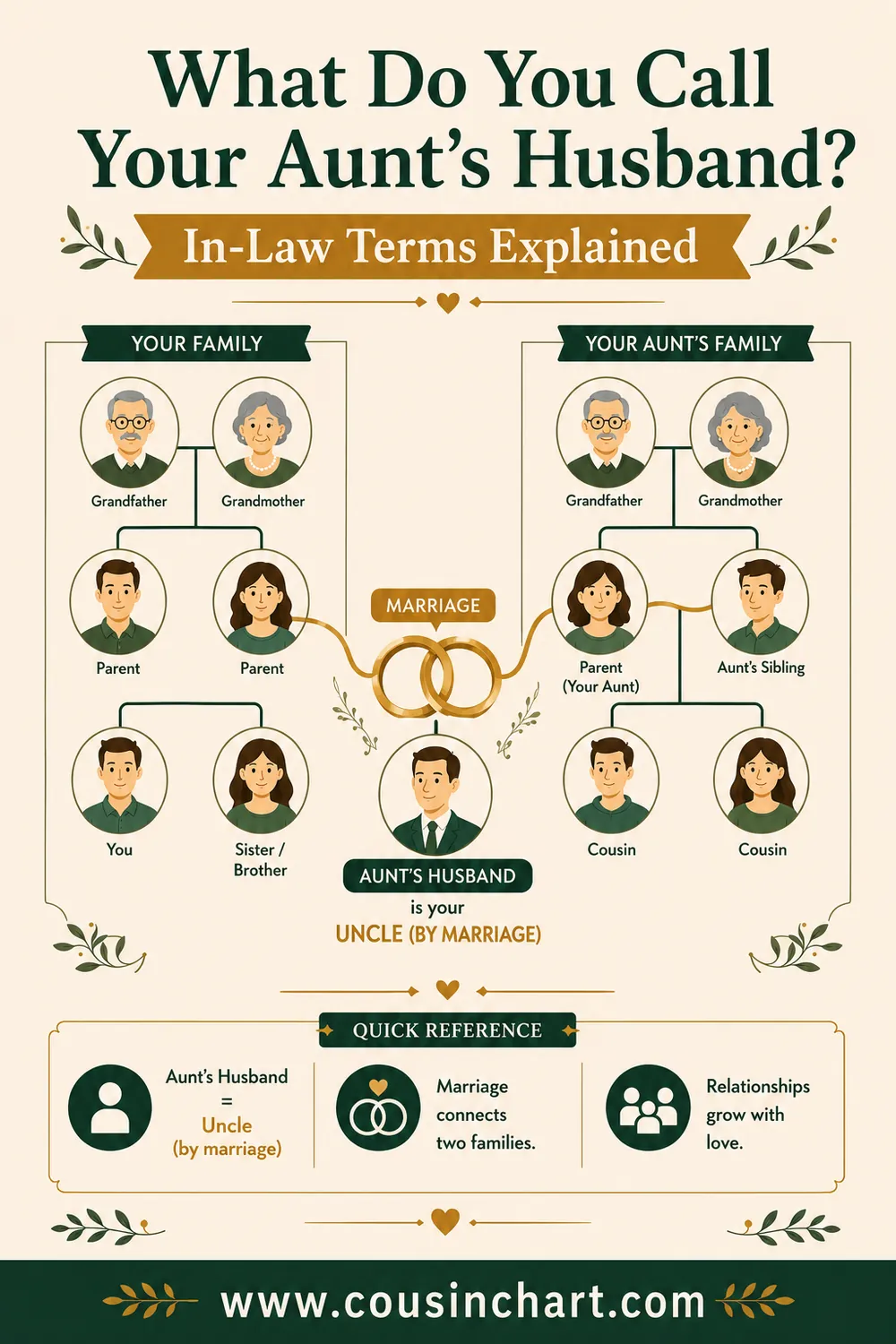
- Your aunt or uncle's spouse — most families simply say aunt or uncle, no asterisk. There's a whole tradition behind that choice, which we unpack in what do you call your aunt's husband.
- Your cousin's spouse — cousin-in-law, or usually just "cousin" by the second family reunion.
The Gray Zone: Co-In-Laws
Two clusters of people sit just outside the official circle, close enough that families need something to call them:
Your spouse's sibling's spouse. Your wife's sister's husband, say. You'll stand next to him in wedding photos for the rest of your life, yet formally he's your spouse's brother-in-law, not yours. Genealogists call this a co-brother-in-law, and most real families quietly promote him to plain "brother-in-law." We give this relationship its own full explainer in co-siblings-in-law.
Your child's spouse's parents. You'll share grandchildren with these people, plan holidays around them, maybe vacation with them — and English gives you nothing better than "my son's in-laws." Co-parents-in-law is the genealogy term; machatunim is the loanword that deserves wider use.
If you're ever unsure whether someone technically counts, trace the path: if it passes through more than one marriage, you've left in-law territory. Or skip the tracing and let the relationship calculator walk the path for you — it handles marriage links as well as blood ones.
Do In-Laws Come With Legal Standing?
Mostly no, with a few practical exceptions worth knowing:
- Inheritance: in-laws generally have no automatic claim under intestacy laws. Your daughter-in-law doesn't inherit from you unless your will says so (though her children — your grandchildren — do).
- Next of kin: legal next-of-kin orders run through blood and adoption, plus your spouse. Your spouse is your closest legal relative, but your spouse's relatives aren't in your order at all.
- Immigration and benefits: some rules recognize parents-in-law for specific purposes (certain military dependent benefits, for example), but this is exception, not rule.
- Affinity rules: a handful of jurisdictions historically restricted marriage between in-laws after a death or divorce. These have mostly disappeared, but the concept of "relation by affinity" survives in some legal codes, including witness and conflict-of-interest rules.
The practical takeaway: in-law is a social and ceremonial category far more than a legal one.
In-Laws vs. Step-Relatives: Don't Mix the Categories
Both come from marriage, so they get confused constantly, but they're different mechanisms:
- In-laws arrive through your own marriage or a relative's marriage — your generation outward.
- Step-relatives arrive when a parent (or grandparent) remarries — the generation above you re-partnering.
So your wife's daughter from a previous relationship is your stepdaughter, not your daughter-in-law. Your mother's new husband is your stepfather, not your father-in-law. The suffix "-in-law" always points at a marriage you or your blood relative made; "step-" always points at a marriage your ancestor made.
What Other Languages Do Better
English's in-law gaps look sloppier once you see how thoroughly other languages cover the same ground. A quick world tour:
- Tagalog has the whole gray zone solved. Biyenan is a parent-in-law, manugang a child-in-law, bayaw and hipag are brother- and sister-in-law — and then it keeps going where English quits: bilas is your spouse's sibling's spouse (the co-brother/sister-in-law English can't name), and balae is your child's spouse's parent. Two everyday words for the two famous English gaps.
- Hindi and Urdu split sibling-in-law terms by side and even by age: sala (wife's brother), sali (wife's sister), devar (husband's younger brother), jeth (husband's elder brother) — each a different word with different traditional expectations attached. Co-parents-in-law get samdhi and samdhan.
- Spanish, as noted, offers concuñado/concuñada and consuegros — both in daily use, not dictionary curiosities.
- Chinese distinguishes in-laws by which spouse they belong to: a husband's mother (pópo) and a wife's mother (yuèmǔ) are entirely different words. There's no single word for "mother-in-law" because the language considers the two roles genuinely different jobs.
The pattern says something real: languages name the relationships their cultures work hardest. Societies where married couples coordinate closely with both extended families kept precise vocabulary; English-speaking cultures drifted toward nuclear-family households and let the outer terms blur. If English's in-law words feel vague, it's not your confusion — the language genuinely under-invested.
Worked Example: Naming the Head Table
Put the two rules to work at an actual wedding. Your sister Ana is marrying Marco. Seated at the head table: Marco's parents, Marco's brother Paolo, Paolo's wife Grace, and Marco's grandmother. What is each of them to you once the vows are done?
- Marco — your brother-in-law. Rule two: spouse of your blood relative.
- Marco's parents — nothing formal. They're Ana's parents-in-law, and your family's balae (or co-parents-in-law) if you borrow the vocabulary. To you directly: no term, no legal tie.
- Paolo — nothing formal, and this surprises people. He's your sister's husband's brother — the path runs through Ana's marriage and then a blood step on the other side. He's Ana's brother-in-law, not yours.
- Grace — even further out: your sister's husband's brother's wife. Two marriages in the chain. Genealogically she's a stranger you'll see at every Christmas for the next forty years.
- Marco's grandmother — Ana's grandmother-in-law; to you, formally nothing.
Notice the asymmetry: Ana gained a full set of in-laws today, but you only gained one — Marco. In-law status radiates from the married couple, not from their families at large. When someone at the reception asks how you're related to Paolo, the honest answer is "we're not — but we're going to be in a lot of photos together." Family by orbit, if not by law. And if that answer feels unsatisfying, you're rediscovering exactly why Tagalog invented bilas.
A 3-Question Test for Any Marriage Relative
When a chain gets confusing, run it through three questions:
- Does the path use exactly one marriage? If it uses two or more, there's no formal in-law term — you're in co-in-law or "family friend with assigned seating" territory.
- Is the marriage yours? Then the person is your spouse's blood relative: attach "-in-law" to whatever your spouse calls them. Spouse's uncle → uncle-in-law.
- Is the marriage a blood relative's? Then the person is the one who married in: attach "-in-law" to the slot they married into. Daughter's husband → son-in-law.
Anything that fails question one has no official name; anything that passes gets its term from question two or three. That's the entire system — the chart above is just this test with the answers pre-filled.
FAQ
Is my brother's wife's sister my sister-in-law?
No. Your brother's wife is your sister-in-law, but her siblings have no formal relationship to you. The in-law link doesn't extend to your in-law's own relatives — it stops one marriage from your bloodline.
What do I call my spouse's sibling's spouse?
Formally, nothing — English has no standard word. Genealogists say co-brother-in-law or co-sister-in-law, Spanish speakers say concuñado/concuñada, and most families just say brother- or sister-in-law and move on.
Are my son-in-law's parents related to me?
Not formally in English. The genealogy term is co-parents-in-law, and Yiddish offers machatunim. You share grandchildren with them, but no legal or blood relationship exists.
Is my aunt's husband my uncle or my uncle-in-law?
Both answers defend themselves. Strictly he's an uncle by marriage (uncle-in-law), since he shares no blood with you. Socially, virtually every family calls him uncle, full stop.
Do I stay in-laws with my spouse's family after divorce?
Legally, relationships by affinity generally end with the marriage. Socially, it's up to the people involved — many ex-in-laws stay close, especially where grandchildren are involved. Widowhood is different again: most families consider those bonds permanent.
Is my sibling-in-law's child my niece or nephew?
By blood, only if the child is your sibling's — your brother's kids are your nieces and nephews regardless of who he married. Your spouse's sibling's children are technically nieces- and nephews-in-law, but almost every family drops the suffix: you're their aunt or uncle, and arguing otherwise at a birthday party wins you nothing.
Do half-siblings' spouses count as in-laws?
Yes, exactly like full siblings' spouses. Your half-brother is your blood relative, so his wife is your sister-in-law under rule two. "Half" describes the blood link between siblings; it doesn't weaken the in-law logic that hangs off it.
Do in-laws share any DNA with me?
No. In-law relationships are purely by marriage, so you share no DNA with any of them. Your children, however, share DNA with your spouse's blood relatives — which is why the two family health histories both matter for your kids.
Name Any In-Law in Seconds
The two-rule system covers most cases: your spouse's blood relatives, and your blood relatives' spouses. Everything past that edge is a co-something with no everyday name. When a real chain gets long — "my husband's sister's husband's mother" — don't untangle it by hand. Open the free family relationship calculator, tap through the path person by person, and get the correct term instantly, with a little map of how you connect. No signup, no cost — just the answer before the toast ends.