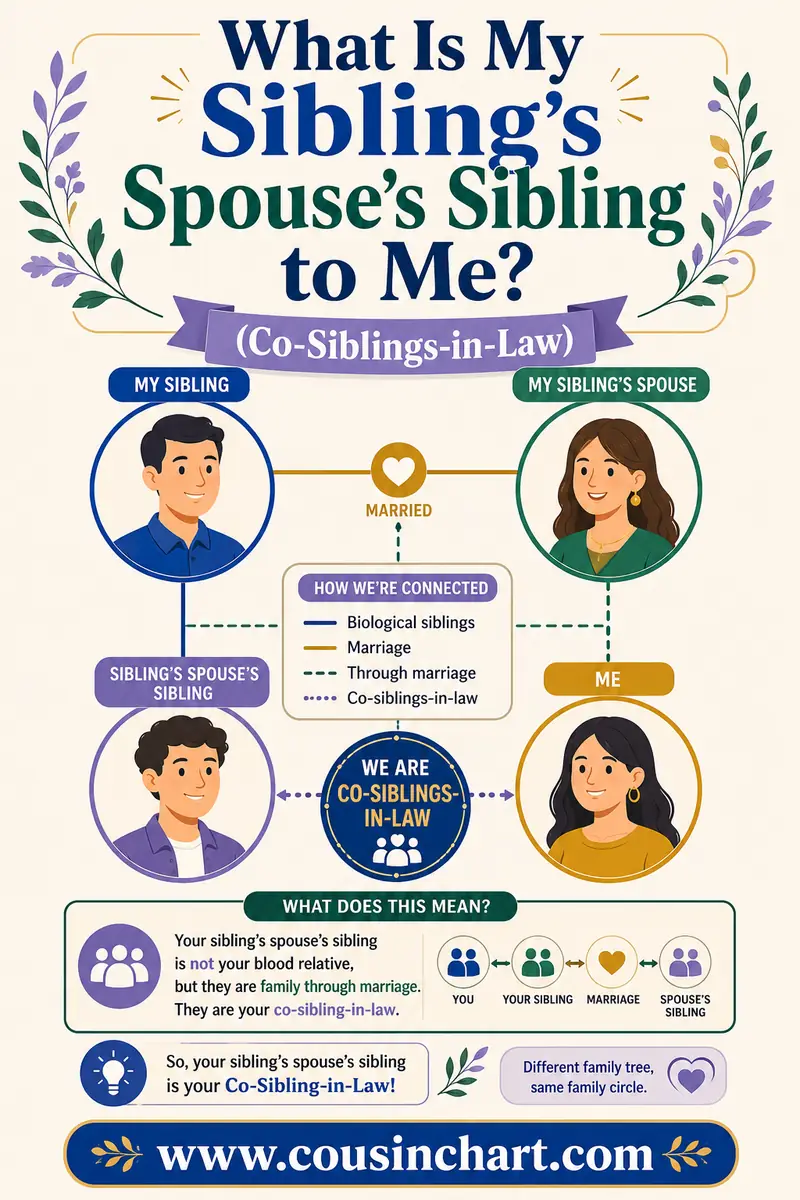
What Is My Sibling's Spouse's Sibling to Me? (Co-Siblings-in-Law)
Your sibling's spouse's sibling is your co-sister-in-law or co-brother-in-law — together, your co-siblings-in-law. There's no blood between you and no legal relationship either; you're two people connected through one marriage, standing on opposite sides of it. English barely has a word for this, which is why the question gets asked so much.
The same term covers the mirror case: your spouse's sibling's spouse (the person who, like you, married into your spouse's family). This guide untangles both versions, shows what other languages call them, and maps the rest of that in-between family. For any connection you can't label, the free relationship calculator on our homepage names it instantly.
Relationship quick-check. Tap a phrase to see the correct term:
The answer will appear here.
The Two Flavors of Co-Sibling-in-Law
The "co-" prefix means "alongside" — someone who holds an in-law position parallel to yours, or on the far side of the same marriage. It shows up in two situations that feel different but share one structure:
- Your sibling's spouse's sibling. Your brother marries Maya; Maya's sister is your co-sister-in-law. You each have a true in-law bond to the married couple, but not to each other.
- Your spouse's sibling's spouse. You married into a family; so did someone else. Two men married to two sisters are each other's co-brothers-in-law.
In both cases, exactly one marriage sits between you and the other person, plus a sibling link on each side. That's one step too far for the ordinary "-in-law" terms, which only stretch across a single connection: spouse's sibling or sibling's spouse, never sibling's spouse's sibling.
Why English Doesn't Really Have a Word for This
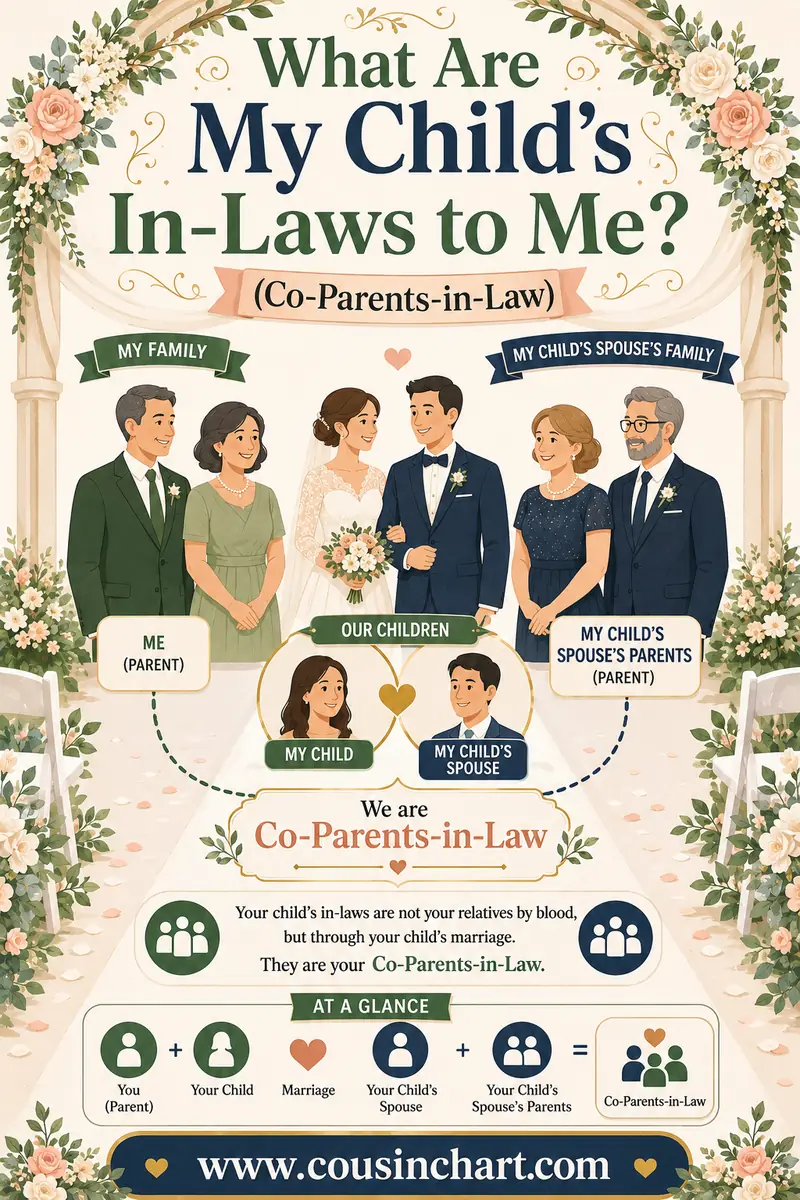
English kinship vocabulary is famously minimalist. It doesn't distinguish maternal from paternal aunts, has no standard word for your child's parents-in-law, and offers nothing everyday for co-siblings-in-law. "Co-sister-in-law" and "co-brother-in-law" exist in dictionaries and genealogy writing, but you could go a lifetime without hearing either at a dinner table.
What people actually say:
- "My brother's sister-in-law" or "my sister-in-law's sister" — descriptive chains, assembled on the spot.
- "My sister-in-law," loosely — many families round the term up and extend it to the whole married-in cluster.
- First names — the overwhelming winner.
None of these are wrong. Kinship terms exist to communicate, and if "sort of my sister-in-law" gets the idea across at a barbecue, it has done its job. Precision only matters when you're building a family tree or settling a bet — which is what the relationship calculator is for.
Other Languages Do Have the Word
This relationship is common enough that plenty of languages issue it a dedicated term — a nice reminder that English's gap is a choice, not a universal:
| Language | Term | Covers |
|---|---|---|
| Spanish | concuñado / concuñada | Spouse's sibling's spouse; sibling's spouse's sibling |
| Italian | consuoceri-style "con-" compounds | Parallel in-law relationships |
| Yiddish | shvogers extended usage | Married-in men of one family |
| Hindi/Urdu | sadhu bhai (husbands of sisters) | Two men married to sisters |
| Tagalog | bilas | Spouse of one's sibling-in-law |
Cultures where extended households are the norm tend to name these positions precisely, because who owes what to whom actually depends on them. American English mostly waves everyone toward the buffet instead. (One generation up, the same pattern repeats: Spanish has consuegros for your child's parents-in-law — a gap we cover in what are my child's in-laws to me.)
No Blood, No Legal Tie — Here's the Map
Genealogically, a co-sibling-in-law is two links past you: a sibling (blood), then a marriage, then another sibling (their blood, not yours). No shared ancestor ever enters the picture, so:
- No shared DNA — a test would show zero match.
- No cousin number or "removed" — those only apply to blood relatives.
- No legal in-law status — the law's family circle (inheritance, family leave, next of kin) stops well before this.
Here's the whole neighborhood around one marriage, from your seat:
| Person | Relationship to you | Type |
|---|---|---|
| Your brother | Sibling | Blood |
| His wife | Sister-in-law | True in-law |
| Her sister | Co-sister-in-law | Marriage-adjacent, no legal tie |
| Her parents | No standard term (your brother's in-laws) | Marriage-adjacent |
| Your brother + his wife's kids | Nieces/nephews | Blood (~25% DNA) |
| Her sister's kids | No relation | — |
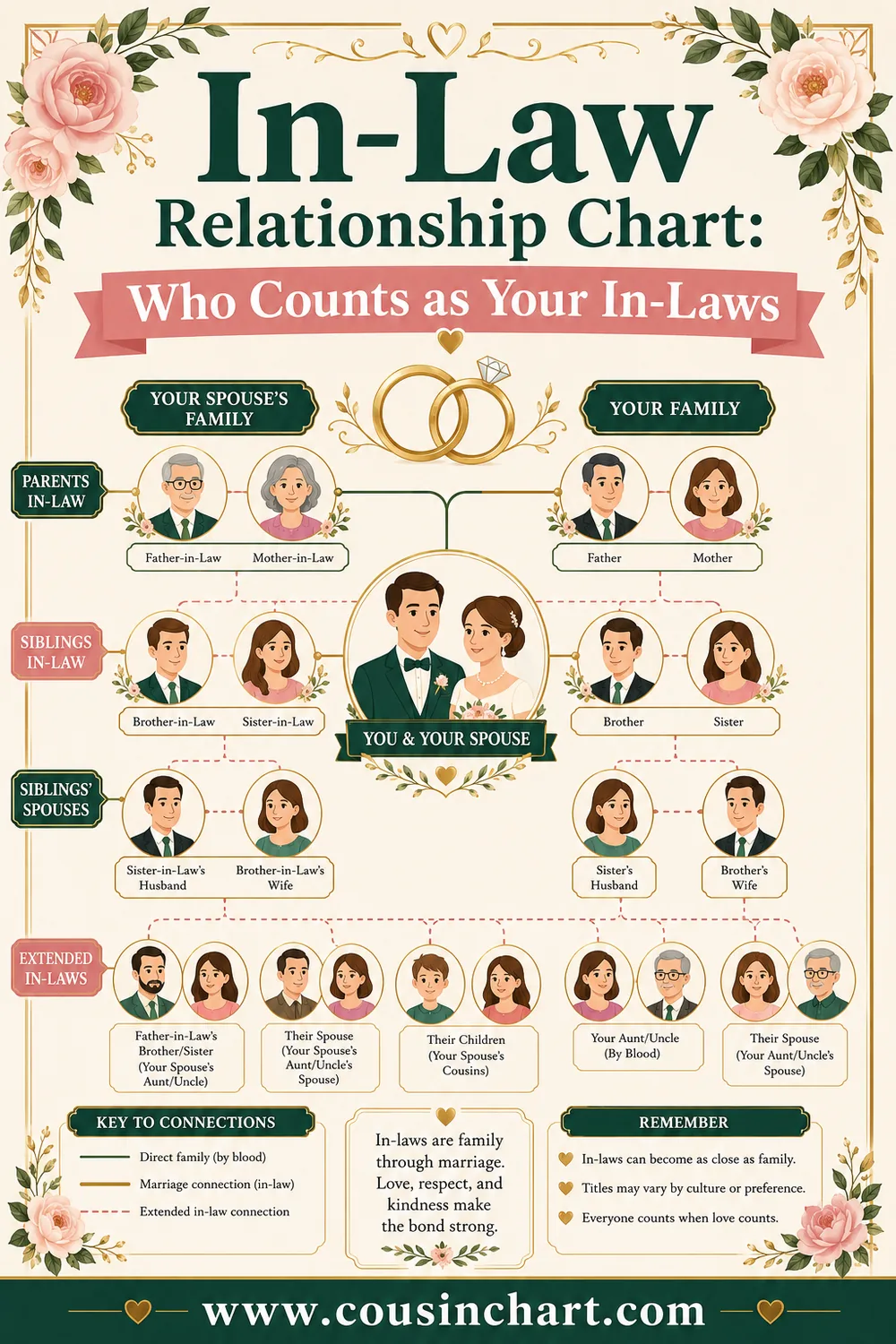
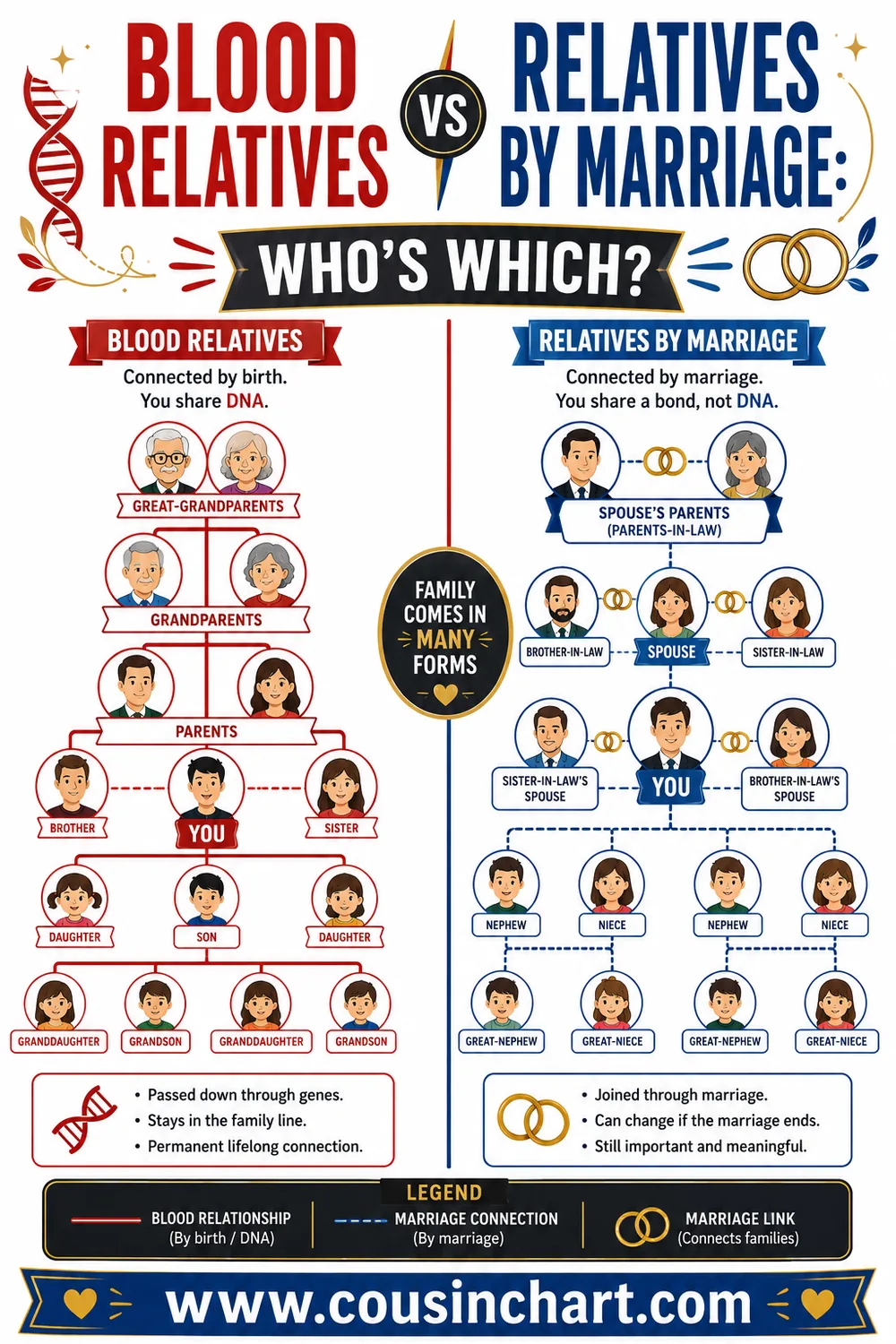
The in-law relationship chart extends this map to every marriage-based connection, and the blood vs marriage guide explains the underlying divide.
The Interesting Part: Your Families Merge One Generation Down
Here's what makes co-siblings-in-law more than trivia. You and your co-sister-in-law share no relatives today — but you likely will. Your brother's children are your blood nieces and nephews and her blood nieces and nephews at the same time. One set of kids, beloved aunt on each side, no relation between the aunts.
That makes co-siblings-in-law something like co-workers in the family business: no formal bond, but a lifetime of shared holidays, shared babysitting, and shared group chats. Anthropologists would say you're affines of affines; the kids will just say you're both "my aunts."
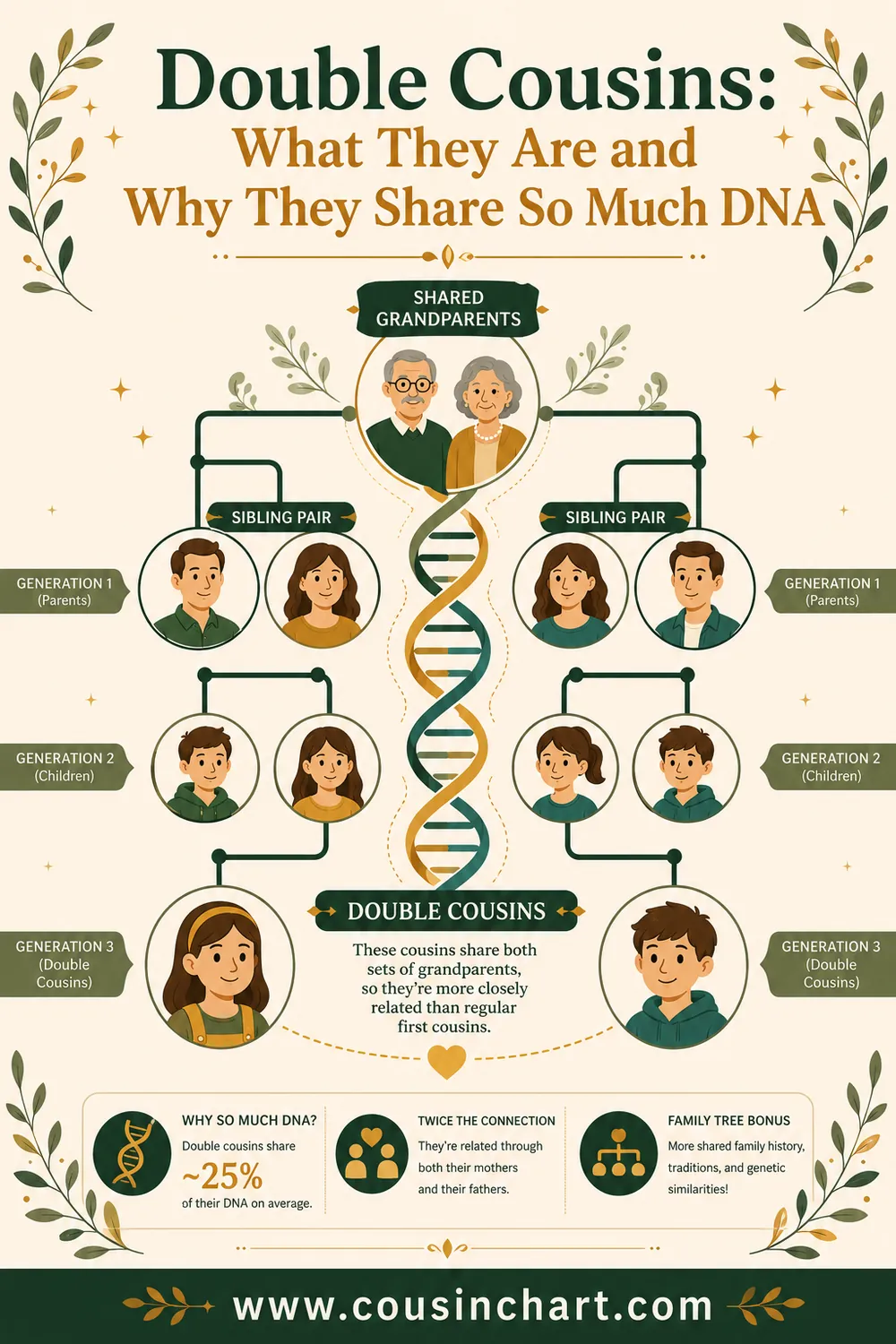
And if a second marriage ever links the families again — say, your sister later marries her brother — the two trees genuinely fuse, and the children of both couples become double first cousins. Rare, but it's the kind of plot twist family trees love.
The Two-Link Rule: How Far In-Law Terms Stretch
Once you see why "co-sibling-in-law" barely exists, you can predict every in-law naming question before it's asked. English affinal terms follow a simple budget: one marriage, plus at most one blood step, gets a name. Anything longer doesn't.
Count the links from you to the other person, where each link is either a blood step (parent, child, sibling) or a marriage:
| Links | Example | Term? |
|---|---|---|
| 1 (marriage) | Your spouse | Named: spouse |
| 2 (marriage + blood) | Spouse's sister | Named: sister-in-law |
| 2 (blood + marriage) | Brother's wife | Named: sister-in-law |
| 3 (blood + marriage + blood) | Brother's wife's sister | Budget exceeded: "co-sister-in-law" at best |
| 3 (marriage + blood + marriage) | Spouse's brother's wife | Same: co-sister-in-law |
| 4+ | Brother's wife's sister's husband | Nothing — descriptive chain only |
Two things fall out of this rule instantly. First, it explains the classic dinner-table confusions: "my sister-in-law's sister" feels like she should be something because she's only one person past a named relative — but that one person costs a third link, and the budget is two. Second, it tells you when to stop searching for a term: if the path between two people contains two marriages, or two blood steps on opposite sides of a marriage, English has already given up, and the honest answers are a descriptive chain, a "co-" coinage, or the universal solvent, "family."
The rule also travels up and down generations without changing: child's spouse (2 links) = daughter-in-law, named; child's spouse's parent (3 links) = no term, hence the borrowed consuegros. Wherever you sit on the tree, the arithmetic is the same — which means you now hold the answer to every "what is my X's Y's Z to me?" question that in-law chains can generate: count the links, and past two, name them with love instead of taxonomy.
Practice: Place These Three
Cover the answers first:
- Your husband's brother's wife. Someone who married into the same sibling set you did: your co-sister-in-law.
- Your sister's husband's sister's son. Chain runs sibling → marriage → sibling → child; no blood ever enters: no relation ("my brother-in-law's nephew" if you need words).
- Your brother's wife's brother — who then marries your cousin. Before the wedding: your co-brother-in-law. After: also your cousin-in-law. Two independent marriage links, both real, neither blood.
If number 3 felt like a logic puzzle, that's because it is one — and it's exactly the shape of problem the calculator solves without breaking a sweat.
FAQ
What do I call my brother's wife's sister?
Formally, your co-sister-in-law. In everyday speech, most people say "my sister-in-law's sister" or just use her name. Some families loosely call her a sister-in-law too, which is common and harmless.
Is my sibling's spouse's sibling legally related to me?
No. Legal in-law relationships extend one link — your spouse's immediate family and your immediate family's spouses. A co-sibling-in-law is two links away and has no legal status.
What is my wife's sister's husband to me?
Your co-brother-in-law — a man who married into the same family you did. In several languages this exact pair has its own word (Spanish concuñado, Hindi sadhu bhai).
Do co-siblings-in-law share any DNA?
No — the connection runs entirely through one marriage, so there's no shared ancestor and no shared DNA (unless the two families happen to be related some other way).
What are my co-sister-in-law's children to me?
Formally, nothing — no blood, no standard term. Socially, they're often "the cousins' cousins" at family events, since they share real cousins (your sibling's kids) with your own children.
What is my brother's wife's sister's husband to me?
Nothing at all — that chain contains two marriages, which is past the point where any language commonly bothers. Descriptively he's "my sister-in-law's brother-in-law," and practically he's the guy you team up with for yard games precisely because neither of you is related to anyone.
Is there a term for the whole married-in group?
Genealogists say "affines" for all relatives by marriage. Casually, English speakers just say in-laws and let the edges blur — the "co-" terms exist when you want to be precise.
Name the Unnameable Relatives
So: your sibling's spouse's sibling is your co-sibling-in-law — no blood, no legal tie, and frequently a front-row seat in your life anyway. Family trees are full of these almost-relationships, and every reunion surfaces a new one. When it does, the free family relationship calculator traces the exact path between any two people and tells you whether there's a term — and what it is.