What Is My Cousin's Wife to Me? (Cousin-in-Law, Explained)
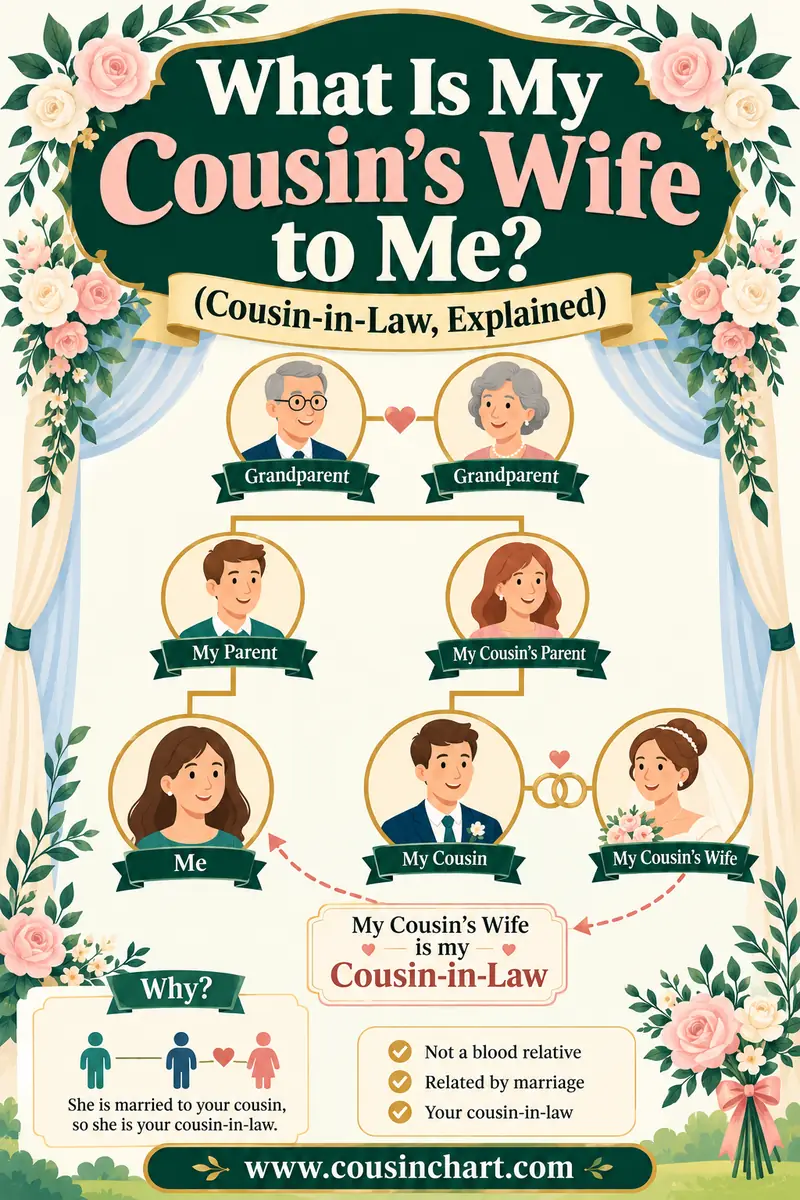
Your cousin's wife is your cousin-in-law. She's family by marriage, not by blood — there's no shared ancestor between you, so no cousin number or "removed" applies. The same term covers your cousin's husband, and it also works in the mirror direction: your spouse's cousins are your cousins-in-law too.
That's the short version. Below we'll cover what her children are to you (that one does have a blood answer), whether "cousin-in-law" is a real term, and how the whole marriage side of the family tree fits together. For any connection you can't name, the free relationship calculator on our homepage sorts it out instantly.
Relationship quick-check. Tap a phrase to see the correct term:
The answer will appear here.
Is "Cousin-in-Law" a Real Term?
Yes — it's the standard informal label, and dictionaries list it. It just isn't as official as mother-in-law or brother-in-law, which describe relationships the law has historically cared about. "Cousin-in-law" lives in the conversational tier: everyone understands it, genealogy software rarely bothers with it, and most families simply say "my cousin's wife" or use her name.
The term covers two mirror-image situations:
- The spouse of your cousin — your cousin's wife or husband.
- The cousin of your spouse — the people you gained when you married.
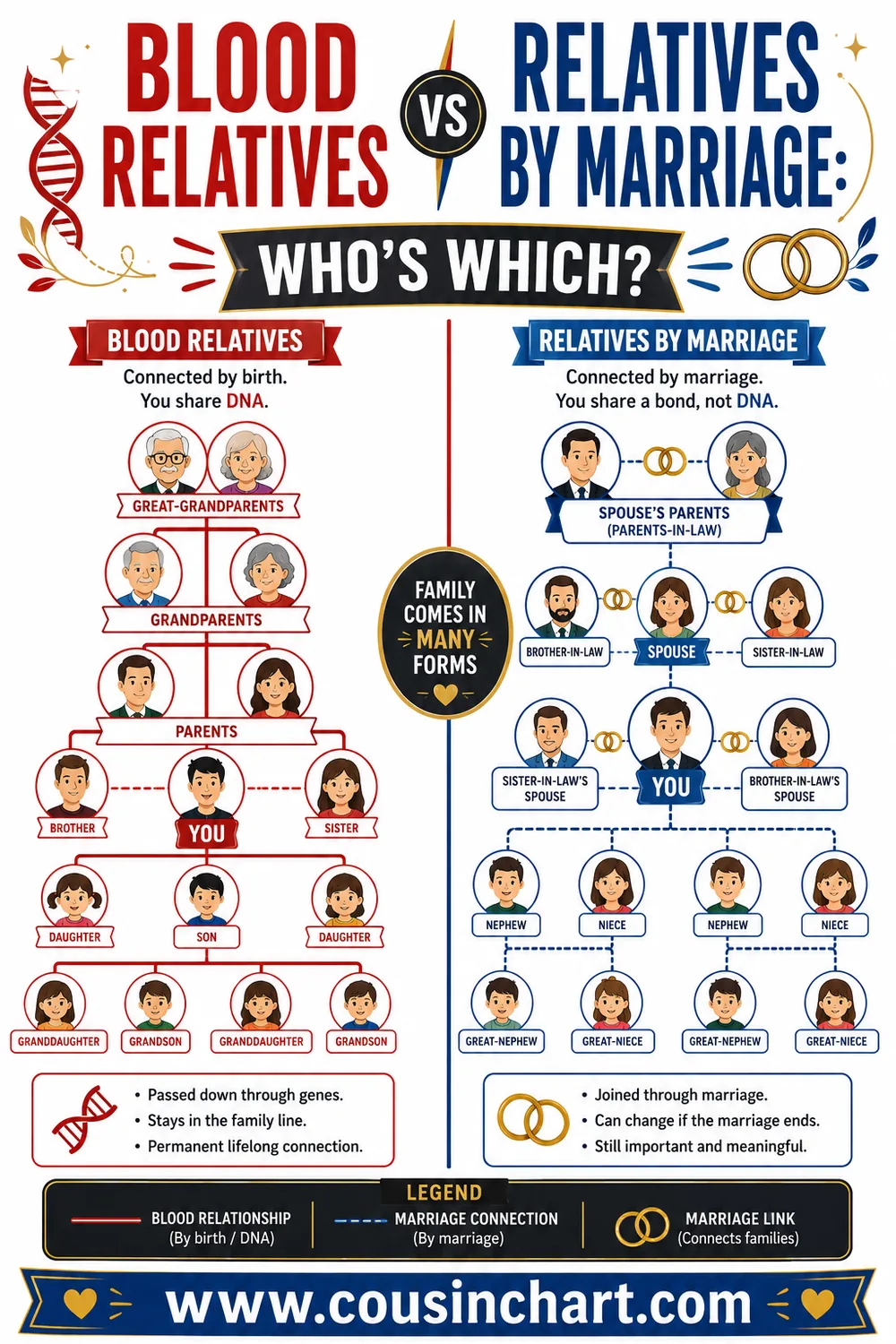
Both are relationships of affinity (marriage) rather than consanguinity (blood). That distinction sounds academic, but it's the key that unlocks every question on this page: blood relationships get cousin numbers and "removeds"; marriage relationships get "-in-law" and stop there. Our guide to blood relatives vs relatives by marriage maps the whole divide.
No Blood, No Cousin Number
Because your cousin's wife shares no ancestor with you, none of the cousin machinery applies to her:
- She is not your first cousin, second cousin, or any cousin number.
- "Removed" doesn't apply — that word measures generation gaps between blood relatives.
- A DNA test would show zero shared centimorgans (barring coincidence or a small-town tangle where she happens to be distantly related to you anyway — it happens more than people think).
What she is: your cousin's spouse, a full member of the family in every social sense, and the co-parent of some of your blood relatives. Which brings us to the interesting part.
Her Kids Are Your Blood Relatives (Through Your Cousin)
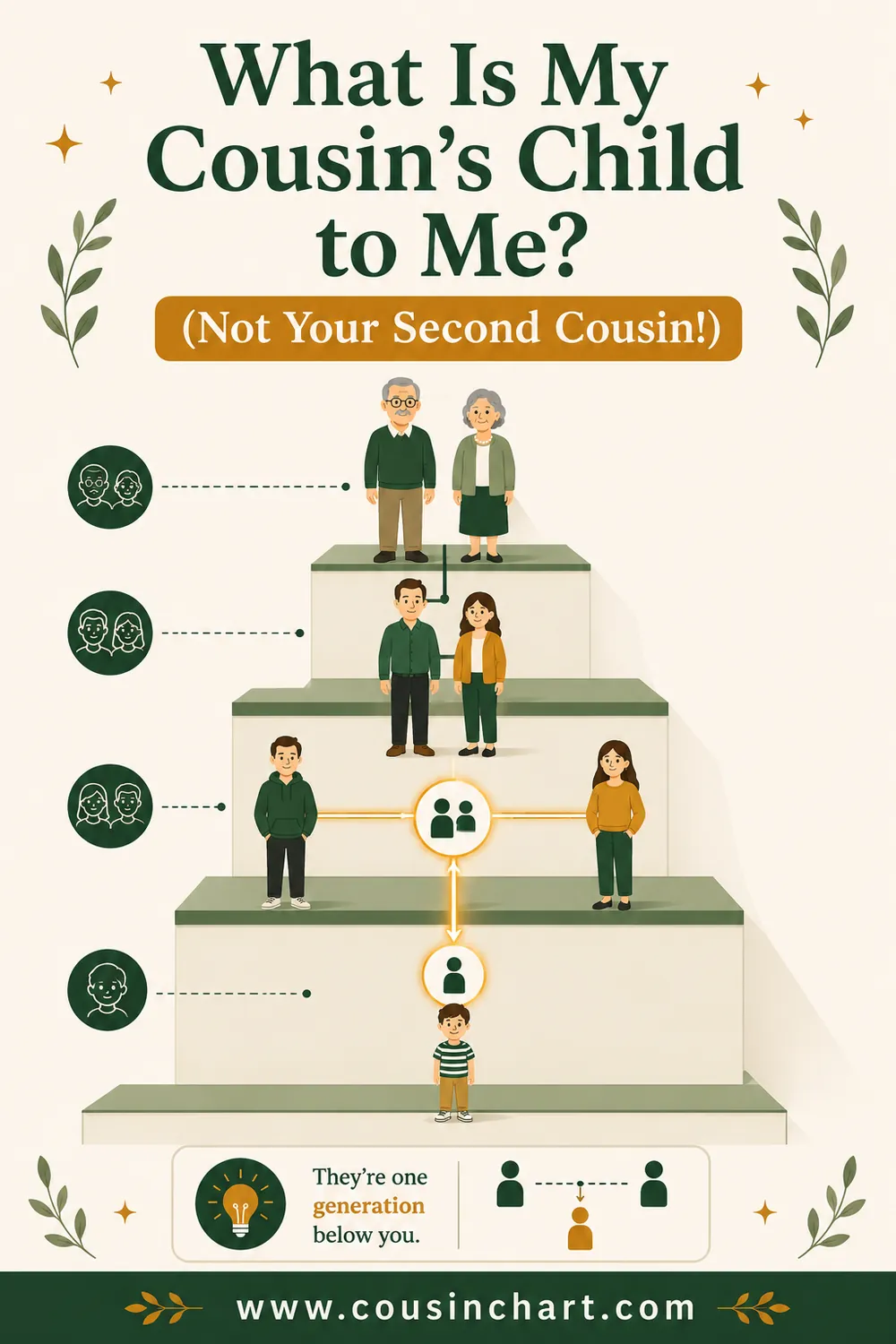
Here's where the tree gets satisfying. Any children your cousin and his wife have together are your first cousins once removed — genuine blood relatives, connected through your cousin, sharing about 6.25% of your DNA on average.
The wife is the bridge that never becomes blood herself, even though the children on the other side of her are. One family, three different relationship types:
| Person | Relationship to you | Type |
|---|---|---|
| Your first cousin | First cousin | Blood (~12.5% shared DNA) |
| His wife | Cousin-in-law | Marriage only |
| Their children | First cousins once removed | Blood (~6.25%) |
| Her child from a previous relationship | No relation (cousin's stepchild) | Marriage only |
| Her parents, siblings | No relation to you | They're your cousin's in-laws |
That last row trips people up at weddings. Your cousin's wife's sister isn't your anything — the connection runs through two marriages' worth of distance, and English simply doesn't issue a term for it. "My cousin's sister-in-law" is the accurate description if you ever need one. The full explainer on your cousin's child picks up the blood side of this table.
What Do You Actually Call Her?
In real life, almost nobody says "cousin-in-law" out loud. The common options:
- Her first name — the default in most families, since cousins-in-law are usually peers.
- "My cousin Sarah" — lots of families extend the cousin label to spouses without a second thought, especially after a decade or two of holidays together.
- "My cousin's wife" — the precise descriptor when you're explaining the connection to someone else.
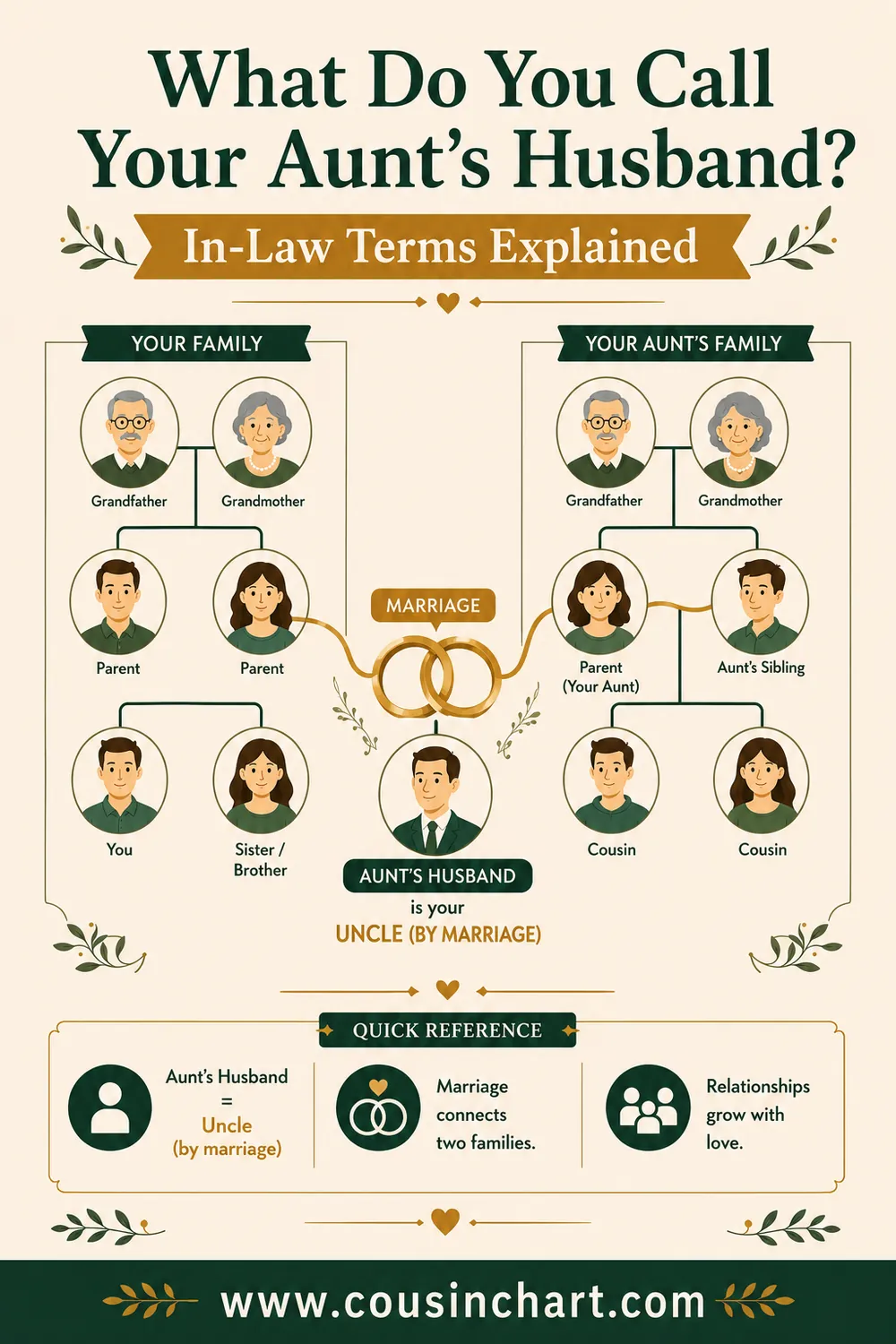
There's no etiquette trap here. Unlike an aunt's husband — who traditionally gets promoted to "Uncle" (we cover that in what to call your aunt's husband) — a cousin's spouse sits in your own generation, so first names feel natural from day one.
Does the Relationship End With Divorce?
Genealogically, an in-law relationship exists through the marriage that created it. If your cousin divorces, his ex-wife stops being your cousin-in-law in any formal sense — she becomes, at most, "my cousin's ex-wife."
Two things survive the divorce untouched, though:
- The kids' status. Your cousin's children remain your first cousins once removed forever. Divorce changes nothing about blood relationships.
- Whatever bond you actually built. Plenty of families stay close to a former in-law, especially one who co-parents the family's kids. The tree describes connections; it doesn't legislate affection.
If your cousin's ex remarries, her new spouse has no connection to you at all — the chain of marriages gets too long for even informal English to bother naming.
The Wider In-Law Neighborhood
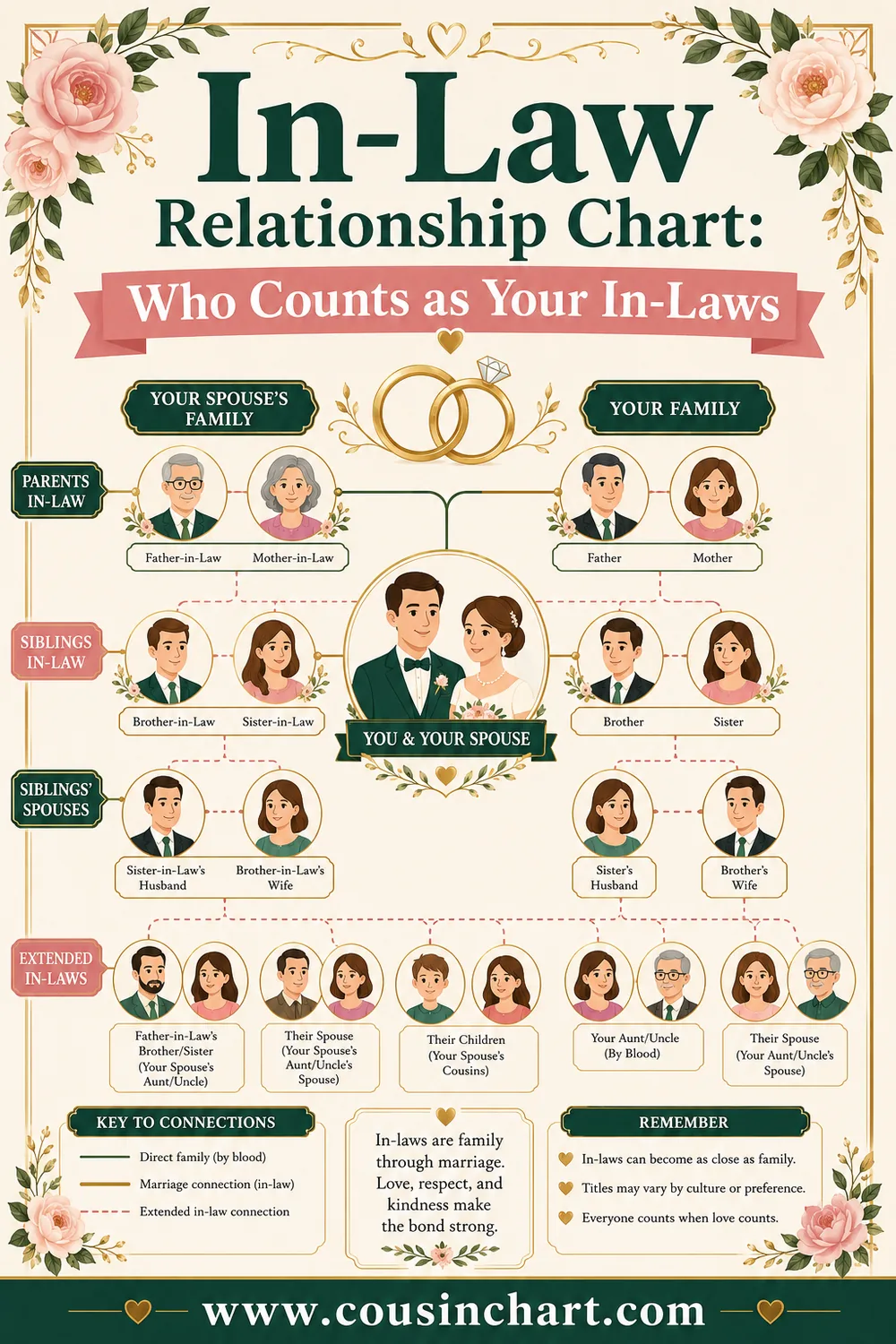
Cousin-in-law sits in a family of marriage-based terms that are worth seeing side by side, roughly ordered from formal to informal:
| Term | Who it means | How official is it? |
|---|---|---|
| Mother-/father-in-law | Spouse's parents | Fully standard, legally meaningful |
| Brother-/sister-in-law | Spouse's sibling, or sibling's spouse | Fully standard |
| Son-/daughter-in-law | Child's spouse | Fully standard |
| Aunt/uncle "by marriage" | Aunt or uncle's spouse | Standard in usage, informal in law |
| Cousin-in-law | Cousin's spouse, or spouse's cousin | Informal but widely understood |
Everything below sibling-in-law on that list is social vocabulary rather than legal category. That's why job bereavement policies and immigration forms mention parents-in-law but never cousins-in-law — the law draws its family circle tighter than the reunion invite list does. Our in-law relationship chart lays out the entire marriage side of the map.
Where the Label Actually Comes Up
Nobody needs "cousin-in-law" on a Tuesday. The term earns its keep at a handful of specific moments, and knowing the conventions saves real awkwardness:
- Wedding planning. Guest lists and seating charts sort by household, not bloodline — your cousin and his wife are one unit, always invited together. Where couples do consult the tree is the processional and the family-photo list: "immediate family" photos traditionally mean blood plus spouses-of-blood, which puts your cousin-in-law comfortably in frame.
- Obituaries. Convention lists a cousin's spouse in parentheses attached to the cousin — "cousins Mark (Sarah) Delgado" — rather than as a separate survivor. It's a compact way of honoring the marriage without implying a blood tie, and funeral homes will format it that way by default.
- Family medical history. Leave her out entirely — a cousin-in-law's health history says nothing about your genetic risks. Her children with your cousin, on the other hand, are 6.25% relatives and do belong in the picture.
- Genealogy software. Enter her as your cousin's spouse and stop there. The software knows what to do: she'll appear on the tree connected by a marriage line, her ancestors will form their own unconnected branch, and any children will correctly link to both trees at once. Resist the urge to file her under a cousin slot "to keep things tidy" — that invents a bloodline that doesn't exist.
- Estate matters. If your cousin dies before his wife, she generally inherits as his spouse — but she has no intestate claim on your side of the family, and you none on hers. The marriage connects two people, not two clans. (As always, laws vary by state.)
The thread through all five: the social world treats her as full family, the genetic and legal worlds treat her as your cousin's partner, and both are being consistent — they're just answering different questions.
Practice: Place These Three
Cover the answers and test yourself:
- Your husband's first cousin. Marriage bridge, cousin on the other side: your cousin-in-law.
- Your cousin's wife's daughter — born two years before the marriage. No blood path to you: your cousin's stepdaughter, no formal relation to you.
- Your cousin's wife's daughter — born two years after the marriage, with your cousin as her dad. Blood flows through your cousin: your first cousin once removed.
Same household, same mom, two completely different answers — the tree cares about biology and adoption, not addresses.
FAQ
Is my cousin's wife my cousin?
Not in the genealogical sense — she's your cousin-in-law, related by marriage only. Many families happily call her a cousin anyway, which is a social choice, not a tree fact.
What are my cousin's wife's children to me?
If your cousin is their parent, they're your first cousins once removed — blood relatives. If they're from her previous relationship, they're your cousin's stepchildren and have no formal relation to you.
Is cousin-in-law an official legal relationship?
No. Legal "in-law" categories generally stop at parents, children, and siblings of a spouse. Cousin-in-law is an accepted everyday term, but it carries no legal weight in things like inheritance or family-leave policies.
What is my spouse's cousin's spouse to me?
Nothing nameable — two marriages and a cousin link apart. Descriptively, "my wife's cousin's husband" does the job, and socially you're all just family at the barbecue.
Do I share DNA with my cousin-in-law?
Not through this relationship — marriage adds zero shared DNA. Any match a test found would be coincidence or a separate, unrelated family connection.
What is my cousin's wife to my children?
Formally, nothing — the in-law link doesn't extend to your kids. Descriptively she's their first cousin once removed's wife, which no one will ever say out loud; in practice she's "Aunt Sarah" or just "Sarah," and her kids with your cousin are your children's second cousins.
Does "removed" ever apply to in-laws?
No. "Removed" measures generation gaps between blood cousins. In-law relationships don't carry cousin numbers or removals — the "-in-law" suffix is the whole label.
Sort Out Any Branch — Blood or Marriage
So: cousin's wife = cousin-in-law, her kids with your cousin = your first cousins once removed, and her side of the family = lovely people with no genealogical label at all. When the next puzzle comes up — and at any decent-sized wedding, it will — the free family relationship calculator traces the exact path between any two people and tells you the correct term before the toast is over.