What Is a Direct Descendant?
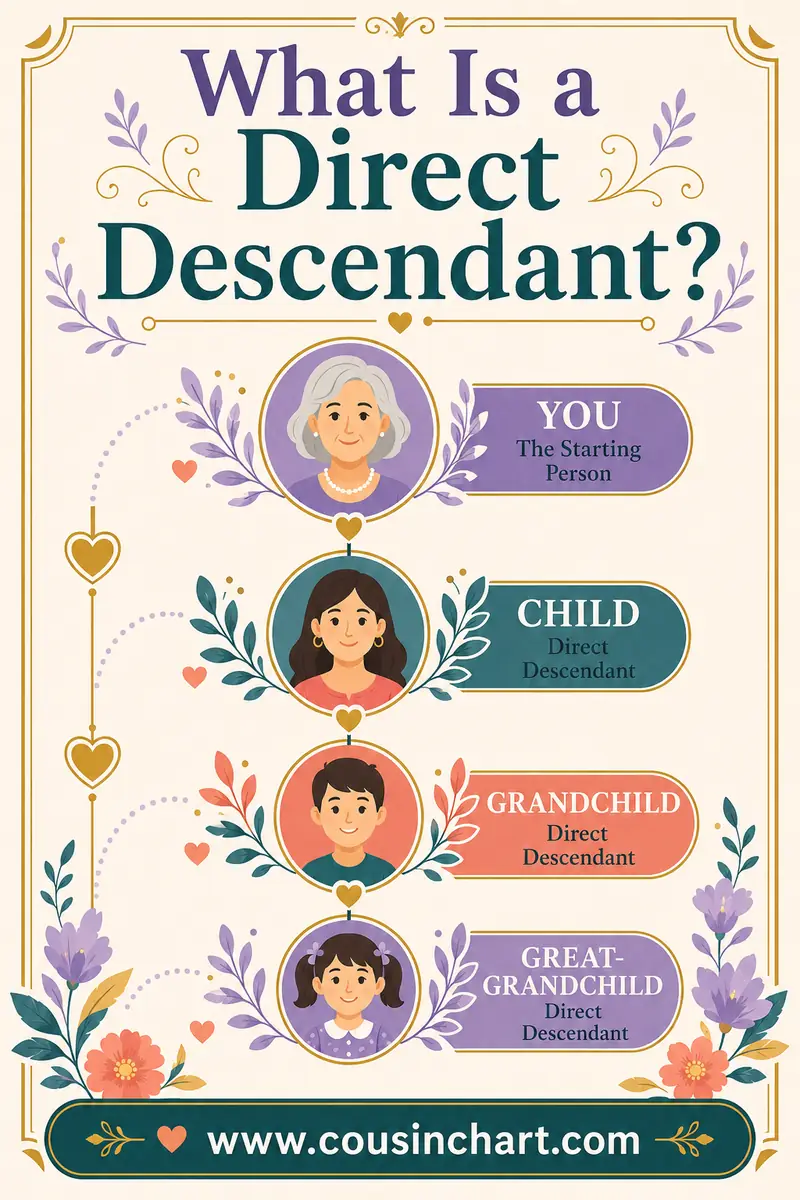
A direct descendant is someone in an unbroken child-by-child line from a person: their children, grandchildren, great-grandchildren, and every generation after. If you can trace from an ancestor to yourself using only parent-to-child links — no siblings, no cousins, no marriages sideways — you are that ancestor's direct descendant. Nieces, nephews, and cousins of the ancestor never count, no matter how close.
That definition sounds simple, and it is — but it carries real weight in wills, lineage societies, citizenship-by-descent claims, and family lore ("we're direct descendants of a Mayflower passenger!"). This guide covers exactly who qualifies, the adoption and step-family wrinkles, and how descent is actually proven. And if you're mid-argument about what some relative is to you, the free family relationship calculator on our homepage settles it in seconds.
Relationship quick-check. Tap a person — direct descendant or not?
The answer will appear here.
The Definition, Unpacked
"Direct descendant" and "lineal descendant" mean the same thing: a person connected to an ancestor by an unbroken chain of parent-to-child links. Each link must be a generational step down — from parent to child, then that child to their child, and so on.
Three things follow from that definition:
- Direction matters. Descent flows downward only. You're your grandmother's direct descendant; she is your direct ancestor (formally, a lineal ascendant), never your descendant.
- Sideways steps break the chain. The moment a path detours through a sibling, aunt, or cousin, descent is broken. Your great-uncle's grandchildren descend from him, not from your great-grandparents through your line — they're your cousins, not fellow travelers on your line of descent. (They ARE direct descendants of your shared great-great-grandparents, though — every path is relative to a chosen ancestor.)
- Every generation counts equally. A 10th-great-grandchild is exactly as much a direct descendant as a daughter. Distance dilutes DNA, not descent.
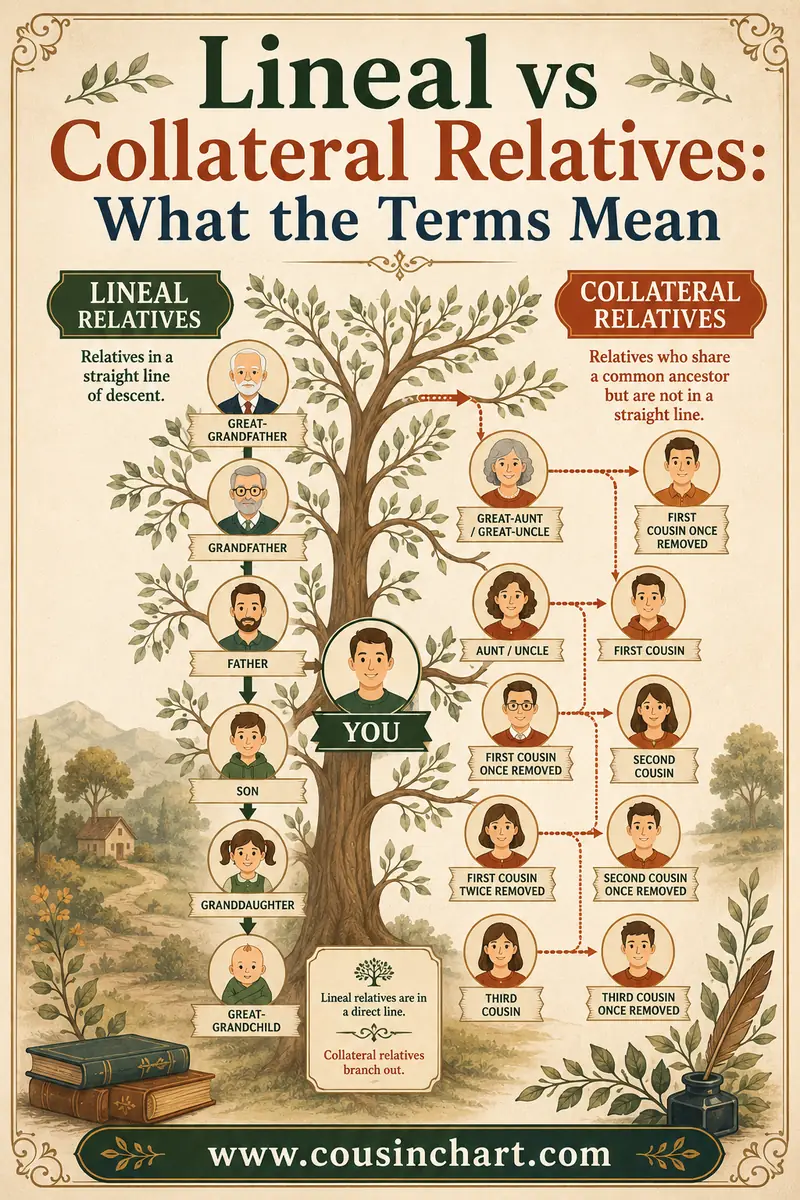
That third point trips people up in a fun way: the word "direct" makes some folks think it means immediate — children only. It doesn't. "Direct" contrasts with collateral (side-branch), not with distant. The full lineal-versus-collateral split is mapped out in our lineal vs collateral relatives guide.
Who Counts and Who Doesn't
| Person | Direct descendant of you? | Why |
|---|---|---|
| Your son or daughter | Yes | One parent-to-child link |
| Your grandchild | Yes | Two unbroken links |
| Your great-great-grandchild | Yes | Four unbroken links |
| Your legally adopted child | Yes (in law) | Adoption creates full lineal status |
| Your stepchild | No (unless adopted) | Descends from your spouse, not you |
| Your niece or nephew | No | Descends from your sibling |
| Your cousin's children | No | Descend through a side branch |
| Your son-in-law | No | Related by marriage (affinity) |
| Your foster child | No | No legal or biological descent created |
Notice the pattern: blood-or-adoption down the line qualifies; marriage and side branches never do.
Adoption, Step-Families, and Modern Wrinkles
Modern families force the neat definition to answer some practical questions:
- Adoption. In U.S. law (and most modern legal systems), an adopted child is a full lineal descendant of the adoptive parents — identical inheritance rights, identical status for "issue" or "descendants" language in wills. Many lineage societies also accept adopted lines for membership, though policies vary by organization; biological descent can still matter for DNA-based claims, obviously.
- Stepchildren. Not descendants unless adopted. If Grandpa's will leaves everything "to my descendants," a stepgrandchild who was never adopted is generally not included — a genuinely common and painful surprise in probate.
- Children born outside marriage. Historically excluded by harsh "legitimacy" rules; today, biological descent counts regardless of the parents' marital status, though older wills and old-country citizenship laws sometimes still carry legitimacy language.
- Donor conception and surrogacy. Legal parentage, not genetics, controls in most jurisdictions: the legal parents' child is their descendant. Family trees and DNA tests may tell a more complicated story, and genealogists increasingly record both.
Where "Direct Descendant" Actually Matters
Wills and estates
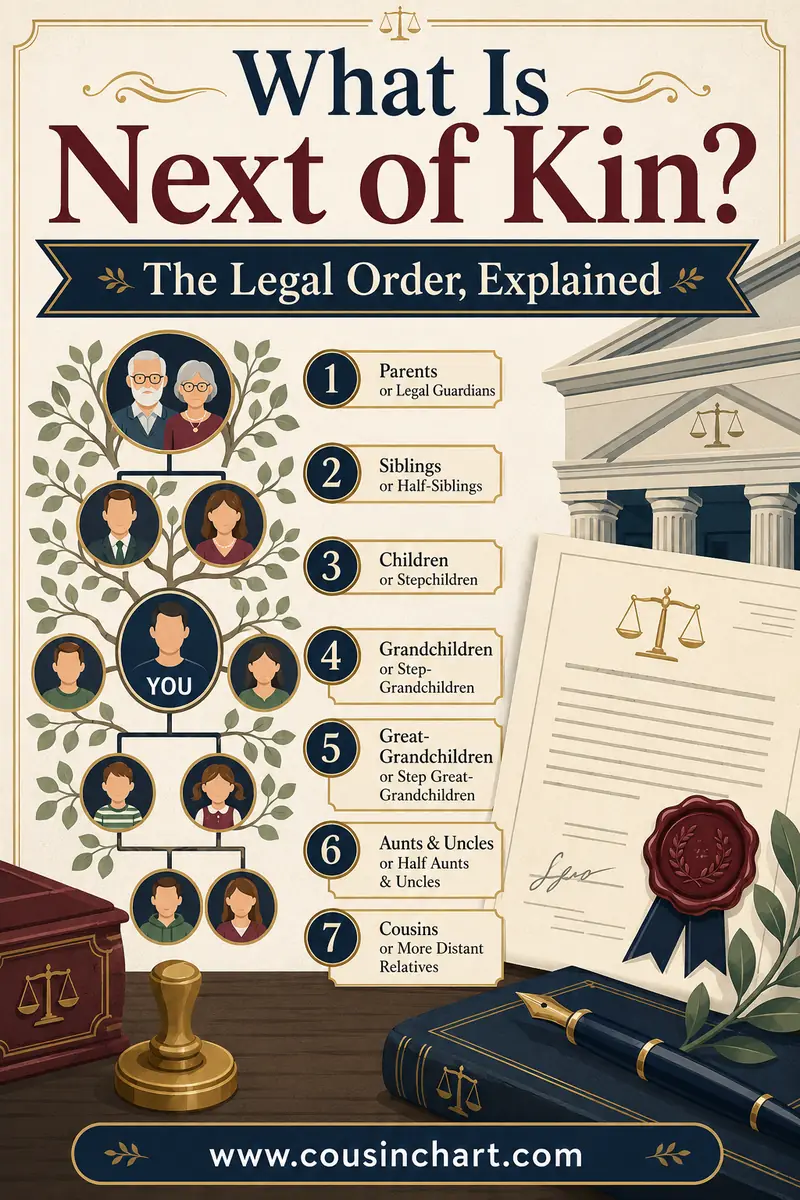
Estate documents constantly use the phrase (or its synonyms "issue" and "lineal descendants"). "Per stirpes to my descendants" divides an estate down the branches of your descendants' lines. Because the word excludes nieces, nephews, and steps, precision here decides who inherits — closely related to the priority rules in our next of kin explainer.
Lineage societies
The Daughters of the American Revolution, Sons of the American Revolution, General Society of Mayflower Descendants, and dozens of similar organizations admit only proven direct descendants of qualifying ancestors. Descending from a patriot's brother doesn't qualify — that makes you the patriot's collateral relative. If you suspect a qualifying line, our guide to finding Revolutionary War ancestors walks through the DAR/SAR research process.
Citizenship by descent
Several countries offer citizenship to direct descendants of emigrants — Italy and Ireland are the famous examples (each with generation limits and paperwork rules that change, so always check current law). The claim stands or falls on documented parent-to-child links, generation by generation.
Tribal enrollment and heritage claims
Many Native American tribal nations require documented direct descent from a person on a historical roll (such as the Dawes Rolls). Collateral descent — from an enrollee's sibling — typically doesn't qualify.
How to Prove Direct Descent
Family stories claim descent; documents prove it. The standard method is one generation at a time:
- Start with yourself and work backward — never start with the famous ancestor and work down.
- Link each generation with a vital record: your birth certificate names your parents; each parent's birth certificate names theirs; and so on up the chain.
- Bridge gaps with substitutes where vital records don't exist: baptism records, census entries showing the child in the parent's household, wills naming children, obituaries, gravestones, and marriage records.
- Document every link. Lineage societies want a paper chain where each document explicitly connects one generation to the next. One undocumented link breaks the whole application.
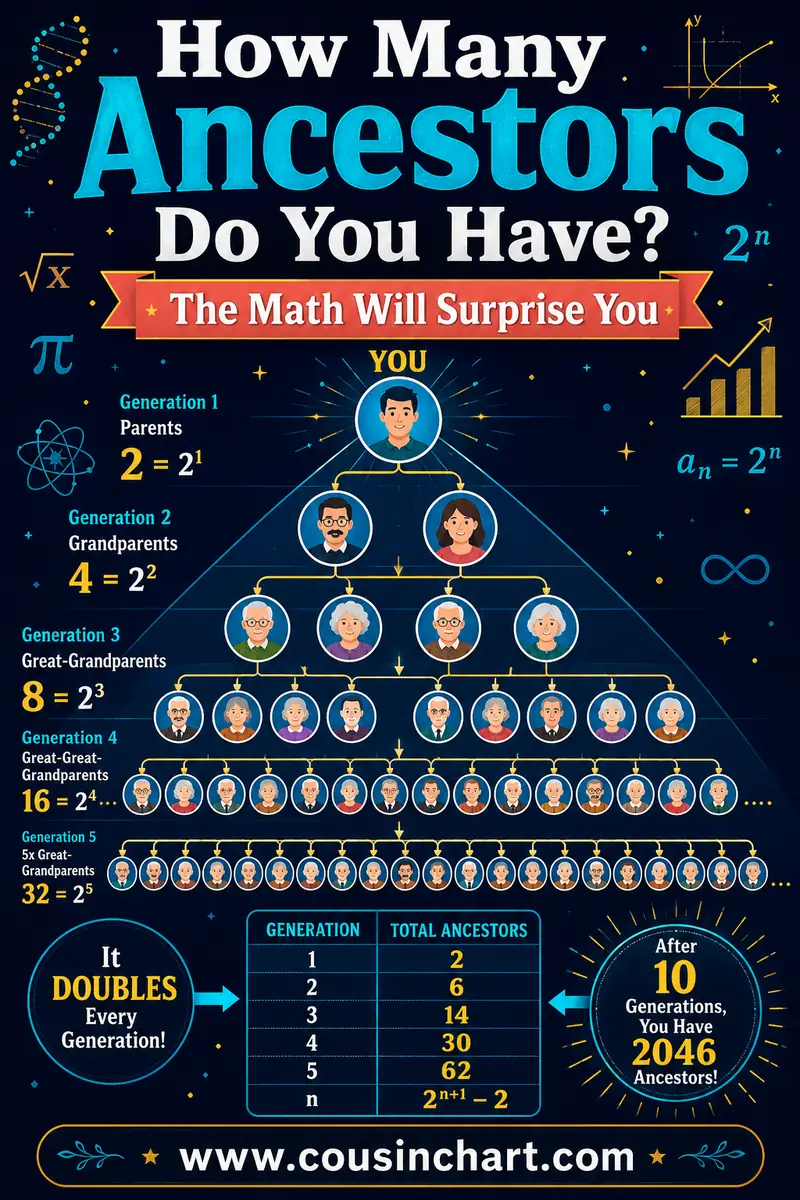
A sobering math note: you have 2 parents, 4 grandparents, 8 great-grandparents — the ancestor count doubles every generation (the full arithmetic is in how many ancestors do you have). Being someone's direct descendant is therefore far more common than family pride suggests: a prolific 17th-century ancestor can easily have hundreds of thousands of living direct descendants. Descent from Charlemagne is the classic example — statistically, essentially everyone with European ancestry qualifies. It's still fun; it's just not rare.
Direct Descendant vs Heir vs Next of Kin
Three terms people blur together:
- Direct descendant describes a biological/legal position: anyone down your unbroken line. You have descendants whether or not you have money to leave.
- Heir describes an inheritance outcome: someone entitled to inherit under law. Heirs are often descendants, but a childless person's heirs might be parents or siblings — not descendants at all.
- Next of kin describes the closest living relative(s) recognized by law, used for inheritance and for decisions like medical consent. Your next of kin may be a spouse, who is not your blood relative, let alone your descendant.
So all three labels can point at the same person — your only daughter is your direct descendant, your heir, and your next of kin — but each answers a different question.
FAQ
What does direct descendant mean?
Someone connected to an ancestor through an unbroken chain of parent-to-child links: children, grandchildren, great-grandchildren, and onward. "Direct" (or "lineal") contrasts with collateral relatives like nieces and cousins, who descend from a shared ancestor but not from the person themselves.
Is a niece a direct descendant?
No. A niece descends from your sibling, which makes her your collateral relative. She is a direct descendant of your parents — descent is always measured from a specific ancestor, and the answer changes depending on which ancestor you pick.
Are grandchildren direct descendants?
Yes. Grandchildren, great-grandchildren, and every generation down the line are direct descendants. "Direct" doesn't mean "immediate" — it means the chain runs strictly parent-to-child with no sideways steps.
Do adopted children count as direct descendants?
Legally, yes — adoption gives a child full lineal-descendant status, including inheritance rights under wills that say "descendants" or "issue." Lineage-society and DNA contexts may distinguish biological descent, so check the specific organization's rules.
Is a stepchild a direct descendant?
Not unless legally adopted. A stepchild descends from your spouse, so estate language leaving property to "my descendants" generally won't include them. Families who intend otherwise need to name stepchildren explicitly in the will.
How do I prove I'm a direct descendant of someone?
Build a documented chain, one generation at a time, from yourself back to the ancestor: birth, marriage, and death records, census entries, wills, and baptism records that each connect a child to a parent. Lineage societies like the DAR require this document trail for every single generation.
Trace Your Line — Both Directions
Direct descendant: unbroken line down, blood or adoption, any number of generations. Everyone else — siblings' kids, cousins, in-laws — is family of a different shape. Once you know which ancestor you're measuring from, the answer is usually ten seconds of tracing.
And for the relationships that aren't a clean straight line — the "okay, so what's my great-grandpa's brother's great-granddaughter to me?" puzzles — that's exactly what the free family relationship calculator is for. Pick the two people, and it names the relationship instantly. (Third cousin, in case you were wondering.)