Immediate Family vs Extended Family: Who Counts?
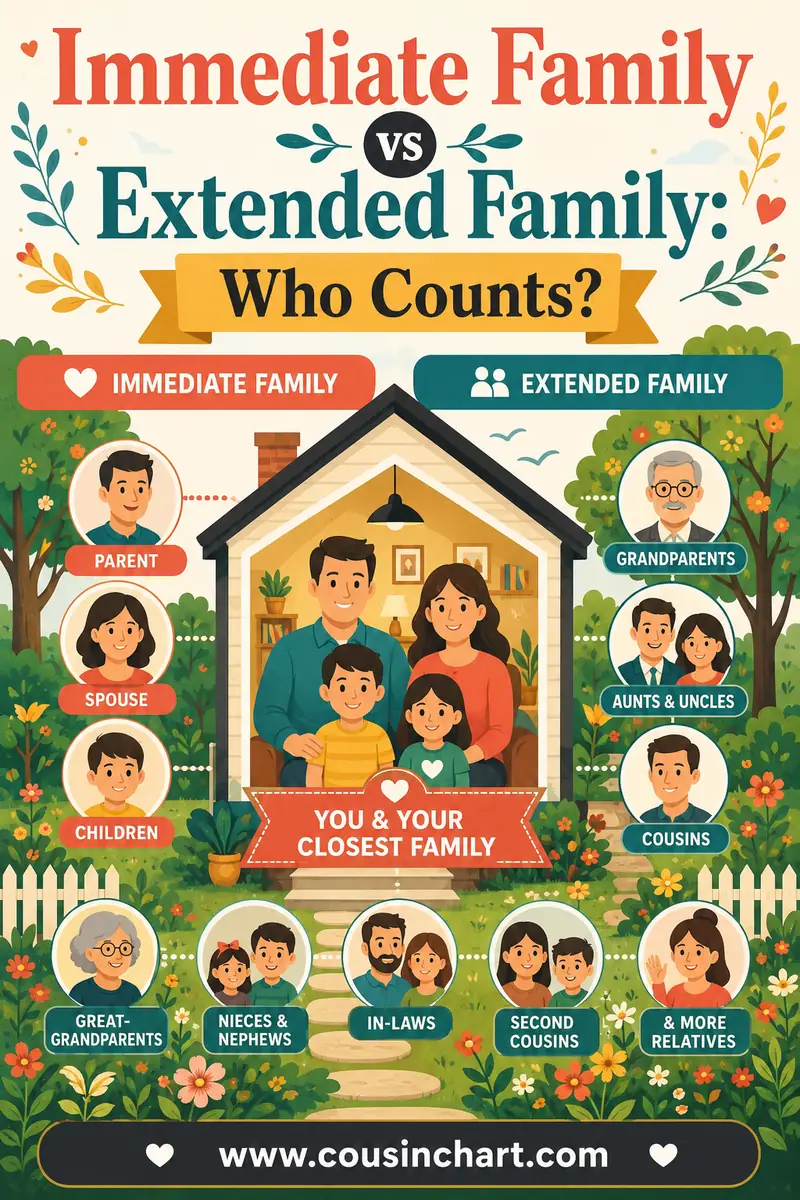
Immediate family usually means your spouse, parents, children, and siblings — the tight inner circle. Extended family is everyone beyond that: grandparents, grandchildren, aunts, uncles, nieces, nephews, cousins, and in-laws. But here's the catch that sends people searching: there is no single official definition. Your employer's bereavement policy, federal leave law, immigration rules, and your grandma's kitchen table all draw the line in different places.
This guide lays out the common-sense version first, then shows exactly how the line moves in the contexts where it matters — time off work, FMLA, immigration, hospitals — and how to handle the gray areas like step-siblings and mothers-in-law. And whenever you need to pin down what someone actually is to you before you can decide which circle they fall in, the free family relationship calculator on our homepage names the relationship in seconds.
Relationship quick-check. Tap a person to see which circle they usually land in:
The answer will appear here.
What "Immediate Family" Usually Means
Strip away the fine print, and immediate family is the household-and-heart core:
- Your spouse
- Your parents (including adoptive parents)
- Your children (biological and adopted)
- Your siblings (including half-siblings)
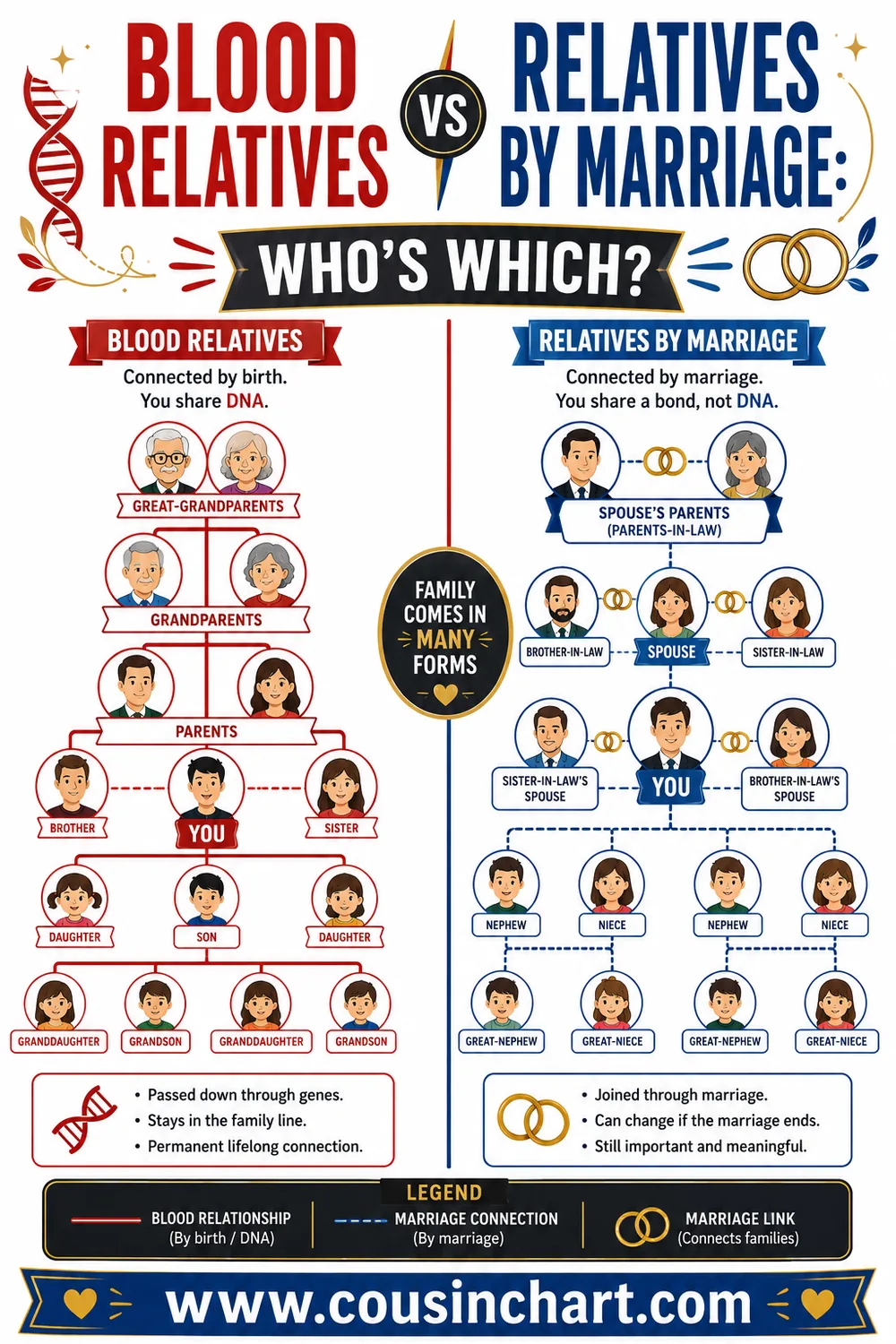
Notice the pattern: apart from your spouse, these are all first-degree relatives — people one direct step from you on the family tree, each sharing roughly 50% of your DNA. That genetic shorthand is why medical forms asking about "immediate family history" mean exactly this group: parents, siblings, children.
Many everyday definitions stretch one ring further to include grandparents, grandchildren, and parents-in-law. That's not wrong — it's just a different rulebook, which is the whole theme of this article.
What "Extended Family" Means
Extended family is everyone you're related to beyond that inner circle:
- Grandparents and grandchildren
- Aunts and uncles
- Nieces and nephews
- First cousins, second cousins, and every cousin beyond
- Great-grandparents and great-aunts and great-uncles
- Relatives by marriage — in-laws of every flavor
Sociologists sometimes use "extended family" in a second sense: a household structure where multiple generations live under one roof. That's a living arrangement, not a relationship category — your uncle is extended family whether he lives across the hall or across the ocean.
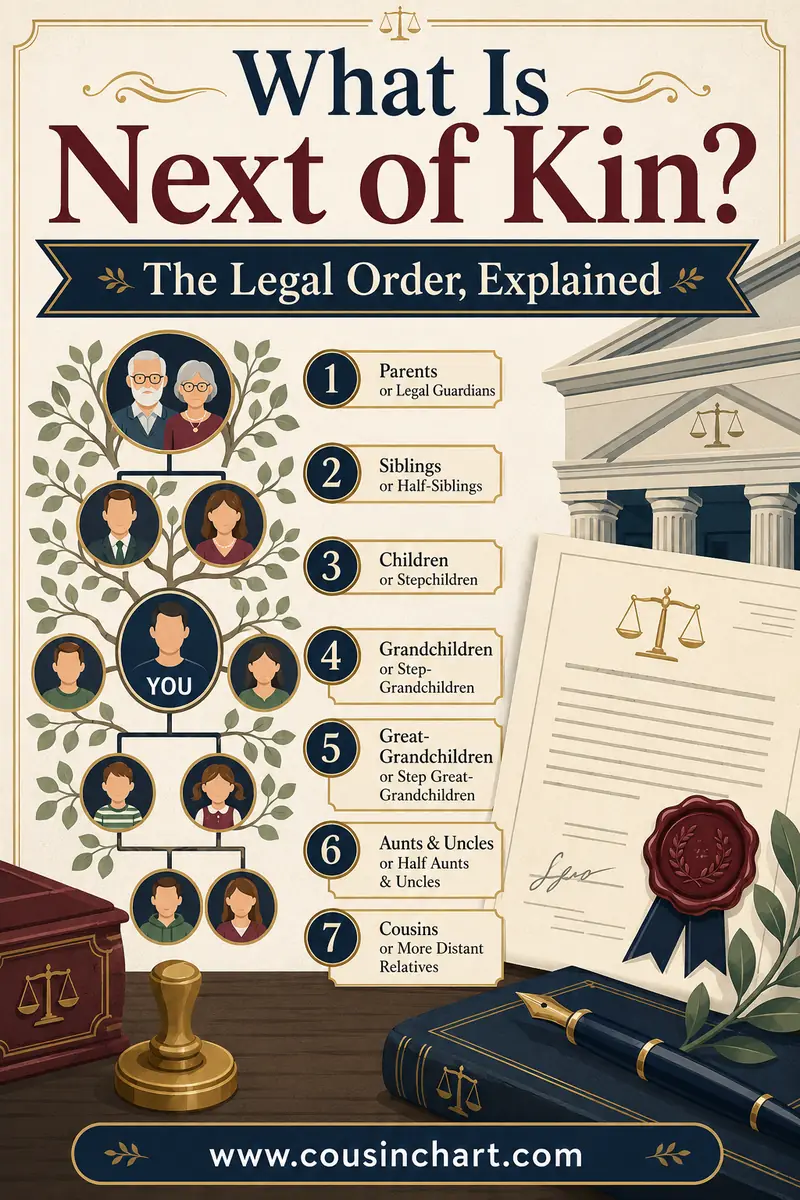
One more useful term: degrees of kinship. Courts and genealogists count the steps between two people to measure closeness — it's the same math behind the next of kin order. The fewer the steps, the closer the relative, and the more likely a given policy counts them as "immediate."
The Same Question, Five Different Answers
Here's where "who counts as immediate family" gets its real answer: it depends on who's asking. The same mother-in-law can be immediate family to your HR department and a legal stranger to federal leave law.
| Context | Who typically counts as "immediate family" |
|---|---|
| Everyday conversation | Spouse, parents, children, siblings — often plus grandparents |
| Bereavement leave (typical employer policy) | Spouse or partner, children, parents, siblings — commonly plus grandparents, grandchildren, and in-laws |
| FMLA (US federal leave law) | Spouse, children, and parents only — not siblings, grandparents, or in-laws |
| US immigration ("immediate relatives") | A US citizen's spouse, unmarried children under 21, and parents |
| Medical history forms | First-degree relatives: parents, siblings, children |
Two of those deserve a closer look, because they surprise people constantly.
FMLA: the narrowest major definition
The Family and Medical Leave Act lets eligible employees take unpaid, job-protected leave to care for a spouse, child, or parent with a serious health condition. That's the whole list. Siblings, grandparents, and parents-in-law generally don't qualify — no matter how close you are.
There's one humane exception: in loco parentis. Someone who raised you as a parent — a grandmother, an aunt, a family friend — can count as your "parent" under FMLA even with no blood or legal tie, and a child you're raising as your own can count as your child. The law looks at who actually did the parenting, not the label.
Immigration: "immediate relative" is a term of art
In US immigration law, immediate relatives of a US citizen — spouse, unmarried children under 21, and parents — aren't subject to annual visa caps, which makes the category hugely consequential. Siblings and adult children are "family preference" categories instead, with long waits. Same words, completely different stakes.
The Gray Areas Everyone Asks About
In-laws
Your mother-in-law is your spouse's immediate family, and by extension many people — and many employer policies — treat her as yours. Law mostly doesn't: in-laws are relatives by affinity (marriage), not blood, so they sit outside definitions built on kinship. Practical rule: assume in-laws count for workplace policies and don't count for legal ones, then verify.
Grandparents and grandchildren
One ring out from the core, and the most commonly promoted relatives. Plenty of bereavement policies include them; FMLA doesn't (barring in loco parentis); everyday usage splits. If a grandparent raised you, both custom and several laws treat that as a parent-child bond.
Step-relatives
A stepparent or stepsibling joins the family through a parent's marriage, not through blood or adoption. Modern workplace policies increasingly count step-relatives as immediate family — and bonus family terms reflect how real those bonds are. Legally, though, step-relationships usually carry no automatic status unless an adoption made them official.
Adopted family
The cleanest answer on the list: adoption creates full legal kinship. An adopted child is immediate family in every sense — legal, medical-form, everyday — identical to a biological child.
Unmarried partners
The person closest to you in life can be the hardest to classify on paper. A long-term partner isn't immediate family under most laws unless you marry or register a recognized partnership, though many employers have added "domestic partner" to their policies. If this is your situation, the fix is the same as with next of kin: get it in writing.
Chosen family
The auntie who isn't your aunt, the brother-from-another-mother — fictive kin can outrank blood in daily life. A few policies (and the FMLA's in loco parentis rule) make room for them; most formal definitions still don't.
Why There's No Single Definition
It feels like a bug, but it's a feature. Each rulebook defines family to fit its job:
- Leave policies balance compassion against staffing, so they draw a generous-but-bounded circle.
- FMLA guarantees a legal minimum nationwide, so Congress kept the list short and clear.
- Immigration law rations limited visas, so "immediate relative" is deliberately narrow.
- Medical forms track genetic risk, so they follow shared DNA — degrees, not affection.
Once you see that each definition answers a different question, the inconsistency stops being confusing and starts being predictable: the more a rule costs to apply, the tighter its circle.
How to Check Who Counts (in Two Minutes)
- Find the actual text. Employee handbook, statute, or form instructions — the definition is nearly always spelled out.
- Look for the magic words: spouse, domestic partner, child, parent, sibling, grandparent, in-law, step-. What's listed counts; what isn't, usually doesn't.
- Name the relationship precisely first. Policies say "first cousin" or "great-aunt," not "my mom's cousin's daughter." If you're fuzzy on the exact term, run the connection through the relationship calculator — it traces the path and gives you the label the paperwork expects.
- When in doubt, ask HR in writing. Gray-area calls (step-grandparents, partners, in loco parentis) are decided by people, and a clear question gets a clear answer.
Quick Scenarios, Decided
Sometimes the fastest way to internalize the rules is to watch them work:
- "My grandfather died — do I get bereavement leave?" Check your handbook. Grandparents appear in most employer bereavement lists even though they're technically extended family. If the policy is silent, ask HR; many managers approve it as a matter of course.
- "Can I take FMLA leave to care for my sister?" Generally no — siblings aren't on FMLA's spouse-child-parent list. Exceptions exist if you stand in loco parentis to her (you're raising her) or she meets the standard for you. Some states' own leave laws are broader, so check both layers.
- "My company gives immediate-family discounts. Does my mother-in-law qualify?" Coin flip — this is exactly the kind of policy where definitions vary most. Read the definition section; if in-laws aren't named, assume no and ask.
- "The form says list immediate family medical history." Give parents, siblings, and children. That's the first-degree genetic circle the form is actually built to capture — your aunt's condition may still be worth mentioning, but the core answer is those three rows.
- "My step-dad raised me since I was two. Is he immediate family?" In life, obviously. On paper: yes under most modern workplace policies, yes under FMLA's in loco parentis rule, and no under strictly blood-based legal definitions unless he adopted you.
Notice the pattern in every scenario: the answer lives in the specific rulebook, and the relationship term is the key that unlocks it.
FAQ
Who counts as immediate family?
Most commonly: your spouse, parents, children, and siblings. Many definitions also include grandparents, grandchildren, and in-laws, while legal definitions like FMLA are narrower — always check the specific policy or law in play.
Are grandparents immediate or extended family?
Traditionally extended family, since they're one step beyond the parent-child-sibling core. But many bereavement policies count them as immediate, and a grandparent who raised you may count as a parent under rules like FMLA's in loco parentis standard.
Are in-laws immediate family?
Usually not in law — in-laws are relatives by marriage, outside blood-based definitions. But many employers include parents-in-law (and sometimes siblings-in-law) in bereavement and emergency-leave policies, so read yours before assuming.
Are cousins immediate family?
No. First cousins — and every cousin beyond — are extended family in essentially every definition, casual or legal. Close in heart doesn't move them into the inner circle on paper.
Is a stepbrother immediate family?
Often yes under modern workplace policies, which increasingly list step-relatives. Under most laws, no — step-relationships carry no automatic legal status unless there was an adoption.
What's the difference between immediate family and next of kin?
Immediate family is a descriptive circle (spouse, parents, children, siblings); next of kin is a ranked legal order used for inheritance and medical decisions. They overlap heavily, but next of kin is a queue with tie-breakers, not just a group.
Draw Your Own Circles with Confidence
So: immediate family = spouse, parents, children, siblings; extended family = the wider web of grandparents, aunts, uncles, cousins, and in-laws — with the exact boundary redrawn by every policy, law, and form you'll ever meet. The one skill that works everywhere is naming the relationship precisely, because that's the word the fine print is written in. Whenever you need it — for HR, a visa form, or a family debate — the free family relationship calculator works out exactly how any two people are related, instantly.