Fictive Kin: Aunties and Uncles Who Aren't Related
Fictive kin are people treated as family — with family names, family roles, and family obligations — who are related to you by neither blood nor marriage. Mom's best friend you call Auntie. Your play cousins. Your godfather. The neighbor who's been "Grandpa Joe" since before you could talk. Anthropologists coined the term for kinship created by social agreement rather than biology, and it describes one of the most universal human practices there is.
The word "fictive" is misleading if you read it as fake — the relationships are real; only the genealogy is invented. In fact the term has jumped from anthropology textbooks into actual law: many U.S. child-welfare systems formally recognize "fictive kin" as a placement category for children. This guide covers what counts, examples across cultures, the legal uses, and how fictive kin relate to the chartable tree — which, for everyone who is on it, the free family relationship calculator on our homepage can label instantly.
Relationship quick-check. Tap a person — real chart position, or family by choice?
The answer will appear here.
What Counts as Fictive Kin
The anthropological definition is simple: kinship ties that are not based on blood (consanguinity) or marriage (affinity), but are socially recognized and carry family-like roles. Three ingredients matter:
- Family terminology — the person is called aunt, uncle, cousin, grandma, brother.
- Family roles and obligations — showing up, helping out, holiday membership, discipline rights over kids, expected loyalty.
- Social recognition — the family (and often the wider community) treats the tie as real.
What it's not: a nickname alone doesn't make fictive kin ("bro" said to a stranger), and neither does formal politeness (calling an elder "auntie" once in a market). The bond has to function like family over time.
A note on the word itself: scholars increasingly prefer terms like chosen kin, voluntary kin, or ritual kin, because "fictive" seems to rank these bonds below biological ones — which is exactly backwards in the many cultures where a godparent bond or blood-brotherhood was considered more binding than cousinhood. The older term persists because it's entrenched in the literature and, importantly, in child-welfare law.
Examples Across Cultures
Fictive kinship is a human universal with wonderfully varied local forms:
- Play cousins, play aunties (Black American communities). Long-standing tradition of extending family terms to close family friends — "play cousin" is affectionate, precise, and widely understood. Rooted partly in histories where formal kin records were destroyed by slavery, and community networks were the family infrastructure.
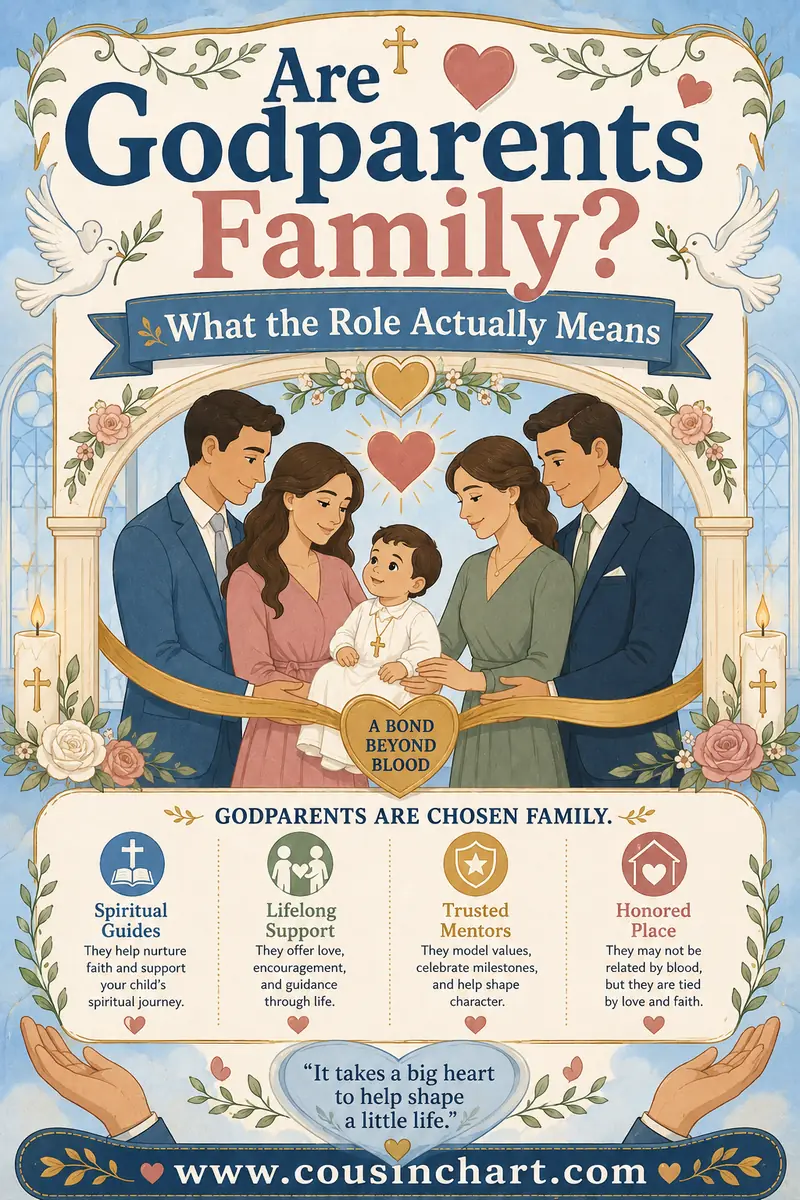
- Compadrazgo (Latin America, Spain, the Philippines). Godparenthood that formally bonds the adults: parents and godparents become compadres/comadres — co-parents — with lifelong mutual obligations. Perhaps the most institutionalized fictive-kin system in the world; more in our godparents guide.
- Auntie/Uncle cultures (South Asia, Africa, the Caribbean, Pacific, and beyond). Every adult of your parents' generation in the community is Auntie or Uncle — a kinship etiquette that shades into genuine fictive kin for the close ones.
- Milk kinship (historical Islamic and Mediterranean practice). Children nursed by the same woman became milk-siblings — a recognized kinship with real consequences, including marriage restrictions in Islamic law.
- Blood brotherhood — sworn ritual siblinghood, documented from Scythians to sworn sisterhoods in China.
- Institutional siblinghood — fraternities, sororities, military units, religious orders (Brother, Sister, Father, Mother Superior): organizations deliberately borrow kinship's vocabulary to manufacture its loyalty.
- Chosen family (contemporary usage). The modern umbrella term, especially meaningful in LGBTQ+ communities, where chosen families have historically supplied what families of origin sometimes withheld.
When Fictive Kin Is a Legal Category
Here's where the textbook term earns a surprising second life. In U.S. child welfare, when a child can't remain with parents, placement preference typically goes first to relatives — kinship care. Many states extend that preference to fictive kin: adults with a significant, pre-existing relationship to the child — a godparent, a longtime family friend, a coach or neighbor the child knows and trusts.
The details vary by state, but the pattern is consistent:
- Statutes or agency policy define fictive kin (wording differs — "an adult with a significant relationship to the child" is typical).
- Fictive-kin caregivers can often be licensed as kinship foster parents, sometimes with the same supports as relative caregivers.
- The federal Family First legislation nudged states toward broader kin definitions, and most now include fictive kin in some form.
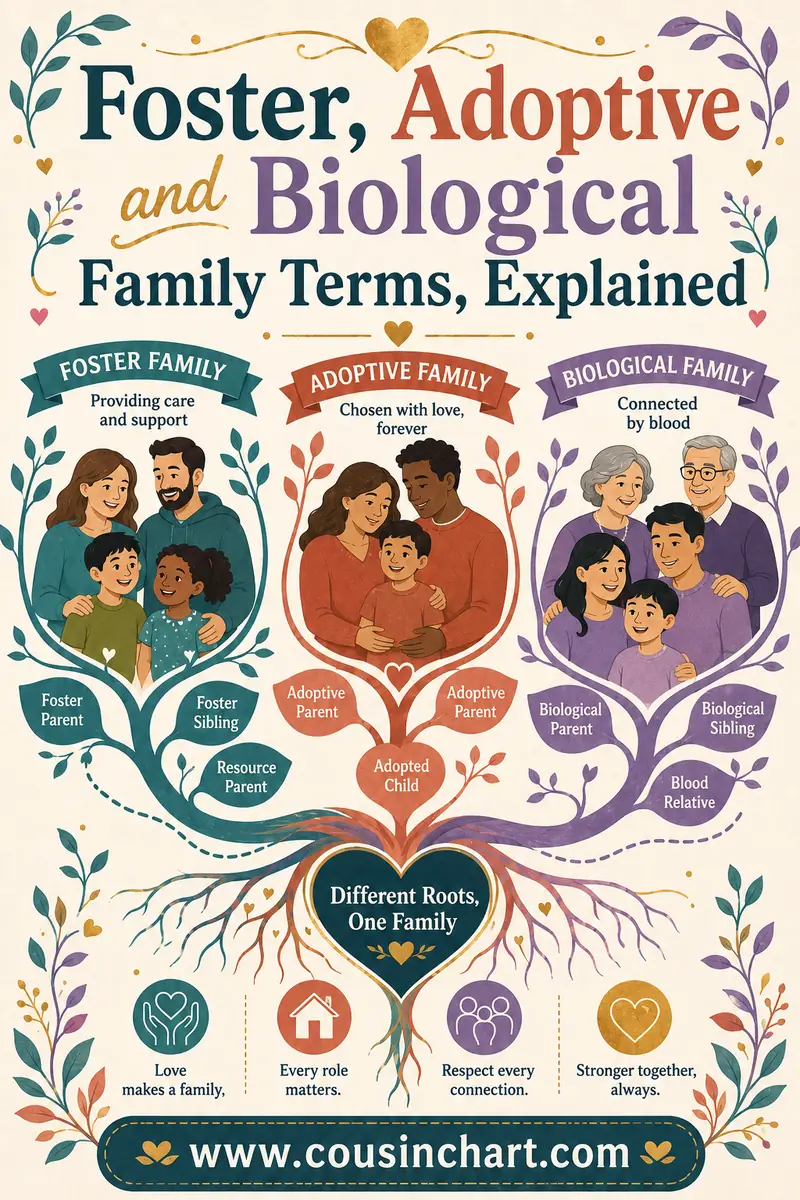
The reasoning is pure child-centered pragmatism: placement with someone the child already loves preserves stability, school, and community. The full landscape of relatives-raising-children — grandfamilies, licensing, supports — is covered in our kinship care guide, and the adjacent vocabulary of foster and adoptive relationships in foster, adoptive and biological family terms.
Outside child welfare, though, the general rule holds: fictive kin have no default legal standing — no inheritance without a will, no medical decision authority without documents, no custody without court action. Chosen family who want legal weight behind the bond need the paperwork: wills, guardianship designations, powers of attorney.
Fictive Kin vs the Neighboring Terms
| Term | Tie based on | Example | On the family tree? |
|---|---|---|---|
| Blood kin (consanguine) | Shared ancestor | Your first cousin | Yes |
| Affinal kin | Marriage | Your brother-in-law | Yes (by marriage) |
| Step-kin | A parent's remarriage | Stepbrother | Yes (by marriage) |
| Adoptive kin | Legal adoption | Adopted sister | Yes — full legal kinship |
| Fictive kin | Social bond / ritual | Play cousin, godparent, Auntie | No |
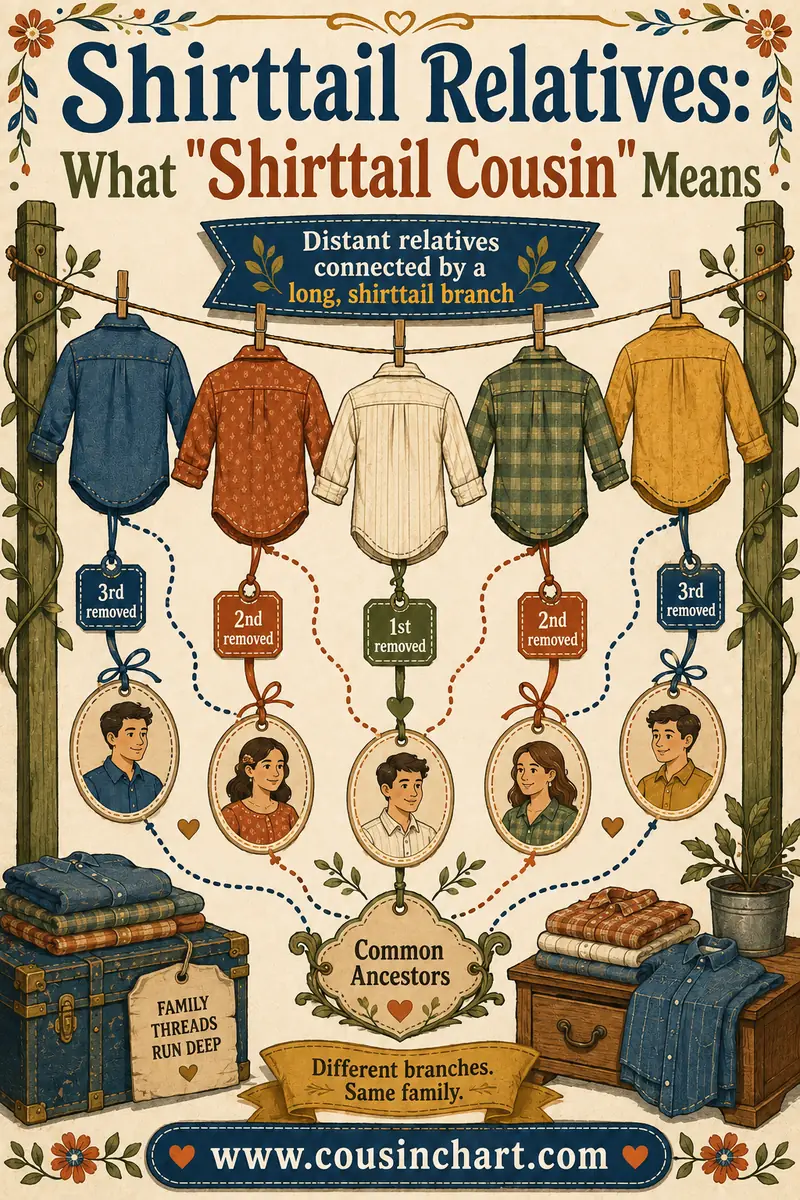
| Shirttail kin | Vague mix of all the above | "Cousins" from the next farm | Sometimes |
Two boundary cases worth flagging. Adoption is not fictive kinship — it creates full legal (and genealogical) kinship; the law literally redraws the tree. And the fuzzy folk category of shirttail relatives overlaps fictive kin at one end (honorary cousins) while including real distant blood kin at the other — half the fun of that term is nobody checking.
And a genealogist's caution in the other direction: some "fictive" kin turn out to be actual kin. Families drift out of touch, and the "family friend" Auntie is sometimes a genuine second cousin nobody traced. Before filing someone under fictive, it can be worth running the connection — the relationship calculator makes checking a suspected blood path trivial.
Why Humans Do This Everywhere
The universality is the tell: fictive kinship isn't a quirk, it's infrastructure.
- Kinship is society's oldest safety net, and biology alone never supplies enough of it — migration, death, distance, and estrangement leave gaps. Fictive kin patch the net.
- It formalizes trust. Calling someone Uncle Ray announces to your children — and to Ray — what may be expected of everyone involved. The vocabulary does real coordination work.
- It survives what biology can't control. You can't choose your cousins; communities everywhere quietly evolved a workaround.
- Research backs the function: studies of extended support networks consistently find fictive kin providing childcare, eldercare, financial help, and crisis support at levels comparable to blood relatives — in some communities, exceeding them.
Genealogy, for all its charts, has always known this. Family historians constantly encounter the boarder listed with the family in five straight censuses, the "aunt" in every photo who matches no record. Good family history records those people too — the tree is the skeleton, but fictive kin are part of the story.
FAQ
What does fictive kin mean?
People treated as family — with family names like aunt, uncle, or cousin, and family-like roles — who are related by neither blood nor marriage. Examples: honorary aunties, play cousins, godparents, and chosen family. The bonds are real; "fictive" refers only to the genealogy.
Is fictive kin a legal term?
Increasingly, yes — in U.S. child welfare. Many states formally recognize fictive kin (adults with a significant pre-existing relationship to a child) as preferred placements alongside relatives in foster care. Outside that context, fictive kin generally have no automatic legal rights.
What is a play cousin?
A close family friend's child raised alongside you and called your cousin — a long-standing tradition especially in Black American communities. Play cousins are fictive kin: genuine family bonds without a genealogical connection.
Are godparents fictive kin?
Usually, yes — godparenthood creates a spiritual and social bond, not a blood or legal one. The exception is when the godparent is also a relative (an aunt serving as godmother), which is extremely common; then the chart position is aunt, with godmother as an added role.
What's the difference between fictive kin and chosen family?
Largely emphasis and era. "Fictive kin" is the older anthropological/legal term; "chosen family" is the contemporary phrase, prominent in LGBTQ+ communities, for the same core idea — family built by commitment rather than birth. Scholars increasingly use "chosen" or "voluntary kin" to avoid the dismissive ring of "fictive."
Do fictive kin appear on a family tree?
Not on the pedigree itself — no blood or marriage line connects them. Genealogists record them as associated people, witnesses, godparents, or household members, where they often turn out to be crucial clues. Occasionally research reveals a "fictive" auntie was a real blood cousin all along.
Two Kinds of Family, One Table
Every thriving family is a merger: the people the chart assigns you, and the people the years assign you. Fictive kin are the second group — the aunties, godfathers, and play cousins who hold no chart position and miss no birthday. Anthropology gave them a clumsy name; your family gave them a better one.
Keep the chart honest anyway. When you want to know exactly what the chartable people are to you — or to test whether Auntie Rose is secretly a second cousin once removed — the free family relationship calculator settles it in seconds. The rest of the table needs no calculating.