Shirttail Relatives: What "Shirttail Cousin" Means
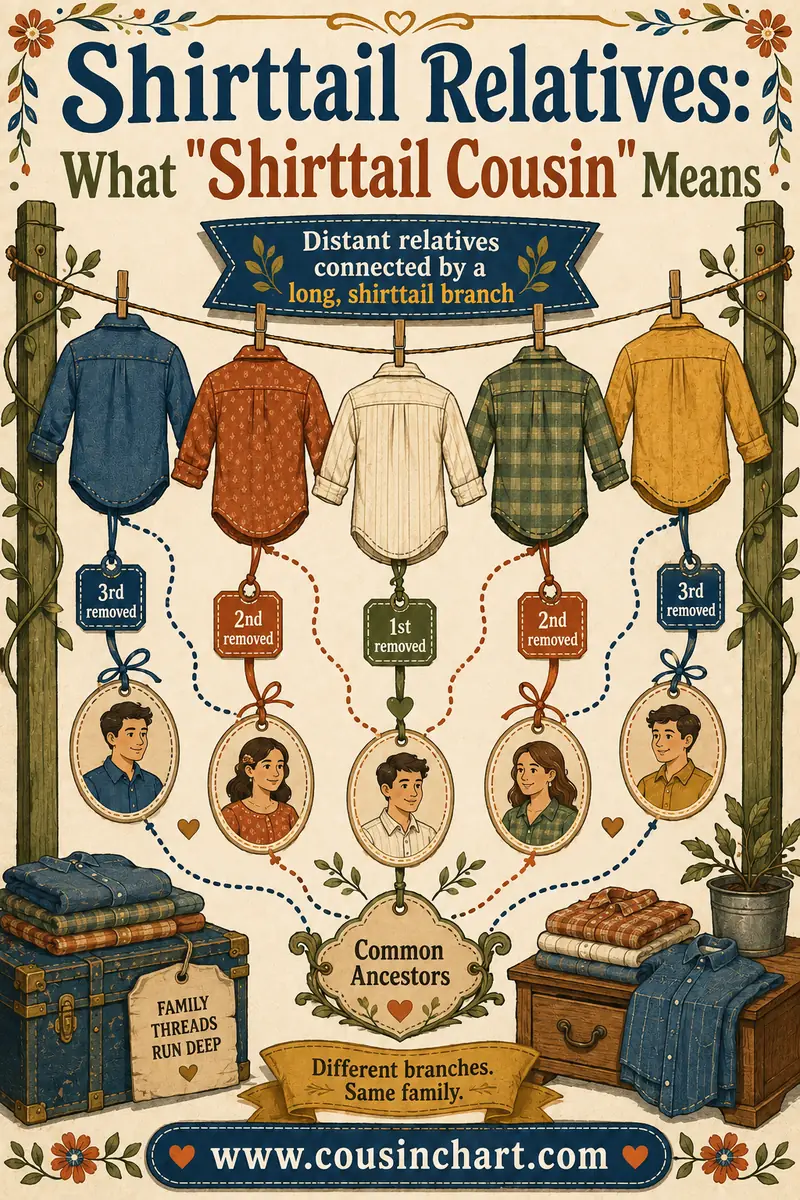
A shirttail relative (or shirttail cousin, shirttail kin) is someone who's family, but only just — related distantly, related by marriage rather than blood, or not technically related at all yet permanently on the reunion invite list. Your cousin's wife's brother. Your great-grandma's cousin's grandkids. The folks from the neighboring farm who've been "cousins" since the 1940s. If the connection is real but you'd need a whiteboard to explain it, that's shirttail territory.
It's a folksy American expression, strongest in the Midwest and Upper Midwest, and it fills a genuine gap: English has precise words for close relatives and nothing convenient for the fuzzy outer ring. The fun twist is that many "shirttail" connections do have exact names — and this guide supplies them. For any specific person hanging off the edge of your tree, the free family relationship calculator on our homepage produces the proper term in seconds.
Relationship quick-check. Tap a classic "shirttail cousin" — does a real term exist?
The answer will appear here.
What the Phrase Covers
"Shirttail relative" is deliberately elastic. In actual use it stretches over three different kinds of connection:
- Distant blood relatives. Third cousins, second cousins once removed, your grandfather's cousin's family — people who genuinely share an ancestor with you, far enough back that nobody at the table can reconstruct it.
- Relatives by marriage, at one or two steps. Your cousin's husband, your sister-in-law's parents, your uncle's second wife's kids. Connected to your family, not to your bloodline.
- Honorary kin. Longtime family friends absorbed into the family — invited, loved, called "cousin," and related to you by precisely nothing.
What unites all three: the social tie outruns the genealogical one. A shirttail cousin is somebody you treat as family without being able to say exactly why on paper.
Dictionaries agree on the gist. Merriam-Webster files "shirttail" (adjective) as meaning distantly related — and the word carries a secondary flavor of "small" or "meager" (as in the old phrase "shirttail outfit" for a tiny ranch), which fits: kin, but only a scrap of it.
Where "Shirttail" Comes From
The origin is folk etymology rather than documented coinage, but the leading images all point the same direction:
- Hanging on by the shirttail. The most repeated explanation: these relatives are connected to the family the way a shirttail connects to a shirt — trailing off the end, barely attached, flapping loose.
- The shirttail as the last scrap. A shirttail is the bottom edge of the garment — the leftover fabric. A shirttail relation is likewise the tail end of kinship.
- Kids running around in shirttails. A gentler theory ties it to the era when small children ran around in long shirts; shirttail kin were the kids underfoot at every gathering regardless of exact relation.
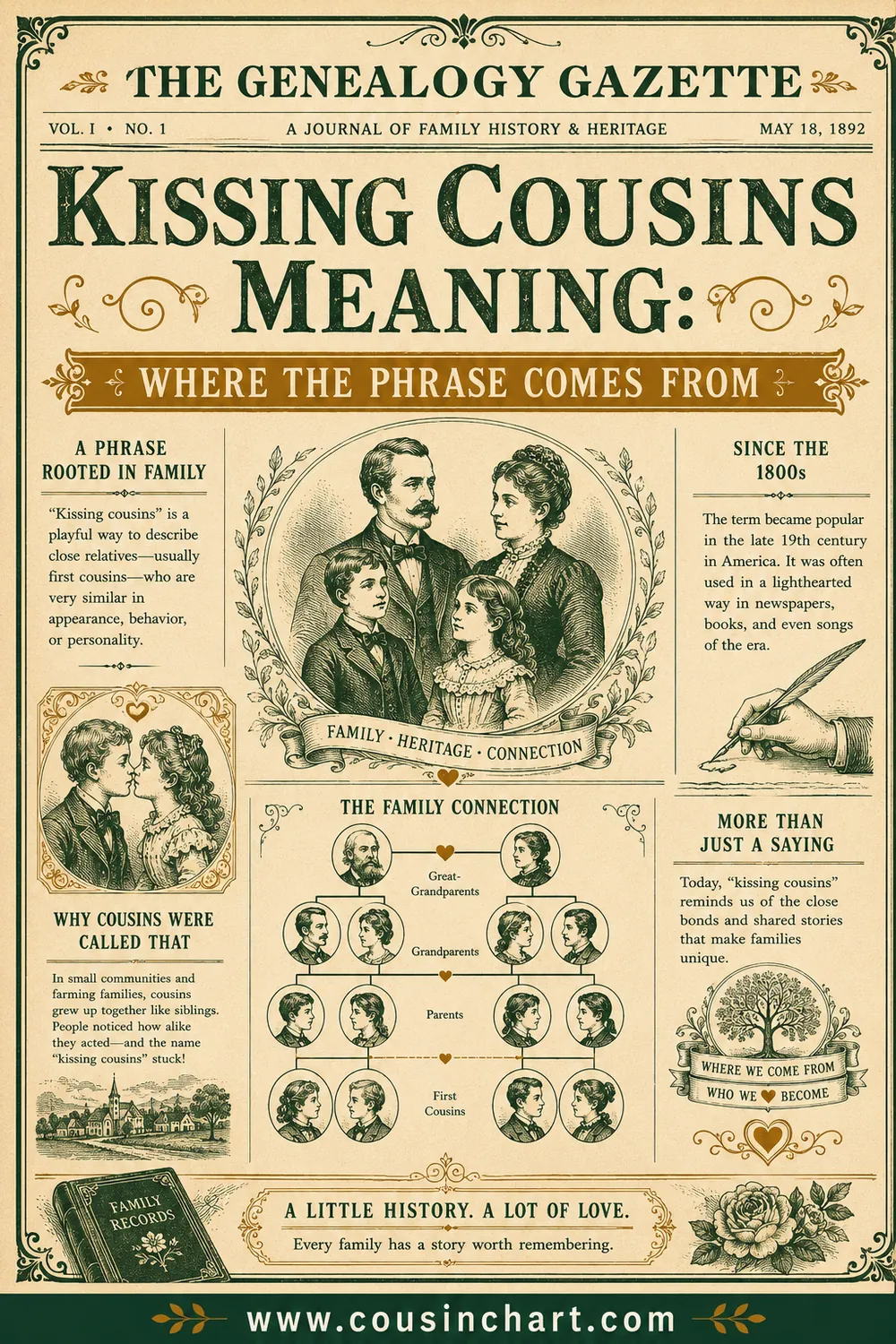
The phrase shows up in American print by the late 1800s and settled into everyday speech across the Midwest, the Plains, and Appalachia — regions of big farm families, where decades of marriages between neighboring clans produced exactly the tangle the word describes. It belongs to a whole folk vocabulary of kinship — kissing cousins, country cousins, Dutch uncles — that we've collected in our family relationship idioms guide.
Shirttail Cousin vs Kissing Cousin vs Fictive Kin
Three overlapping folk terms, three different centers of gravity:
| Term | Core meaning | Emphasis |
|---|---|---|
| Shirttail cousin | Distantly or vaguely related — blood, marriage, or habit | How thin the connection is |
| Kissing cousin | A relative close enough to greet warmly, distant enough that closeness is optional | How warm the connection is |
| Fictive kin | Family by choice or role, with no blood/marriage tie at all | The tie is social, not biological |
A kissing cousin (full story in our kissing cousins explainer) might be a genuine second cousin you adore. A shirttail cousin might be someone whose exact link nobody remembers. And Aunt Ruth from next door is fictive kin — the anthropologists' term for family-by-love, which has its own rich article on this site.
The Fun Part: Most Shirttail Kin Have Real Names
Here's what surprises people: genealogy has precise terms for a huge share of the relationships families wave off as "shirttail." A sampler:
- Your grandma's cousin → your first cousin twice removed (cousin line, two generations up).
- Your great-grandma's cousin's grandchild, same generation as you → your third cousin — check it: the shared couple is your great-great-grandparents, four steps up for you both.
- Your mom's cousin → your first cousin once removed; your mom's cousin's kid → your second cousin.
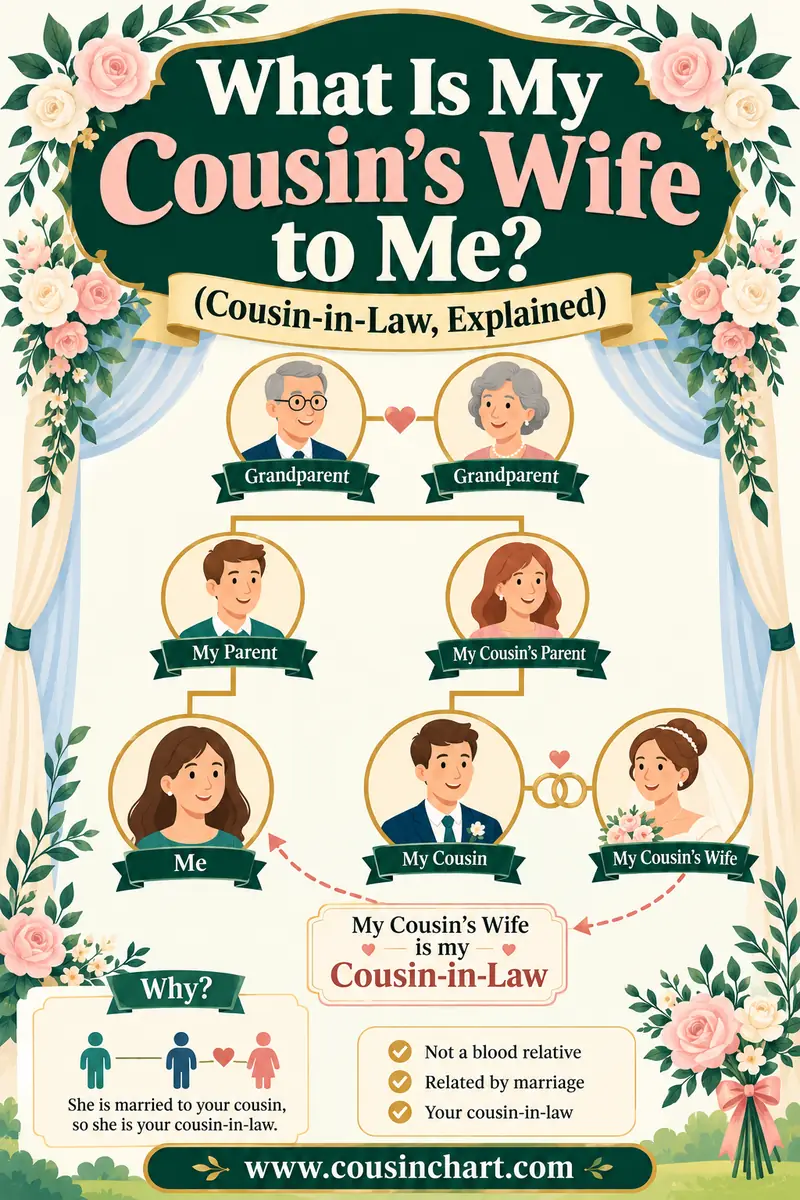
- Your cousin's wife → your cousin-in-law; a real if informal term, and the subject of our cousin's wife explainer.
- Your spouse's sibling's spouse → your co-sibling-in-law — a legitimate term most English speakers have never needed twice.
And then there are the genuinely nameless ones: your brother-in-law's brother, your cousin's cousin on the other side, your stepdad's ex-wife's kids. For those, "shirttail" isn't imprecision — it's the correct answer, because no shared ancestor or single marriage chain connects you. English shrugs, and the shirttail flaps free.
The dividing line is always the same question: can you trace a path of blood links (or one marriage) between you? If yes, a term exists and the relationship calculator will produce it. If the path needs two marriages or a leap of pure affection, you've left the chartable tree.
Why Shirttail Kin Deserve the Invite Anyway
A short defense of the outer ring, because it's the best part of family culture:
- They're the memory bank. Distant cousins carry photos, stories, and family Bible pages your direct line lost. Genealogists learn fast that the gold is usually in a shirttail cousin's attic.
- They're how communities held together. In small towns, the web of shirttail connections — half kin, half neighbor — was the social safety net long before anything official existed.
- They're future DNA matches. That vaguely-related branch will surface in your match list someday, labeled "3rd–4th cousin," and the old shirttail lore will suddenly be the clue that identifies them.
- Nobody audits the guest list. The whole charm of the term is its generosity: family membership by warmth rather than paperwork. Every culture has a version of it, because every family needs one.
Three Questions That Untangle Almost Any Shirttail Cousin
When somebody at the reunion says "oh, we're shirttail cousins somehow," you can usually crack the mystery on the spot with three questions:
- "Whose side — and through whom?" Pin the connection to one named person: "through Grandma Elsie's people" beats "through the Larsons" every time. One name gives you a trailhead.
- "Blood or marriage?" Ask whether the link runs through a birth or a wedding. If anyone says "well, his first wife was a…," you've found a marriage step, and marriage steps are where chartability goes to die.
- "How far back is the shared couple?" If the family can name a common ancestor at all — "we both come from the Havlicek brothers who homesteaded together" — count generations down from that couple and you've got a real cousin term waiting.
Try it on a real case: "Dale" at the reunion turns out to connect through your great-grandmother's sister. That's not shirttail at all — her kids are your grandma's first cousins, her grandkids are your parent's second cousins, and Dale (her great-grandson) is your honest-to-goodness third cousin. One conversation, one whiteboard avoided.
FAQ
What does shirttail cousin mean?
A relative connected to you only loosely — through distant blood (like a third cousin), through marriage (like your cousin's husband), or through long family friendship with no formal tie at all. It's an American folk term, common in the Midwest, for kin who are family in practice but hard to chart on paper.
Where does the term shirttail relative come from?
Folk etymology, most likely from the image of "hanging on by the shirttail" — attached to the family the way a shirttail trails off a shirt. The phrase appears in American usage by the late 1800s and took strongest root in the Midwest and Plains states.
Is a shirttail cousin a real blood relative?
Sometimes. The term covers genuine distant cousins (who share an ancestor with you), in-law connections (who don't), and honorary family (also don't). That ambiguity is the point — it labels the social closeness while shrugging at the genealogy.
What's the difference between a shirttail cousin and a kissing cousin?
A kissing cousin emphasizes warmth — a relative distant enough to marry, historically, but close enough to greet with a kiss. A shirttail cousin emphasizes thinness of connection — someone barely attached to the family tree. One person can be both.
What is my cousin's wife's brother to me?
Nothing chartable — a textbook shirttail relative. He shares no ancestor with you, and the connection passes through two marriages. "My cousin's brother-in-law" describes him; genealogy assigns no term.
Do shirttail relatives show up in DNA tests?
Only the blood variety. A distant cousin may appear as a small match (or none at all — third cousins share DNA only about 90% of the time). In-law and honorary shirttail kin share no DNA, however many Thanksgivings they've attended.
Chart the Chartable, Cherish the Rest
"Shirttail cousin" is the affectionate shrug at the edge of every family tree — and half the time, the shrug is premature. Grandma's cousin has an exact name (first cousin twice removed). The mystery branch at the reunion may be honest-to-goodness third cousins. The connection you assumed was unmappable often maps in one try.
So run the fun experiment: next gathering, pick your most notorious shirttail relative and trace them with the free family relationship calculator. Either you'll finally have the real term — or you'll confirm they're pure shirttail, family by love alone, which was always the better story anyway.