Is It Legal to Marry Your Cousin? Laws by State
Last updated: September 30, 2026
It depends on the state and on which cousin. First-cousin marriage is legal in roughly a third of U.S. states, legal with conditions in about half a dozen more, and prohibited in the rest — a few states even attach criminal penalties. Second-cousin marriage is legal in nearly every state. There is no federal law on the question; each state draws its own line, and lines move (Tennessee, for example, banned first-cousin marriage in 2024).
This guide lays out how the state laws group, where once-removed and half cousins fall, how states treat marriages performed elsewhere, and what the genetics research actually says — all neutrally and factually. One important note up front: marriage statutes change, so always check your state's current law before making plans. And if you first need to confirm what kind of cousins you actually are, the free family relationship calculator on our homepage sorts that out in seconds.
Relationship quick-check. Tap a phrase to see the relationship (and where the law generally stands):
The answer will appear here.
First, Be Sure Which Cousin You Mean
Marriage statutes are written in relationship terms, so precision matters:
- First cousins share grandparents — your parent and their parent are siblings. This is the relationship the phrase "cousin marriage" almost always refers to, and the one state laws regulate.
- First cousins once removed are a first cousin's child or parent — one generation offset.
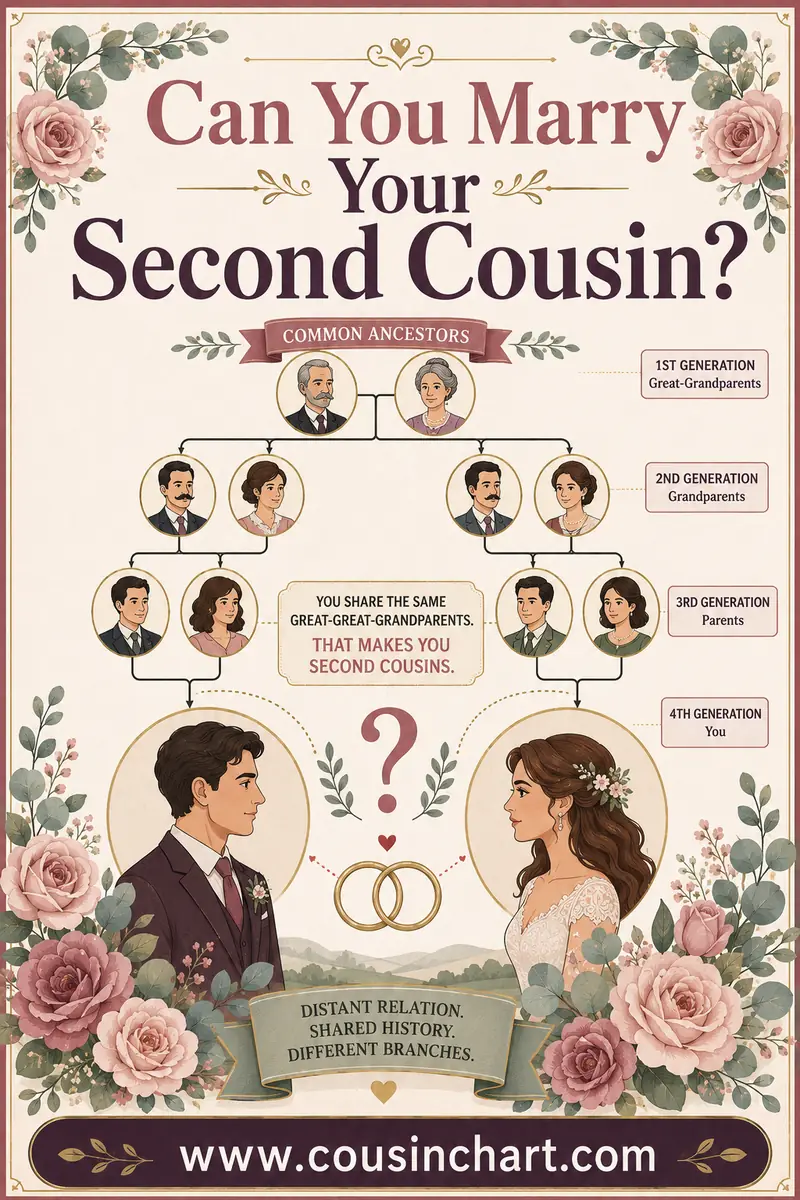
- Second cousins share great-grandparents. Legally unrestricted everywhere in the U.S. — the details live in our second cousin marriage guide.
- Half cousins share one grandparent instead of two.
If the family connection is fuzzy ("our grandmothers were sisters… I think"), work it out before reading statutes — the relationship calculator names the exact relationship from any two family positions.
How the 50 States Group
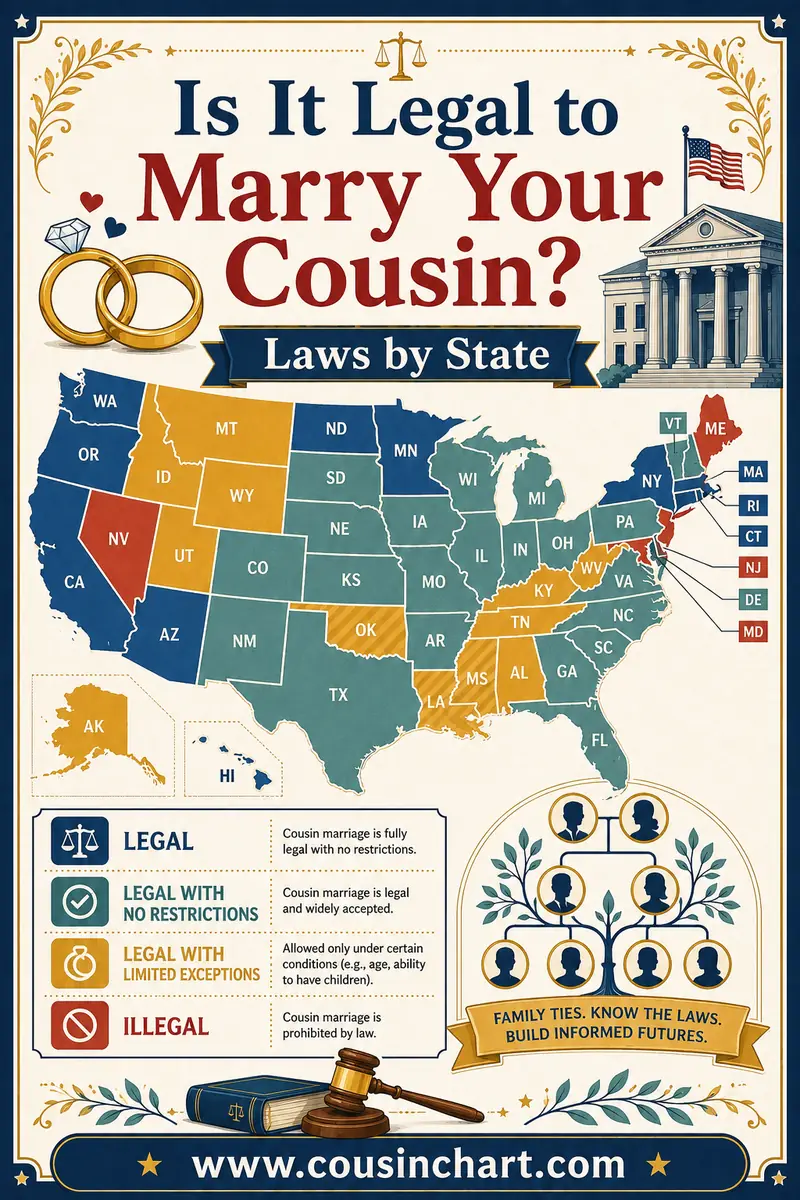
State laws on first-cousin marriage fall into four broad categories. Counts below are approximate as of the mid-2020s — legislation is active in this area, so treat this as a map, not a legal opinion, and verify current law in your state.
| Category | Approx. count | What it means | Example states |
|---|---|---|---|
| Legal, no conditions | About a third of states + D.C. | First cousins may marry like any couple | California, New York, Florida, Massachusetts, Virginia, Colorado |
| Legal with conditions | ~6 states | Allowed only in defined circumstances | Arizona, Illinois, Indiana, Utah, Wisconsin, Maine |
| Prohibited (void) | ~25 states | Licenses not issued; marriage not valid | Ohio, Michigan, Pennsylvania, Washington, Oregon, Tennessee |
| Prohibited + criminal penalties | A few states | Marriage barred and the relationship itself can be a criminal offense | Texas, Kentucky, Nevada (penalties and definitions vary) |
The conditional states are the curiosity of the list. Their conditions are generally designed around reproduction: Arizona, Illinois, Indiana, Utah, and Wisconsin allow first-cousin marriage only when the couple is past a statutory age (ranging from 50 to 65 depending on the state) or provides evidence that at least one partner cannot have children. Maine takes a different approach, permitting first-cousin marriage after genetic counseling. Exact requirements differ state to state, and these clauses are amended from time to time.
Two more wrinkles worth knowing:
- Once-removed pairs. Many prohibition states bar marriage "between first cousins" specifically; some statutes also reach first cousins once removed, while others don't mention them. This is a detail where reading the actual statute matters.
- Double first cousins. North Carolina permits ordinary first-cousin marriage but specifically prohibits double first cousins (who share about 25% of their DNA, like half-siblings) from marrying.
Laws Change — Recent Examples
This area of law is genuinely in motion, in both directions historically, though the recent trend has been toward restriction:
- Tennessee prohibited first-cousin marriage in 2024, having permitted it before.
- Several other state legislatures have debated similar bills in recent sessions.
- Meanwhile, existing marriages are generally unaffected by new bans — statutes almost always apply prospectively.
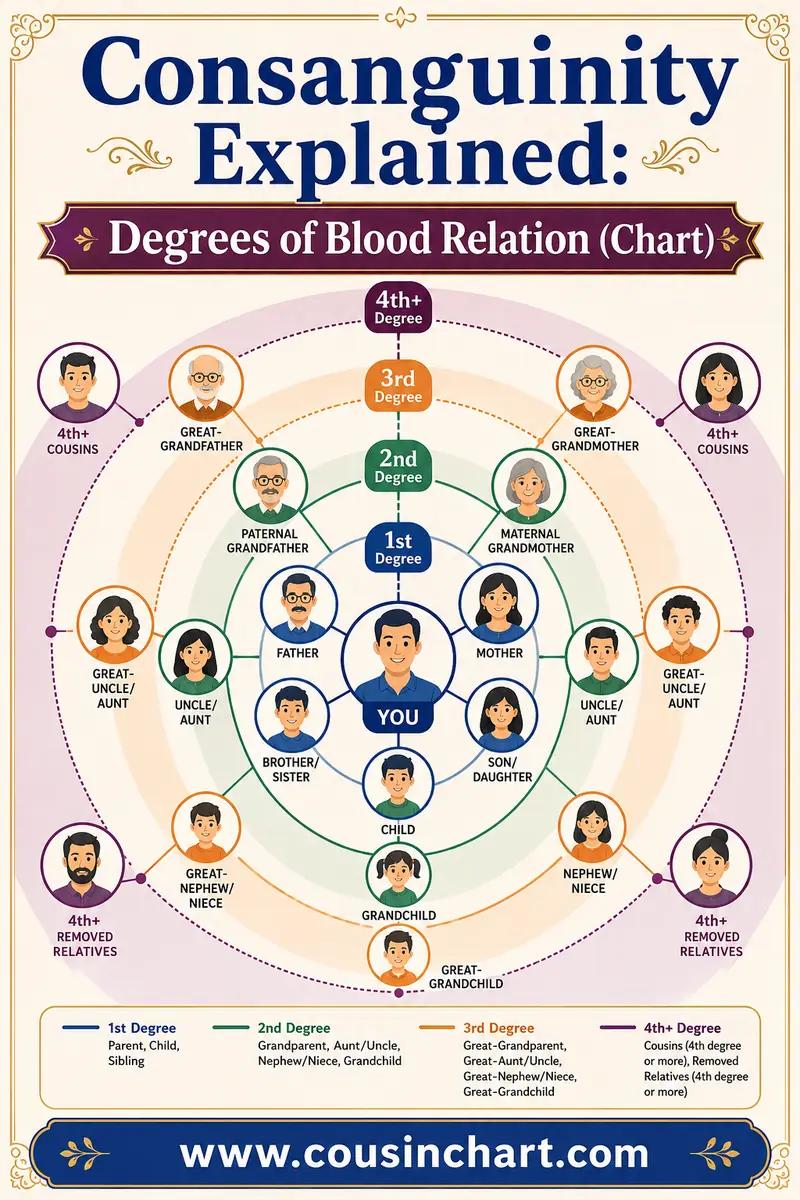
The practical takeaway is the one lawyers give about everything: the table above describes the general landscape, but the only authoritative source is your state's current marriage statute (usually findable by searching the state legislature's site for "marriage" and "consanguinity" — the legal blood-relation framework we explain in our consanguinity guide).
Married in One State, Living in Another
A common practical question: if first cousins marry legally in, say, California and later move to a state that prohibits cousin marriage, is the marriage valid?
Usually yes — most states recognize marriages that were valid where celebrated, under a principle sometimes called lex loci celebrationis. But there are exceptions: a minority of states have statutes declaring that their residents cannot evade the state's marriage prohibitions by marrying elsewhere and returning, and a few explicitly refuse recognition of cousin marriages regardless of where they occurred. Couples in this situation are the textbook case for an hour of a family-law attorney's time — recognition affects inheritance, insurance, and immigration matters.
Internationally, first-cousin marriage is legal in Canada, Mexico, the United Kingdom, and most of Europe, Latin America, and Asia. The United States is actually the outlier among Western countries in restricting it — a legacy of a wave of state legislation in the late 1800s.
What the Genetics Research Says
Since the health question drives most of the law, here's the research picture, stated plainly:
- Every couple, related or not, carries a baseline risk of birth defects of roughly 3–4%.
- First cousins share about 12.5% of their DNA. Large reviews (including a frequently cited 2002 report by the National Society of Genetic Counselors) estimate that children of first cousins face an additional risk of about 1.7–2.8 percentage points — that is, roughly 4–7% overall rather than 3–4%.
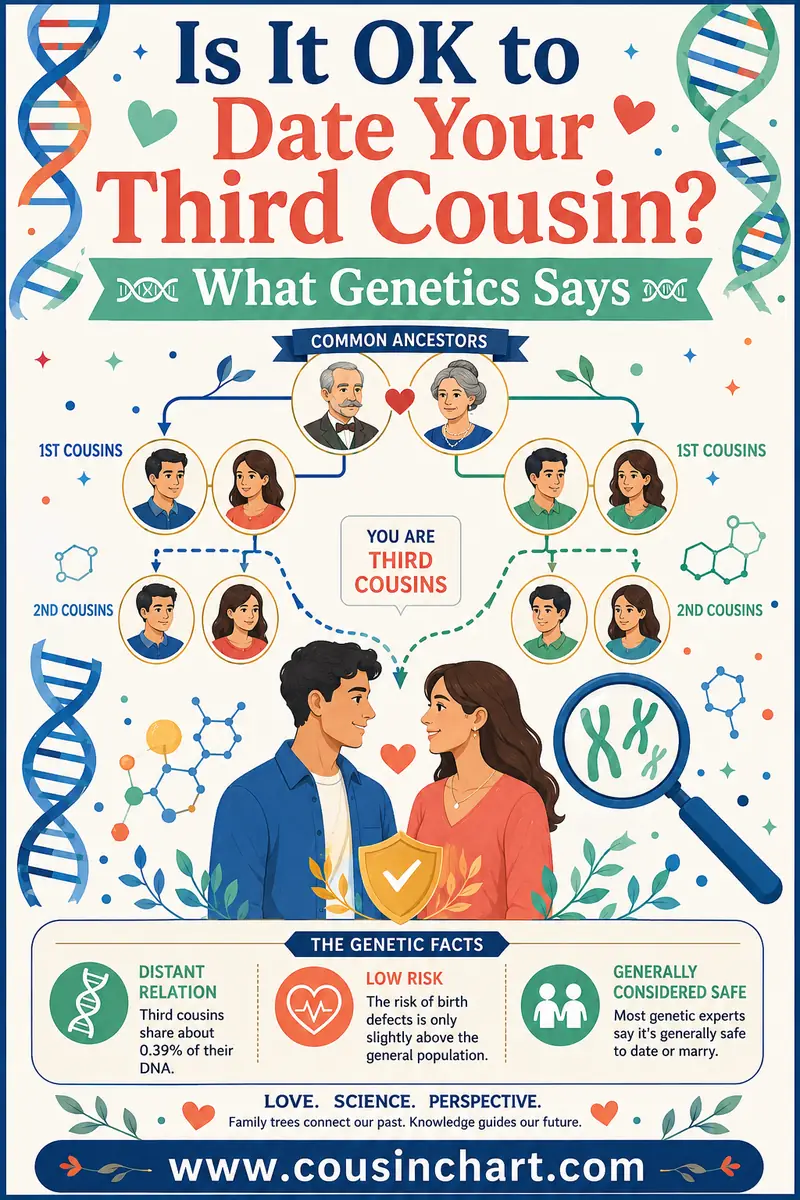
- For second cousins (about 3% shared DNA) the added risk is small enough that major reviews describe it as negligible, and no state restricts them.
- Risk concentrates and compounds when cousin marriage repeats across many generations within a family line, which is a different situation from a single cousin couple.
- Genetic counseling exists precisely for couples who want individualized answers — which is why Maine wrote it into statute.
Different people and different legislatures weigh those numbers differently; that's the policy debate, and it's outside this article's lane. The numbers themselves are not particularly disputed.
A Little Historical Context
Cousin marriage was unremarkable through most of recorded history — among royalty (Queen Victoria and Prince Albert were first cousins), scientists (Charles Darwin married his first cousin Emma Wedgwood), and ordinary villagers everywhere, simply because marriage pools were small. Estimates suggest around 10% of marriages worldwide today are between second cousins or closer, concentrated in regions where the practice remains customary.
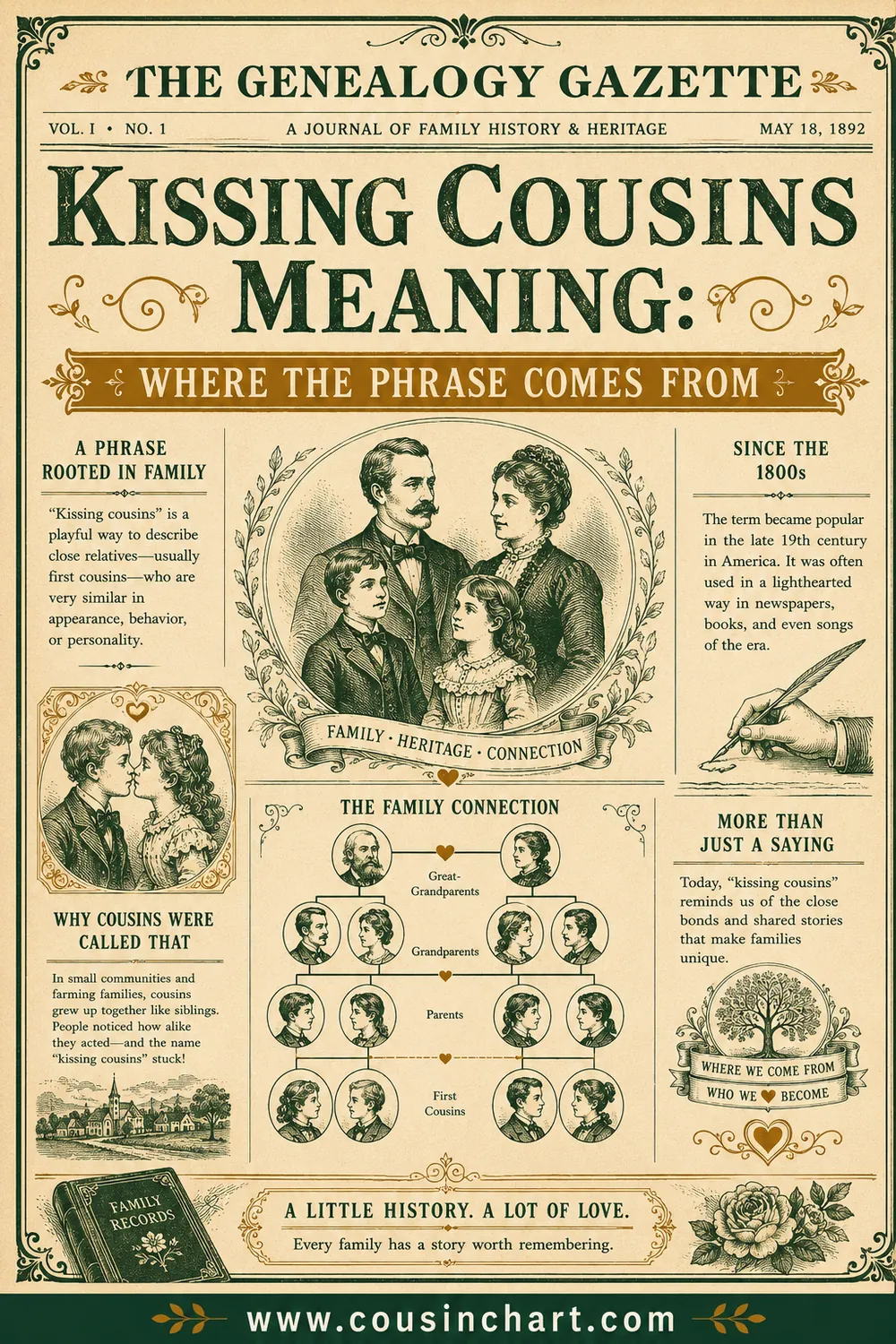
The American term "kissing cousins" — relatives close enough to greet with a kiss, sometimes carrying a wink of that older history — gets its own lighthearted treatment in our kissing cousins explainer.
How America Ended Up the Outlier
The U.S. patchwork isn't random — it has a traceable history. Cousin marriage was legal everywhere in the early republic, as it had been under English common law. Then, beginning in the mid-1800s, state legislatures started banning it in a wave: Kansas moved first in 1858, and dozens of states followed over the next half-century, motivated by the era's emerging (and often crude) ideas about heredity. Notably, the bans were a distinctly American project — no European country followed, and the U.K., whose law America had inherited, never restricted cousin marriage at all.
That timing explains the map's odd geography. States admitted or legislating heavily during the ban wave (the Midwest and West, mostly) tend to prohibit; the original colonies, whose marriage laws predate the movement, largely still permit — which is why New York, Massachusetts, and Virginia allow first-cousin marriage while Ohio and Washington don't. It's less about modern regional attitudes than about when each state last rewrote its marriage code.
The modern era added the conditional category: twentieth-century legislatures looking for a compromise wrote fertility-based exceptions, reasoning that if the concern is genetic risk to children, a marriage without expected children raises no concern. Whatever one thinks of the logic, it makes those statutes unusually explicit about their purpose — few marriage laws state their reasoning so plainly.
Around the World: Where the U.S. Sits
Zoom out and the American restrictions look unusual rather than typical:
| Region / country | First-cousin marriage |
|---|---|
| United Kingdom | Legal (and always has been) |
| Canada, Australia, New Zealand | Legal |
| Most of Europe and Latin America | Legal |
| Middle East, North Africa, South Asia | Legal and customary in many communities |
| China | Prohibited (close collateral relatives barred) |
| South Korea | Prohibited (broad close-kin restrictions) |
| Philippines | Prohibited (collateral relatives within the fourth civil degree) |
| United States | Mixed — the state-by-state patchwork above |
Worldwide, an estimated 10% or so of marriages are between second cousins or closer, so globally the practice is common, regionally concentrated, and legally accepted in most of the world. The short list of national bans — China, South Korea, the Philippines, and a few others — mostly reflects distinct legal traditions around kinship degrees rather than the American pattern of state-level experimentation. For couples with an international dimension (marrying abroad, immigration petitions), the interaction between two countries' rules is yet another reason to get real legal advice rather than relying on charts, this one included.
Before You Head to the Courthouse: A Quick Checklist
For couples actually navigating this, the homework list is short and concrete:
- Pin down the exact relationship. First cousins, first cousins once removed, half first cousins, and second cousins can all land differently under a statute. Verify against records, not family memory — the calculator plus a birth certificate or two settles it.
- Read your state's current statute yourself. Search the legislature's site for the marriage chapter and its consanguinity list. Summaries (again, including this one) go stale; the statute is the law.
- If you live in a prohibition state, don't assume a destination wedding solves it. Check whether your state has an evasion or non-recognition clause before planning a marriage elsewhere.
- Consider genetic counseling regardless of the law. It's inexpensive relative to the stakes, it answers the couple-specific question the statistics can't, and in at least one state it's the literal legal pathway.
- For anything touching inheritance, immigration, or benefits, get an attorney. Marriage validity is the foundation dozens of other legal rights sit on — worth an hour of professional time to get right.
Quick answer: Start by naming your exact relationship, then read your own state's current marriage law, because these laws do change. The most recent example: Connecticut stopped allowing new first-cousin marriages on October 1, 2025. This page is general information, not legal advice, so confirm anything important with your county clerk or a family-law attorney.
Recent Changes to Know About
Lists of "states where cousins can marry" go out of date quickly. A few changes worth knowing:
- Connecticut (2025). The state added first cousins to its list of relatives who may not marry. The change took effect October 1, 2025, and, according to the legislature's Judiciary Committee report, applies to marriages from that date forward.
- Tennessee (2024). Tennessee's ban on first-cousin marriage became law in April 2024, as noted above.
- Florida (2026). A bill that would have stopped first-cousin marriage in Florida did not pass in March 2026. Supporters said they expect the idea to come back, so keep an eye on it.
If a website, book, or chart was written before these dates, it may still show Connecticut or Tennessee as allowing first-cousin marriage. Always check the date on whatever you're reading.
How to Read Your State's Marriage Law in Five Steps
You don't need legal training to find the right section. Here's a simple way to do it:
- Go to the official source. Every state legislature has a website with the state's laws. Search it for "marriage" and look for the family law or domestic relations section.
- Find the "who can't marry" section. It's usually labeled something like "prohibited marriages," "void marriages," or "consanguinity." That last word just means being related by blood (our consanguinity guide explains it in plain terms).
- See how the line is drawn. Some laws name relatives one by one, like "first cousins." Others use a phrase such as "nearer of kin than second cousins." Kentucky's law, for example, uses that exact wording, which means first cousins can't marry there but second cousins aren't blocked.
- Look for "half blood." Some laws, including Kentucky's, say "whether of the whole or half blood." That wording means half cousins, who share one grandparent instead of two, are treated the same as full cousins.
- Check for exceptions and dates. Some states allow cousin marriage only in certain situations, such as age limits. Also look at when the section was last changed, and whether there's a rule about marriages that took place in another state.
When you're done, a quick call to your county clerk's office can confirm how they apply the law in practice.
Worked Examples: Relationship First, Law Second
"Our grandmothers were sisters."
Two sisters share parents. Those parents are each grandmother's mother and father, which makes them your great-grandparents and your partner's great-grandparents too. Sharing great-grandparents makes you second cousins. Under a law written as "nearer of kin than second cousins," second cousins are on the allowed side of that line.
"He's my mom's first cousin."
Your mom's cousin is one generation above you, so he's your first cousin once removed, not your first cousin and not your second cousin. This is the pair where the exact wording of your state's law matters most, since some laws mention only first cousins and others are written in a way that could reach a once-removed pair. If this is your situation, it's worth a conversation with a family-law attorney.
"We have the same grandfather but different grandmothers."
You share one grandparent, not two, so you're half first cousins. Look for the "half blood" wording in step 4 above. Where a law includes it, half first cousins are treated like first cousins.
If you can't tell which of these fits your family, type both of your family paths into the relationship calculator before you read a single statute.
Common Mix-Ups
- Mixing up "second cousin" and "first cousin once removed." Your parent's cousin is a first cousin once removed. That person's child is your second cousin. The two can land differently under the same law.
- Trusting an old list. As the recent changes show, a list that was right a few years ago may be wrong today.
- Assuming "half" means "not really related." Half cousins are still blood relatives, and some laws say so directly.
- Going by what the family always called each other. Plenty of families call a parent's cousin "cousin" or even "aunt." The law cares about the actual relationship, not the nickname.
FAQ
In how many states is it legal to marry your first cousin?
About a third of U.S. states plus the District of Columbia allow it without conditions, and about six more allow it under conditions (such as the couple being past childbearing age or completing genetic counseling). The remaining states — about half — prohibit it. Exact counts shift as legislatures act, so check current law.
Is marrying your second cousin legal?
Yes — in every U.S. state. No state restricts marriage between second cousins or any more distant relationship. Restrictions apply to first cousins and closer relatives only.
Which states allow first-cousin marriage only with conditions?
Arizona, Illinois, Indiana, Utah, and Wisconsin allow it when the couple is past a statutory age (50–65, varying by state) or infertile; Maine allows it with genetic counseling. Statutory details vary and get amended, so read the current statute for specifics.
If cousins marry legally in one state, is the marriage valid everywhere?
Usually — most states recognize marriages valid where performed. But a minority refuse recognition or bar residents from evading their laws by marrying out of state. Couples planning around this question should consult a family-law attorney in their home state.
What is the actual genetic risk for children of first cousins?
Research puts the added risk at about 1.7–2.8 percentage points above the general population's 3–4% baseline — roughly 4–7% overall. For second cousins and beyond, studies find the added risk negligible. Genetic counseling can give couple-specific answers.
Can first cousins once removed marry?
It depends on the state. Some prohibition statutes name only first cousins, leaving once-removed pairs unrestricted; others sweep them in. Because the statutory language varies, this is a check-your-state question. (A first cousin once removed is your cousin's child or your parent's cousin.)
Did any state change its cousin marriage law recently?
Yes. Connecticut stopped allowing new first-cousin marriages on October 1, 2025, and Tennessee banned first-cousin marriage in 2024. A 2026 bill to ban it in Florida did not pass. Laws in this area keep moving, so check your state's current law.
Does a new ban end cousin marriages that already exist?
New marriage laws usually apply going forward. Connecticut's Judiciary Committee report, for example, describes its ban as applying to marriages on and after October 1, 2025. If you're already married and your state changes its law, a family-law attorney can tell you exactly where you stand.
What does "nearer of kin than second cousins" mean?
It means anyone more closely related than second cousins can't marry under that law. First cousins, who share grandparents, are closer than that, so they're blocked. Second cousins, who share great-grandparents, are not.
Are half cousins covered by cousin marriage laws?
In some states, yes. Kentucky's law, for example, includes the words "whole or half blood," which puts half cousins in the same group as full cousins. Other states word it differently, so read your own state's wording to be sure.
How can we tell if we're first cousins or second cousins?
Find your closest shared ancestors. If you share grandparents, you're first cousins. If you share great-grandparents, you're second cousins. The relationship calculator on our homepage works it out from both of your family paths.
Know the Relationship, Then Check the Law
The legal answer to "can we marry?" starts with a genealogy answer: are you first cousins, second cousins, once removed, half, step? Each lands differently under state law — and family memory is famously fuzzy about which is which.
That first step is free and instant: the family relationship calculator tells you exactly how you and another person are related. For the second step — what your state's statute currently says — go straight to the source, because on this topic, the law refuses to sit still.