Is It OK to Date Your Third Cousin? What Genetics Says
Legally and genetically, yes — dating or marrying your third cousin raises no legal issue anywhere in the United States (or virtually anywhere else), and the genetics are close to a rounding error: third cousins share only about 0.78% of their DNA on average. Studies of couples this distantly related find risks to children essentially at the general population baseline. Socially, most people you'd survey wouldn't blink — many wouldn't even be sure what a third cousin is.
That last part is the real work of this article: confirming the person actually is your third cousin, understanding what that sliver of shared DNA means, and putting the whole question in context (including the famous Iceland problem). If you want the relationship verified before you read on, the free family relationship calculator on our homepage will name it in seconds.
Relationship quick-check. Tap a phrase — how distant is this cousin, really?
The answer will appear here.
What a Third Cousin Actually Is
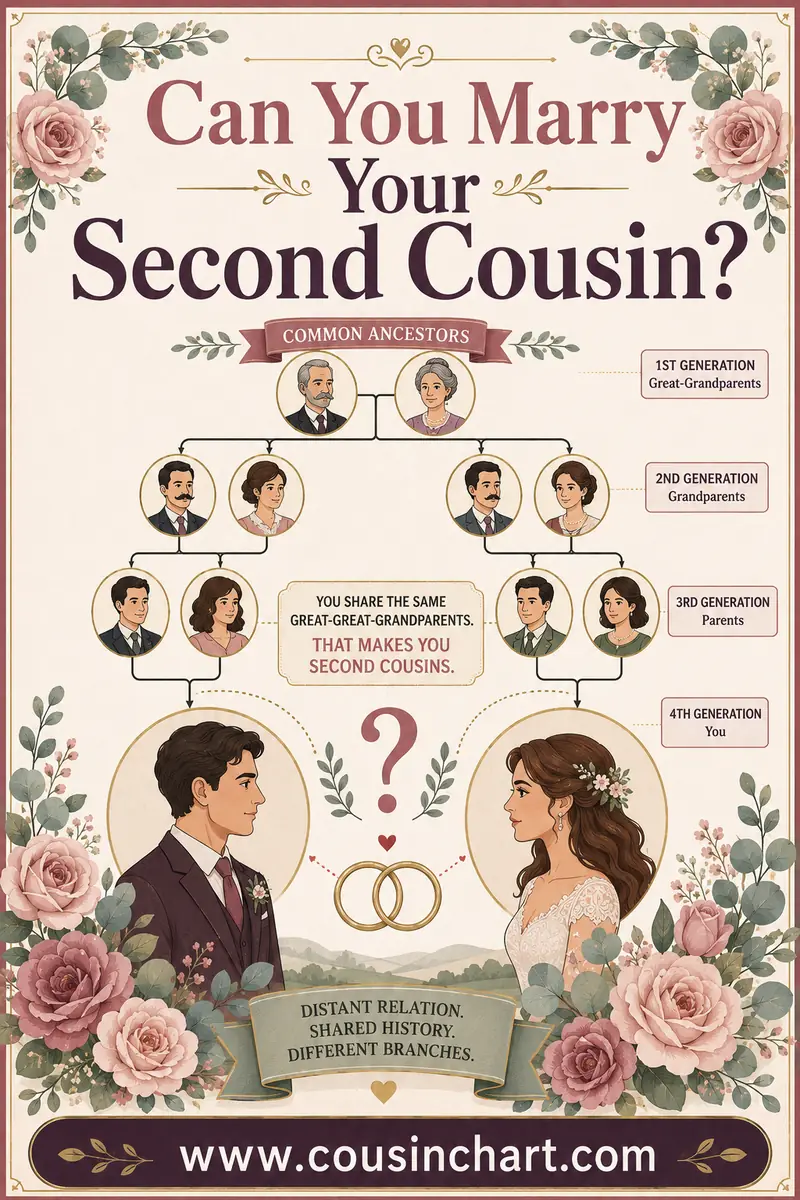
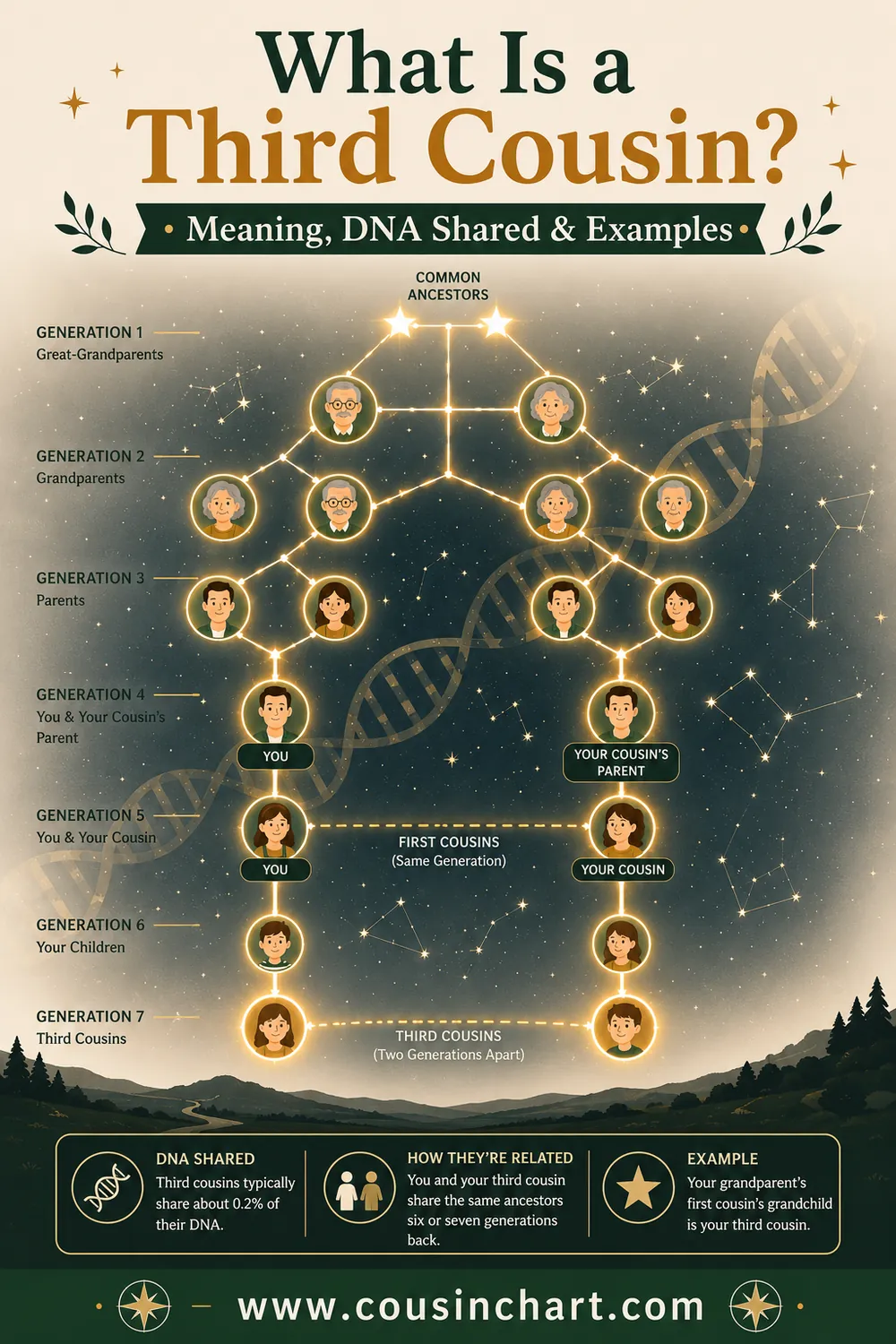
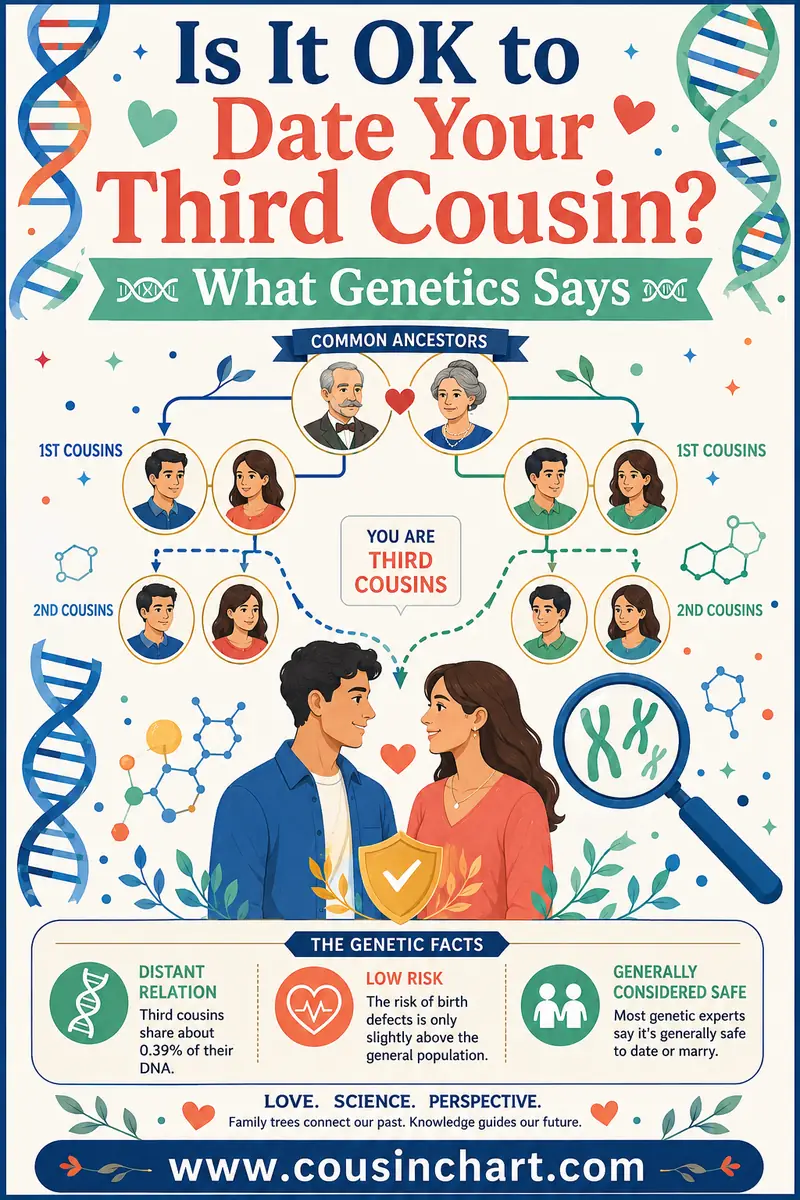
Third cousins share great-great-grandparents. Walk it up the tree: your parent and their parent are second cousins; your grandparent and their grandparent are first cousins; your great-grandparent and their great-grandparent were siblings; and one couple — your shared great-great-grandparents — sits at the top, four generations above you both.
Some perspective on how distant that is:
- Your great-great-grandparents were likely born in the mid-1800s. The family split happened before automobiles.
- You have 16 great-great-grandparents, so third cousins exist on up to eight different couples' lines.
- The average person has hundreds of third cousins — estimates commonly run 100–200+, and prolific family lines can push it far higher. You almost certainly have third cousins you've never heard of living within an hour of you.
That last fact reframes the whole question. Third cousins aren't really "family" in the practical sense for most people — they're strangers with a shared entry in a 19th-century church register. Our third cousin explainer goes deeper on the definition and the DNA.
The Genetics: 0.78% Is Nearly Nothing
The average shared DNA by cousin level (full ranges in our shared DNA chart):
| Relationship | Avg. shared DNA | Avg. centimorgans |
|---|---|---|
| First cousins | 12.5% | ~850 cM |
| Second cousins | 3.125% | ~230 cM |
| Third cousins | 0.78% | ~73 cM |
| Fourth cousins | 0.2% | ~35 cM |
| Unrelated people | ~0% | 0 cM |
Two facts put 0.78% in context:
- The concern with related couples is recessive conditions — both partners inheriting the same hidden variant from the common ancestor. The probability scales with shared DNA. First cousins (12.5%) carry a measurable added risk of roughly 2–3 percentage points; second cousins (3%) a fraction of that; by third cousins the added risk is so small that studies struggle to distinguish it from the baseline ~3–4% risk every couple carries.
- DNA testing can't even reliably see the relationship. Around 10% of true third-cousin pairs share no detectable DNA at all — the segments simply didn't survive four generations of shuffling. A relationship too weak for a DNA test to consistently detect is a good intuition for how weak it is biologically.
There's even research suggesting the historical norm ran the other way: a well-known Icelandic study (deCODE Genetics, 2008) found that couples related at roughly the third-to-fourth-cousin level historically had the most children and grandchildren — the researchers proposed a mix of biological and social explanations. You don't need to lean on that finding to make the point; baseline-level risk is the point.
The Legal Answer: Nothing to Discuss
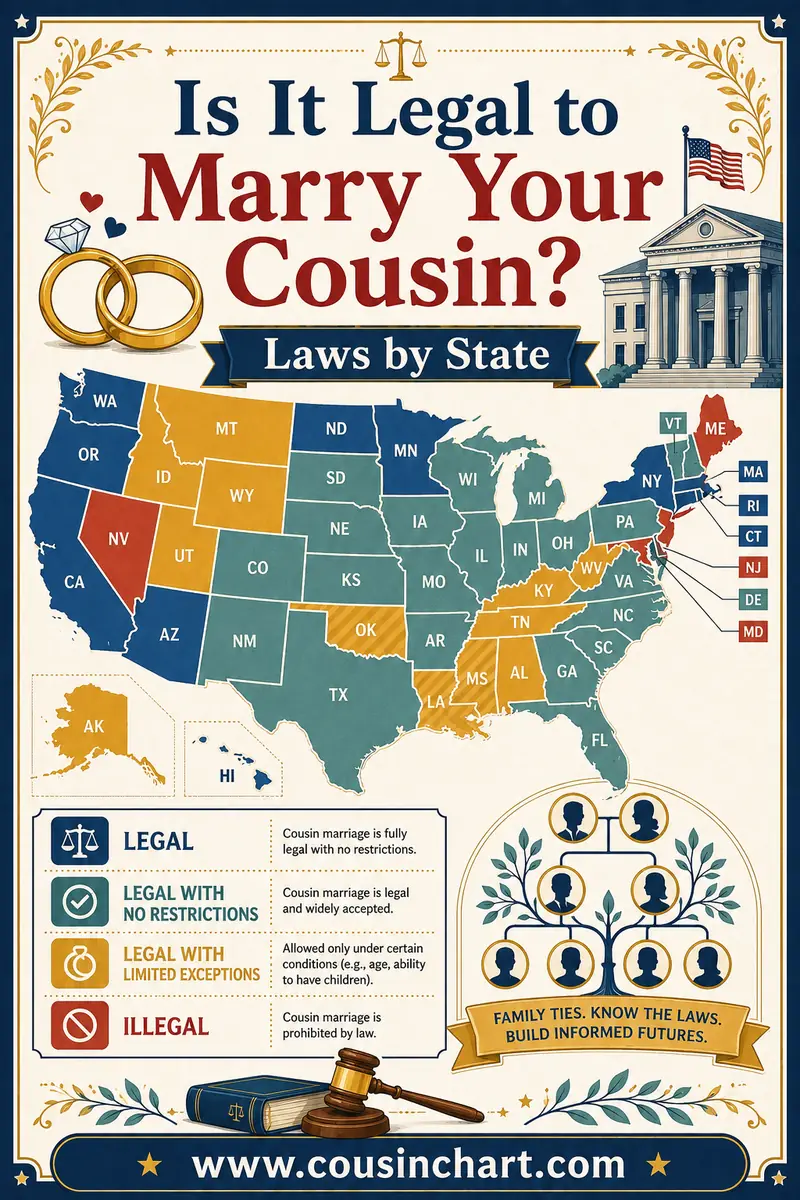
No U.S. state restricts marriage between third cousins — or second cousins, for that matter. State consanguinity laws top out at first cousins and, in some states, first cousins once removed; the state-by-state details live in our cousin marriage laws guide. Internationally the story is the same: third-cousin marriage is legal essentially everywhere on Earth, and closer cousin marriage is legal across most of it.
So there's no license issue, no officiant issue, no recognition issue. Legally, a third cousin is simply another person.
The Iceland Story (Or: Everyone Has This Question Somewhere)
Iceland makes the best case study because the whole country is, genealogically, one small town: about 400,000 people descended from a limited founding population. Any two Icelanders are likely to be traceable cousins — often closer than they'd guess.
The national response wasn't panic; it was software. The genealogy database Íslendingabók (the Book of Icelanders) documents nearly the entire population's family connections, and a companion app famously let users check how they're related — the joke feature was a "bump alarm" for dates who turn out to be closer than second cousins. Notice where Icelanders drew their comfort line: around second cousins. Third cousins were never the concern.
The same logic applies at smaller scale to any tight-knit population — small towns, island communities, endogamous groups. Go back four generations in a town of 2,000 people and marriage options overlapped constantly. Statistically, many couples throughout history were third or fourth cousins, mostly without knowing. Some still are, and find out via a DNA kit two anniversaries in.
The Social Question (The Only Real One)
Since law and biology come back clean, what's left is culture — and honestly, third cousins barely register:
- Most Americans can't name a single third cousin, and "our great-great-grandparents were the same couple" reads as trivia, not taboo.
- Anthropologically, marrying at this distance is historically normal in nearly every society; many cultures actively preferred cousin matches far closer.
- The awkwardness people imagine ("we're family!") usually dissolves when the actual math is on the table: 99.2% of your DNA is not shared, which is barely different from the two of you being random strangers (who, per the deep-ancestry math, are themselves distant cousins — everyone is).
Practical advice if this is a live question for you: confirm the relationship precisely (family labels are unreliable — plenty of rumored "third cousins" turn out to be second cousins or not blood relatives at all), and if children are in the plans and a specific hereditary condition runs in the shared line, carrier screening gives couple-specific certainty. Those are the same two steps any careful couple might take; the cousin part adds nothing further.
The Look-Alikes: Relationships That Test the Same
Here's a wrinkle worth knowing if a DNA kit is your evidence: at ~73 cM, "third cousin" is only one of several relationships with the same expected sharing. The genetic look-alikes include:
| Relationship | Avg. shared DNA | How it differs from a third cousin |
|---|---|---|
| Third cousin | ~0.78% | Same generation, shared great-great-grandparents |
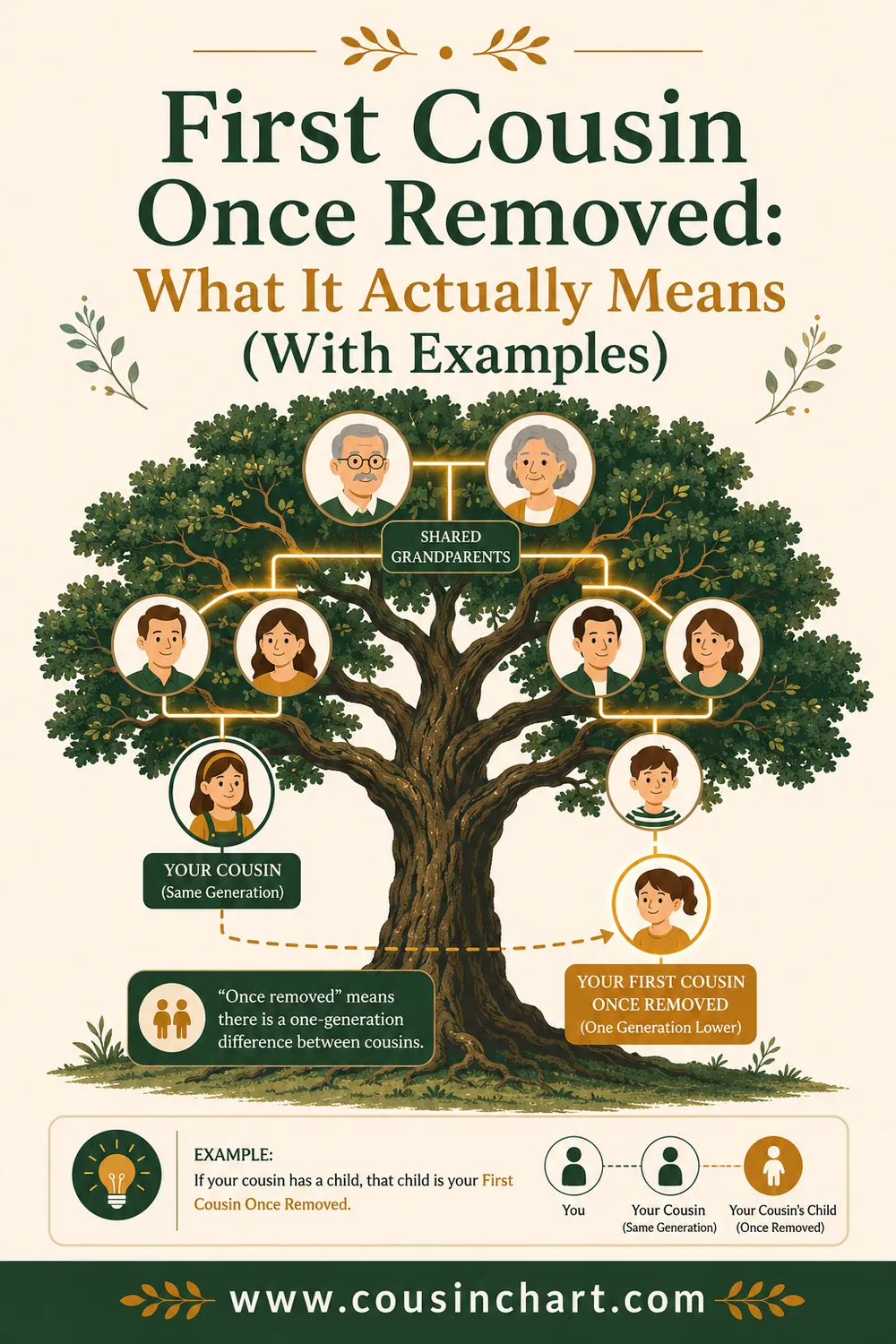
| Second cousin twice removed | ~0.78% | Two generations offset — could be much older or younger |
| Half second cousin once removed | ~0.78% | One shared great-grandparent, one generation offset |
| First cousin three times removed | ~1.56% | Three generations offset — usually a different era entirely |
| Fourth cousin (high end) | ~0.2% avg | Ranges overlap; a lucky fourth cousin can hit third-cousin numbers |
For the dating question, the differences are immaterial — every relationship on that list is legally unrestricted and genetically trivial. But for accuracy, the table explains a common scene: a couple matches at 70 cM, declares themselves third cousins, and later finds the actual paper trail shows a half second cousin once removed. The number was never going to tell them; only the tree could.
The practical rule: centimorgans set the range, records pick the relationship. If you want the true label rather than the genre, trace both lines to the shared couple and count the generations — or hand the path to the calculator and let it name things properly.
How Couples Usually Find Out (and What Happens Next)
Almost nobody discovers a third-cousin connection by studying pedigree charts before a first date. The discoveries arrive in a handful of standard ways:
- The matching DNA kits. One partner tests, then the other, and the site quietly lists them in each other's match column. This is now the most common route, and often the most startling — the app treats it with all the drama of a software update.
- The wedding genealogist. Every family has one. Somewhere between the engagement and the invitations, an aunt with a tree on Ancestry announces that the couple's great-great-grandmothers were the Kowalski sisters of Erie, Pennsylvania.
- The overlapping funeral. Both partners turn up at the same distant relative's memorial and slowly work out why.
- The hometown coincidence. Two families from the same small town or immigrant parish — statistically, some connection was always likely; the surprise is only in finding the paperwork.
What happens next, in nearly every real case: a flurry of tree-checking, one very entertaining phone call to the grandmothers, and then life continues exactly as before. Which is the correct response. A few sensible follow-ups if you want them:
- Verify the exact relationship (see the look-alikes above) so the story you retell is accurate.
- Save the documentation. The shared ancestors, the connecting line, the cM count — future kids doing school family-tree projects will find this genuinely delightful.
- Mention it to a doctor only if a specific hereditary condition runs in the shared line — the same trigger that would apply to any couple. Otherwise there is nothing to raise.
- Prepare one good line for the reception toast. Experience suggests "we kept the guest list efficient" performs well.
The pattern across all of these: discovery feels momentous for about a week, then settles into what it actually is — a footnote two families share.
FAQ
Is it legal to date or marry your third cousin?
Yes, everywhere in the United States and virtually everywhere in the world. U.S. marriage restrictions stop at first cousins (or first cousins once removed in some states); third cousins are legally just two unrelated adults.
How much DNA do third cousins share?
About 0.78% on average — roughly 73 centimorgans — and the normal range runs from 0% to about 2%. Notably, around one in ten true third-cousin pairs shares no detectable DNA at all.
Is it genetically bad to have kids with your third cousin?
Research finds the risk essentially at the general-population baseline (~3–4% for any couple). The added risk from 0.78% shared DNA is too small for studies to reliably measure. Couples with a known hereditary condition in the shared family line can get carrier screening for individualized answers.
What exactly is a third cousin?
Someone who shares great-great-grandparents with you. Your parents are second cousins to each other, your grandparents are first cousins, and your great-grandparents were siblings. Most people have well over a hundred third cousins, nearly all strangers.
How do I find out if someone is actually my third cousin?
Trace both of you back to the supposed shared couple and count generations — if you're both four steps down, you're third cousins; unequal steps make it a "removed" relationship. A relationship calculator does the counting for you, and a DNA test can support (but not always detect) the connection.
Do we need to tell our families we're third cousins?
There's no obligation either way — it's your information. Most couples do share it, because it's a good story and because the older generation often fills in the connecting branch ("oh, the Kowalski sisters!") within minutes. If you expect teasing, leading with the math helps: sharing 0.8% of your DNA means you're 99.2% genetically distinct, which is barely different from any two people from the same region.
Would a DNA test reveal that my partner is my third cousin?
Often, but not always — about 90% of third-cousin pairs share detectable DNA, meaning roughly 10% don't. If both of you have tested with the same company, a match in the 30–150 cM range with the right tree geometry is consistent with third cousins.
Check the Tree, Then Relax
"Third cousin" sounds close because it has the word cousin in it. The tree says otherwise: a shared ancestor born in the 1800s, a 99.2% genetic difference, zero legal restrictions, and a few hundred other people who hold exactly the same relationship to you without either of you knowing it.
The one genuinely useful step is verification, because family terminology is sloppy exactly where precision matters. The free family relationship calculator maps how any two people connect — third cousin, second cousin once removed, or no blood relation at all — instantly. Get the term right, and the rest of the question mostly answers itself.