Can You Marry Your Second Cousin?
Yes. Marrying your second cousin is legal in all 50 U.S. states and the District of Columbia — no state restricts marriage between second cousins or anything more distant. Genetically, second cousins share only about 3% of their DNA, and research finds the added risk to children is small enough that major reviews call it negligible.
So the short answer is settled. The longer answer — making sure the person actually is your second cousin (family shorthand gets this wrong constantly), what the law says about closer relationships, and what the genetics numbers really look like — is worth five minutes. If you want to verify the relationship right now, the free family relationship calculator on our homepage will confirm it from just a couple of clicks.
Relationship quick-check. Tap a phrase — is this person really your second cousin?
The answer will appear here.
First: Make Sure They're Actually Your Second Cousin
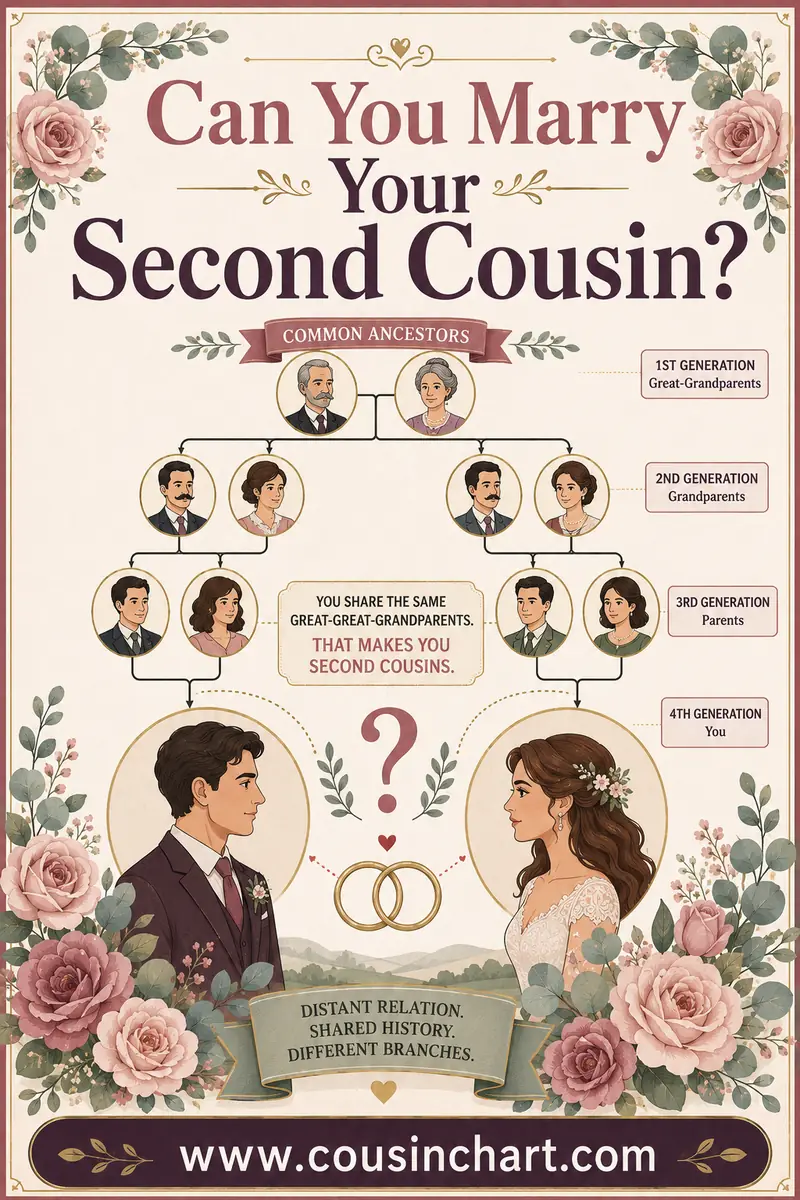
"Second cousin" might be the most misused term in family vocabulary. People use it for their cousin's child, their parent's cousin, sometimes any relative vaguely beyond the first-cousin circle. The actual definition:
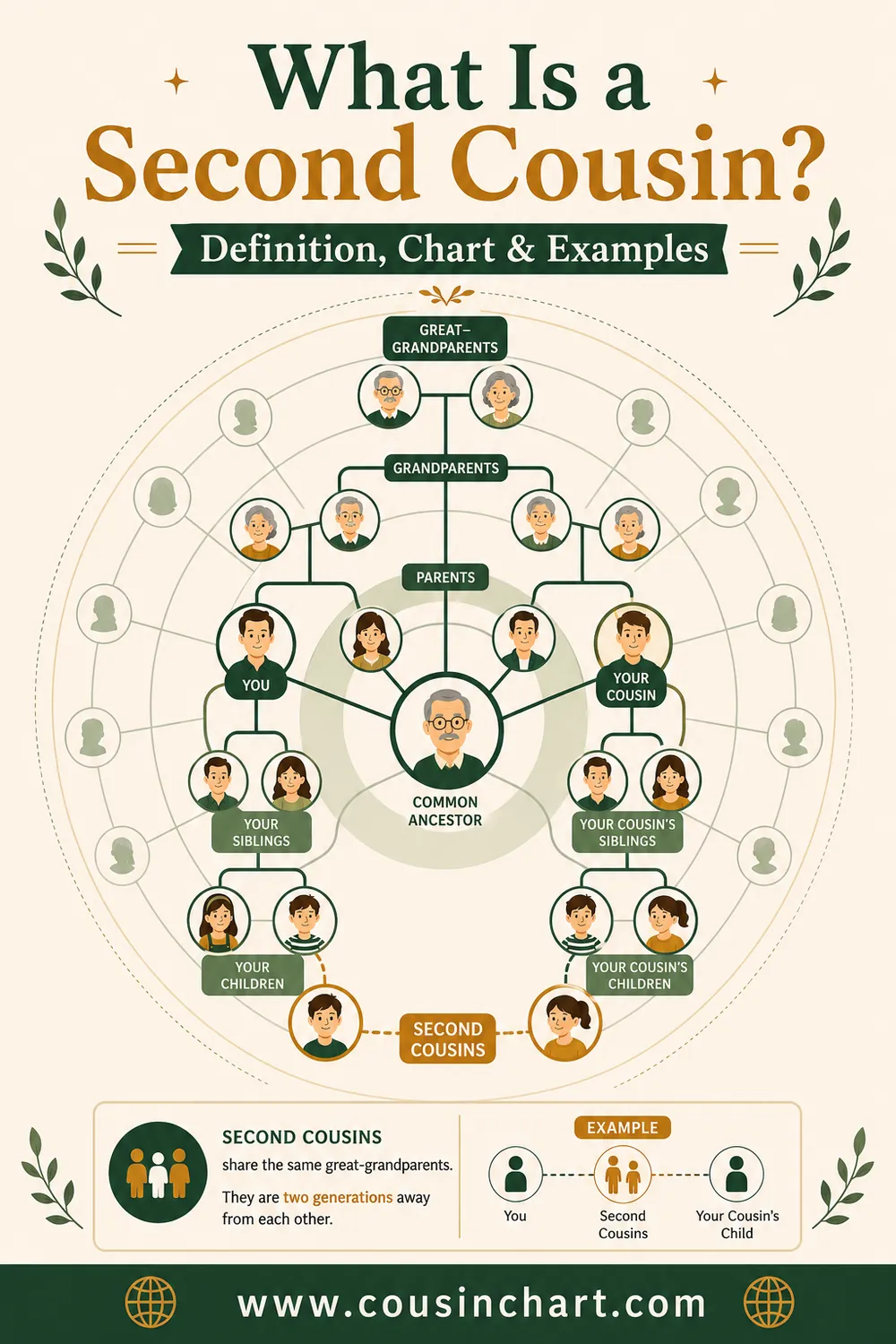
Second cousins share great-grandparents. Your grandparent and their grandparent were siblings; your parent and their parent were first cousins; you two are second cousins — same generation, four steps each from the common ancestors.
The look-alikes people confuse it with:
| Person | Actual relationship | Shares with you |
|---|---|---|
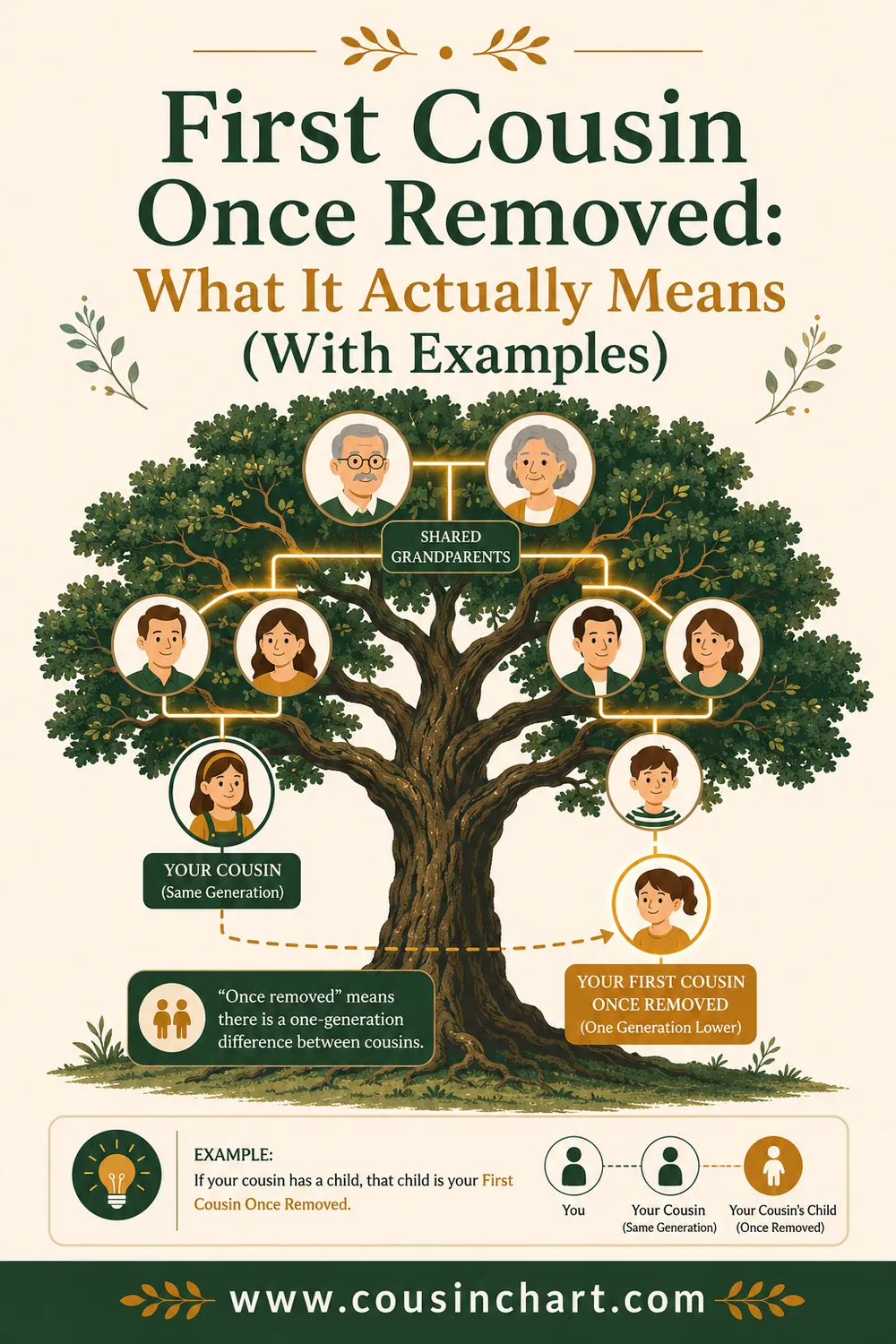
| Your parent's cousin | First cousin once removed | Grandparents/great-grandparents (offset) |
| Your first cousin's child | First cousin once removed | Same, other direction |
| Your grandparent's cousin | First cousin twice removed | Two-generation offset |
| Your mom's cousin's child | Second cousin | Great-grandparents — the real thing |
Why it matters here: the legal and genetic picture differs between second cousins and first cousins once removed. Some states restrict once-removed pairs alongside first cousins; none restrict second cousins. Before relying on the family's label, confirm it — our second cousin explainer covers the definition in depth, and the relationship calculator resolves any specific pair instantly.
The Legal Answer: Clear Nationwide
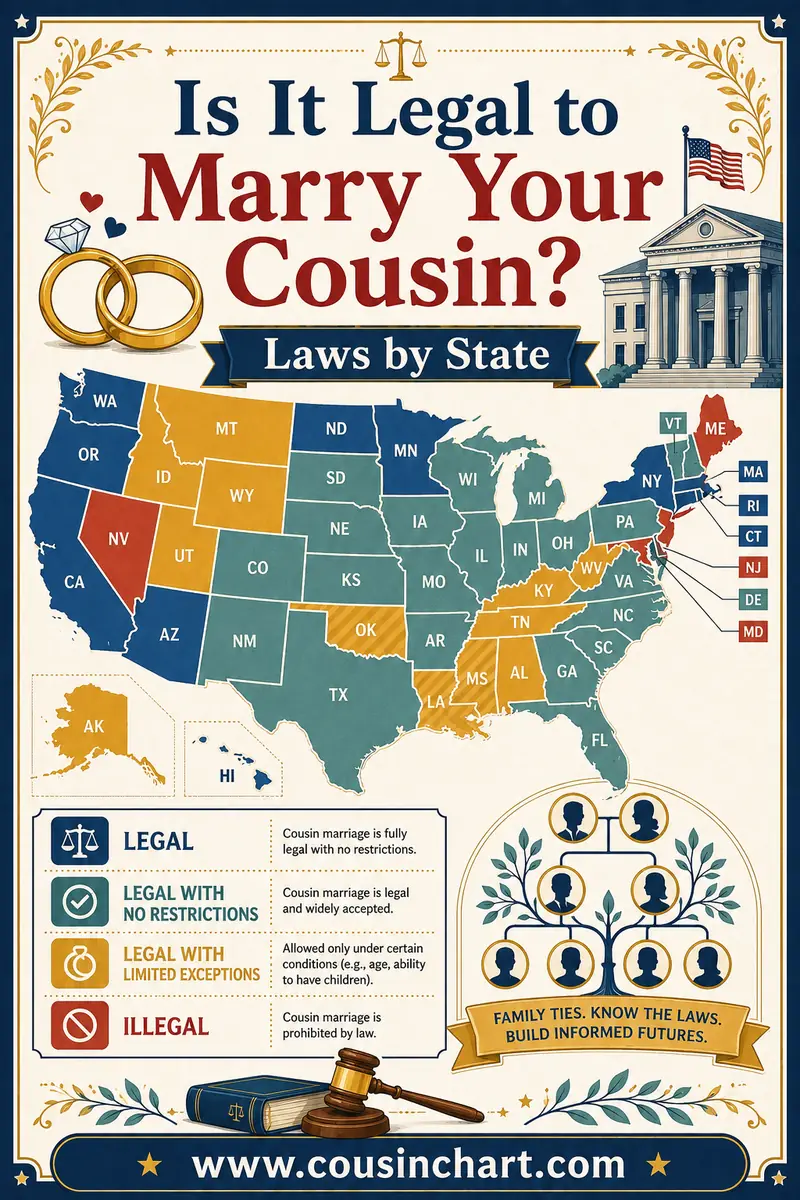
U.S. marriage prohibitions are written in terms of close blood relationships — ancestors and descendants, siblings, aunt/uncle with niece/nephew, and (in about half the states) first cousins. No state statute reaches as far as second cousins. That has been true consistently: even the states with the strictest consanguinity rules stop at the first-cousin or once-removed line.
So for second cousins there's no conditional clause, no age requirement, no counseling requirement, nothing — a marriage license application treats you like any other couple. The full state-by-state landscape for closer cousin relationships (where it genuinely does vary) is mapped in our cousin marriage laws guide.
Internationally the answer is the same or more permissive. Second-cousin marriage is legal essentially everywhere, and even first-cousin marriage is legal across Canada, the UK, Europe, and most of the world.
One honest caveat that isn't about law: individual religious congregations or officiants can have their own policies, and historically the Catholic Church required dispensations for marriages within the fourth degree of canon-law kinship (which included second cousins) — modern canon law no longer restricts second cousins, but couples marrying within a specific tradition should ask their officiant.
The Genetics: What ~3% Shared DNA Means
Second cousins share on average about 3.125% of their DNA — roughly 230 centimorgans, though anywhere from about 2% to 4.5% is normal (the ranges for every relationship are in our shared DNA chart).
For children of related couples, the concern is recessive conditions: both parents passing down the same hidden variant inherited from a common ancestor. The math scales down fast with relationship distance:
- All couples carry a baseline risk of birth defects around 3–4%.
- First cousins (12.5% shared DNA): studies estimate roughly 1.7–2.8 percentage points of added risk.
- Second cousins (3.1% shared DNA): the added risk is a small fraction of the first-cousin figure — typically estimated at well under one percentage point, which is why medical reviews describe it as negligible and no legislature regulates it.
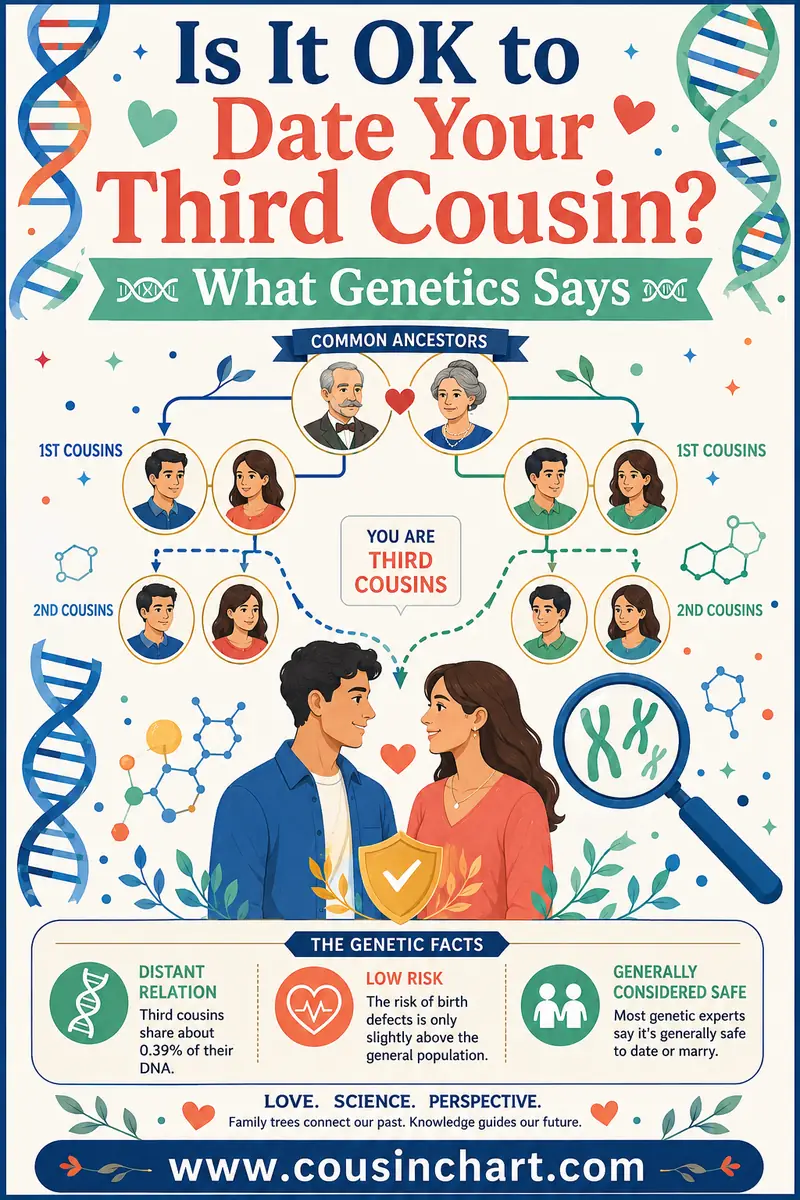
- Third cousins and beyond: statistically indistinguishable from unrelated couples.
Put differently: a second-cousin couple's risk profile is closer to the general population's than to a first-cousin couple's. Couples who want individualized certainty — for instance, if a specific recessive condition runs in the shared family line — can get carrier screening and genetic counseling, which answers the question for your genomes rather than population averages.
How Common Is This, Really?
More common than modern intuition suggests:
- Globally, an estimated 10% or so of all marriages are between second cousins or closer, concentrated in regions where cousin marriage is customary.
- Historically, second-cousin marriages were thoroughly unremarkable in American and European villages — marriage pools were small, and many couples were distant cousins without knowing it.
- Famous examples exist across history; to pick one, Franklin D. Roosevelt and Eleanor Roosevelt were fifth cousins once removed (further than second cousins, but a reminder that cousin marriages sit throughout the historical record — Queen Victoria and Albert, first cousins, being the closer classic).
- Statistically, you have around 30 second cousins on average (many people have far more), and most people couldn't pick half of them out of a lineup. Meeting and marrying one unknowingly is a genuinely regular occurrence — sometimes discovered via a DNA test after the fact.
That last scenario — couples discovering a distant cousinship through consumer DNA testing — has become common enough that genetic counselors field it routinely. The standard professional answer tracks everything above: for second cousins and beyond, the finding is an interesting fact about your wedding toast, not a medical event.
What About the Social Side?
Law and genetics aside, some couples worry about raised eyebrows. A few honest observations, no advocacy either way:
- Reactions vary by family and culture — in much of the world a second-cousin match is traditional and welcomed; in parts of the U.S. it collects jokes.
- "Second cousin" often sounds closer to people than it is, precisely because of the terminology confusion this article opened with. Explaining "our great-grandparents were the same people — we share about 3% of our DNA" tends to recalibrate reactions quickly.
- Family gatherings get simpler, not weirder: same reunion, one guest list.
For the closely related question of even more distant matches, our companion piece is it OK to date your third cousin covers the next ring out.
If a DNA Kit Just Broke the News
A growing version of this question arrives backwards: a couple, already together or already married, takes DNA tests for fun and finds each other on the match list. If that's you, here's the calm walkthrough:
- Check the number, not the label. Sites bucket matches loosely — "2nd–3rd cousin" can cover anything from ~90 to ~400 cM. Around 230 cM suggests true second cousins; under ~120 cM points to third-cousin territory or farther, which is even less consequential.
- Confirm the paper path if you can. Shared matches usually reveal which grandparent lines connect you. Knowing the actual link (say, great-grandmothers who were sisters) turns a vague surprise into a specific, usually charming, family story.
- Remember what the finding changes: nothing legal, almost nothing medical. The marriage was and remains valid in every state, and the genetics are the same ~3% they always were — the test revealed the relationship, it didn't create it.
- Mention it at your next physical if you're planning children, purely so carrier screening can be considered like it would be for any couple with shared ancestry. Expect your doctor to be unfazed; genetic counselors see this weekly.
The consistent theme: discovery changes the story you tell at dinner, not the answers in this article.
FAQ
Is it legal to marry your second cousin in the United States?
Yes, in all 50 states and D.C. State marriage prohibitions stop at first cousins (or first cousins once removed in some states); no state restricts second cousins or any more distant relationship.
Are there genetic risks if second cousins have children?
Very small ones. Second cousins share about 3% of their DNA, and the estimated added risk of birth defects is well under one percentage point above the general baseline of 3–4% — a level medical reviews describe as negligible. Carrier screening can provide couple-specific answers.
What exactly is a second cousin?
Someone who shares great-grandparents with you. Your grandparent and theirs were siblings, making your parents first cousins and you two second cousins — same generation, no "removed."
Is my cousin's child my second cousin?
No — your first cousin's child is your first cousin once removed. Your children and your cousin's children are second cousins to each other. The distinction matters legally in some states, so verify before assuming.
Can second cousins marry in the Catholic Church?
Modern canon law restricts marriages only within closer degrees (up to first cousins, which require a dispensation); second cousins are not restricted. Historically dispensations were required for second cousins too, which is why they appear in old church records. Individual parishes may ask about the relationship during preparation.
How much DNA do second cousins share?
About 3.125% on average — roughly 230 centimorgans, with a normal range from about 2% to 4.5%. That's a quarter of what first cousins share (12.5%) and dwarfed by what siblings share (50%).
The Verdict: Legal Everywhere, Genetically Minor
Second-cousin marriage sits comfortably on the "yes" side of every line American law draws, and the genetics numbers explain why no legislature has ever seen a reason to move that line. The one genuine pitfall is terminology — plenty of "second cousins" turn out to be first cousins once removed, which is regulated in some states.
So nail down the actual relationship first. The free family relationship calculator traces exactly how you and another person connect — second cousin, once removed, or something else entirely — in less time than it took to read this sentence. Then, if the answer is second cousin: congratulations, the law has nothing further to add.