What Is a Three-Quarter Sibling? Genealogy's Oddest Relationship
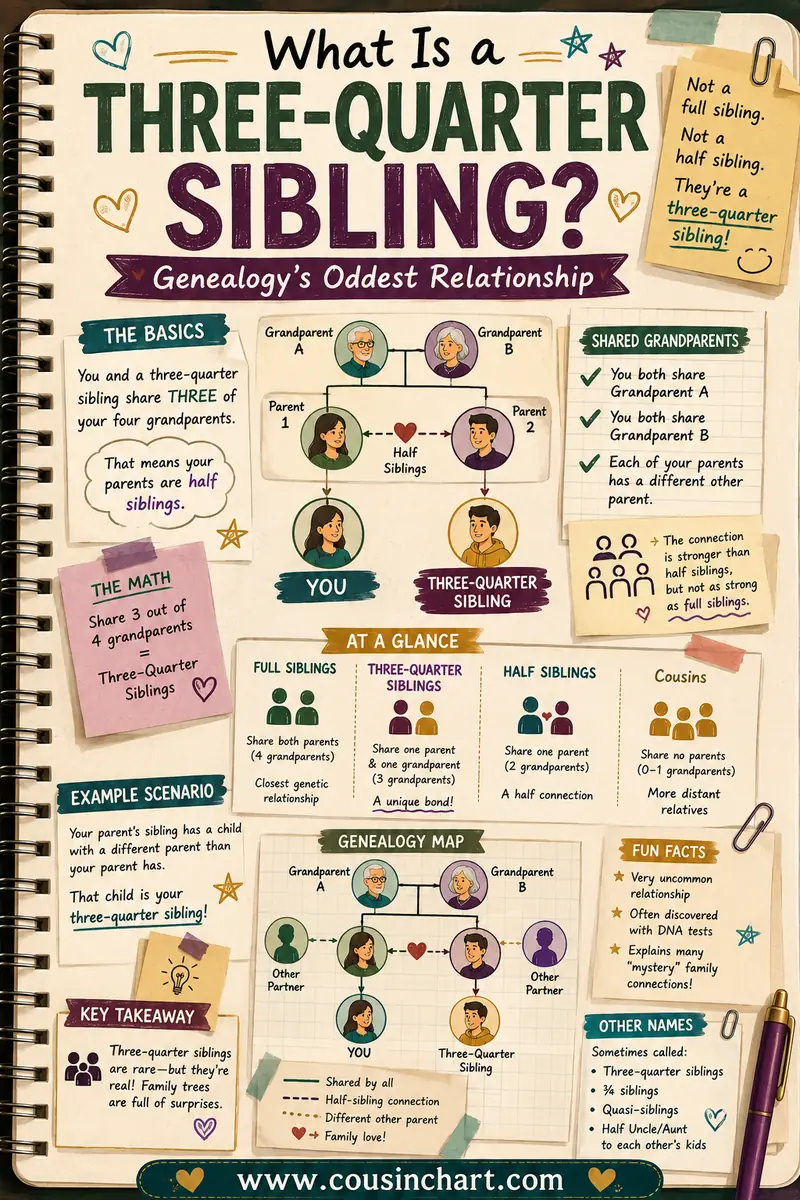
Three-quarter siblings share one parent — like half-siblings — but their other parents are also close relatives of each other, usually siblings. The result: they share about 37.5% of their DNA, landing squarely between full siblings (~50%) and half-siblings (~25%). Hence the name: three-quarters of the way to full.
It sounds like a genealogy riddle, but it comes from ordinary history — a widower marrying his late wife's sister, two brothers with children by the same woman across different marriages. This guide explains the setups that create it, the DNA math, and why testing companies struggle to label it. For any relationship your family tree throws at you, the free family relationship calculator on our homepage names it in seconds.
Relationship quick-check. Tap a phrase to see the correct term:
The answer will appear here.
The Recipe: One Shared Parent + Related Other Parents
Every three-quarter sibling pair has the same two-part structure:
- One parent in common — same mother or same father. On its own, that makes half-siblings.
- The two non-shared parents are first-degree relatives of each other — most commonly siblings, occasionally parent and child.
The classic historical setups:
- A widower marries his late wife's sister. Children from both marriages share a father, and their mothers are sisters. Extremely common in the 18th–19th centuries, when a sister often helped raise her late sibling's children and marriage followed.
- Two brothers have children with the same woman, across sequential marriages or relationships — shared mother, fathers are brothers.
- Father-and-son or mother-and-daughter variants — rarer, sometimes scandal-adjacent in the records, but genetically the same arithmetic since parent and child are also 50% relatives.
If you do deep genealogy, you will eventually hit one of these. Records-era families remarried within their circles constantly, and "deceased wife's sister" marriages were common enough that Britain spent decades legislating about them.
The DNA Math, Step by Step
The 37.5% figure isn't a convention — it falls straight out of addition. Three-quarter siblings are related through two stacked paths:
- The shared parent contributes the ordinary half-sibling amount: ~25%.
- The related non-shared parents contribute a first-cousin-style path on top. If the fathers are brothers (who share ~50% themselves), the children pick up an extra ~12.5% through that line.
Total: 25% + 12.5% = ~37.5% — roughly 2,300–2,900 cM territory, though real pairs scatter widely around it. In genealogical terms, three-quarter siblings are simultaneously half-siblings and first cousins, and the label "three-quarter" is just the sum written as a fraction.
| Relationship | Structure | Avg shared DNA |
|---|---|---|
| Full siblings | Both parents shared | ~50% |
| Three-quarter siblings | One parent shared + other parents are siblings | ~37.5% |
| Half-siblings | One parent shared | ~25% |
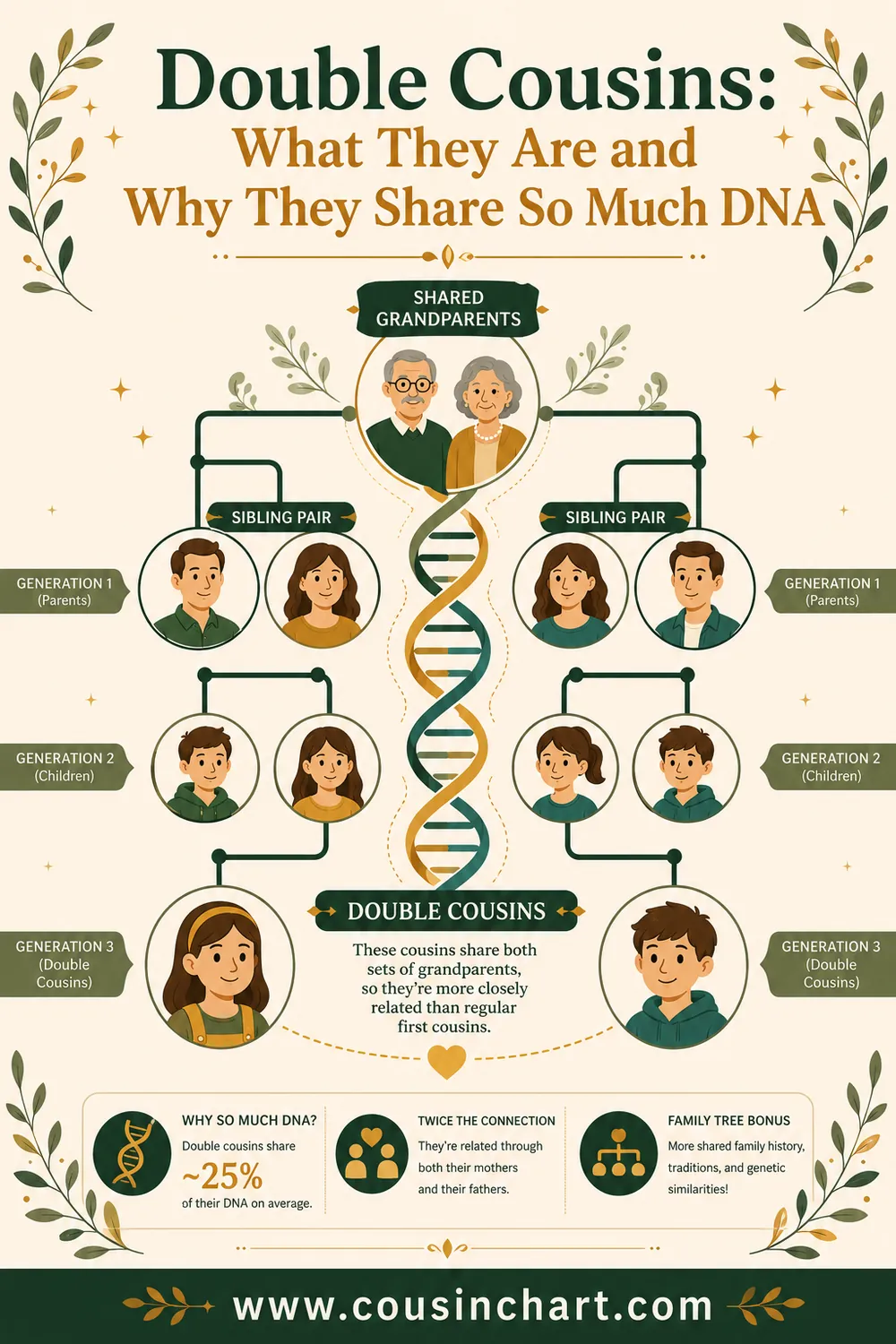
| Double first cousins | No parent shared, related through both sides | ~25% |
| First cousins | Parents are siblings | ~12.5% |
And the delightful edge case: if the non-shared parents are identical twins, their DNA is (effectively) identical, so the extra path contributes a full 25% — the children average ~50% shared and are genetically indistinguishable from full siblings, despite having different fathers or mothers on paper.
Why DNA Sites Get This Wrong
No major testing company has a "three-quarter sibling" label. Their algorithms sort matches into bands — full sibling, half sibling, first cousin — and 37.5% falls into the crack between the first two:
- A pair sharing on the high side may be labeled full siblings.
- A pair on the low side may be labeled half siblings or "close family."
- Sites that measure fully identical regions (segments matching on both chromosome copies) can add a clue: three-quarter siblings have some, half-siblings essentially none, full siblings lots.
So the test alone can't settle it. What settles it is tree evidence: birth records, marriage dates, and the tell-tale pattern of a shared parent plus related co-parents. This is a recurring theme in DNA genealogy — percentages narrow the options, but paper and tree logic pick the winner. If you have a sibling-range match that doesn't quite fit either standard label, three-quarter siblinghood belongs on the candidate list.
What It Means for the Rest of the Tree
Three-quarter siblings pass their "extra" relatedness downstream, just like halves pass their deficit:
- Their children are cousins twice over: half first cousins through the shared grandparent (~6.25%) and second cousins through the related fathers (~3.125%). Add the paths and expected sharing lands around ~9.4% — noticeably more than an ordinary half-first-cousin pair.
- Aunt/uncle relationships get the same boost: a three-quarter sibling's child relates to you at roughly three-quarters of full niece/nephew strength (~18.75% vs ~25%).
- Terminology stays informal. Genealogy software has no three-quarter category; most researchers record the two component relationships (half-sibling; first cousins via the fathers) and add a note. That double-entry habit is the accurate one — the tree really does contain both paths.
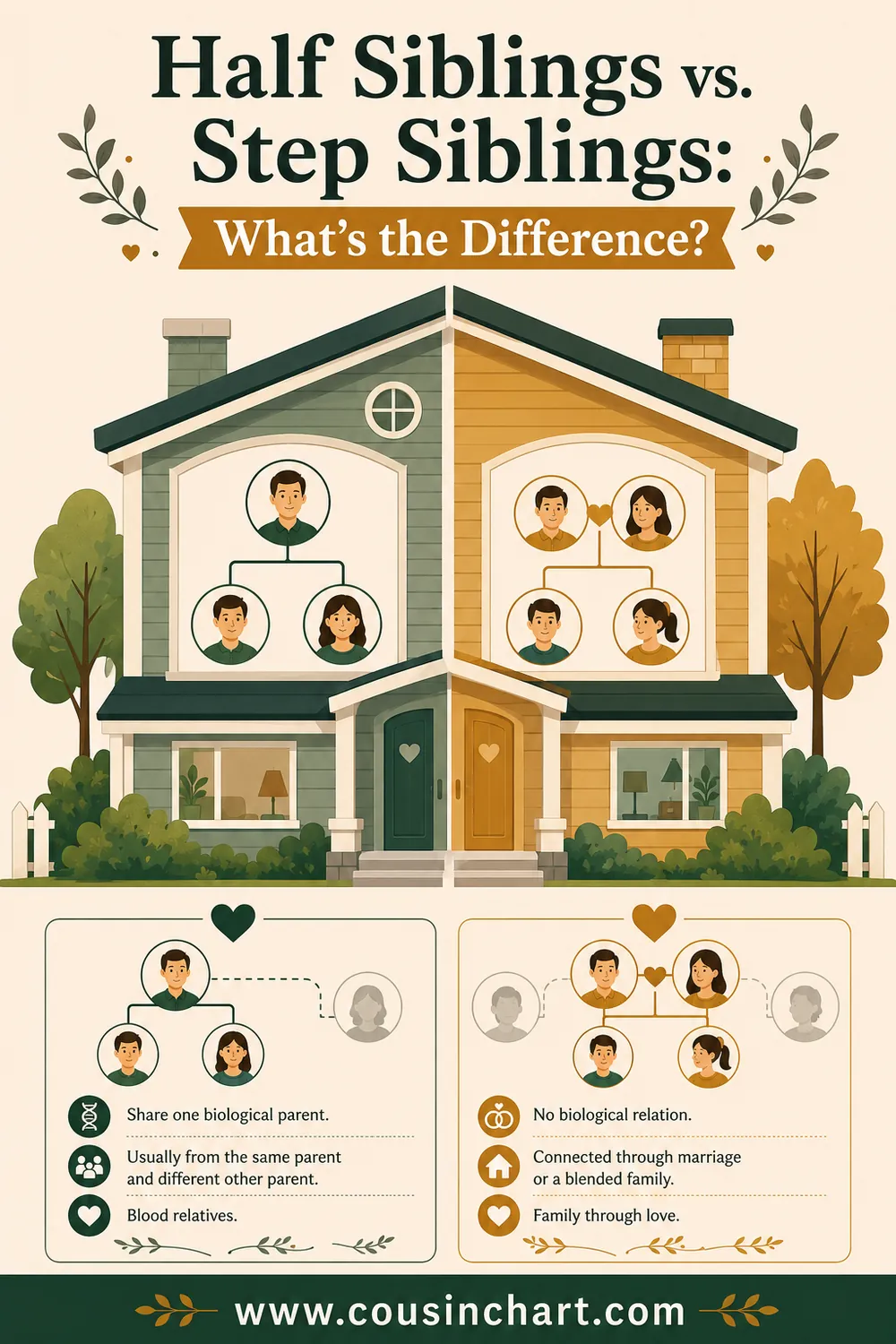
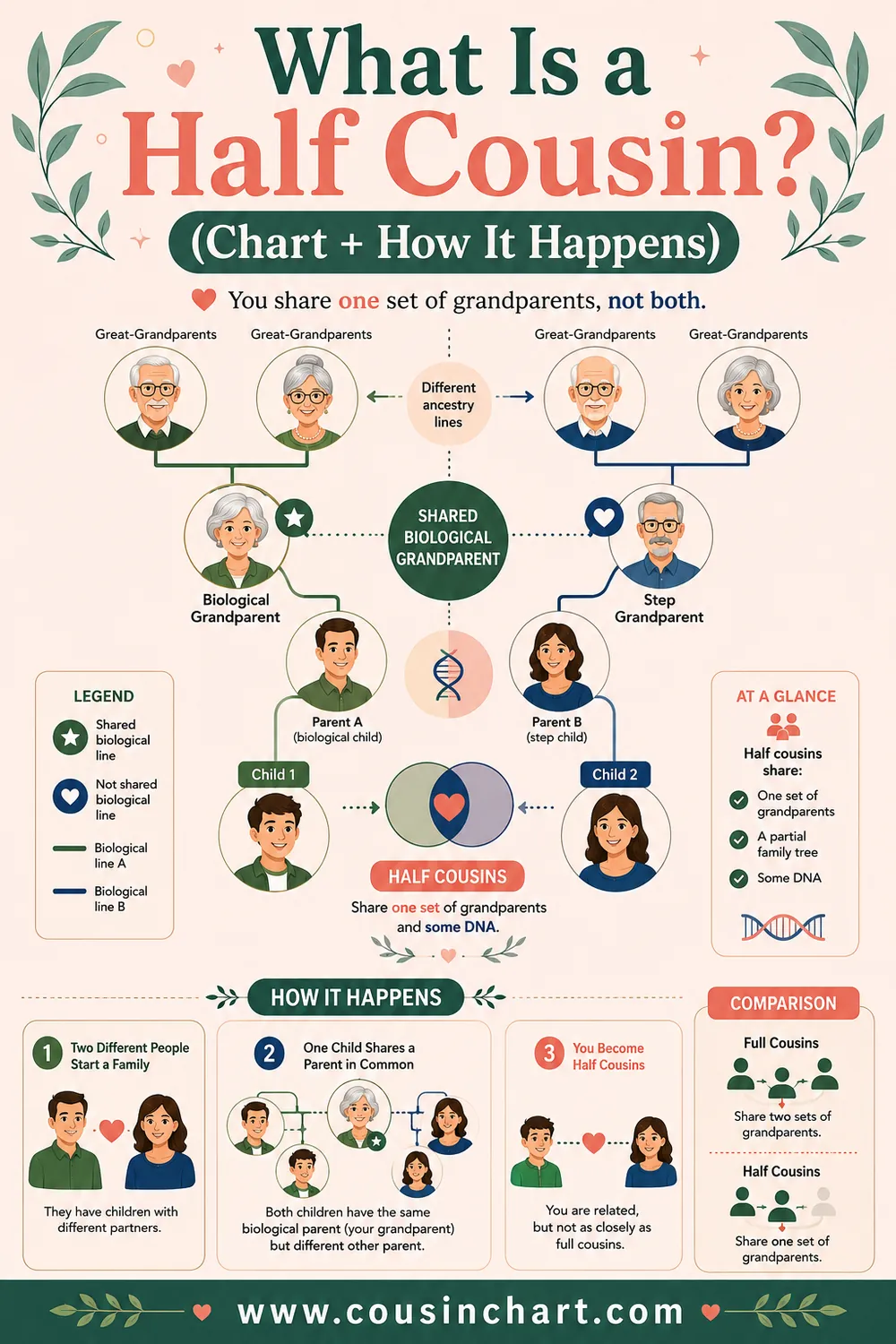
If halves are the fuzzy part of that comparison, start with half vs step siblings and the half cousin explainer — three-quarter relationships are just those building blocks stacked.
Is It Legal? Is It Common?
Both setups that create three-quarter siblings are ordinary and legal:
- Marrying a deceased or divorced spouse's sibling is legal throughout the US and most of the world today (historic England famously banned "deceased wife's sister" marriage until 1907 — a ban long since repealed).
- Two siblings having children with the same person sequentially breaks no law anywhere, whatever the group chat thinks of it.
How common? Nobody keeps statistics, but genealogists encounter three-quarter lines routinely in pre-1900 records — high mortality plus tight-knit communities made in-family remarriage practical and normal. Modern DNA testing has been quietly rediscovering these pairs ever since, usually as a "sibling" match that shares a few hundred centimorgans too few.
How to Spot a Three-Quarter Line in Old Records
Three-quarter siblings rarely announce themselves — you find them by noticing a pattern. The classic paper-trail signals:
- A remarriage where the new spouse shares a maiden name or household with the old one. A widower marrying "Margaret Kelly" three years after burying "Bridget Kelly" is the single biggest flag. Check whether the two women were sisters — church registers and census households often confirm it in minutes.
- The new spouse already lives in the household. Pre-1900 censuses frequently show a sister-in-law living with a family, often listed as helping with children. When the wife dies and the sister-in-law becomes the wife in the next census, the children of both marriages are three-quarter siblings.
- Children with the same mother but two fathers of the same surname. Two brothers marrying (or having children with) the same woman sequentially produces baptism records where the mother is constant and the father's given name changes while the surname doesn't. Easily misread as a clerical error — sometimes it isn't.
- Godparent and witness patterns. In many traditions, the co-parent's family shows up as godparents and marriage witnesses across both sets of children. Dense repetition of one family's names across two marriages is a nudge to check how the spouses were related.
- Wills that treat two sets of children evenly. A testator leaving equal shares to "my children and the children of my late wife's sister by me" (or similar phrasing) is occasionally explicit enough to hand you the whole structure.
When you find one, resist the urge to squeeze it into a single relationship field. Record the marriage sequence and both parent couples in full, and add a note naming the three-quarter connection — future researchers matching DNA against your tree will need exactly that detail.
One more practical note: these discoveries cluster. A community that produced one deceased-wife's-sister marriage usually produced several, because the same pressures — high maternal mortality, small marriage pools, a sister already caring for the children — applied to every family in the parish. If you confirm one three-quarter line, skim the sibling families on both sides for the same pattern before moving on; you'll often bag two or three more in the same afternoon, and each one quietly explains a DNA match that had been sitting a few hundred centimorgans off from its expected label.
A Case Study: The Sibling Match That Came Up Short
Here's how a three-quarter pair typically surfaces in the DNA era, compressed from the pattern genealogists see over and over.
Two testers, Ray and Gloria, both in their seventies, match at 2,150 cM. They grew up as full siblings — same household, same parents on every document either ever saw. But 2,150 cM sits below the typical full-sibling range and inside half-sibling territory, and the site labels them "half siblings or close family." Cue alarm.
The tiebreaker was fully identical regions (FIR) — chromosome stretches where both copies match. Half-siblings share essentially none, because they inherit from only one common parent. Full siblings share plenty. Ray and Gloria showed some FIR — too much for half-siblings, too little for full. That in-between signature is the three-quarter fingerprint.
The records then told the story: their mother had been married twice — to two brothers. Ray was born during the first marriage; his father died young; the widow married his brother, and Gloria arrived. Same mother, fathers who were brothers: three-quarter siblings, sharing a bit less than full siblings and carrying just enough FIR to prove both paths.
Three lessons travel well beyond this pair:
- An odd sibling number isn't automatically a non-paternity event. The scandal-free explanation — related co-parents — deserves a look before anyone upends a family story.
- FIR data (on sites that expose it, like 23andMe) is the single most useful lab clue for separating full, three-quarter, and half siblings.
- The final answer always comes from documents plus DNA together. The centimorgans raised the question; the marriage records answered it.
Practice: Label These Three
Cover the answers first:
- Anna and Beth share a mother; their fathers are brothers. One shared parent + sibling fathers: three-quarter sisters, ~37.5%.
- Carl and Dev share a father; their mothers are first cousins. The mothers are only ~12.5% related, so the boost is small: half-brothers, plus distant extra sharing (~28%) — not true three-quarter siblings, which require first-degree-related co-parents.
- Eve and Fay share a mother; their fathers are identical twins. The twin fathers are genetically the same man: genetically full siblings (~50%), legally half-siblings.
Number 2 is the subtle one: the "three-quarter" label is reserved for the sibling/parent-child co-parent cases; anything more distant is a half-relationship with a footnote.
FAQ
What exactly makes two people three-quarter siblings?
They share one parent, and their other parents are first-degree relatives of each other — typically siblings, occasionally parent and child. The pair is simultaneously half-siblings and first cousins.
How much DNA do three-quarter siblings share?
About 37.5% on average — 25% via the shared parent plus 12.5% via the related co-parents. Individual pairs vary; results can drift toward full-sibling or half-sibling territory.
Will a DNA test say "three-quarter sibling"?
No — no major company uses the label. Results typically come back as full sibling or half sibling/close family. Fully-identical-region data and documentary records are what identify the true structure.
Are the children of identical twins three-quarter siblings?
Children of identical twins by different partners are legally first cousins but genetically half-siblings (~25%). If identical twins have children with the same person, those children are genetically full siblings (~50%) — the most extreme version of the three-quarter effect.
Is it legal to marry your late wife's sister?
Yes — everywhere in the US and in most countries today. Historic bans (like England's, repealed in 1907) are long gone. As always with marriage law, check current local law for specifics.
How can I tell three-quarter siblings from full siblings?
Shared percentage alone can't always do it — the ranges overlap. Look at fully identical regions (three-quarter siblings have noticeably fewer than full siblings), then check the paper trail for a shared parent plus related co-parents, such as a remarriage to a sibling-in-law.
What are three-quarter siblings' kids to each other?
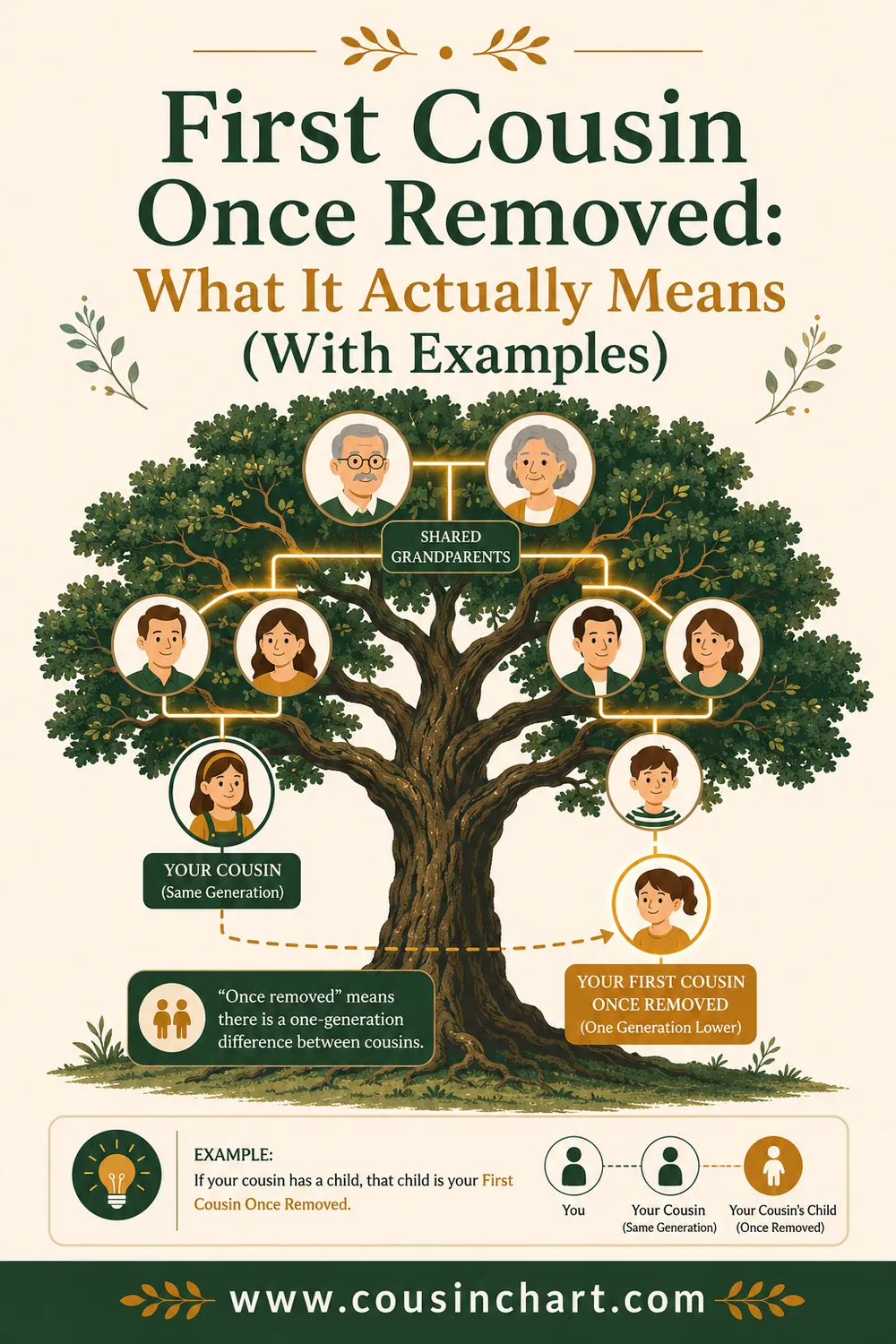
First cousins on paper, with in-between DNA: about 9.4% shared on average — more than half first cousins (~6.25%), less than full first cousins (~12.5%) — because two paths connect them. Record both component relationships in your tree and let a calculator do the arithmetic.
Let the Calculator Hold the Weird Ones
So: three-quarter siblings share one parent plus related co-parents, average ~37.5% DNA, confuse every testing algorithm, and turn up in old family trees far more often than the name suggests. Relationships like this are exactly why eyeballing a tree fails — two paths, one pair of people, fractions everywhere. The free family relationship calculator traces every connection between two relatives and names what it finds, no scratch paper required.